Showing posts with label magical traditions. Show all posts

Thursday, February 18, 2016

Notions amid the approaching Full Snow Moon III


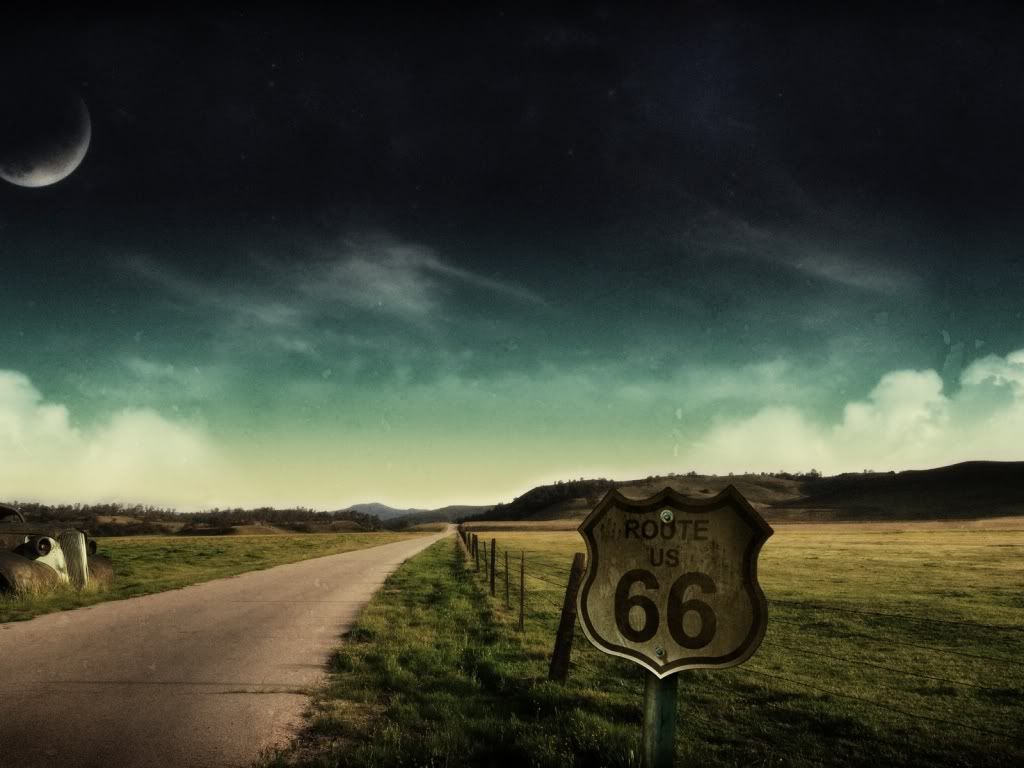
Route 66 - The spiritual connection

U.S. Route 66, established in 1926, was the main auto route opening up the west from Chicago to L.A. It travels through Illinois, Missouri, Kansas, Oklahoma, Texas, New Mexico, Arizona, and southern California. As the hit song goes, "Get your kicks, on Route 66." Even though my family took a more northern route to northern California, I still see the highway as a historical symbol of this east-west trek. It was one of the reasons for the incredible growth of Los Angeles in the 50s and 60s, as opposed to the slower growth of the San Francisco area.

The 2,000 mile highway has been the backdrop to countless movies. The 1983 comedy 'Vacation' and the 1986 thriller 'The Hitcher' come to mind off the top of my head. Clearly its part of the psyche of the country, whether or not we're even conscious of it or not. It's not just about the highway as it is today, but imagine a family traveling across its vast rural stretches over the many decades. Traveling on a hot early evening during the summer, perhaps even prior to air conditioning, looking forward to the next road stop. Imagine life along the highway, in one of those towns, the endless motorists stopping in.

There were probably many people on the run, down on their luck, victimized somehow, or big dreamers who got on it to "just head west." The concept of freedom; "the promised land" just "a little further west." It wasn't enough to only go part way, but somehow they had to go all the way. Some probably should have stopped short, as they eventually ended up on skid row, or many dreamers ended up another tragedy. It's almost a little like "the crossroads." It's more than just a stretch of road. Just as in nature, it has a duality to it.


Route 66- John Mayer (with lyrics)

amjdamjd


A hidden gem by Patsy Cline


PATSY CLINE - In Care of the Blues (1957 Original)

verycoolsound


Who's hotter at The Weather Channel - Jen Carfagno or Maria LaRosa?

It's funny, this YouTuber is obsessed with the women on The Weather Channel.


Jen Carfagno and Maria LaRosa (both also have legs (15) wow! (HD))

Paul

Great segment(s) from "Weather Center Live" of Jen Carfagno & Maria LaRosa. (6/26/15)


The Hex Factory interviews

Recently, I've been downloading all types of podcasts and articles into my iPod for some very long and tedious work I've had to do. For text, I copy and paste it into FromTextToSpeech.com where I can make mp3's out of them; some even an hour or longer. With the "Alice" voice, it's just like a person reading them to you, and I did this with three text interviews so far from Hunter Yoder (TheHexFactory.com). They were great.

Jack Montgomery - A very interesting and unique current and historical American perspective, especially from the standpoint of German-speaking folk culture where it developed (Pennsylvania, Ohio, the Carolinas, etc.). Also, aspects of German neopagan influence under the surface.

Robert Taylor - A perspective from an artist and musician who's lived a very interesting life; and it gives an insight into one of many ways that one can reach their true calling in this modern non-congruent American culture.

Wyatt Kaldenberg - Great insights into the blunt reality of Odinism and American/world politics. I mean, I believe that he's correct in his conclusions.

Although I love books and text, I enjoy these interviews and long articles more just having them read to me like this. The spirit of the words really come through.


Kamchatka - A beautiful unknown northern land

It's amazing that Russia has so much open and underpopulated land, and sitting right above billions of people in Asia. The pristine Kamchatka Peninsula sits north of Japan and west of Alaska, and its landscape is much like Alaska. I was surprised to read that its people are overwhelmingly Russian (origin from Russia proper) and Ukrainian, with very few Siberian native types. The former Soviet Union tried to populate every corner of its massive landmass, and under Communism it's didn't work especially well, but they did it to a large extent. There are many photos and documentaries about Kamchatka's wilderness and wildlife, but the below video shows its capitol and largest city Petropavlovsk-Kamchatsky. Although rather backwards currently, I still feel like the northern gods are present in this land.


Discovering Kamchatka

cucumax

.

Wednesday, July 29, 2015

More Blue Moon musings


If you take a Bible and put it out in the wind and the rain, soon the paper on which the words are printed will disintegrate and the words will be gone.

Our Bible IS the Wind and the Rain.

-- Author Unknown

**************************************************

Pennsylvania history of magic, occultism, and folklore

Poke Runyon is a legend within American Hermeticism--aka Alchemy--and he's still going strong with weekly podcasts at Blog Talk Radio every Thursday. There's a good variety of various interesting subjects. Of course, the German magical traditions have long been prevalent in rural Pennsylvania, so this subject immediately caught my eye. I don't know of any American region where Stregheria has any particular presence, although I have have hypothesized about Upper Michigan Alpine "folk medicine."

The Hermetic Hour: Poke Runyon and Frater Julian

**************************************************

Boeing X-37

The Boeing X-37, also known as the Orbital Test Vehicle (OTV), is a reusable unmanned spacecraft. It is boosted into space by a launch vehicle, then re-enters Earth's atmosphere and lands as a spaceplane. The X-37 is operated by the United States Air Force for orbital spaceflight missions intended to demonstrate reusable space technologies. It is a 120%-scaled derivative of the earlier Boeing X-40.

Aside from obvious black ops programs, the X-37 spaceship itself is a remarkable vehicle. The importance of which has been downplayed. This spaceship is able to re-enter earth's atmosphere without being damaged just for starters. Apparently, but not fully provable yet, NASA has a fleet of these craft which has conducted many missions..far beyond what is admitted currently.


**************************************************

The Holographic Universe

The below video is part one of a five part series regarding the unfolding mainstream scientific endeavor of trying to understand matter. It's one of those videos where if you merely start to watch, you may find that you will just want to keep going. I think just watching the first video is sufficient to getting the gist of it. Did you know that during experiments, now known to be true with 100% accuracy, that electrons conduct themselves differently depending on whether or not they're being directly "watched" by someone during the experiment itself. From our understanding, this of course shouldn't be.. but it is; and this is the mainstream talking!


I don't really agree with the wording that it used however. It leaves the laymen with the impression that our physical world literally doesn't exist. A better analogy would be to focus on how matter is viewed. The majority of matter we cannot even see from our perspective. Another way to look at it is the video game example, where the more we learn about particles of matter, the more it looks like pixels of a video game. It's as if we are part of some grand (from our limited perspective) computer-simulated world, created by someone or something.

Another aspect of this is that if we look at the entirety of the known universe, especially between the galaxies, it's very empty. We only perceive it to be "full of stars and stuff." When magnifying particles down to the sub-atomic level, there are comparatively large expanses of "space" like "little universes." Therefore, how do we know that we aren't looking at this all wrong; and that we may be a "tiny universe" within say the fingernail of some "being" in a larger universe... or that the universe of this "being" isn't merely part of..... well, you get the point.

***************************************************

Iberian Lynx Documentary

The regional European lynx in Spain struggles against extinction.


.

Monday, June 1, 2015

Sun Moon abstractions I


Full Sun Moon

Tuesday's full moon will be a "strong sun moon," where the sun and moon will be at their closest point of each other this year. I think that only by truly being outdoors, mostly likely on a trail or at a more remote location, can one truly feel the energetic interaction occurring. It's not a must for one to be there at night, but the twilight period can often be just as special. Some great locations are accessible and safe late in the day, but not after dark.


'Twins of Evil'

'Twins of Evil' was a 1971 vampire horror Hammer Film from the UK, starring Peter Cushing and the beautiful English-Maltese Collinson sisters. The sisters play the roles of Maria and Frieda, recently orphaned identical twin teenage girls, move from Venice to Karnstein in Central Europe to live with their uncle Gustav Weil. Weil is a stern puritan and leader of the fanatical witch-hunting 'Brotherhood'. Both twins resent their uncle's sternness and one of them, Frieda, looks for a way to escape. Resenting her uncle, she becomes fascinated by the local Count Karnstein, who has the reputation of being "a wicked man."

I saw this movie on our local Creature Features in the Bay Area when I was very young. This was an earnestly acted and produced film; and one which captured an alluring, superstitious, and wonderfully dark Middle Ages German/Central European countryside. I watched the full movie (above) some weeks back, and it was everything I remembered it to be.


Northern Lights

An aurora is a natural light display in the sky (from the Latin word aurora, "sunrise" or the Roman goddess of dawn), predominantly seen in the high latitude (Arctic and Antarctic) regions.

Spectacular images of auroras from the Lake Superior region can be viewed on the following link at LakeSuperiorPhoto.com. These images are amazing. They feel like a connection between worlds.


Mr Crowley

'Mr Crowley' by Ozzy Osbourne, somewhat like 'Immigrant Song' by Led Zeppelin, is a good song that references an earth-based/magical tradition. In the case of 'Mr Crowley', a tribute to Aleister Crowley (Western Ceremonial Magic); as opposed to 'Immigrant Song' which is a tribute to Norse-Germanic migration and Heathen tradition.

I have mixed feelings about Aleister Crowley, but I don't think that he was misrepresented as with Guido von List. He usually made himself quite clear as far as it relates to criticism of him. I do, however, think that there is malevolent magic which can be leaned from his works; such as 'The Book of the Law'. I wouldn't recommend it, but it's real.

Thelema is a religion based on a philosophical law of the same name, adopted as a central tenet by some religious organizations. The law of Thelema is "Do what thou wilt shall be the whole of the Law. Love is the law, love under will."

The law of Thelema could probably be interpreted in different ways. I think it's fairly clear though. One interesting occultic aspect of the symbol of Thelema is that it utilizes a unicursal hexagram with an inverted five-petaled flower at the center. This inverted hexagram is basically the same symbol as the Saturnian hexagram ("Star of David"); and the inverted (upside down) five-petaled flower is basically the same as any five-pointed vehmic star (pentagram). The Saturnian hexagram always goes hand-in-hand with the pentagram... as with the Talisman of Saturn. I know this for certain, however I can only speculate what I have heard and read from researchers that Satanists "invert symbols" to reflect the negative.

In other words, the Saturnian cults were not innately "evil," or no more so than any of the other Saturnian or Sun cults (Christianity) of the ancient world. Examples of this type of inverted symbol are the unicursal hexagram, an upside down cross, and an inverted pentagram. We do need to be careful, as some Christians have said that the Norse Life Rune is a "broken cross," as if to suggest that it is an explicitly "anti-Christian" symbol, even though it's older than the Christian cross by tens of thousands of years.


Top 20 religions in the United States

Interesting statistics. I'm sure that the Wicca/Pagan/Druid category is vastly under counted, with many solitary practitioners. I would guess that the 307,000 number is about half of what it really is; and out of about 600,000, maybe 50,000 are even remotely folk-pagan.


Count of Saint Germain

The following is a full twenty minute episode of 'In Search of' from the 1970s, entitled 'The Immortal Count of Saint Germain'. Apparently many of his time believed him to be hundreds of years old. There have been many mysterious figures like this in history, such as Edward M. House... and Mr. Crowley.


.

Wednesday, May 20, 2015

'Alchemical Invocations of Vox Populi – Leland’s Aradia & the Creation of the Folk' [Part III]


This combination of ingredients is found in Christian exorcism rites practiced by the Catholic church, or more pointedly rites which would have been found in the Episcopalian tradition that Leland adopted during his time at Princeton:

“These four—water, wine, salt, and ashes—were the ingredients of the Exorcising Water to expel the enemy from a Church at its consecration ; the water symbolizing the outpouring of tears, and so penitence ; the wine, exultation of mind ; the salt, natural discretion or wisdom; and the ashes, the humility of penitence.”

– The symbolism of churches and church ornaments, Guillaume Durandus


And these three can also be equated in alchemical terms to Mercury (water), Sulphur, (wine) and Salt, which in the Paracelsian tradition are the three essential elements that form the basis of reality prior to the four elements of fire, water, earth and air. The rectification of these three also forms the basis of the Philosopher’s Stone. Leland was well acquainted with Paracelsus by the time he wrote Aradia, we find him discussing Gnosticism and Neo-Platonism at Princeton while still a student:

“When (Professor Dodd) asked me how it was that I had renegaded into Trinitarianism, I replied that it was due to reflection on the perfectly obvious and usual road of the Platonic hypostases eked out with Gnosticism. I had…learned…that ” it was a religious instinct of man to begin with a Trinity, in which I was much aided by Schelling, and that there was no trace of a Trinity in the Bible, or rather the contrary, yet that it ought consistently to have been there…For man or God consists of the Monad from which developed spirit or intellect and soul; for toto enim in mundo Ivcet Trias cujus Monas est princeps, as the creed of the Rosicrucians begins (which is taken from the Zoroastrian oracles)…and it is set forth on the face of every Egyptian temple as the ball, the wings of the spirit which rusheth into all worlds, and the serpent, which is the Logos.”

– Memoirs, Charles Leland


Here we see the core of Leland’s belief, “there was no trace…yet…it ought consistently to have been there.” Aradia is a classic work of Pastoral poetry, the work of an educated Romantic who longs for the Golden Age of Nature. Through the use of vox populi he takes the unrefined elements of folk culture and, in an alchemical moment of myth building, creates what “should be there.” He separates out the dross of true poverty and seeks the essence of hunger, desperation and wisdom that exists in the lives of the dispossessed.

Leland takes what the common people already know, but have no chance to define, and  shows them a reflection of themselves. Reworking their traditions with the purpose of returning to them the freedom that they already have, while undermining the bonds of control that have been put on them by social conventions that laud ostentation while rejecting the simplicity of life.  It is therefore no surprise that Aradia has had a foundational affect on contemporary witchcraft, that was the very purpose of the book.

Margherita Taluti’s information alone could not complete his vision, but it provided the ground and reality from which he could perfect the Work. It contained the Prima Materia missing from his own experience and provided the Key. Leland’s practice is no different than Ovid, Homer, Chaucer, Boccacio, Shakespeare, or any of the great Traditional Poets who took the popular mythologies and legends of their time and re-veiled them.

As he remarked to one of his fellow folklorists, “I am proud to be a first pointer-out – just as I am of having been acknowledge to be the first discoverer of Shelta…also of Italian-Latin witch lore and mythology, which latter has not as yet been credited to me, but will be some day.”

Through an alchemical invocation of the popular voice Charles Leland created a vision for the dispossessed to lay claim to. His ‘gospel of the witches‘ was the ‘good news‘ of the free spirit, the reclamation of the Edenic purity of Humanity that “shall dance, sing, make music, and then love in the darkness.”  It is the message to the establishment that “the true God the Father is not yours; for I have come to sweet away the bad, the men of evil, all will I destroy!” It’s a mark of success that Leland’s work has been reviled by the Academy, he wasn’t writing it for them, he was writing it for the People.


Note: The folks at Red Wheel/Weiser were kind enough to provide a copy of Charles Leland’s Aradia, Gospel of the Witches for research and review. Check out Bob Freeman’s review of Aradia and Freeman Presson’s review as well.

.

Saturday, May 9, 2015

'Secrets of the Occult: The Magicians' - Magical and Alchemical roots of Science!


It's amazing to me--that whenever the subject of alchemy is brought up--even intelligent, educated, and well-read people resort to the tired old "they tried to turn base metal into gold" line. As if they were "failures" who at least "tried." What a joke! Even someone as well-known as Michio Kaku will cite alchemy as "science's humble beginnings." That's proof that he never bothered to even look into it at all. Career scientists are usually terrified of anything they can't explain or do not understand; which has lead to practices such as hiding away fossils and artifacts from the public into storage because they do not fit their theories of human origins (aka "false theories").


Some excellent quotes from the documentary:

"Magic is both an art and a science. Certain things cause certain affects to happen. At the same time they have to be done with a certain intention and perhaps a certain flair in order to work." -- James Wasserman, Author, 'The Mystery Traditions'

"Science nowadays really is touching against ideas dealing with where magic and spirituality and religion intersect and they're both ways of trying to find out about how the world works." -- Richard Kaczynski, Ph.D, Author 'Perdurabo: The Life of Aleister Crowley'

"The occult means secret or hidden, and its early masters were regarded as true magicians, but they were also the first scientists. Their discoveries in the occult arts of astrology and alchemy gave birth to modern scientific disciplines. Many still view the occult with suspicion, but modern science is often working on the edge of the supernatural. Trying to solve mysteries that confronted the first magicians. Were the early occult masters keepers of secrets that modern science is only beginning to rediscover?" -- John Cullum, Narrator, 'Secrets of the Occult: The Magicians'

"You go back to ancient times, there was no science. So the magicians and the alchemists and the proto-mathematicians; they were doing science, but they were also doing literature and philosophy and cosmology and religion, and there was no sorting out of those things. Since the birth of what we would call modern science, science and the occult have sort of separated paths. Serious physicists are contemplating time travel. Serious physicists are contemplating parallel universes. Serious physicists are trying to understand the eleven dimensions of string theory, and when you get into those realms, you start to look at myth and sort of magical thinking, and almost surreal thinking as a way to even talk about those things. -- Dan Burstein, Author, 'Secrets of the Code'


"That was really an approach to try and understand the way the physical world works, and alchemy as a practice was the forefather of modern chemistry." -- Richard Kaczynski, Ph.D, Author, 'Perdurabo: The Life of Aliester Crowley'

 "Alchemy had existed since the early Egyptians, but in the hands of the Renaissance scientists it reached new heights. Alchemists were on the leading edge of science. They discovered phosphorus, zinc, the distillation of alcohol, the germ nature of diseases. They were the first to understand how blood circulates in the body. The church viewed their unorthodox experiments and scientific breakthroughs with growing suspicion." -- John Cullum, Narrator, 'Secrets of the Occult: The Magicians'

"Everything that we know and do today in our modern science was developed by the alchemists. Laboratory techniques were part of the alchemical tradition. The observation of results. The scientific method is a child of alchemy." -- James Wasserman, Author, 'The Mystery Traditions'


.

Monday, March 9, 2015

"Revive European Animism..."


Revive European Animism Paganism, Wyrd, Asatru, Wicca 

ThunderWizarddotcom YouTube channel

http://www.Thunderwizard.com

For 50,000 years, Europeans were animist polytheists who believed that all of the manifested Cosmos possessed a spirit with which humans could directly interact and communicate. It has only been in the last 500 or so years that peoples of European descent have lived outside their immediate resources. This change took place when our European ancestors abandoned their ancient animist traditions. The consequences were devastating. 


Today our modern world was shaped primarily by people of European descent and it is this modern Western culture that has been separated from it's traditional animist ways that has created plagues, racism, slavery, global warming, nuclear weapons, air pollution, economic disaster, etc... These are not divine punishments, but merely the natural consequences of the decisions made by a people who have forgotten their ancient animist traditions. Let's return to our animist roots. Let's return to the "Old Ways" that kept our people and our traditions alive for 50,000 years.

Music - 'Promentory' by Trevor Jones

.

Sunday, March 1, 2015

Robert Blumetti interview on The Hex Factory


www.thehexfactory.com

The Following is an excerpt from the book,  9 Worlds of Hex Magic , 2013 by Hunter M. Yoder:

Robert is a Rune Magician and as such is the Vril Master of the Folk Faith of Balder Rising, www.vrilology.org/ . He is a prolific author, both of science fiction and on Germanic magic, metaphysics,  and mythology, what he refers to as Vrilology. 

I can't copy the interview, but it can be found at the link below...

Robert Blumetti, Twelve Questions 

FromTextToSpeech.com


Regarding the rosette or sun of the Alps symbol

Question eleven has been explored here before, and Robert Blumetti gives his ideas about it.... 

11. Any reaction to what the Deitsch (Pa Germans) call the Rossette, or 'Sun of the Alps' in Padania, (Po Valley)?

I will confess I know very little about the controversy regarding the Sun of the Alps, but it is interesting that it looks like the six-armed variation of the Hagalaz Rune. Hagalaz is considered the “Mother of all Runes,” and in its shape we can find all 24 Runes of the Elder Futhark. Halagaz means “Hail” and hail is ice that falls from the heavens.  When it crashes into the surface of the earth, it destroys all life, but then the ice melts and is transformed into water, it fertilizes the earth, permitting new life to grow.  This is evolution and the cycle of all life–birth-growth-age-death-rebirth.

From what I know of the Sun of the Alp it is a very ancient symbol found in many parts of the world, just like the Swastika which represents that sun.  Like the Swastika it is a symbol of great occult knowledge and where ever it was used by ancient people, it survived through the centuries, in most cases, losing its original meaning and being adopted by the local inhabitants as its own national or tribal symbol.

I understand that Northern Italians have adopted it as their own tribal symbol and regard it as a symbol relating the the many flowers that grow in the Po Valley. The Po Valley of Italy has always been famous for its flower industry, and that’s why the Northern League of Italy has adopted it as its symbol.

What you might find interesting is that my name “Blumetti,” which is Italian might have a connection to the Rosette or Sun of the Alps.  My Paternal grandfather came to America in 1893 from Northern Italy. My grandfather belonged to the north Italian aristocracy and a member of the Royal Guard to the King of Italy before coming to America, after his family lost everything in a economic depression of the early 1890s. The Blumetti family has a family cress with red roses on it because the Blumetti name means “Little Flower.” The first part of my name Blum, is actually German for “flower.”  The suffix etti in Italian for little.  

.

Saturday, August 16, 2014

The Study of the Occult


Good short video from YouTube user Venus Satanas. She mentioned keeping notes, which is a good idea for maintaining important points. I have found that a composition book dedicated to one area of study is preferable to keeping notes on MS Word files, in which it just seems to get lost. With a composition book, your study is always handy.

It's amazing how quickly the great points can collect and harmonize together... and develop into a certain construction. I say this for anyone, even beyond the broad definition below... Christians, Heathens, etc. The only thing I disagreed with a bit here is the idea that one must devour book after book and be active every day. We can get to things when we get to them.

Occult

Occultism has its basis in a religious way of thinking, the roots of which stretch back into antiquity and which may be described as the Western esoteric tradition. Its principal ingredients have been identified as Gnosticism, the Hermetic treatises on alchemy and magic, Neo-Platonism, and the Kabbalah, all originating in the eastern Mediterranean area during the first few centuries AD.

--Nicholas Goodrick-Clarke


.

Wednesday, August 6, 2014

Mystery schools of ancient Egypt, Greece, Babylonia, and India


There's has been much talk--probably since the advent of Harry Potter--about "mystery schools" in the ancient world, and even to the present. Mainstream academics seem to avoid the subject. Freemasonry, Rosicrucianism, Hermeticism, and Kabbalah--just to name a few--seem to have hoarded ancient knowledge over the many centuries of religious zeal. I believe that to be true, and justified... but often self-serving.

Sometimes the Druids are included within the mystery schools of ancient times, but somehow a shared-knowledge network stretching from Ireland to India thousands of years ago seem a bit far-fetched to me. I do think that ancient peoples had knowledge of how to use the Earth's energy in areas of anti-gravity, alchemy, sacred geometry, etc.

.

Saturday, October 27, 2012

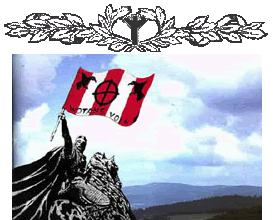
Wotansvolk flag as an Umbrella Symbol of European Neo-Paganism?: Part 2

The 'Wotansvolk flag as an Umbrella Symbol of European Neo-Paganism?' entry from last February has been one of the most viewed pieces ever published on this blog. I thought that it needed some slight clarification.

I am not specifically an Odinist. However, it seems obvious to me that it could be beneficial for there to exist a united-concept; a "European-American folkish neopagan concern." Not an organization, but more of a periodic panel.

The Odinic Rite makes some attempt at this by stating that they represent all pre-Christian faiths of North-Central/West Europe. Lets face it, there are concerns even within that idea which do not wish to be a wing of Odinism; and see themselves as a folk-family within themselves.

Recently, the California-based Asatru Folk Assembly--in an article regarding "folkishness"--at least hinted that Wicca was not of their people (Northern European). Well, lets examine that. On the surface, this would seem to be correct. Wicca attracts many people who, if I merely attempted to name them, would make me sound like a "hater"; but whom are infinitely different than we are, on many levels. On the other hand, Wicca is based on a magical tradition, chiefly from the British Isles as far as its specifics, and actually tied to magical traditions from all over Europe. Many of these spiritual traditions overlapped one-another, and the history of that is too much to go into now; but suffice to say that they often existed openly within (and even part of) more prevalent belief systems like Odinism. In other words, they ARE in essence from and of our people. It's an open secret that Odinism and the "magical traditions" (i.e. "witchcraft") have a lot of common themes.

I believe that Cernunnos, the chief god of the Gauls, developed from a long natural-syncretization between the native "horned god" (of many names) and Odin. Also, Odin--and other major gods like Cernunnos, Lugus, etc.--was associated to the Roman and Greek god Mercury. While this stemmed from an attempt to force-syncretize a new paradigm of Roman rule; there seems to have been some genuine tie-in (Odin-Mercury), written about by Guido von List in his book 'The Religion of the Aryo-Germanic Folk', which was unrelated to this policy. In addition, Slavic heathenism clearly has many ties and common themes to Odinism.

What I am driving at is that there is a strong basis, in an effort for a "European-American folkish neopagan concern", to utilize the Wotansvolk flag as a unifying symbol. The solar cross and the raven symbolism are tied deeply to a host of other European heathen traditions. Odinism, and all of it's folkish denominations, seems to overwhemingly be the major spiritual tradition that we're talking about here; past and present. It found its way, in some form, to every corner of Europe. Why not acknowledge that, and finally make good on this flag? The founder(s) of the flag must be given the full right to profit from it; regardless if it's patented or not.

One of the great failures of all of the folkish neopagan concerns applicable here, is the failure to connect solitary adherents of even their own spiritual path.... must less the unifying principle we're looking at here. Think of how often "solitaries" have lived in close proximity, but never connected. The reality of the situation is as follows: There are perhaps a dozen or so folkish neopagan concerns, each with many denominations. Collectively we represent a tiny minority of the population at large. There are a sizable number of "universalist neopagans" (mostly Wiccans), but they're not folkish; or even decent or honorable people in many cases. They probably outnumber us ten or twenty to one! Okay, that adds some additional confusion. So we find ourselves in this social rut that we should climb ourselves out of. We can solve this problem.

No individual or group needs to intrinsically change, just form a larger folkish outer social perimeter. Reach out locally. We don't need an organization, but new local structures and networks. It's more logical for this to start locally, and work it's way up; rather than the other way around. You can, as an individual, make a big impact locally. Your existing hearth or coven can remain entirely unchanged, and exist as a separate entity from a "loose local folkish neopagan milieu."

.

Friday, March 16, 2012

Rethinking the Vehme Star Rose

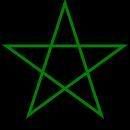
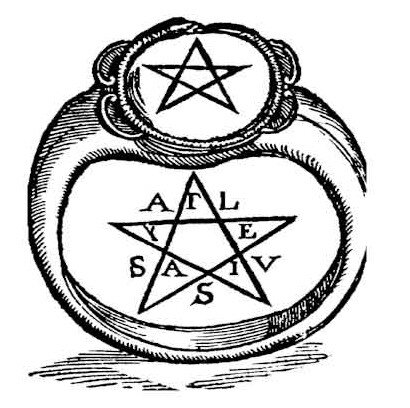
Guido von List referred to the pentagram as the "vehme star rose." All of his other signs seemed to be of Germanic or European origin, except that one. Why? It could be that the star was loosely from our ancestors, perhaps even tens of thousands of years ago. It might have been that List couldn't resist the powerful symbol, which easily can be traced back to ancient Sumeria.

More than likely it was because the star was adopted into secret pagan circles in Europe sometime during the middle ages, which makes it "half-folkish" I suppose. A lot of neo-pagans may not want to hear this, but very far back in ancient times, it appears that as the ancestors of Norse, Celtic, and Mediterranean peoples migrated westward, they both drowned out and/or co-opted the various traditions of Sabbat witchcraft. As a result, it's spiritual survival depended upon it's ability to constantly reinvent itself. The "migration" of the vehme star seemed to be a part of that process. A symbol was needed, and with the long eroding disappearance of icons of it's own heritage, one was co-opted.

The symbol found it's way eastward, into the Orient, as well. Curiously, List's term "vehme star" only shows up on six webpages on a google search. It should be noted that the Pythagorean Greeks referred to this symbol as "hugieia" ("health") in the fifth century BC, but it appears that it was more of a symbol of geometry to them. Culturally, it appears, this symbol could be thought of as a symbol of both the West and the Middle East. In other words, the real origin was from a people who later migrated into southern and western Europe and became Indo-Europeans; while those who remained largely merged with dark skinned Semites who dramatically migrated out of the southern Saudi Peninsula northward starting in the sixth century.

[Right:  Drawing of a pentagram ring from Crotone, Italy, taken from IMAGINI DEGLI DEI ANTICHI (V. Catari, 1647)]

What I'm really driving at is that the vehme star rose could be looked at by a Eurofolkish person as being "half folkish." Perhaps even a little bit more than half, since it originated from a people whose racial stock later came to be known as Indo-European. The proto-Norse once occupied northern Eurasia, tens of thousands of years ago. However, nobody today thinks of them as "Asian" in any way. They became Indo-Europeans. In the spiritual tradition of Stregheria in central and southern Italy, during the Middle Ages, the vehme star rose was adopted. It could be said that they adopted a symbol which their remote ancestors had once held sacred. At the least, it's a symbol which has deep roots in Europe.

.

Thursday, March 8, 2012

Hexology: Part II


[Conducted by, and borrowed from, AllFatherWotan.org]


1) Greetings Hunter. To begin please introduce yourself and give the readers some info on your roots in Heathenism.

Heil Georg! I am a Heiden Hexologist, owner and creator of the Hex Factory Gallery in Philadelphia, which is dedicated to Germanic tribal art and Pa German Hexology. I have authored numerous essays on the subject of the new Heathen Hexology and magic plants and the book, The Backdoor Hexologist, Volume One. I am the founder of the online site www.Zaubereigarten.com where I have interviewed the avante garde of the Pa German magical traditions known as Hexerei. I was born and raised in the heart of Pennsylvania Dutch country, Berks County, PA., I began painting hex signs on barns at an early age. I am an avid Netherland Dwarf rabbit breeder, entheologist, and father of four.

My roots in Heathenry are in Berks County, Pennsylvania or Barricks Kaundi in Pennsilfaania in Deitsch, a German dialect spoken there. Der Deitsch Volkskultur where I grew up is the basis for my reanimation of our Folk ist prechristian beliefs and customs. I prefer the Deutsch, 'Heiden' to Heathen which is Anglo Saxon. Berks County is ground zero for Hexerei in the New World. My area of interest has always been Hexerei, or Germanic witchcraft, which is not directly associated with any organized or institutionalized form of religious practice but rather a flexible, individual approach to folk magic, specific to a folk culture in this case the Pennsylvania Germans.


2) Who were the individuals that were the most inspirational in your beginnings with Hexology?

Well let me preface the response to this question by stating that the frequency of Hex signs or Barnstars is the greatest in Northern Berks County then anywhere else in North America, maybe the world. I grew up on a farm near the small town called Virginville on the Maiden Creek which later contributes to the Schuylkill River which runs to Philadelphia. The farm was on the Saucony Creek a Lenni Lenape word for 'little bear' The Barnstars were on all the barns on all the farms. Locally, Milton Hill was the source of most of these barnstars. The great Hexologist, Johnny Ott of Lenhartsville was a couple of miles downstream, where he had the Deitsch Eck Hotel and where he also painted his famous Hexes that he and Jakob Zook of Lancaster made famous. Johnny sold his Hex business to a Johnny Claypoole who was from Upper Darby in Philadelphia, but moved up into an old stead just outside of Lenhartsville. I went to school and ran with his sons engaging in country youth activities such as skinny dipping in the Maiden Creek and jumping off cliffs into quarry lakes. We also drove old Dodge pickup trucks from the early fifties that we bought very cheap and fixed up. Eric, one of Johnny's sons now has the Hex business in Berks County.


3) You originally were from Berks County. Then you lived in Brooklyn and now Philadelphia. What was your interest in moving to Philadelphia?

Philadelphia was the portal for most the German immigration into North America for centuries. My ancestors and yours entered the 'new world' here in Philadelphia. During Colonial times, so many Germans came to Pennsylvania, Ben Franklin called them the Palatinate Moors. My arrival to East Kensington which still today retains a very Germanic population was not by chance. My own spiritual evolution brought me to the source of our Folk to this their new Heimot. Germans love to farm and SE Pennsylvania including my Berks County has 'die besten Ackerboden' I however find the innercity as the new frontier and the retaking of old neighborhoods which our folk built and rebuilding them has been both rewarding spiritually but also materially. I see the future in the city, life there is more efficient less reliant on the petroleum fueled monokultur which has alienated us from our true kultur and has bankrupted us. The culture of the car is growing to a close despite frantic efforts by our governments and world financial players to the contrary.


4) Please explain what Hexology is and also elaborate on it as a magical practice.

Hexology is actually a term invented by Jakob Zook and Johnny Ott in the very late 1940's. The Zook/Ott collaboration has made the term, 'Hexology' internationally famous. It came about at a time after the War, when America was booming, as in Baby Boom. Car Culture was really taking off. Families went places in the car for summer vacations. Lancaster County in Pennsylvania tapped into this tourist trade which continues to this day. The PA Folk Festival in my Hometown of Kutztown, in Berks County started. As we are today, back then people were fascinated with Pa German Barnstars. Ott designed them and painted them on round disks. This differed from the traditional practice of painting them directly on buildings or furniture. Zook took Ott's designs and silk screened them onto masonite disks for the tourist trade. Ott became a self styled Professor of Hexology as Dr Johnny Ott, and there you have it. Hexology was then a commercialization of the darker practice of Hexerei, or as it was called by the Deitsch (Pa Dutch) Hexerie or the Jinks, sometimes called Pow Wow magic.


5) You are a practioner of magic plants. Tell the readers more about this and how it differs from herbalism.

My knowledge of plants contrasts in many ways with herbalism. Knowledge of 'die Blantz' is essential in the Pa German kultur. We hear how the European settlers learned about plants from the so called 'indigenous' or Indians. However, the knowledge transferred went both ways. I recently procured a variety of snow white sunflower seed from a tribal seed bank in Arizona from the Tarahumara, a tribe made famous in, "The Peyote Dance," a book by Antonin Artaud. However the real source of the seed variety came from the Tarahumara's interaction with the Mennonites who settled near them in the Chihuahua desert which they turned into a garden. This is what our Folk do. We grow better then anybody including the so called 'Indigenous'.

Anyway, my 'herbal remedies' are far different then the Herbalists. Hexerei uses Power Plants or Plant Teachers to cure the spirit of the patient.


6) How does your usage of magic plants relate to magical symbols?

The Deutsch term is Zauber or magische. There is power in the words, how they are spoken and spelled, the Icelandics call it Galdr, the Deutsch, gesprochen Magie. The connection between die Blantz und die magische Zeichen; the answer is simple, plants have been used in folk art since the neolithic times. Powerful plants and especially trees populate Germanic tribal 'art' The essence, the spirit of the plant is represented through a stylization of it. The stylization is really just a symbol that invokes the power of the plant, visually. My own contribution to this process has been to replace the Christian plants and flowers in the traditional Pa German Folk art seen in Fraktur and Hexology with the Heiden magic plants. For an example, tulips are used as symbolic of the resurection of the Christ. I will substitute them for my own stylizations of Datura Stranomium, 'Geilskimmel' and Black henbane or 'Niger Bilsenkraut'. These two are power plants for the prechristian Germanic tribes used by the Volvas for divination. We find henbane seeds in the burial mounds of these exalted 'Hexes' In post reformation Germany, usage of Black Henbane seeds would result in a terrible death, being burned at the stake. More 'witches' were exterminated by Protestant Germany then anywhere else. The commonly held belief that witches fly on broomsticks comes from the practice of female 'Hexes' using an ointment of fat and Bella Donna to grease a broomstick which they stradled to absorb the Atropine a powerful hallucinatory agent through their genitalia.


7) What is the relation between sex magic and Hexology?

Pa German Sex Magic is a way of life. It is in fact a way of living and survival. On the farm, success is gauged by the ability to reproduce plants and animals and children. In a sense the farmer is a sex magic zauberer, a f*****g machine. The feminine counterpart is the the nourisher, the source of life, the goddess, the woman, the Hex, the repository of charms, the magical creature, the river of life.

It is my personal view that the Pa Deitsch are descended not from the apes but from certain flowering plants. This is evident by the usage of their Hexology, their 'creation myth' so to speak.


8) Explain the difference between Asatru and Germanic Witchcraft (Hexerei).


Asatru is a religion of contemporary Icelandic Heathens which has spread worldwide as an alternative to other institutionalized religions such as the Monotheisms. This Icelandic prechristian tradition has the advantage of a complete written legacy in the Eddas and other texts.

Germanic Witchcraft or Hexerei is a general term but it is just that, witchcraft. Witchcraft, generally feared by the Christians is neither black or white, evil or good. It is just the acquirement of personal magical power. This magical energy is always much more powerful if used positively. Cursing is actually very easy to do, but it never really ends up well for the one who has done the cursing. The result has a boomerang effect, and when the target determines the source which is usually pretty easy, the malicious energy is simply returned to the sender usually in a much more powerful form. This is primitive stuff, practices that have existed since before prehistory. Hexerei can be employed through everyday means, cooking, humor, sex, business, child rearing, hunting and fishing. Using an intention to acquire a desired result is just natural, be careful what you wish for.


9) You mentioned to me before about the Pennsylvania Germanic roots of Blues music. Can you tell us more about this. Most seem to believe that Blues music's origin is "African American."

I think what you are referring to is my statement that Pa German Hexology is similar to the 'Blues' because virtually anybody can do it (hexes). I've found that the public's interest in making them is at least as great as their viewing them or learning about them. I've done quite a few workshops with people of all ages most recently with children for the Hexenkinder Show at the Hex Factory with O. Henrietta Fisher, and it is always a big hit. Similar to playing music, practice making Hexes is essential. It is useful to learn the basic designs first before moving on to more elaborate ideas.


10) Another subject relating to Germanic magic/witchcraft is called "Hoodoo." Could you explain what this is exactly?


Well Hoodoo is not strictly a Germanic form of sympathetic magic. It is very American. It is most commonly recognized as a southern form but its roots are actually very Appalachian. The German, Scotch, Irish pioneers and settlers that moved through Pennsylvania to the South and out West took their unique ways of effecting their world. Hoodoo was practiced in PA. Hidden or buried 'intentional' objects would typify this practice. Jack Montgomery, Lee Gandee's student has published his book, "American Shamans" and he has a more 'Hoodoo' bent which is appropriate for his Kentucky neck of the woods. Orva Gaile Clubb is another who is very knowledgeable in this form. She correctly sees this as Hexerei and she has a very unique perspective being raised in western Maryland on the farm just below the Mason Dixon line. I will hopefully have her interview up shortly on Zaubereigarten.com . Hoodoo is an American form of the Caribbean Voodoo, or the Brazilian, Makumba. It is interesting to note that Voodoo scholars have great interest in the Pa Deitsch grimnoir, "The Long Lost Friend" published by Hohman in Reading Pa, 1820 as Der Lange Verborgene Freund. It makes extensive usage of the Sator Rotas magic square. Up until the 1930's the State of Pa issued licenses to practice Pow Wow magic, another term for the Pa German Hexerei.


11) I understand you learned about Kabbalah through a Rabbi friend of yours while living in Brooklyn. Could you please explain more of your friendship with this gentleman?

Yes, living thirty years in NYC certainly gave me a positive insight into Judaism. The basics of Christianity are very much from Judaism. Terms like, congregation, pentecost, trinity, originate in Judaism which has undergone many changes in its old and venerable history. Kabbalah however is relatively recent, as a powerful form of mysticism. Briefly just off the top of my head, Kabbalah originated not in Israel but in the German Rhineland and Spain during the later middle ages. In Germany, the Jews were employed much as they still are, for their knowledge of law which required an ability to read and write, something the various German nobilities lacked. The Germans and the Jews have always had a very symbiotic relationship. It is an unusual one, even amongst the Pa Germans. The Pa German dialect or Deitsch is remarkably similar to Yiddish. Both are lower German dialects. When Martin Luther translated from the Latin, the Bible which was subsequently published for the first time and is known as the Gutenberg Bible, he fixed what is known today as high German. Many other German dialects still exist.

Anyway back to your question, Rabbi Joshua Saltzman and I exchanged ideas and information including an intro of Kabbalah on his part. At the time I had 'discovered' that all religious traditions contained the simple concept of a 'tree of life'. The Sephirot as a tree was discussed. Hebrew as a magical alphabet was studied. All magical alphabets include gematria or assignment of numerical values to letter in the alphabet. Hebrew, Greek and the Elder Futhark are examples of magical alphabets. Ultimately our studies led to my conclusion that I could not place any rational reason to. I found myself intuitively unable to absorb the Jewish alphabet and the Sephirot seemed unacceptable numerically and geometrically. I however retained a great respect for the magical traditions of the Jews. Their mysticism is very powerful. In particular the Kabbalistic concept of 'gathering the fallen sparks' impressed me. Joshua had a keen interest in Shamanism and traveled extensively to India, Nepal to further his knowledge in various traditions such as the Sufi. I myself returned to my Pa German roots and have ultimately rejected Shamanism as being a modern day jingoism, a quick fix for a lack of a personal tribal tradition.


12) Do you consider yourself a "Radical Traditionalist"? If so please explain.


Radical traditionalism refers to the renaissance in Germanic 'paganism' I view it through my usual Pa German lense as the reindigenization of my folk. The magical traditions I grew up with in Berks County are the legacy of our European forefathers. That is our tradition. Revitalizing it, reanimating it and rejecting multiculturalism and the petroleum fueled "monokultur" is the radical part, advanced thinking is being done today by such 'traditionalists' all over the world.


13) Thank you very much for your comradeship, your wisdom, and your time in completing this interview. Any closing comments to share with the readers?


I would say this, there is an energy in the magical signs of our Germanic ancestors. It is very real and powerful. Anyone can participate in making them. In doing so you are tapping into something much larger then mere personal self expression. As I explained to a former teacher and friend, A stream or river has run in its bed for hundreds of thousands of years maybe longer, so it is with folk magic. No one is quite sure how it works, just that it does.


Zaubereigarten (Hunter Yoder's website)

.

Monday, December 5, 2011

Guido von List: Part 13

I hadn't intended on making this into this type of "series," but as there are connections to the larger Alpine peoples of ancient times, I see fit to keep adding to this. One area, in which I had not anticipated tie-ins to our culture, was the connection of "primal words." However, some of List's concepts, especially regarding the precise fabric of ancient word patterns, are so deep that one would need to buy the book.

List seemed to believe that Wotanism was too large of a concept for the average person's daily life. He believed in what he called "Armanism," which was basically an elite priesthood who could study the finite details of the ancient concepts, and interpret it for the larger society. List believed that spirituality, art, science, architecture, education, etc., were "all one" within the Wotanist culture in ancient times. If ever was there a religion or spiritual tradition which did not conflict with science, it was Wotanism.

To clarify once again, I use the word "Wotanism" in the sense that it seems to tie in more with the expression of Odinism in central Europe, not the mainstream incarnation and related perception of the word. "Odinism" even specifically sounds Scandinavian. Actually, much of what is modern Odinism or Ásatrú, is largely "Norse mythology." If you look at Gaulish or Slavic spirituality and myth, it has close ties to Wotanism. Either through direct migration, or through more subtle spiritual influence, often the ancient spiritual traditions more-or-less referred to the same "All Father" (Wotan). Therefore, when I use "Wotanism," I'm referring to the larger European whole, usually in ancient times.

Guido von List's Armanic ideas were strongly entertained, long after his death, by the National Socialists; and it developed (along with the work of others) into what was called "Ariosophy," which was similar to List's Armanism. I just don't see exactly how that has to do with von List? Consequently, the Armanic concept itself has been demonized. People from the Tre Valli Bresciane ("Three Brescian valleys"), our people, invented the "hand held cannon" five centuries ago. Does this mean that our culture should be vilified as a result of how many people have been shot during the past five centuries?

I was going to place some Wikipedia text regarding Armanism here, but it was just "too anti-von List." It's like Christopher Columbus. He was a hero in his day, and a bad guy today; all because some "social scientist" who never placed his fingers in the Earth's soil or hammered in a single nail, said so. Of course, there's also the factor that our own Camunian ancestors were killed for their pagan faith; so wouldn't von List have been a hero to them, especially during "the burning times"? Perhaps we should consider this before we automatically demonize von List. I'm going to put out some information here soon which will really show what the Catholic officials and the Venetian state thought of us. They believed that we were a bunch of devils.

Because many sun symbols, from western Europe to India, have subtle similarities; this also becomes an area of perceived controversy. In other words, if you compare the circular swastika to the Celtic cross, it's quite obvious that it is the same symbol. The Odinic Rite sells t-shirts and material which features the circular swastika with the slogan "Heritage Not Hate." I can think of some symbols which were used politically, and where many innocents perished in its name, and yet not demonized at all. Aside from that, it should be noted that the "sun of the Alps" is a sun symbol as well. Personally, I can't see how anyone can divorce at least the basic Celtic cross--the circular one, crossed in the middle only--from any type of European neo-paganism.

List apparently wrote extensively about old folk traditions which were incorporated into Christianity; which is far from "the concept of renouncing the imposed foreign creed of Christianity and returning to the pagan religions of the ancient Indo-Europeans" (Wikipedia). It appears that most of the anti-von List ideas simply originate from an opportunity by some Christian concerns to smear paganism in general. So, are pagans "far right" now? Again, a good quote regarding 'Secret of the Runes' and von List by an Amazon.com critic:

This is a classic book on runic magic. A lot of New Age writers [copy] his occult ideas. The Right misunderstands him and the Left smears him. One of the most lied about men in occult history.

This book is well worth the price. Even though many of his ideas have been used by other occult writers, and some of his ideas on magic are standard New Age rite, it is always interesting to visit the source where these rivers sprung. Hopefully, all of Von List's books will be made ready to an English speaking market.

--Wyatt Kaldenberg, Amazon.com review

I wanted to add here that many cultures perceive that they lived in a type of paradise at one time, then something happened to foul it all up for them. I think that these ideas are often greatly exaggerated, but do have some truth to them. About as close as it can get to this, at least in the ancient world, seems to be the Etruscan civilization. They didn't have the philosophy and order of the ancient Greeks or Egyptians--although since the Romans destroyed almost all of their text, we'll never know for certain--they had better land and resources, plenty of technology, and were not "war-like." In fact, it appears that they didn't even have a definite bordered "Nation"; hence the name "Etruscan civilization," as opposed to "Roman Empire." As a "Padanist" (or for that matter, a "Langbardist," "Cisalpinist," or "Etrurianist."), I believe that they would have eventually and peacefully merged with the Umbrians, Cisalpine Gauls, Alpine tribes, etc, and formed a "northern nation"; the specific name of which, not being at all important.

I just didn't want it to sound like I was placing the Etruscans or Umbrians out of my spiritual idealism. Their technology was greater than the Teutons, and their spirituality was on the same level. They seemed to be as close to "living in paradise" as it was possible in the ancient world. The quality of life for the average Roman or Egyptian wasn't very good. There was a tremendous amount of slavery, classism, sexism, and general abuse. I don't just mean that in a modern political usage of terms, but also in a spiritual way. Perhaps the Greeks had something better, but I don't know enough about ancient Greece to say. The ancient Etruscans had great architecture, the institutions of civility, a great farming culture on great land, women had it fairly good, and there just didn't seem to be much strife.

From 'Secret of the Runes' pages 75-76, related to Armanism and society:

All of this is based on the fact that all Aryans or Teutons felt themselves to be one folk. On account of this, every individual, be he free-man or king, had to belong to the provider-class in order to prevent this class, as the main class, from being devalued. Everyone had, therefore, to be a farmer, that is "Ing-fo"--an original maintainer and perpetuator of the ancestors. The second class was the intellectually advanced, the intelligentsia, the rulers, the "teaching-class," to which the skalds, the high nobility, and the kings (princes, counts, etc.) belonged--without ceasing to be farmers. It has already been said on p. 56 above that "ar" means the sun and the law of the sun, and the earn, the eagle [Aar] is its symbol and hieroglyph. Therefore a member of the second class was called an Ar-man or Ir-man, namely a sun-man, Se-man. The Se-mans were the men of knowledge [Wissenden], and from them emerged the skalds--the priests of Wuotan--or better said their core group was the skalds, who, as priests and teachers were also the judges--for in those times "Wihinei" (religion) was simultaneously science and law. one believed what one knew--or at least intuitively recognized, and lived accordingly. Since the Semans, Irminons, Skalds, etc., were one and the same with the scholars, artists, etc., this second class is the "teacher-class"--in spite of the fact that it too belonged to the farmer-class--and is to be recognized as the root area of the activation of the Aryan spiritual work. Therefore, all original lines of the collective arts and sciences are to be derived from it. However, the skalds must remain the central focus in which all the diverse special manifestations of the hieroglyphics can be unified.

.