Showing posts with label Middle Ages. Show all posts

Monday, September 19, 2022

Giordano Bruno: Philosopher, Mathematician, Astronomer, Mystic, Free Thinker, & Martyr - Part II


"Perchance you who pronounce my
sentence are in greater fear than I am."
-- Giordano Bruno


*************************


Giordano Bruno and the Poem Worth Dying For

Seekers of Unity

Presenting Giordano Bruno, the enigmatic mystic who bet his soul against the Catholic Church. Who was he, and why was he killed? The famous Renaissance martyr, but a martyr for what?
Watch the Full Video here: The Real Story of Giordano Bruno https://youtu.be/wy_OTBVvfKA

00:00 Who was Giordano Bruno?
00:41 Martyr for what?
01:13 Missing Documents
01:50 What was Bruno’s Heresy?
02:32 False Dichotomy?
03:22 Two New Questions
05:17 Master of Memory
06:18 Memory Games
07:48 The Gamble Pays off  
08:46 Silencing the Eternal Poem
10:13 Invitation

con't....


************


"I've been fascinated with Bruno since I was a girl and read  a quote of his  about the nature of the stars and possibility of other worlds.  I don't think he returned to Italy for just one reason.  He hinted many times that he thought the fire was his fate.  Perhaps, he wanted to challenge a church that had hounded his footsteps for far too long. Perhaps,  he had grown tired of running. I do not agree he was arrogant as some think. I think it was just the opposite. I have wondered, at times, if he wasn't a wounded soul trying to find union within himself.   Mystics live by a different set of rules than most people and Bruno definitely was  a mystic. I agree, he was looking for a holistic worldview."

-- Kathleen Hensley


*************************


Philosophy and Magick of Giordano Bruno

Giordano Bruno - Philosopher / Heretic

The Real Story of Giordano Bruno | Why Was He Burnt Alive?


*************************


~~ FREE THOUGHT ~~


.

Sunday, September 18, 2022

Giordano Bruno: Philosopher, Mathematician, Astronomer, Mystic, Free Thinker, & Martyr - Part I

The Life of Giordano Bruno

42,282 views - February 7, 2021

Let's Talk Philosophy

Vacillating, intriguing, and tragic; if I were to ascribe three words to the life of Giordano Bruno it would undoubtedly be these. I suspect many know of this stories fiery denouement, but if you are interesting in discovering how Giordano Bruno, searching and wondering, transformed from priest to philosophical martyr for free speech and tolerance of differences then give me 10 minutes of your time.

If you enjoyed this video and are interesting in learning more about history’s greatest philosophic minds and ideas consider subscribing to the channel. Here my goal is to bring philosophy to whoever may be seeking it by illuminating the individuals who, by the prestidigitation of their thought, changed the world.


Music:
"Solstice" - Scott Buckley
"Breathing Planet" - Doug Maxwell


Sources:
https://www.britannica.com/biography/Giordano-Bruno
The Story of Civilization VII – The Age of Reason Begins (Will and Ariel Durant)


CC Attributions:

Head of inquisition - https://it.wikipedia.org/wiki/Giulio_Antonio_Santori#/media/File:Giuliano_finelli,_monumento_al_cardinale_giuliano_antonio_santori,_1637_ca._03.jpg

Sorbonne - https://en.wikipedia.org/wiki/%C3%89cole_nationale_sup%C3%A9rieure_des_arts_d%C3%A9coratifs#/media/File:Facade_5_rue_de_lecole_de_medecine_paris.jpg

Martin Luther University - https://en.wikipedia.org/wiki/Martin_Luther_University_of_Halle-Wittenberg#/media/File:Wittenberg_University,_Collegianstrasse,_Wittenberg.jpg

Aviceena  - https://www.flickr.com/photos/blondinrikard/14310226742

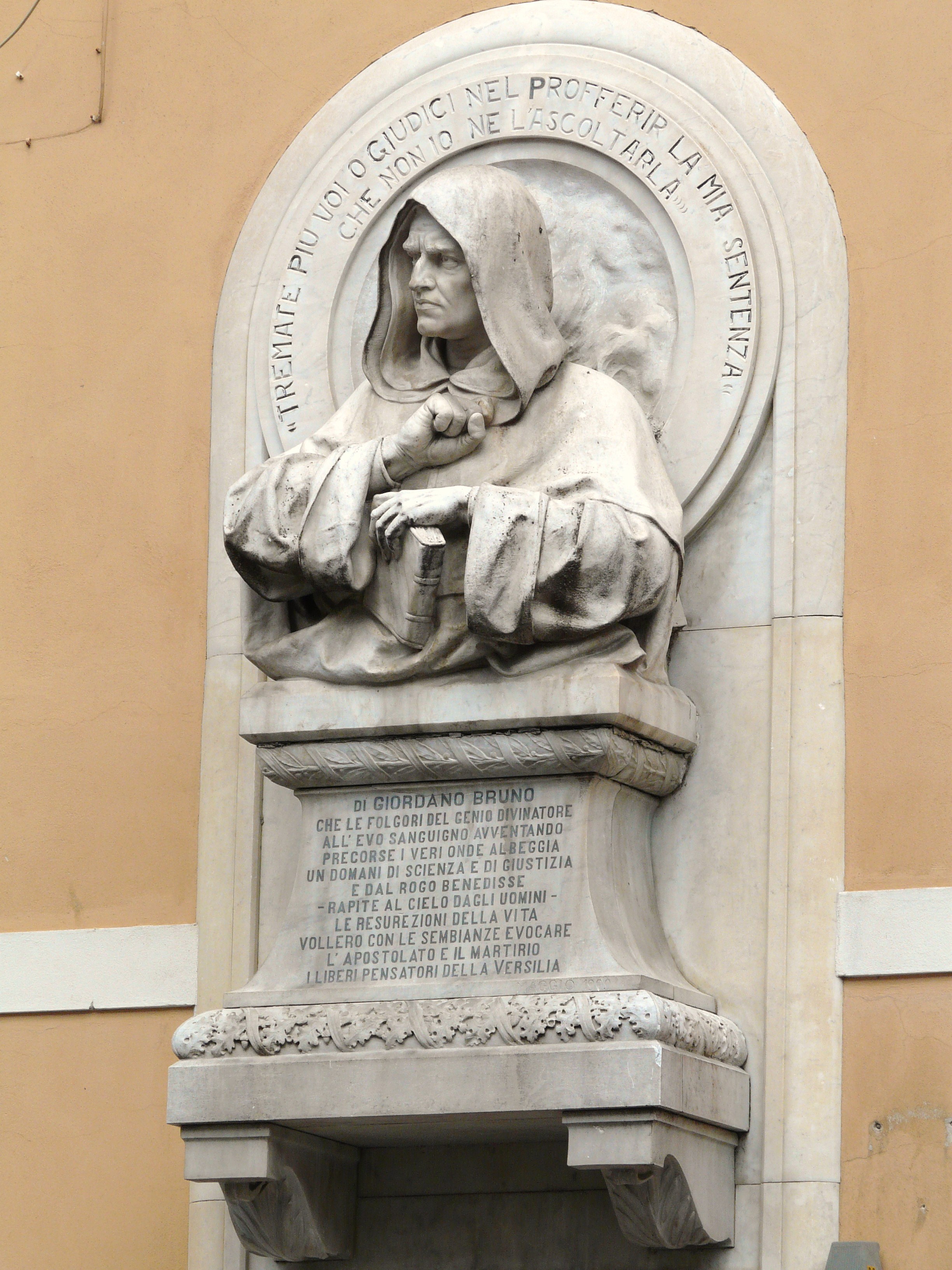
Bruno Monument - https://en.wikipedia.org/wiki/Giordano_Bruno#/media/File:Monument_to_Giordano_Bruno_at_Potsdamer_Platz_in_Berlin._Germany.jpg

Bruno Monument 2 - https://en.wikipedia.org/wiki/Giordano_Bruno#/media/File:Monument_to_Giordano_Bruno_in_Campo_de'_Fiori_square_Rome,_Italy-_6_June_2014_rectified.jpg

Bruno Monument 3 - https://upload.wikimedia.org/wikipedia/commons/e/e0/Pietrasanta-monumento_Giordano_Bruno.jpg

Bruno Monument 4 - https://upload.wikimedia.org/wikipedia/commons/d/d2/Klagenfurt_Kreuzbergl_Bruno_Giordano_Weg_1_Volkssternwarte_Gedenktafel_Giordano_Bruno_02052009_47.jpg

Dominican Monastery - https://upload.wikimedia.org/wikipedia/commons/b/bc/Domi0nican_Monastery_Dubrovnik.JPG


*************************


Giordano Bruno

Giordano Bruno (Latin: Iordanus Brunus Nolanus; born Filippo Bruno, January or February 1548 – 17 February 1600) was an Italian philosopher, mathematician, poet, cosmological theorist, and Hermetic occultist. He is known for his cosmological theories, which conceptually extended the then novel Copernican model. He proposed that the stars were distant suns surrounded by their own planets, and he raised the possibility that these planets might foster life of their own, a cosmological position known as cosmic pluralism. He also insisted that the universe is infinite and could have no "center".

While Bruno began as a Dominican friar, during his time in Geneva he embraced Calvinism. Bruno was later tried for heresy by the Roman Inquisition on charges of denial of several core Catholic doctrines, including eternal damnation, the Trinity, the divinity of Christ, the virginity of Mary, and transubstantiation. Bruno's pantheism was not taken lightly by the church, nor was his teaching of the transmigration of the soul (reincarnation). The Inquisition found him guilty, and he was burned at the stake in Rome's Campo de' Fiori in 1600. After his death, he gained considerable fame, being particularly celebrated by 19th- and early 20th-century commentators who regarded him as a martyr for science, although most historians agree that his heresy trial was not a response to his cosmological views but rather a response to his religious and afterlife views. However, some historians do contend that the main reason for Bruno's death was indeed his cosmological views. Bruno's case is still considered a landmark in the history of free thought and the emerging sciences.

In addition to cosmology, Bruno also wrote extensively on the art of memory, a loosely organized group of mnemonic techniques and principles. Historian Frances Yates argues that Bruno was deeply influenced by the Empedocles, Neoplatonism, Renaissance Hermeticism, and Genesis-like legends surrounding the Hellenistic conception of the Egyptian god Hermes Tresmigestus. Other studies of Bruno have focused on his qualitative approach to mathematics and his application of the spatial concepts of geometry to language.

con't....

.

Wednesday, June 1, 2022

Ritus Sulphurium: The Darkest Mass - Part III

So who made up this revolutionary coalition? They were a small segment of dissidents from all of the victimized groups, including: Templars, Freemasons, Rosicrucians, Luciferians, Hermeticists, and Alchemists who were driven underground…. persecuted Jews, Catholics who were thrown under the carriage due to politics or some other alternate reason, and even a few forcefully converted crypto-Muslims…. Protestants in hiding, such as Cathars, Waldensians, Spiritual Franciscans, Hussites, and Beguines…. Druids, Odinists, Witches, and many other pagan polytheists living in the shadows…. overthrown Monarchs, Gnostic heretics, and miscellaneous others who were destroyed by the ruling order for reasons that were political and economic, or those who ended up on the wrong side of personal vendettas from the ruling class…. or simply the kith and kin of innocent people who were tortured and murdered!

All of these dissidents made up a relatively small number of people who began to network together. They wouldn’t represent the typical person from their own communities, but as individuals they were traumatized, angry, and damaged. Everything above is based on fact, and now for the speculation. Knowing now the clear pattern of their behavior over time, I believe there must have been one night that the general leadership of this revolutionary coalition were all in one place at one time to be counted, to lay out their goals, and to permanently cement their new accord. The one conclave where they could commence their movement; where they swore revenge, and vowed to someday destroy the Church forever.

Over the coming centuries, this hidden hand would operate via proxy under the guise of many revolutionary movements where only they would be the victors. Each step seemingly unconnected to the next, and the next, and the next. History has known them as Jacobins, Illuminati, British-Israel World Federation, Hellfire Club, League of the Just, Royal Institute of International Affairs, Council on Foreign Relations, Communism, Monopoly Capitalism, war profiteers, frackers, Big Pharma, Secret Intelligence Service (compartmentalized black operations cells), Black Rock, Zionism, Globalism, Process Church, Bohemian Club, Skull and Bones, Société Générale de Belgique, Fabian Socialism, Business Roundtable, Carlyle Group, Project for the New American Century, International Bank of Settlements, Frankfurt School, Hand of Death, Hollywood, Lucis Trust, Rockefeller Foundation, Neo-Conservatives, Neo-Liberals, Silicon Valley, Bohemian Club, Wall Street, Central Intelligence Agency (compartmentalized black operations cells), Club of Rome, World Economic Forum, United Nations, and more than could ever be listed here.

They can destroy any opposing movement through infiltration and slander, they can create artificial revolutions through controlled opposition, create wars and arm both sides, make the innocent guilty and the guilty innocent, conduct weather wars, and a hundred other vicious tactics to permanently run roughshod over society. They’ve either taken over from the inside or created alliances with their former enemies. They’re white leather loafers on a marble floor in an ivory tower on Wall Street manipulating a few blips on a computer screen to steal the wealth from a Midwest farmer, while at the same time they’re black boots on a concrete street a few miles away setting a hard working immigrant's business on fire. They’re more than evil; there may not be an appropriate word for them in the English language.

So lets just speculate that at midnight, on Saturday, May 1, 1509, this revolutionary coalition secretly met in a remote wooded location in the Sonian Forrest south of Brussels, then the capitol of a small regional state within the Holy Roman Empire, to finally set their plans in stone. The abused will become the abuser, and much worse than that abuser. Saturday literally means “Saturn’s Day.” “May 1” is their admitted date for “Revolution.” I’m aware that May 1st had a different pagan spiritual meaning, but they've co-opted it like so many other things. May 1, 1509 = 5-1-1509 = 5+1. 1+5, and 9 = 669 = 666, the numerical dimensions of Saturn’s north pole. Of course, this is probably not the date or the place, but I’m sure that there is some deep occult tie-in to whatever name, date, place, and time that it actually was. Perhaps July 15, 1506, Midsummer, such as with the ‘Cremation of Care” ritual at Bohemian Grove. I’m 99% certain that there was a DATE involved. Even if somehow there wasn't a definitive date, then they must have later installed one! It's probably some date that they've symbolically foisted upon us as part of their incessant fetish ever since. The founding of the Illuminati was in 1776 (I guess putting the exact date on the back of the dollar bill would have been too overt even for them), and that date is the exoteric, while this unknown earlier starting date is the esoteric.

All of this secret history is recorded and is a major fetish for them, that I suppose they will come out in the open with at some future point. For example, when they created the Project for the New American Century. They absolutely did not need to create that group, and with a website, with plans no less! They love to fetishize their actions. They could have created a secret temporary group with all of the same individuals to meet their goal, and it would have been much more practical; but the fetish, always the fetish! They just love to create yet another secret group! The Trilateral Commission was created by longtime Democrat hander Zbigniew Brzezinski, and has NO practical function! They merely did it for the fetish of it! So for whatever it’s worth, I’m sure they had a specific date and time for their first ritual. I’ll just speculate that it may have been called ‘Ritus Sulphurium’ (The Rite of Sulphur), as they've been such a corrosive force in the world.

.

Friday, May 6, 2022

Ritus Sulphurium: The Darkest Mass - Part II

To jump ahead to clarify one point, there are different types of Satanists today; from a simple harmless theology, to something somewhat like benevolent Paganism, to ritual mass murderers. One size doesn’t fit all. Anton Levey was either a legitimate philosopher so to speak, and simply tried to make money to fund his organization, or he was a fraud who was in it for the money, or he was an agent of the higher ups who were trying to create like a "minor league Satanism" for maybe recruitment or some other purpose. I would guess the latter. I don't know, but Leveyan Satanism is not big league Satanism. It’s like grammar school Satanism. Maybe they thought they need that. Real Satanism is the “Cult of Saturn,” which is massive. If a person just doesn’t care about anything, has no principles, is of average intelligence, and wants to be successful… just seek them out and join! I don’t suggest it, if for no other reason than they’re dishonest!

How can you follow their motto, “Do what thou wilt,” when you’re completely controlled by highly advanced mechanisms that plug you into a technocratic system? It’s impossible, so "do what thou wilt" isn't worth a damn. I’ve looked closely at their plans, and it’s nothing short of suffocating. According to the Bible, Satan is a liar, and they’ve adopted that personality! It doesn’t matter what you believe; that’s their system! Personally, I like the old Saturnian tradition, as long as it doesn't have anything to do with men in high places or the projected “bad guy from the Bible.” One size doesn't fit all. The more malevolent type, as stated previously, got started in the Middle Ages; likely initially when Christian heretics were caught numerous times in various places, having orgies with animals, and conducting rituals involving numerous bodily fluids that I won’t name. The Church felt that it had to respond to this, and perhaps also used it as a pretext to establish a stronger socio-religious-political bond, so they created the "boogey man" from the Bible... Satan! It was all blamed on "Satanism," and that was a legitimately false "Satanic panic."

The genuine ancient Saturnian traditions had long disappeared by that time, only surviving in co-opted symbolism within Catholicism, Islam, and Judaism. Saturn was once a light-purple shining northern star in what was once our binary solar system, during what the ancients referred to as “The Golden Age.” In this age, thousands of years ago, there existed a rivalry between the solar cults and the Saturn cults. As Saturn slowly fizzled out and became a dwarf star, apparently a different process than a supernova which would have killed us all, the Saturn cults faded away. The solar cults took over in a succession of traditions, leading to the Egyptian Sun cult, which became Christianity. There were other Indo-European planetary cults as well; Lunar, Martian, Venusian, and others. Later it became so convoluted that some later religions have symbolism from more than one. For example, Islam has both Saturnian and Venusian symbolism. The lower crescent symbol is actually a Venusian symbol, as it was much more prominent in the sky in past centuries.

As has occurred throughout human history, the new revolutionary coalition adapted the ancient Saturnian tradition as their organizing principle for waging war. However, they predominantly adopted the Biblical version; not the genuine Saturnian tradition! In their self-serving manner, returning to “The Golden Age” simply meant that they would begin their quest to bend the entire world to their will. Now it is true that the ancient Saturnian Priesthood, such as existed in Phoenicia-Canaan, did engage in human sacrifices… including sacrificing children. However, the early Christians did the very same thing, and it continued right through the Middle Ages! The Eucharist wasn’t always merely wine and crackers. Also, every major church and cathedral constructed during the Middle Ages has a dark secret; a small child was kidnapped and cemented alive in one of the front pillars.

So when a Christian zealot complains about Halloween, and how the Druids conducted human sacrifices; or about Easter, and how the Canaanites sacrificed people; or even Christmas, and perhaps how the ancient Teutons held brutal rites… they did the same. The various inquisitions shouldn’t be any surprise. The Medieval Church caused, by their own actions over a long period of time, a reaction; an “underground Satanic church” that has now existed for centuries. This oppression, despotism, torture, and murder caused their victims so much trauma, that a small number of very angry people got together and created SATANISM!! Now it always has, and it always will, be conflated with the ancient Saturnian Priesthood. Of course, they’ve also plagiarized from the ancient European pagan traditions, such as with the seasonal Sabbats. However, the new Satanism is still a perversion of them; a system founded and designed specifically for revenge. A terrifying legacy from damaged people of centuries past; a program intended to poison everything they touch.

.

Sunday, April 10, 2022

Ritus Sulphurium: The Darkest Mass - Part I

World history changed in one night
During the second half of the Middle Ages, long after the Dark Ages supposedly were to have ended, something sinister came across the land. Political and religious upheaval, the inquisitions, witch hunts, the Burning Times. In March of 1314, as the Grand Master of the Knights Templar was literally burning to death, he was said to have cursed the Monarchy and Church. Jacques de Molay swore vengeance! Somehow after the Templars were finished with their business in Jerusalem, they returned, massively expanded their membership, and became an incredible maritime/business/banking empire; a veritable breakaway international state! Many powerful people, including the King himself, were soon up to their eyeballs in debt to them. The Church, in particular it's own banking empire, apparently felt threatened. It's as though they found some type of lost secrets from the ancient world during their travels in the near east. The secrets of money?

de Molay swearing vengeance
Some of the revolutionary coalition mentioned throughout this whole piece were probably guilty of a whole lot of things! There are always two sides to a story, even though it's not popular today to say so. For example, written history charges the pagan Vikings with engaging in endless violent raids on Christian monasteries, forgetting that the Christians had first deliberately blocked most of their trade routes. Lets try to set aside most of the speculation of who may have been justified in their actions, or not, for now. This story is to answer the question of why the world is the way that it is today. This is the ultimate tale of the abused becoming the abuser. This is about how a small coalition of thoroughly defeated groups of people coalesced to conquer the world. There have always been those who will say that it's this group or that group; saying that it's "them" or it all goes back to "this group." Often, over the course of history, most of these are just small temporary coteries designed to fulfill one particular goal, and then disbanded.  However, in the bigger picture, it was only a very tiny segment of each victimized concern which participated from the beginning, and form the ruling families of today.


Satanism: From imagination to reality
The brutal oppression, show trials, tortures, and executions of people based on their imaginary allegiance to Satan took place between the years 1450 and 1750. The vast majority of these people had no connection to any sort've pagan tradition at all. Probably exactly ZERO of them were actually "Satanists," at least in the beginning of this. Many of those charged were done so based on economic, political, or some personal reason if truth be known. Up to 50,000 people were executed during this time, and countless others tortured. This is aside from other religious persecutions, such as the Spanish Inquisition (1478-1834) or the destruction of the Cathars and other protestant sects. The emerging revolutionary coalition must have been made up of an almost boundless number of religious, political, or economic concerns.... or even just the families of innocent people who were murdered by the symbiotic state-church structure! It may have been an old lady merely collecting herbs for some type of simple folk medicine!

The high point of the witch trials occurred between 1580 and 1630. The torture was immense! I suppose that I don't really need to delve into all of that, except to ponder that this occurred over fifteen generations! If they had started in 1722, then they would just be ending now. There were private entrepreneurs and opportunists who got into the act. When a government promotes something stupid, there will never be a lack of willing participants! One such group was the Vehmic Court in Westphalia, who hunted down and executed pagans. They could have just operated as paid assassins! They could murder someone and just say that the person was a witch or Devil worshiper, and it would then be okay. Another example, in approximately the year 1473, German Domincan Churchman Heinrich Kramer was appointed as the official inquisitor by the Archbishop of Salzburg. Henricus Inquisitor, as he was known, was responsible for the Tyrol, Salzburg, Bohemia, and Moravia. In other words, he was a paid thug put in charge of stopping the rise of the imaginary Satanic sects in those areas. He was going to "find them" whether they existed or not. He was just one of the many leaders of the inquisition across Europe for centuries! In 1487 he authored 'Malleus Maleficarum' ("Hammer of Witches"), a guide to witchcraft and how to interrogate people in order to get a confession out of them. The methods were so extreme that even some authorities of the day condemned it.

Three centuries of torture
The Spanish Inquisition was part of the larger Catholic Inquisition (or known simply as "The Inquisition"), as was the Roman, Portuguese, and other Inquisitions. These inquisitions very much included Protestant sects! Cathars, Waldensians, Spiritual Franciscans, the Hussites, and the Beguines were terrorized by the inquisitors. Any institution which could be thought of as competition to the Catholic Church, and later other dominant Protestant sects, had the screw put to them. It wasn't just the death toll, 50,000 over three centuries, as there were battles in World War II where 100,000 soldiers died in a single day. It was the aura of fear that existed over that time period, a dark cloud that just wouldn't go away. As is human nature, the fear eventually turns to anger. When the vast majority of history's conquerors finally defeated the targeted population, such as with the Roman Empire, the next step was to allow them to partake in its system and bring them into the fold. These religious zealots did not offer that at all! They just kept putting the screw to them! Even a bully in school, who wants smaller students' lunch money, is at least satiated if they hand it over to him. They're backed into a corner, but they're at least allowed a chance to get out of that corner if they cooperate. However, as stated, there was no end to the violent oppression, and anyone could be a victim if they weren't careful.

.

Sunday, August 15, 2021

The Tarot: The name originally came from the Brescian "Tarocho" - Part II

Arms for the Visconti-Sforza family

Trionfi (cards)

Trionfi (Italian: 'triumphs') are 15th-century Italian playing cards with allegorical content related to those used in tarocchi games. The general English expression "trump card" and the German "trumpfen" (in card games) have developed from the Italian "Trionfi". Most cards feature the personification of a place or abstraction.


************

History

Many of the motifs found in trionfi are found in trionfo, theatrical processions that were popular in the Italian Renaissance. The Palazzo Schifanoia in Ferrara, once owned by the ducal House of Este, contains many murals depicting these floats. Petrarch wrote a poem called I Trionfi which may have served as inspiration.

The earliest known use of the name "Trionfi" in relation to cards can be dated to 16 September 1440 in the records of a Florentine notary, Giusto Giusti. He recorded a transaction where he transferred two expensive personalized decks to Sigismondo Pandolfo Malatesta.

In a letter from 11 November 1449, Antonio Jacopo Marcello used the expression triumphorum genus for a deck that was produced sometime between 1418 and 1425. It was commissioned by the duke of Milan, Filippo Maria Visconti, painted by Michelino da Besozzo and described in an accompanying text by Martiano da Tortona.

Two decks from June 1457 seem to relate to a visit at Ferrara of the young Milanese heir of the dukedom Galeazzo Maria Sforza in July/August 1457. Each deck consisted of 70 cards — the modern Tarot deck typically has 78.

The earliest known appearance of the word "Tarocho" as the new name for the game is in Brescia around 1502).

[Depaulis, Thierry (2008). "Entre farsa et barzelletta: jeux de cartes italiens autours de 1500". The Playing-Card. 37 (2): 89–102]

************

Tarocchini

Tarocchini (plural for tarocchino) are point trick-taking tarot card games popular in Bologna, capital city of the Emilia-Romagna region of Italy and has been confined mostly to this area. They are the diminutive form of tarocchi (plural for tarocco), referring to the reduction of the Bolognese pack from 78 to 62 cards, which probably occurred in the early 16th century.

The games of Tarocchini are very complex, yet the rules have changed little over the years.

************

Visconti-Sforza tarot deck

The Visconti-Sforza tarot is used collectively to refer to incomplete sets of approximately 15 decks from the middle of the 15th century, now located in various museums, libraries, and private collections around the world. No complete deck has survived; rather, some collections boast a few face cards, while some consist of a single card. They are the oldest surviving tarot cards and date back to a period when tarot was still called Trionfi ("triumphs" i.e. trump) cards, and used for everyday playing. They were commissioned by Filippo Maria Visconti, Duke of Milan, and by his successor and son-in-law Francesco Sforza. They had a significant impact on the visual composition, card numbering and interpretation of modern decks.

************

Overview

The surviving cards are of particular historical interest because of the beauty and detail of the design, which was often executed in precious materials and often reproduce members of the Visconti and Sforza families in period garments and settings. Consequently, the cards also offer a glimpse of nobiliary life in Renaissance Milan, which the Visconti called home since the 13th century.

************

Pierpont Morgan Bergamo (card deck)

This deck, also known as Colleoni-Baglioni and Francesco Sforza, was produced around 1451. Originally composed of 78 cards, it now contains 74, i.e. 20 trumps, 15 face cards, and 39 pip cards. The Morgan Library & Museum in New York City has 35, the Accademia Carrara has 26 in its catalogue, while the remaining 13 are in the private collection of the Colleoni family in Bergamo. Trumps and face cards have a gilt background, while the pip cards are cream-coloured with a flower and vine motif. The two missing trumps are the Devil and the Tower. Modern published reproductions of this deck usually contain attempted reconstructions of missing cards.

.

Saturday, August 14, 2021

The Tarot: The name originally came from the Brescian "Tarocho" - Part I

Tarot

[The Tarot] first known as trionfi and later as tarocchi or tarock, is a pack of playing cards, used from at least the mid-15th century in various parts of Europe to play games such as Italian tarocchini; many games are still played today; in the late 18th century, some tarot decks began to be used for divination via tarot card reading and cartomancy leading to custom decks developed for such occult purposes.

************

History

The first documented tarot packs were recorded between 1440 and 1450 in Milan, Ferrara, Florence and Bologna when additional trump cards with allegorical illustrations were added to the common four-suit pack. These new decks were called carte da trionfi, triumph cards, and the additional cards known simply as trionfi, which became "trumps" in English. The earliest documentation of trionfi is found in a written statement in the court records of Florence, in 1440, regarding the transfer of two decks to Sigismondo Pandolfo Malatesta.

The oldest surviving tarot cards are the 15 or so Visconti-Sforza tarot decks painted in the mid-15th century for the rulers of the Duchy of Milan. A lost tarot-like pack was commissioned by Duke Filippo Maria Visconti and described by Martiano da Tortona probably between 1418 and 1425, since the painter he mentions, Michelino da Besozzo, returned to Milan in 1418, while Martiano himself died in 1425. He described a 60-card deck with 16 cards having images of the Roman gods and suits depicting four kinds of birds. The 16 cards were regarded as "trumps" since in 1449 Jacopo Antonio Marcello recalled that the now deceased duke had invented a novum quoddam et exquisitum triumphorum genus, or "a new and exquisite kind of triumphs". Other early decks that also showcased classical motifs include the Sola-Busca and Boiardo-Viti decks of the 1490s.

In Florence, an expanded deck called Minchiate was used. This deck of 97 cards includes astrological symbols and the four elements, as well as traditional tarot motifs.

The expansion of tarot outside of Italy, first to France and Switzerland, occurred during the Italian Wars. The most important tarot pattern used in these two countries was the Tarot of Marseilles of Milanese origin.

************

Etmology

The word Tarot and German Tarock derive from the Italian Tarocchi, the origin of which is uncertain but taroch was used as a synonym for foolishness in the late 15th and early 16th centuries. The decks were known exclusively as Trionfi during the fifteenth century.

The new name first appeared in Brescia around 1502 as Tarocho.

[Depaulis, Thierry (2008). "Entre farsa et barzelletta: jeux de cartes italiens autours de 1500". The Playing-Card. 37 (2): 89–102]


During the 16th century, a new game played with a standard deck but sharing a very similar name (Trionfa) was quickly becoming popular. This coincided with the older game being renamed tarocchi. In modern Italian, the singular term is Tarocco, which, as a noun, refers to a cultivar of blood orange. The attribute Tarocco and the verb Taroccare are used regionally to indicate that something is fake or forged. This meaning is directly derived from the tarocchi game as played in Italy, in which tarocco indicates a card that can be played in place of another card.

************

Gaming decks


The original purpose of tarot cards was to play games. A very cursory explanation of rules for a tarot-like deck is given in a manuscript by Martiano da Tortona before 1425. Vague descriptions of game play or game terminology follow for the next two centuries until the earliest known complete description of rules for a French variant in 1637. The game of tarot has many regional variations. Tarocchini has survived in Bologna and there are still others played in Piedmont and Sicily, but in Italy the game is generally less popular than elsewhere.

************

Tarocco Piemontese: the Fool card

These were the oldest form of tarot deck to be made, being first devised in the 15th century in northern Italy. Three decks of this category are still used to play certain games:

The Tarocco Piemontese consists of the four suits of swords, batons, cups and coins, each headed by a king, queen, cavalier and jack, followed by the pip cards for a total of 78 cards. Trump 20 outranks 21 in most games and the Fool is numbered 0 despite not being a trump.
 
The Swiss 1JJ Tarot is similar, but replaces the Pope with Jupiter, the Popess with Juno, and the Angel with the Judgement. The trumps rank in numerical order and the Tower is known as the House of God. The cards are not reversible like the Tarocco Piemontese.

The Tarocco Bolognese omits numeral cards two to five in plain suits, leaving it with 62 cards, and has somewhat different trumps, not all of which are numbered and four of which are equal in rank. It has a different graphical design than the two above as it was not derived from the Tarot of Marseilles.

************

Card reading

The earliest evidence of a tarot deck used for cartomancy (fortune telling) comes from an anonymous manuscript from around 1750 which documents rudimentary divinatory meanings for the cards of the Tarocco Bolognese.

.

Tuesday, September 1, 2020

'Magnificat' by Claudio Moneverdi (Cremonese ancestry)


Claudio Monteverdi - Magnificat (complete)

1,045,138 views - April 4, 2012

S. Quimas

Claudio Giovanni Antonio Monteverdi (Italian pronunciation: [ˈklaudjo monteˈverdi]; 15 May 1567 (baptized) -- 29 November 1643) was an Italian composer, gambist, and singer.

Monteverdi's work, often regarded as revolutionary, marked the transition from the Renaissance style of music to that of the Baroque period. He developed two individual styles of composition -- the heritage of Renaissance polyphony and the new basso continuo technique of the Baroque. Monteverdi wrote one of the earliest operas, L'Orfeo, an innovative work that is still regularly performed. He was recognized as an innovative composer and enjoyed considerable fame in his lifetime.


Music in this video

Magnificat II a 6 - Anima mea

Magnificat II a 6 - Et exultavit

Magnificat II a 6 - Quia respexit

Magnificat II a 6 - Quia fecit

Magnificat II a 6 - Et misericordia

Magnificat II a 6 - Fecit potentiam

Magnificat II a 6 - Deposuit potentes

Magnificat II a 6 - Esurientes implevit

Magnificat II a 6 - Suscepit Israel

Magnificat II a 6 - Sicut locutus est


************


'Magnificat'


The Magnificat (Latin for "[My soul] magnifies [the Lord]") is a canticle, also known as the Song of Mary, the Canticle of Mary and, in the Byzantine tradition, the Ode of the Theotokos (Greek: Ἡ ᾨδὴ τῆς Θεοτόκου). It is traditionally incorporated into the liturgical services of the Catholic Church and of the Eastern Orthodox churches. Its name comes from the incipit of the Latin version of the text.

The text of the canticle is taken directly from the Gospel of Luke (1:46–55) where it is spoken by Mary upon the occasion of her Visitation to her cousin Elizabeth. In the narrative, after Mary greets Elizabeth, who is pregnant with John the Baptist, the latter moves within Elizabeth's womb. Elizabeth praises Mary for her faith (using words partially reflected in the Hail Mary), and Mary responds with what is now known as the Magnificat.

The Magnificat is one of the eight most ancient Christian hymns and perhaps the earliest Marian hymn. Within the whole of Christianity, the canticle is most frequently recited within the Liturgy of the Hours. In Western Christianity, the Magnificat is most often sung or recited during the main evening prayer service: Vespers in the Catholic and Lutheran churches, and Evening Prayer (or Evensong) in Anglicanism. In Eastern Christianity, the Magnificat is usually sung at Sunday Matins. Among Protestant groups, the Magnificat may also be sung during worship services, especially in the Advent season during which these verses are traditionally read.


************


'Magnificat' is a hymn which a part of the musical setting 'Vespro Della Beata Vergine' 1610

Vespro Della Beata Vergine - Claudio Monteverdi - John Eliot Gardiner (complete)

Vespro della Beata Vergine (Wikipedia)


.

Monday, December 30, 2019

That old Albanian witchcraft legend in Val Camonica


.
During the sixteenth century, it is estimated that there were approximately 30,000 people living in the Val Camonica, then part of the Venetian Republic. Out of that number, about 10,000 were adherents of native paganism aka "Camunian witchcraft." I would guess that the whole of the Brescian Tri-Valley, the region of the Bergamo Alps, the Valtellina, and the Val Chiavenna probably had a similar ratio of Roman Catholics to native pagans. There apparently were no problems with between the two. Many times rural Christians had old folkways which would have looked very pagan, or many pagans have long used Christian symbolism. For example, the "cult of Mary" is heavily conflated with the Goddess Diana.... whom was called the Goddess Mona in Camunian; "Mon" being the ancient word for Moon. Separate from the ancient roots of Camunian witchcraft, there was another somewhat unsubstantiated legend of another old tradition.

During the Ottoman/Islamic invasion of the western Balkans in mid to late fifteenth century, fairly large numbers of pre-Ottoman Albanians of Illyrian origin--purportedly all Christian--were settled in southern Italy; the Arbëreshë. According to some old Venetian records, but apparently not written in the official historical narrative anywhere, the Venetians accepted a small number of Albanian refugees. Not knowing what to do with them, they just brought them inland and sent them into the Camunian mountains. Perhaps the number was so small that it was neglected by the history books, but according to Venetian and Church authorities some of them were adherents of what they called "witchcraft." They were blamed for the upsurge in what they considered the scourge of ungodly activity in the Val Camonica. Were they just a convenient scapegoat to justify sending an army of Venetian soldiers and Church inquisitors up into the mountains to forcefully reestablish Church rule?

 
.
We'll probably never know, but it's possible that the native pagans at least made some attempt to keep outward displays of their traditions to a minimum. It's also possible that the Albanian pagans did not, so it may have been a combination of the two. The church and state may have wanted to do something about it before, and this allowed them a pretext to action, which one-way-or-another ultimately culminated in the Val Camonica witch trials; perhaps also the witch trials in the Valtellina as well. Aside from the various church complaints that witches' spells had brought droughts, injury, pestilence, fires, and general Satanic heresy, they also mentioned what seemed to be an upsurge of a particular "evil sect." Could that have been the Albanian witches?; or was it merely more of the synergistic bluster they used to galvanize themselves into action?

In the Alps, in the Balkans, and in seemingly every corner of Europe, there was the ancient witch-cult from somewhere very deep in the history of the Proto-European people. In ancient Greece, there was the Hecatean tradition which predated the Olympian pantheon of gods. In central Italy, there were similar traditions which predated the Romans.. and even the Etruscans. In Scandinavia, there was a similar tradition which predated the Vikings, and so on. A tradition before the Mediterraneans, before the Teutons, before the Celts, Slavs.... back beyond the last glacial movement to the mysterious Proto-Europeans.

"Witchcraft has no origin, it has always been with us."
 -- Leo Ruickbie, 'Witchcraft Out of the Shadows: A History'

.

Monday, February 18, 2019

Stregheria, Goddess Diana, Aradia, and Evolutionary Struggle


.

The one concept that I see that is sorely missing from Wicca and other similar religions or spiritual traditions is "evolutionary struggle"; that condition that very few of us are able to avoid in life to any comfortable degree. The struggle doesn't have to be something as overt as, for example, the film 'The Grey'. It could be fighting traffic to get to work, getting beat out've a job to someone for a bad reason (younger/better figure, the bosses friend, a major client's niece, etc.), betrayal, a false rumor, a health issue, someone unexpectedly interfering with your life, a bad neighbor, danger, a bad living condition, more month at the end of the money, the list could go on and on. It has been said that there are two types of people in the world, the predators and the prey. Certainly this would be true of animals and ocean creatures. I think for people, that statement is at least mostly true.

The below text are the words of the Goddess Diana, to her daughter Aradia, sometime prior to sending her to the earth to live as a mortal with a mission to fulfill. This text was translated by Raven Grimassi in 'The Book of the Holy Stega' (1981), from Charles G. Leland's 'Aradia: Gospel of the Witches' (1899). Clearly this would be in regard to the Catholic Church of the 14th century, and it's quite aggressive; some could obviously argue that's it's based on self-defense due to the Church's past actions and present conditions. Regardless of all of that, we all have enemies; there's no escaping it. Only the softest head-in-the-clouds suburbanite could possibly believe that they have no enemies. "Evolutionary" could be used in reference to many different considerations; however, probably chiefly the "evolution of the individual." We all "evolve"; for example, we may cringe a bit when pondering of some long-ago action or words that we offered.

The opposames called Capitalists and Socialists frequently brag about "progress" while engaging in their system-approved passive-aggression. "Progress" could be anything that anyone wants it to be. When Capitalists seek to obliterate a beautiful natural area or massively wipe out the view of mountains or a body of water for profit--forever--they would call it "progress." For that reason, I would argue that an individual or small collective keep their translation of the below text to themselves. Personally, I think it could regard numerous different things; along with a couple of personal items. It doesn't matter that much because evolutionary struggle (individual or a larger collective) is applicable to all. However, since this is a folk-based religion/spiritual tradition, it belongs to it's devoted adherents.


.

"It is true that you are a spirit,
But you were created to become again a mortal;
You must go on earth
And become a Teacher,
To be a teacher to women and men
Who will receive your schooling
In the ways of witchcraft."

"You must not be like the ones of darkness,
And to the race that became
Wicked, infamous, because of their seed,
You shall not go among them."

"You shall be the first witch;
The first goddess to become a witch on earth.
You shall teach the secret knowledge of plants
To harm and to heal,
And you shall teach the ways of power
To bind and to slay the spirit of the oppressor."

"And where there is found to be a greedy peasant
That has come to wealth in this way,
Then you shall teach your witches, your pupils, how
To ruin all his harvest
With tempest, lightning and with thunder,
With hail and wind."

"And when a priest shall do you spiritual injury
By his benedictions, ye shall do to him
Double the harm, and do it in the name
of me, Diana, Queen of witches all!"

"And when the nobles or priests tell you
that you must believe in the Father, Son, and Mary,
answer them that serve only devils,
and say the true God is not your God,
and tell them to instead Diana,
The Queen of all witches!"

"You shall go on earth to teach this,
And to destroy the evil of these people.
Your poor people will suffer hunger
And work wretchedly,
And also suffer prison."

"But these are of one soul,
One good and true soul
And in the Otherworld they
Shall be happy
But their tormentors on earth shall discover
That an ill Fate awaits them in the Otherworld.

.
Saturday, December 1, 2018

'Carmina Burana' - Largely based on eclectic European pre-Christian spiritual folk traditions... and possibly of South Tyrolian origin: Part 2


Carl Orff - O Fortuna - Latin and English Lyrics

Metalius


************


I think that it can be proven that 'O' Fortuna' at least, is based on The Goddess of The Old Religion. The other pieces in 'Carmina Burana', as well as the other two parts of Orff's 'Trionfi' musical trilogy, can be examined over time by any of us interested in examining the pre-Christian tie-ins to this great and famous musical art piece. I would encourage that, as I don't claim in any way that I have all of the answers here. Some of the musical pieces, in my perception, seem to correspond energetically to different times of the year. Much further examination of the poems will be the judge of that. Just the fact that the goddess Fortuna is a deity from Roman mythology is the first small clue, and the idea expands from there.

When examining the translated English lyrics (from the above video) along with the music... it gives a very different look at the intended meaning from the poetry.... as well as the music itself. This was a complaint about Fortuna, the inexorable fate that rules both gods and mortals in Roman and Greek mythology, and this anger was well demonstrated by Carl Orff's work. Most of the poems and songs appear to be the work of Goliards, clergy (mostly students) who satirized the Catholic Church. This brings up two groupings of questions:

1) How was it that they felt comfortable expressing criticism, in any form, towards an often vengeful Catholic Church?... and from within its walls? Does the possible location of origin, the South Tyrol, offer any intrinsic clue to any of this? Was the Church not as strong there? The "witch burnings" there occurred centuries later, so perhaps the Church had not gained a strong foothold there yet? Was there still a folk pagan element alive there, and expressed itself in occult poetry?... or even more explicitly a "folk-pagan occult underground?" (which may or may not have been a part of either the Christian heretical or later Satanic underground). Another possibility is that it was simply a criticism of the old folk-traditions, which--in this particular piece--was a fusion of Roman mythology with The Old Religion (aka Proto-European Witchcraft). That doesn't seem very likely; we already know that they had so often directed satire towards the Church.

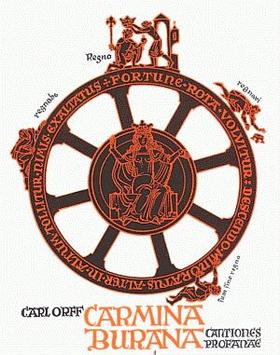
Wheel of Fortune symbolism (Rota Fortunae)

2) What exactly was their motivation behind using clear ancient folk-pagan mythology? Was the exoteric meaning implied to be a simple secular reference to the Roman goddess Fortuna; with the real esoteric meaning being a reference to Diana/Hecate? The best question of all.... was this really a cleverly crafted esoteric invocation to the goddess Diana?.... with that "anger" actually being more of a powerful reverence towards her? Since the authors of 'O Fortuna' and other poems from 'Carmina Burana' are apparently unknown (perhaps by design), and there were scores of other poems (Orff only used a small handful), I can only guess. There's much work to do, digging through all of these works. The authors were from numerous locations in western Europe; were these "Goliards" some type of occult underground network? They did all end up together when they were found in deep storage apparently. The South Tyrol connection may not be of any particular importance, as all three possible locations of origin were in the same general south German cultural region, and it was retrieved apparently hidden away in a monastery in Bavaria.

I wanted to sift through all of this piece by piece, but I can see that I've gotten ahead of myself here. Therefore, lets just look at all of this as one big puzzle. In other words, I can't begin to do this justice at this time. It's at least very possible that this could be some sort've underground expression from the old folk traditions. If that was the case, then this could very well be considered a part of neopagan folk history.... and I suppose Car Orff's 'Carmina Burana' as well.... which certainly was not intended to be Christian. It seems almost too convenient that Carl Orff just puts some very old obscure poems to music and it's so perfect! Either he was part of some occult connection, or he's a genius who just happened upon these poems and had a eureka moment! I'll go with the latter at this time.


The Wheel of Fortune from Carmina Burana


The upside cross could mean something, or it may not. Knowing a little bit about how these occult societies work, I wouldn't doubt it. It's at least possible that a Saturnian cult had infiltrated the lower rungs of the Church. Certainly the Catholic Church uses Saturnian symbolism. Also, some of these secret societies have long used symbols of mythology and pagan traditions. Also, the above "wheel of fortune" looks a bit like an eight-pointed wheel of the year from the old Proto-European tradition.


'O' Fortuna' lyrics

O Fortune,
like the moon
you are changeable,
ever waxing
and waning;
hateful life
first oppresses
and then soothes
as fancy takes it;
poverty
and power
it melts them like ice.
Fate - monstrous
and empty,
you whirling wheel,
you are malevolent,
well-being is vain
and always fades to nothing,
shadowed
and veiled
you plague me too;
now through the game
I bring my bare back
to your villainy.
Fate is against me
in health
and virtue,
driven on
and weighted down,
always enslaved.
So at this hour
without delay
pluck the vibrating strings;
since Fate
strikes down the strong man,
everyone weep with me!


 A clear conflation of the Roman Fortuna with the Proto-European Almother (aka Diana, Hecate, Mona, etc.):
O Fortune,
like the moon
you are changeable,
ever waxing
and waning


The first and last movements of the piece are called 'Fortuna Imperatrix Mundi' ('Fortune, Empress of the World') and start with the very well known 'O Fortuna.'The first and last movements of the piece are called 'Fortuna Imperatrix Mundi' ('Fortune, Empress of the World') and start with the very well known 'O Fortuna. The "Empress of the World" sounds very much like the many titles given to Hecate in particular. I would have dismissed that idea except for the additional reference to the Moon Goddess.... so lets face it, it's the Moon Goddess of ancient legend.... the Proto-European Almother! However, was the poem really a criticism of the Christian God?.... or of the Pagan Goddess?.... or, was it really just an esoteric invocation of the Pagan Goddess? Love and anger can work very well together symbiotically! The greatest deflation is often when we're let down by someone or something that we love and are devoted to. Also, the Latin text could easily have hidden some clues that were lost in the translation.


.

Wednesday, October 3, 2018

Christian human sacrifice - Rampant in the Middle Ages


.
Although Christian "human sacrifice" rituals were a common part of this religious culture during its ancient beginnings, it has generally been assumed that this is where it ended. Apparently this is not the case! I can't help but recall with demusement, various lectures by Christian "anti-Halloween" advocates in which they described in horror the accounts of human sacrifice rituals by the Druids. This, of course, was intended to discredit Druidic culture in every manner... and ultimately demonize the traditions which led to the All-Hallows Eve or Samhain holiday; brought to America by mostly Irish immigrants. I can recall the look of absolute contempt on the face of Christian zealot Doc Marquis as he recounted accounts, probably from Roman sources, of the culture of the Druids as it related to what we know as Halloween. Moreover, he suggested Druidic crimes against children. I don't know if that has any truth to it, but there were brutal ritual sacrifices such as "The Wicker Man." However, Christian human sacrifice during the Middle Ages is seldom ever mentioned by anyone today despite it's well documented history.

The following are excerpts from page 18 of the book 'The Tradition of Household Spirits' (Lecouteux; 2000); Chapter 1 - 'The House and its Construction'.


Christian child sacrifice (translated and copied from a real account)

When the people decided to build the church of Skrunda, in Courland (Latvia), two pastors left on horseback to select the site. They first passed by the Krievukalns, where one horse dislocated a hoof; then by the Pilskalns, where a horse started bucking. They finally came to the spot where the church now stands. Here one of the horses went down on its knees, and they saw that the site was intended for the building. But during this period it was not possible to build a church without walling up a chaste young girl or child in a pillar, otherwise whatever one built during the day would collapse at night, which is what happened with the church of Skrunda. Messengers were sent to ask young boys and girls if they wanted to look after the keys of the church. The children had been warned to say no if anyone asked them this question. But one little girl responded: "I would really like to keep them." She was taken away and walled up in a pillar of the church. And look, what was built during the day no longer collapsed at night."

Obviously the construction work did not fall during the night; they merely wanted to conduct the ritual. If they were evil enough to murder a little girl, then I see no reason that they wouldn't have walled her inside the pillar alive. This was not isolated incident either.


The "construction sacrifice"

The construction sacrifice, which is well substantiated throughout the whole of Europe, became proverbial in Latvia: "Every church demands a sacrifice." Furthermore, it was assumed that the victim transformed into a supernatural guardian spirit.


The Sacrifice for the Building (excerpt from pages 19-20)

As the sacrifice for a building has already been extensively studied by various scholars, I will not dwell on it and simply noting certain aspects will suffice here. Depending on the time and the place, it could appear in a wide variety of forms: actual sacrifice of a human being or an animal, or a simulation of such a sacrifice. In the later case, the shadow or its life-size approximation was buried in the foundations, and even today a photograph may be used to perform the same function. Whatever the case, the person will die forty days or even a year later, which is why a stranger to the village is often chosen for this purpose. In the southern Slavic countries, the victim can be the first person to walk past the construction--his or her shadow will be walled up--a form of sacrifice (now) condemned by the Nomocanon (legal canon) of the Byzantine Church.

.

Saturday, June 16, 2018

da Vinci's 'La belle ferronnière' - Mystery subject possibly the Duchess of Milan


La belle ferronnière is a portrait of a lady, usually attributed to Leonardo da Vinci, in the Louvre. It is also known as 'Portrait of an Unknown Woman'. The portrait was painted in between 1490-96 by either Leonardo da Vince or one of this Milanese circle of students.

Although the model of the painting "La Belle Ferronniere" is still shrouded in mystery, the landmark exhibition "Leonardo Da Vinci: Painter at the Court of Milan" (National Gallery, London, 9 Nov. 2011 – 5 Feb. 2012) listed the portrait as possibly depicting Beatrice d'Este, wife of Ludovico Sforza. This challenges the portrait's earlier attribution to Lucrezia Crivelli, a mistress of Ludovico.

.