Showing posts with label German. Show all posts

Saturday, December 1, 2018

'Carmina Burana' - Largely based on eclectic European pre-Christian spiritual folk traditions... and possibly of South Tyrolian origin: Part 2


Carl Orff - O Fortuna - Latin and English Lyrics

Metalius


************


I think that it can be proven that 'O' Fortuna' at least, is based on The Goddess of The Old Religion. The other pieces in 'Carmina Burana', as well as the other two parts of Orff's 'Trionfi' musical trilogy, can be examined over time by any of us interested in examining the pre-Christian tie-ins to this great and famous musical art piece. I would encourage that, as I don't claim in any way that I have all of the answers here. Some of the musical pieces, in my perception, seem to correspond energetically to different times of the year. Much further examination of the poems will be the judge of that. Just the fact that the goddess Fortuna is a deity from Roman mythology is the first small clue, and the idea expands from there.

When examining the translated English lyrics (from the above video) along with the music... it gives a very different look at the intended meaning from the poetry.... as well as the music itself. This was a complaint about Fortuna, the inexorable fate that rules both gods and mortals in Roman and Greek mythology, and this anger was well demonstrated by Carl Orff's work. Most of the poems and songs appear to be the work of Goliards, clergy (mostly students) who satirized the Catholic Church. This brings up two groupings of questions:

1) How was it that they felt comfortable expressing criticism, in any form, towards an often vengeful Catholic Church?... and from within its walls? Does the possible location of origin, the South Tyrol, offer any intrinsic clue to any of this? Was the Church not as strong there? The "witch burnings" there occurred centuries later, so perhaps the Church had not gained a strong foothold there yet? Was there still a folk pagan element alive there, and expressed itself in occult poetry?... or even more explicitly a "folk-pagan occult underground?" (which may or may not have been a part of either the Christian heretical or later Satanic underground). Another possibility is that it was simply a criticism of the old folk-traditions, which--in this particular piece--was a fusion of Roman mythology with The Old Religion (aka Proto-European Witchcraft). That doesn't seem very likely; we already know that they had so often directed satire towards the Church.
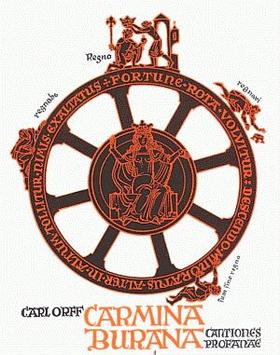
Wheel of Fortune symbolism (Rota Fortunae)

2) What exactly was their motivation behind using clear ancient folk-pagan mythology? Was the exoteric meaning implied to be a simple secular reference to the Roman goddess Fortuna; with the real esoteric meaning being a reference to Diana/Hecate? The best question of all.... was this really a cleverly crafted esoteric invocation to the goddess Diana?.... with that "anger" actually being more of a powerful reverence towards her? Since the authors of 'O Fortuna' and other poems from 'Carmina Burana' are apparently unknown (perhaps by design), and there were scores of other poems (Orff only used a small handful), I can only guess. There's much work to do, digging through all of these works. The authors were from numerous locations in western Europe; were these "Goliards" some type of occult underground network? They did all end up together when they were found in deep storage apparently. The South Tyrol connection may not be of any particular importance, as all three possible locations of origin were in the same general south German cultural region, and it was retrieved apparently hidden away in a monastery in Bavaria.

I wanted to sift through all of this piece by piece, but I can see that I've gotten ahead of myself here. Therefore, lets just look at all of this as one big puzzle. In other words, I can't begin to do this justice at this time. It's at least very possible that this could be some sort've underground expression from the old folk traditions. If that was the case, then this could very well be considered a part of neopagan folk history.... and I suppose Car Orff's 'Carmina Burana' as well.... which certainly was not intended to be Christian. It seems almost too convenient that Carl Orff just puts some very old obscure poems to music and it's so perfect! Either he was part of some occult connection, or he's a genius who just happened upon these poems and had a eureka moment! I'll go with the latter at this time.


The Wheel of Fortune from Carmina Burana


The upside cross could mean something, or it may not. Knowing a little bit about how these occult societies work, I wouldn't doubt it. It's at least possible that a Saturnian cult had infiltrated the lower rungs of the Church. Certainly the Catholic Church uses Saturnian symbolism. Also, some of these secret societies have long used symbols of mythology and pagan traditions. Also, the above "wheel of fortune" looks a bit like an eight-pointed wheel of the year from the old Proto-European tradition.


'O' Fortuna' lyrics

O Fortune,
like the moon
you are changeable,
ever waxing
and waning;
hateful life
first oppresses
and then soothes
as fancy takes it;
poverty
and power
it melts them like ice.
Fate - monstrous
and empty,
you whirling wheel,
you are malevolent,
well-being is vain
and always fades to nothing,
shadowed
and veiled
you plague me too;
now through the game
I bring my bare back
to your villainy.
Fate is against me
in health
and virtue,
driven on
and weighted down,
always enslaved.
So at this hour
without delay
pluck the vibrating strings;
since Fate
strikes down the strong man,
everyone weep with me!


 A clear conflation of the Roman Fortuna with the Proto-European Almother (aka Diana, Hecate, Mona, etc.):
O Fortune,
like the moon
you are changeable,
ever waxing
and waning


The first and last movements of the piece are called 'Fortuna Imperatrix Mundi' ('Fortune, Empress of the World') and start with the very well known 'O Fortuna.'The first and last movements of the piece are called 'Fortuna Imperatrix Mundi' ('Fortune, Empress of the World') and start with the very well known 'O Fortuna. The "Empress of the World" sounds very much like the many titles given to Hecate in particular. I would have dismissed that idea except for the additional reference to the Moon Goddess.... so lets face it, it's the Moon Goddess of ancient legend.... the Proto-European Almother! However, was the poem really a criticism of the Christian God?.... or of the Pagan Goddess?.... or, was it really just an esoteric invocation of the Pagan Goddess? Love and anger can work very well together symbiotically! The greatest deflation is often when we're let down by someone or something that we love and are devoted to. Also, the Latin text could easily have hidden some clues that were lost in the translation.


.

Friday, November 16, 2018

'Carmina Burana' - Largely based on eclectic European pre-Christian spiritual folk traditions... and possibly of South Tyrolian origin: Part 1


Carl Orff: Carmina Burana (fantastic performance)

classicalplus


************

I. Fortuna Imperatrix Mundi
1. O Fortuna 00:00
2. Fortune plango vulnera 02:37

II. Primo vere
3. Veris leta facies 05:27
4. Omnia Sol temperat 09:19
5. Ecce gratum 11:32

III. Uf dem anger
6. Tanz 14:21
7. Floret Silva 16:16
8. Chramer, gip die varwe mir 19:45
9. Reie 23:01
10. Were diu werlt alle min 27:39

IV. In Taberna
11. Estuans interius 28:37
12. Olim lacus colueram 31:04
13. Ego sum abbas 34:53
14. In taberna quando sumus 36:25

V. Cour d'amours
15. Amor volat undique 39:36
16. Diex, nox et Omnia 42:48
17. Stetit puella 45:12
18. Circa mea pectora 46:55
19. Si puer cum puellula 48:53
20. Veni, veni, venias 49:50
21. In trutina 50:50
22. Tempus est iocundum 53:05
23. Dulcissime 55:32

VI. Blanziflor et Helena
24. Ave formosissima 56:17

VII. Fortuna Imperatrix Mundi
25. O Fortuna 58:07


[Video contents compiled by Mauricio Rosas]


************


'Carmina Burana' (Orff)

'Carmina Burana' is a scenic cantata composed by Carl Orff in 1935 and 1936, based on 24 poems from the medieval collection 'Carmina Burana'. Its full Latin title is 'Carmina Burana: Cantiones profanæ cantoribus et choris cantandæ comitantibus instrumentis atque imaginibus magicis' ('Songs of Beuern: Secular songs for singers and choruses to be sung together with instruments and magical images'). It is part of Trionfi, a musical triptych that includes Catulli Carmina and Trionfo di Afrodite. The first and last movements of the piece are called 'Fortuna Imperatrix Mundi' ('Fortune, Empress of the World') and start with the very well known 'O Fortuna.'


'Carmina Burana' (manuscript)

'Carmina Burana', Latin for 'Songs from Benediktbeuern' [Buria in Latin]) is a manuscript of 254 poems and dramatic texts mostly from the 11th or 12th century, although some are from the 13th century. The pieces are mostly bawdy, irreverent, and satirical. They were written principally in Medieval Latin, a few in Middle High German, and some with traces of Old French. Some are macaronic, a mixture of Latin and German or French vernacular.

They were written by students and clergy when the Latin idiom was the lingua franca throughout Italy and western Europe for travelling scholars, universities, and theologians. Most of the poems and songs appear to be the work of Goliards, clergy (mostly students) who satirized the Catholic Church. The collection preserves the works of a number of poets, including Peter of Blois, Walter of Châtillon, and an anonymous poet referred to as the Archpoet.

The collection was found in 1803 in the Benedictine monastery of Benediktbeuern, Bavaria, and is now housed in the Bavarian State Library in Munich. It is considered to be the most important collection of Goliard and vagabond songs, along with the Carmina Cantabrigiensia.

The manuscripts reflect an international European movement, with songs originating from Occitania, France, England, Scotland, Aragon, Castile, and the Holy Roman Empire.

Twenty-four poems in Carmina Burana were set to music by Carl Orff in 1936. His composition quickly became popular and a staple piece of the classical music repertoire. The opening and closing movement 'O Fortuna' has been used in numerous films.


Carl Orff

Carl Heinrich Maria Orff (10 July 1895 – 29 March 1982) was a German composer, best known for his cantata 'Carmina Burana' (1937). In addition to his career as a composer, Orff developed an influential approach toward music education for children.


'O Fortuna' (poem and cantata)

 'O Fortuna' is a medieval Latin Goliardic poem written early in the 13th century, part of the collection known as the 'Carmina Burana'. It is a complaint about Fortuna, the inexorable fate that rules both gods and mortals in Roman and Greek mythology.

In 1935–36, 'O Fortuna' was set to music by German composer Carl Orff as a part of 'Fortuna Imperatrix Mundi', the opening and closing movement of his cantata 'Carmina Burana'. It was first staged by the Frankfurt Opera on 8 June 1937. It opens at a slow pace with thumping drums and choir that drops quickly into a whisper, building slowly in a steady crescendo of drums and short string and horn notes peaking on one last long powerful note and ending abruptly. The tone is modal, until the last 9 bars. A performance takes a little over two and a half minutes.

Orff's setting of the poem has influenced and been used in many other works and has been performed by countless classical music ensembles and popular artists. It can be heard in numerous films and television commercials, and has become a staple in popular culture, setting the mood for dramatic or cataclysmic situations. 'O Fortuna' topped a 2009 list of the most-played classical music of the previous 75 years in the United Kingdom.


Carl Orff's 'O Fortuna' in popular culture

In 1935–36, the 13th-century poem 'O Fortuna' was set to music by the German composer Carl Orff for his twenty-five-movement cantata 'Carmina Burana'. The composition appears in numerous films and television commercials and has become a staple in popular culture, setting the mood for dramatic or cataclysmic situations. For instance, it is used to portray the torment of Jim Morrison's drug addiction in the film 'The Doors'. In 1983, Doors' keyboardist Ray Manzarek released his third solo album, 'Carmina Burana', which is an interpretation of the piece in a contemporary framework.


'O Fortuna' has been called "the most overused piece of music in film history", and Harper's Magazine columnist Scott Horton has commented that "Orff’s setting may have been spoiled by its popularization" and its use "in movies and commercials often as a jingle, detached in any meaningful way from its powerful message." Its contemporary usage is often joking or satirical in nature, owing to its oversaturation in popular culture.


.

Sunday, March 1, 2015

Robert Blumetti interview on The Hex Factory


www.thehexfactory.com

The Following is an excerpt from the book,  9 Worlds of Hex Magic , 2013 by Hunter M. Yoder:

Robert is a Rune Magician and as such is the Vril Master of the Folk Faith of Balder Rising, www.vrilology.org/ . He is a prolific author, both of science fiction and on Germanic magic, metaphysics,  and mythology, what he refers to as Vrilology. 

I can't copy the interview, but it can be found at the link below...

Robert Blumetti, Twelve Questions 

FromTextToSpeech.com


Regarding the rosette or sun of the Alps symbol

Question eleven has been explored here before, and Robert Blumetti gives his ideas about it.... 

11. Any reaction to what the Deitsch (Pa Germans) call the Rossette, or 'Sun of the Alps' in Padania, (Po Valley)?

I will confess I know very little about the controversy regarding the Sun of the Alps, but it is interesting that it looks like the six-armed variation of the Hagalaz Rune. Hagalaz is considered the “Mother of all Runes,” and in its shape we can find all 24 Runes of the Elder Futhark. Halagaz means “Hail” and hail is ice that falls from the heavens.  When it crashes into the surface of the earth, it destroys all life, but then the ice melts and is transformed into water, it fertilizes the earth, permitting new life to grow.  This is evolution and the cycle of all life–birth-growth-age-death-rebirth.

From what I know of the Sun of the Alp it is a very ancient symbol found in many parts of the world, just like the Swastika which represents that sun.  Like the Swastika it is a symbol of great occult knowledge and where ever it was used by ancient people, it survived through the centuries, in most cases, losing its original meaning and being adopted by the local inhabitants as its own national or tribal symbol.

I understand that Northern Italians have adopted it as their own tribal symbol and regard it as a symbol relating the the many flowers that grow in the Po Valley. The Po Valley of Italy has always been famous for its flower industry, and that’s why the Northern League of Italy has adopted it as its symbol.

What you might find interesting is that my name “Blumetti,” which is Italian might have a connection to the Rosette or Sun of the Alps.  My Paternal grandfather came to America in 1893 from Northern Italy. My grandfather belonged to the north Italian aristocracy and a member of the Royal Guard to the King of Italy before coming to America, after his family lost everything in a economic depression of the early 1890s. The Blumetti family has a family cress with red roses on it because the Blumetti name means “Little Flower.” The first part of my name Blum, is actually German for “flower.”  The suffix etti in Italian for little.  

.

Saturday, February 7, 2015

"Will to Power" (Nietzsche)


Ontologistics YouTube channel
 

Will to Power - Nietzsche
 

Neo-Nihilism: the Philosophy of Power
 

PDF: http://www.philosopher.eu/products-page/

**************************************************

Will to power

The will to power is a prominent concept in the philosophy of Friedrich Nietzsche. The will to power describes what Nietzsche may have believed to be the main driving force in humans — namely, achievement, ambition, and the striving to reach the highest possible position in life. These are all manifestations of the will to power; however, the concept was never systematically defined in Nietzsche's work, leaving its interpretation open to debate.

.

Friday, January 30, 2015

Reflections upon Lupercus

Festa di Lupercus (February 2)

The Festival of Lupercus marks the puberty of our Lord, Lupercus. The Grigori have set “twelve labours” before the young Wolf God that he must master to prove his worth as the new Sun God. Lupercus proves his worth by completing the tasks. Lupercus is invoked at this time of year to scatter the wolves of the dark winter night. Assisting us in releasing the atavistic power within us all. Through him, we are free of the constraints of our bodies, and of the winter season.

Clearly "Lupercus" stems from the root word "Lupus"... or wolf. The Stregherian legend may come from ancient Etruscan mythology, or possibly may be tied to pre-Etruscan pagan culture...or perhaps both. This festival is the equivalent of Imbolc. While I am on the subject, my position on Stregheria is that it is impossible to pacify everyone as to forming one tradition. Raven Grimassi has made this crystal clear, yet some people are still too dense to grasp the simple idea. His family tradition from the Naples area, could even be a bit different from a nearby part of Campania. What is so hard to understand about that!??


Groundhog Day (February 2)

The celebration, which began as a Pennsylvania German custom ("Grundsaudaag ") in southeastern and central Pennsylvania in the 18th and 19th centuries, has its origins in ancient European weather lore, wherein a badger or sacred bear is the prognosticator as opposed to a groundhog. It also bears similarities to the Pagan festival of Imbolc (the seasonal turning point of the Celtic calendar, which is celebrated on February 1 and also involves weather prognostication) and to St. Swithun's Day in July 15.

The annual "Punxsutawney Phil" Groundhog Day celebration, depicted in from the memorable 1993 Bill Murray movie 'Groundhog Day', is an actual event. Not to be left out, the holiday also has a Christian connection with "Candlemas"... also on February 2.


"Three blackbirds" 

In my family's old arms, one symbol which is very present is of "three blackbirds." That's curious enough in of itself, except that I experience a lot of synchronicity tied to this symbol. I frequently see three blackbirds, and it's difficult to express how this complex synchronicity occurs. However, for example, just looking this concept up online in search of a possible meaning.. I noticed very non-ambiguous symbols from "my own personal unrelated last twenty-four hours" merely in the search. A person cannot truly prove synchronicity to anyone, except to themselves. I can go many weeks without anything.. then suddenly a deep pattern unfolds.


Valentine's Day (February14)

Valentine's Day is of Christian origin; although the "heart of Freya" is frequently used to symbolize it. St. Valentine's Day began as a liturgical celebration one or more early Christian saints named Valentinus. 

Another symbol is the Roman god Cupid. In classical mythology, Cupid (Latin Cupido, meaning "desire") is the god of desire, erotic love, attraction and affection. He is often portrayed as the son of the love goddess Venus, and is known in Latin also as Amor ("Love"). His Greek counterpart is Eros.

Legend

Saint Valentine supposedly wore a purple amethyst ring, customarily worn on the hands of Christian bishops with an image of Cupid engraved in it, a recognizable symbol associated with love that was legal under the Roman Empire; Roman soldiers would recognize the ring and ask him to perform marriage for them. Probably because of the association with Saint Valentine, amethyst has become the birthstone of February, and it's thought to attract love.


Folk tradition

Another proverb says "Valentin – prvi spomladin" ("Valentine — the first spring saint"), as in some places (especially White Carniola), Saint Valentine marks the beginning of spring. Valentine's Day has only recently been celebrated as the day of love. The day of love was traditionally March 12, the Saint Gregory's day, or February 22, Saint Vincent's Day. The patron of love was Saint Anthony, whose day has been celebrated on June 13.


Lupercalia (February 13 to 15)

Lupercalia was a very ancient, possibly pre-Roman pastoral festival, observed on February 13 through 15 to avert evil spirits and purify the city, releasing health and fertility. Lupercalia subsumed Februa, an earlier-origin spring cleansing ritual held on the same date, which gives the month of February (Februarius) its name.

It's interesting to note that Lupercalia and the Festival of Lupercus both likely originated with the Etruscans, and both share the same root word ("Lupus").

.

Sunday, July 27, 2014

Badalisc: Camunian folklore - Part III


Pre-Christian Alpine traditions

The central and eastern Alps of Europe are rich in folklore traditions dating back to Pagan (pre-Christian) times, with surviving elements amalgamated from Germanic, Gaulish (Gallo-Roman), Slavic (Carantanian) and Raetian culture.


Survival through the ages

Ancient customs survived in the rural parts of Austria, Switzerland, Bavaria, Slovenia, western Croatia and Italy in the form of dance, art, processions, rituals and games. The high regional diversity results from the mutual isolation of Alpine communities. In the Alps, the relationship between the Roman Catholic Church and paganism has been an ambivalent one. While some customs survived only in the remote valleys inaccessible to the church's influence, other customs were actively assimilated over the centuries. In light of the dwindling rural population of the Alps, many customs have evolved into more modern interpretations.


Krampus

The word Krampus originates from the Old High German word for claw (Krampen). In the Alpine regions, the Krampus is a mythical horned figure represented as accompanying Saint Nicholas. Krampus acts as an anti–Saint Nicholas, who, instead of giving gifts to good children, gives warnings and punishments to the bad children. Traditionally, young men dress up as the Krampus in the first two weeks of December, particularly in the evening of December 5, and roam the streets frightening children and women with rusty chains and whips and bells. This figure is believed to originate from stories of house spirits such as kobolds or elves.


Perchten

Originally, the word Perchten (plural of Perchta) referred to the female masks representing the entourage of an ancient goddess, Frau Perchta, or Pehta Baba as it is known in Slovenia. Some claim a connection to the Nordic goddess Freyja, though this is uncertain. Traditionally, the masks were displayed in processions (Perchtenlauf) during the last week of December and first week of January, and particularly on 6 January. The costume consists of a brown wooden mask and brown or white sheep's skin. In recent times Krampus and Perchten have increasingly been displayed in a single event, leading to a loss of distinction of the two. Perchten are associated with midwinter and the embodiment of fate and the souls of the dead. The name originates from the Old High German word peraht ("brilliant" or "bright").

Regional variations of the name include Berigl, Berchtlmuada, Berchta, Pehta, Perhta-Baba, Zlobna Pehta, Bechtrababa, Sampa, Stampa, Lutzl, Zamperin, Pudelfrau, Zampermuatta and Rauweib. The Roman Catholic Church attempted to prohibit the sometimes rampant practise in the seventeenth and eighteenth centuries but later condoned it, resulting in a revival.


In the Pongau region of Austria large processions of Schönperchten ("beautiful Perchten") and Schiachperchten ("ugly Perchten") are held every winter. Other regional variations include the Tresterer in the Austrian Pinzgau region, the stilt dancers in the town of Unken, the Schnabelpercht ("trunked Percht") in the Unterinntal region and the Glöcklerlaufen ("bell-running") in the Salzkammergut. A number of large ski-resorts have turned the tradition into a tourist attraction drawing large crowds every winter.

Sometimes, der Teufel is viewed to be the most schiach ("ugly") Percht (masculine singular of Perchten) and Frau Perchta to be the most schön ("beautiful") Perchtin (female singular of Perchten).


Badalisc


The Badalisc is a "good" mythological animal who lives in the woods of Andrista, in Val Camonica, Italy. During an annual town festival someone dresses up as the creature and is "captured" and brought to the town. The animal is made to tell the people of the town gossip. At the end of the festival the creature is released until the next year's ceremony.


.

Friday, May 9, 2014

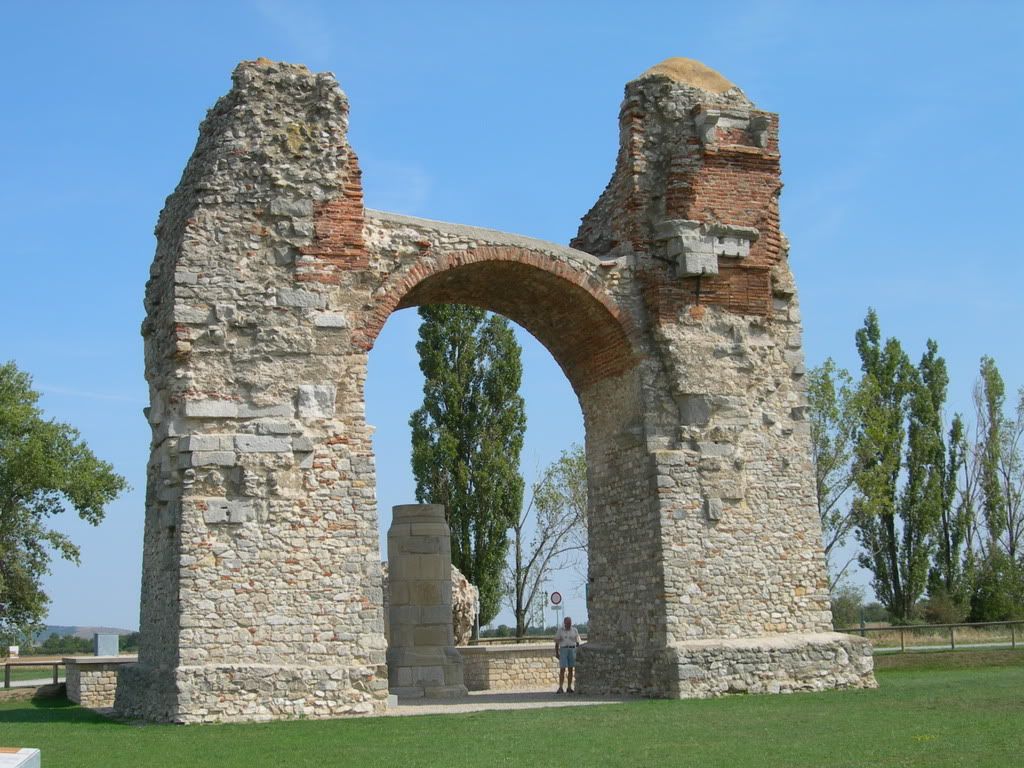
The Almother, Carnuntum, and "Pagan's Gate": The ancient cultural and spiritual overlap between the "two Austrias" and the north Balkans

Heidentor aka "Pagan's Gate"


From an overall historical point of view, the Austrians could seem more like an old rival than a kindred people. The region of the eastern Alps and north of the Adriatic Sea has long been a tri-cross-cultural area between the Italo-Roman speaking world, the German-speaking world, and the Slavic-speaking world. For example, some parts of the north Balkans are more culturally and politically tied to Russia than to nearby Austria or the Veneto; in most ways, the tri-Veneto area has more in common with Rome than to St. Moritz; and in general, Austrians would tend to see themselves as being more ethnically tied to Scandinavia than to the nearby Venetians or Slovenes.

By the "two Austrias" I mean the original, and actually proper term "Austria," state within the old Langbard Kingdom... which was approximately the northeast Italian peninsula between Lombardy and the tri-Veneto area. Much later, the term "Austria" was clumsily resurrected as the English-language nickname for Österreich... or the Austria we know today.

Five thousand years ago, there would have been no difference at all between peoples of this region. They would have all been proto-European. The early stream of Teutonic migration formed the loosely defined Celtic culture, which later overran the general Lombardo-Venetian area. Still, approximately three thousand years ago, there was little difference. I'm guessing that this would have also included the north Balkans as well. Without going into the entire history of it.... a later "final push" of Teutonic tribes burst into Switzerland, Austria, Bavaria, Hungary, Bohemia, etc.... an equally intense migratory push of Slavic tribes moved into the Balkans... and--of course--the march of the Roman Empire overtook generally all of what is now "Italy."


The Roman province of "Raetia" was north of the Alps, even though the original "Raetians" were an ancient people who lived in a much larger area at one time. Although a clear lingo-ethnic divide was established between the three, each clearly influenced the other two. For example, in the Middle Ages when parts of the Friul were decimated by plagues, Slavic people were invited in to repopulate, and there is a clear Slavic influence in the Friulian dialect. Also in the Middle Ages, Cimbrians from Bavaria migrated into the Veneto, and many Cimbrian villages were still very linguistically and culturally distinct until the Fascist era. That particular brand of nationalism actually destroyed regional culture. One modern Camunian surname is "Mitterpergher," which is probably of Cimbrian origin, meaning "a person from the middle of the mountain"... and with the old-Bavarian spelling for "mountain person".... "pergher" rather than "berger."

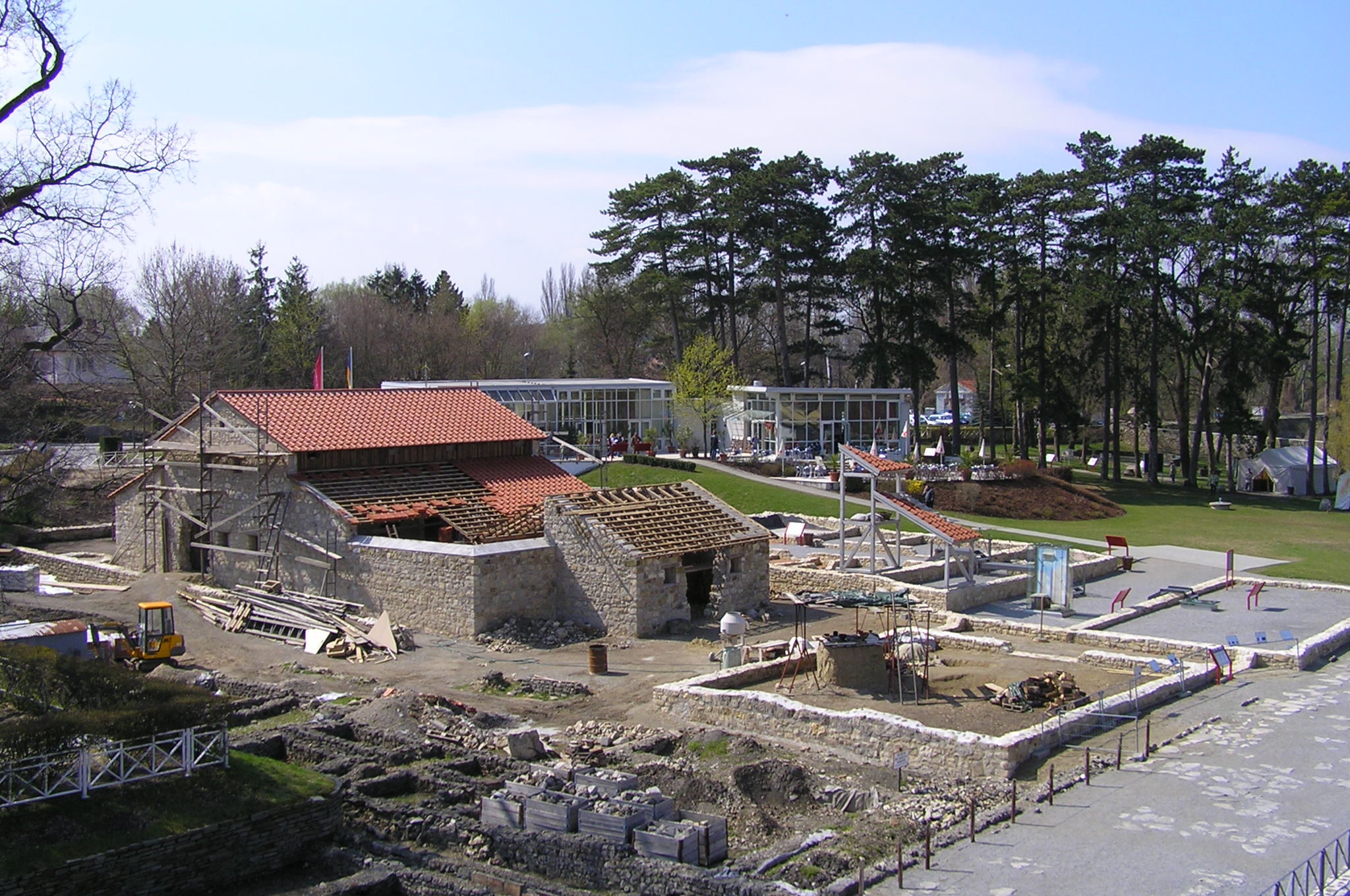
During the Roman era, the Romans did most of the pushing, while the Germanic tribes took over that role in the early Middle Ages. Of course, the ancient territorial struggle between Germans and Slavs occurred over a very long time. In the first century, the Romans established a military base on the Danube River, in what is now Austria, called Carnuntum. This camp served as a trading center, as well as a political headquarters for further Roman expansion. This particular Celtic kingdom was called Noricum. Interestingly, in typical passive-aggressive Roman political style, they used a regional Celtic name.. which was apparently "Karnuntum" originally. I'm not absolutely certain, but it appears that a migration of northern Teutons--separate from the regional Celts--later invaded and destroyed Carnuntum.

The Teutonic destruction of this Roman expansion was glorified in Guido von List's late 19th century book 'Carnuntum'. This book has not been translated into English to my knowledge, so I can't vouch for it in any way... although I would like to read it. For some reason, List was fascinated by what is apparently the leftover opening gate to Carnuntum... after the invading Teutons demolished the walls, or perhaps this occurred over a longer period. That leftover ruin is now called "Heidentor," or evidently "Pagan's Gate" in German. Ironically, "Pagan's Gate" could be seen as a monument to both the Romans and the Germans. To List, I think it represented a regional Austrian symbol of the glory of past victory. Also, there were many old legends surrounding the ruin. In List's day, historians and archeologists didn't know anything about ancient German-Celts. It actually got it's name in the Middle Ages because it was once thought to have been constructed by ancient pagans. Austria is now reconstructing Carnuntum if you would like to look that up.


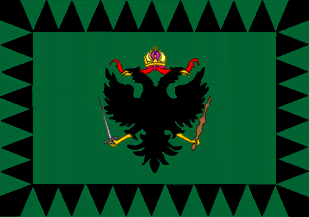
Flag of Lombardy-Venetia
Venus of Willendorf is a 27,000 to 32,000 year old artifact discovered in Austria. This little statue was carved from limestone not native to the area, and I believe was part of a much larger proto-European archetypical symbol of the "mother goddess." Also significant is its age, which would make it a counterpart to the "horned god." Because there are so many regional names for this goddess, which I think are linked back to the last glacial movement, I refer to her as "the Almother"... the proto-European equivalent to "the Alfather" Odin within old Teutonic culture. Among other things, the Almother was a fertility goddess in those early days. As strange as this may sound, there is ample evidence that the Roman goddess Diana of the Carnuntum era, and Venus of Willendorf, have a common origin going back to the last Ice Age. The Almother in the Italian peninsula, of course, going through many more manifestations over time. However, when half of Europe was covered under a massive continental ice sheet, the local manifestations of the mother goddess and the horned god would have been very likely of the same origin.

As far as the later colonial aggression of the Habsburgs... I mean lets face it, this was basically a soft dictatorship in which the average citizen of Austria-Hungary was not really responsible for national/monarchial policy anymore than a Roman citizen was responsible for Roman imperialism. The Austrian soldiers stationed in Lombardy-Venetia could, at times, be brutal... but probably not any more brutal than other occupations. It could be said with certainty that during pre-Roman times---which would have been pre-Teutonic and pre-Slavic times as well---this tri-cultural region would have been largely of the same people. Nobody there spoke Italian, German, or Slavic back then. Three very aggressive peoples came later and staked their territorial claim, and consequently the past etho-cultural dynamic was forgotten.

.

Saturday, February 1, 2014

The Arctic Home in the Vedas: Part 16 - "Thule, Saturn, & an alternative explanation"


Thule, Saturn, & an alternative explanation: Part 5

The way the Greeks understood their relationship with non-Greek peoples was significantly moulded by the way myths of the Golden Age were transplanted into the contemporary scene...

We often hear the phrase “golden age” in reference to the zenith of something; “the golden age of cinema.” However, there was THE golden age, and it may be stranger than anything we will ever uncover. It has to do with everything from the deep past to the present day. It has to do with every ancient culture, and in particular the original Teutonic people before their migrations. I will tie this big loose end. But for now, we are talking about a “Golden Age” in which there were no seasons as we know them today; and in which the North and South Poles was literally habitable.

A particular Hyperborean legendary healer was known as "Abaris" or "Abaris the Healer" whom Herodotus first described in his works. Plato (Charmides, 158C) regarded Abaris as a physician from the far north...

Could Abaris the Healer have been of a migrating people from the “far north”… Thule? The ancient Greeks were very scientifically-minded, so couldn’t this “shaman”--who caused such a stir--seem a little out of place?

Above the Arctic Circle, from the spring equinox to the autumnal equinox (depending on latitude), the sun can shine for 24 hours a day...


There is a deep tie-in here with the “Golden Age” and Bal Gangadhar Tilak’s theory, but I will have to wait until Part 17 to reveal it.

Unaware of the explanation offered by modern science (i.e. that these insects had lived in times when the climate of northern Europe was much warmer, their bodies preserved unchanged in the amber) the Greeks came up with the idea that the coldness of northern countries was due to the cold breath of Boreas, the North Wind. So if one travelled "beyond Boreas" one would find a warm and sunny land.

This is clearly part of the Greek mythology of the “Golden Age.” However, these mythologies of that possible era are present in the mythologies of every ancient civilization. Again, I’m focusing mostly on the legend of Thule, but this “Golden Age” affected every person living on Earth at that time if it was real.

Northern Europeans (Scandinavians), when confronted with the classical Greco-Roman culture of the Mediterranean, identified themselves with the Hyperboreans, neglecting the traditional aspect of a perpetually sunny land beyond the north.

This was only a perception, but could it literally be tied to a real time and place? There is now mounting evidence that it may.


Hyperborean Indo-European hypothesis

John G. Bennett wrote a research paper entitled "The Hyperborean Origin of the Indo-European Culture" (Journal Systematics, Vol. 1, No. 3, December 1963) in which he claimed the Indo-European homeland was in the far north, which he considered the Hyperborea of classical antiquity. This idea was earlier proposed by Bal Gangadhar Tilak (whom Bennett credits) in his The Arctic Home in the Vedas (1903) as well as the Austro-Hungarian ethnologist Karl Penka (Origins of the Aryans, 1883).

Now this is a big tie-in, and in hindsight part of the intellectual process of looking into something which seemingly is impossible. They weren’t, however, “Indo-Europeans.” They were the original Teutonic race. This intrinsically has nothing to do with the Nazis. In fact, the German sub-race--specifically--is less than half Teutonic.. and less so in the southern German lands. The larger part being primarily proto-European (“Alpine”).

According to these esoterists, Hyperborea was the Golden Age polar center of civilization and spirituality...


I doubt this part, as there is no strong evidence of it. That doesn’t mean that evidence of a great Thule civilization couldn’t be out there undiscovered. We can look into what may exist as far as ruins at a later point. What there is evidence of is the presence of Teutonic people in some of these lost lands like the Tarim Basin.

Robert Charroux first related the Hyperboreans to an ancient astronaut race of "reputedly very large, very white people" who had chosen "the least warm area on the earth because it corresponded more closely to their own climate on the planet from which they originated."

After Part 17, this may show to be theoretically possible, but wild theories can and do hurt the areas where facts can be established. In any case, this original Teutonic race would no longer exist in the exact form that they did. Even in the far north of the post-Golden Age Europe, or in modern times, I would guess that this certain stock would be at no more than 50%.


They may not have been as physically attractive as their Teutonic-Protoeuropean descendants later became. The very tall, square-headed, almost white-haired, very light blue-eyed, and pure white skinned people became shorter, rounder-headed, more ash or wheat blonde haired, more medium blue-eyed, and perhaps a bit tan to give one possible example.

Unlike other places where Teutonic people came and ruthlessly conquered, they were taken with these shorter, stocky, sexier, probably brown-eyed, perhaps dark brown haired European natives.. and merged with them. Only in what I would call the “final great migration,” a horde of more pure stock Teutons came and permanently placed their clear genetic and linguistic stamp on some places like Scandinavia and northern Germany.


The one other example of where they mixed their blood was in ancient Persia, which produced the Aryan culture and people (original Teutons & true Mediterraneans). To make this perfectly clear, this original Teutonic race didn't produce "The Golden Age"; the Golden Age may explain their origins. I use the term "Teutonic" for the original stock; as opposed to the modern "Germanic," which is a loose and somewhat undefined term. For example, the "Germanic Austrians" probably have only a minimally larger Teutonic element than say Venetians, Croatians, or Slovenes... yet the loud terms "GERMAN," "ITALIAN," or "SLAV" are thrown around recklessly by many. Language often defines a culture more than actual racial stock in the perceptions of most people.


Golden Age (Wikipedia)

The term Golden Age (Greek: Χρυσόν Γένος Chryson Genos) comes from Greek mythology and legend and refers to the first in a sequence of four or five (or more) Ages of Man, in which the Golden Age is first, followed in sequence, by the Silver, Bronze, Heroic, and then the present (Iron), which is a period of decline. By extension "Golden Age" denotes a period of primordial peace, harmony, stability, and prosperity. During this age peace and harmony prevailed, humans did not have to work to feed themselves, for the earth provided food in abundance. They lived to a very old age with a youthful appearance, eventually dying peacefully, with spirits living on as "guardians". Plato in Cratylus (397 e) recounts the golden race of humans who came first. He clarifies that Hesiod did not mean literally made of gold, but good and noble.

There are analogous concepts in the religious and philosophical traditions of the South Asian subcontinent. For example, the Vedic or ancient Hindu culture saw history as cyclical, composed of yugas with alternating Dark and Golden Ages. The Kali yuga (Iron Age), Dwapara (Bronze Age), Treta yuga (Silver Age) and Satya yuga (Golden Age) correspond to the four Greek ages. Similar beliefs occur in the ancient Middle East and throughout the ancient world, as well.

In classical Greek mythology the Golden Age was presided over by the leading Titan Cronus. In some version of the myth Astraea, also ruled. She lived with men until the end of the Silver Age, but in the Bronze Age, when men became violent and greedy, fled to the stars, where she appears as the constellation Virgo, holding the scales of Justice, or Libra.


European Pastoral literary and iconographic tradition often depicted nymphs and shepherds as living a life of rustic innocence and simplicity, untainted by the corruptions of civilization — a continuation of the Golden Age — set in an idealized Arcadia, a region of Greece that was the abode and center of worship of their tutelary deity, goat-footed Pan, who dwelt among them. This idealized and nostalgic vision of the simple life, however, was sometimes contested and even ridiculed, both in antiquity and later on.


Abaris the Hyperborean (Wikipedia)
Abaris the Hyperborean (Greek: Ἄβαρις Ὑπερβόρειος, Abaris Hyperboreios), son of Seuthes, was a legendary sage, healer, and priest of Apollo known to the Ancient Greeks. He was supposed to have learned his skills in his homeland of Hyperborea, near the Caucasus, which he fled during a plague. He was said to be endowed with the gift of prophecy, and by this as well as by his Scythian dress and simplicity and honesty he created great sensation in Greece, and was held in high esteem.


Gothicismus (Wikipedia)

Gothicismus, Gothism, or Gothicism (Swedish: Göticism) is the name given to what is considered to have been a cultural movement in Sweden, centered around the belief in the glory of the Swedish ancestors, originally considered to be the Geats, which were identified with the Goths. The founders of the movement were Nicolaus Ragvaldi and the brothers Johannes and Olaus Magnus. The belief continued to hold power in the 17th century, when Sweden was a great power following the Thirty Years' War, but lost most of its sway in the 18th. It was revitalized by national romanticism in the early 19th century, this time with the vikings as heroic figures.


**************************************************


By extension "Golden Age" denotes a period of primordial peace, harmony, stability, and prosperity. During this age peace and harmony prevailed, humans did not have to work to feed themselves, for the earth provided food in abundance. 

This sounds a bit like someone's warm and fuzzy account of some long ago "place" in their imagination. However, this will make a lot more sense during Part 17.

He (Abaris) was supposed to have learned his skills in his homeland of Hyperborea, near the Caucasus...

Apparently Abaris was a real figure who caused a sensation in early Greek civilization. Since he dressed like a Scythian, there seems to be a Persian connection, which would tie-in well as far as his possible Teuton roots at that time. If it was about one-thousand BCE, then the Aryan connection would make sense here.


Gothicismus

There is a definite tie-in here, but this national/racial historical perception (likely partly true in this case) starts to lead us down some rabbit trails and into confusion. Suffice to say that there were some early Gothic legends of Thule.

.

Saturday, November 2, 2013

'The Rules of Braucherei' by Silver RavenWolf

'The Rules of Braucherei' by Silver RavenWolf

Braucherei (Pow-Wow) actually has very few rules.  If we study the system and its practitioners over the last 300 years, we learn that the practice was often solitary, eclectic, environmentally and culturally driven.  There was no single one right way to practice and the methods and procedures used were as varied as the individuals employing them.  There are, however, two vital rules to the practice and they are:


1.  The practitioner must believe.


2.  Everything must be done in sequences of three.


[Above: Family Protection and Happiness Hex Sign designed by Silver RavenWolf]

For example, all chants charms and methods must be done at least three times, times three, multiplied by three.  I know it sounds a little confusing.   Every charm or chant must be vocalized a total of nine times, on three different occasions, which equals any charm or chant being said a total of twenty-seven times.  This can vary, for example, when mixing chants and charms, the numbers can change.  Therefore, this is only a general rule.  Let’s continue on with just a few more commonalities of the system, each representing a vital piece of the Braucherei puzzle.

The following common practices are not necessarily rules, but can be found in almost every working.  They are:

1.  The practice of stating the individual’s full name before beginning a session, whether it be for yourself or someone else.  It is common, for women, to use both married and maiden surnames.

2.  The practice of deep breathing before a session.  Three breaths are vital, nine better.

3.  The practice of telling the client to concentrate on their religious deity.  Often, it is suggested they close their eyes to focus more intently.

4.  The practice of whispering all chants or charms when there is any chance of being overheard.  This is an absolute must, especially around unbelievers or those who may not feel comfortable with some of the charm derivations.

5.  The practice of short breaths after each charm — the blowing of white spirit light or God/dess into the body. Some do it after every stanza, others wait until after all nine repetitions as they are concentrating on building the power and the inserting of breath, especially when learning, can ruin your focus.  These short breaths can turn into a magickal sound of your own.  If that occurs, do not be surprised.  Let the sound flow uninhibited (just don’t scare the heck out of the client — wailing would be unacceptable).

6.  The practice of sealing the work by drawing a sigil or equal-armed cross in the air with the right or left thumb (whichever hand is dominant).

7.  The practice of washing one’s hands after a working, some insist on doing this under running water, where others will have a bowl of clean water nearby so they don’t have to leave the client, and

8.  The practitioner cannot take the credit for the result, either way.  That’s why they call it trying. You can only try — the healing is up to the client and their belief.

If we dig deeply, we find the Braucherei system relies on the following foundation:

To Believe
To Think (Visualize)
To Take Action/Feel
To Be Silent

Sound familiar?

An integral part of the Braucherei system is the various chants and charms garnered from non-religious as well as religious sources.  Most of the chants and charms used in Pow-Wow system are not lengthy for the ease of remembrance and repetition.  Although planning is lovely in magick, Pow-Wow is meant to be a system that can be used any time, anywhere, for anyone.  Hence, you will find few tools necessary, and in many cases you are the only tool required.


.