Showing posts with label Guido von List. Show all posts

Thursday, September 29, 2022

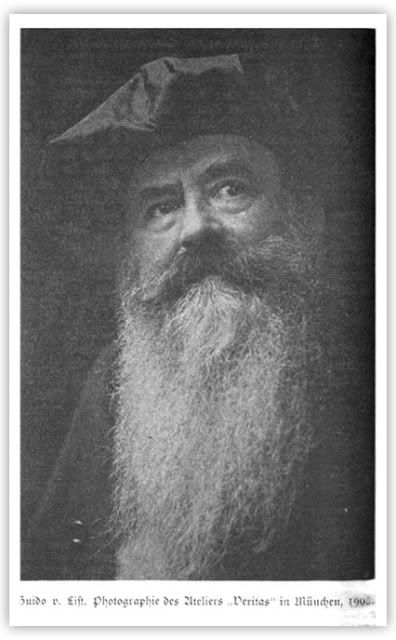
Guido von List: Part 35 - The Mysteries of the Rûna

According to Dr. Stephen Flowers, in short, the word Rûna means “seek the mysteries.” I would suggest to anyone interested, to google "dr stephen flowers runa" and you can find numerous lectures that go into detail about Rûna. I've already posted some of that. I'm going to look at just a few different observations and possible connections. The word and concept is of Teutonic or Proto-European origin, from northern Europe but adopted into words of languages across the rest of Europe. Although possibly it may have developed on its own--but from the same basic root word--via the Proto-European languages in several of those regions over time. Within any practical study of history and language, we would call it of Teutonic origin.


*************************


Above: Goddess Idun

From thaliatook.com

Idun, Norse Goddess of Youth, Immortality, and Beauty from the World Goddess Oracle by Thalia Took.

Nova Luna Center

Idun, Norse Goddess of Youth and Immortality by Thalia Took Idun ("She Who Renews") is the Norse Goddess of youth Who grows the magic apples of immortality that keep the Gods young. Her husband Bragi is God of poetry.


************


Excerpt from 'Guido von List: Part 1'

During the years 1888–1899 List was involved with two important literary associations. In May 1891 Iduna, which had the descriptive subtitle of "Free German Society for Literature", was founded by a circle of writers around Fritz Lemmermayer. Lemmermayer acted as a sort of "middle man" between an older generation of authors (which included Fercher von Steinwand, Joseph Tandler, Auguste Hyrtl, Ludwig von Mertens, and Josephone von Knorr) and a group of younger writers and thinkers (which included Rudolf Steiner, Marie Eugenie delle Grazie, and Karl Maria Heidt). The name Iduna was provided by List himself and is that of a North Germanic goddess of eternal youth and renewal. Richard von Kralik and Joseph Kalasanz Poestion, authors with specifically neo-Germanic leanings, were also involved in the circle.


*************************


KHPR: The Voice of Darkness

KHPR 004: Dr. Stephen Flowers on Runa

Dec. 23, 2009

ABOUT THIS EPISODE

Today we are taking a bit of a different turn. Instead of an interview, KHPR is presenting a lecture by Dr. Stephen Flowers an Ipssisimus of the Temple of Set and the Magus who uttered the word Runa, which means “seek the mysteries.” Dr. Flowers gave this lecture at the recent Conclave held in Austin, Texas and is an accomplished writer of over twenty books on Runa and related subjects.

In 1980 he founded the Rune-Gild, the world’s largest and most influential initiatory organization dedicated to Rune-Work and the Odian path. For more information on Dr. Flowers work you can visit his community website at www.edred.net. Dr. Flowers also hosts the thrice weekly Radio Free Runa podcast on this site.

As always you can email us at radams@khprvod.org  or via skype at KHPRshow and follow us on Twitter @KHPRvod. You can also sign up to receive an email whenever a new show or post is put up. Just use the subscription form to the right which includes an opt-in ability so that no one can sign you up without your knowing about it.


************************* 


Rune and Runa

Is there a connection between these words, what they symbolize, or even male and female symbolism? For starters, Rune (male) and Runa (female) are indeed given names in Scandinavia. Rune is a masculine given name derived from the Old Norse word rún, meaning "secret." It is earliest attested in a runestone as runi. That's really interesting just in of itself, and reflects a linkage. Could the masculine aspect of the mysteries manifest in signs, while the feminine aspect of it manifest inner spiritual symbolism (i.e. the Norse runes [ex. Othala] and the divine feminine energy [ex. Iduna])? There is a female given name of Japanese origin, and meanings in other languages, which I would discount as linguistic coincidence. However, I do think there are many connections which are ancient and widespread, and are linked back to the ancient travels of the Teutonic peoples.

Runa is a given name in countries around the Himalayas, which very possibly could tie into to the original Teutonic homeland north of the Himalayas, going clear back to the last glacial movement. Even a version of the triskelion is found in Tibetan Buddhist culture. How did it get there?. Runa is the name of a former civil parish in Portugal, and still goes by that name. Runa is also the name of a city in West Virginia, named after Runa McClung, the sister of an early settler. According to Wiktionary.org, Borrowed from Old Norse rún, which is from Proto-Germanic *rūnō (“letter, literature, secret”), which is borrowed either from Proto-Celtic *rūnā or from the same source as it; compare Dutch rune, German Rune and Swedish runa. This would seem to suggest a possible Proto-European origin via the Proto-Celts; however, I think most of the evidence points to a very ancient, pure Teuton origin.

The etymology on the above "rune" Wiktionary page, all point to a Norse origin. Interestingly though, in Italian, "runa" means "dart or javelin," with "runa" being the plural, and is of Latin origin... or at least that's what's stated. However, there could have been a very ancient Proto-European origin there, or it may still link to a Norse origin since everything else links to it. In the bigger picture of history, the ancient Teutons brought Rûna with them from their original homeland, in small waves across northern Europe (and their progeny down into southern Europe), and down to ancient Persia, Assyria, and Asia Minor (and their progeny down to the Indus Valley), and finally across half of northern Europe in a final huge wave (and their progeny down into southern Europe).

In Albanian, "runë" means an air-hole of a chimney, with runa as its plural form. The book 'The Tradition of Household Spirits' (Lecouteux; 2000) describes how many parts of a home--across different cultures--were once thought of as sacred (such as a chimney), and they were intimately connected with everyday spiritual traditions. In Turkish, "rün" has the general runic meaning that we usually think of... the runes. This would originate from people who long predated the invasion of Turkic tribes about nine hundred years ago. Also, other regions of the near and middle east are demographically much different than in ancient times.


*************************


"The invisible society is a secret and most august fraternity whose members are dedicated to the service of a mysterious arcanum arcanorum."
-- Lectures on Ancient Philosophy


The personal arcana

Whose to say that you can't be a "secret society" or study group of one or two? Knowledge, occult revelations, or applied symbols and concepts can be constructed brick by brick.


*************************


Haliurunas

Haliurunas, haljarunae, Haliurunnas, haliurunnae, etc., were Gothic "witches" (also called priestesses, seeresses, shamans or wise women) who appear once in Getica, a 6th century work on Gothic history. The account tells that the early Goth king Filimer found witches among his people when they had settled north of the Black Sea...

In the Wiktionary links for "rune" and "runa," within the offshoots in other European languages, often were "runa" for singular and "runas" for plural... sometimes with a double "nn." The Goths, who spread to almost every corner of Europe at various times, were originally from Scandinavia... The Land of Rûna.


Etymology

The name has been emended as the Goth-Latin forms haliurunnas, or haljarunae (and variations of the two forms) from several variants in the ms, i.e. aliorumnas, alyrumnas, aliorunas and aliuruncas.

The first element halju- is a variant of halja- 'Hell' (i.e. 'Hel, the abode of the dead'), but it has also been suggested that the first element does not refer to the realm of the dead, but instead directly to Hel, the goddess of the dead. Scardigli (1973) has analysed the second element as runnas, from *rinnan 'to run', and so the word would mean 'hell runners', i.e. female shamans. Lehmann (1986) considers this analysis preferable to Müllenhoff's who analyzed it as haljo-runas and compared it to OHG holz-rûna 'witch'.

However, others are of the same opinion as Müllenhoff, and analyse the second element as runas, and so it is considered to be cognate with Old English, hellerune ('seeress' or 'witch') and OHG hellirûna ('necromancy') and hellirunari ('necromancer'). Orel follows this interpretation and reconstructs it as the Proto-Germanic form *χalja-rūnō(n) in which the first element is *χaljō 'hel, the abode of the dead', and the second is *rūnō ('mystery, secret').

During Proto-Germanic times, the word *rūnō still referred to chanting and not to letters (rune), and in the sense 'incantation' it was probably borrowed from Proto-Germanic into Finnish where runo means 'poem'.

Klaeber and Niles et al. write the Latin-Gothic word as haljarunae and comment that the word appears in Beowulf in hwyder helrūnan where it means 'such demons', and it shows that the word would have been helrūne in the nominative singular. Neidorf adds that the use of the word in Beowulf supports the early 8th century dating of the poem, because besides the unambiguous attestation in the 6th century Getica (haljarunae), it is only attested in the 8th century Aldhelmian glosses, where it appears five times. The word is glossed consistently as divinatrix ('seeress') and phitonissa ('witch'), and twice wicca ('witch') is listed as a synonym. The appearance of the word in these early sources shows that in the 8th century helrūne and wicca were competing terms, but helrūne was out-competed very early in the Anglo-Saxon language and so the word wicca dominates with 28 attestations.

Lukman (1949) argued that Cassiodorus was inspired by a Roman account about a Germanic seeress whose name appeared in the form Auriniam, but the word haliurunna is generally considered to be an authentic Gothic word.


Account

Sixth century Goth scholar Jordanes reported in his Getica that the early Goths had called their seeresses haliurunnae (Goth-Latin).

Filimer, king of the Goths, son of Gadaric the Great, who was the fifth in succession to hold the rule of the Getae after their departure from the island of Scandza — and who, as we have said, entered the land of Scythia with his tribe — found among his people certain witches, whom he called in his native tongue Haliurunnae.

The Haliurunnae found refuge in the wilderness where they were impregnated by unclean spirits from the Steppe, and engendered the Huns, which Pohl compares with the origin of the Sarmatians as presented by Herodotus.


Beowulf


Damico (1984) connects haliurunae, which she translates as 'demons' and 'sorceresses', to the word helrūnan, which is glossed as Valkyrie, as a grim spirit of battle, and that it also appears in Beowulf as a name for Grendel, and for his mother by implication. She points out similarities between the haliurunas, the "fierce and hellish tribe", and Grendel and his mother.

She further connects them to the supernatural female powers called dísir in Scandinavian tradition who were appeased by sacrifices and adds that after the attack by the helrūnan, the Danes sacrifice at heathen temples hærgtrafum with honours of war, weorþunga.


*************************


Albruna

Albruna, Aurinia or Albrinia are some of the forms of the name of a probable Germanic seeress who would have lived in the late 1st century BC or in the early 1st century AD. She was mentioned by Tacitus in Germania, after the seeress Veleda, and he implied that the two were venerated because of true divine inspiration by the Germanic peoples, in contrast to Roman women who were fabricated into goddesses.


Name debate

Lukman (1949) claimed that Cassiodorus may have been influenced by the form aurinia and used it when writing his account on the Haliurunas in the Getica, but the word haliurunna is generally considered to be an authentic Gothic word.


Albruna

It was Wackernagel who first proposed the emendation Albrunam, and Albruna, and which was accepted by Müllenhoff, and de Vries. It has since then been the most commonly accepted form. The name is also attested independently for other women as Albrun in OHG, Ælfrun in OE and Alfrun in ON.


Western Pennsylvania German folk magic

The possible appearance of Albruna in Tacitus' work 98 AD, suggests, however, that these names may have reflected much older naming traditions.

The name element -run is a rare element in Old Germanic names. Sixth century Goth scholar Jordanes reported in his Getica that the early Goths had called their seeresses haliuru(n)nae and the word also identified in Old English, hellerune ('seeress' or 'witch') and in OHG as hellirûna ('necromancy') and hellirunari ('necromancer'), and from these forms an earlier Proto-Germanic form *χalja-rūnō(n) has been reconstructed, in which the first element is *χaljō, i.e. Hel, the abode of the dead, and the second is *rūnō ('mystery, secret'). In the Proto-Germanic period, before the introduction of runes, the word *rūnō did not yet refer to letters (rune) but it appears to have referred to chanting, and with this meaning it was probably borrowed from Proto-Germanic into Finnish where runo means 'poem'. In the daughter languages, it had various meanings in addition to runic writing. In Gothic it had the meanings 'secret' and 'decision', in Old High German it meant 'secret' and 'whisper', in Old English it referred to 'secret' and 'secret advice', and in Old Norse it meant 'secret knowledge'.

Rudolf Much translated the name as 'having secret knowledge of elvish spirits' or 'confidante of elves'. Schweizer-Sidler and Schwyzer follow Wackernagel and explain her name as 'one gifted with the divine, magical powers (runa) of the [elves]', and Simek interprets Albruna as 'the trusted friend of the elves' or 'the one gifted with the secret knowledge of the elves'. Although, Orchard cautions that most manuscripts have the name Aurinia, he considers Albruna to be "highly appropriate" and he agrees on the translation 'elf-confidante'. Morris translates her name as 'a sorceress with elf-like power' and compares it to Old English liodruna which meant 'sorceress with the help of songs' and helliruna 'a sorceress with the power of hell'.


Aurinia

Reichert has studied the name Guiliaruna, which appears as the name of a female Christian priest among the Germanic Vandals in Hippo Regius in North Africa, and he argues that Albruna can not be dismissed. He comments that it can hardly be a coincidence that a priestess is attested with a name having the second element -runa, from Proto-Germanic *rūnō, and it is probably not the name she was given at birth, but an epithet meaning 'priestess'. The first letters Gu- is a common representation of Germanic w-.


*************************


Seeress (Germanic)

In Germanic paganism, a seeress is a woman said to have the ability to foretell future events and perform sorcery. They are also referred to with many other names meaning "prophetess", "staff bearer", "wise woman" and "sorceress", and they are frequently called witches or priestesses both in early sources and in modern scholarship.


Names and terminology

Aside from the names of individuals, Roman era accounts do not contain information about how the early Germanic peoples referred to them, but sixth century Goth scholar Jordanes reported in his Getica that the early Goths had called their seeresses haliurunnae (Goth-Latin). The word also appears in Old English (OE), hellerune ("seeress" or "witch") and in Old High German (OHG) as hellirûna ("necromancy") and hellirunari ("necromancer"), and from these forms an earlier Proto-Germanic form *χalja-rūnō(n) has been reconstructed, in which the first element is *χaljō, i.e. Hel, the abode of the dead, and the second is *rūnō ("mystery, secret"). At this time the word *rūnō still referred to chanting and not to letters (rune), and in the sense "incantation" it was probably borrowed from Proto-Germanic into Finnish where runo means "poem."

In OE, hellerune ("seeress" or "witch"), or helrūn...


Projection

According to de Vries, the origin of gandr is a word gan- meaning "magic", of which there was an ablaut grade gin- (in English there is still a semantic relationship between the ablaut grades swam and swim, and sat and sit) that may be found in the name of the primordial chasm Ginnungagap ("space filled with magic powers"), and on the migration age Björketorp and Stentoften runestones, it appears in the sense "magically powerful" in Proto-Norse ginnarunaʀ ("powerful runes"


*************************


Rûna root words in Camun dialect

There are many mysteries within ancient Camunian culture. The Rosa Camuna, pentagrams, labyrinths, life runes, the horned god, stone observatories with connections to the Ophiuchus constellation (astronomy and astrology; the 13th sign of the zodiac; 13 month calendar starting in April), and much more. The Camunian dialect was isolated, therefore it has many ancient pre-Latin words. For example, the world for moon is mòn, not luna. The name for the Moon Goddess is still present in the dialect, Mòna, but after centuries of Christian zealotry, it now embarrassingly means basically "a whore."

So, if any old language had so arcane a word as Rûna, it might be Camun, which is really a sub-dialect of the Brescian dialect of Western Lombard, which itself is a branch of the Lombard language. I did find a few words with "runa," but did they follow any consistent pattern, or did they allude to anything suggesting any metaphoric pagan or mystery connections? With some of the words here, it was likely just a coincidence of spelling, but with others it may well have been part of a compound word at some point in time.

Amprunà -  reverse, overturn
Amprunàh - to tip over, lie down
Amprunàh-dó - go to bed
Cahtrunàda - to talk rubbish
Cerûna -  beautiful, healthy face
Ciacerûna - chatty
Corùna or cùrùna -  crown
Incurunasciù - coronation
Ompruna - to dish, to damage a reputation
Omprunas - topple over
Ontruna (or ontrunat ?) - deeply asleep
Patrùna or padrûna - mistress
Pirùnàt - harpoon
Poltrùna - lazy - chair with armrests (armchair)
Pultrùna - lounge chair
Sbarùnà - go to pieces
Scarùnà - driving wagons on mountain mule tracks
Scavrùnàda - picnic, excursion
Slandrùna - whore
Smarunada - gross error
Sperùnà - ram
Sperùnada - rammed
Spérunada (Bienno sub-dialect) - rammed, fork ?
Spirunà - break into shreds, use fork ?
Spirùnada - shred, forkful
Tèruna (Bienno sub-dialect) - begin to ripen (ex. grapes)
Terunàs - derogatory for a southerner

Two words, Cerûna (beautiful, healthy face) and Ciacerûna (chatty), had the exact spelling with the exact accent mark! Rûna. I suppose that it's a bit curious, if we're looking for some ancient connection to the divine feminine, that both words could allude to what maybe are female traits. Certainly "beauty" would be linked to the feminine. Some of the definitions could be interpreted as a type of regeneration of nature from death in winter (shred, overturn, ram), to life in spring (ripen, beautiful), while others could suggest a certain nobility (crown) which could hearken back to some type of spiritual nobility.

There's nothing absolutely etched in stone that states that the ancients just adored the Goddess Mòna. In an extremely harsh environment, she may have been despised for bringing winter (death) upon them! She was "a whore" ("slandrùna") perhaps? Then when she ushered back the spring (life), she was beautiful and healthy ("cerûna"). I don't know, but I'm just brain storming what could possibly have been the origin for these words. I have a little bit of a hard time imagining that they would think of the Moon Goddess as "a whore," but maybe that meaning was a bastardization of something else describing the harshness of winter, and cursing it.

.

Saturday, July 6, 2019

Guido von List: Part 33 - More on the Vehme star rose in German countries

This is in regards to List's "vehme star rose," which is a pentacle... a pentagram within a circle of nature; different than a barnstar or welcome star. While the barnstar represents the "hospitality" aspect of Heathenry, the vehme star rose is used for "protection." In the book 'The Tradition of Household Spirits' (Lecouteuz; 2000), Chapter 3 'The Openings of the House', page 51, it states: "In the Germanic countries, a pentagram was drawn on the door along with the naive inscription, 'If fever comes, I won't be in' or 'Fever, don't come in, so-and-so isn't here!' "

The first part of the chapter focuses on traditions and folklore regarding doors and the doorway, much of it from the Medieval German culture when old spiritual traditions had largely been eliminated or changed to new Christian meanings. I suspect, in some instances, there was a full 180-degree shift in the meaning; a Heathen, Hexerei, or other pagan symbol was replaced with a cross or other Christian symbol, or protective rites and charms from German witchcraft were changed and used to actually keep "witches" out.

From page 52: "In 1411, Hans Vintler remarked in this regard that 'many evil folk enter at night through locked doors', and we know from other sources that witches and spirits (Walridersken, Scgrättele, Alp, Mahr) enter through the keyhole, which should therefore have their keys left in them at night. Also from page 52: "In Appenzell canton in Switzerland, it is said that 'witches can slip inside through the keyhole' (Häxa chönid dör-ena schlüselloch döra schlüffa)." Another example from page 53: "To prevent witches from entering, a new broom should be placed upside down behind the door, and if a pentacle is drawn upon the door, witches will keep their distance (Swabia)."

It wasn't just German-speaking lands as far as the rituals to "ward off witches," but throughout mainly the Alps, and central and eastern Europe. It should be stated that these symbols weren't just scribbled on or above a door; they were beautifully engraved and finished into the wood. One example from the book shows a dark red six-pointed star within a circle with a white background, as-well-as a dark blue four-petaled "Celtic rose" within a circle with a white background; both perfectly melded and finished into the heavy dark brown wooden door frame. The red six-pointed star was not a rosette, but more of a standard "star shape" with the points slightly thinned out near the end. 


************


7-7-19 ADDITION:

Now that we know what the Minnesinger Order was, it still leaves us with the mystery of the German Builders Guild and the German Heraldic Guild. There was a 'German Builders Guild' magazine ('Deutsche Bauhütte') which was published from 1897 to 1942. The name itself sounds like a type of craft union, or perhaps an architectural contractors association.

German Builders Guild

'Deutsche Bauhütte' was the title of a magazine for and about architecture, which was published in Hanover from 1897 to 1942 by Curt R. Vinzentz.

Its first editor-in-chief was the architect F. Rudolf Vogel. One of her editorial staff was the German architect and painter Konrad Wittmann (1891-1951).

The magazine had changing subtitles, such as the central bulletin for the German construction industry.


Supplements

The following titles can be assigned to the magazine as a supplement:

'Der Betonbau' (The concrete construction)
 

'Architektonische Details' (Architectural details)
 

'Studien alter Bauweise' (Studies of old construction)
 

'Raumstudien' (Spatial studies)
 

'Musterblätter aus Bauindustrie und Kunsthandwerk' (Sample sheets from the construction industry and handicrafts)
 

'Das Miethaus' (The rental house)

.

Saturday, June 29, 2019

Guido von List: Part 32 - The Minnesinger Order


Did the Wotanists go underground after the reign of Charlemagne?

Guido von List sited something called the Minnesinger Order as having sprang from the Skaldic Order, a Wotanic priesthood gone underground....

Out of the "Skaldic Order" the "Minnesinger Order" later emerged, as did the "German Builders' Guild" and the "German Heraldic Guild." From all this, in broad branchings, sprang the judicial sciences, poetic arts, linguistic sciences, graphic arts, etc. Because the skalds, as poets and singers, were also the maintainers and formulators of language--and because it was neccessary for them to preserve in strict secrecy the Wuotanism that they took with them underground into the "heimliche Acht" (in order not to be persecuted as heretics), they had to use the three-fold interpretation of words to have their messages delivered--even by messengers--without these or other noninitiates being able to understand the correct interpretation. Through steady skillful practice they reached such refinement in this double-edged type of poetry (called heimliche Acht or kala), that one and the same text could conceal two completely different messages, whose obvious sense (understood by everyone) would actually be secondary, while the concealed sense (kala) would contain the only real, secret message for the men of knowledge.

What is the Minnesinger Order?


************

What is a minnesinger?

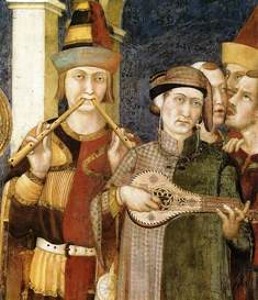
A minnesinger is a secular musician from Germany. They flourished from the twelfth to the fourteenth century. They composed their lyrics in their native language, German.

Walther von der Vogelweide (c. 1170-1230) was most likely a knight from a German-speaking region of Europe, possibly Austria or Bohemia.

Walther von der Vogelweide


Neidhart von Reuenthal


German:
 

Aller êrst lebe ich mir werde
Sît mîn sündic ouge siht
Daz reine lant und ouch die erde
Der man sô vil êren giht
Mirst geschehen des ich ie bat
Ich bin komen an die stat
Da got mennischlichen trat

Schæniu lant rîch unde hêre
Waz ich der noch han gesehen
Sô bist duz ir aller êre
Waz ist wunders hie geschehen!
Daz ein magt ein kint gebar
Here ubr aller engel schar
Waz daz niht ein wunder gar?

Daz in dô des niht verdrôz
Dast ein wunder alze grôz
Aller wunder übergnôz


English:
 

My life only now has a deeper meaning
These sinful eyes have gazed
Upon his holy ground
The land so greatly praised and deeply cherished
I now experience what I have long since prayed for
I have arrived where God, as man
Has walked among us

Many countries, mighty, rich and splendid
Have I seen
You shine above them all
So many wonderous things have happened here!
That a maiden has born a child
Lord of all the hosts of angels
Is that not a miracle?

We need not despair
For this mighty miracle
Is grander still than before.
 

Neidhart 


************


If they were secular, why the references to "God?" In any case, the examples above and below are actual music from the Minnesingers of the Middle Ages.


************


Minnesingers, Wagner, and Metal [Updated]

September 25, 2009 by Mark Samples

As Taruskin recounts (I, 134-142), Richard Wagner recognized the potential in the stories of the historical minnesinger/meistersinger (German-speaking analogue of the trovères) and appropriated their caché for his operas Die meistersinger von Nürnberg and Tannhäuser. But Wagner is not the only one to cash in on this potential. In a 21st-century example, In Extremo (a German medieval metal band) performs the popular minnesang “Palästinalied”, by Walther von der Vogelweide. The band is true to Walther’s melody and lyrics, in the original Middle High German (they get to three out of the twelve verses, then repeat the first). As you will see in the video below, they are also true to Wagner’s spirit of artistic liberty through a modern lens, complete with a shredding metal electric guitar solo, tatooed bagpipe players, and pyrotechnic explosions. And guess what? The audience loves it.

[Update:]

I put this video up kind of on a whim, because I was surprised by the ability for music that’s almost a millennium old to be relevant in the 21st century, and this video was so zany that I was simply flabbergasted by the find. But I have since become aware that it is potentially offensive to viewers, due to the song’s subject matter (the crusades), and the context of performance (Germans singing in a creepy—goth? occult?—way about the Holy Lands). Let’s just say that I wouldn’t let my son watch this video. It would be sure to give him nightmares. (He’s only 4 months old, but still.)


One Response

What is it about Wagnerian pomp, Germanic mythology, and the Medieval Age that appeals so much to metal musicians? There’s an interesting symbolic/semiotic connection there that would be fun to explore. (I just heard about another related subgenre, “Tolkien Metal,” that is of course centered around another Ring.) But for a metal band to actually perform from the minnesang repertory? That’s taking the connection to a whole new level of realism. Great find!

This reminds me of a farcical metal project I was involved in while at NYU. We performed 19th century German opera and lieder with electric guitar, bass, drums, keys, and two opera singers. The name of the group was “Take Me To Your Lieder.”

-- Zach Wallmark


************


Selected references to the Minnesingers can be found at the following link....

'What We Hear In Music' (Anne Shaw Faulkner; 1913)


************


German Minnesingers

Like in many other European cultures German poetry and music were derived from medieval ages of single performers whose life has enriched the pool of national legends and myths: it is not doubt that everyone has heard about minstrels and minnesingers who inspired their audience with romantic world of never-ending love and devotion, patriotism and dignity.


German medieval singers were mostly poetizing love, therefore, their name ‘minnesingers’ was derived from the word ‘minne’ translated as ‘love’. Minnesingers were mainly knights of medieval Germany , however, they did not belong to the high nobility. The most popular topic of their lyrics was unequal love between a knight and a lady who belonged to the higher social grade. Of course, the knight’s love seemed very unhappy and made lyric songs more romantic and attractive.

Among famous minnesingers the most significant recognition was given to those who influenced further development of the German poetry and music. Such minnesingers developed lyric verses and rhymes up to appearance of sonnet prosody in 15 th -16 th centuries. One of such names belonged to Wolfram von Eschenbach who created the German original minne songs called Spruch. Eschenbach was classical German minstrel who roved throughout the country and poetized love and legendary brave knights and kings of Germany. Later his songs inspired many German musicians to create original German music famous all over the world. Such of these songs was a fable about Parsifal, the fable which gave the breath of the Wagner’s outstanding opera.

The value of the German medieval minnesingers cannot been lessened. They started original minstrels’ Spruch songs which reflected German folklore, fairy tales, legends, myths and real historical events existed in Germany from ancient world. They developed modern poetry and music and remained German origin in people’s hearts and souls.

Nowadays minnesingers’ epoch can be traced by visitors of numerous German medieval castles which were places of minstrels’ contests. The knights who became minnesingers and then started roving around Germany as minstrels were amusing castles’ inhabitants. Usually these inhabitants belonged to upper levels of German society and German kings such as Ludwig II were inspired by minstrels to remain royal dignity and remember the times when German nation was free and proud of its origin.


************ 


The Minnesingers (Medieval-Spell.com)

They had a rare gift and thorough knowledge of their art. With perfect spontaneity they created poems with musical accompaniment subjected to strict rules in terms of number of strophes. The ability with which the Minnesinger utilized all possibilities of rhyme is perfectly amazing.


************


The Minnesingers were certainly in a position to do what von List said that they did. They were secular which would seem to be strange for the time, they demonstrated a certain musical genius, and they were mainly inspired by German legends and folklore.


************


.

Wednesday, December 5, 2018

Guido von List: Part 31 - 'The Religion of the Aryo-Germanic Folk' (book review)

 
'The Religion of the Aryo-Germanic Folk: Esoteric and Exoteric' (List 1909; Flowers' translation 2005)

Actually this is more of a 56 page pamphlet, but a good one! I read this some years ago, but didn't review it because I wanted to support Runa Raven Press and Dr. Stephen Flowers, and in particular the very explicit warning on one of the first pages about the copyright. I have referred to it occasionally in this series. If it wasn't so stern of a warning, then I may well have reviewed it; including a few excerpts. Since it's now easily available on Amazon.com, I wanted to try to promote it in some way with something of a review. Apparently Runa Raven Press is no longer active; perhaps Dr. Flowers uses his own publisher. In any case, I still wanted to adhere to the copyright warning. However, I will go out on a limb to use one particularly important and integral word below; along with just a few words from its definition in the glossary to help promote this publication.


************


From the publisher

A general outline of the religious philosophy of Guido von List originally published in the 1920s and a companion volume to The Secret of the Runes. There is an introductory essay by Stephen E. Flowers on the roots of Lists ideas and philosophy.


************


Customer Review

Ron Spolar - 5.0 out of 5 stars - January 7, 2018

Excellent book on Wotan and Aryan beliefs, pre-Christain Germanic customs, religion and much more. Impressive.

This decides the Germanic tradition with what I would call linguistic-forensics. I outlined this book and found it difficult at times to untangle some of the meanings. It was written over 100 years ago; it reflects racism that had yet to germinate. I'm amazed over all the Wotan and Aryan teachings borrowed by the founders of the Christianity;ideas that we were taught in Catechism as being original to Christianity. Approaches religious thought like paganism, Wicca and Faery Tradition concerning God being within yourself, not in a church. List's thoughts on this religion may help some readers integrate their religious thoughts in a way they may have never thought possible. Lots of good pre-christian mythology which can be hard to find. Upon completing the book I felt like had read something profound. Never felt that way about a book before.


************


My take on this book is a little different. I see the information as being just as much Proto-European as it is Teutonic in origin. Of course, they became one people in any sort've modern reflection. I recall somewhere in the book, List makes some mention of perhaps the presence of various spiritual concepts which are of different--maybe sub-tribal--origin. I believe that this may be due to the blending of Proto-European with Teutonic 3,000 or more years ago. I prefer the word "Teutonic" here to Germanic as to not be mixed up with modern ethnic German culture. List uses the term "Aryan" in a manner which is more attuned to an Indo-European concept. In other words, he ties many items from ancient Teutonic, European, Greek, Persian, and Indian languages, spirituality, and traditions. The book delves deep into mysticism, metaphysics, symbols, and linguistics.


Getting back to the linguistics, having spent time closely examining words from the Camunian dialect of the Lombard language (in large part a mixture of Proto-European and Roman/Latin), many Lombard/Camunian words are clearly not of Latin origin. These words are also probably not of Gaulish (the Camunni were not a Gallo-Celt tribe) or Teutonic origin. List, along with the mainstream historians of the day, did not seem to acknowledge the ancient Celtic or Proto-European component of Austria for example. It was "Teutonic," period. Having experienced a type of "mystical" experience before myself, I don't discount List's mysticism. However, some of it may well be of the Proto-European connection.


"Wihinei"

Pronounced "VEE-inn-eye," this is the Listian term for esoteric religion. The exoteric being the simpler outer spiritual layer; the esoteric being the deeper meaning of it. List believed that this deeper connection was administered to by a Skaldic priesthood, something similar to the Druidic priesthood. I won't delve any deeper regarding the origin of this word, but it essentially defines this book. In other words, buy the book. I don't think that I've crossed the line by at least making mention of it. I believe that the ancient roots of at least the Teutonic component of this spirituality originated in the Teutonic homeland, somewhere north of the Himalayas, and was brought to both ancient northern Europe and ancient Persia. This may explain some of the connections. From there, it likely was further transported to Spain, Italy, India, Assyria, etc. As far as I can see, 'The Religion of the Aryo-Germanic Folk' is a great short work that defines the deeper essence of Asatru/Odinism.


Related Links

The Religion of the Aryo-Germanic Folk: Esoteric and Exoteric Paperback

Guido von List books (more are now available)

Dr. Stephen Flowers' books (Amazon.com page)


Dr. Stephen Flowers' books (InnerTraditions.com page)


SeekTheMystery.com (Dr. Flowers)

Woodharrow.com (Dr. Flowers)

.

Thursday, October 4, 2018

Guido von List: Part 30 - October 5 "Ice wheel" 160th birthday tribute!


Spinning Ice Disk Forms in Washington

Wall Street Journal

A perfect circle of ice was spotted spinning in the Middle Fork Snoqualmie River in Washington on Saturday. Meteorologists say the rotating disk is the result of water flowing around the river bend spinning a sheet of ice against the surrounding ice to create a smooth disk.


************

Ice circle

An ice disc, ice circle, ice pan, or ice crepe is a natural phenomenon that occurs in slow moving water in cold climates.

Ice circles are thin and circular slabs of ice that rotate slowly in the water. It is believed[1] that they form in eddy currents. It has been shown that existing ice discs can maintain their rotation due to melting.[2]

An unusual natural phenomenon, ice disks occur in slow moving water in cold climates and can vary in size, with circles more than 15 metres (49 ft) in diameter observed.


************


'Nature's Bizarre Formations - Ice Circles'

MessageToEagle.com - September 26, 2013

Nature creates a variety of geometric figures, but this rather rare phenomenon is normally associated with rivers and lakes in Scandinavia and other northern European and American countries.

According to one of many theories, warming of the water surface may be the origin of the circles.

Another popular theory says that ring patterns - sometimes so large that they are clearly visible from space - are created by quick shifts in temperature.

According to one of many theories, tectonic activity deep inside the Earth may be responsible for methane gas emissions, which in turn produce a rising mass of warm water.

The water, according to the so-called Coriolis effect, begins swirling in circular pattern (always clockwise in the Northern hemisphere and counterclockwise in the Southern hemisphere) creating rings of different size.


con't....


************

There are various forms of solar or "sun wheels" in ancient Indo-European traditions; Teutonic traditions in particular. In the same manner as the proverbial "ring of fire," there is also a "ring of ice." Could the solar wheels be fashioned into perhaps "lunar wheels" as well? Von List saw the solar wheels as a symbol of the endless wheel of revolving nature; of regeneration; of life, death, and rebirth; and of reincarnation. We see this in the eternally spinning galaxies, or even of gophers turning up the soil as birds, bees, or the wind spread seeds about. It's appropriate that the Alfather sun's "ring of fire" is accompanied by the Almother moon's "ring of ice." Tomorrow is Guido von List's 160th birthday; being born in Vienna on October 5, 1848.


von List's 'Armanen Futharkh'
.


************


"Fire from Ice"

How can we get fire from ice? By shaping a piece of ice into a "lens" with your hand; then it could possibly be directed with the sun's energy to make a fire. 


"Ice from Fire?"

The Washington State forests and rivers are well documented as being mysterious places where bizarre natural phenomena occur due to its volcanic activity. -- Cat DeSpira, YouTube


Unusual phenomenon: Giant ice circle spinning in North Dakota river

euronews (in English)

A retired engineer out hunting in North Dakota on Saturday spotted a huge disk of ice spinning on the Sheyenne River, over 50 feet in diameter. George Loegering posted video online on Tuesday of his unusual sighting, clearly showing the snow-covered disc rotating.


.

Monday, February 8, 2016

Guido von List: Part 29


Armanen Futhorkh - An Introduction
 

Südhimmel Hearth
 

A basic introduction to Guido von list Armanen Futhorkh Runes.
 

For further information: Guido Von List - The Secret of the Runes
http://www.scribd.com/doc/99276984/Guido-Von-List-The-Secret-of-the-Runes#
 

Temple of Wotan -
https://archive.org/details/Temple_Of_Wotan
 

The Masks of Odin: Wisdom of the Ancient Norse -
http://www.theosociety.org/pasadena/odin/odin-hp.htm
 

Teutonic mythology -
https://archive.org/details/teutonicmytholo04grim
 

Legends of Gods and Heroes -
http://www.norron-mytologi.info/diverse/munch-legends.pdf
 

Deceived, Damned & Defiant - 
https://archive.org/details/DeceivedDamnedAndDefiant
 

Might is Right -
https://archive.org/details/MightIsRightByRagnarRedbeard
 

The Will to Power -
https://archive.org/details/TheWillToPower-Nietzsche
 

Recommended Reading -
http://ahfenner.tripod.com/OtherArticles.htm


Tacitus, Germania and the Armanenschaft 

While "Armanism" is a system which can be adhered to today, the "Armanenscaft" was a Germanic socio-folk system from pre-Christian times. The blog "Aryan Myth and Metahistory" is another site with many references to Guido von List.

The Complete Armanen and the Untold Story 

.

Monday, February 9, 2015

Guido von List: Part 27 - A Wotanist hof in his honor


Ron McVan YouTube channel

McVans Mountain Viking Hof

An evening journey through a modern day Wotanist Viking Hof, built by Ron McVan among the wooded mountains of Northern Idaho.


**************************************************

This particular hof was constructed as a tribute in honor of Guido von List. Although not visible in this video, photographs which I have seen show this temple appearing very beautiful among the trees and mountains.

When List was a young boy, he visited some ruins I recall, and he proclaimed out loud.. something to the effect of "some day I will construct a temple to Wotan!" It's great that there is at least one temple in his honor.

A hof built in a particular persons honor is referred to by combining their first name with hof (ex. "Freyashof"); therefore I believe that this would be "Guidoshof."

I think it would it be great to see one constructed in the memory of Queen Gambara, King Rothari, or King Alboin of the Langobards. There couldn't be one for Queen Theodelinda, because she was Catholic, which shows that one must do their homework first. Also, perhaps something for a favorite direct ancestor?

**************************************************

2-11-15 Addition: I had intended to post a video titled 'Guido von List - The Runes' but at the end of the video there were too many National Socialist symbols. However, part of the video gave a touch of the spirit of List; who actually lived from 1848 to 1919, and obviously had no part in National Socialism... which was really "National Capitalism" after the Socialist element was taken out. Anyway, I just wanted to at least place the link here.

.

Friday, May 9, 2014

The Almother, Carnuntum, and "Pagan's Gate": The ancient cultural and spiritual overlap between the "two Austrias" and the north Balkans

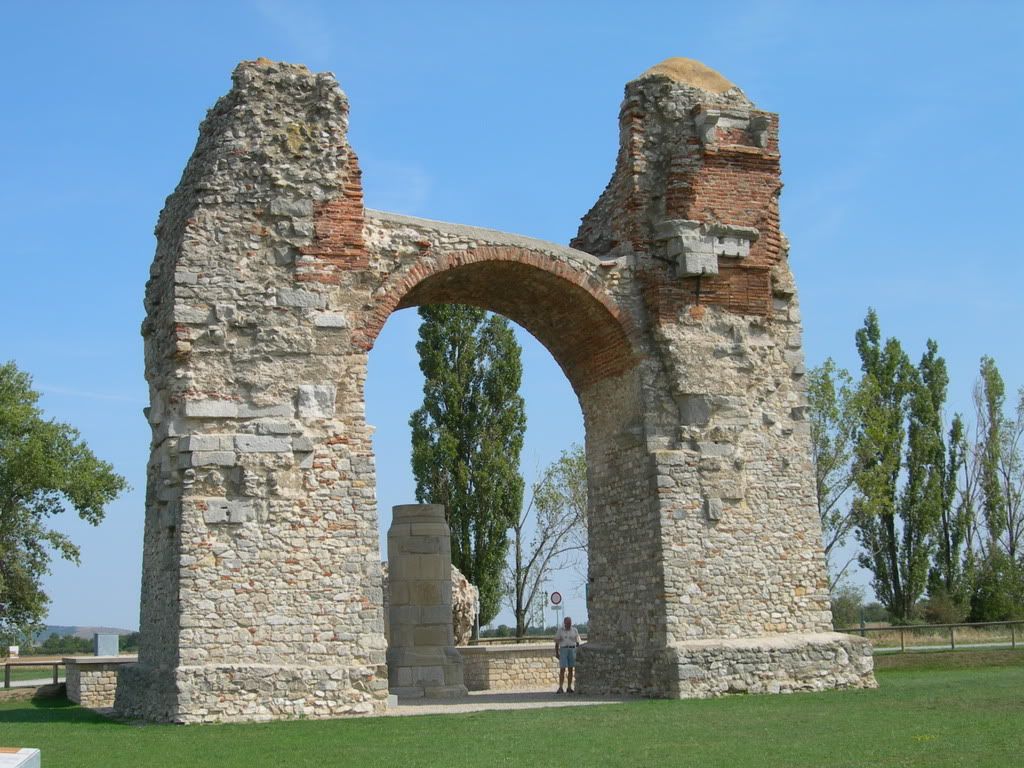
Heidentor aka "Pagan's Gate"


From an overall historical point of view, the Austrians could seem more like an old rival than a kindred people. The region of the eastern Alps and north of the Adriatic Sea has long been a tri-cross-cultural area between the Italo-Roman speaking world, the German-speaking world, and the Slavic-speaking world. For example, some parts of the north Balkans are more culturally and politically tied to Russia than to nearby Austria or the Veneto; in most ways, the tri-Veneto area has more in common with Rome than to St. Moritz; and in general, Austrians would tend to see themselves as being more ethnically tied to Scandinavia than to the nearby Venetians or Slovenes.

By the "two Austrias" I mean the original, and actually proper term "Austria," state within the old Langbard Kingdom... which was approximately the northeast Italian peninsula between Lombardy and the tri-Veneto area. Much later, the term "Austria" was clumsily resurrected as the English-language nickname for Österreich... or the Austria we know today.

Five thousand years ago, there would have been no difference at all between peoples of this region. They would have all been proto-European. The early stream of Teutonic migration formed the loosely defined Celtic culture, which later overran the general Lombardo-Venetian area. Still, approximately three thousand years ago, there was little difference. I'm guessing that this would have also included the north Balkans as well. Without going into the entire history of it.... a later "final push" of Teutonic tribes burst into Switzerland, Austria, Bavaria, Hungary, Bohemia, etc.... an equally intense migratory push of Slavic tribes moved into the Balkans... and--of course--the march of the Roman Empire overtook generally all of what is now "Italy."


The Roman province of "Raetia" was north of the Alps, even though the original "Raetians" were an ancient people who lived in a much larger area at one time. Although a clear lingo-ethnic divide was established between the three, each clearly influenced the other two. For example, in the Middle Ages when parts of the Friul were decimated by plagues, Slavic people were invited in to repopulate, and there is a clear Slavic influence in the Friulian dialect. Also in the Middle Ages, Cimbrians from Bavaria migrated into the Veneto, and many Cimbrian villages were still very linguistically and culturally distinct until the Fascist era. That particular brand of nationalism actually destroyed regional culture. One modern Camunian surname is "Mitterpergher," which is probably of Cimbrian origin, meaning "a person from the middle of the mountain"... and with the old-Bavarian spelling for "mountain person".... "pergher" rather than "berger."

During the Roman era, the Romans did most of the pushing, while the Germanic tribes took over that role in the early Middle Ages. Of course, the ancient territorial struggle between Germans and Slavs occurred over a very long time. In the first century, the Romans established a military base on the Danube River, in what is now Austria, called Carnuntum. This camp served as a trading center, as well as a political headquarters for further Roman expansion. This particular Celtic kingdom was called Noricum. Interestingly, in typical passive-aggressive Roman political style, they used a regional Celtic name.. which was apparently "Karnuntum" originally. I'm not absolutely certain, but it appears that a migration of northern Teutons--separate from the regional Celts--later invaded and destroyed Carnuntum.

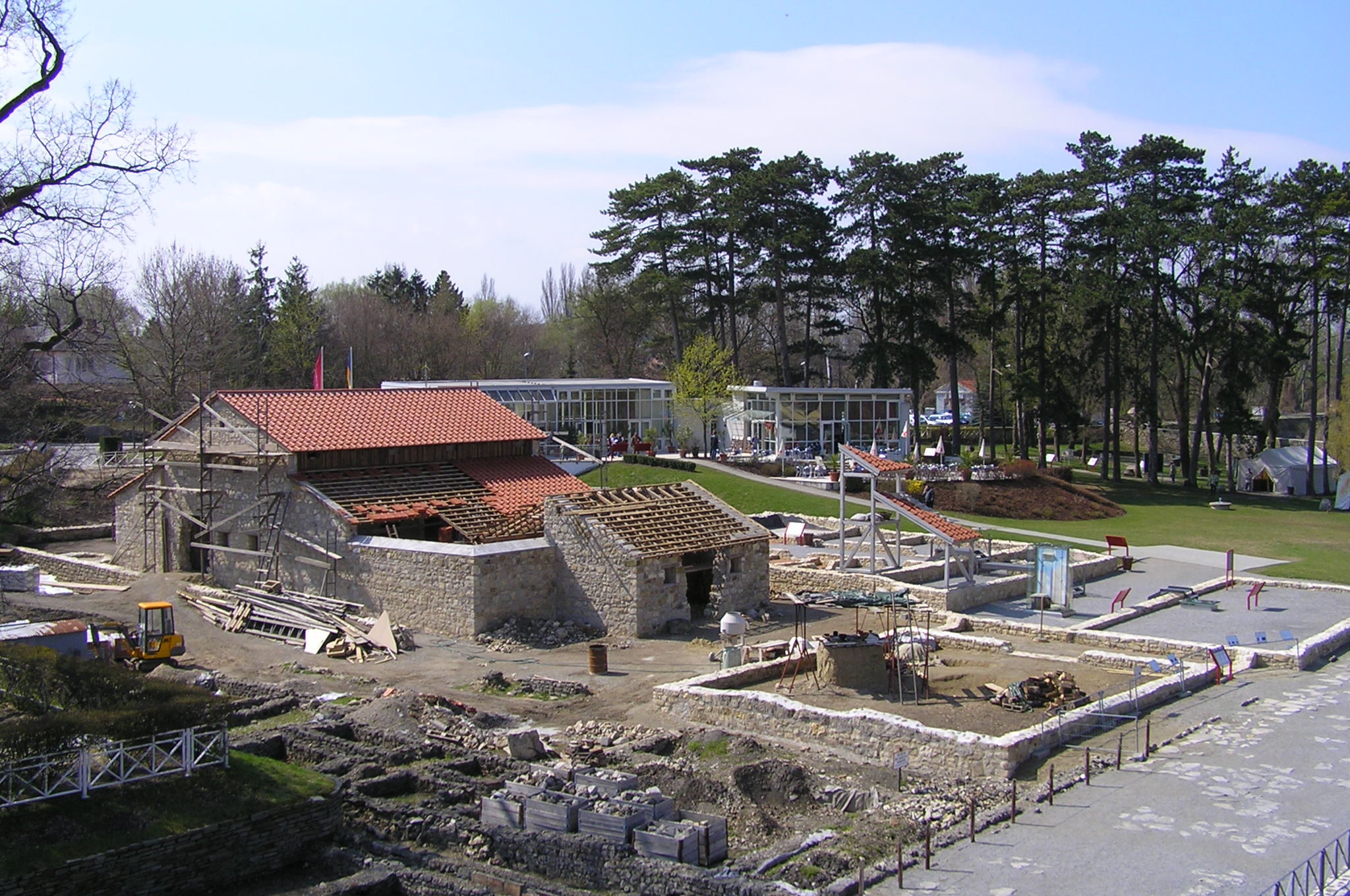
The Teutonic destruction of this Roman expansion was glorified in Guido von List's late 19th century book 'Carnuntum'. This book has not been translated into English to my knowledge, so I can't vouch for it in any way... although I would like to read it. For some reason, List was fascinated by what is apparently the leftover opening gate to Carnuntum... after the invading Teutons demolished the walls, or perhaps this occurred over a longer period. That leftover ruin is now called "Heidentor," or evidently "Pagan's Gate" in German. Ironically, "Pagan's Gate" could be seen as a monument to both the Romans and the Germans. To List, I think it represented a regional Austrian symbol of the glory of past victory. Also, there were many old legends surrounding the ruin. In List's day, historians and archeologists didn't know anything about ancient German-Celts. It actually got it's name in the Middle Ages because it was once thought to have been constructed by ancient pagans. Austria is now reconstructing Carnuntum if you would like to look that up.


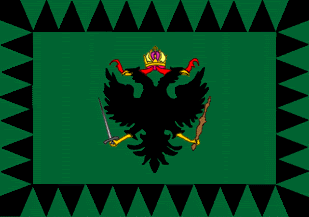
Flag of Lombardy-Venetia
Venus of Willendorf is a 27,000 to 32,000 year old artifact discovered in Austria. This little statue was carved from limestone not native to the area, and I believe was part of a much larger proto-European archetypical symbol of the "mother goddess." Also significant is its age, which would make it a counterpart to the "horned god." Because there are so many regional names for this goddess, which I think are linked back to the last glacial movement, I refer to her as "the Almother"... the proto-European equivalent to "the Alfather" Odin within old Teutonic culture. Among other things, the Almother was a fertility goddess in those early days. As strange as this may sound, there is ample evidence that the Roman goddess Diana of the Carnuntum era, and Venus of Willendorf, have a common origin going back to the last Ice Age. The Almother in the Italian peninsula, of course, going through many more manifestations over time. However, when half of Europe was covered under a massive continental ice sheet, the local manifestations of the mother goddess and the horned god would have been very likely of the same origin.

As far as the later colonial aggression of the Habsburgs... I mean lets face it, this was basically a soft dictatorship in which the average citizen of Austria-Hungary was not really responsible for national/monarchial policy anymore than a Roman citizen was responsible for Roman imperialism. The Austrian soldiers stationed in Lombardy-Venetia could, at times, be brutal... but probably not any more brutal than other occupations. It could be said with certainty that during pre-Roman times---which would have been pre-Teutonic and pre-Slavic times as well---this tri-cultural region would have been largely of the same people. Nobody there spoke Italian, German, or Slavic back then. Three very aggressive peoples came later and staked their territorial claim, and consequently the past etho-cultural dynamic was forgotten.

.

Monday, October 7, 2013

Guido von List: Part 25 - The Mystery of the Vehme: Entry A


The five-angled star, the Vehme-Star, the Truthenfuss* (truh = turn, fuss = foot) is the hieroglyph of "revolving or turning generation," of "rebirth"--one of the most important articles of faith in the Aryan religion. In its exoteric interpretation this sign simply says: "return," and was therefore a favorite sign used at hostels and inns, in order to convey the meaning: "whoever is a guest here should come again."

*List: Truthenfuss, standard modern German: Drudenfuss, the foot of a Drude; pentagram. Drude: "a dangerous female numen of the night," cf. Old Norse Thrudhr, old English dhrydh: "a wood maiden." Cf. further Jacob Grimm, Teutonic Mythology. vol. 1, pp. 422-23.

[excerpt from pages 86 and 87 from 'Secret of the Runes']

 
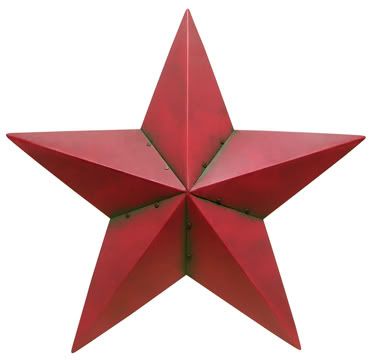
I recall when I first read this, in particular the words "a favorite sign used at hostels and inns," I didn't have any historical point of reference. It may have been because I was thinking "pentagram symbol," rather than "five-pointed star." A few days ago I saw a home with a black star on its porch on a television program, and it finally hit me. He meant "star," not "symbol!" I have seen those stars on homes, usually black and contoured as the symbol below is, but I didn't make the connection.

One person on a Christian forum answered this question this way: Google "Amish Barn Star" It is a symbol of good luck. Nothing sinister, just a decorating fad. There's also the apparent truth of the pentagram having once been a symbol of Christianity.

 
From Yahoo Answers:

It's supposed to keep evil away or a an old amish good luck charm are the reasons I have been told the most.

I've also read that it has military meaning:
Blue 5-angel star= Family member currently serving in a War
Gold 5-angel star= Lost a Family member in a War
Brown 5-angel star= Veteran of the military
Red 5-angel star= Family member wounded in combat

Some people do just use it for decoration.

 
Excerpt from another Christian forum:

Five-pointed stars on houses?

Does anyone know the meaning of (presumably plastic) 5-pointed stars mounted on the fronts of houses, usually next to the doors? They appear to be plastic and I've seen them in various colors. White is common. There is only one per house. They have a radius of about one foot. I saw a lot of them when we traveled through KY, TN, NC and into Georgia about 2 weeks ago. There are a few of them here in the Chicago suburban area. I'm aware that the five-pointed star is a symbol of witchcraft and wonder if the inhabitants of these houses are proclaiming that.

While I don't know what those stars mean today, when I was a child living in Illinois, a star in someone's window meant that it was a "safehouse". They were homes along the routes students walked on the way to school, and if there was a problem going back and forth to school, a child could run to that house for safety. I would be very surprised if in our day and age, the star meant it was a safehouse.

There are probably a number of meanings that developed separately over time, but the most solid origin for at least the American star tradition--which ties directly to the German-speaking countries--is the "Amish barn star." Not surprisingly, these stars are particularly popular in western Pennsylvania, which ties directly to the German/Dutch "hex signs" which we have covered here on the Hexology series. Yes, this is the link to List's vehme tradition in today's world. Also, they are easy to purchase online with a simple "barn star" or "Amish barn star" search. This "American tradition" isn't as popular here in California, which is why I failed to make the connection sooner. They come in many colors, including this nice eggshell-colored one.

Within Amish culture, which no longer even exists in Switzerland, we see some of the old German country traditions. I'm slightly embarrassed that a lot of connections here have escaped me, even though I have been close to them here and there in my life. California descendants of the "dust bowl" era, which are in the millions--and who can trace their roots back to Oklahoma and Texas--brought many folk traditions and cultural expressions with them which exist to this day. I can recall seeing some of this symbolism in country-style stores over the years... including the barn star. This star is of ancient Heathen origin; although the related pentagram has some Christian roots.

.