The five-angled star, the Vehme-Star, the Truthenfuss* (truh = turn, fuss = foot) is the hieroglyph of "revolving or turning generation," of "rebirth"--one of the most important articles of faith in the Aryan religion. In its exoteric interpretation this sign simply says: "return," and was therefore a favorite sign used at hostels and inns, in order to convey the meaning: "whoever is a guest here should come again."
*List: Truthenfuss, standard modern German: Drudenfuss, the foot of a Drude; pentagram. Drude: "a dangerous female numen of the night," cf. Old Norse Thrudhr, old English dhrydh: "a wood maiden." Cf. further Jacob Grimm, Teutonic Mythology. vol. 1, pp. 422-23.
[excerpt from pages 86 and 87 from 'Secret of the Runes']
I recall when I first read this, in particular the words "a favorite sign used at hostels and inns," I didn't have any historical point of reference. It may have been because I was thinking "pentagram symbol," rather than "five-pointed star." A few days ago I saw a home with a black star on its porch on a television program, and it finally hit me. He meant "star," not "symbol!" I have seen those stars on homes, usually black and contoured as the symbol below is, but I didn't make the connection.
One person on a Christian forum answered this question this way: Google "Amish Barn Star" It is a symbol of good luck. Nothing sinister, just a decorating fad. There's also the apparent truth of the pentagram having once been a symbol of Christianity.
From Yahoo Answers:
It's supposed to keep evil away or a an old amish good luck charm are the reasons I have been told the most.
I've also read that it has military meaning:
Blue 5-angel star= Family member currently serving in a War
Gold 5-angel star= Lost a Family member in a War
Brown 5-angel star= Veteran of the military
Red 5-angel star= Family member wounded in combat
Some people do just use it for decoration.
Excerpt from another Christian forum:
Five-pointed stars on houses?
Does anyone know the meaning of (presumably plastic) 5-pointed stars mounted on the fronts of houses, usually next to the doors? They appear to be plastic and I've seen them in various colors. White is common. There is only one per house. They have a radius of about one foot. I saw a lot of them when we traveled through KY, TN, NC and into Georgia about 2 weeks ago. There are a few of them here in the Chicago suburban area. I'm aware that the five-pointed star is a symbol of witchcraft and wonder if the inhabitants of these houses are proclaiming that.
While I don't know what those stars mean today, when I was a child living in Illinois, a star in someone's window meant that it was a "safehouse". They were homes along the routes students walked on the way to school, and if there was a problem going back and forth to school, a child could run to that house for safety. I would be very surprised if in our day and age, the star meant it was a safehouse.
There are probably a number of meanings that developed separately over time, but the most solid origin for at least the American star tradition--which ties directly to the German-speaking countries--is the "Amish barn star." Not surprisingly, these stars are particularly popular in western Pennsylvania, which ties directly to the German/Dutch "hex signs" which we have covered here on the Hexology series. Yes, this is the link to List's vehme tradition in today's world. Also, they are easy to purchase online with a simple "barn star" or "Amish barn star" search. This "American tradition" isn't as popular here in California, which is why I failed to make the connection sooner. They come in many colors, including this nice eggshell-colored one.
Within Amish culture, which no longer even exists in Switzerland, we see some of the old German country traditions. I'm slightly embarrassed that a lot of connections here have escaped me, even though I have been close to them here and there in my life. California descendants of the "dust bowl" era, which are in the millions--and who can trace their roots back to Oklahoma and Texas--brought many folk traditions and cultural expressions with them which exist to this day. I can recall seeing some of this symbolism in country-style stores over the years... including the barn star. This star is of ancient Heathen origin; although the related pentagram has some Christian roots.
.
Country-folk art
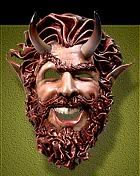
Recently, I went to a Mexican restaurant in San Rafael for lunch. All along the walls were rustic face masks. I didn't get the impression that they were of Mexican origin. They reminded me of old rural European folk art. They were like a rustic type of art. Something that you might see on a fence in the countryside. In other words, a crude type of outdoor country art. Even if they were Mexican, they would have been from a European face mask tradition.
I suspect that the owner purchased them somewhere, feeling that they would liven up the place. They sure did. You can't help but notice them. I recall some were like the image of "Pan," with horns, or maybe like a stereotypical old "country woman" face. I think some were of animals. With Mexican art like that, that I have seen, the faces look "Mexican or Mayan." These seemed much more old rural European. Something that could have been observed in the semi-pagan European countryside--perhaps on a fence or barn--maybe 700 years ago.
There really is something to be said of the crudely beautiful country art. Not trashy, but rustic! Rustic is like an old barn, while trashy is like "junk all over." Rustic is like nature. I think of Brescian history. The southern urban Brescians were fine artisans; while the people of the northern Alpine "Tre Valli Bresciane" (Camunians, Sabines, Trumpilinians) were more in tune with country folk art. Venetian masks are different, as they are more of a fine craft.
**************************************************
Rabbit's feet?
I remember as a young boy, that I had a red rabbit's foot. I may have gotten it in some gift shop in Wyoming. I was one of my prized possessions, as I kept it in that special box with those types of items. Somehow I lost it over the years. A rabbit's foot is an old pagan symbol for good luck. I was thinking recently, are rabbit's feet somehow immoral? A rabbit isn't an animal that humans regard as special, like dogs, horses, or cats. We still hunt and eat them.
I like rabbits, but I don't really see them as ideal pets. They belong in the foothills and brush, so they can kick their hind legs and take off. They're ill suited for a small cage, like small pet rodents. But is there something wrong with a rabbit's foot? People have deer or other horns, which they may well have found while hiking. Unlike a horn, "fur" isn't something that one would really retrieve from an animal at the end of it's life. A rabbit's foot is sort've in-between a horn and fur.
I say it's not immoral. The question of animal furs or reptile skins will go on, but rabbits are not in any way rare. It's just too "sensitive" of us to be so perturbed by a rabbit's foot. It's not like rabbit's feet are some big industry. It's another small part of our past and history that lingers on.
**************************************************
 Daily synchronicity
One evening several weeks ago, I ran across a book in pdf form entitled 'Miners, merchants, and midwives: Michigan's Upper Peninsula Italians' (Magnaghi; 1987). The Upper Michigan Italians were almost all from the north, and have a history even going back to the 1860s. The book is out-of-print, and used copies are very expensive. My family migrated to the Montreal River area with other immigrants from Lombardy. Reading a bit about that history was very fascinating to me. Although solidly Catholic, some women of the community gained a reputation as practitioners of folk medicine, brought with them from rural Alpine villages. A leftover from the "La Vecchia Religione" of the ancients.
The very next morning, I was driving and thinking about a part of the book where it talked about Upper Michigan immigrants who came from around the Valtellina north of Val Camonica, Trento, and the Südtirol. Just as I'm about to park, still engrossed in this particular section of the book that I had read the night before, I look at the bumper of the car directly in front of me.... and I see an old sticker with a red eagle, which read "Tyrol!" That particular coat-of-arms was of the German Tirol, but I would lean towards a synchronistic connection for me there.
**************************************************
An animal message?
Animals are a way for the goddesses and gods to communicate with us, as has been covered here before. A couple of weeks ago I was sitting on a deck overlooking a vast hillside, having a beer. The occasion was the finalization of a long-range plan for a business. As I was sitting there, a small bird landed right on the railing. I can state conclusively that it was within two feet from me! It chirped, and remained there for about ten seconds before flying off.
.