Showing posts with label Milanese culture. Show all posts

Saturday, August 14, 2021

The Tarot: The name originally came from the Brescian "Tarocho" - Part I

Tarot

[The Tarot] first known as trionfi and later as tarocchi or tarock, is a pack of playing cards, used from at least the mid-15th century in various parts of Europe to play games such as Italian tarocchini; many games are still played today; in the late 18th century, some tarot decks began to be used for divination via tarot card reading and cartomancy leading to custom decks developed for such occult purposes.

************

History

The first documented tarot packs were recorded between 1440 and 1450 in Milan, Ferrara, Florence and Bologna when additional trump cards with allegorical illustrations were added to the common four-suit pack. These new decks were called carte da trionfi, triumph cards, and the additional cards known simply as trionfi, which became "trumps" in English. The earliest documentation of trionfi is found in a written statement in the court records of Florence, in 1440, regarding the transfer of two decks to Sigismondo Pandolfo Malatesta.

The oldest surviving tarot cards are the 15 or so Visconti-Sforza tarot decks painted in the mid-15th century for the rulers of the Duchy of Milan. A lost tarot-like pack was commissioned by Duke Filippo Maria Visconti and described by Martiano da Tortona probably between 1418 and 1425, since the painter he mentions, Michelino da Besozzo, returned to Milan in 1418, while Martiano himself died in 1425. He described a 60-card deck with 16 cards having images of the Roman gods and suits depicting four kinds of birds. The 16 cards were regarded as "trumps" since in 1449 Jacopo Antonio Marcello recalled that the now deceased duke had invented a novum quoddam et exquisitum triumphorum genus, or "a new and exquisite kind of triumphs". Other early decks that also showcased classical motifs include the Sola-Busca and Boiardo-Viti decks of the 1490s.

In Florence, an expanded deck called Minchiate was used. This deck of 97 cards includes astrological symbols and the four elements, as well as traditional tarot motifs.

The expansion of tarot outside of Italy, first to France and Switzerland, occurred during the Italian Wars. The most important tarot pattern used in these two countries was the Tarot of Marseilles of Milanese origin.

************

Etmology

The word Tarot and German Tarock derive from the Italian Tarocchi, the origin of which is uncertain but taroch was used as a synonym for foolishness in the late 15th and early 16th centuries. The decks were known exclusively as Trionfi during the fifteenth century.

The new name first appeared in Brescia around 1502 as Tarocho.

[Depaulis, Thierry (2008). "Entre farsa et barzelletta: jeux de cartes italiens autours de 1500". The Playing-Card. 37 (2): 89–102]


During the 16th century, a new game played with a standard deck but sharing a very similar name (Trionfa) was quickly becoming popular. This coincided with the older game being renamed tarocchi. In modern Italian, the singular term is Tarocco, which, as a noun, refers to a cultivar of blood orange. The attribute Tarocco and the verb Taroccare are used regionally to indicate that something is fake or forged. This meaning is directly derived from the tarocchi game as played in Italy, in which tarocco indicates a card that can be played in place of another card.

************

Gaming decks


The original purpose of tarot cards was to play games. A very cursory explanation of rules for a tarot-like deck is given in a manuscript by Martiano da Tortona before 1425. Vague descriptions of game play or game terminology follow for the next two centuries until the earliest known complete description of rules for a French variant in 1637. The game of tarot has many regional variations. Tarocchini has survived in Bologna and there are still others played in Piedmont and Sicily, but in Italy the game is generally less popular than elsewhere.

************

Tarocco Piemontese: the Fool card

These were the oldest form of tarot deck to be made, being first devised in the 15th century in northern Italy. Three decks of this category are still used to play certain games:
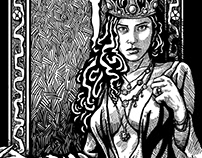
The Tarocco Piemontese consists of the four suits of swords, batons, cups and coins, each headed by a king, queen, cavalier and jack, followed by the pip cards for a total of 78 cards. Trump 20 outranks 21 in most games and the Fool is numbered 0 despite not being a trump.
 
The Swiss 1JJ Tarot is similar, but replaces the Pope with Jupiter, the Popess with Juno, and the Angel with the Judgement. The trumps rank in numerical order and the Tower is known as the House of God. The cards are not reversible like the Tarocco Piemontese.

The Tarocco Bolognese omits numeral cards two to five in plain suits, leaving it with 62 cards, and has somewhat different trumps, not all of which are numbered and four of which are equal in rank. It has a different graphical design than the two above as it was not derived from the Tarot of Marseilles.

************

Card reading

The earliest evidence of a tarot deck used for cartomancy (fortune telling) comes from an anonymous manuscript from around 1750 which documents rudimentary divinatory meanings for the cards of the Tarocco Bolognese.

.

Wednesday, June 12, 2019

Rick Steves' Europe - Milan and Lake Como


Milan and Lake Como

Rick Steves' Europe

Rick Steves' Europe Travel Guide | No trip to Italy is complete without Milan and Lake Como. In Milan we'll take a peek at Italy's highest fashion, fanciest delis, grandest cemetery, and greatest opera house...not to mention Leonardo's Last Supper. Then we'll cruise along Lake Como, settling down in the lakeside village of Varenna...classic honeymoon country, where Italy meets the Alps.

.

Tuesday, December 20, 2016

'Te Deum Laudamus' - Ambrosian-Milanese hymn


TE DEUM LAUDAMUS THE AMBROSIAN HYMN

piddflicks


The Te Deum, also called the Ambrosian Hymn because of the association with St. Ambrose, is the Church's great hymn of joy and thanksgiving; a tribute to the majesty of Almighty God: Father, Son, and Holy Spirit. At first thought to have its origin with St. Ambrose and St. Augustine, or St.Hilary it is now accepted as having been written in the fourth century by Nicetas, Bishop of Remesiana (present-day Bela Palanka, Serbia). Although recited or sung by clergy, religious and devout laity in the Liturgy of the Hours, it is most popularly known to be sung on the Church's great Solemnities and Feast Days accompanied by the joyful ringing of bells.

*************************

Ambrosian Rite

The Ambrosian Rite, also called the Milanese Rite, is a Catholic liturgical Western rite. The rite is named after Saint Ambrose, a bishop of Milan in the fourth century. The Ambrosian Rite, which differs from the Roman Rite, is used by some five million Catholics in the greater part of the Archdiocese of Milan, Italy (excluding, notably, the areas of Monza, Treviglio, Trezzo sull'Adda and a few other parishes), in some parishes of the Diocese of Como, Bergamo, Novara, Lodi and in about fifty parishes of the Diocese of Lugano, in the Canton Ticino, Switzerland.


.

Wednesday, February 5, 2014

'Rocco and His Brothers' (movie review)

Rocco and His Brothers (Wikipedia)

Rocco e i suoi fratelli (English: Rocco and His Brothers) is a 1960 Italian film directed by Luchino Visconti. Set in Milan, it tells the story of an immigrant family from the South and its disintegration in the society of the industrial North. The title is a combination of Thomas Mann's Joseph and his Brothers and the name of Rocco Scotellaro, Italian poet who described the feelings of the peasants of southern Italy.

The film stars Alain Delon, Renato Salvatori, Annie Girardot, and Claudia Cardinale, in one of her early roles before she became internationally known. The film's score was composed by Nino Rota.


*************************


This movie didn’t pull any punches. The opening scene shows the family arriving at a train depot in Milan from rural Basilicata. They’re loud and rambunctious. One of the brothers says from the bus that all of the lights make it look like the daytime. This movie would have taken place somewhere between 1945 and 1960, part of the large migration from southern Italy to the northern industrial centers after World War II.

When I first read the short description of this film, the family is said to be from “the country” migrating to Milan. I was thinking maybe they were from the Valtellina or somewhere in the Lombard Alps? There are rural areas in Lombardy or the north... but of course it would be the South. The family loosely seems to live in or around a more-or-less “southern milieu” of people, but that wasn’t really clear.

Other southerners teach them how to cheat the Milanese system as they had by renting an apartment in a good district, apparently beyond their means, then to stop paying rent after two months.. at which time the city would give them free housing. As they said: “Milan don’t let anyone live in the street.” Soon after, they see snow for the first time, and they start off with odd jobs like shoveling snow.

At the start and end of this movie was played a song entitled ‘Oh my beautiful country’. Initially the message went over my head, but at the end it was clear their country was not “Italy,” but their region of origin. The song was basically about missing “home.” There were numerous references about the “old country” or “my country,” but other than that they seemed to be socially accepted into society. There’s even a reference to something like “we don’t speak our language anymore.”

The family is portrayed as loud and emotional, and the only stereotype missing was “hand gestures” which the director seemed to largely leave out. Soon one of the five brothers, Simone, meets a local woman named Nadia; who said that she was from Cremona, and this is maybe the central storyline of the movie. She is a prostitute, but she really isn’t portrayed that way. There are references to her parents house nearby, she dresses well, and there are many scenes of her just appearing like any well-dressed middle class woman on a date.

The matriarch Rosaria doesn’t like Nadia at all, and this begins a long rocky road that I can’t give all the details of or I will spoil the movie. Suffice to say, it’s a tragic relationship between Nadia and this family. They become almost negatively addicted to each other. Perhaps I’m the only one, but I had a soft spot for Nadia; like one of those people whom you wish would get their life in order, but they never do.

Although it wasn’t entirely clear--with the cast being a mixture of Italian, French, or Greek actors--the brothers seemed to have a thing for Milanese women. The mother, perhaps frustrated by these “quasi-liberated” young local women, says something like “these northern girls have skin like a chicken!” or some such thing about them being skinny and pale.

Some of the brothers get into boxing, and start construction work; and later one or two of them works for Alfa Romeo. The movie portrays them engaging in shady behavior at times, like stealing from a woman who owns a clothing and tailoring shop where one of their girlfriends works. There is no “mafia subplot” however. The Milanese are also portrayed as being excitable and gregarious, but never as loud and emotional as “the Parondi’s.”

The two main brothers are Simone and Rocco. Simone is always in trouble, while Rocco is the noble one.. and would be considered the main protagonist of the movie. He’s always trying to fix Simone’s problems. Rocco’s wife Gianetta is played by Claudia Cardinale, who later became a famous actress. Apparently "Rocco" is short for Rocchino. I found a lot of this movie a little hard to follow. One of the main characters is their local head boxing trainer, who trains several of the brothers, and always seems to end up frustrated by what he sees as a lock of dedication. He has some rant about “these southerners are not serious!” Some of the plot surrounding him sort’ve goes over my head. It’s hard to read text and try to watch. You miss some things.

There is one scene which I found very funny. The mother finally gets into it with Nadia. There’s some new negative issue with Simone and he leaves, and Rosaria bursts into the bedroom to confront Nadia while she’s in bed. A real “meeting of the minds.” At one point, Rosaria has both of her hands in the shape of horns and pushes Nadia.. as if to call her “a devil.”

I don’t want to give away the movie, but there was much sympathy for Simone near the end. One of the brothers ends up saying to his nephew, “Simone had good roots, but he got poisoned by bad herbs.” If you see, or saw, the movie; you will know why I think that’s total BS. He was a bad seed, period… but it’s just a movie….

There were a lot of socio-political issues surrounding this film, which was filmed in Milan and Lombardy, but I can’t say because it would give away the movie. Some of it you can find on the movie's IMDb trivia page here. This film has been really popular. From the link: Francis Ford Coppola was such a big fan of this film that he hired its composer, Nino Rota, to score his 1972 masterwork, The Godfather (1972). Directed by Vichino Visconti, who was of Milanese descent, the film won numerous awards at the 1960 Venice Film Festival among others.

.

Tuesday, August 20, 2013

Milanese singer Laura Luca's hit single 'Inutilmente Tu' (1978)


Laura Luca was a mainstream Italian singer from Milan. I don't quite feel like saying that she was a "pop singer," but she was perhaps something close to that. I found this charming hit song by accident, as I was unfamiliar with her. She was active from 1978 to 1998, and appears to be retired, at least officially. A music video of this song can be found here, but you may prefer to just listen without distraction. The YouTube channel "LauraLucaFanClub" has other hit songs by her taken live or in music video form, and there are other songs by her on YouTube if you prefer the studio quality.

When I first listened to this song one evening last week, I guess I was in my daydreaming mode; as I imagined a special town I'm long familiar with, and what it may have been like there in 1978 when this song was popular in Italy but not in the U.S. So it was like comparing the 70's California and the 70's Europe. I imagined the typical sunny day there overlooking the tree covered northern California mountains, then I imagine the sunny Italian peninsula.. Lombardy. The landscapes and weather of California is very similar to Italy. It was like a spiritual-connection for me, as she is Lombardian like me; and the quasi-connecting of time and place via this nice song. Anyway, I imagine that special place as it may have been in 1978 when I listen.

.