Wednesday, October 26, 2011

Centurion (movie review)

I viewed the movie 'Centurion' (2010) last evening, and thought there were enough cultural tie-ins to put a review here. The movie was from the UK, and I think they did a pretty good job with it. The movie, set about 2,000 years ago in what is now the Scottish Highlands, was similar to "a Roman versus Pictish Braveheart." The one big difference was that there was no effort to turn either side into either protagonists or antagonists. It was chiefly from a Roman perspective.


Centurion is a 2010 British film directed by Neil Marshall. It centres on the supposed disappearance of the Ninth Legion in Caledonia. The movie stars Michael Fassbender, Olga Kurylenko and Dominic West.


Plot

It is AD 117 and the Roman garrisons are struggling to contain the Picts, the original inhabitants of the Scottish Highlands. The Picts, under their king, Gorlacon, are perfecting guerrilla warfare and are eliminating Roman outposts one by one. Centurion Quintus Dias is the only survivor of a Pictish raid and is taken prisoner by Vortix. In the meantime, Agricola, the Roman governor of Britannia wants to obtain favour with the central administration, hoping to secure a transfer back to the comforts of Rome. He dispatches the Ninth Legion to the front under General Titus Flavius Virilus, with orders to eradicate the Pict threat, providing him with a Brigantian scout, a mute woman, Etain.


**************************************************


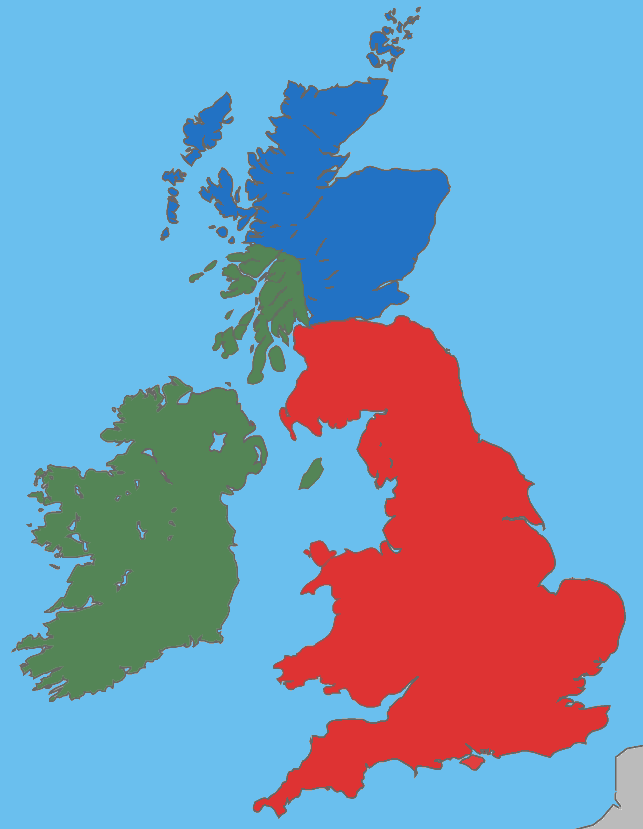
One interesting parallel with our culture is that the Picts were not Gaels. They were not Celts, but from a people who predated the Gaels in Scotland. A very ancient Atlanto-Mediterranean people. The vast majority of Scotland--or as the Romans called it: "Caledonia"--was their domain at this point. Gaels, originally from Ireland, occupied the far west end of Caledonia. Therefore, there is an interesting parallel to our culture with the very ancient Euganei people, and the Celto-Gaulish people who arrived later; and with the Euganeians and the Cisalpine Gauls both opposing the Romans. So I suppose that a Scottish person could take pride in both their Pictish and Gaelic heritage in the same manner that we would take pride in both our Euganeian (ancient Camunnian) and Gaulish heritage.

Pict homeland in blue
I thought that the acting and cinematography were very good. It was a particularly violent movie, and the characters reflected a world in which life was not worth much. In other words, they appeared like people who knew that they could die at any time. There wasn't much time for sentiment as the mortal struggle continued right to the very end. The mountainous Caledonian landscape was portrayed as rugged and beautiful. I would guess more beautiful, just in terms of the landscape, than it is today. For one thing it was more forested in ancient times; and inhabited by an equally rugged people. Most of the scenery appeared to be of the Scottish Highlands, or at least was intended to be. It was wonderfully dark, gloomy, cold, and wet. I would say that the Picts reminded me of the ancient Camunni.

Arianne
With all the good acting and characters, one which stood out with me was the character of Arianne (Emogen Poots), an exiled Pictish woman, thought to be a witch, who risked her life to help several Roman soldiers. She reminded me, very plausibly, of a beautiful, rugged, and self-sufficient young woman; both dainty and tough. She seemed to have managed a positive outlook despite a very rough life; which I found inspirational. Arianne, with her dark green dress, somehow reminded me more of a Welsh woman; however, Emogen Poots is actually English. The Romans in her home seemed to be taken in with her self-determinism and hospitable manner, and showed a great respect for her. While I'm on the subject, the movie portrayed a couple of Pictish warrior women, which I believe is historically accurate. I'm not sure about the Norse or Germanic peoples, but Celts and other ancient cultures did have a few of the stronger females serving as warriors.

The movie is based on the true story of the disappearance of the Roman Ninth Legion. A legion recruited in Roman Hispania (modern Spain/Portugal), and sent to Roman Britannia. It should be noted that the Roman Empire never conquered Pictish Caledonia or Gaelic Hibernia (Ireland). In reality, the Picts were the protagonists. They had every right to defend their homeland. I definitely recommend this movie. By the way, a "Centurion" was a Roman officer.

.

Tuesday, October 25, 2011

“Patihi, Patahé!” The Camuni of Brescia in Monongahela City: Part III


On Saturday, while attending the Stanford-Washington college football game, someone pointed out to me that #5 on the sidelines of the Washington Huskies football team was freshman quarterback Nick Montana; son of legendary NFL quarterback Joe Montana. Near the end of the game, he was able to take some snaps; and it occurred to me the article I had found regarding the immigrants from the Camunian Valley who had settled in Monongahela, Pennsylvania, and possibly the most famous Camunian descendant Joe Montana. I thought it was time that I entered it here.

The author, and historic preservation consultant--Terry Necciai--did a great job researching and putting that article together. It was short, but touched upon all the major elements of the Camunian and Brescian Tri-Valley heritage. Maybe the one exception was Beretta Firearms, in continuous business in Val Trompia since 1526; and possibly the actual inventor of the "hand-held cannon" itself, but it was a fascinating read nevertheless.

One interesting coincidence is that Monongahela City is called "Mon City," and in the Val Camonica, the town and comune of Monno was named "Mòn" in the Camunian dialect. Perhaps more coincidental than that are the three-letters "MON" in "ca-MON-ica"; in relation with their settling largely in one city... "Mon City." I don't know, I think that's quite a coincidence in itself, considering that it was the one city in North America that they settled in... in relatively large numbers.

I can see from further reading that we need to cover more material regarding the Monongahela area and it's history. Naturally, it would be great if Camunian descendants from the Monongahela region could hook up with us here, and we could connect with a lot more of our history. I suspect that most of our history would center around the Great Lakes region, and from my own research, it appears that the Pacific Northwest is another area to look at.

It was so interesting to actually learn a little about how Camunians, in an area where they had a large population, interacted with people from other cultures. The greeting "Patihi, Patahé" really captured the spirit of this, from a rough existence in Western Pennsylvania. It was curious, as the author stated, that this phrase is not well-known in modern Brescia/Valcamonica. Apparently, this could be explained from another century-plus of the Italian language overriding the local Brescian and Camunian dialect.

If you happen to be of Camunian ancestry from the Monongahela area, or elsewhere on this continent, feel free to connect with us! We're really more of a larger family clan, than "hyphenated Americans." Remember, all of our Camunian ancestors, yours and mine, were practically "family." So whether we live in Monongahela, Pittsburgh, Montreal, Seattle, Sacramento, or Denver; we're like long lost cousins.

~Patihi, Patahé~

.

Monday, October 24, 2011

“Patihi, Patahé!” The Camuni of Brescia in Monongahela City: Part II

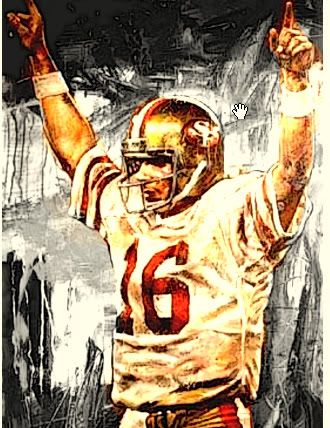
Sports legend Joe Montana, of half Camunian ancestry

Borrowed from the archives of 'Poche Parole' (May 2009), the newsletter of the Italian Cultural Society of Washington D.C.


By Terry Necciai

The second of two articles

Railroad construction went at a furious pace through the region, both before and after the Panic of 1873, and gangs of temporary workers were recruited to level the grade and lay the ties and tracks. It is particularly difficult to determine who the workers were and where they came from because of the short term nature of the work and lack of records. However, it appears that the Italian workers found other jobs as a result of the new lines. Railroad development was often justified by the expectation that each line would open up a new area for coal mining. Industrial villages cropped up almost instantaneously as each line was completed. Meanwhile, other Pittsburgh area industries, such as steel, specifically avoided hiring Italians because they thought they were less suited than the Slovaks and other Eastern Europeans for the heavy work required at the larger industrial plants, a prejudice that is on record in some of the surviving trade literature. Because the Italians had an easier time finding jobs in coal mines, they ended up scattered all over the region, in the 500 or more mining villages found within a 100 mile radius of Pittsburgh. Those who brought trade skills with them eventually struck off as entrepreneurs, serving as carpenters, blacksmiths, barbers, tailors, and grocers/fruit handlers, and also sometimes as musicians, writers, or bankers in the new villages.

The Bresciani who came to Monongahela City helped to set off a chain reaction that brought Italians from almost every other part of Italy, boosting the population within and surrounding a very small city that is still 25% Italian-American today. A small group of Calabresi who came in the 1870s may have been the first, followed in the 1890s to 1910s by other Italians from north of Rome, a large group of families from Tuscany, and smaller groups from Umbria, Piemonte, and Venice, and then by large groups from Naples, Calabria, and Sicily, with smaller groups from Abruzzi and Molise. In one of the later waves of immigration, families came from Suisio, an industrial town west of Bergamo, where the dialect was almost the same as that of Brescia. The Italian-Americans in Monongahela whose roots are in the other parts of Italy often refer to the Bresciani and Bergamaschi as the “Patihi, Patahé,” an obscure phrase that the Bresciani had apparently used as a greeting and a shibboleth (though no one from modern day Brescia seems to remember exactly what this phrase means). (My theory is that it could be derived from a word “dialect,” similar to the French “patois.” Or another possibility is “patéser” a verb in the local dialect that means the same as “soffrire” — to “suffer” or to “put up with” someone. Assuming the two words are conjugated forms of a verb, say “patihare” or “patéher,” with an “h” being substituted for a “c” or an “s,” the meaning of “se patahi, pataho” could be “if you speak the dialect, then I will” or “if you put up with [me], then I’ll put up with [you]”)

A small group apparently came about 1886, probably as a gang of young, single men looking for work. Three of the first surnames were: Milani, Pezzoni, and Carrara. Serafino Carrara came to Monongahela from Brescia in ca.1886-88, taking a job in the Catsburg Mine, and by the 1890s, his daughter Maria operated a boarding house for Italian miners on a hillside site overlooking the mine. Undoubtedly, this facility housed many of the Camuni when they first arrived. By about 1915, the Odelli family had a very popular fruit market that later became a peanut and candy store. When Joe (Gio’ann’) Odelli, Sr., rebuilt his fruit stand in 1925, he erected one of the most impressive buildings on Main Street. The Anton family, Bavarian Catholic immigrants who made open flame lamps for the coal miners, took an interest in the Brescians and sponsored the establishment of an Italian Catholic Church in 1904. It was named for St. Anthony of Padua in part to recognize the Antons as the benefactors. The Bresciani were the core group in the congregation. A few years later, in 1913, open flame lamps were blamed for a mine disaster at a mine near Monongahela, taking the lives of 97 men, of whom at least 8 or 10 were from Brescia. Legislation outlawing lamps with open flames after this disaster led to the invention of the safety lamp and then the battery-powered flashlight.

The best known Brescian-American from Monongahela is football quarterback Joe Montana (who played for Notre Dame in the 1970s and the San Francisco 49ers in the 1980s and 1990s). The name Montana is slightly Americanized, apparently from Montagni (he is also half Sicilian, through his mother, Theresa Bavuso Montana).

The Val Camonica is named for the Camunni, an ancient culture of unknown origin that became blended with the Celts of Northern Italy in pre-Roman times. Today, the inhabitants of the valley call themselves “Camuni” (with one “n”). The ancient Camunni left approximately 350,000 rock carvings on the face of the mountains, depicting pre-Roman-era life in the valley. Some are as much as 10,000 years old. To interpret the sparse written passages in the Camuno language that accompanies some of the later carvings, linguists have begun to analyze the peculiarities in the local dialect, which preserves some Camuno characteristics, differentiating it from other dialects of Northern Italy.

.

Sunday, October 23, 2011

“Patihi, Patahé!” The Camuni of Brescia in Monongahela City: Part I

Old steamers on the Monongahela River
Borrowed from the archives of 'Poche Parole' (March 2009), the newsletter of the Italian Cultural Society of Washington D.C.


Summary of a talk by ICS member Terry Necciai at the American Italian Cultural Institute of Pittsburgh, (AMICO) Feb 15, 2009

The first of two articles

“The Daily Republican, 18 November 1892 — MONONGAHELA CITY, PA — The Italians living here joined in the celebration of the town’s centennial by raising a large Italian flag. The celebrating … being over, the Italians refused to take their flag down, and trouble was brewing over the incident. It is not known what would have been the consequences had not Mayor Huston compelled the colony to put the American flag on top of the Italian banner.” (Quoted from an earlier piece in the Pittsburgh Times)

By the 1860s, engineers around the world had learned, through “coking,” how to purify coal enough to replace charcoal in the iron smelting process. In places like Pittsburgh, iron masters built large smelting furnaces in the city, speeding up manufacturing operations, making iron less costly, and replacing primitive furnaces that had operated for years in the mountains. In some mountainous areas of Italy where there was no coal and where charcoal-fired iron had been made for centuries, the transition away from charcoal triggered the demise of the local economy.

As jobs became scarce in the province of Brescia, hundreds of families immigrated to the United States. Some of the first immigrants found work in the small, aging, riverfront mines around Monongahela City, a small town an hour south of Pittsburgh, by the mid-1880s. The first immigrants may have been Bersaglieri or Alpini veterans of the Risorgimento. According to a theory put forward by Don Franco Bontempi, the current parish priest in the Brescian town of Ono San Pietro, they may have been inspired by the fact that President Lincoln had offered Garibaldi a position in the Union Army, in 1861, at a point when the fires of the Risorgimento appeared to have died down. Brescians continued to come to Monongahela until the 1920s because it was one of few places in the world where their dialect (Camuno-Brescian) could be understood. They also found their way to this one town, following friends and relatives. Even today, in certain communities in the Brescian mountains, the name “Monongahela” is well-known, perhaps because many families have kept and handed-down letters from loved ones with the name in the return address (Some Brescians refer to the Pennsylvania locality as “Mononga-elapà,” not knowing that the last two letters in the address stand for the name of the state). Most of the Brescians who came to Monongahela City were from the Val Camonica and the smaller tributary valleys to the east and west of it, an area that comprises the northern two-thirds of the province of Brescia. A 60-mile-long industrial valley in the Alps, the Val Camonica has about a hundred towns and villages clustered around iron furnaces, water-powered forges, wine presses, and other traditional manufacturing facilities. In addition to iron and other metals, as well as table wine, the valley is also known for its cheese and sausages.

Italians may have been among the earliest settlers of Western Pennsylvania. At least two travel writers, as they passed through the area in 1803 and 1806, mentioned an Italian component in local culture as if Italian immigrants were already living in Pittsburgh by then, but research has not been successful in identifying specific familes. A group Passionist Fathers came to Pittsburgh in 1845 to serve the local Catholic community, which, in the middle decades of the nineteenth century, consisted almost exclusively of Irish and German immigrants. Many immigrants from iron manufacturing areas in Germany had come by the 1840s to work in the Pittsburgh iron industry. However, it was not until after the onset of the Panic of 1873 that groups of immigrants from southern and eastern Europe began to show up in large numbers as a new pool of workers. Unstable conditions, particularly in the smaller coal mines between Monongahela City and Pittsburgh, made seasonal jobs available for incoming workers. One well-documented episode in immigration history was a shoot-out that occurred in 1874, at a mine in the village of Buena Vista about 12 miles northeast of Monongahela City and 22 miles south of Pittsburgh, between a group of Italian families who had been hired as workers to break a small-scale strike and the local people whose jobs they were hired to take. Based on their names, this group of Italians appears to have been from near the Swiss border.

.

Saturday, October 22, 2011

Janet Farrar

Born: 24 June 1950

Occupation: Writer; Wiccan Priest

Spouse: Stewart Farrar and Gavin Bone


Janet Farrar (born Janet Owen on 24 June 1950) is a British teacher and author of books on Wicca and Neopaganism. Along with her two husbands, Stewart Farrar and Gavin Bone, Farrar has published "some of the most influential books on modern Witchcraft to date." According to George Knowles, "some seventy five percent of Wiccans both in the Republic and Northern Ireland can trace their roots back to the Farrar's."

Farrar has been one of the most public faces of Wicca, having appeared as a model for book covers and illustrations in several of the best-read books on the subject. Farrar is a frequent guest lecturer on the subjects of Wicca, Neopaganism and witchcraft in North America and Europe.

Farrar, in a photograph taken by her husband, Stewart Farrar, demonstrates the "Osiris pose" in a 1981 book she co-authored. Farrar's willingness to model for early books about Wicca made her one of the most recognized faces in Neopaganism.


Biography

Farrar was born in Clapham in 1950. Her family, of mixed English, Irish and Welsh descent, were members of the Church of England. Farrar attended the Leyton Manor School, and the Royal Wanstead High School girls' school. After high school, Farrar worked as a model and receptionist.

Farrar was initiated into Alexandrian Wicca by the tradition's founders, Alex and Maxine Sanders. Farrar met the Sanders in 1970 through a friend who had become interested in exploring Wicca. Farrar accompanied her friend in order to keep the friend "out of this weird cult", but Farrar instead joined the Sanders coven, and would go on to become, in the words of Knowles, one of "England’s most eminent and respected modern day witches." In the coven she met Stewart Farrar, her future husband and co-author.

Janet Farrar asserts that the couple were both elevated to the second degree "in an unoccupied house in Sydenham" by the Sanders on 17 October 1970, and that they received the third, and final, degree of initiation in their flat on 24 April 1971, but that these events are disputed by some Alexandrian "revisionists".

The Farrars had begun running their own coven in 1971, before their third degree initiation ceremony, and were handfasted in 1972 and legally married in 1975. Janet Farrar left the coven in 1972 to explore Kabbala with a ceremonial magic lodge, but returned within the same year. In 1976 the Farrars moved to Ireland to get away from the busy life of London. They lived in County Mayo and County Wicklow, finally settling in "Herne Cottage" in Kells, County Meath. Both husband and wife went on to publish a number of books on the Wiccan religion and on coven practises. Farrar continued to model and appeared in the illustrations to multiple early books about Wicca, including the cover of the paperback version of Margot Adler's 1979 Drawing Down the Moon.

Farrar also posed for many of the photographs in their 1981 Eight Sabbats for Witches, which included material the authors claimed to be from the Alexandrian tradition's Book of Shadows. The Farrars, with the support of Doreen Valiente, argued in the book that even though the publishing of this material broke their oath of secrecy, it was justified by the need to correct misinformation. Janet Farrar indicates that some of the rituals contained in the couple's books were actually written by them, and that they left the Alexandrian tradition after the book's research was complete. The couple co-authored four more books on Wicca. Janet Farrar's post-Alexandrian practice has been referred to as "Reformed Alexandrian".

The Farrars returned to England in 1988, but by 1993 had returned to Ireland. They were joined by Gavin Bone, with whom they entered into a "polyfidelitous relationship". The three of them would co-author two more books, The Healing Craft and The Pagan Path, an investigation into the many varieties of Neopaganism. Stewart Farrar died in February 2000 after a brief illness.

After Stewart Farrar's death, Janet Farrar and Gavin Bone have continued to author books, and have given a number of lectures on Wicca in the United States, Australia and in Britain. The title of their 2004 book, Progressive Witchcraft, is the description that the couple prefers for their current religious practice.


Bibliography
Farrar has co-authored a number of books about Wicca and Neopaganism.


With Stewart Farrar
1981: Eight Sabbats for Witches
1984: The Witches' Way
1987: The Witches' Goddess: The Feminine Principle of Divinity
1989: The Witches' God: Lord of the Dance
1990: Spells and How they Work
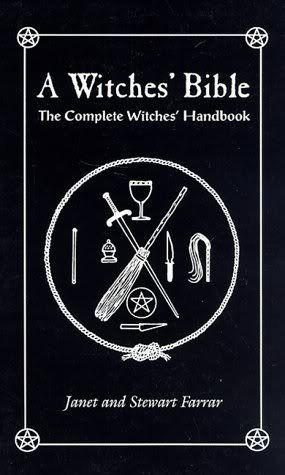
1996: A Witches' Bible: The Complete Witches' Handbook (re-issue of The Witches' Way and Eight Sabbats for Witches)


With Stewart Farrar and Gavin Bone
1995: The Pagan Path
1999: The Healing Craft: Healing Practices for Witches and Pagans
2001: The Complete Dictionary of European Gods and Goddesses


With Virginia Russell
1999: The Magical History of the Horse


With Gavin Bone
2004: Progressive Witchcraft: Spirituality, Mysteries, and Training in Modern Wicca


**************************************************


From what I have seen, Janet Farrar is about as close as it gets within the leadership of the current milieu, of a woman worthy of the title of "a daughter of Cern." I have not liked a lot of what I have seen within the current leadership. There are a lot of modern politial tie-ins, non-folkish beliefs, lack of cultural pride, and "Feminism" as opposed to the tradition of Cernic women actually being leaders in the community at large. "Man-hating," in general, is about as far as one can get from the Cernic tradition; and, of course, the opposite would be true as well.

Janet Farrar is beautiful lady in many ways. The only thing I have looked at so far that I don't really agree with is the nudity as far as initiations. There are a lot of problems with that. It unnecessarily makes earth-based paganism look suspect; and it generally "throws a monkey wrench" into the whole idea of Cernic woman being close to people within their communities.

Cernic women are to be "spiritual mothers"; advisers of life's problems. I think we have all seen examples, just in general, of certain women--virtually all married mothers--who have friends or relatives who, while visiting their home, gravitate to them for advise. Sometimes these women are younger than those to consult with them. It's a beautiful aspect of our distant culture, which has been lost within "cultural" Capitalism and Marxism.

Personalty, I can think of three such women. Once I found myself speaking to one of them while her husband was in the garage working on his motorcycle. I was distressed about something, and I found myself sitting on an ottoman, literally at her feet, looking up at her. She had on a long, mostly black, earthy dress. Her leg was crossed, and her foot was slowly spiraling in a circle as I told her about a certain issue of mine. She gazed at me, listening, as her two young children quietly played on the floor nearby. Her brown eyes reflected neither an upbeat nor a gloomy mood; before finally giving her assessment of the situation. Now this woman was Catholic, but somehow our folk traditions remain deep inside of our genetic memories.

One other such woman, also married, a Christian, and a mother; comes to mind. I can recall one time walking up to her home with her husband. She was in front of her door, then greeted me by name, smiling. It was confirmation that this was "her home," not like just walking into someone's house and maybe saying "hi" to them sitting across the room. "Hospitality" is one of the Nine Noble Virtues of Odinsim. It's a big part of Cernism I believe. It doesn't mean that anyone is welcome. I think that it chiefly means that this part of our lives is important, and how a family treats a guest genuinely stands for something.

Another time, exactly the same thing; I walked into a friend's home for the first time. As I entered the living room, there she was! His wife, very long light brown hair, hazel eyes, slender, long red earthy-type dress, holding a fluffy orange cat, and standing directly in our path. As I know now, she was the type of woman whom you must earn her trust. She looked right into my eyes as I approached her. Her stare was neither positive nor negative. The message was not lost upon me... this was HER house! I have not witnessed this power from any man I don't think. It's sad that so many younger men cannot comprehend what a real woman is all about.

One time recently I heard a young adult ask the question, regarding our culture, "what is our culture anyway?" I think the foundation would start with women like these. I believe that we have been herded into the false paradigm of a symbiotic Hegelian dialectic; and this pervades even modern attempts at getting back to our folkish earth-based spirituality.


.

Thursday, October 20, 2011

Loose Ends: Valcamonica, Cernunnos, Wicca, Druids, and the Pentagram - Part II


Witches: Part 1 (Part 2 below)

This is an episode of Lifetime's Intimate Portrait: Witches

This I believe aired around mid 90's. I don't remember when I taped it. It's a bit jumpy in a few parts. This was taped originally on VHS (remember them?!)

I cropped out the "Historical" parts. Many of the info is outdated. I tried mostly to get the interviews with Modern day Witches & Wiccans.

However I don't agree or support all of the info. I think this would be interesting for those who follow the teachings of Laurie Cabot, Z. Budapest and Janet Farrar.


**************************************************


The original 'Loose Ends: Valcamonica, Cernunnos, Wicca, Druids, and the Pentagram' was posted on March 5, 2009; and it has been the most popular post from this blog by a country mile! Out of over 10,500 page views, most of that fairly recent, that one post accounts for about 20% of the total. So I think it's only logical to update some of the knowledge. The original was an attempt to tie-in various concepts. It was more of a musing of the subjects. Maybe we can do better.

To start with, the "Cernic tradition"--after many centuries of often brutal state and church-sponsored religious condemnation--developed into what is referred to as "European witchcraft." The idea of "Wicca" is a recent development; and one which does not necessarily adhere to it's parent "Celtic paganism." By "Celtic" I mean the spiritual-traditions of the loosely-connected pre-Roman Celtic cultures who lived, at one time or another, from Ireland to Turkey and from Poland to Spain. It seems pretty clear that the Cernic spiritual hub was located in Gaul, and Cisalpine Gaul, but it may have sprung from the Hallstatt culture in what is today south Germany. Horned or antlered images can be traced back as far as 20,000 years ago in central Europe. It seems at least possible that the origins of this spiritual tradition may date back with the early proto-Europeans who predated other Indo-European peoples.

Recent archeology is showing more and more that the ancient Celts built roads which served as trade routes across Europe; from marketplace to marketplace; from community to community. Cernic spiritual concepts likely migrated in this way, and mixed with other spiritual traditions on those far off places. For example, the ancient Celts, in what is today England and Wales, apparently made no reference in art or symbology regarding Cernunnos; but they developed their own concept of the "horned god." It seems to be true that females, special females, were generally the high priestesses of this earth-based spiritual traditon. The forest was their church.

Wicca is a universalist concept developed by Freemasons in the United Kingdom; and the pentagram they adopted goes back to Sumeria. However, there are references to the pentagram within European witchcraft which can be traced back about five centuries. Having "borrowed" many things from other pagan religions worldwide, Wicca only vaguely resembles European witchcraft or Celtic paganism. For example, the ancient Egyptian goddess Isis had nothing whatsoever to do with Cernunnos. It's fun to compare certain traditions, but to splice them together only accomplishes to spoil their uniqueness. Also, modern politics are no place to inject religion; and many well-intentioned people are turned off by politically-minded people within any religion.

But getting back to the Cernic tradition of the ancient world; it's not entirely clear how this spiritual tradition interacted with the Druidic spiritual tradition which was also Celtic in origin. The Druids lived in ancient Gaul as well, although it appears that most of the high priests of Druidism were males. It was also an earth-based spiritual tradition, which also existed in what is now the British Isles. It appears that the Cernic traditions merged with the Teutonic Wotanist traditions in some areas. I haven't seen evidence of how Druidic ideas may have interacted with the Wotanists, but I would guess that all of these beliefs merged in some places. I don't think that today it's pragmatic to open up ancient feuds; but there is absolutely no doubt that Christianity fully replaced the Cernic, Druidic, Wotanist, and many other earth-based rites; either by coercion or force. It was not just the Romans who perpetrated this policy either.

 It should be mentioned that Cernunnos was not the only Celto-Gaulish god, and that there were other gods and goddesses like there is in Odinism; but Cernunnos (pronounced as "KER-new-nos") was the chief one in most places (just as Odin is in Odinism). Some of the dark symbolism in European witchcraft is probably a result of it having to exist underground for so long; but some of it may have always existed. "Dark imagery" does not necessarily reflect "evil." The ancient forests were often dark places. It seems obvious to me that this is mainly just a reflection of nature. To the ancients, the night was a scary place; and they may have counted on Cernunnos to protect them. Any hike at night in a remote natural area will give us an instant connection to that world.

It seems obvious to me that the rightful daughters of Cern today, would be the most logical ones to access "Cernism" and serve as its high priestesses. To the ancient Cernic pagans, the family was at the heart of their culture; and the woman was the head of the household. Not the "head" like she was bossing around her husband, but boss of the "household" while he was away hunting, providing, or at war. This one element of their culture marginally found it's way into later Christian societies, which had entirely different views regarding men and women. The Cernic male represented "law"; while the Cernic female represented "justice." Cernic women were the spiritual leaders of their folk societies. They were at the center of everything.

Cernic women were very strong-women, not "Feminists," which is an entirely modern political construct which attempts to make females more masculine. There were "women warriors" in Cernic societies. They weren't like guys, but simply were just big strong gals, period. Obviously there are some women who could wipe the floor up with weaker men; and these women were pragmatically allowed to serve the tribe in battle. It was all about the family, clan, and tribe... maybe sometimes of a "tribal federation," or loosely their nation.

It's important to compare the Cernic societies with the Odinic societies. Of course, the Cernic culture had it's own mythology, just like Odinism. There are many similarities. Odinism may have developed a little more of a "heroic ethic," which seems to remind one a little more of "the masculine"; while Cernism, although in many ways a "warrior society," somehow seemed to be a little bit more "down to earth," and reminds one a little more of "the feminine." As to where the Druids fit into all of this, I don't know. Some Celtic societies seemed to be Druidic, while others seemed to have been Cernic. I think it's also very important to remember that Cernism influenced other tribal groups. For example, some ancient Norse seemed to be almost Cernic, or at least strongly influenced by them.

Obviously, the first 'Loose Ends" article was from the point of view of historical Camunian culture. The Camunians had not surrendered their native beliefs by the sixteenth century, which is pretty remarkable. However, the Val Camonica witch trials were just two of many such events in Europe during the Middle Ages, and after. In all of these tragic events, think of the great women and men who died. They were martyrs who aren't even given the proper status of martyrs. In the earlier article, I had stated that I believed that the witch trials were exaggerated; and they probably were in most locations in Europe and the American colonies. However, in some locations it was pretty extreme, as the last link above reflects in its 'Counting the Witch Hunt' graph by Ronald Hutton. It's hard to argue with those numbers.

.

Wednesday, October 19, 2011

Guido von List: Part 10

The Raido rune

I wasn't going to look at another one of von List's runes here, but perhaps just one more. The numerous names that he used for it did not include "raido," so I actually had to look it up since I'm not especially familiar with the rune names other than a few. Naturally I was familiar with this runic symbol itself.

This post could have some material that some would put in the category of what I would call "guilt by association." All I can say is that I see this as partly a spiritual endeavor. By that, I mean earth-based religion(s). I see a lot of beautiful and powerful ancient symbolism in particularly Alpine Gaulish, Germanic, Slavic cultures; and even from proto-European cultures like the Camunni. These aren't necessarily runic artifacts found in some cave. Some of these pre-Roman, Alpine cultures were far more advanced than archeologists had previously thought. Recent digs from Celtic peoples in modern France and south Germany have shown that their architecture often consisted of an underground cellar, a strong stone foundation, with a finely-constructed two-story wooden building on top. They had trade routes, marketplaces, metalurgy, fine art, weaponry, leather products, and a system of tribal identity-socialism. Everyone was accounted for. Nobody went hungry.


**************************************************


The website Thora Design quickly sums up the Raido rune with the following description:

Raido means riding as in traveling and moving. On a deeper level, Raido refers to the wheels of a wagon, the mechanism behind which movement actually occurs. To the early germanic people, the wheel was a symbol by which the gods set the universe into motion, a great cosmic wheel by which all the cycles, patterns and orders of the universe move in rhythm too. Being a rune, then, Raido also represents moving in the right direction and doing what is proper and correct.


**************************************************


*Raidô "ride, journey" is the reconstructed Proto-Germanic name of the r- rune of the Elder Futhark ᚱ. The name is attested for the same rune in all three rune poems, Old Norwegian Ræið Icelandic Reið, Anglo-Saxon Rad, as well as for the corresponding letter of the Gothic alphabet 𐍂 r, called raida. The shape of the rune may be directly derived from Latin R.


Name Proto-Germanic Old English Old Norse *Raiđō Rad Reið "ride, journey" Shape Elder Futhark Futhorc Younger Futhark Unicode
U+16B1
Transliteration r Transcription r IPA [r] Position in rune-row 5


Rune Poem:[1]
English Translation:
Old Norwegian
ᚱ Ræið kveða rossom væsta;
Reginn sló sværðet bæzta.

Riding is said to be the worst thing for horses;
Reginn forged the finest sword.
Old Icelandic
ᚱ Reið er sitjandi sæla
ok snúðig ferð
ok jórs erfiði.
iter ræsir.

Riding is of sitting a blessing
and swift journey
and horses toiling
Anglo-Saxon
ᚱ Rad byþ on recyde rinca gehwylcum
sefte ond swiþhwæt, ðamðe sitteþ on ufan
meare mægenheardum ofer milpaþas.

Riding seems easy to every warrior while he is indoors
and very courageous to him who traverses the high-roads
on the back of a stout horse.


References
1.    ^ Original poems and translation from the Rune Poem Page.


External links


**************************************************


Guido von List's "Raido rune" (he used different names):

rit, reith, rath, ruoth, rita, rat [rede], roth, [red], rad [wheel], rod, rott, Recht [right], etc.

A fifth I heard, if from a happy flight
          a shot flies into the host;
however swiftly it flies, I will force it to stop
          if I can only catch it with my gaze.

The thrice hallowed "Rita," the solar-wheel, the "Urfyr" (primal fire, God) itself! The exalted introspective awareness [Innerlichkeitsgefuehl] or subjectivity of the Aryans was their consciousness of their own godliness, for "internity" is just "being-with-one's-self," and to be with one's Self is to be with God. As long as a people possesses unspoiled their entire original "internity" as a "natural people,"* it also has no cause to worship an external divinity, for an external divine service bound by ceremony is only made obvious when one is not able to find God in one's own innermost being, and begins to see this outside his "ego" and outside the world--"up there in the starry heaven."

The less internal the person is, the more outward his life becomes. The more a people loses its internity, the more pompous and ceremonialized its outward manifestations become--in the character of its government, law, and cult (all of which will begin to emerge as separate ideas). But they should remain one in the knowledge: "What I believe, is what I know, and so I also live it out." For this reason, the Aryan devine-internity is also the basis for a proud disdain for death among the Aryans and for their limitless trust in God and in the Self, which expresses itself gloriously in the "Rita," [cosmic order, law] and which has the fifth rune as its symbolic word-sign. Therefore, this rune says: "I am my rod [right], this rod is indestructible, therefore I am myself indestructible, because I am my rod."

*The "people as a natural people" is not being in a savage condition, for uncivilized "savages" live in the bondage of the most horrible "shamanism." The "people as a natural people," on the contrary, stipulates a high level of culture,yet free from any kind of false sophistication.


**************************************************


Rachel

Sometimes I think that the concept of "Wotan" is simply too big for everyday living. When I use the term "Wotan," I'm not referring to the very recent usage of the word. I am using it in relation to what I think was the more widespead pronunciation. To me, "Odin" sounds more specifically Scandinavian, or even Icelandic; while "Wotan" somehow reminds me more of the ancient mountain forests of central Europe. Wotanism, with all of it's related myths and concepts, is a little much for the 6:00 AM alarm.

I have gotten the impression, from my very limited knowledge of Guido von List, that he may have thought the same thing. He did found a folkish spiritual doctrine which he named "Armanism" after "the Armanen." The Armanen were a priest-class in the pre-Roman German lands. From 'Secret of the Runes', I got the sense that he believed that the more complex concepts and ideas of Wotanism were more of a study for a "priest-class," similar to what we know in the major religions today. In other words, to ease the burden, of a complex spirituality for everyday living, for the average person. Of course, it's going to be there; but it's impractical for it to be twenty-four/seven, if you understand what I mean. Wikipedia, which is pretty good when it's not dealing with subjects on the periphery of "political correctness," has von List wanting to replace "alien Christianity" with Armanism; despite clear evidence to the contrary, as we covered earlier.

We can cover Armanism and other related ideas at a later time. As one can see in von List's interpretation of the Raido rune, there is a close tie-in with the ideas behind Armanism. I think part of the idea was for a simpler version of Wotanism for the masses. I guess what I'm really trying to say is that there is no practical way that a person can truly live by "The Creed of Iron" from dawn to dusk. Life is struggle, and sometimes "going on instinct" cannot be avoided. Often, life is one big fight! Why not just acknowledge that one needs a bare-bones version of one's spiritual path, for everyday living. A "mode of operation" for the daily fight, to be blunt.

One common theme of Armanism is imagery of the natural world, sometimes mixed with shrines or temples with folkish symbology. Often, nudity is depicted as well. When people marry, they form a new kinship. At least that's what was intended, but I can't say that it's always the case today with Western governments totally obsessed with alien ideas. I don't even mean alien to our culture, but more like alien to the human race at large. This kinship was intended to be sacred. A new family construct, still tied to its clan, still tied to its tribe, and still tied to its nation. I think that this kinship was closely connected to the Armanism concept. I don't necessarily mean connected to Wotanism, although that too. That's obvious. But to the spirit of one's daily life. To all the things that might be just mundane, and seemingly not have anything to do with one's spiritual path.

My ex-fiance was named Rachel. She was a physically beautiful woman of Tuscan descent. She had really long straight brown hair. The type of hair that looked very dark in dim light, but could look blondish in the bright sun. Her eyes were basic brown, somewhat prominent, and with thin rounded feminine eyebrows. Her nose wasn't very prominent, probably average for a straight nose. Her skin was a beautiful flesh tone; not ivory, not pinkish, not olive. She had an unusual bite. It's difficult to describe, but it added a certain character to her look. Her head and face were subtly round, with somewhat prominent cheekbones, but her features weren't "heavy." If her personality was even marginally docile, you might even say that she was cute. Her headstrong manner and loud high-pitched voice were in strong contrast to her appearance.

Rachel stood 5'8 1/2" tall, weighed about 140 pounds, and had the natural body of a 70s playboy bunny. She was Mediterranean, but looked almost like a German brunette. When they were into all of that artistic nude pagan-like photography in Germany; hypothetically, I think that they would have been really impressed with Rachel. The wide shoulders, long limbs, the muscularity. She wasn't literally athletic, but she would have been a fine athlete if she had any desire to be. She had large feminine hands which didn't necessarily match her body type. Her surname loosely meant "sun," like the sun-worship of Armanism; and her sister's name was "Rita," like the Raido rune or solar-wheel; and the "R" rune is the same as the "R" in Rachel; so there's the synchronistic connection to this for me.

She had an absolute hold on me, even though her drug use and verbal and even physical abuse made the relationship entirely impractical. Her awesome physical beauty was such that I would have just let her "be boss" if that could finally reconcile our relationship. Yes, I wanted the beautiful Tuscan girl from the East Bay. No doubt about it. Eventually, as her audacity grew, and I finally grew tired of "fixing things," the relationship ended; and she went on to meet her self-appointed destiny.

The only really good memories was the occasional humor. She could be really funny if she wanted to be, but chose not to be for some unknown reason. For example, her childish attempts to "punish me" for some absurd reasoning, could be pretty funny. The contrived attempt to "be mean" to me. Sometimes she would make loud funny comments in public. Things that were true, but nobody had the guts to say it, and people usually laughed at the sheer audacity of it. She was totally serious about those comments, but in her own crazy way, it was almost like her version of a "dry sense of humor." And, sometimes people would tell me stories of how she did some audacious thing which struck them as funny usually because they didn't know the dark side of her. I sometimes laughed at her misplaced "fighting spirit." Maybe she was a warrior in a previous life, and didn't really fit in well in this life because of it? She needed a war to fight.

I guess I look back at Rachel as a type of "spirit." Not a goddess, but an "energy." If I'm in a good fight, then I want to be like her; but otherwise, I don't want to be like her. Like a "spirit-energy" to draw upon from memory. This energy could also represent, for me, wasted talent. Misplaced energy. If she put all that energy into a business maybe, she probably could have been very successful. So, maybe it's like a lesson too. Use your energy and resources wisely. Originally I wanted to mention her because she reminded me of certain aspects of Armanism, for me. Maybe she is like a goddess for me. Sort've like an aloof goddess, like the god Loki.

~RIP my dear ♥~

.