Showing posts with label business. Show all posts
Saturday, March 7, 2020
The "Trident" story - what does the Beretta logo mean?
'The "Trident" story - what does the Beretta logo mean?'
Matteo Recanatini - Beretta Blog - October 12, 2011
One day, we were sitting around the large desk of one of our conference rooms, discussing over and unders and the staggering heritage that links these guns to the five centuries of Beretta history.
At one point, Angela pointed out that most people recognize the Beretta logo: the iconic three arrows and circles often referred to as "Trident," but that most people don't really know why and how Beretta's logo came to be.
On our Facebook and Twitter accounts, we have mentioned it, in the past, and have answered questions about just this, but I thought it wise to publish a quick post about our most recognizable graphic.
Like all respectable 500-year old companies, Beretta has had its share of logos: the shield with the letters "PB" (for Pietro Beretta, the father of the industrialized Beretta,) the duck with open wings, and the more simple "Fabbrica d'Armi Pietro Beretta" are some of the representations that many of our readers will recognize.
And then, there's the "Trident," which (truth be told) is not a trident at all.
The story of this logo starts not far from Gardone Val Trompia, in the small town of Cargnacco, where poet, writer, director, mariner and journalist Gabriele d'Annunzio ended his days, in the late 1930s.
When you walk into the villa that Gabriele d'Annunzio purchased and where he retired, you will find the very first "Trident." It was he who, ever-the-artist, developed this graphic design to symbolize the will to get things done. The encircled arrows represent the three shots fired by a battleship that engages a potential enemy: the arrow on the left reprents the first warning shot, fired at the ship's stern; the arrow on the right represents the second warning shot, fired at the ship's bow. The central arrow is the last round fired, when the ship doesn't yield: this one is aimed at the ship itself. The logo was dubbed "Dare In Brocca" or "hit the target."
Mr. Beretta was fascinated with this symbol, and asked Gabriele d'Annunzio if he could "borrow it." Gabriele d'Annunzio gave Mr. Beretta the rights to use it as the company's symbol, and from that moment, the "Trident" became the company's logo.
So, now you know it. Next time you're wearing a hat like this one, or carry your Beretta firearm to the range or on the field, make sure you share this story with your fellow shooters!
************
'Beretta’s “Trident” logo explained'
************
BerettaUSA.com
.
Labels:
Beretta firearms,
Brescia,
Brescian tri-valley,
business,
industry,
Lombardy,
Val Trompia
Thursday, February 27, 2020
Volpi Foods - 118 year old family business of Lombard origin in St. Louis
Volpi Foods - Patience and Passion Since 1902
volpifoods
VOLPI CRAFTS FOOD WITH CARE
We’re the only midwestern specialty foods company that makes our own dry-cured meats, letting nature perfect each flavor in our family’s authentic recipes. There are no shortcuts or artificial processes. We let nature take its time to bring our foods to their delicious peak with fresh local meats and few ingredients.
Volpi is mindful of what goes into our foods so that you can feel good about eating them.
visit VolpiFoods.com for more
************
Our Heritage
In 1898, John Volpi arrived in America from his home in Milan, Italy, bringing with him little more than a craft and a vision. Having learned from his elders the ancient European art of dry curing, John had a dream of importing the centuries-old traditions across the ocean—thus continuing to serve his customers once they migrated to America.
Four years later, in 1902, he opened Volpi Foods at the intersection of two dirt roads in the St. Louis neighborhood known as The Hill. There, he created cacciatore—dried salami small enough to fit into the pockets of the local clay miners. He used only local ingredients and suppliers and dried the meats using the same method he’d learned in Italy: opening and shutting windows to control the temperature and humidity of the air that circulated throughout the room. The response to John’s exquisite craftsmanship was overwhelming. He soon added delicacies such as prosciutto, guanciale, pancetta, and coppa.
As demand grew, John expanded both his products and his personnel, recruiting his fourteen-year-old nephew, Armando Pasetti, from Italy. His new apprentice traveled by boat to his new home in America lived upstairs from the shop and learned the business just as his uncle had: from the bottom-up.
Armando swept the floors, tied sausages, and eventually, mastered every aspect of his uncle’s craft—right down to the opening and closing of the windows.
In 1957, upon John’s passing, Armando took the helm of the company, which was now a thriving business. In 1980, he continued to meet consumer demand by bringing Volpi Foods national and enlisted his daughter to help run the manufacturing plant. An eager pupil, Lorenza studied first-hand the techniques behind Volpi’s premium meats—and supplemented her culinary expertise with an MBA from Washington University.
In 2002, exactly 100 years after John Volpi opened his business, Armando passed the torch to Lorenza. Now, as president of Volpi Foods, Lorenza continues to refine her great-uncle’s craft—while adhering to the techniques he brought with him to America more than a century ago. Volpi Foods still relies exclusively on local suppliers. It still dries its meats by adjusting the temperature and humidity of natural airflows. It still prides itself on satisfying consumer needs. And it still sells cacciatore from its storefront in The Hill.
************
Lidia's Italy in America with Volpi Foods
volpifoods
Lidia's Italy in America stops by Volpi Foods in Saint Louis.
************
Our Home
At Volpi Foods, we continue to improve on our traditions as we move forward to keep pace with our customers.
Our home remains on The Hill in St. Louis. There, as long-standing members of the community, we’ve been serving generations of meat lovers from the same storefront for more than 110 years. We also follow our customers, distributing Volpi Foods to locations throughout the country. And whenever those customers come back to The Hill, we’re ready to help them recapture the taste of the “old neighborhood.”
We prepare our meats in the same facility John Volpi opened in 1902, although we’ve added two more since then. Our meat is still sourced here in the Midwest. All of our farmers are within two hundred miles of our facilities, and all of our meat arrives within forty-eight hours of slaughter. As a result, our meat is the freshest anywhere. Plus, our pork has the ideal pH level to ferment naturally, which means we don’t steal flavor or nutrients by over-processing. Instead, we tolerate only the most minimal processing, allowing nature to take its course, and letting the natural flavors in the pork blossom.
Each of our facilities—Uno, Due, and Tre—comes with its own climate, humidity, and airflow. The conditions of each are paired with certain products, so we plan accordingly. They cure salami and other deli products in Uno, prosciutto and specialty items in Due, and Primo and Prep products in Tre. Our craftsmen continually adjust the conditions of each room, ensuring that all of our salume is prepared to perfection, and in the most natural way possible—individually, and by hand.
************
Milanese heritage
"The Hill" in St. Louis was long ago a "Little Lombardy" in particular, and is still a mostly Italian neighborhood. Actually, the Lombard community was specifically from the Milano province. The Lombard community still in San Rafael, California also has it's roots specifically from the Milano province, and was also one of the dozen "Little Lombardys" from a century ago.
I purchased Volpi mortadella meat from Safeway in Daly City yesterday, without any knowledge of Volpi Foods. I saw they were in St. Louis, and I suspected the possible connection. What I also liked is that there are no nitrates or gluten.
.
Labels:
business,
Lombard food,
Lombard heritage,
Milanese heritage,
Missouri,
St. Louis
Monday, February 6, 2017
Alfa Romeo "Giulia" Super Bowl commercial
Official 2017 Alfa Romeo Giulia Super Bowl Commercial | "Dear Predictable" | Extended Cut
Alfa Romeo USA
Leave predictable behind. The all-new Alfa Romeo Giulia stirs your soul, feeds your desires and delivers a permanent escape from monotony. The Alfa Romeo Giulia says goodbye to “Predictable.” A common emotion that comes from driving any other luxury sedan. Giulia has found her true love - a driver that appreciates her for more than just her beauty. Someone who feeds her passion and embraces her power. Therefore, she must say farewell to Predictable for good.
Learn more: https://www.alfaromeousa.com
SUBSCRIBE FOR MORE ALFA ROMEO USA VIDEOS: https://www.youtube.com/user/AlfaRomeoUSA
To ensure a positive online experience for the entire community, we may monitor and remove certain postings if we find them to be inappropriate.
Follow the Alfa Romeo brand on social:
· Facebook: https://www.facebook.com/alfaromeousa
· Twitter: https://twitter.com/AlfaRomeoUSA
· Instagram: https://instagram.com/alfaromeousa
· Tumblr: http://alfaromeousa.tumblr.com/
· Google+: https://plus.google.com/+AlfaRomeoUSA
*************************
There were several ads on the Alfa Romeo YouTube channel under "official" Super Bowl commercials, but this one was the Giulia model. In any case, this is interesting in that is seems to suggest a major upsurge of business for Alfa Romeo USA. This model is in the $42,000 price range, making it a little more affordable than most of the other popular luxury sport cars. Of course, Alfa Romeo being from Milan, Lombardy; but now is a subsidiary of FIAT, headquartered in Turin.
Alfa Romeo Giulia - Car and Driver
Official 2017 Alfa Romeo Giulia Super Bowl Commercial | Mozzafiato
AlfaRomeoUSA
Mozzafiato: To take one's breath. The Alfa Romeo Giulia gives it back.
.
Labels:
automobile industry,
automobiles,
business,
cars,
Italy,
Lombardy,
Milan,
Milano,
United States
Wednesday, March 30, 2016
Countdown to the Pagan New Year - Part 5
Friday is April 1st - Pagan New Year's Day?
"Actually April 1st was the beginning of the new year until the reorganizing of the calendar by the Gregorians. After this happened though many people continued to celebrate the beginning of the new year on April 1st. These people were called April Fools and many people played pranks on them. Now we just play pranks on everyone." -- wyldcatt76, Yahoo user
It seems to me that this idea is something that we should take a much closer look at from a historical, and then a practical standpoint. Currently, Christmas/Yule is a week behind New Years Day; just as within this concept, Ostara is a week behind Veneralia. The origin of the names becomes less important when one considers that there were numerous regional names. Even if Ostara itself was considered the beginning of the new year, it would require the same change of perception. I don't have the answer at this time, but our Pagan ancestors did see spring as marking the beginning of the new year.
************
The Julian Calendar
The Julian Calendar, established by Julius Caesar in 46 BC, made January 1 the first day of the year. But as Christianity spread throughout Europe, efforts were made to christianize the calendar by moving New Year's Day to dates of greater theological significance, such as Christmas or Easter. Some countries continued to use January 1, justifying this as the date of Christ's circumcision. As a consequence, by the 1500s the European calendar system was a mess. Not only had errors in the Julian calendar caused the solar year to diverge from the calendar year, but also countries were beginning the year on different dates.
Most regions in France had been using Easter as the start of the year since at least the fourteenth century. This caused particular confusion since the date of Easter was tied to the lunar cycle and changed from one year to the next. Sometimes the same date would occur twice in a year.
However, the French used Easter as the start of the year primarily for legal and administrative purposes. January 1, following the Roman custom, was widely regarded as the traditional start of the year, and it was the day when people exchanged gifts.
Festival of Lud
Northern Europeans observed an ancient festival to honor Lud, a Celtic god of humor. There were also popular Northern European customs that made sport of the hierarchy of the Druids.
'The Origin of April Fool’s Day'
Neopagan business
I think that "thinking economically" is important for any type of community. I wanted to give a plug to an upcoming business, which hasn't begun operations as of yet. It's called Brimming Horn Meadery, owned and run by Heathens. I've been listening to some Northern Runes Radio, which has guest interviews as well as hosting audio programs from other Heathen groups, so I've made note of some new particulars. I prefer to think of the larger concept of "Neopagan business" rather than "Heathen business" because I believe that someone shouldn't only draw the line at their own path or tradition.
Brimming Horn Meadery
28615 Lewes-Georgetown Hwy.
Milton, DE 19968
brimminghornmead@gmail.com
New Heathen podcast
Tier One Viking Radio is part of the Northern Runes Radio network. I think NRR and Daniel Updike have done a great job of putting together a defacto "channel" for the Heathen community. It's important to have that literal "voice" out there.
Tier One Viking Radio
Tier One Viking Radio facebook
Stalkers
I've become a bit addicted to stalking TV programs, maybe because I've observed it firsthand. 'Obsession: Dark Desires' is one such program on the Investigation Discovery channel... which is basically a soap channel for true crime addicts. This was an 'Obsession' program from season two entitled 'Occult Following', in which a married Wiccan woman was stalked by an absolutely incorrigible maniac. You would probably need to go full screen on this.
Obsession Dark Desires s02e05 Occult Following
Amanda Fonda
Nordic Circle Kindred
The Nordic Circle Kindred is a Heathen kindred in Arizona which gets involved in the larger community; particularly in helping veterans who often wind up in a sink or swim situation in civilian life. You can find their recent interesting interview on NRR. Also, the Huginhof Kindred of Indiana has one of the NRR network podcasts.
Lady
I so remember this song when I was a child with my family on vacation in Los Angeles. Driving along on a warm twilight, looking out the window, and listing to the powerful melody of this song.
LITTLE RIVER BAND Lady
daveinprogress3
One of the greatest joys of 1978 for me was observing the great Aussie band Little River Band conquer the American market and how!
'Reminiscing' had been a huge hit earlier in 1978, and "Lady" was to be another big hit on Billboard's chart; one of their six Top 10 hits there, and contributing to their 25 million selling albums. The aforementioned hits were sadly not big successes at home (the tall poppy syndrome seemed to be alive and well in Australia by 1978); either that or we simply didn't think that middle of the road pop/rock was hip anymore
Air Supply struggled a little at home too while they smashed it in America, so maybe these two groups were ultimately more American than Australian in spirit and style.
Nonetheless, Australia couldn't be prouder of the achievements of this marvellous band of musicians, songwriters and performers. LRB certainly leave behind a great legacy of pop gems and solid albums filled with memorable tunes and hit singles.
"Lady" caught my ears thanks to the Top 40 Countdown and the ubiquitous Kasey Casum. However, this sweet track couldn't do any better than #46 at home, whilst climbing to #10 in America.
Enjoy!
Maybe the most important quote of them all
In this age of outrageously selected, omitted, double-standard, and mismanaged information; these may ultimately be the quotes most relevant to our time.
"Truth is truth even if no one believes it. A lie is a lie even if everyone believes it." -- Author unknown
"Better to be slapped with the truth than kissed with a lie." -- Russian proverb
"Even if you are a minority of one, truth is still truth." -- Gandhi
Our big metal ball
Few people are even aware that at the center of the earth is a giant molten metal ball... almost the size of the moon! It spins underneath us, and we're not even aware of it.
Massacre of Verden
The Massacre of Verden, Bloodbath of Verden, or Bloody Verdict of Verden (German Blutgericht von Verden) was a massacre of 4,500 captive Saxons in October 782. During the Saxon Wars, the Saxons rebelled against Charlemagne's invasion and subsequent attempts to christianize them from their native Germanic paganism. The massacre is recorded as having occurred in what is now Verden in Lower Saxony, Germany. Some scholars have since attempted to exonerate Charlemagne of the massacre, but these attempts have been generally rejected.
Just the other day, I was watching a 2007 documentary entitled 'The Dark Ages' on the History Channel. One of the historians, in no uncertain terms, painted the Vikings as evil and destructive. What they rarely tell us was that the Christian missionaries were conducting what is called today "economic discipline" on the Vikings because they wouldn't convert to Christianity. This included cutting them off from established trade routes. Of course, Charlemagne and his army were a big part of this process.
A response to our trash culture
I was reading an article about how Nancy Sinatra, who was tactfully "sexy" in her day, was critical of the overt, entirely over-the-top, expressions of sexuality from many mainstream musical acts today. Miley Cyrus is a good example of this, and it's really not sexy. Some have even suggested that she may be mentally disturbed. I doubt that. The "system" always knows what it wants, and relays it in the unspoken language (trial and error method). People get the message, and there will always be people who will do its bidding. I wanted to add a quote in regards to this phenomenon. The first part is an old quote, and I added in the second part.
"There’s no freedom without restraint; nothing can be sexy or alluring without class."
The bonfire of Germany
The absolute horror story which has occurred in Germany during the last year is truly beyond description. If I even attempted to write down some of the things which have happened, it would ruin your day. It would be difficult to believe. We're obviously not getting the real news of what has, and what continues to occur over there. Right now, energetically, I would like to place the following text and video here.
Where have all the good men gone
And where are all the Gods?
Where's the street-wise Hercules
To fight the rising odds?
Isn't there a white knight upon a fiery steed?
Late at night I toss and I turn
And I dream of what I need
I need a hero, I'm holding out for a hero
'Til the end of the night
He's gotta be strong
And he's gotta be fast
And he's gotta be fresh from the fight
I need a hero, I'm holding out for a hero
'Til the morning light
He's gotta be sure
And it's gotta be soon
And he's gotta be larger than life
From ' I Need A Hero' by Bonnie Tyler
Germany, Heart of Europe
Bogoljubskij
A tribute to Germany, the heart of Europe.
The track is "Von den Elben" by FAUN.
Timeless
Patsy Cline - Crazy
BasqueLady86
Crazy
Crazy for feeling so lonely
I'm crazy
.
Labels:
ancient festivals,
Asatru,
business,
Germany,
mead,
music,
neopagan,
popular culture,
quotes,
science,
wheel of the year,
Wicca
Wednesday, February 17, 2016
Notions amid the approaching Full Snow Moon II
Incredible promo photo from the 2009 movie 'Agora'
The film 'Agora' was about the life of the brilliant Greek mathematician, astronomer, and philosopher Hypatia in 4th century BCE Roman-Egypt. Click here and blow up this wonderful computer generated image to its full extent and notice the realistic detail. It's something of a time machine, showing what 4th century Alexandria may have really looked like. Included is the legendary Lighthouse of Alexandria, which from all accounts, functioned just like any modern lighthouse. The great mystery being how the light and power was generated, since it was destroyed by earthquakes many centuries later. Actually the lighthouse was constructed after the time of Hypatia. Murdered by a Christian mob for heresy, Hypatia belongs right up there with Boudicca, Joan of Arc, or Queen Isabella as one of the greatest women in history.
Cucina Aurora - A neopagan enterprise
I always read where neopagans, right up to the present, are always poor. Well, perhaps that is changing a bit. With the Irminfolk in New York state minting their own currency, the Asatru Folk Assembly in northern California having recently purchased great building and property, and with a few business upstarts like the New Hampshire-based Cucina Aurora, true socio-economic communities may take some type of form. Presumably a person may go out of their way or pay a little more to patronize or support something they feel connected to.
Dawn Hunt ("the kitchen witch") is the owner, an Italian-American, and a great cook. I first heard of her when she was a guest on a podcast by Raven Grimassi and his wife, and it was a great interview. I don't know if she practices Stregheria or not, but she is a neopagan witch and active in that community.
Cucina Aurora website
Cucina Aurora YouTube
Introducing Cucina Aurora and Dawn the Kitchen Witch!
Cucina Aurora
A Kitchen Witch is any one who has ever said a prayer over a meal. She is any one who has ever thought of the smiling faces on her guests when they taste the dinner she has made. He is any one who has ever put love into a surprise dinner that he made for his sweetheart. The Kitchen Witch puts intention in the foods that she or he eats and shares with others. Meet Dawn Hunt "The Kitchen witch" of Cucina Aurora.
Having a long standing love for cooking, a passion for good food and joy for gathering friends around the dinner table, Dawn started Cucina Aurora in 2008. Her purpose is to bring families and friends together around simple, naturally delicious and good for you foods. Cucina Aurora’s products are centered on home, family and the nurturing of those things. Check out her products, recipes & cooking demos at cucinaaurora.com.
Stephen Hawking Claims Black Holes Are Gateway To Another Universe
According to a new theory from astrophysicist Stephen Hawking, humans
can escape from the irresistible pull of a black hole by traversing the
event horizon into another universe entirely. "The existence of
alternative histories with black holes suggests this might be possible,”
Hawking said at a Stockholm event.
"The hole would need to be large and if it was rotating it might have a passage to another universe. But you couldn’t come back to our universe. So although I’m keen on space flight, I’m not going to try that." Humans might also appear as a ghost image or an extraterrestrial hologram hovering on the edge of the super-dense abyss, Hawking said. The theoretical information might be preserved like a frame grab of their passage into another dimension or parallel universe.
"If you feel you are in a black hole, don’t give up," Hawking said. "There’s a way out."
**************************************************
"The hole would need to be large and if it was rotating it might have a passage to another universe. But you couldn’t come back to our universe. So although I’m keen on space flight, I’m not going to try that." Humans might also appear as a ghost image or an extraterrestrial hologram hovering on the edge of the super-dense abyss, Hawking said. The theoretical information might be preserved like a frame grab of their passage into another dimension or parallel universe.
"If you feel you are in a black hole, don’t give up," Hawking said. "There’s a way out."
**************************************************
As I've said many times, the "Theism vs. Atheism" Hegelian dialectic blinders will soon be on its way out. Even a hardcore lifelong Atheist like Stephen Hawking is talking Metaphysical science. Far from being put out to pasture, Christians and Atheists will be jumping aboard and saying "I was with ya all along!"
Wikipedia is also a good source, with lists and webpages for nearby national, state, and county parks. There are also other areas that you can make note of, which may be be "forests" or even official parks, but contain smaller groves of trees and wooded trails which are just like forests.
A moment in time, a man in his element
Glen Campbell and the late Jerry Reed performing 'Southern Nights', and doing it just as good or better than a studio recording. This was probably from around 1990. Campbell is from Arkansas, and lived there his entire life I think. From his shirt, I'm guessing that this was in Arkansas somewhere, in perhaps late summer, along a lake, in a small setting, during a warm late afternoon. This would be one to go full screen. His perfect moment in time...
Jerry Reed and Glen Campbell - Southern Nights
santickles
.
Labels:
ancient history,
ancient science,
business,
community,
cuisine,
Egypt,
films,
food,
Greek,
Hypatia,
metaphysical science,
movies,
music,
nature,
neopagan,
popular culture
Saturday, May 10, 2014
Paul J. Baroni Company of Calumet, Michigan
![]() |
| Calumet, Michigan |
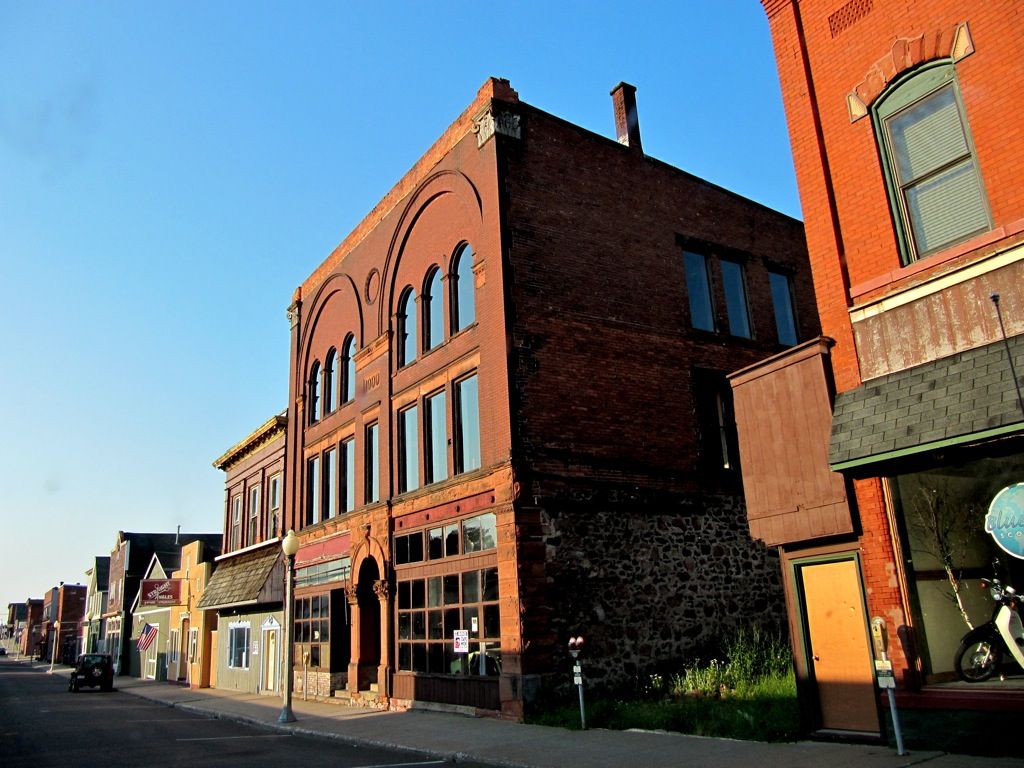
Calumet, Michigan is a village in the northwest part of Upper Michigan, which has a very long history of people generally of Lombardo-Venetian descent. The Paul J. Baroni Company has long been a distributor of Italian food products. The old Italian-American Federation of the Upper Peninsula was based in Calumet I believe. We can look into the history of that an another time.
A tradition on the move
Calumet’s Baroni Company to be taken over by Vollwerth’s of Hancock
KURT HAUGLIE - Mining Gazette.com - 8-22-08
CALUMET - Having a business owned by the same family for 73 years is quite a tradition, but some traditions have to come to an end. Although the products of the Paul J. Baroni Company will still be made, the company will no longer be owned by the Baroni family.
Nancy Baroni, who has been running the company, which makes sauces, various pastas and frozen pizzas, for two-and-a-half years, said although family members hadn't been giving serious thought to getting out of the business, when the opportunity came up last November they took it.
"It just kind of came up in conversation," she said.
That conversation was with Jim Schaaf, general manager of Vollwerth & Company of Hancock, Baroni said.
Because she's the only family member involved with production of their products, and because the next generation of Baronis have other career interests, Baroni said it seemed like the proper moment to think about moving on.
"The time was right," she said.
Currently, Baroni said besides herself there are one full-time and one part-time employee making the Baroni products. She does much of the local delivery of the products herself.
Baroni said Vollwerth's distributes its products, as well as Baroni products, to most of the Upper Peninsula and to parts of Northern Wisconsin, which is one of the factors that helped the family make the decision about selling to the sausage manufacturer.
"They're just a competent, long-standing company," she said.
Baroni said after Vollwerth's takes over production at their plant at the beginning of 2009, she'll be around for a time as production manager.
"I'm going to stay on as long as they need me," she said. "We have to keep the Baroni name going."
To assure that, Baroni said company containers and labels will continue to be used after the switch to Vollwerth's, as will the company product recipes.
"Nothing's really going to change," she said. "Your still going to have the same great products."
The full-time employee, Jared Liimatta, will continue making Baroni products when the production is moved to the Vollwerth Hancock plant.
Schaaf said after Baroni suggested Vollwerth & Company take over Baroni's it was decided that was a good idea because of the Baroni tradition.
"They've been a business for a long time," he said.
Vollwerth is a family-owned business, also, Schaaf said, and because Baroni's makes quality products, Vollwerth officials are interested in keeping the line going.
"They have a lot of loyal customers," he said. "We're not going to make any changes."
Production of the Baroni items will continue in Calumet until the kitchen at the Vollwerth Hancock Street plant can be expanded to accommodate the Baroni canning equipment, Schaaf said. A new storage facility will be constructed behind the plant.
On Sept. 1, Vollwerth will take over production at the Baroni plant on Sixth Street in Calumet, Schaaf said.
Schaaf said after the take over of Baroni, Vollwerth's will still make most of their products, including the sauces, ravioli, chili and frozen lasagna and ravioli entrees. The company doesn't have the floor space to continue the Baroni frozen pizzas now, but they may add them in the future.
Schaaf said it was decided not to purchase the Baroni manufacturing plant and continue production there.
"It was most practical to have it in one building," he said.
Baroni said the Baroni building will either be sold or rented out.
It is sad the tradition of Baroni family ownership of the company is coming to an end, but Baroni said it's time.
"It's going to be hard," she said. "I think it's a good move."
Kurt Hauglie can be reached at khauglie@mininggazette.com
.
Labels:
business,
Calumet,
cuisine,
foods,
Lombardian-American,
Upper Michigan,
Yooper culture
Monday, October 24, 2011
“Patihi, Patahé!” The Camuni of Brescia in Monongahela City: Part II
![]() | ||
| Sports legend Joe Montana, of half Camunian ancestry |
Borrowed from the archives of 'Poche Parole' (May 2009), the newsletter of the Italian Cultural Society of Washington D.C.
By Terry Necciai
The second of two articles
Railroad construction went at a furious pace through the region, both before and after the Panic of 1873, and gangs of temporary workers were recruited to level the grade and lay the ties and tracks. It is particularly difficult to determine who the workers were and where they came from because of the short term nature of the work and lack of records. However, it appears that the Italian workers found other jobs as a result of the new lines. Railroad development was often justified by the expectation that each line would open up a new area for coal mining. Industrial villages cropped up almost instantaneously as each line was completed. Meanwhile, other Pittsburgh area industries, such as steel, specifically avoided hiring Italians because they thought they were less suited than the Slovaks and other Eastern Europeans for the heavy work required at the larger industrial plants, a prejudice that is on record in some of the surviving trade literature. Because the Italians had an easier time finding jobs in coal mines, they ended up scattered all over the region, in the 500 or more mining villages found within a 100 mile radius of Pittsburgh. Those who brought trade skills with them eventually struck off as entrepreneurs, serving as carpenters, blacksmiths, barbers, tailors, and grocers/fruit handlers, and also sometimes as musicians, writers, or bankers in the new villages.
The Bresciani who came to Monongahela City helped to set off a chain reaction that brought Italians from almost every other part of Italy, boosting the population within and surrounding a very small city that is still 25% Italian-American today. A small group of Calabresi who came in the 1870s may have been the first, followed in the 1890s to 1910s by other Italians from north of Rome, a large group of families from Tuscany, and smaller groups from Umbria, Piemonte, and Venice, and then by large groups from Naples, Calabria, and Sicily, with smaller groups from Abruzzi and Molise. In one of the later waves of immigration, families came from Suisio, an industrial town west of Bergamo, where the dialect was almost the same as that of Brescia. The Italian-Americans in Monongahela whose roots are in the other parts of Italy often refer to the Bresciani and Bergamaschi as the “Patihi, Patahé,” an obscure phrase that the Bresciani had apparently used as a greeting and a shibboleth (though no one from modern day Brescia seems to remember exactly what this phrase means). (My theory is that it could be derived from a word “dialect,” similar to the French “patois.” Or another possibility is “patéser” a verb in the local dialect that means the same as “soffrire” — to “suffer” or to “put up with” someone. Assuming the two words are conjugated forms of a verb, say “patihare” or “patéher,” with an “h” being substituted for a “c” or an “s,” the meaning of “se patahi, pataho” could be “if you speak the dialect, then I will” or “if you put up with [me], then I’ll put up with [you]”)
A small group apparently came about 1886, probably as a gang of young, single men looking for work. Three of the first surnames were: Milani, Pezzoni, and Carrara. Serafino Carrara came to Monongahela from Brescia in ca.1886-88, taking a job in the Catsburg Mine, and by the 1890s, his daughter Maria operated a boarding house for Italian miners on a hillside site overlooking the mine. Undoubtedly, this facility housed many of the Camuni when they first arrived. By about 1915, the Odelli family had a very popular fruit market that later became a peanut and candy store. When Joe (Gio’ann’) Odelli, Sr., rebuilt his fruit stand in 1925, he erected one of the most impressive buildings on Main Street. The Anton family, Bavarian Catholic immigrants who made open flame lamps for the coal miners, took an interest in the Brescians and sponsored the establishment of an Italian Catholic Church in 1904. It was named for St. Anthony of Padua in part to recognize the Antons as the benefactors. The Bresciani were the core group in the congregation. A few years later, in 1913, open flame lamps were blamed for a mine disaster at a mine near Monongahela, taking the lives of 97 men, of whom at least 8 or 10 were from Brescia. Legislation outlawing lamps with open flames after this disaster led to the invention of the safety lamp and then the battery-powered flashlight.
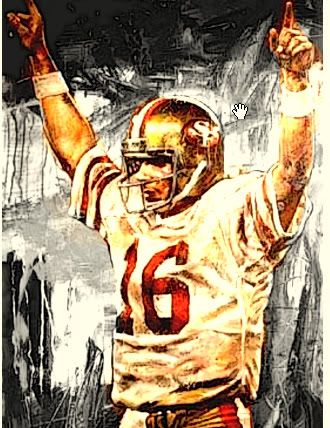
The best known Brescian-American from Monongahela is football quarterback Joe Montana (who played for Notre Dame in the 1970s and the San Francisco 49ers in the 1980s and 1990s). The name Montana is slightly Americanized, apparently from Montagni (he is also half Sicilian, through his mother, Theresa Bavuso Montana).
The Val Camonica is named for the Camunni, an ancient culture of unknown origin that became blended with the Celts of Northern Italy in pre-Roman times. Today, the inhabitants of the valley call themselves “Camuni” (with one “n”). The ancient Camunni left approximately 350,000 rock carvings on the face of the mountains, depicting pre-Roman-era life in the valley. Some are as much as 10,000 years old. To interpret the sparse written passages in the Camuno language that accompanies some of the later carvings, linguists have begun to analyze the peculiarities in the local dialect, which preserves some Camuno characteristics, differentiating it from other dialects of Northern Italy.
The second of two articles
Railroad construction went at a furious pace through the region, both before and after the Panic of 1873, and gangs of temporary workers were recruited to level the grade and lay the ties and tracks. It is particularly difficult to determine who the workers were and where they came from because of the short term nature of the work and lack of records. However, it appears that the Italian workers found other jobs as a result of the new lines. Railroad development was often justified by the expectation that each line would open up a new area for coal mining. Industrial villages cropped up almost instantaneously as each line was completed. Meanwhile, other Pittsburgh area industries, such as steel, specifically avoided hiring Italians because they thought they were less suited than the Slovaks and other Eastern Europeans for the heavy work required at the larger industrial plants, a prejudice that is on record in some of the surviving trade literature. Because the Italians had an easier time finding jobs in coal mines, they ended up scattered all over the region, in the 500 or more mining villages found within a 100 mile radius of Pittsburgh. Those who brought trade skills with them eventually struck off as entrepreneurs, serving as carpenters, blacksmiths, barbers, tailors, and grocers/fruit handlers, and also sometimes as musicians, writers, or bankers in the new villages.
The Bresciani who came to Monongahela City helped to set off a chain reaction that brought Italians from almost every other part of Italy, boosting the population within and surrounding a very small city that is still 25% Italian-American today. A small group of Calabresi who came in the 1870s may have been the first, followed in the 1890s to 1910s by other Italians from north of Rome, a large group of families from Tuscany, and smaller groups from Umbria, Piemonte, and Venice, and then by large groups from Naples, Calabria, and Sicily, with smaller groups from Abruzzi and Molise. In one of the later waves of immigration, families came from Suisio, an industrial town west of Bergamo, where the dialect was almost the same as that of Brescia. The Italian-Americans in Monongahela whose roots are in the other parts of Italy often refer to the Bresciani and Bergamaschi as the “Patihi, Patahé,” an obscure phrase that the Bresciani had apparently used as a greeting and a shibboleth (though no one from modern day Brescia seems to remember exactly what this phrase means). (My theory is that it could be derived from a word “dialect,” similar to the French “patois.” Or another possibility is “patéser” a verb in the local dialect that means the same as “soffrire” — to “suffer” or to “put up with” someone. Assuming the two words are conjugated forms of a verb, say “patihare” or “patéher,” with an “h” being substituted for a “c” or an “s,” the meaning of “se patahi, pataho” could be “if you speak the dialect, then I will” or “if you put up with [me], then I’ll put up with [you]”)
A small group apparently came about 1886, probably as a gang of young, single men looking for work. Three of the first surnames were: Milani, Pezzoni, and Carrara. Serafino Carrara came to Monongahela from Brescia in ca.1886-88, taking a job in the Catsburg Mine, and by the 1890s, his daughter Maria operated a boarding house for Italian miners on a hillside site overlooking the mine. Undoubtedly, this facility housed many of the Camuni when they first arrived. By about 1915, the Odelli family had a very popular fruit market that later became a peanut and candy store. When Joe (Gio’ann’) Odelli, Sr., rebuilt his fruit stand in 1925, he erected one of the most impressive buildings on Main Street. The Anton family, Bavarian Catholic immigrants who made open flame lamps for the coal miners, took an interest in the Brescians and sponsored the establishment of an Italian Catholic Church in 1904. It was named for St. Anthony of Padua in part to recognize the Antons as the benefactors. The Bresciani were the core group in the congregation. A few years later, in 1913, open flame lamps were blamed for a mine disaster at a mine near Monongahela, taking the lives of 97 men, of whom at least 8 or 10 were from Brescia. Legislation outlawing lamps with open flames after this disaster led to the invention of the safety lamp and then the battery-powered flashlight.
The best known Brescian-American from Monongahela is football quarterback Joe Montana (who played for Notre Dame in the 1970s and the San Francisco 49ers in the 1980s and 1990s). The name Montana is slightly Americanized, apparently from Montagni (he is also half Sicilian, through his mother, Theresa Bavuso Montana).
The Val Camonica is named for the Camunni, an ancient culture of unknown origin that became blended with the Celts of Northern Italy in pre-Roman times. Today, the inhabitants of the valley call themselves “Camuni” (with one “n”). The ancient Camunni left approximately 350,000 rock carvings on the face of the mountains, depicting pre-Roman-era life in the valley. Some are as much as 10,000 years old. To interpret the sparse written passages in the Camuno language that accompanies some of the later carvings, linguists have begun to analyze the peculiarities in the local dialect, which preserves some Camuno characteristics, differentiating it from other dialects of Northern Italy.
Labels:
America,
business,
Camunian,
Catholic Church,
coal,
comminity,
entrepreneurs,
immigration,
industry,
Joe Montana,
labor,
mining,
Mon City,
Monongahela,
Pittsburgh,
railroads,
steel,
United States,
Val Camonica
Subscribe to:
Comments (Atom)