Role of the Maternal Spirit I believe that the tv program 'A Haunting'--which was brought back in 2012--is the best program regarding ghosts and metaphysics since they became popular about ten years ago. If you are interested in the subject, but don't have the time to mark and watch tv programs... and you wanted to purchase one, then this would be the one. It's done in the narrative/documentary style, not the investigative style. Recently I purchased season five (2012), and found it to be of similar quality to the original; and also with a diverse array of cases to learn from. I'm constantly processing new information to match with what I already know as I view them. One episode during season five was entitled 'Dark Dreams'. One part of that episode tied in with a number of subjects covered here. As a family in Michigan was sealing off their property from negative entities, their "spiritual healer" described what they were doing... "And so what we're going to do is create a perimeter here where we're going to want the negative energies to stay over here and the positive energies on that side."
The narrator added... "They use a water-based solution; different salts, sands, and herbs."
The spiritual healer continued... "What we are creating is an energetic wall that those negative energies cannot cross back in."
Spiritual healer to the mother of the home... "You're the nurturer. You're going to be the one to protect this house."
The spiritual healer then added... "Anyone can do the sealing of the property, but it's best given to the mother. This comes from the tradition and the understanding that it is women who create and hold space."
I believe that the Fabian-symbiosis of Monopoly Corporatism, Abrahamic religion, Capito-Feminism, Social Science, Cultural Marxism, the rapidly-growing Atheist movement--and even some aspects of the New Age Movement--have formed a wall to the path of the ancient spiritual role of Maternal Leadership within communities. Nature is harsh, and could care less about self-interest movements who will all be vanished to forgotten dust in a historical blip of time. The rules of nature have always, and will always, apply to us; and denying them is like jumping off of a cliff and then denying the law of gravity as you're falling.
Janet Farrar (born Janet Owen on 24 June 1950) is a British teacher and author of books on Wicca and Neopaganism. Along with her two husbands, Stewart Farrar and Gavin Bone, Farrar has published "some of the most influential books on modern Witchcraft to date." According to George Knowles, "some seventy five percent of Wiccans both in the Republic and Northern Ireland can trace their roots back to the Farrar's."
Farrar has been one of the most public faces of Wicca, having appeared as a model for book covers and illustrations in several of the best-read books on the subject. Farrar is a frequent guest lecturer on the subjects of Wicca, Neopaganism and witchcraft in North America and Europe.
Farrar, in a photograph taken by her husband, Stewart Farrar,
demonstrates the "Osiris pose" in a 1981 book she co-authored. Farrar's
willingness to model for early books about Wicca made her one of the
most recognized faces in Neopaganism.
Biography
Farrar was born in Clapham in 1950. Her family, of mixed English, Irish and Welsh descent, were members of the Church of England. Farrar attended the Leyton Manor School, and the Royal Wanstead High School girls' school. After high school, Farrar worked as a model and receptionist.
Farrar was initiated into Alexandrian Wicca by the tradition's founders, Alex and Maxine Sanders. Farrar met the Sanders in 1970 through a friend who had become interested in exploring Wicca. Farrar accompanied her friend in order to keep the friend "out of this weird cult", but Farrar instead joined the Sanders coven, and would go on to become, in the words of Knowles, one of "England’s most eminent and respected modern day witches." In the coven she met Stewart Farrar, her future husband and co-author.
Janet Farrar asserts that the couple were both elevated to the second degree "in an unoccupied house in Sydenham" by the Sanders on 17 October 1970, and that they received the third, and final, degree of initiation in their flat on 24 April 1971, but that these events are disputed by some Alexandrian "revisionists".
The Farrars had begun running their own coven in 1971, before their third degree initiation ceremony, and were handfasted in 1972 and legally married in 1975. Janet Farrar left the coven in 1972 to explore Kabbala with a ceremonial magic lodge, but returned within the same year. In 1976 the Farrars moved to Ireland to get away from the busy life of London. They lived in County Mayo and County Wicklow, finally settling in "Herne Cottage" in Kells, County Meath. Both husband and wife went on to publish a number of books on the Wiccan religion and on coven practises. Farrar continued to model and appeared in the illustrations to multiple early books about Wicca, including the cover of the paperback version of Margot Adler's 1979 Drawing Down the Moon.
Farrar also posed for many of the photographs in their 1981 Eight Sabbats for Witches, which included material the authors claimed to be from the Alexandrian tradition's Book of Shadows. The Farrars, with the support of Doreen Valiente, argued in the book that even though the publishing of this material broke their oath of secrecy, it was justified by the need to correct misinformation. Janet Farrar indicates that some of the rituals contained in the couple's books were actually written by them, and that they left the Alexandrian tradition after the book's research was complete. The couple co-authored four more books on Wicca. Janet Farrar's post-Alexandrian practice has been referred to as "Reformed Alexandrian".
The Farrars returned to England in 1988, but by 1993 had returned to Ireland. They were joined by Gavin Bone, with whom they entered into a "polyfidelitous relationship". The three of them would co-author two more books, The Healing Craft and The Pagan Path, an investigation into the many varieties of Neopaganism. Stewart Farrar died in February 2000 after a brief illness.
After Stewart Farrar's death, Janet Farrar and Gavin Bone have continued to author books, and have given a number of lectures on Wicca in the United States, Australia and in Britain. The title of their 2004 book, Progressive Witchcraft, is the description that the couple prefers for their current religious practice.
Bibliography
Farrar has co-authored a number of books about Wicca and Neopaganism.
With Stewart Farrar
1981: Eight Sabbats for Witches
1984: The Witches' Way
1987: The Witches' Goddess: The Feminine Principle of Divinity
1989: The Witches' God: Lord of the Dance
1990: Spells and How they Work
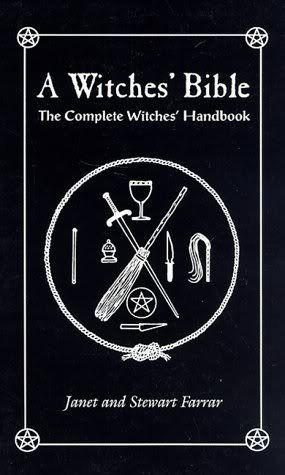
1996: A Witches' Bible: The Complete Witches' Handbook (re-issue of The Witches' Way and Eight Sabbats for Witches)
With Stewart Farrar and Gavin Bone
1995: The Pagan Path
1999: The Healing Craft: Healing Practices for Witches and Pagans
2001: The Complete Dictionary of European Gods and Goddesses
With Virginia Russell
1999: The Magical History of the Horse
With Gavin Bone
2004: Progressive Witchcraft: Spirituality, Mysteries, and Training in Modern Wicca
From what I have seen, Janet Farrar is about as close as it gets within the leadership of the current milieu, of a woman worthy of the title of "a daughter of Cern." I have not liked a lot of what I have seen within the current leadership. There are a lot of modern politial tie-ins, non-folkish beliefs, lack of cultural pride, and "Feminism" as opposed to the tradition of Cernic women actually being leaders in the community at large. "Man-hating," in general, is about as far as one can get from the Cernic tradition; and, of course, the opposite would be true as well.
Janet Farrar is beautiful lady in many ways. The only thing I have looked at so far that I don't really agree with is the nudity as far as initiations. There are a lot of problems with that. It unnecessarily makes earth-based paganism look suspect; and it generally "throws a monkey wrench" into the whole idea of Cernic woman being close to people within their communities.
Cernic women are to be "spiritual mothers"; advisers of life's problems. I think we have all seen examples, just in general, of certain women--virtually all married mothers--who have friends or relatives who, while visiting their home, gravitate to them for advise. Sometimes these women are younger than those to consult with them. It's a beautiful aspect of our distant culture, which has been lost within "cultural" Capitalism and Marxism.
Personalty, I can think of three such women. Once I found myself speaking to one of them while her husband was in the garage working on his motorcycle. I was distressed about something, and I found myself sitting on an ottoman, literally at her feet, looking up at her. She had on a long, mostly black, earthy dress. Her leg was crossed, and her foot was slowly spiraling in a circle as I told her about a certain issue of mine. She gazed at me, listening, as her two young children quietly played on the floor nearby. Her brown eyes reflected neither an upbeat nor a gloomy mood; before finally giving her assessment of the situation. Now this woman was Catholic, but somehow our folk traditions remain deep inside of our genetic memories.
One other such woman, also married, a Christian, and a mother; comes to mind. I can recall one time walking up to her home with her husband. She was in front of her door, then greeted me by name, smiling. It was confirmation that this was "her home," not like just walking into someone's house and maybe saying "hi" to them sitting across the room. "Hospitality" is one of the Nine Noble Virtues of Odinsim. It's a big part of Cernism I believe. It doesn't mean that anyone is welcome. I think that it chiefly means that this part of our lives is important, and how a family treats a guest genuinely stands for something.
Another time, exactly the same thing; I walked into a friend's home for the first time. As I entered the living room, there she was! His wife, very long light brown hair, hazel eyes, slender, long red earthy-type dress, holding a fluffy orange cat, and standing directly in our path. As I know now, she was the type of woman whom you must earn her trust. She looked right into my eyes as I approached her. Her stare was neither positive nor negative. The message was not lost upon me... this was HER house! I have not witnessed this power from any man I don't think. It's sad that so many younger men cannot comprehend what a real woman is all about.
One time recently I heard a young adult ask the question, regarding our culture, "what is our culture anyway?" I think the foundation would start with women like these. I believe that we have been herded into the false paradigm of a symbiotic Hegelian dialectic; and this pervades even modern attempts at getting back to our folkish earth-based spirituality.
This is an episode of Lifetime's Intimate Portrait: Witches
This I
believe aired around mid 90's. I don't remember when I taped it. It's a
bit jumpy in a few parts. This was taped originally on VHS (remember
them?!)
I cropped out the "Historical" parts. Many of the info is
outdated. I tried mostly to get the interviews with Modern day Witches
& Wiccans.
However I don't agree or support all of the info. I
think this would be interesting for those who follow the teachings of
Laurie Cabot, Z. Budapest and Janet Farrar.
The original 'Loose Ends: Valcamonica, Cernunnos, Wicca, Druids, and the Pentagram' was posted on March 5, 2009; and it has been the most popular post from this blog by a country mile! Out of over 10,500 page views, most of that fairly recent, that one post accounts for about 20% of the total. So I think it's only logical to update some of the knowledge. The original was an attempt to tie-in various concepts. It was more of a musing of the subjects. Maybe we can do better.
To start with, the "Cernic tradition"--after many centuries of often brutal state and church-sponsored religious condemnation--developed into what is referred to as "European witchcraft." The idea of "Wicca" is a recent development; and one which does not necessarily adhere to it's parent "Celtic paganism." By "Celtic" I mean the spiritual-traditions of the loosely-connected pre-Roman Celtic cultures who lived, at one time or another, from Ireland to Turkey and from Poland to Spain. It seems pretty clear that the Cernic spiritual hub was located in Gaul, and Cisalpine Gaul, but it may have sprung from the Hallstatt culture in what is today south Germany. Horned or antlered images can be traced back as far as 20,000 years ago in central Europe. It seems at least possible that the origins of this spiritual tradition may date back with the early proto-Europeans who predated other Indo-European peoples.
Recent archeology is showing more and more that the ancient Celts built roads which served as trade routes across Europe; from marketplace to marketplace; from community to community. Cernic spiritual concepts likely migrated in this way, and mixed with other spiritual traditions on those far off places. For example, the ancient Celts, in what is today England and Wales, apparently made no reference in art or symbology regarding Cernunnos; but they developed their own concept of the "horned god." It seems to be true that females, special females, were generally the high priestesses of this earth-based spiritual traditon. The forest was their church.
Wicca is a universalist concept developed by Freemasons in the United Kingdom; and the pentagram they adopted goes back to Sumeria. However, there are references to the pentagram within European witchcraft which can be traced back about five centuries. Having "borrowed" many things from other pagan religions worldwide, Wicca only vaguely resembles European witchcraft or Celtic paganism. For example, the ancient Egyptian goddess Isis had nothing whatsoever to do with Cernunnos. It's fun to compare certain traditions, but to splice them together only accomplishes to spoil their uniqueness. Also, modern politics are no place to inject religion; and many well-intentioned people are turned off by politically-minded people within any religion.
But getting back to the Cernic tradition of the ancient world; it's not entirely clear how this spiritual tradition interacted with the Druidic spiritual tradition which was also Celtic in origin. The Druids lived in ancient Gaul as well, although it appears that most of the high priests of Druidism were males. It was also an earth-based spiritual tradition, which also existed in what is now the British Isles. It appears that the Cernic traditions merged with the Teutonic Wotanist traditions in some areas. I haven't seen evidence of how Druidic ideas may have interacted with the Wotanists, but I would guess that all of these beliefs merged in some places. I don't think that today it's pragmatic to open up ancient feuds; but there is absolutely no doubt that Christianity fully replaced the Cernic, Druidic, Wotanist, and many other earth-based rites; either by coercion or force. It was not just the Romans who perpetrated this policy either.
It should be mentioned that Cernunnos was not the only Celto-Gaulish god, and that there were other gods and goddesses like there is in Odinism; but Cernunnos (pronounced as "KER-new-nos") was the chief one in most places (just as Odin is in Odinism). Some of the dark symbolism in European witchcraft is probably a result of it having to exist underground for so long; but some of it may have always existed. "Dark imagery" does not necessarily reflect "evil." The ancient forests were often dark places. It seems obvious to me that this is mainly just a reflection of nature. To the ancients, the night was a scary place; and they may have counted on Cernunnos to protect them. Any hike at night in a remote natural area will give us an instant connection to that world.
It seems obvious to me that the rightful daughters of Cern today, would be the most logical ones to access "Cernism" and serve as its high priestesses. To the ancient Cernic pagans, the family was at the heart of their culture; and the woman was the head of the household. Not the "head" like she was bossing around her husband, but boss of the "household" while he was away hunting, providing, or at war. This one element of their culture marginally found it's way into later Christian societies, which had entirely different views regarding men and women. The Cernic male represented "law"; while the Cernic female represented "justice." Cernic women were the spiritual leaders of their folk societies. They were at the center of everything.
Cernic women were very strong-women, not "Feminists," which is an entirely modern political construct which attempts to make females more masculine. There were "women warriors" in Cernic societies. They weren't like guys, but simply were just big strong gals, period. Obviously there are some women who could wipe the floor up with weaker men; and these women were pragmatically allowed to serve the tribe in battle. It was all about the family, clan, and tribe... maybe sometimes of a "tribal federation," or loosely their nation.
It's important to compare the Cernic societies with the Odinic societies. Of course, the Cernic culture had it's own mythology, just like Odinism. There are many similarities. Odinism may have developed a little more of a "heroic ethic," which seems to remind one a little more of "the masculine"; while Cernism, although in many ways a "warrior society," somehow seemed to be a little bit more "down to earth," and reminds one a little more of "the feminine." As to where the Druids fit into all of this, I don't know. Some Celtic societies seemed to be Druidic, while others seemed to have been Cernic. I think it's also very important to remember that Cernism influenced other tribal groups. For example, some ancient Norse seemed to be almost Cernic, or at least strongly influenced by them.
Obviously, the first 'Loose Ends" article was from the point of view of historical Camunian culture. The Camunians had not surrendered their native beliefs by the sixteenth century, which is pretty remarkable. However, the Val Camonica witch trials were just two of many such events in Europe during the Middle Ages, and after. In all of these tragic events, think of the great women and men who died. They were martyrs who aren't even given the proper status of martyrs. In the earlier article, I had stated that I believed that the witch trials were exaggerated; and they probably were in most locations in Europe and the American colonies. However, in some locations it was pretty extreme, as the last link above reflects in its 'Counting the Witch Hunt' graph by Ronald Hutton. It's hard to argue with those numbers.
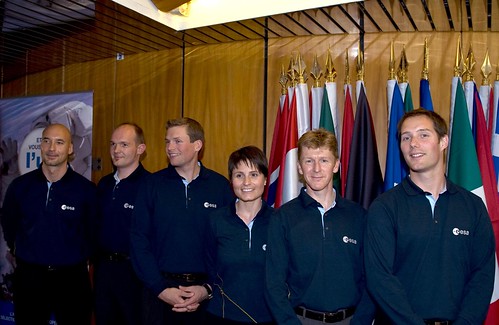
Air force pilot Samantha Cristoforetti makes history
May 20, 2009 (ANSA) - Rome, May 20 - Italy got its first woman astronaut Wednesday when a 32-year-old Italian Air Force pilot became the European Space Agency's first female pick.
Samantha Cristoforetti, 32, an air force lieutenant with an engineering degree and a passion for scuba diving, was among the six new members of ESA's astronaut team.
''It's hard to say what I'm feeling, even in Italian,'' said Cristoforetti, who speaks several languages. ''Space flight has always fascinated me,'' she told a packed press conference in Paris.
''I feel lucky to be here,'' she added, thanking all those who supported her through a final year of gruelling training.
''I think we're going to be a good team,'' Cristoforetti said of the ESA flight force whose numbers have been boosted from ten to 16.
Another Italian, 33-year-old air force test pilot Luca Parmitano, was among the happy six.
''It's an incredible moment,'' he said, thanking his parents and wife ''without whom I don't think I would ever have been able to reach this goal''.
The final selection from thousands of aspiring space cadets was announced by ESA Director General Jean-Jacques Dordain and personnel chief Simonetta Di Pippo.
A Milan native, Cristoforetti attended scientific lycee' in Trento before getting a degree in mechanical engineering at the University of Munich.
She graduated from Italy's Aeronautical Academy in 2005.
Cristoforetti speaks fluent German, English and French and has a good working knowledge of Russian.
As well as scuba diving, she lists her hobbies as reading, yoga, swimming, skiing, mountain biking and caving. The six new astronauts were selected from some initial 9,000 applicants from ESA's 17 member nations.
ESA launched its recruitment drive last year, its biggest since 1992, to boost the European Astronaut Centre (EAC) in light of new projects, especially at the International Space Station (ISS).
Two of ECA's team are already Italian, Roberto Vittori and Paolo Nespoli, who are both set for more spells aboard the ISS in the near future.