Is learning the Tarot too complicated? Let me teach you Tarot!
In these videos we will break down the Tarot step by step, starting at the Basics. This video is perfect for the beginner Tarot reader!
This first Tarot lesson is all about the structure of your Tarot deck: What is the difference between the Major Arcana and the Minor Arcana? What is the meaning of the 4 Suits?
I like to link the tarot to several other spiritual tools, like Astrology, Numerology, Mythology, and so on. If you want to join me on this adventure, please don't forget to subscribe to my channel and follow me on Instagram!
There are a lot of Tarot channels on YouTube. This is just one of them. It's an ongoing study, and this was the first program. I think to really understand how to use them, you would have to seek instruction or from a book. What struck me here is that Anne Vos is very knowledgeable and thorough, and incorporates other disciplines such as numerology or astrology.
I think it's interesting that there is an indirect Brescian Tarot-Camunian pentagram link. The likely oldest pentagrams have been discovered in the Val Camonica. They showed up in the "mainstrem" so to speak, about 3,000 years ago. Ultimately, there had to be a pentagram first, before the pentacle. The pentagram is an earth symbol, and I interpret the circle surrounding a symbol as a circle of nature... making the pentacle a very powerful sigil. The Fibonacci tie-in was very interesting, and new to me.
************
PENTACLES EXPLAINED: What is the meaning of the Pentacle suit?
PENTACLES EXPLAINED! Everyone has seen the Pentacle before, but what is the meaning of this mysterious symbol?
In this video I explain the meaning of the Pentacle in general, but I also walk through the pentacle cards one by one. Let me teach you everything about the Pentacle suit!
I wanted to clarify that the reappropriation of, for example, a corporate logo.... could be esoteric from your own personal perspective. The occultic elite behind these symbols play games with us, so why not send the energy right back at'em? For example, the logo for the brand "Hurley" is a play on the triple moon. From my personal perspective, there is a double meaning: the triple moon/triple goddess, and the name Hurley is where my family first settled in America (Hurley, Wisconsin). Another example is the iconic American symbol of "Route 66." Route 66 runs from Chicago to Los Angeles, but it could have strong meaning for any person or family which had migrated from the Midwest to California or anywhere along the way. Of course it could just represent America itself, or numerous elements of more personal esoterism at the same time. One time someone gave me a Seattle Mariners cap, as they had assumed a box of them. Well I'm not a Mariner's fan; I saw that it had an "S" on it, so I assigned it my own meaning. With letters it should be very easy, such as with the Texaco "T." Of course, it could represent America or Texas, or whatever personal occultism you want to attach to it. The Alchemical occultists at the top may have the patent to the corporate logo, but they don't own these symbols. Freemasons or Hermeticists have their own symbols, but often they use Indo-European symbols which they don't have any more claim to than many other people. I just don't think that flags, symbols, or emblems absolutely must have one-meaning. The Canadian flag, the red mable leaf, or the old red ensign flag could also also represent "North America"; or the popular but fictional Vinland flag could represent Scandinavian pride, Asatru, Canada, North America, or Neo-Pagan pride since Leif Erikson was a pre-Christian era Viking.
It is very likely you’ve never noticed the large amount of pentagrams used in the logos of big corporations. To use a clichéd phrase, they are using its magic against you and your unconscious mind, tapping into and exploiting what 20th century psychologist Carl Jung called the “collective unconscious”: “My thesis then, is as follows: in addition to our immediate consciousness, which is of a thoroughly personal nature and which we believe to be the only empirical psyche (even if we tack on the personal unconscious as an appendix), there exists a second psychic system of a collective, universal, and impersonal nature which is identical in all individuals. This collective unconscious does not develop individually but is inherited. It consists of pre-existent forms, the archetypes, which can only become conscious secondarily and which give definite form to certain psychic contents." —Wikipedia
The pentagram appeals to our “collective unconscious” because our ancestors, since ancient times all the way down through and into the 21st century, have all had experiences with this symbol. A deep and ancient part of your mind or brain knows this symbol, because your forefathers knew it, even though you personally have not had a personal experience with it.
[Right: The pentagram as the perfect symbol of man. The two “arms” of the pentagram match man’s arms. The two “legs” of the pentagram match man’s legs.] ************ Another term used for this collective unconscious is "genetic memory." This concept is much more prevalent with people who have shared a common culture and history for many centures. For example, Ireland or Sicily. Both are islands with distinct cultures and a history of collective resistance.to foreign tyranny. It's a bio-spiritual concept.
Within a pentagram is a pentagon; and when the 5 points of a pentagram are connected, a pentagon is formed. Therefore it's like holding up a mirror to a mirror... it's infinity. Just as with collective unconscious/genetic memory, it's not limited to time and space... it's the soul, it's the blood, it's the folk, it's DNA, it's reincarnation. .
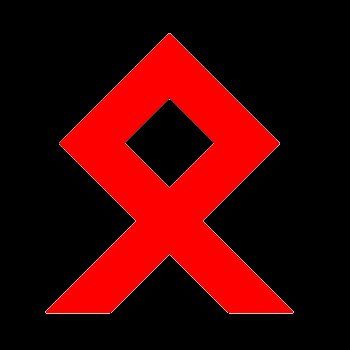
A red Othala on black background was a Langobard symbol
Recently I crafted two symbols out of popsicle sticks for a wooden fence. I selected the Odal Rune and the Pentagram due to them being fairly easy to construct. I started with the Othala. I drilled a few holes, attached them with thin wire, tightened them with twine, spray painted it bright red, and attached it to the door of a fence leading out to a deck. It showed up nicely against the stained wood. A proud symbol of my Langobard heritage, as the red Othala was actually on the old flag of Langbard, right? Not necessarily. A few days later, I happened to turn on the Investigation Discovery channel. On one of their many programs, there was a case of a group of neo-Nazis, somewhere, someplace. On their "compound" were certain flags and symbols, such as Swastikas. Although there were no Odal Runes, and actually there are relatively few used by so-called "neo-Nazis," it not totally unheard of for them to be used in places like that. I was a little bit confused as I pondered my flaming red Odal Rune featured soo prominently on the fence. The color red is a powerful symbol in of itself, and I believe clearly to the Langobards it did literally symbolize "blood and nation" in a tribal sense. It also may symbolize other concepts, such as "connection to the land," "the family/clan homestead," or "harmony with nature." Of course, if it was most any other symbol, this wouldn't even be an issue.
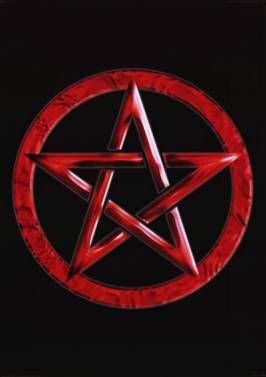
The Pentacle, a very ancient symbol
After a week of occasional thought about this, I decided to repaint it an "Earth color," which was dark green... more symbolizing a connection to the land. I also thought about the Pentagram, or what Guido von List called "the Vehme star rose." I thought perhaps I could at least paint that red? Upon pondering that question, it occurred to me that this symbol too... could be perceived by some as "Satanic." After all, Satanists do use red "inverted Pentagrams." Was I actually going to be intimidated by possible perceptions again? I eventually decided to paint it another Earth color... dark blue. Blue is a color of water and sky, and fits well with the five elements. Also, it is a color of magic.. like red or purple. Being that the new colors were a good fit for the energy I wanted to use, I was not displeased by the changes. However, it still brought up the issue of false "projections" which are placed on people by others. To me, the whole idea of "losing cultural symbols" is a big issue. Someone could just as well argue that the Odal rune and the Vehme star were symbols of certain cultures which were victims of cultural genocide themselves! Why aren't those facts "projected" for public consumption as many others always are? Nobody seems to complain very much about Communist symbols; they only took out a couple of hundred million people in the last century. .
This is not a movie review, as 'The Blair Witch Project' doesn't really directly tie into any of the subjects covered on this blog. However, the movie's curious use of a little-known ancient rune makes it worth looking at. After having viewed the movie again, I will try to make sense of it within the context of the 1999 film. To start with, the movie itself was one of those unusual low-budget, box office success stories. It was filmed as an amateur documentary about a fictional "legend" around the tiny town of Burkittsville, and the surrounding Black Hills Forest, in Maryland. It's more of an interesting one-time-watch thriller; although it was a forerunner for a lot of similar thriller/horror movies since that time. I don't want to do a review, but I'll just mention three small interesting factoids before looking at the symbol. One, the main character was played by a then 24 year old Amanda Donohoe; and instead of becoming a star, she has all but disappeared from the industry. That's in stark contrast to the way it usually works with a big box office success. Two, apparently there is no "Black Hills Forest," and the movie was filmed in a small wooded area with a few trails. Three, the real town of Burkittsville (pop. 151) soon became the involuntary recipient of many, mostly young, "tourists" who seemed to believe that the movie was real. Guido von List called the ancient five-pointed symbol the "Vehme star rose" (Vehm/Feme = "5"). However, he did not include this symbol among his runes in his famous book 'Secret of the Runes'. He did include it among the modern expressions of the ancient symbols, but it appeared as a Sumerian Pentacle. He only hinted the Vehme as a symbol of ancient Europe, but never expanded--that I could see--upon this. From his enthusiasm of the ancient Alpine/Germanic "Feme" symbol, one would think that he surely would have included it among his bread-and-butter Listian runes. He did not. If there was so much peripheral symbolism surrounding the "Feme" spirituality, then it would seem that there must have been some chief symbol... even if it were a very simple five points. According to Crossroad.to, RadioLiberty.com, and other sites, the "Blair Witch" (Feme) is A five-pointed compound symbol with a center triangel (see below) pointing down. The five lines resemble the microcosmic man with arms and legs outstretched inside a circle (with a pentagram in the background)-- a magic symbol or charm among medieval alchemists and wizards. That would place the symbol in the Medieval time period (5th to 15th centuries). According to CastleOfSpirits.com...... The stick figures in the forest - what do they mean?
The producers of the film say that the stick-man is based on and taken from an ancient Rune, it basically means a warning - they say that with the large amount of stick figures hanging in the forest which mean "warning", Josh, Heather and Mike just don't get it - it's a BLOODY BIG WARNING!!! right there in front of them.
It is also said that the figures hanging in the trees in the forest represent spirits of the dead being able to travel between earth and the spirit world. The trees, with their roots in the earth and branches up in the air, serve as bridges between the earth and spirit world. When the stick men are hung in a tree they provide a way for the spirit to travel between worlds. Although it is not shown, Heather cut down one of these figures to have a closer look. You hear Josh later on tormenting her with the camera yelling "you cut down one of the Blair Witch's Trinkets and now she's after you". Well it's not just that the Blair Witch is after Heather for cutting it down and giving the witch the sh**s, but when she cut the figure down it supposedly traps the spirit in one of the worlds. Heather therefore trapped the spirit on earth, and the spirit didn't seem terribly impressed by that fact!.
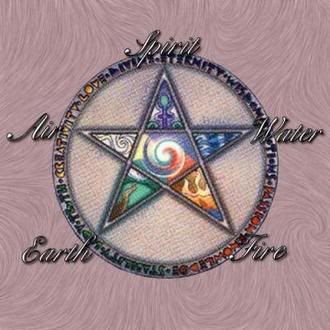
So far they've done numerous amounts of things to really piss off both the Blair Witch and the spirit world. BOY ARE THEY IN FOR IT! If the producers of 'The Blair Witch Project' said that the symbol was from an "ancient rune," then that may add some credibility to "the Feme" legend (Feme=Five elements: Earth, Air, Fire, Water, and Spirit) of ancient Europe. If so, then it would have likely been from pre-Germanic Europe... the proto-Europeans.. the Alpine sub-race; which then crossed over into expressions of later Germanic culture. Also, the concept of the figures hanging in the trees in the forest represent spirits of the dead being able to travel between earth and the spirit world is right out of List's writings! Now, to me, that lends greater credibility to the "ancient rune" legend. During one scene later in the movie, the main character (apparently a fictional "Heather Donohoe" played by Heather Donohoe)--while frantically fumbling around something with her hands--is wearing a Pentacle ring. It was just shown for a split second, so it was one of those clues for the more observant viewers. Of course, the Pentagram and the Vehme mean the same thing. In other words... the irony that she is terrified of the five-pointed Vehme, while actually wearing a five-pointed Pentagram of the same spiritual meaning, on her five-pointed/fingered hand. Of course, these symbols are not to be feared... and are merely ancient symbols of science, including the metaphysical/spirit world.
Although the movie doesn't offer a whole lot for repeated viewings, I find remote areas to hold endless appeal. The simple trails through wood and brush, where you may find yourself temporarily "lost," are a refreshing change from the increasingly micro-managed society that we live in. In our genetic memory, the sight of the coming night holds an ominous feeling; as during the scenes which reflected this, and the portrayed reality of this concept, and further reinforced by the rural surroundings.
Our ancestors feared the night, which was one of the main reasons that they loved the Sun... and the Moon... "the Alfather" and "the Almother." The Alfather = the Sun, the law of the universe, the hunt and agriculture of the day; The Almother = the Moon, especially the full moon giving light and symbolically protecting us when we are the most vulnerable at night, the Justice of our planet. Law + Justice = Family (and ancient clan, tribe, and nation... and "freedom" itself); not domination by one, or the other, but both. Note: On the cover drawing of Guido von List's 1898 book 'The Invincible' is shown two five-pointed flowers of some type. Is this List's "Vehme star rose?" I have not read that book yet, but it's nice to see that it was translated (now out-of-stock) so that I may have a chance to purchase it at some point.
The sequel produced nothing new as far as insight into the vehmic star. It was shown a few times, and that's about it. The film was about a "research team"--called "The Blair Witch Hunt Team"--which ascends upon Burkittsville, Maryland amid "Blair Witch movie tourists" doing the same. The five members (the five points of the vehme?) were pretty much like most semi-annoying young adult characters cast in B-horror movies. While sometimes these types of characters grow on you, this group did not. The group included a Wiccan woman and a "Goth" woman who was the hanger-on of the team. The Wiccan character was habitually complaining about negativity and exploitation of her religion... yet the title of this movie was a major exploitation of the "book of shadows," which is simply a Wiccan's spiritual diary. A "Goth" is usually a youth or young adult who dresses in all black, with black makeup, sometimes dyes their hair black, and is attracted to dark imagery. This movie received low critical reviews. I had seen it once before, probably late one evening, and wasn't really impressed with it. However, when watching it the other evening when I was feeling more awake, it's actually not a bad movie. It's very captivating at the end, and would have been fine as a low-budget horror flick. Apparently, there is going to be a third movie in the series. .
By Bryce Haymond - TempleStudy.com (LDS) - February 4, 2008
One of the more well-used and worn-out attacks from our critics has been the Church’s use of the symbol of the pentagram (a 5-pointed star) on some of our temples, most particularly on the early temples of this dispensation such as the Nauvoo Temple. In an sweeping gesture they pass these symbols off as absolute proof that Mormonism is a Satanic organization. They cannot imagine why a so-called Christian faith would even think to use such symbols when it is so clear to them that they are evil and of the devil.
Why do these critics always assume the worst, and ignore the simple evidence? It didn’t take me more than a few minutes of Googling to find the following information on the symbolism of the pentagram from several different sites: During the times of the Hebrew Scriptures (Old Testament), the pentacle was the first and most important of the Seven Seals – an amulet whose seals represented the seven secret names of God. It was inscribed on King Solomon’s ring, which is often called Solomon’s Seal in error. Each point of the pentagram was also interpreted as referring to the five books of the Pentateuch – the first five books in the Hebrew Scriptures; the Torah.
To the Hebrews the five points of the pentagram were tied to the Pentateuch (the first five books of the bible) and represented as a whole the concept of truth.
There are many connections between the pentagram and Christianity. Before the cross, it was a preferred emblem to adorn the jewelry and amulets of early Christians (followed by an ‘x’ or a phoenix). The pentagram was associated with the five wounds of Christ, and because it could be drawn in one continuous movement of the pen, the Alpha and the Omega as one.
A ‘point down’ pentacle is nothing new, nor is it necessarily Satanic when it appears as such. Historical depictions of the pentagram were as likely to be points down as point up; a distinction between one or the other was rarely made by the ancients.
Perhaps most curious is the pentagram as it relates to early Christianity. Constantine the Roman Emperor who converted to Christianity chose to use the pentagram on his seal and amulet. Up until medieval times, the five points of the pentagram represented the five wounds of Christ on the Cross. During these times the pentagram carried no evil implications at all and in fact, in a lesser way than the cross, was symbolic of the Savior.
Up until medieval times, the five points of the pentagram represented the five wounds of Christ on the Cross. It was a symbol of Christ the Saviour. This is in stark contrast to today where the pentagram is criticized by modern Fundamentalist Christians, as being a symbol of evil. The church eventually chose the cross as a more significant symbol for Christianity, and the use of the pentagram as a Christian symbol gradually ceased.
The adoption of the pentacle as a Satanic emblem is quite recent, dating only to the latter half of the twentieth century.
Eliphas Levi (born Alphonse Louis Constant), a former Roman Catholic priest, in 1856 turned the previously harmless Jewish and Christian pentagram into a ridiculous Satanic symbol.
In the nineteenth century Eliphas Lévi, an Occultist, was the first to adapt the inverted pentagram as symbolic of evil.
Probably due to misinterpretation of symbols used by ceremonial magicians, it later became associated with Satanism and subsequently rejected by most of Christianity sometime in the twentieth century.
It’s amazing what a few minutes of Google will do. For most of human history the pentagram has symbolized good things – the heavens, stars, health, scriptures, truth, and even the Savior, Jesus Christ. The adaptation of the pentagram into a Satanic symbol is a modern invention, another attempt of the Adversary to turn everything that is good into evil (Isaiah 5:20).
FAIR also has gathered some good research on this subject. .
After not being taken seriously by local churches, Randy and his family then turned their trust to a local Wiccan “White Witch” named Mike Bosick. A White Witch is someone who believes in God, but I think there are other definitions; but in any case, all define it as only being involved with positive energy.
Now this was in 1974, so if we think there was a negative association to pagan magic now… it must have been much moreso then. Immediately, while watching this, I thought it to be something significant. It should be noted that dark spirits and negative energies respond to “ritual.” In other words, they respond to whatever religion or spiritual tradition the person--or family which is being affected--is.
Naturally I found myself rooting his man on, so to speak. I was hoping that it worked. His job was to “close that door” and form a “ring of protection” around the family. This was his first attempt at this type of spiritual cleansing. He stated that it was like "a leap of faith," as he was following a ritual which was like an old blueprint.
In the dark of night, he walked outside to begin. I don’t recall if the episode stated the time. Often it would take place at midnight. When he began, a sudden strong wind started. I have personally witnessed strong winds occurring on calm days during key moments of socio-religious ceremonies like weddings. That would have been due to positive energy, while in this case it was negative energy.
The White Witch—armed with only a ritual robe, lantern, and a book of White Witchcraft—set about trying to seize control the the situation. This wind phenomena would not have taken place if these entities did not feel threatened by this positive-energy ritual. Once completed with the closing-of-the-door ritual, he went back into the house.
Next came the ring of protection. A pentagram was laid onto the floor with candles placed around it, representing the elements of Earth, Air, Spirit, Water, and Fire. With the family standing inside of it until completion, a ring of salt was poured around them and the star to form a protective seal.
Normally this ritual would have worked I believe, but these particular negative-energy entities are extremely powerful. Unfortunately, it didn’t work. Ultimately the family was able to find a Christian medium who was able to cleanse their home. I still feel that this was a great early attempt.
As stated earlier, negative forces do respond to whatever religion or spirituality that the person or family feels close or closest to. I think it’s like a “ritual command” to leave their home; as well as the particular positive spirit entity. .
We have covered some of the undeniable history of traditions of witchcraft in the Valle Camonica, and there are more areas to look at. This may not follow any consistent pattern, as we're tying in a number of related loose ends into one entry.
The above video is from the YouTube channel VeraMajestic, and is called 'Wicca vs Satanism.' It covers the issue well I think (3-2-12: this video was changed due to VeraMajestic closing her YouTube account). Wicca probably originated with the Celts, and goes back far before Christianity. A native European tradition. Intrinsically, there is nothing "Satanic" about Wicca/Witchcraft. Starting in the twentieth century, there exists some problems with undue influence in the "Wiccan Revival," with Illuminist type people infiltrating. However, the exact same thing has occurred in some areas of Christianity, and most other religions, as we have painfully seen in recent times. Also, it should be noted that the word "occult" merely means "hidden," and really has no meaning beyond that. It literally goes back to the idea of anything non-Christian being labeled "Occult!" For example, "He got involved in the occult!," has no meaning. Either he got involved in something specific, or not. Also, being called a "heathen" was once a major accusation, when it merely means something "non-Christian." An "infadel" if you will. The most important fact is that virtually all religions and faiths have had undue (mainly Illuminist) influence, and it certainly is a problem; but it's not just pagans. In fact, ironically, Wiccans have done a far better job of weeding out this negative influence than Christians have.
Following the lead of the video, I would like to cover the Pentagram, or also known as the Pentacle. It's basically a "Celtic Star Pentagon" (pentagon = 5 points). Satanists/Illuminists take already existing symbols and contort them to reflect the "evil side." As shown in the video, a Christian Cross, when put upside down, symbolizes Satanism. Nobody believes that the original cross is evil merely based on the fact that it can be turned upside down at any time.
The Pentagram goes back, probably with the Celts, thousands of years. Long before Christianity. It's is not at all Satanic... unless it's turned with one point downward into a "goat's head," at which time it does become a Satanic symbol, but not until. Now the above image probably isn't the best one to use because it's red and gives the wrong impression. A traditional non-Satanic/Celtic Pentagram is usually black I think.
I also wanted to at least mention Cernunnos, Celtic Reconstructionist Paganism, Celtic polytheism, Celtic mythology. Unfortunately, these bring up many false images to most people. Lets separate a little fact from fiction. Some areas, both in the Middle Ages in Europe, and in the early American colonies (Salem witch trials), were exaggerated in their scope. In other areas, it wasn't. The persecution of other forms of Christianity and Protestantism were probably far more brutal. For example, the attacks on the Cathars or the Waldensians. What was not exaggerated was the elimination and demonization of the Wiccan and Druid traditions.
From Wikipedia: "Cernunnos is a pagan Celtic god whose representations were widespread in the ancient Celtic lands of western Europe. As a horned god, Cernunnos is associated with horned male animals, especially stags and the ram-horned snake; this and other attributes associate him with produce and fertility." What has to be understood is that this was from ancient pre-Christian Europe. Fertility, the success of crops, the weather, etc., were of utmost importance. From what I have been able to gather, it was usually deer antlers that men wore.
From Wikipedia: "Archaeological sources such as inscriptions and depictions from Gaul and Northern Italy (Gallia Cisalpina) have been used to define Cernunnos. ...... Several images without inscriptions are thought to represent Cernunnos. The earliest known probable depiction of Cernunnos was found at Val Camonica in Italy, dating from the 4th century BC, while the best known depiction is on the Gundestrup cauldron found on Jutland, dating to the 1st century BC. The Cauldron was likely to have been stolen by the Germanic Cimbri tribe or another tribe that inhabited Jutland as it originated from south east Europe."
I'm only briefly going into Cernunnos, as it's involved and may confuse the issues. What is amazing is that related occult traditions, like Cernunnos, go back thousands of years in the Camunian Valley.
From Wikipedia: "Neopaganism
"In Wicca and derived forms of Neopaganism a Horned God is revered, a divinity which syncretises a number of horned or antlered gods from various cultures, including Cernunnos. The Horned God reflects the seasons of the year in an annual cycle of life, death and rebirth.
"In the tradition of Gardnerian Wicca, the Horned God is sometimes specifically referred to as Cernunnos, or sometimes also as Kernunno.
"Modern Druidry, which derives from Celtic culture, honors Cernunnos in his ancient Celto-European form as the guardian of the forests, the defender of the animal tuatha (tribes), the source of the deep forest wisdom, and the masculine half of creative energy. His restorative work in the cycle of the year is particularly celebrated at Beltaine, and is often paired with one or another of the female deities in her maiden aspect. Druids may call upon him in reference to vital, non-violent masculine divinity."
Celtic polytheism, "sometimes known as Celtic paganism, refers to the religious beliefs and practises of the ancient Celtic peoples of western Europe prior to Christianisation" (Wikipedia). Also, Celtic mythology "is the mythology of Celtic polytheism, apparently the religion of the Iron Age Celts. Like other Iron Age Europeans, the early Celts maintained a polytheistic mythology and religious structure" (Wikipedia). Lastly, Celtic Reconstructionist Paganism "is a polytheistic, animistic, religious and cultural movement. It is an effort to reconstruct and revive, in a modern Celtic cultural context, pre-Christian Celtic religions" (Wikipedia).
It should also be noted that the old Greek and Roman deities were exchanged with Northern European traditions, which is too confusing to go into now. Also, don't be afraid to go to YouTube and look some of these things up. It doesn't mean that you're becoming a Druid, a witch, an Odinist, etc. I've said it before, and I will continue to say it, the Greek-Americans have no problem at all adhering to the Orthodox Christian sect while honoring their pagan past. I think that this is the way to go. Who said that there ever had to be any conflict? Why deny what our ancestors were for thousands of years?
I wanted to end this by briefly taking a look at Druidism. From Wikipedia: "A druid was a member of the priestly and learned class in the ancient Celtic societies of Western Europe, Britain and Ireland. They were suppressed by the Roman government and disappeared from the written record by the second century CE. Druids combined the duties of priest, judge, scholar, and teacher. Little contemporary evidence for them exists, and thus little can be said of them with assurance, but they continued to feature prominently in later Irish myth and literature. Most of what is known about them comes from the Roman writers." More subjects relating to the Druids can be found at Wikipedia's Druidry categories.
4-8-09 ADDITION: I think that there are several items that could use clarification here. First, if you are new to the LAA, this had been "Bresciani nel Mondo - Northern California," and focused on issues of Brescian or Camunian origin. One such subject was the deep roots of witchcraft in the Valle Camonica, likely of predominantly Celtic origin. We still want to cover this, and any other part of the history and tradition of any other province of Lombardia (including Ticino and Grigioni). You may send us items to post if you like.
Second, it should be noted that Druidism is not the same as Wicca, although both are mainly identified with Celtic tradition. Also, that's an area where we need a little help on. How did the two interact. I'm not certain, but Druidism seems more Patriarchal, while Wicca seems more Matriarchal, so it would be interesting to find out how the two interacted, especially within a single culture.
Lastly, and this is interesting. The Runes, of Etruscan origin, not only were adopted (and modified) and used by Odinist traditions, but also by Wiccans (not sure about Druids), who used them in their practices. That would be something to look into. As stated before, the Romans destroyed virtually everything Etruscan.
8-1-09 Clarification: The third sentence of the second paragraph begins "Wicca probably originated with the Celts...." Wicca is the modern incarnation of European Witchcraft, therefore was not in existence prior to the twentieth century. It was used here as a convenient term, rather than saying "European Witchcraft." Christians probably would not like a term like "Levantine Priestcraft," and the same for other religions.