Friday, June 11, 2010

Economic crisis and fools gold: Interview with historian Giorgio Cheda

Economic crisis and fools gold: Interview with historian Giorgio Cheda

"We shall not stay long"

Dale Bechtel - SwissInfo.ch - December 1, 2009


Migrations interview: Part one


Historian Giorgio Cheda, the pre-eminent expert on Ticino emigration, provides answers in this five-part interview to many questions about the mass movements abroad.

Cheda, whose own father lived in the United States for a few years, is the author of comprehensive volumes on the migrations to California and the Australian state of Victoria.

In the books, the stories of the 19th and early 20th century "emigranti" come alive through the countless letters they wrote to the loved ones they left behind.

Cheda also based much of his work on research he conducted in archives in the two countries during visits in the 1970s.

swissinfo: What were the economic conditions like in 19th century Ticino, which led to the first wave of migrations overseas?

Giorgio Cheda: There was a period of economic crisis in the mid-19th century, also in Ticino. In particular, there was the potato blight. There was a drop in production from the alpine pastures because there was a very serious disease that decimated the livestock. And, above all, there was an economic embargo.

Since Liberals in Ticino were helping the men of the Italian "Risorgimento" to achieve Italian unity, the Austrian authorities decreed an economic embargo between Ticino and Italy. This led to the immediate return of some 5,000 workers who were employed in Lombardy. It also meant it was impossible to buy grain (because Ticino depended on Lombardy for its bread), and it was impossible to sell timber, cheese, livestock and so on to Lombardy.

So it was a very hard time.

swissinfo: So where did these first "Ticinesi" migrants go, and what influenced their decision to go there?

Giorgio Cheda: The first place to have a real impact was Australia. Why? Because the emigration agencies insisted especially on recruiting immigrants for Australia. The reasons are complex, but I can sum it up as follows: the Hamburg ship owners had invested a lot of money in order to carry emigrants to the goldfields. But the German authorities realised that this form of emigration was also a matter of speculation, and that the clauses in the contracts were not being respected. Since the agencies could no longer recruit further emigrants in Germany, they looked for new sources and so came to Switzerland.

However, strict laws were in force in the cantons regulating the activities of the emigration agencies. Ticino was the only one that had not passed a law of this kind. So for 18 months or a couple of years, the agencies had a free hand.

Through newspaper adverts, personal contacts and other means, they were able to recruit roughly 2,000 Ticinesi, especially from the valleys above Locarno. Almost half of these 2,000 came from the Valle Maggia, and many others from the Val Verzasca. And with these groups of emigrants they stipulated very tough contracts: the voyage was expensive, so almost all of these emigrants had to borrow money, take out a mortgage loan, to be able to buy their tickets for Australia.

Meanwhile, in those years only a few hundred went to California. So there was a difference from the very beginning: speculation on the part of the agencies, which deprived Ticino not only of 2,000 emigrants but also of some SFr2 million to pay for the voyage, while on the other hand those who went to California found fertile ground. Not only were they able to work in the goldfields and save a few dollars; they were also able to invest their savings straight away in land. Unlike in Australia, where land ownership was still the privilege of the British, in America land was available for anybody who wanted to cultivate it.

So these peasant farmers from the valleys of Ticino found fertile ground in California and were able to develop their working skills, like raising livestock, and making good quality butter and cheese, and selling it in centres such as San Francisco, and later Salinas and many other places - Sacramento, Los Angeles and so on.

They were able to perform very productive activities which enabled some of them to progress in time from being ranchers to being traders, or send their children to university and get involved in new professions which, here in Ticino would have been unthinkable for mere peasants. And so they were able to make their fortunes.


Migrations interview: Part two

In this section, historian Giorgio Cheda describes why, in general, the migrations to Australia were a failure and those to California a success.

swissinfo: Can you explain in more detail how and where they got their money from to travel abroad and start new lives, since they were very poor?

Giorgio Cheda: Yes, this is a very significant issue. And it explains the difference between emigration to Australia, which occurred over a period of only two years, and emigration to California, which involved many more people but was spread over a century.

In the case of Australia, as I said before, the issue is very complex because, since the vast majority of these emigrants did not have the money to pay their fares, they had to contract debts. This meant that, in a village, when ten, 15 or 20 young people decided to go to Australia, they would form a partnership and go to a notary. The notary would make them sign a personal contract, but with joint and collective liability. This meant that if, for example, someone died on board ship or during the early days in Australia, without having earned anything, the partners who had signed the contract were obliged to repay the debt of their late companion, as well as their own.

This meant that a great deal of the property of the families in these villages, where 100 or a 150 young people (and not so young people) were going to Australia, became burdened with debt – their houses, cowsheds, and their land. In many cases, I have discovered that part of these debts were repaid, ten or 15 or 20 years later, but with the savings accumulated by their relatives who had emigrated to California.

Therefore in general, albeit with some exceptions for which we have documentation, emigration to Australia was a failure from a financial point of view and also on the human level. Because, of the 2,000 who emigrated to Australia, only ten or so were women. This meant that in Australia they were not able to rebuild their families, as happened in California, where, because emigration was spread over so many years, it could be self-financing. Apart from the first emigrants, who had to contract a debt, those of the second, third and fourth waves were generally funded by their relatives already working in California. So it was self-financing.

Then, many of those who emigrated to California were able to rebuild the kind of family life they had known in Ticino, on the ranches of the Salinas Valley, in Sonoma county, West Marin and so on, where full-scale "colonies" were formed by groups of Ticinesi. The women were Ticinesi. The young men were Ticinesi, and if a young man could not return to Ticino to find a wife, he would write a letter inviting his mother or father to find him a promising young woman, then he would send her the money to join him in California and get married. As a result, many weddings were celebrated in San Francisco, or in Salinas or elsewhere, but still within the village community. So nuclei of Ticinesi peasants were reconstituted, but operating on a different geographical and economic basis from that of the Val Verzasca or the Valle Maggia, because obviously the conditions in California were very different from those of their native valleys.


Migrations interview: Part three

The voyage overseas could only begin once families had given their consent to the emigranti and the necessary funds had been scraped together. In this section, Cheda describes the journey.

swissinfo: Let's take a step back and talk about how they actually travelled abroad. Did the first emigranti in the 1850s begin their journey on foot, or did they take diligences (stagecoaches) to the ports?

Giorgio Cheda: They travelled partly on foot, partly by diligence and partly by train. There were already sections of railway - because in the 1850s they were beginning to build railways very quickly - in both France and Germany. So it was possible to get to the ports of embarkation using fairly good means of transport.

Some parts of the journey did have to be covered on foot, for example the St. Gotthard. They could go as far as Airolo with the diligence, but then they had to cross the pass on foot.

I'm thinking of a letter from someone writing from Hamburg to say they had had to leave one of their companions in a hospital somewhere because, climbing hurriedly over the Gotthard pass in cold weather and snow, he had caught pneumonia.

So this chap had to be taken to hospital, stay there until he was better, then join the following convoy so he could reach Hamburg and take the next ship, which was leaving the following month, and so arrive in Melbourne later than the group with which he had begun the journey. But generally the journey to the port of embarkation was fairly easy, because it could be done by public transport.

swissinfo: Was Hamburg the only port they embarked from?

Giorgio Cheda: Almost all of the 2,000 emigrating to Australia took the ship from Hamburg, for the reason I explained before: the Hamburg recruitment agencies exerted pressure so they could fill their ships with passengers for Australia. Some went to London, some to Dieppe or other northern European ports but almost all left from Hamburg.

But for California the assembly point was Le Havre. In 1850, 1880, 1890, almost all emigrants bound for California embarked at Le Havre for New York.

For Australia, the voyage was by sailing ship. Of course, sailing ships were dependent on the winds and might take up to six months, as I have been able to discover by comparing the dates of embarkation in Hamburg, where I have been to research the ships' passenger lists, with the disembarkation lists in Melbourne.

Meanwhile, the journey to California was fairly long until 1869, because they had to go round South America, round Cape Horn, then sail up the Pacific coast. After 1869, when the construction of the first transcontinental railroad was completed, the train journey from New York to San Francisco took no more than ten days, maybe only a week. So getting to California in 1870 or 1880 was relatively easy. It took about a month: three weeks to cross the Atlantic and then, from New York to San Francisco, a further week by train – and there you were.

This explains why return journeys to California in the late 19th/early 20th century were, I would say, fairly common, especially for those families who, having a ranch in California but still having relatives and friends in the villages here, wanted to return fairly often to visit their places of origin. So many very positive contacts were maintained between the valleys of Ticino and the "colonies" the Ticinesi had founded in California.


Migrations interview: Part four

There were two sides to the migration coin with both winners and losers.

But as Giorgio Cheda argues in this part of the interview, the mass movements abroad, especially those to California, must be seen as benefiting both the emigranti and those who remained in Ticino.

swissinfo: So over many decades, people continued to migrate to California – but not only to California, to Argentina as well between 1880 and 1914 and to London. What impact did the loss of all of these people have on Ticino and the people left behind?

Giorgio Cheda: As always, there were both positive and negative aspects. In my opinion the net result was positive. I know that not everyone agrees with my view, but let me explain. There were negative aspects, of course, which were borne mainly by the women, because emigration created an imbalance of the sexes. It was mainly men who left, especially in the case of Australia and the first waves of people going to California, and the women were left behind. So these women could not get married and it fell to them to perform all sorts of heavy tasks, which also affected them physically.

I've seen some doctors' reports in which they say that women had difficulty in giving birth because they were obliged from childhood to carry heavy burdens up and down the mountainsides carrying, for example, cheese, ricotta and butter from the alpine pastures at 2,000 metres above sea level to the market in Locarno. All this work fell on the women's shoulders. Or think how they had to make hay in the woods to be able to feed a cow or two during the long winters. This was very hard work for a woman, and very dangerous.

These hardships have been illustrated very well by the painter Vanoni, who has left a whole series of ex voto images in our churches graphically portraying the sufferings of the women who were forced to perform these tasks.

So, on the one hand, there was this imbalance of the sexes, which weighed most heavily on the women. But, on the other hand, you have to remember that the departure of many people, mainly to California, also meant fewer mouths to feed with the limited supplies of food that could be produced in our mountains, because the arable land there could produce only a limited amount.

Then senseless deforestation caused partly by politicians out to make a quick profit led to the loss of quite a few hectares of arable land. Then there was the damage caused by the flood of 1868, the year in which emigration from Ticino peaked. The people were demoralised. They no longer saw how they could survive in a valley as poor as the Val Verzasca or the Valle Maggia, so they preferred to go to California. Therefore there is also this very positive aspect: emigration as a safety valve, an outlet for a population that was increasing in numbers and could not make a decent living from its native soil.

swissinfo: Were there other positive aspects?

Giorgio Cheda: A good proportion of those who emigrated to California may have lived a hard life as cowhands, ranching, working all hours of the day, but they were also able to acquire land at an affordable price, especially between 1860 and 1910 –something that would have been unthinkable here in Ticino.

So clearly this explains how a thousand or so of these 27,000 Ticinesi who went to California were able to purchase, in total, an area almost as large as the Sopraceneri (upper part of Ticino): 1,800 square kilometres of land. This is putting together all the small, medium and large-size ranches that the Ticinesi purchased between the border of Oregon, up in Humboldt County, and San Diego and the Mexican frontier, and especially of course in certain counties such as Marin, Sonoma, Napa, the Salinas Valley, San Luis Obispo, the Santa Maria Valley, or on the Sierra, in Plumas County and so on, where the largest and most important "colonies" of Ticinesi became established.

Not forgetting San Francisco, where already in the 19th century - before the San Francisco earthquake - there were more than 500 Ticinesi living. Obviously they were not working on ranches but in the various trades and professions, because the children of the first ranchers had been able to attend college or university, and so they had settled in the major cities – cultural capitals, we might say – of the American West.

We could put it another way: if today we visit the Ticino valleys of Sopraceneri, we find many fine houses built between 1880 and 1910-15, which were paid for with the dollars earned in California. The finest houses in the Valle Maggia and the Val Verzasca, and indeed in other areas such as the Leventina or the Riviera, were built during that period thanks to the savings made by the ranchers in California, or rather by the emigrants, since not all of them were ranchers, of course.

They managed to save a certain amount of money, returned to Ticino and built their houses. Unfortunately, there is a negative side to this, which is often passed over: the failure of the banks. Let us not forget that in 1914 practically all the banks in Ticino collapsed. This represented a loss of a cool SFr40 million, as valued at that time. And almost all of these 40 million, in my humble opinion, were savings remitted by emigrants, largely saved in California - also in Argentina and other places, but most of it had been saved in California.

Years ago, I tried to research this matter in greater depth, but unfortunately I had to give up because all the documentation regarding the 1914 bankruptcies had been destroyed.

But I hold this view because I have read many of the emigrants' letters and have some knowledge of what happened in those years. In particular, we must consider the importance of the Banca Svizzera-Americana, established by the Ticinesi in San Francisco with branches in other towns in California and a centre in Locarno. From Locarno, the Banca Svizzera-Americana reached out into the valleys of Ticino, and played an important role in handling the savings that were regularly remitted from California.

So when the banks crashed, many families lost enormous sums of money, and this must be counted as one of the negative aspects of the (emigration) phenomenon.


Migrations interview: Part five

In the final chapter of the swissinfo interview with Giorgio Cheda, the historian talks about the longing of all migrants – at one time or another – to return to their homeland.

swissinfo: Your own father migrated to California. But he came back...

Giorgio Cheda: My father worked for nine years in California but he returned, as did many, many others. As I told you, 27,000 people emigrated to California but, of these 27,000, only 1,000 established ranches. We need to double that figure, because there were the wives of these ranchers, though not all of them were Ticinesi. And some became involved in other business activities and spent the rest of their lives in California. But others returned, after five, ten, 15, 20 years or more. This is normal because, where emigration is concerned, there is always a longing to return home.

Many emigrants want to come home, sooner or later, and spend the rest of their lives in their native village. This, too, is interesting and positive, especially in my own case (and in the case of many others) because it meant I had a different relationship with California. In other words, for me California was not just any old place. Not only was it a place to which 27,000 Ticinesi had gone, but also close relations, members of my own family. And so I was interested to know what kind of life, what kind of society this relative had experienced when working for a number of years in California. It was the trigger, if you like, that initiated my research into these letters and motivated me to reconstruct this important episode in the history of Ticino.

swissinfo: How strong are the ties today between the descendants of the emigranti and their relatives in Ticino?

Giorgio Cheda: Relations with Ticino emigrants have become reduced to the purely private level today, largely because there is no longer the financial dimension I referred to earlier. Today, there are certainly many families which still have ties with relatives in California. But these are becoming less and less important year on year, because the old people are dying off and the young people are not interested in forming new relationships.

In some cases, there are fairly intense relationships between family members who still have common interests, because there are still some families living in Ticino which have property in California, or economic interests in California, but obviously these are private matters.

I think there must be money coming into Ticino because there are still families which receive income from property acquired by their relatives in California. But they have little impact on modern-day Ticino.

swissinfo: Are people in Ticino today aware of the importance of the overseas migrations of the past?

Giorgio Cheda: Yes, there are quite a few Ticinesi who are aware of their importance, but this is more a matter of nostalgia for the older generation. I would say that the younger generation is not at all interested in this subject. They are much more affected by the phenomenon of immigration.

You only need to consider the success of certain far-right parties, certain xenophobic parties, which make it their business to point the finger at immigrants and blame the most recently arrived for all our social problems and so on. Immigration is viewed negatively, partly because it is exploited by political movements of the right, which would have us curl up hedgehog-like, creating a very closed, limited society such as ours, rather than thinking of the importance of being open, both economically and culturally, which could be a positive benefit of immigration.

.

Thursday, May 27, 2010

Absolute distain is aimed at a tiny assembly of peaceful Odinists in a Southern California public park


Odinist Group Files Lawsuit Against NOR Parks Department

Group Claims They Were Discriminated

BAKERSFIELD, Calif. -- The Odinist group has now formally filed a complaint with the North of the River Parks and Recreation Department and also began the process to file a lawsuit with the ACLU.

Two weeks ago, ABC23 reported on the story of a group of pagans practicing a harvest ritual at Standard Park, and the confrontation that occurred as a result.

ABC23’s Elaina Rusk sat down with both sides to find out what will happen next.

The night of Aug. 12, a group of Odinists gathered at Standard Park for a harvest ritual and were thought to be white supremacists by park-goers and neighbors, two of whom called 911.

[One of two 911 calls which led up to this incident]

Deputies responded after each complaint, but the Sheriff's Department couldn't comment on the situation because no report was filed, which means the deputies did not find any criminal activities taking place.

Don Parkins, an Odinist, said, “We're not breaking the law, because if we were, we'd be in jail." The Odinists' complaint is with the NOR Parks and Recreation Department. They say the ranger who responded to the second call told them they weren't allowed to practice their rituals in any NOR park.

After ABC23's first story aired, NOR officials told the station that they received that complaint, and conducted an internal investigation.

Roger Perez, NOR public relations director, said, “I believe there was a claim that the religion was being disrespected, and we take those types of claims seriously. But in our internal investigation, that wasn’t believed to have been said, was not said, by our deputy. And unfortunately, I think it just got blown out of proportion."

But the Odinists were not satisfied. They began the process to file a civil lawsuit with the ACLU which is considering whether to take the case.

But the Odinists said NOR could have easily resolved the issue.

Collin Bentley, an Odinist, told ABC23, “All it would have required for them is to simply acknowledge that their ranger was in the wrong, and for a formal reprimand."

"Again, we've done our investigation,” Perez told ABC23. “And as far as we're concerned, it’s an issue in the past, and we will definitely keep it in mind for the future, and make sure that there isn't even a question of this type of thing in the future."

Rusk received viewer phone calls and e-mails after the first story aired, claiming that no matter what happened in the park that night, the Odinist religion -- and this group -- is racist.

Other people told Rusk that the group should be allowed their freedom of speech.

The Odinists confirmed theirs is a Viking religion that only allows people of Germanic descent into their brotherhood, but they deny they are racist.

***************************************************************************

This incident actually occurred in August of 2009. What is possibly the most remarkable part of this unfortunate story, is just how distanced certain European-Americans are from their roots; occasionally bordering on a strange type of self-hatred. All one has to do is read some of the comments at the bottom of the above article link for proof of that. Roots that go back about forty thousand years. For example, the raven flag couldn’t be more foreign to them. What a shame it is upon this land that these people couldn’t at least be given the benefit of the doubt. It should be noted that this type of behavior is very unusual for park rangers as a general rule, especially the “MY park” part.

What if some of our brothers and sisters from Comunità Odinista were treated this way? What if people adhering to our own ancestral faith of Cernism were disrespected in this manner? The ancient flag of Langbard, when it is flown with pride, could be called “Nazi” by some of these paranoid people. One can only take so many steps back against the edge of the cliff. It should be also noted that there are many types of European-related heritage festivals, attended by many thousands of people, where there is not this problem.

The above link to one of the actual 911 calls, in which a person actually is heard giving a false report, which is illegal. In fact, the caller even asked for an officer by name, which seems to suggest that she was a frequent caller. Even beyond the American Constitution, these men were denied their basic rights and freedoms as human beings! As far as this group only allowing those of “Germanic descent” into their society. Well, of course! That is their “folk family.” Is that any different than an Irish club or Greek Orthodox Church? Those institutions are not public.

It appears that there is a perception that, because they are of Germanic descent, they should have fewer rights than others. At least that is the subconscious perception that exists now with most people. From personal experience, I know that there are some members of Odinist groups who are not specifically of northwest European descent. The main point being that the construct is based on this ancient Germanic paganism, originally from northern Europe; however, those ancient tribes migrated to many different places all over Europe.

All to often, people’s minds are wired to react by what their perception of something is, especially if it’s different to them, and dismiss any evidence to the contrary. The CCNA condemns the totally unacceptable treatment dished out to the three Odinists in that Bakersfield public park on August 12, 2009. They were not even seeking any attention, and yet were bullied by a number of citizens and park rangers. Even worse than the bullying, was the cultural humiliation. At a minimum, a letter of apology by the NOR Park officials would seem to be acceptable.

Friday, May 14, 2010

Cernunnos: The Astronomical Connection

Sometimes, if you poke around, evidence can be hidden in plain sight. An article which we republished a couple of years back, entitled 'Strange Occultic Tradition Excavated in Valle Camonica' (Silvano Danesi; 1999; silvanodanesi.org), is a good case in point.

Before we go on, we would like to point out that the development of an honorable, historically accurate, and folkish "Cernic Rite" is now a part of the mission of the Camonica Club.

When reading Silvano Danesi's article about the excavation near Cevo, Brescia (Val Camonica), it's very clear that this occultic traditon was deep in astronomy. Early man, for so many thousands of years, looked to the stars for answers to many of the same questions that we ask today. Questions regarding god, the meaning of life, the spirit world, man's place in the universe, the cycle of life, as a compass, the cycles and patterns of the stars in relation to the earths seasons, and even astronomical patterns which repeat at longer patterns than just once a year (ex. "every twenty years").

It should be pointed out that "occultic" simply means hidden, therefore is neither good nor bad in of itself. As has been acknowledged more and more in recent times, most people have separated themselves from the natural world. Nothing reflects this more than the fact that many, or most, people don't even really see the stars in the sky due to the lights emitting from the urban sprawl. When viewing the night sky in a basically rural area, we can see the type of sky that the ancient Camunians saw. 'Our Haunted Planet' (1971), by the late John Keel, gave a deep look into the ancient past; as well as providing possible explanations for the direction of early man.

The Cevo site links the ancient past with the Middle Ages, spanning thousands of years. The megalithic circles connect complex ancient astronomy to the origin of Cernic tradition. One of these altars is in the form of a serpent's head, and is clearly tied to the Ofiuco constellaton, which was percieved by it's shape and symbolized by a man holding a snake. This early serpent cult represented the beginnings of what was to become Cernism. As the article stated: "local legends and feasts of the pagan hinterlands have survived and give the idea of an ancient cult linked with the serpent."

It should be noted that many stone formations were once foundations for structures. In the article, it's also interesting to note that these mostly circular standing stone altars are simply referred to as "churches." As stated in the article, the "Androla Chapel" has probably the best view of the sky in the Camunian Valley. The evolution of this faith over the centuries can be pieced together, and would include influence from the ancient Camunni, the early "serpent people," the Celts, and later Cernic witches who apparently also made use of the deep dark nearby tunnels leftover from ancient copper mines.

The legend states that the witches guarded the serpent of the golden ring in the Androla caves and the serpent is an element of great importance for the study of local traditions and in identifying possible ancient cults. In Andrista, for example, the tradition of the Basilisc is still observed. It's interesting to note how "the serpent" and "the golden ring" sound a lot like the snake and the torc of the depictions of Cernunnos (see image above).

From the article: "In January, according to traditions, the Brescian valleys and countryside, especially in Val Saviore and in Franciacorta, see the arrival of the Basilisc, a serpent that the legend says is stumpy with cows horns on its goatskin head." It continues: "The Cernunno is associated with many animals, but particularly with the bull and the stag and is similar to the mythical serpent with a ram's head (goat – ram). Usually the Cernunno is represented with stag's horns, accompanied by a serpent with a ram's head."

Many aspects of the ancient life in the valley, and the surrounding regions as well, were named after the Basilisco (from basilìskos, little king – the king of serpents). Everything from festivals of the seasonal equinox, to place names, to various local dishes, etc. They would seem to be connected in some way to the harvests and harvest festivals.


The "cult of the serpent" seems to have been mainly associated with the Celts, which would seem to mean that it was from a period after the ancient Camunni, which would be about 500 BC. This cult was also present in other parts of the nearby northeast Italian peninsula and southern ancient Germany. The basic gist of all of this is that the god Cernunnos was most often represented as a man holding onto a serpent and a torc in each hand. All of this originates with the Ofiuco constellation, and ultimately goes deep into pragmatic astronomy as it relates to our planet. It appears that the deeper that one wants to go, the deeper that it will take you as far as the meaning of all of this.

The article goes on to state: "The reference to the serpent, however, could infer stars of particular interest when aligning the megalithic circles. The symbols of the Zodiac, correctly interpreted, should be based on 13 and not 12 signs. In fact, the ecliptic, in fact, after Libra enters Scorpio which occupies only a few degrees (241-248) and then in Ofiuco, which occupies from 248 to 266 degrees. Sagittarius arrives after Ofiuco. The Ofiuco constellation, associated with that of the Serpent, is represented by a human figure holding a serpent in his hands and sometimes entwined with it. The name derives from the Greek ofiòkos, or 'he who holds the serpent.' In the period between November and January, Ofiuco is particularly evident in the sky to the East, before sunrise. Therefore it is not improbable that 'he who holds the serpent' or Cernunno, was identified with Ofiuco.

"If we observe the sky of 1998, we see that the sun rises (at 7.40) for the first time in Ofiuco, abandoning Scorpio, on December 1st and rises for the last time in Ofiuco (at 7.55) on 18 December. The day after, 19 December, the sun rises in Sagittarius. In 1998, therefore, the period influenced by the presence of Ofiuco as a reference for sunrise goes from 1 to 18 December. If we now leap back to 500 B.C., in this period the Celts at Cevo could observe the sky through their megalithic finders. The sun rose at 6.50 in Ofiuco on 1 November leaving Scorpio where it had remained until 31 October. The sun remained in Ofiuco until 18 November (when it rose at 7.15), then to pass, on 19 November, into the sign of Sagittarius. The period influenced by the presence of Ofiuco in 500 B.C. was therefore that between the 1st and the 18th of November.

"Festivities linked to the serpent, therefore, will all probability can be collocated in the period between November 1 and 18 (now December 1 and December 18). A period in which there was the Celtic New Year which began at Samain (the solar rising of Antares with the Moon in a particular position) granting the possibility of contact between the human world and the divinities. The period was dedicated to Lug in his acceptance of Cernunno and the goddess Morrigan."

The article then goes on to many other facinating traditions and connections, many that directly tie in Cisalpine Gaul to Gaul itself. It also seems to prove that their were indeed Druidic traditions in Cisalpine Gaul, but the jury is still out on that as it's generally believed that their were no Druids there. There have been more than one study on this which say yes however.

It concludes: "Visits and the first surveys can reasonably lead us to affirm that the localities Androla and Molinello (we could add Dòs Merlin at Saviore) were places dedicated to the cult and observation of the sky. It is equally reasonable to think that the megalithic circles, dolmen and stone constructions are to be associated with the traditions relative to the 'serpent', or “divin biscio” (divine snake), which represent the survival of ancient cults concerning Cernunno (the Celtic god Lug), associated with the Ofiuco constellation. The number of places visited allows us to say that Cevo, with suitable studies and appropriate surveys, should be an area of considerable archaeological and anthropological interest."

.

Thursday, April 29, 2010

Luigi Bezzera: Milanese Inventor of the Espresso Machine

History of the Espresso Machine (aabreecoffee.com)

Espresso as a beverage and understood term dates back to 1901 when Luigi Bezzera patented the world's first "espresso" machine, a giant steam driven thing with two groupheads called the Tipo Gigante. Luigi's machine had been developed to help reduce the time his employees took for a coffee break. The owner of a manufacturing company, Bezzera needed to increase the production of his employees, so a faster "coffee maker" was the key, he thought. His invention yielded a coffee maker that used a combination of water and steam, forced under high pressure through coffee grounds, to rapidly brew the coffee. It was dubbed the "espresso machine."

However, there was a downside to Luigi's machine. Brewing with a combination of steam and hot water under pressure did produce a cup of coffee faster than other brewers of the time, but the resulting brew was bitter. Desiderio Pavoni, who purchased Bezzera's patent in 1905, was the first person to realize that the bitterness was the result of the steam and the very high temperatures it imposed on the coffee grounds. So, Pavoni began experimenting with various temperatures and pressures, and eventually concluded that brewing at 195 degrees with 8-9 BAR of pressure produced the best results. This is the basis for espresso as we know it today.

The modern day espresso machine dates back to 1947, when Gaggia introduced the Gaggia Crema Caffe machine. This was the first machine capable of consistently introducing pressurized water (8 BAR or higher) into a bed of coffee, and easily and cheaply enough for normal commercial use. Before that, almost every commercial and consumer espresso machine was steam driven and therefore, more akin to the modern day moka brewer.

Here are some other milestones in the history of the espresso machine and the resulting beverage.


Espresso Machine Time Line

1901 - Luigi Bezzera patents his Tipo Gigante, the precursor to what would become espresso machine technology for the next fifty years. Luigi wanted to reduce coffee break times so he made a machine that brewed “coffee” much faster using pressure. Espresso (in a loose translation) means “fast” in Italian.

1905 - Desiderio Pavoni buys Bezzera's patents. La Pavoni was the first manufacturer of espresso machines to be used in coffee bars. Also, Pier Teresio Arduino founds Victoria Arduino, the company that would do more to spread early espresso culture than any other with its advertisements and philosophy behind the drink.

1912 - La Cimbali founded. They are makers of fine high-end home and large capacity espresso machines.

1922 - Universal enters the espresso machine business and soon becomes the leading machine maker with a wide range of products through the 1920s and 1930s and beyond. (They have since disappeared from the market).

1927 - La Marzocco founded. The first espresso machine comes to America as NYC's Regio's Bar installs a La Pavoni two-group machine that is still on display today.

1929 - Rancilio founded by Roberto Rancili.

1932 - La San Marco starts a 10+-year trend towards total Deco design in machines with the introduction of the La San Marco 900. Every company would move to this design style.

1936 - Simonelli founded, who later became makers of medium to heavy-duty espresso machines.

1938 - M. Cremonesi developed a piston pump that forced hot, but not boiling, water through the coffee. The piston pump was quite an improvement as it eliminated the burnt taste of coffee, which occurred in the Pavoni machines.

1946 - Faema founded by Ernesto Valente.

1947 - Gaggia introduces the revolutionary piston lever Crema Caffe machine and modern day espresso in the commercial establishment is born. Many will follow.

1948 - Gaggia introduces the Classica, a 2-group version of the Crema Caffe; La Pavoni, other companies introduce new brewers based loosely on Gaggia's revolutionary system. True espresso, as we know it today, becomes common.

1950 - Elektra experiments with hydraulic pressure machines.

1950 (circa) - Officine Maffioletto makes one of the first machines capable of brewing real pressure espresso, but in the home. It was a piston model with a 1-liter capacity.

1950's - Piston operated machines, both spring action and direct pressure, many direct copies of Gaggia's ground breaking Crema machines, flood the market and make modern day espresso common.

1956 (circa) - Gaggia Gilda machine, not marketed for, but suitable for home use is brought to the market - a dual lever piston single group machine.

1958 - La Marzocco Crema Espress single group lever machine is introduced.

1961 - Faema introduces a very revolutionary machine, the E61 - the first heat exchanger, rotary pump driven espresso machine. Elektra Micro Casa a Leva and La Pavoni Europiccola Lever machine for the home are introduced. Micro Casa had "steam on demand" ability.

1966 - Alfred Peet opens first Peets Coffee in Berkeley, CA later serves as inspiration for the founding of Starbucks by visiting Seattlites.

1971 - Starbucks first opens in Seattle as a roastery.

1974 - La Pavoni Professional Lever machine for the home is introduced. Pavoni introduces "instant steam" and brew machine.

1982 - SCAA founded. Originally called the Specialty Coffee Advisory Board or SCAB; they would soon change their name to something more pleasing to the ear.

1983 - Howard Schultz of Starbucks travels to Italy and becomes immersed in espresso culture.

1985 - Starbucks installs the first espresso machine in their Seattle shop.

1989 - Acorto brings to market the world's first truly complete and marketable commercial super automatic machine, including groundbreaking features such as the self-contained refrigeration system for milk, and different frothing choices on demand.

1990 - Rancilio introduces the Rocky Burr Grinder - a grinder that blurs the line between commercial and home grinding appliances.

1991 (circa) - Saeco brings out the world's first super automatics designed specifically for home and small office use.

1992 - Illy collector cups first introduced, bringing artistry to the cup itself, as well as what's inside the cup.

1994 - Solis brings the SL-90 consumer espresso machine to market, one of the first successful automatic espresso machines for the home.

1997 - Rancilio introduces the Rancilio Silvia, which raises the bar in the home espresso machine market and starts a trend towards better, more professional machines for the consumer. Pasquini markets the Livia 90 (made by Bezzera), one of a new wave of prosumer, heat exchanger-equipped machines for consumers instead of commercial businesses.

1997 - Aabree Coffee Company goes on the web.


Of course, this list is by no means complete. It is presented to give you an idea about several things, including the fact that espresso existed long before the big coffee chains were around. And even though those chains and espresso are somewhat reliant on one another, I'd wager that espresso will far outlast any of the chain coffeehouses you and I know so well. With its unique culture and growing number of devotees who are ultimately dedicated to the betterment of the brew, I'm ready to see what the next hundred years has in store for espresso.

.

Tuesday, April 13, 2010

Iron Crown to Ironwood III

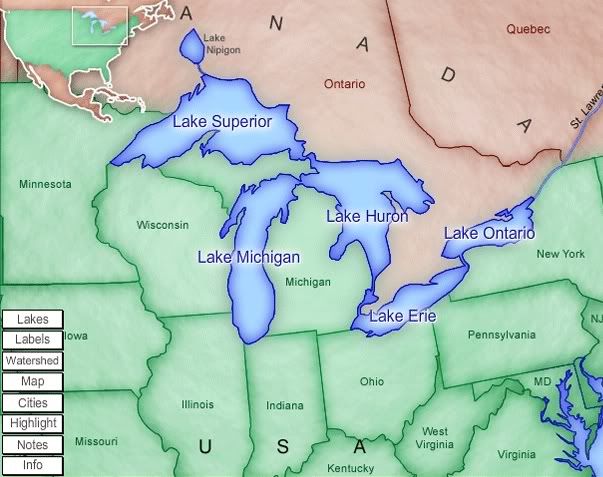
As we have covered before, and it still amazes me, there are so many connections and ironies that tie our Lombardian heritage with the Upper Peninsula of Michigan and northern Wisconsin. The more I look into it, the more I see. I found one old article online, which I have misplaced, about immigrants from Lombardy in Duluth, Minnesota a century ago. Duluth is one of the main ports along the Great Lakes, on the eastern shore of Lake Superior, not far from Ironwood. I will post that article when I find it.

Another piece of information that was brought to my attention from one of our friends, is that certain Lombardians, especially from the Bergamo Alps, were prized as lumberjacks. Probably due to their long rugged Alpine roots. Many did seasonal work in France, for example; or continued their work in the American Northwoods or Canada.

I should point out here that I had made an error in this 'Iron Crown to Ironwood' series. I mistakenly referred to the Upper Peninsula of Michigan as "northern Michigan." The Upper Peninsula, or U.P., is a historically remote region which is totally disattached from the main part of Michigan. I had the region correct, just the name was incorrect. The U.P. was originally given to the state of Michigan long ago as part of a settlement with the state of Ohio. Ohio wanted the Great Lakes port city of Toledo, which was part of Michigan at that time.

Natives of the U.P. are known as "Yoopers." Yoopers have their own regional dialect, which is sometimes referred to as "Finglish," or Engish with imput from the many Finnish and German pioneers of the region. The remoteness of the area had much to do with this as well. There are many light-hearted jokes about Yoopers and the Yooper dialect, in the same way as there are with any regional phenomenon, like "Cajun Country." For example, here is a Yooper "glossary." Another example from YouTube: In Search of the Elusive Yooper. There is even a traveling comedy show called "Da Yoopers."

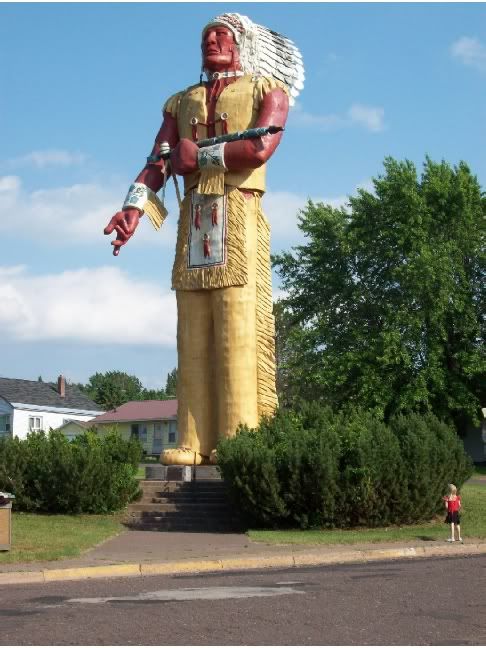
[Above: From Wikipedia >>> "Ironwood is home of the 'World's Tallest Indian' : a 52 ft (15.8 m) fiberglass statue of tribal leader Hiawatha."]

Although I don't have the names and information handy, I did want to make mention that there were two Lombardian immigrants who had a large impact on the Ojibway tribe of the region (west Wisconsin and towards Minnesota and Canada). One man was one of the predominant Catholic missionaries and educators; and the other man did much research into the Ojibway language, which was fading away at that time. He wrote a book on the language, which is now in the Library of Congress. I just don't have that information handy right now, but it's particularly interesting in that there really were not many Lombardian immigrants in the history of the United States, yet they had such a big impact. Our ballpark figure is that there may have been somewhere between fifty to one hundred thousand Lombardian immigrants since the 1600s. We have covered the story of Eugenio Beltrami before, whose exploration in the early 1800s was in this general area.

When looking at the history of the Ironwood area from the 1890s onward, it seems clear that Ironwood was very blue collar and socially conservative. The Knights of Labor had a chapter in Ironwood, which was on the Michigan side of the Montreal River. On the Wisconsin side, there was Hurley. Hurley was the "Deadwood" frontier town of this region. It had an outrageous reputation for vice and violence, especially on Silver Street. All of this was, of course, long ago. However, even today, tiny Hurley is known for it's small strip clubs along Silver Street. A small reminder of the towns' past.

Lastly, I just wanted to mention that today, Hurley is 30.3% "Italian." This is the usual vague demographic or descriptive catch-all term that we have become accustomed to our entire lives. From what I have been able to gather, a high percentage of that must be Lombardian. There were also some immigrants from Southern Italy.

**************************************************

8-3-10 Addition: One good link which is appropriate here is one for local businesses, sites, and organizations in the Ironwood/Hurley area, for anyone interested in visiting.

**************************************************

6-27-11 Addition: Somewhat coincidently, since I have roots in Hurley, I discovered that race car driver Tony Ave is from Hurley. I don't know if he has roots in Lombardy or not however. Last Friday I was at the time trials for the NASCAR sprint cup at the Infineon Raceway in Sonoma, California, and I saw Ave race. He didn't make the time trial, but it reminded me that I had read that he was from Hurley.

.

Thursday, March 25, 2010

Ancient Camunic language and modern Camunian dialect

The ancient Camunian language, and the more modern Camunian dialect, are two different languages. However, the modern dialect likely developed from the ancient language. The Camonica Valley is one of the most remarkable regions in European history. So small, yet able to maintain an incredible cultural continuity for thousands of years. For example, some Rosa Camuna images, as well as other ancient symbols, have been dated at six or eight thousand years, while others are dated at fifteen hundred to two thousand years. The language seems to follow this similar pattern. Also, big upheavals, such as the invasions and/or influence of Gauls, Etruscans, Langobards, Romans, Napoleon, Venetians, and Austrians, over thousands of years, did not interrupt this process.

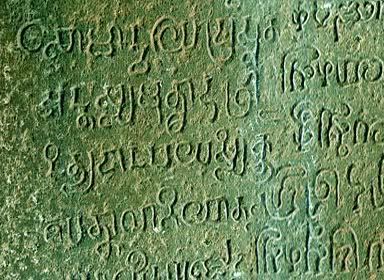
Camunic language (from Wikipedia; with images):

"The camunic language is an extinct language, spoken in the I millennium BC in some valleys of the Central Alps (Valcamonica, Valtellina) and not deciphered.

"The epigraphic corpus is carved on the rock, as similar as the rock engravings of Valcamonica, in one variant of the north-Etruscan alphabet, known as camunian alphabet or alphabet of Sondrio.

"It is possible that the language was related to camuna Rhaetian language; its name derives from the people of the Camunni, who lived during the Iron age in Val Camonica and was the author of much of the stone carvings in the area.

"Today there are known at least 170 inscriptions in camunian alphabet, that are written in lines even from right to left than left to right. The iscriptions are formed mainly by one or two words, and many are those ending in "-au".

"Were found few alphabetaries (a series of letters aligned to forming an alphabet) in Nadro (Zurla and Foppe localities) and in Piancogno, next to the Annunciata. These alphabetaries presents variants of each other, but allow us to date the inscriptions from the 4th to 5th century BC to 100 BC-50 AD)."

Another area which we have covered in the past is the alphabet of the ancient Camunni. In the link is the information sent to us from Naddeo Michelangelo. For further reading on this subject of ancient text, see his website at http://www.michelangelo.cn/. For a look at the characters of the ancient alphabet of the Camunni, see the following link at Wikimedia Commons.

The modern Camunian dialect is a variation of the "Eastern Lombard" dialect, which is eastern Lombardy. As we have pointed out before, and stated on this Wikipedia page: In Italian-speaking contexts, Eastern Lombard is often generically called a "dialect". This is often incorrectly understood as to mean a dialect of Italian, which actually is not the case, it's not a dialect but a language. Eastern Lombard and Italian are different languages and are not mutually intelligible. Eastern Lombard is, in turn, a sub-branch of the Lombard language.

Mauro Fiora has assembled an online Italian-Camunian translator, which has the lists of words by letter, as well as a Babelfish-syle translator. Needless to say, and please look for yourself, "Italian" (Tuscan) and Camunian are as different as English and Polish. What is further remarkable, is that the village of Sonico, and it's immediate surrounding area, speak even a sub-branch of the Camunian dialect!

I wanted to give just a few examples of Camunian words. First, Al Camònega stands for Valle Camonica, with the "Al" meaning "Valley." As with many words, it's different in "Sonican," ..... "Valàr." Also remarkable is that about half the words do not end in a vowel. Many resemble ancient Germanic or Celtic words, but have a unique flavor of their own, very different than the European regional languages that we may be familiar in the English speaking world: English, French, Spanish, German, Italian, etc.

One way to get a real sense of the language is to go to the Italian Wikipedia link: Comunità Montana di Valle Camonica. Then see the list of Camunian villages down on the right side. Click each one, taking you to that respective page, where you can see at the top along with the Italian name.... the Camunian name of that village. In other words, the REAL name. For example, lets take the first one: Angolo Terme. The proper Camunian name is Angól. Monno is Mòn, Gianico is Janec, Borno is Búren, etc.

On the Italian Logos translation website, which seems to be still in the developmental stage, one can search various words in many different languages. Included in these are "Bresciano," "Bergamasco," "Bolognese," "Furlan," as well as other variations of French and others. The translated word, for example, of "family" is family (Engish), famiglia (Italian), familia (Spanish), famille (French), familie (German), familje (Albanian), famija (Brescian), famigghia (Sicilian & Calabrese), famèe (Furlan), and numerous other words in numerous other sub-branches of French, German, etc. "Bresciano" is basically Eastern Lombard, and family in Camunian is famìa. In fact, in Sonican it is Baghècc.

On the television program 'Cake Boss' on the Learning Channel, the show begins with the proprietor of the Hoboken bakery, Buddy Valestro, a Sicilian-American, proclaiming "Mia Famiglia!" Actually, that's TUSCAN. The Sicilian word for "family," as we covered above, is "famigghia." It sort've makes me feel like using the word baghècc just to disagree with the forced paradigm.

I searched the word "market," which earlier had brought me a number of interesting linguistic variations, but it's not working now. In Bresciano, it was "mercàt," (same as in Camunian), as opposed to the Italian "mercato." This is no small potatoes. A language is the birthright of a people! I'm not referring to the United States, as we, or our recent ancestors, accepted the English language.

The Italian book entitled 'Vocabolario Bresciano-Italiano' by Giovanni Battista Melchiori is a more official source for the Bresciano/Camuno dialect of the Lombard language.

[4/12/10 NOTE: Apparently the word "family" is translated as "famija" in all of the Lombard dialects, except Camunian which is "famìa." Also the sub-Camunic variant of "family" is "baghècc" in Sonican, as was covered.

Lastly, I couldn't help but add one other word that really drives home the variations down to Camunian, and Sonican. The word "council" is "consiglio" in standard Italian (Tuscan), "Consèi" in Brescian/Camunian, and "Fabrisiér" in Sonican!

I couldn't easily search out what the word is in Lombard or East Lombard, but we can plainly see that one little community of villages (Sonico) can literally develop it's own language over centuries of continuity. How do we know that this tiny regional dialect wasn't some surviving remnant of ancient Camunian, ancient Langobard, Celto-Alpine, etc?]

.

Sunday, February 7, 2010

Interview with a Gaelic Polytheist

Interview with a Gaelic Polytheist

CC: You previously mentioned that you were a “Gaelic Polytheist.” What is Gaelic Polytheism, and is it the same thing as a “Celtic Reconstructionism?”

GP: Gaelic Polytheism is a branch of Celtic Reconstructionism. We recognize that the various peoples who are today called “Celtic” were, in fact, distinct societies, each with their own language, culture, and pantheon. As Gaelic Polytheists, we practice the Gaelic tradition exclusively; that is, the traditions of Ireland, Scotland, and the Isle of Man.

CC: Does it primarily deal with the pre-Christian pagan traditions? (as opposed to focusing on all aspects of culture and history)

GP: Gaelic Polytheism is based in pre-Christian Gaelic spirituality, though it incorporates a great deal of living tradition from the Gaelic lands. We recognize that the Gaelic peoples have living cultures, and that much of what we find as folk traditions in those lands are survivals of pre-Christian traditions. We do not want to practice the religion as it existed 2,000 years ago; we want to practice it as we believe it would be today if it had never died out.

CC: Are you also a actual practitioner of some aspect of what is referred to as “Celtic Reconstructionist Paganism? If so, what specific tradition?

GP: Yes, Gaelic Polytheism is the Gaelic form of CR.

CC: How would you assess the power of the Druids in Western Europe, prior to Roman influence? Some people believe that they had tremendous influence.

GP: We find clues to the what the role of the ancient Druidh was in the Gaelic lore. I do not speak for the other “Celtic” traditions, but we see that in ancient Ireland and Scotland, the Druid was highly respected, often having a place of honor beside the king, and being his top advisor. He also was known for having powers of magic and divination. Unfortunately, most of this knowledge has been lost to us.

CC: Is the concept of a predominantly male-dominated Druidic system, and the predominantly female-dominated Cernunnos-based Witchcraft tradition, exaggerated, or even true?

GP: Cernunnos was not a deity known to the Gaelic peoples, so I really have no answer to this.

CC: You had previously stated how eclectic and historically inaccurate the Wiccan or neo-pagan movement is. Can you comment on that? Also, do you believe that these modern movements have served any type of modern psuedo-political agenda?

GP: Neopaganism is a new religious movement which is largely based upon post-modern philosophy, medieval ceremonial magic, and some ancient Pagan traditions. However, most of the actual Pagan tradition that has been blended in has been altered from its original form and made to fit into the Wiccan or Neopagan mold. This is nothing short of cultural theft, and while we must respect their right to practice whatever spirituality they wish, I do not condone the co-opting of Gaelic deities or traditions into Neopaganism when they are not accurately portrayed.

CC: What are some of the chief symbols used by Wiccans, which you do not attribute to a Celtic or European origin?

GP: The most common is the Pentacle, which had no place in Gaelic or any other Celtic culture. The Triple Moon symbol is a 20th Century creation and was unknown to any ancient people.

CC: The Wiccan Revival of the twentieth century seemed to have been brought about by Freemasonic men in the UK. Might this initial Freemasonic influence, itself eclectic, Eastern, and universalist, have rubbed off on modern Wicca?

GP: Wicca certainly seems to have been influenced by such movements as Freemasonry and, without doubt, by ceremonial magic.

CC: Historically speaking, both spiritually and in social relations, how would you describe the interaction between the “Gaulic, Gaelic, Druidic” cultures, and the more Teutonic/Odinic peoples?

GP: These two peoples were closely related and there was a frequent exchange of population between them. They share nearly all of the same values, and some common themes appear in their lore. Some scholars believe that the Germanic peoples may have branched off of some paleo-Celtic people group. Whether this is true, the fact is that these two cultural groups have strongly influenced one another.

CC: Can you elaborate further on Gaelic Polytheism. What does it mean to you?

GP: One of the most important things for me is knowing that I am helping to revive and perpetuate the traditions of my ancestors. In fact, reverence for the ancestors is a strong theme in Gaelic tradition, and we definitely seek to reconnect with and honor them.

CC: Can you comment on the ancient seasonal “Wheel of the Year” as far as where it fits into history, and it’s significance?

GP: It seems to be a 20th Century fusion of traditions from various cultures. The ancient Gaels knew four seasonal festivals, which we as Gaelic Polytheists still observe today: Samhain, Imbolg, Beltain, and Lughnasadh. The ancient Gaels knew of the solstices and equinoxes, but there is not evidence that they observed these dates as religious festivals. A few GP’s may follow the 8-festival Wheel of the Year, but that is not the norm.

CC: You had stated that you do not believe that there was a definitive "Celtic culture" in the ancient world. Without necessarily mentioning names, what is your opinion of the current international groups which were organized to facilitate this "Pan-Celtic" concept?

GP: I think to some degree they are helping to perpetuate an interest in the various cultures that have come to be called "Celtic", even though the Pan-Celtic concept itself is a modern fantasy. I used to be Pan-Celtic myself several years ago, and the more I studied the ancient traditions, the more I realized that they were very distinct. I then learned that reputable historians agree with this assessment.

Also, it should be noted where the word "Celtic" itself originated. The ancient Greeks referred to the bararian tribes who lived to the north of them as "Keltoi". It is ironic that so many centuries later, some people decided that the term should be applied to the inhabitants of the British Isles, who are not the descendants of the Keltoi, and are only distantly related to them.

CC: How would you quickly sum up the affect of early Christianity on paganism, especially in what were considered regions of Celtic settlement?

GP: The conversion of the Gaels was not as bloody or brutal as the conversion of the Germanic peoples and some others. The early Celtic Christian Church simply blended traditional Gaelic spirituality with the Christian faith to create a system where followers were free to honor Christ at the same time as Brighde, Daghda, etc. This period of blended faith lasted several centuries, and in fact, it could be said to still exist today, since many Gaelic Christians still honor Brighde as a saint, and may give honor to the spirits of nature as well.

CC: We have a concept that we would like your opinion of. The chief deity, of which the Wicca religion is based on, appears to be the horned god Cernunnos. Correct?. Since one of the alternate names for this deity is “Cern,” couldn’t this tradition be called “Cernism” in a revisionist direction? (in the same way as Odin and Odinism)?

GP: Again, Cernunnos is not a deity known in our tradition, so I’m not really qualified to speak to this.

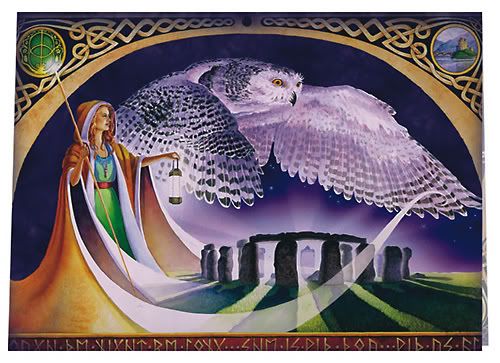
CC: Where do the hundreds of very ancient megalithic monuments located largely in the British Isles, like Stonehenge, fit into the Gaelic Polytheist belief system?

GP: Stonehenge itself is in an area that has never been the home to any Gaelic tribe, so it is pretty irrelevant. We do see other stone circles, such as Calanais, which are in the Gaelic lands, but these predate the Gaels. Likewise, Newgrange in Ireland, which is aligned to the Winter Solstice, is of pre-Gaelic origin.

I'm sure many Gaelic people appreciate these sites as historical landmarks, and even for their spiritual significance, but they were not constructed by Gaelic people, and I'm sure they had much greater significance to the people who actually did build them.

CC: Are there any other subjects which we have missed, but are of importance? If so, can you elaborate on them?

GP: Thank you for the interview. This is actually my first chance to speak for Gaelic Polytheism to people outside our movement. You will find some variation within GP and some may have even answered these questions differently than I did. But I believe I have represented our movement accurately, as far as what the concensus would be on these subjects

We simply seek to restore the spiritual traditions of our ancestors within a modern context. Though some things have been lost, we would rather fill in the blanks with our own innovations which are rooted in our knowledge of Gaelic lore and tradition, rather than borrow from another culture or from a Neopagan tradition.

Being a Gaelic Polytheist is as much about culture as it is religion. To follow this path, one must be willing to study and immerse oneself in Gaelic lore, folk tradition, values, language, art, culture, music…basically, to carry on not only the religion of the ancient Gaels, but the traditions of the living Gaelic cultures. This is an ethno-cultural tradition.

I may recommend a couple of websites if you wish to have more information.

http://www.gaolnaofa.com

This is a GP organization in which I hold membership. The website has a great deal of information and resources.

http://www.paganachd.com

This is another Gaelic Polytheist website, which has an excellent and very lengthy FAQ about the movement.

Thanks again for the opportunity to speak with you..

Froach MacFhionghain Stiubhart
froach222@yahoo.com


.