Saturday, November 15, 2008

Raffaldini Vineyards and Winery

From the main page of the Raffaldini website:

"The Raffaldini family dates back to the year 1348 in the town of Mantua, located in the Northern Province of Lombardy, Italy. Since that time, our family has owned and continues to live on the farm where the great classical poet-philosopher Virgil spent his youth. The romantic town of Verona, home to the ill-fated lovers Romeo and Juliet, lies just to the east.

The Raffaldini family motto, “Audentes Fortuna Iuvat” means, “Fortune favors he who dares.” This Latin phrase originates from the Aeneid, Virgil’s most famous work. Born in 70 BC during the reign of Julius Caesar, Virgil is best known as the author of this epic poem that links the birth of Rome to the Trojan War.

The fusion of family, food and wine is an integral part of our daily life. For more than six hundred and fifty years, the Raffaldini family has witnessed many historic events and has often marked such occasions with special family dinners and homemade Italian wine.

The Raffaldini family made a decision to share our centuries-old winemaking experience with the New World. After a long and exhaustive search for land that would reflect this experience, Raffaldini Vineyards was established in the Swan Creek area of the Yadkin Valley. From this vineyard, we handcraft our Italian wines; wines that express not only their “sense of place”, but also utilize winemaking skills that have been refined throughout the ages.

As you enter our tasting room, let the spirit of the Raffaldini family history, importance of family and celebration of life transport you to our ancestral home. The wine, food and artwork within hold deep meaning for the Raffaldini family and we are delighted to share them with you. Close your eyes as you taste our wine and imagine what it would have been like to celebrate life so long ago…

Salute!"


From the Heritage Page:

"Virgil, the poet, born of Mantua

"The great poet Publius Vergilius Maro ("Virgil") was born to a middle class family in October of 70 BC in the town of Mantua during the reign of Julius Caesar. Mantua was a Roman city in the province of Cisapline Gaul (now Lombardy). The province extended to the Alps and covered the most fertile part of the Po valley. Mantua traces its founding to the Etruscan civilization that ruled most of Italy but quietly disappeared leaving little known of it. In the time of Virgil, Mantua was a quiet agrarian community dominated by farming and shepherding. The beauty of the area so transfixed Virgil that he once wrote, 'dove il Po discende per aver pace con sequcai sui': 'where the Po runs down among its followers to find peace'. Not far to the east of Mantua lies the town of Verona, home to Romeo and Juliet.

"Fertile destiny

"According to legend, while Virgil was in his mother's womb, she dreamt that she gave birth to a laurel branch. Upon touching the earth the laurel branch took root and at once grew to the size of an adult tree, covered with fruits and flowers of various kinds. The following day, whilst traveling to a neighboring part of the country with her husband, Virgil's mother turned aside and gave birth to her child in a ditch beside the road. Legend has it the infant did not cry at its birth, and had such a gentle expression as even then to give assurance of an unusually happy and fertile destiny.

"There was yet a further symbol of Virgil's exceptionally rich contribution to the future land and its people. Traditional to that region on such occasions, a poplar branch is planted where birth occurs. The branch planted where Virgil was born grew so fast that it was equal in size to others planted long before. The poplar branch became known as "Virgil's Tree", and was worshipped with great veneration by women about to give birth, who made their vows beneath it.

"Mantua's history continues

"The history of the Raffaldini Family can be traced back to 1348. The Raffaldini heritage is centered in Mantua where they were extensive landholders, together with the Gonzaga and Bonacolsi families. The Raffaldini Family has for centuries owned and continues to live on the farm where Virgil lived during his youth. The influence of this great poet and philosopher upon the Raffaldini Family has been profound over the multitude of generations.

"The founding principles of Raffaldini Vineyards and Winery are deeply rooted in much of Virgil's philosophy: the belief that by working with the land and understanding its life essence, rather than trying to change it, enables the vineyard to produce grapes of exceptional quality. This harmonious relationship is the cornerstone for the making of great wines. The Raffaldini Family has always believed that the miracle of winemaking does not happen in the winery, but rather in the vineyards. A deep respect for the land, a long sense of history and centuries of aspiring for high achievement all combine to produce a single expression of wine that captures the heritage of the Raffaldini Family - 'Audentes Fortuna Iuvat': Fortune Favors the Daring."

Raffaldini Vineyards & Winery (North Carolina)

Tasting Room Hours
Wednesday – Saturday 10am – 5pm; Sunday 1pm – 5pm and by appointment
Tours: Wed-Sun 1pm & 3pm


Thursday, November 6, 2008

Newark Swiss Park


Up until a few decades ago in California, and particularly in the Greater Bay Area, there were many Swiss clubs. As far as I know, they were largely Italian-Swiss in culture. The record seems to be very clear on this: the traditional "California Swiss" were Italian-Swiss. However, there were German speaking Swiss as well. Between, roughly, 1850 and 1930, 20,000 immigrants arrived in California from the Italian speaking (Lombard dialect) Swiss canton of Ticino. This was the biggest happening in the history of the tiny canton. Up until the decline of the Swiss clubs, 20,000 people, and perhaps double that in descendants, was a comparatively (in%) larger number of people than it would be today. They apparently thought of themselves as "Swiss," rather than Italian. In fact, culturally and ethnically, they were Lombardian. I view Ticino, like Brescia, as another province of Lombardia.

A few years ago I attended the annual local spring Swiss celebration in Newark. I was hoping, perhaps even expecting, to see at least a booth for the Ticinese culture. When I first entered the park, the friendly entry person asked me if I had a "Swiss connection" of some type. I replied that my family was from Lombardy, and how that culture was the specific one represented in Switzerland. The main building was a marvelous German-Swiss traditional style design. A tall fence surrounded a cement patio area (which included a large grill and stage area) around the building, with also a grassy area with picnic tables. A very practical setting for a gathering. There was music, food, booths, etc.

Surrounding the main area was a grassy area on one side, with a dirt parking lot among some trees, and it was fenced in. It had long been a community center, with a bar and restaurant, events, and a nice large hard wood floor room with a high ceiling, which wasn't in use that day, but I walked in to look around briefly. Traditional dancing was probably a much bigger thing way back when it was constructed. Surrounding the facility was a shopping center and Holiday Inn. The building spoiled the visual environment to be honest. I mean, a beautiful traditional building with one tall modern building next to it. In Italy they are pretty good about planning freeways and large buildings, as to not spoil the look of the countryside. It was clear that there was a mixture of the old with newcomers, from the old country. However, you don't have to be Swiss. Anyone can visit.

In general, although very German, they were not a tall people. More of an Alpine type. I did see one beautiful young woman in traditional dress. A classic tall blonde German beauty. Most Germans (Germans, Austrians, Swiss, etc.) are of Alpine stock, with Nordic traits. It depends, at Oktoberfest, there are definitely some tall people. One time I was watching one video on YouTube, and there were two German girls. They looked eighteen or so, speaking German. One with dark blonde hair, basically Nordic looking, and the other struck me as looking so much like one of my grandmothers. Very Alpine. There are German Alpines, French Alpines, Italian Alpines, and Slavic Alpines. I remember that happened one other time. My family used to have an old photograph of one of my great grandmothers when she was probably in her early twenties. I memorized her face from it being there for so long. Anyway, one time I saw a young woman who had the same face! I think everyone has had an experience like that at least once It's funny because, if you told them, they would never understand.

After we got some bratwurst, as I started to sit at one of the picnic tables, a very burly brooding red haired man with a walrus mustache growled that the seat was taken. However, the people at large were very friendly. Sometimes in popular culture, Germans are portrayed as being brooding, calculating, and humorless. I don't really see how that can wash, as there are so many loud, gregarious, beer drinking, laughing, back-slapping Germans. I never did see anything "Italian-Swiss" at all. There is a group "Pro Ticino Nord California," which is part of what amounts to a Ticinesi nel Mondo type group. I sent them a letter once time, but I received no response.

While I'm on sort've this German-Swiss Alpine subject. Recently I read something online about Bavarian immigrants in America, in certain places, where they, for a couple of generations in America, only married other "Bavarian-Americans." I mean, like, not even other German speaking or descended people. I thought that was curious. Historical regions, like Bavaria, were distinct, regardless of what administrative jurisdiction they were under. I'm referring to the way it was over centuries. For example, even when Polish speaking districts were broken up under different kings or empires, there was still "a Poland." I always thought it was tragic that Prussia was erased from the map.

The following text is from the Newark Swiss Park website: "The Newark Swiss Park was constructed on dairy and farm land in rural Alameda County in 1934, by Swiss Immigrants who wanted to preserve some of their Swiss Culture and Traditions. As time has passed, suburban Newark has grown up around the park. The restaurant and bar is open to the public, serving both American and Swiss/German fare. The Park and Banquet Hall are available for rental use. Many Swiss events are held at the facility and are open to the public: Regular Swiss / German Ländler Music and Dancing; Spring and Fall Schwingfests (Swiss Wrestling Competitions); The Big Swiss Independence Day Celebration, occurring near August 1st each year."

Aside from Newark Swiss Park, there were two other California Swiss websites that I found when I was searching for Newark Swiss Park, which I wanted to place here, even though they are not connected to anything Italian-Swiss. They are the Lugano Swiss Bistro restaurant in Carmel (not Ticinese at all, despite the name), and the Swiss Park Banquet Center in Whittier.

Saturday, October 18, 2008

Sons of Lombardy


We believe that the time is long overdue for the establishment of a "Sons of Lombardy" type of group in America. "Sons of Lombardy" is just a reference point, as the name should refer to all of our people, and not just adult males. We can only guess at the regional demographics, but Missouri and Northern California, and possibly Oregon, should be the focal points. We estimate that perhaps 100,000 immigrants, from Lombardia and Ticino, have migrated to America since it's founding. That would equal many more descendants by this time. The only heartbeat for "Lombardian America" right now are the small remnants of Milanese in Missouri (St. Louis), the Ticinese groups in California, and us here. Ticinese, or Italian Swiss, are of our people. They have their own indentiy, but it's like a provincial one, like Brescia or Bergamo. They speak the same dialect: "Lombard."

Lombardi nel Mondo's North American Regional Council has made little or no effort to reach out to Americans of Lombardian descent. Their website is in Italian only and is very difficult to navigate. Not to mention their unusual URL, which is slow, erratic, and seems to be offline very often. I was just about to place their link here now, but it's offline yet again! Their board of directors is made up of Italian male nationals ONLY. I have no idea of what they hope to accomplish? They do work on the Milan-Chicago Sister City Committee, but that's economics only. What about us Lombardians!? They do write about our history on this continent, but they basically ignore US! There is amazing technology available, like Facebook, YouTube, Blog Talk Radio, etc. They don't even have a simple blog or message board! I state these facts and complaints advisably, as I hope to inspire all of us to make some changes.


As you may already know, we here are heavily involved with the Padanian-American League, and are unable, and unwilling, to take on this endeavor all by ourselves. We can, however, be a voice for our community and culture here. Even though we are "Bresciani nel Mondo" in name, we are also "Camuni nel Mondo" and "Lombardi nel Mondo" in this region. As I see it, there are two choices. 1) Try to push for changes within the North American Regional Council; or 2) Begin to develop our own institution. Since the council exists, and presumably has funding from the regional government of Lombardia, I think we should try to reform their policy first.

One workable example of what we're talking about is the Tuscan American Association. They do receive funding from the regional government in Toscana, Italy. They at least have a website in English (and Italian). Even then, they have none of the interactive web infrastructure that we mentioned, which is a negative. However, their council has both Italians AND Americans on it! I mean, it would be silly for a heritage association to exist in America, via and by an overseas country, in which there are no Americans! What would be the point?? Not to mention actually ignoring the Americans, and still write the history of our ancestors here. Makes zero sense.

An exact google search (with quotes) of "Lombard Americans" shows only three results, which is now four as of the publishing of this entry. It's a start. We would prefer "Lombardian American" (with no hyphenation in this case). As stated earlier, "Lombard" is of the ancient tribe. For example, one wouldn't call modern day Tuscans... "Etruscans." If people of "Sicilia" are "Sicilians" (in English), then people of Lombardia are Lombardians. They're not called "Sicani" (an ancient tribe on the island), and we're not specifically "Lombards" of ancient times.

Sunday, October 12, 2008

Marvel Comics "Maggia" crime


Between 1850 and 1930, about 20,000 Italian-Swiss immigrants from Ticino, migrated to California. There was a well known quote, by a very well respected California politician of that time, which reflected how these people were absolute "model citizens." I checked, but unfortunately I don't have that quote handy right now. Perhaps someone out there can help us out with that. A good percentage of those immigrants came from the Maggia Valley in Ticino.

***************************************************************************

Well, Marvel Comics, a long time publisher of comic books, chose the name "Maggia" for another purpose. From Wikipedia (Maggia page):

"The Maggia is a fictional international crime syndicate that has appeared in various comic book series published by Marvel Comics. The organization exists in Marvel's main shared universe, known as the Marvel Universe. Its structure is somewhat similar to the Mafia (which is itself almost never referred to in Marvel stories), but the Maggia differs in that it frequently hires supervillains and mad scientists to work for them. The characters Count Nefaria and his daughter Madame Masque have both been leaders of an important Maggia family.

The Nefaria family

This group bears little resemblance to the rest of the Maggia. The late Italian nobleman, Count Luchino Nefaria, a scientific genius, was the world's most powerful Maggia leader until his initial defeat by the Avengers. Afterwards he moved his base of operations to the New York City area, and then imprisoned Washington, D.C. within an impenetrable force-dome and held it for ransom. After his defeat and capture, his daughter Giulietta, also known as Whitney Frost, succeeded him as family head and led an unsuccessful attempt to capture the advanced weaponry of Tony Stark. She was eventually succeeded by a costumed criminal, the Masked Marauder, who demanded complete control of New York City or else he would detonate a nuclear device there. After his capture, the family again apparently came under control of Whitney Frost, by then known as Madame Masque. Contrary to standard Maggia practice, the Nefaria family, principally consisting of men under 40, has employed futuristic weaponry and even robots (like the Dreadnoughts), as well as costumed super-powered agents (Unicorn, Whiplash, Gladiator, etc.), and has launched open attacks on society. Its leader is always known as "Big M." There are many other Maggia "families" in the United States and Europe which do not employ superhuman agents. With both Count Nefaria and Madame Masque now pursuing separate agendas, it is not known who, if anyone, currently heads the Nefaria Family.

Luchino Nefaria is a wealthy Italian aristocrat, who while a traditionalist also desires greater wealth and power, driving him to join the criminal organisation the Maggia.

Madame Masque was born as Giulietta Nefaria, the daughter of the master criminal Count Luchino Nefaria, in Rome, Italy. She accepted her father's offer to become a professional criminal mastermind and was trained by him in strategy, criminal activities, and combat. She turned out to be a brilliant student and when her father was imprisoned, she became the new Big M, the leader of the Nefaria family of the Maggia."

***************************************************************************

The Maggia Valley is a district of the Swiss Canton of Ticino, and within it is the municipality of Maggia. It has an identity and a people of it's own. It has a coat of arms. Marvel Comics has no business whatsoever in "using" it's name in this slanderous manner.

There are corners of southern, northern, and eastern Europe, where the root stock population has a very serious organized crime problem within the native population. Northern Italy, Rome, Ticino, and Maggia are NOT in that short list..... AT ALL.

Many unfair stereotypes do have at least some grain of truth to them. In this case, there isn't a grain or even a single speck of truth. Shame on Marvel Comics for using and slandering the peaceful Maggia Valley and it's people.

Saturday, September 27, 2008

East Lombard, West Veneto, or Orobia?

[Left: Flag of "Orobia" or East Lombardy]


Languages of Italy

I hate to sound overly judgmental or reactionary, but anyone who thinks that there is ONE Italian language is bananas. Italy was hastily put under one roof, just like Yugoslavia was, without any regard for local cultures. The Italian peninsula has numerous languages and cultures. Some developed on their own, stemmed from ancient peoples, and/or were influenced by migrating or invading peoples. "The official language of Italy is Standard Italian, a descendant of the Tuscan dialect..." (Wikipedia: Languages of Italy). For a lot more information and maps, see the Wikipedia web page for Languages of Italy.


Lombard language

From Wikipedia: Lombard language: "Lombard is a language spoken mainly in Northern Italy (most of Lombardy and some areas of neighbouring regions, notably the eastern side of Piedmont) and Southern Switzerland (Ticino and GraubĂĽnden). Lombard belongs to the Gallo-Italic group within the Romance languages.

The two main varieties (Western Lombard language and Eastern Lombard language) show remarkable differences and are not always mutually comprehensible even if Western Lombard is generally easier to understand for an Eastern Lombard speakers than the converse. The union of Western Lombard or Insubric, Eastern Lombard and intermediate varieties under the denomination of "Lombard" is a matter of debate, and it has been argued that the two might potentially form separate languages."

From Wikipedia: Lombard language: Usage: "Standard Italian is widely used in Lombard-speaking areas. However, the status of Lombard is quite different between the Swiss and Italian areas. This justifies the view that nowadays the Swiss areas (sometimes referred to as Swiss Lombardy (Lombardia svizzera) have become the real stronghold of Lombard."

From Wikipedia: Lombard language: In Switzerland: "In the Swiss areas, the local Lombard varieties are generally better preserved and more vital than in Italy. No negative feelings are associated with the use of Lombard in everyday life, even when interacting with complete strangers. Some radio and television programmes in Lombard, particularly comedies, are occasionally broadcast by the Swiss Italian-speaking broadcasting company. Moreover, it is not uncommon for people from the street to answer in Lombard in spontaneous interviews. Even some television ads in Lombard have been reported."

Apparently, the Lombard language developed, at least partially, from the ancient Lombardic language of the Langobardi. From Wikipedia: Lombardic language: "Lombardic or Langobardic is the extinct language of the Lombards (Langobardi), the Germanic speaking settlers in Italy in the 6th century. The language declined from the 7th century, but may have been in scattered use until as late as ca. AD 1000. The language is only preserved fragmentarily, the main evidence being individual words quoted in Latin texts."

For much more information and maps about the Lombard and Lombardic languages, see the Wikipedia page Lombard language and the Wikipedia page Lombardic language. I know I'm copying and pasting a lot of this but, there's a lot of information I'm covering and tying together, so bear with me. On the Lombard language page, don't miss the two example images on signs (a restaurant and town hall). It's amazing to see our language in living usage. The one "BAIT DAL CAMUN" looks very unique, needless to say. No vowels, but it's doesn't look German either. It could even have Celti roots.


Eastern Lombard language

From Wikipedia: Eastern Lombard language: "Eastern Lombard is a group of related dialects, spoken in the eastern side of Lombardy, mainly in the provinces of Bergamo, Brescia and Mantua, in the area around Crema and in a part of Trentino.

In Italian-speaking contexts, Eastern Lombard is often generically called a "dialect". This is often incorrectly understood as to mean a dialect of Italian, which actually is not the case. Eastern Lombard and Italian are different languages and are not mutually intelligible.

As per today, Eastern Lombard does not have any official status either in Lombardy or anywhere else: the only official language in Lombardy is Italian."

For more information on the Eastern Lombard language, see the Wikipedia web page Eastern Lombard language.


Orobia

From Flags of the World: Padanian Flag of Orobia (Italy): "This flag on top is neither the actual flag of "Liga Veneta" (= Northern League Venetian section), nor the flag of the "Serenissimi" ("Serenisimi" in Venetian language), indipendentist movement from Veneto, who became famous in 1997 for having "conquered" for some hours the famous Bell-Tower of St. Mark in Venice.

Northern League reused the flag with the sword as the "Flag of Orobia" (= Eastern Lombardy, Provinces of Bergamo and Brescia, which were once dominated by the "Serenisima") where people speak a "dialect" quite different from Western Lombardy (or "Insubria") and hardly understandable for other people: in Italian, when we hear a strange word or phrase, we may say "Che è, bergamasco?" (= What is this? Bergamo idiom?). You can see a small gif at . I daresay that's the top flag modified with blue background!)
Paolo Montanelli, 20 March 2003

It is not the flag of Liga Veneta, but the flag of Eastern Lombardy ("Orobia"): in a project by Lega Nord (even if it's not the official political line of the party) the present Lombardy should be divided in two parts: "Insubria" (Western Lombardy) and "Orobia" (Eastern Lombardy).
Paolo Montanelli, 1 May 2003

The military pattern old Venetian Republic flag (with dark red border) is used by the Serenisima Republic, and now adopted by the Orobico autonomist but with the border changed to gold, and its devices to blue, and the central rectangle changed from dark red to blue according to .
Jaume Olle', 2 May 2003

North League has a different flag for Eastern Lombardy (called Austrasia). So there is two movements claiming a region of Eastern Lombardy? (one Leghiste and other disident?). In my notes Orobia and Austrasia are two different entities: Orobia is Western Veneto, and Austrasia is Eastern Lombardy. Besides, it is not the flag of Liga Veneta, but the flag of Eastern Lombardy ("Orobia").
Jaume Olle', 13 May 2003

What's "Austrasia"? I know only a region called Austrasia about 1,500 years ago and it was not in Northern Italy but in present Central Germany (). Even if I never heard about it, I've found some websites referring to Eastern Lombardy as "Austrasia". But they are very few. Instead, a lot of pages refers to Bergamo/Bèrghem as "capoluogo orobico", Eastern Lombardy as "terra orobica" and so on. Has anyone a description of this flag of "Austrasia"? Is it different from the "bandiera orobica" I located on the web?
Paolo Montanelli, 1 July 2003

The term Orobia never existed, so it is only an invention by North League; the "Orobi" were a pre-roman people that lived in the region of Bergamo, and "Orobie" is the name of the Alps between Bergamo, Lecco and Sondrio.
Fabio Facoetti, 1 July 2003

The Kingdom of Austrasia existed from 511 to 751 in the north-east of Gaul. Its territory covered Rhineland (now in Germany), Luxembourg, a part of Belgium and Lorraine (now in France). Its capital city was Metz, now in Lorraine. I Austrasia was a Merovingian kingdom, in struggle with Neustria, located more westwards. Pepin de Herstal (635-714), from Austrasia, defeated King of Neustrie Thierry III in 687 and unified Austrasia and Neustrie. His son and successor was Charles Martel, father of Pepin le Bref and grand-father of Charlemagne. Charlemagne later invaded the so-called Padania when he suppressed the Lombard kingdom, but I am not aware of any Austrasia he might have created in northern Italy.
Ivan Sache, 1 July 2003

Surely Paolo is right refering with Eastern Lombardy as Orobico (even if is also called Austrasia sometimes). There are several autonomist sensibilities in North Italy. For some, Bergamo was part of the Republic of Venice and is in West Veneto; for others, Bergamo is yet in Lombardy. Who know what were the boundaries of the Celtic tribe that give name to the region? I dont know this and perhaps this is depending of the point of view. Italy has a lot of political parties, coalitions, minor movements, etc... and when is for autonomist groups the situation is complicate (very much complicate!).

I asked Matte Colaone for a clasification of the autonomist movements: Leghiste, League allieds, autonomist out of League, regional italianist, etc... Dozens of flags were published in Flag Report, in several issues. He answered that the clasification will be issued in the next Flag Report, and it seems that this will shed some light on the panorama, but some specifics questions, like this one of Orobia, will remain pending.
Jaume Olle', 1 July 2003

In my opinion, the term "Orobia" never existed. I live 10 kms far from Bergamo, in the land that 2.000 years ago was inhabited by the "Orobi". This people was established in the actual Lombard provinces of Bergamo, Lecco, Como and Sondrio (in fact, the Alps of this region are called "Alpi Orobie"). The origin of Orobi is uncertain (it is not known if they were Celtic or Ligures), and we don't have many documents of their existence, like buildings or objects, because of their backwardness: their region were first occupied by the Etruscan, and then conquered by the Romans, about in 200 B.C., becoming part of the "Gallia Cisalpina" (Cisalpine Gaul).

Roman occupation civilized these regions, with the building of roads and towns. As already said, we people of Bergamo don't have any cultural heritage of these tribes, because many people crossed our territories in the past (Longobard, Ostrogoth, German, Venetian...).
Austrasia is a historical region, completely unreleated to Bergamo and to Italy.
Fabio Facoetti, 2 July 2003

Austrasia was the name of the east lands of Frankish empire (opposite to Neustria). I believe that Austrasia mean "Eastern land" (from germanic ost, derived aust, like Austria) or so, and this is Eastern Lombardy.
Jaume Olle', 3 July 2003

I'm a linguistics student and I only used the term "Orobico" to describe the Eastern Lombardy dialect, which is quite different form that spoken in the western part of Lombardy. I found "Orobico" a much better term than "Bergamasco" (and much more better than "Austrasiano"... ), which is still the most frequent term in dialectology, because that linguistic area also includes Bresciano and Camuno. It's just a question of conventional names.

For example, referring to Northern Italy dialects I use indifferently the words "dialetti gallo-italici" or "dialetti padani" (which do not comprehend neither Venetian nor, of course, Friulian and Ladin) without giving political support to any political party or secessionist project. I'm quite sure the word "Austrasia" has been never used referring to Bergamo and Brescia, either in past times or in recent times, either by sovereigns or by common people...
Paolo Montanelli, 4 July 2003

Austrasia mean the easter lands of any region. To relate current Austrasia with the Frankish kingdom that was known under this name is not the issue. Even if the genesis of the name is the same there is no relation neither simbolic or reivindicative.
Jaume Olle', 4 July 2003

Austrasia is the name of a kingdom whose existence is documented from 511 to 751. At the same time, there was a kingdom of Lombardia, whose eastern part has nothing to do with Austrasia. Wether Austrasia refers to the east or not is absolutely irrelevant in this case. Austrasia cannot be eastern Lombardia.
Ivan Sache, 4 July 2003

[Right: Flag of "Insubria" or West Lombardy]


Western Lombard language

From Wikipedia: Western Lombard language: "Western Lombard is a Romance language spoken in Italy, in the Lombard provinces of Milan, Monza, Varese, Como, Lecco, Sondrio, a little part of Cremona (except Crema and its neighbours), Lodi and Pavia, and the Piedmont provinces of Novara, Verbano-Cusio-Ossola and a small part of Vercelli (Valsesia), and Switzerland (Canton Ticino and part of Grischun). After the name of the region involved, land of the former Duchy of Milan, this language is often referred to as Insubric (see Insubria and Insubres) or Milanese, or, after Clemente Merlo, Cisabduano (literally "of this side of Adda River").

In Italian-speaking contexts, Western Lombard is often incorrectly called a dialect of Italian language, but actually it is a separate language. It has more than a few similarities to French. Insubric and Italian are different languages and are not mutually intelligible, because of lexical, phonetic, and grammatical differences. Western Lombard, more than many other languages spoken in Italy, has many varieties, because of the mountain geography and history of various political divisions.

Western Lombard is divided into four main classes, called by many Italian linguists lombardo alpino (provinces of Sondrio and of Verbania, Sopraceneri of Canton Ticino and Grigioni in Switzerland), lombardo-prealpino occidentale (provinces of Como, Varese and Lecco, Lugano and its neighbors in Canton Ticino), basso-lombardo occidentale (Pavia and Lodi), and macromilanese (provinces of Milan, Monza, Novara and Valsesia of Vercelli). The boundaries are obviously schematic, since the political division in provinces and municipalities are usually independent from languages spoken.

For more information about the Western Lombard language, see the Wikipedia web page Western Lombard language. Roughly, the Western Lombard language is the majority of Lombardy, Ticino (Switzerland), and the southernmost areas of GraubĂĽnden (Switzerland, east of Ticino; Grigioni in Italian); and the Eastern Lombard language is in the provinces of Brescia, Bergamo, Mantua, and Cremona.


Insubria

As East Lombardy is called "Orobia," West Lombardy is referred to as "Insubria." The Insubres were a Celti tribe who lived in the region before it was Romanized by conquest. Our Lombardian friend in Italy, Alessio Mezzenzana, stated "The UNESCO classifies Lombardic (InsĂĽber and Orobech) as own Languages, within the Gallo-Romance family." Now these names sound very German. It can be confusing. Also, the West is usually identified with Milano, while the East is usually identified with Brescia or Brescia-Bergamo.

Further strengthening the differences between the two regions, is the fact that the East was an important part of the Venetian Republic for a number of centuries. There's one street in Brescia named "San Marco di Brescia," which always symbolizes this nexus for me. The Brescian Council purposely broke away from dictatorial Visconti rule (Milanese) in order to join with the more progressive statecraft (regarding internal matters) of the Venetians, which became official after the "Treaty of Lodi," in the fifteenth century. Therefore, East Lombardia is almost like the "West Veneto" in some people's minds.

From Wikipedia: Flags of the World: Padanian Flag of Insubria: "That is the historical region where I live [=Lumbardia Ucidental/Western Lombardy(I) + Cantun Tisin/Canton Ticino (CH)]. Insubria flag was born on tne 5th september 1395, created by Emperor Venceslao of Holy Roman Empire for Duca Gian Galeazzo Visconti of Milan
Matteo Colaone, 21 August 2000

I see a connection with Ticino by the II and III quarters, showing a charge quite similar to the arms of Bellinzona. What about the other quarters, what does the black eagle on gold stand for? Roman Empire, in any of it's incarnations?...
Antonio Martins, 30 August 2000

Antonio is absolutely right here, the serpent (in italian "biscione") appearing on this flag is the same as the one appearing on the arms and on the flag of Bellinzona (Ticino).
Pascal Gross, 30 August 2000

Insubria is another term to refer to Western Lombardy. It is taken from the celtic tribe (Insubrae) which settled between the Tessin and the Adda rivers in ancient times. The heraldic flag is the historical banner of the Dukedom of Milan. It was granted by the emperor Wenceslaw in 1395 to Gian Galeazzo Visconti first duke of Milan, being the dukedom part of the Holy Roman Empire. That is why the black eagle appears in the first and fourth quarter. The figure in the second and third quarter is the traditional heraldic simbol of the possessions of Milan first and the Dukedom after. Possession which included the whole of nowdays Western Lombardy, parts of Piedmond and the whole of Canton Tessin in Switzerland.

That is also why the City of Bellinzona still bears the same arms today (in different colours though and without the moor in the mouth of the snake. Bellinzona was always one of the most faithfull cities of the dukedom) and why the people on both side of t! he border speak the same language (that is western lombard). The origin of the use of the snake, apart from the legends, dates back to the first crusade when it was granted by the municipality of Milan to Ottone Visconti one of the leaders of the lombard contingent. Since then it has rappresented the arms of the State of Milan.

The flag has been the official emblem of the Dukedom from 1395 till 1796 when Napoleon dismantled it (together with the Holy Roman Empire) and it appears also in the arms of every emperor of the house of Hapsburg from Carl the fifth onwards (having carried the emperors themselves the title of Duke of Milan after the death of the last Sforza). When the Hapsburgs will re-enter their possessions in 1815 after Napoleon's fall the dukedom will be unified with the former Republic of Venice and Dukedom of Mantua to form the Lombardo -Veneto kingdom.
GianPietro Gallinelli, 29 September 2000

The Padan's Insubria flag was first presented on 4th of June 2000 at Pontida (Bg), Lombardia by Cultural Association "Terra Insubre". See http://www.terrainsubre.com/il_simbolo.htm.
Matteo Colaone, 4 October 2000

In Milan (Lombardy, Italy) page, Jaume Olle said: "Visconti flag 1277-1397. Reconstructed from writen descriptions. In 1397 the use of imperial eagle was granted by Empeor" . Above GianPietro Gallinelli said: "It was granted by the emperor Wenceslaw in 1395 to Gian Galeazzo Visconti first duke of Milan, being the dukedom part of the Holy Roman Empire. That is why the black eagle appears in the first and fourth quarter."

In conclusion the image at Milan's page is, chronologically, the first flag of the Dukedom, and the above flag was the evolution after 1395 of the previous flag , so it should be considered as a political flag in its modern use (autonomist of Insubria), but it is also an historical flag of Milano and Western Lombardy.
Matteo Colaone, 11 November 2000"

Another webpage, which sheds some light on this issue is the Bandiere del Popoli (flags of the people) page for Lombardia.

Friday, August 29, 2008

Third, fourth and fifth generation keeps Nichelini Winery alive

Third, fourth and fifth generation keeps Nichelini Winery alive

Paul Franson - Napa Life [originally published in the St. Helena Star]

Though tourists flock to Napa’s old Beringer and Charles Krug Wineries, another historic treasure lies so far off the beaten path that only the determined – or lucky – stumble onto it.

In 1884, Swiss-Italian immigrant Anton Nichelini homesteaded property high up in Sage Canyon that probably reminded him of his home in the Ticino canton of Switzerland.The French-trained stone mason built Nichelini Winery in 1890 and it still hangs on the side of the hill, close to the road like those found back home.

The rustic winery remains in family hands after more than 100 years, the oldest winery still operating by the original family in Napa County, and one of very few with that pedigree in California.

The present owners of the winery are grandchildren and great-grandchildren of Anton and Caterina Nichelini, for while three generations isn’t many to span 116 years, Anton and Caterina had 12 children, and they stretched the equivalent of a generation among themselves.


Recollections of history

Anton actually met Caterina in San Francisco, even though she was also from Ticino in Switzerland. She largely ran the vineyard and winery as Anton worked as a stonemason.

Like most wine-making families—they didn’t call them vintners then—they made wine and sold it during Prohibition, making regular deliveries to Oakland and other places with wine hidden under the floorboards of a ’24 Lincoln that once belonged to the mayor of San Francisco.

Caterina also served meals to rare passers by; the steep and rough road was only paved in the early ‘40’s and electricity came in 1947.

Family legend says Caterina accidentally sold wine to treasury agents during Prohibition, but since they didn’t then jail women, Anton had to serve her sentence, though only on weekends so he could work.

All the Nichelini cousins lived or visited regularly, though the old homestead in now occupied only when they visit. The original tiny cabin where four children were born has been moved down the hill to a site near the winery and awaits restoration.

It would take a genealogical chart to clarify the family’s relationships, but the present owners are Marie “Toni” Nichelini-Irwin, Greg Boeger, Dick Wainright and Joe, Jr. and Mike, the sons of Joe Nichelini, who died three years ago.

Other cousins from the fourth and fifth generation are also involved and help at the winery.

And just to confuse things, one branch of the family owns the vineyards used to source grapes and a family corporation owns the property.

To try to clarify the present ownership, Anton's oldest son Bill acquired the winery business in 1934 at the end of Prohibition and he handed it down to his son, Jim, in 1959.

Jim updated the winery after the years of neglect during Prohibition and ran it until he died in 1985.

Three of Jim's cousins and his sister formed a partnership and acquired the winery from Jim's estate in 1990.

Jim’s sister, Marie "Toni" Nichelini-Irwin, is the daughter of Bill and acts as director of the tasting room and outside sales and marketing.

Dick Wainright, son of the eighth child, helped Jim in the winery and is now secretary/treasurer and in charge of operations.

The winemakers are Greg Boeger, son of the youngest child (a daughter) and his son Justin who bring over 30 years of experience as the owner-winemakers of Boeger Winery in El Dorado County.

In addition to the 500-acre winery property, Anton Nichelini's two eldest sons, Bill and Joe F., acquired property in nearby Lower Chiles Valley in the late l920s. With their father, they planted the vineyards.

Although planting has expanded over the years to about 80 acres, about 20 acres of zinfandel planted by Anton in the late 1920s remain in production, as do 3 acres planted by Bill & Joe F. in 1946.

Joe A. Nichelini, son of Joe F., also served as president of the winery as well as grape supplier. He passed away in March 2003 and the vineyards are now farmed by his sons, Joseph C. & Michael Nichelini.

None of the original plantings on the original winery property remain, though a level spot suitable for grapes may be replanted in the future.


A new era

The first crush under the new management was the 1990 old-vine centennial zinfandel, which has been produced at Nichelini since 1890, now partly from vines planted in 1929.

The winery makes about 3000 cases per year, and is also focusing on cabernet sauvignon, merlot and petite sirah and expects to add other Italian varietals besides primitivo, the Italian cousin of zinfandel it already makes.

It also produces sauvignon vert, also called muscadelle, a rare Bordeaux white from the 1946 planting.

This third and fourth generation of Nichelini's continue to carry on the 100 + year-old traditions of their historic Napa Valley winery.

Nichelini also produces a sweet muscat dessert wine.

All are reasonably pricesd particularly for Napa Valley mountain wines from historic vines.

The winery building is a historic site that demonstrates Anton's stonework. Though the winery equipment has been modernized, the old Roman press he once used highlight’s the visitor center, a rustic tasting room and family museum they extends outside in benign weather.

For the future, the clan is considering some capital improvements including additional planting. In addition to fourth generation family members like Justin Boeger, Joe Jr and Michael Nichelini and Robert Oswald (Dick Wainright’s daughter), a fifth generation is now involved as well: AimĂ©e Sunceri, who like the Boegers has a degree in enology from UC Davis, also helps out with winemaking.

Tasting at Nichelini Winery is free, a rare treat in Napa Valley these days. The winery is open on weekends and by appointment (963-0717). It is on Hwy. 128 about 11 miles east of Rutherford on the way to Lake Berryessa. Be sure to bring a picnic if you visit, for it’s one of the best places nearby to enjoy dining outside.

**************************************************

Nichelini Winery website

Sunday, August 24, 2008

Val Camonica witch trials

I'm basing this entry on three items: 1) the new Wikipedia page for the "Val Camonica witch trials," 2) an extension of my earlier entry entitled "Strange Occultic Tradition Excavated in Valle Camonica," and 3) a very related e-mail that I just received from our friend Pier Luigi Milani of the Camunian historical, genealogical, and cultural group Circolo Culturale Ghislandi. All of this just sort've fell into my lap, and should make for a nice addition entry here. I will start by simply adding most of the information from the Wikipedia page, then tying all of this together at the end.


Val Camonica witch trials

Val Camonica witch trials was the name of two large witch trials which took place in Val Camonica in Italy between 1505-1510 and 1518-1521. They were among the biggest witch trials in Italy and caused the deaths of hundreds of people; c. 60 in each trial.

The best source for the trials are considered to be that of the Venetian Marin Sanudo, who was the chronicler of the Council of Ten in 1496-1536. The documents were to have been ordered to be destroyed by the bishop of Brescia, Giacinto Gaggia, to prevent it from being used by anticlerical opposition.


Background

Christianity is not considered to have been strong in the area, though it was formally Christened in the 400s. In 724, King Liutprando of Lombardy feared a rebellion after he had issued a ban against Paganism. In 1498, stern laws were issued against all "Devilish heresy." In 1499, some were accused of having participated in a "Black mass," and it was reported to be common with such "depravity" in the area.


The first trial 1505-1510

In 1433, witches were burned in the South Tirol, 1460 in Valtellina, and in 1485, the Inqusisitor Antonio da Brescia had strongly criticized the ongoing heresy and witchcraft in Val Camonica in the Venteian Senate. On 23 June 1505, seven women and one man were burned in Cemmo in Val Camonica, and in 1510, witches were burned who were accused of having caused the drought by magic: 60 women and men confessed to having injured people, animals and land with their spells, caused fires with help of Satan: "The whole world mourns for the sad lack of faith in God and the saints in Valcamonica. In four places in Valcamonica, c. sixty four people men and women, have been executed, and many more are placed in prison..."


The second trial 1518-1521

The second trial occurred after the peace of Noyon with France. During the first months of 1518, inquisitors were stationed in the parishes of the Val Camonica; Don Bernardino de Grossis in Pisogne, Don James de Gablani in Rogno, Don Valerio de Boni in Breno, Don Donato de Savallo in Cemmo, and Don Battista Capurione in Edolo. All were under the bishop Inquisitor Peter Durante, who presided at the central court of the Inquisition at Cemmo. In July 1518, more than sixty women and men were burned at the stake.

In a letter from August 1518, an official, Josef di Orzinuovi, reported the trial to Ludovico Quercini. The letter stated that several people had been burned for witchcraft after spreading the plague by magic. They were also accused of causing thunder and lightning storms.

The same year, one Carlo Miani, a Venetian nobleman, wrote to Dr Zorzi: "Some women in Breto have confessed to having spread powder from Satan through the air, which caused sickness and the death of 200 people..."


Aftermath

In 1573, it was reported that Christianity was still weak in the area; few fulfilled their religious responsibilities, women went to church without covering their hair with a veil, and people danced on holidays. In 1580, the church again instigated a visit to make the inhabitants "more Catholic." A lot of old Pagan cults and habits were still alive there. On the Tonale mountain, the "witches" were reputed to meet in July. This time, however, the visit of the church did not lead to executions.

*************************

Mr. Milani sent me the following link, entitled 'La caccia alle streghe nelle valli alpine e in Italia nei secoli 16° e 17°' ('The witch hunts of the Alps and Italy in the 16th and 17th centuries'). It seems to be of a program of upcoming lectures regarding this unfortunate part of the history of our people. In Greek culture, as far as I know, there was/is no conflict between the Greek Orthodox faith and honoring ancient Greece's pagan past. Personally, I would like to know more about the unique pagan traditions of the Camonica Valley, which has been supressed for so long.

As detailed in my previous entry entitled "Strange Occultic Tradition Excavated in Valle Camonica," there was some very complex knowledge of the stars and how they affected the earth, and the witchcraft and occultic traditions which surrounded it. I haven't even presented an entry yet for the prehistoric rock art of the valley, but do go ahead and google that, and you will find much information. The United Nations has declared these areas as a "world heritage site," but we can go into that at another time. Hopefully very soon.

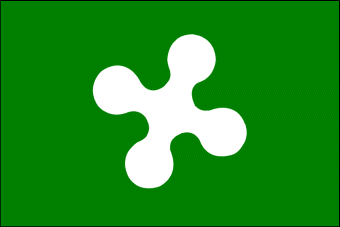
On top of key periods in history, which affected the world (Etruscan civilization, the Roman Empire, the Venetian Empire, the Kingdom of the Lombards, etc.), we have this astonishing local history that goes back well over 6,000 years. Of course, the Rosa Camuna (Camunian Rose) can be traced back many thousands of years, and is featured on the present flag of Lombardy. I'm proud to be of Camunian descent. I'm sorry that I can't just go on and on here! We haven't even begun to delve into this history. Thankfully, Circolo Culturale Ghislandi is doing the work they are.

Lastly, and perhaps this may sound a little silly, but maybe we can produce some artwork, symbols, or costumes which relate to this history? To reiterate what I said earlier, when I was at a local Greek-American festival a couple of years ago, with the backdrop of a Greek Orthodox Church, they're not the least bit ashamed of their pagan past. It doesn't mean they're pagan now, but as a way of celebrating their heritage. Lets maybe look into this.