The Essential Witch Stregheria Show Ravenwings If you missed the original show you can listen to it here! Learn about Italian Witchcraft! ************ I didn't agree with every single part of this lecture, but it was fine in that it explored the history and essence of Stregheria.... the only true work of it's kind up there. I'm surprised that this video only has about one thousand views in over a year and a half. I wouldn't be surprised if there were only about two thousand adherents to Stregheria in all of North America. Still, the work by Raven Grimassi and the importance of Aradia would seem to suggest more interest... including YouTube searches for "Stregheria Aradia." Even Raven Grimassi's YouTube channel only has 383 subscriptions; surprising in that he is also an important figure among Wiccans. It reminds of me the excellent four-part interview of Heimgest, the leader of the international organization of the Odinic Rite, on YouTube. After twelve years up there, only 37,000 views for the first video? The interview took place somewhere in Alberta, Canada, where Heimgest was visiting and naturally promoting Asatru/Odinism. He assesses the current state of the movement; in other words this is important! With the subtle rise of Asatru, large in a relative-time sense, why not more interest in a video such as this? The Neo-Pagan movement is still somewhat shrouded in mystery. We're still mostly solitary practitioners, who may be holding ritual three miles away from where a like-minded person might be holding ritual. I once gave the example of seeing a stained-glass Valknut in a front window of a home nearby; and of once coming upon (inadvertently interrupting) a black robed woman seemingly holding a ritual when I was hiking at dusk. She then disappeared away into the shadows. "We're around".. yet we're strangers.... *************************
An interesting, if perhaps unflattering, "Stregheria" reference from popular culture. Of course, some form of Stregheria was present in every part of the Italian peninsula. This film was to have taken place in New York City (some say that this film was based on real events). *************************
Drawing the Magic Circle I conjure thee, O Circle of Power, that thou beest a meeting-place of love and joy and truth; a shield against all wickedness and evil; a boundary between the world of men and the realms of the Mighty Ones; a rampart and protection that shall preserve and contain the power that we shall raise within thee. Wherefore I bless thee and consecrate thee, in the names of Cernunnos and Aradia. -- Wiccan circle-casting ritual
*************************
. Human Rites: The Role of Ritual in Witchcraft
The High Priestess stands skyclad within the circle, arms outstretched, clothed only in the flickering candle-light. The High Priest kneels before her and, drawing an inverted triangle upon her from right breast, begins the incantation:
'I invoke thee and call upon thee, Mighty Mother of us all, bringer of all fruitfulness; by seed and by root, by stem and bud, by leaf and flower and fruit do I invoke thee to descend upon the body of this thy servant and priestess.'
He throws up his arms:
Hail Aradia! From the Amalthean Horn Pour forth thy store of love; I lowly bend Before thee, I adore thee to the end, With loving sacrifice thy shrine adorn. Thy foot is to my lip [kisses] my prayer upborne Upon the rising incense-smoke; then spend Thine ancient love, O Mighty One, descend To aid me, who without thee am forlorn.
As he rises and steps back the High Priestess draws a pentagram in the air before her with her wand:
Of the Mother darksome and divine Mine the scourge, and mine the kiss; The five-point star of love and bliss-- Here I charge you in this sign.
They have drawn down the moon. -- From page 187 of 'Witchcraft Out of the Shadows' (Ruickbie; 2004) *************************
A few more thoughts The above ritual is Wiccan, and reflected the common Neopagan "borrowing," which is fine since so much was lost to us over the ages. In some cases, as with utilizing an alternate name of a god/goddess or anything else, the borrowing may be slipping a missing puzzle piece back into place which already existed in the other tradition over time. However, the story of Aradia is distinctly Tuscan; but it could be thought of as relating to the larger picture; if the Goddess Diana were to send her daughter to the Earth to live among us, she had to be send to some locale.
In this manner, Aradia, the Horned God, Hecate, "The Sorcerer" cave art; Stonehenge, the Carnac stones, the Temple of Mona, the Temple of Artemis, Venus of Willendorf, the Nebra sky disk, the Bosnian pyramids, or the Megalithic Temples of Malta.... ALLcould be part of the same general ancient collective Proto-European spiritual tradition. That's not necessarily "borrowing." The megalithic structures go back beyond the Celtic/Gaulish/Druidic cultures; and "Mona" was the Proto-European name of the Great Mother. Nationalistic/ethnic perceptions could, in certain instances, get in the way of the larger folklore. They're sort've.... both. The nudity and direct sexual aspects of Wiccan rituals have some basis in the ancient history of the Proto-European tradition(s). Stregheria has this aspect as well. However, we should also think about the type and volume of people we want to attract. Nude rituals would tend to keep away some of the best people.. if for not any other reason than if, for example, a family with younger children was interested. This is kind've a no-brainer I think.
. Academically at least, it should be acknowledged that there was a certain relative social/spiritual intimacy in ancient times. Beyond our control, the West is now both oversexualized and oversensitive to almost everything. Male and/or female non-sexual energy is lost within this condition. The above ritual was clearly an attempt to bring forth the divine feminine, which would be best conducted today in a non-sexualized manner. Our ancient ancestors would not have been socially corrupted by the insanely incongruent "American Pie" (contrasted by the Me Too movement) culture that we live in. If we ever do free ourselves from this clusterbleep, it probably won't be during our lifetimes. At times, the midnight "witching hour" is of course very appropriate. However, at times the energy might not be there. Someone may have gotten up early, and fifteen or sixteen hours later they may be mentally fatigued. It's often easier to get out and away in the evening, compared to daylight hours, but a daytime ritual may be just as beautiful and more energetic.. and not as dependent on the weather. One idea that I have mentioned prior, is the utilizing of music in ritual... outdoors. Although an iPod would work, I was thinking more of a group experience. Imagine the 'Wytches Chant' playing amid a forest clearing, upon a full moon, loudly humming through the trees! This is not an original idea, but something that deserves more exploration. A simpler idea would be to sing, individually or as a group. How about singing the Wytches Chant? That hymn is the Neopagan equivalent of 'Amazing Grace'. For the most part, the goddesses in the chant were based on our Almother. Who's to say that you couldn't change the names to reflect this if you felt the need? Personally, I wouldn't feel the need for that. That simple hymn was a work of genius by Inkubus Sukkubus. Call it silly, but the idea of that hymn echoing through the forest--or emanating from a mountaintop--on a warm evening almost gives me goose bumps. .
For the most part, what is today known as the culture of Asatru came into being in northern Europe within the last 3,000 years. For example, prior to about 1,000 BCE, there were no runes carvings. It's at least possible that this culture was actually formed from a fusion between proto-Europeans and the incoming Teutons. Would it be a stretch to speculate that the legend of Jötunheim, and it's giants (the Jötnar), could have originated with the proto-Europeans regarding the early migration of Teutons? The original Teutonic homeland was likely located from the Himalayas to the Arctic Sea, not including later migratory outposts such as ancient Aryan Persia.
The average height of men back then was a little over five feet tall; and I'm guessing that the pure Teutons were at least a foot taller than that on average.... "Giants." I can recall reading of how the Greek Byzantines thought of the Langobards as "giants." Even today, the Dinka tribe in Africa has an average height of about ten inches taller than the surrounding peoples; so there is genetic precedent for this type of height disparity between basically similar peoples. Montenegrins are about seven inches taller on average than their Balkan neighbors. It may sound crazy, but the Teutons could have been 15 inches taller than the proto-Europeans... having now been diffused down to an average of 5'11".
The imcoming Teution warriors must have struck tremendous fear into the proto-Europeans of northern Europe. To put it bluntly... could northern Europe have been "Midgard" and northern Eurasia "Jötunheim"? "Nordic" is a regional ethnographic term, and the traditional Norse are themselves partly descended from proto-Europeans. Aspects from the ancient indigenous people could also have simply merged into what later became Asatru. What may sound sort've odd today, "different" types of Scandinavians, has at least some equivalent examples in northern Europe in the written record. For example, there were different "types" of Irish people a thousand years ago.... some Teutonic, some Atlanto-Mediterranian; some dark haired, some blonde; some tall, some short..... different cultures which later became "the Irish." The worst and coldest winters blow from Siberia across northern Europe, that is from the east, where the frost-giants waft cold blasts of wind to blacken tender buds and chill the hearts of men, but it was in the far north, where the night reigned longest and the ice never melted that the entrance to Nefl-heim and Angerbode's Ironwood lay. In the psycho-geography of the Other World, Angerbode could be both east of Midgard in Jötunheim and in Ironwood; such was her reputation that she dwelt simultaneously in the world of places. -- Leo Ruickbie, 'Witchcraft Out of the Shadows' (1988), 'East of Midgard: Witchcraft, Magic and Religion Amongst the Pagan Tribes of Northern Europe', page 43 I'm not suggesting that the entire legend originated with the proto-Europeans, but that certain aspects may have come from their long-ago culture and perspective. Other aspects may have been different. Some may have seen the Teutons as "gods" or some other mystical concept. I suppose that it's even possible that the fantastic Germanic "imagination of itself," from more modern history, may have been a long cultural carryover from the original indigenous people. I suppose that you could say that Dolph Lundgren could be sort've a modern representative of the original Teutonic element, and Mariska Hargitay a modern representative of the proto-European element of northern Europe... a perfect mixture. Even their names give a certain mystical clue; the powerful Teuton and the magical Alpine. Nordic/Viking Music - Jötunheimr
A new Viking song that goes straight into Norse Mythology! It's the longest and most powerful Viking song that I made so far, and we're one step closer again to the video of "1 Hour of Viking Music" that I promised. =) Hey, if you already know what the title means feel yourself high-fived by me, and if you can pronounce it then feel double high-fived!^^ Jötunheimr is the home world of the Giants from Norse Mythology (one of the Nine Worlds, more known worlds are for example Midgard and Asgard). Jötunheimr is definitely one of the lesser known worlds commonly, but for me it was always one of the most fascinating. Therefore since I started making those songs that are focused on Vikings and Norse Mythology I always knew that I would do a song specifically about Jötunheimr one day. And here it is!^^
Ah yes, the voice that you hear in the song is my own, and believe it or not: It's not edited. It's a raw recording, only hall effect was added.^^ People already asked me in the song „Einherjer" whether I edited my voice to make it deeper, but it's naturally like that. Maybe I'll show you once. xD
Also, adding this note again because I want no misunderstandings: (I know many people are very fond of Viking culture -- I'm one of them^^)
People were asking me how would I know what kind of music the Vikings really made, since they are gone since centuries. But I don't claim to know that, what I do is writing ABOUT Vikings.^^ I don't know what they played 1000 years ago, I simply compose music that I personally see fitting to tell tales about them. So if there are Fantasy elements or Film music-like parts included -- that's why.^^ I mostly try to keep it traditional though, as well as my knowledge about it lets me do that. =)
Composed and arranged 100% by myself as always, on keyboard.
************************* The misty forest gave a sense of foreboding, that the warrior could not disagree with. But, he was a Viking; he would not run just because of the tales women tell while at the spindle. He removed his helmet, setting it down in front of him and drew his sword and a rag, wiping off the dark ichors of the last fight.
Thump.
He heard it, looking up. It was a loud sound, as if a tree fell in the distance. He quietly returned to work on his blade, hand gripping the hilt tightening.
CRACK!
He heard the splintering of a great oak. Closer. He stood, placing his helmet on as a dark shape towered over him in the mist, it was massive, at least as tall as a house. Two piercing white eyes illuminated the fog, watching him. “Norseman...” It rumbled. “These woods are not your place.”
“I shall not be cowed with words!” He declared back, sword in hand, “A brave one too...” The giant mused, cocking it's head. “And meat. There is good meat on you...” It crouched down to get a better look, gripping a tree, the wood straining under it's crushing grip. “What brings you to this cursed wood?” The viking weighed his odds. He had the arrow wounds from the last fight, his shield had been smashed, and his body ached. He smiled grimly.
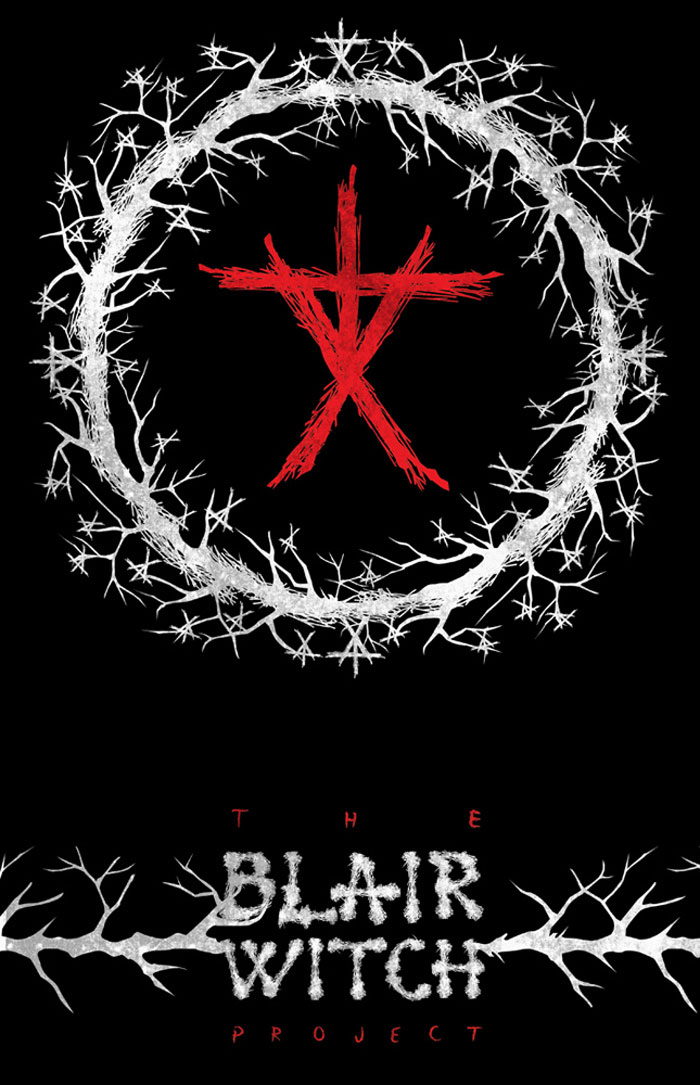
Blair Witch (film) Blair Witch (formerly marketed under the faux-title, The Woods) is an upcoming American found footage psychological horror film directed by Adam Wingard and written by Simon Barrett. It is a direct sequel to The Blair Witch Project (1999). The film follows a group of college students who venture into the Black Hills Forest in Maryland to uncover the mysteries surrounding the disappearance of James’ sister Heather in 1994 who many believe is connected to the legend of the Blair Witch. It premiered at San Diego Comic-Con on July 22, 2016 and is scheduled for release in the United States on September 16, 2016. ************************* I often have very mixed feelings regarding films like this. Something loosely tied to what had been an ancient spiritual tradition, now projected as like a milieu of... "monsters." No other tradition is treated this way. However, that's not what interests me here. The now recognizable symbol of the "Blair Witch" is described as A five-pointed compound symbol with a center triangel pointing down. The five lines resemble the microcosmic man with arms and legs outstretched inside a circle (with a pentagram in the background)-- a magic symbol or charm among medieval alchemists and wizards. It may be an ancient European vehmic symbol, although I have found no direct evidence of that. Even Guido von List's "Vehme star rose" was basically just a Pentacle star within a circle of nature. He hinted at an ancient European origin, and offered the Barnstar in relation to that idea. I refer to this symbol as the Vehmic rune, or a Vehme star rose if within a circle. The five-pointed sign symbolizes Earth, Air, Fire, Water, and Spirit..... or basically.. "Science!" (including Metaphysical science). The popularity of 'The Blair Witch Project' (1999) and perhaps this upcoming sequel, which opens on September 16, should lead to an increased interest in this symbol. While the Pentagram (or Pentacle star when inside of a circle) can be traced back to ancient Sumeria, the Vehmic run is quite possibly proto-European. The fact that this symbol is again being projected by popular culture notwithstanding, is could have a far greater objective meaning; the lost ancient European vehme, the missing puzzle piece. In addition, the Vehmic rune, when hung in a tree, seems to have another meaning. It is also said that the figures hanging in the trees in the forest represent spirits of the dead being able to travel between earth and the spirit world. The trees, with their roots in the earth and branches up in the air, serve as bridges between the earth and spirit world. When the stick men are hung in a tree they provide a way for the spirit to travel between worlds. Overzealous Christian YouTuber A Call For An Uprising actually gave a pretty good description of the symbol for about 90 seconds, starting at 5:30...
'The Blair Witch Project Co-Creator Eduardo Sanchez Talks Blair Witch' Steve Barton - DreadCentral.com - August 19, 2016 Along with Daniel Myrick, Eduardo Sanchez burst onto the scene with The Blair Witch Project, a film that broke a lot of rules and struck box office success. Now, with a new sequel on its way, Sanchez sat down with podcast The Found Footage Critic to offer his opinion on Blair Witch (review). “It’s just full-blast Blair Witch,” he explained. “It’s really creepy, and the last third is just crazy. It’s just all over the place. It just does not let you go, you know? I’m really happy to have been a part of it… it kind of progresses the found-footage genre a little bit, which I think is really cool.” He continues: “It’s really, really well grounded in the original. And I think that the fans of the original will get a lot out of it. It’s kind of a recognizable… it’s almost like you’ve been, like kind of a deja vu, but then it turns into just a — like I said, it kinda takes our film and blows the doors off and goes nuts with it in a really, really good way.” Written by Simon Barrett and directed by Adam Wingard, Blair Witch stars James Allen McCune, Callie Hernandez, Brandon Scott, Valorie Curry, Corbin Reid, and Wes Robinson. Roy Lee (The Ring, The Grudge, The Strangers, It), Steven Schneider (Paranormal Activity, Insidious), Keith Calder, and Jessica Wu (You’re Next, The Guest) produce. Synopsis: A group of college students venture into the Black Hills Forest in Maryland to uncover the mysteries surrounding the disappearance of James’ sister, who many believe is connected to the legend of the Blair Witch. At first the group is hopeful, especially when a pair of locals offer to act as guides through the dark and winding woods, but as the endless night wears on, the group is visited by a menacing presence. Slowly, they begin to realize the legend is all too real and more sinister than they could have imagined. Blair Witch (2016 Movie) - Official Trailer
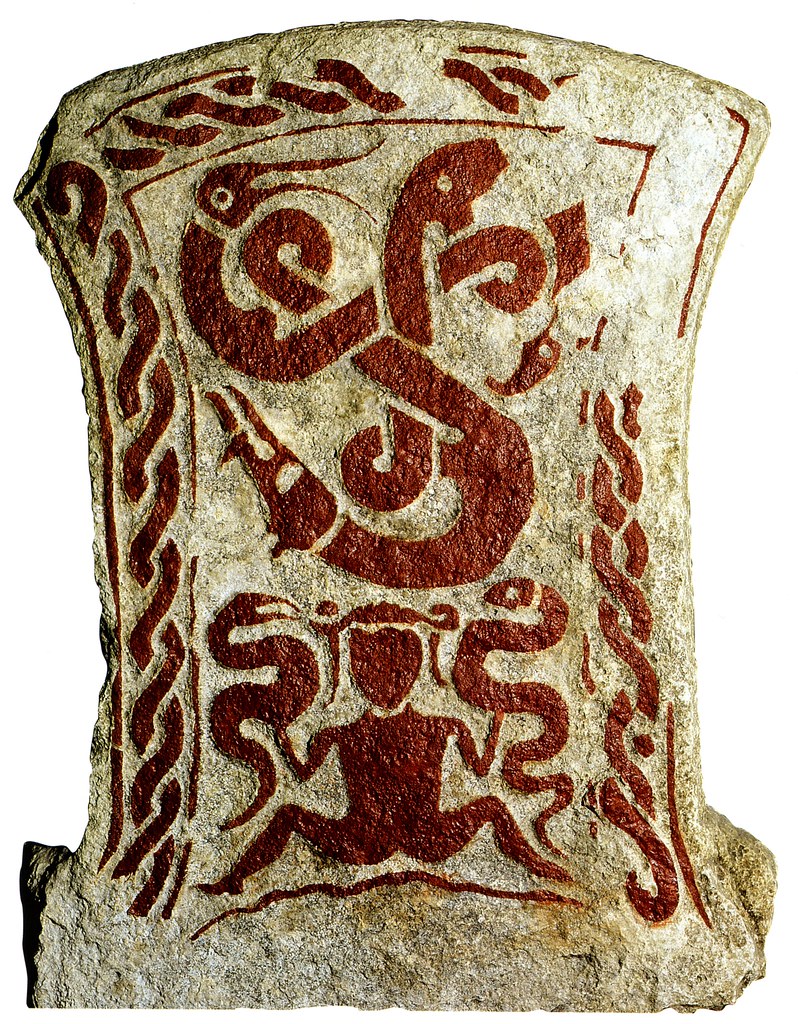
Snake-witch stone The Snake-witch (Ormhäxan), Snake-charmer (Ormtjuserskan) or Smiss stone (Smisstenen) is a picture stone found at Smiss, När parish, Gotland, Sweden. Discovered in a cemetery, it measures 82 cm (32 in) in height and depicts a figure holding a snake in each hand. Above the figure there are three interlaced creatures (forming a triskelion pattern) that have been identified as a boar, an eagle, and a wolf. The stone has been dated to 400–600 AD.
Although many scholars call it the Snake-witch, what the stone depicts—an accurate interpretation of the figures—and whether it derives from Celtic art or Norse art remain debated.
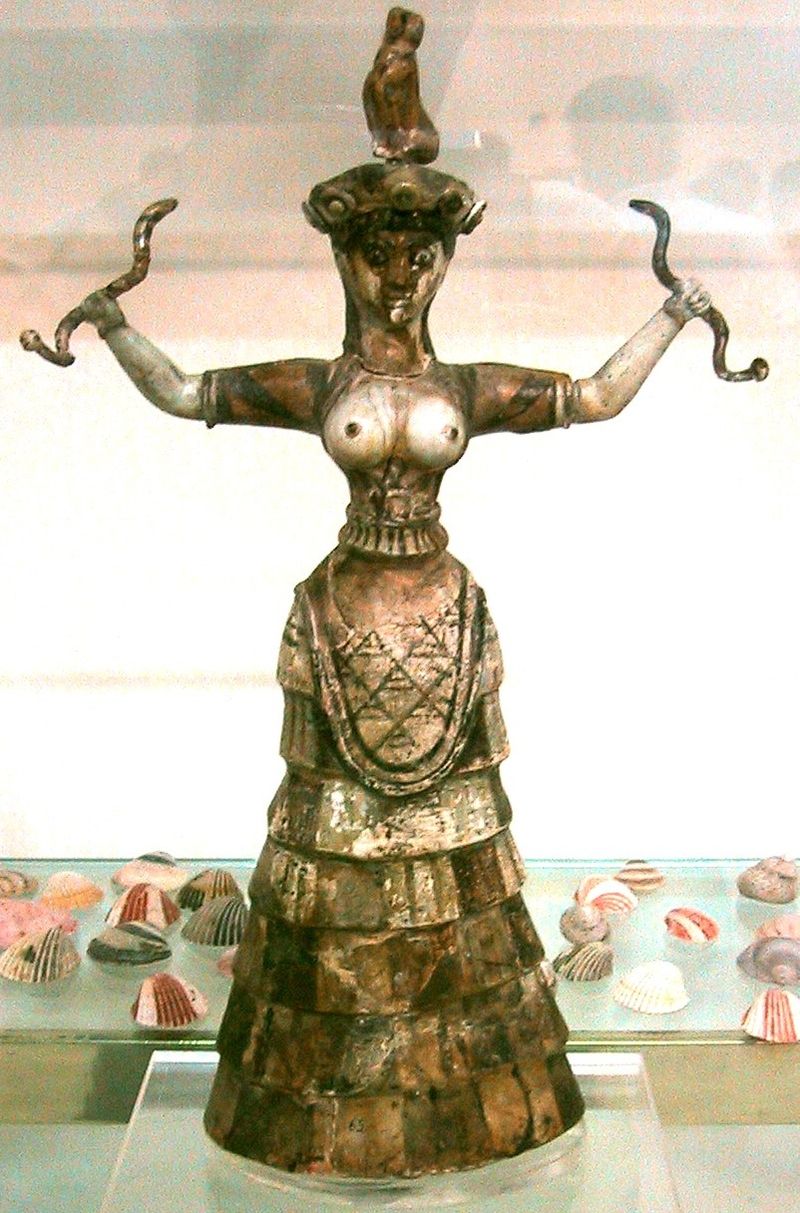
It seems to me that various neopagan concerns have never been certain as what to do with the symbolism on this standing stone/grave marker. First of all, is it Odinic, Druidic, Gaulish polytheistic, proto-European witchcraft, or some combination? This style of standing stone, the serpentine symbolism, and its location would seem to suggest an Odinic origin. However, there was snake symbolism in Gaulish culture, and the Gaulish god Cernunnos was found depicted on the Gundestrup cauldron from some centuries earlier in Denmark. Also, the "snake-witch"--like Cernunnos--is depicted holding a snake; although this artifact may have been obtained in trade between Teutons and Gauls. The snake-witch herself seems to suggest an element of proto-European spiritual influence, such as the pre-Olympian "Snake goddess" of Crete.
Also, just as interesting as the "snake-witch," is the powerful design symbol. To fully appreciate it, you must look at it and fill in the two sections which were somehow chipped off on the animal figure on the upper right. After you do that, then it's clear that this is what I would call a "double-triskellion." The boar, eagle, and wolf are formed as serpentine, with both heads and tails interwoven for this effect. The triskellion or "triple spiral" is found in many ancient European cultures. My guess is that the snake-witch stone is Odinic, with proto-European symbolism. The old Gotlanders, somewhat isolated on an island, probably held onto some aspects of pre-Odinic spirituality. As to whether or not this ties into what is known as "Norse witchcraft," I really don't know at this time. I suppose that there is the possibility or concurrent idea that this was tied to something unique to old Gothic culture and spirituality.
Parallels, interpretations, and speculation
The figure on the stone was first described by Sune Lindquist in 1955. He tried unsuccessfully to find connections with accounts in Old Icelandic sources, and he also compared the stone with the Snake Goddess from Crete. Lindquist found connections with the late Celtic Gundestrup cauldron, although he appears to have overlooked that the cauldron also shows a figure holding a snake. Arrhenius and Holmquist (1960) also found a connection with late Celtic art suggesting that the stone depicted Daniel in the lions' den and compared it with a depiction on a purse lid from Sutton Hoo, although the stone in question does not show creatures with legs. Arwidsson (1963) also attributed the stone to late Celtic art and compared it with the figure holding a snake on the Gundestrup cauldron. In a later publication Arrhenius (1994) considered the figure not to be a witch but a male magician and she dated it to the Vendel era. Hauk (1983), who is a specialist on bracteates, suggested that the stone depicts Odin in the fetch of a woman, while Görman (1983) has proposed that the stone depicts the Celtic god Cernunnos.
It also has been connected to a nearby stone relief on a doorjamb at Väte Church on Gotland which shows a woman who suckles two dragons, but this was made five centuries later than the picture stone.
Snake symbolism
Snakes were popular as a motif on later picture stones which show snake pits, used as a painful means of execution; this form of punishment also is known through Norse sagas. Snakes are considered to have had an important symbolism during the passage from paganism to Germanic Christianity. They were frequently combined with images of deer, crustaceans, or supernatural beasts. The purpose may have been to protect the stones and to deter people who might destroy them.
See also
Hyrrokkin, a female jötunn in Norse mythology who uses snakes as reins
************
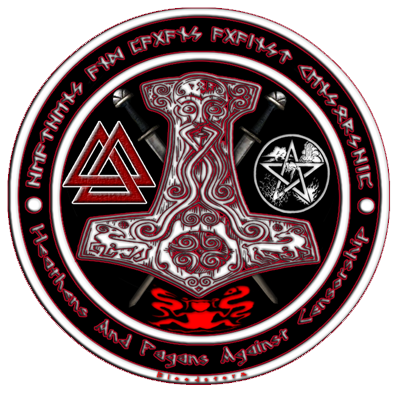
3-2-16 ADDITION: I just wanted to add an interesting logo, featuring the Snake-Witch, from a concern called "Heathens and Pagans Against Censorship." Also noteworthy is that this logo---just as with the snake witch/triskellion standing stone---has both proto-European and Teutonic symbolism. However, as covered here before, the proto-Europeans used a different 5-pointed Vehmic rune.
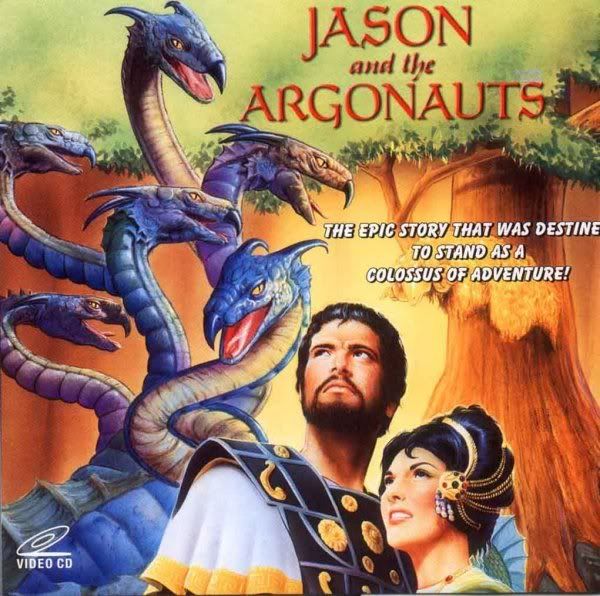
In pre-Olympian Greek mythology, Medea is the daughter of Hecate, and held a fearsome reputation. Although Hecate is the regional (ancient Greece/Asia Minor) term for the proto-European "Almother," Medea is distinctly Greek; as Aradia, daughter of the regional "Almother" Diana, is distinctly Tuscan/Italian. This older Greek mythology was occasionally conflated with the later Olympian pantheon as in 'Jason and the Argonauts'. In the following excerpt from the book 'Witchcraft Out of the Shadows' (Ruickbie; 2004), I saw a powerful parallel with the image of the Teutonic Goddess Freya riding a chariot carried by two large cats: A chariot drawn by winged serpents conveyed her across the night sky, leaving broomsticks to more humble witches. At midnight, with her hair flying and dancing barefoot under the stars, she howled her threefold incantations. She invoked the forces of darkness - the very night itself and infernal Hecate - and the forces of nature - the gods of the forest, of the earth, wind and water...
9-12-15 ADDITION: The 1963 film 'Jason and the Argonauts' featured the mythological Hecatean priestess Media prominently, played by Nancy Kovack. This was a rare portrayal of what really had been a regional outgrowth of "European witchcraft," or at least an attempt to show even a marginal speck of respect for it. Again, this mythology was a conflation of the "old religion" with the Olympian tradition; in this case, in the form of the hero Jason.
This mythology, as well as the ample history of the Old Religion in Greece, is covered in the book 'Witchcraft Out of the Shadows'. European witchcraft had truly been "European," having been present in every corner of the continent at one time. Having originated from the Jason-Media myth and its portrayal in ancient Greek tragedies and literature; there have been many plays, operas, ballets, works of art, films, etc. based on the mythology. .