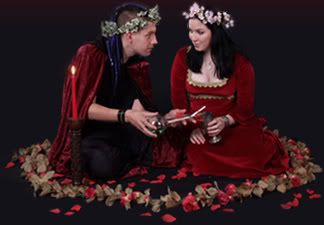
 Your Ancestors Were Heathen...
[Article borrowed from the Temple of Our Heathen Gods group on facebook; February 5, 2011; exact article source page link above]
This essay is written for those that know very little about Asatru or Heathenry, or perhaps have not even heard of it.
It is a simple question, really. Did your family come to America from Northern Europe...or do you have Northern European Ancestry? Well, if you do...then your ancestors were "Heathens."
Many people with Northern European ancestry do not realize that the original religion of our People and our ancient culture was not Christianity. If you go back a 1000 years or more, prior to the conversions to Christianity in Europe, our ancestors had their own native Folk Religion that was rich and meaningful in their lives.
Our People honored their own Gods and Goddesses, their ancestors, and the spirits in nature. These original Heathens were the pre-Christian Northern European peoples who lived in the lands around what is now called the North Sea. These included the people of Anglo-Saxon England, Scandinavia, and other areas of Northern Europe.
Some of our ancestors were convinced to convert to Christianity by missionaries. Some were coerced into converting, based on threats of physical violence. Others converted due to political or economic pressures brought on them by Christians. And some of our ancestors were killed, because they refused to give up the Ways of their People.
THE ORIGIN OF THE WORD "HEATHEN"
If you are just hearing about Heathenry, then you are very likely thinking, "But isn't the word Heathen a word for a bad person?"
Well, it is true that Christians frequently use it this way. The word "heathen" refers to people who don't worship the Christian God or follow the Christian religion. The historical origin of this use of the word "Heathen" is pretty interesting.
The word "Heathen" comes from the fact that the country people (those living on the heath), honored the old gods for centuries after the city-dwellers were already converted to Christianity.
This is why "heathen" is a bad word in Christianity. The missionaries and preachers in the cities would rail against the "heathen" (those living out in the heath), that still honored the old gods. But we embrace the term, for we are proud of those ancestors that resisted the conversion to a foreign religion, and who remained loyal to the Gods and the Ways of our People.
Another word commonly used for heathenry is Asatru, meaning "loyalty to the gods." Though, Asatru is normally used to refer to a more Icelandic influenced heathenry, while the word heathenry itself is a broader term encompassing those focusing on the Icelandic, the Anglo-Saxon, the Frankish, etc.
Our Heathen ancestors did not refer to themselves as "Heathen" or "Asatru." It is believed they did not have a name for their religion, and simply called it their Way.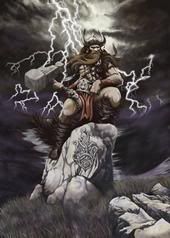 HEATHENRY IS A VIABLE OPTION IN OUR MODERN WORLD
So many modern Americans are dissatisfied with their religious options. Many of the descendants of our Heathen ancestors have become dissatisfied with Christianity. Modern Heathens would make the point, that much of this dissatisfaction comes from the fact that Christianity did not originate with our People. It is a foreign religion that was relentlessly pushed on our Ancestors, until our native Folkway was suppressed or destroyed among our People.
Modern Heathens around the world are reviving the Ways of our Ancestors, and find that the religion of our Ancestors is truly satisfying and feels "like coming home." Heathenry is very family and community-oriented, and encourages us to live responsible lives of loyalty and honor. A person's word matters greatly, and each person is judged by his/her choices and actions. The Ways of our Ancestors are life-fulfilling and natural to who we are and how we think, and they work to strengthen and enrich our lives.
You will hear modern Heathenry called many things by the people who practice it. You may hear it called Asatru, the Northern Tradition, Odinism, Forn Sed, Germanic Pagan Reconstructionism or, simply, Heathenry. In Iceland, which did not convert to Christianity until the 11th Century, Heathenry has once again become an official (nationally recognized) religion. There are growing numbers of Heathens and Heathen groups across the United States, and that growth seems to be accelerating as more and more people tire of the foreign religions.
SOMETHING WORTH CONSIDERING...
If you have found yourself dissatisfied with Christianity and organized religion, take a little bit of time to look into modern Heathenry. When your heathen ancestors were pestered, coerced, or forced into giving up the Ways of the People, I have to imagine that they wondered if years down the line their descendants would again return to their true religion and way of life. As someone who has returned to the religion of my Ancestors, it is hard to describe how much it has improved my life. In the end, it is something you have to look into yourself and explore whether it makes sense for you.
A good starting place to learn more, is this Heathen FAQ. Reading through all the topics there will give you some idea of what heathenry is all about:
http://heathengods.com/temple/modules/xoopsfaq/
And for some basic information on Heathenry and how to start and maintain a Heathen group (normally called a kindred), you might want to read this book which is available as a free download or in paperback and hardback versions:
http://www.heathengods.com/library/book/
Mark Ludwig Stinson
Jotun's Bane Kindred
Temple of Our Heathen Gods
http://www.heathengods.com/
.

Saturday, April 30, 2011
Your Ancestors Were Heathen...


Thursday, December 23, 2010
An Interview with the Slavic Faith Association (by the Odinic Rite)
 This was a text interview from either in late 2009 or early 2010, which was not conducted by us, but was published by the Odinic Rite. However, since the OR has removed it from their press service website, and we were able to retrieve it, we wanted to post it here so it would not be lost.
It's so interesting to examine how certain pre-Christian traditions overlapped one another. For example, how the old Gallic paganism (what we call "Cernism") overlapped with Odinism in the north and east or with the British Isles. Also, in this case, how Slavic paganism overlapped with Odinism. There are many common themes and symbols.
One interesting term used by the interviewee was "native believer," or anyone who believes in their specifically ancestral faith. Also interesting is a reference to the Celtic people who lived in Poland in ancient times. Especially around Slenza mountain, as he mentioned. Celtic roots are such a common thread among European peoples, hence the Celtic solar cross found all over from the ancient world.
An Interview with the Slavic Faith Association
OR: What is the name of your organization and what is it’s purpose? What are it’s aims?
SFA: The full and official name of our organization is The West – Slavic Denominational Association “Slavic Faith” (ZZW “Słowiańska Wiara”) but we’re commonly known as “Slavic Faith” or “Slavonic Faith”. Our aim is to deepen our Slavic beliefs, to create a unique philosophy of life and sustain our heritage. Over the past few years we have created an inimitable community of people dedicated to this aims.
OR: When was your organization formed?
SFA: Unofficially the organization was formed nearly 3 years ago. First ideas had been in our minds since about 2004. It took time to find other really devoted neopagans from all around Poland. I became a native-believer about 12 years ego. And I don’t remember such a successful enterprise over the previous decade. This has taught me to be patient.
OR: What are the beliefs of the Slavic Faith?
SFA: Let me quote the first point of the Denomination of Slavic Faith, the most important of our declarations:
“We believe in the Slavic Gods. We believe in the wisdom, goodness and beauty hidden under their countenances. Slavic Gods are the founts of life, power and happiness. Belief in our Gods is the heritage which we continue.”
OR: What are the values of the Slavic Faith?
SFA: The eighth point says:
“We are the defenders of our values, families and community. We defend the right to live on our own territory; we defend the space of our civilization. This duty arises from the most obvious laws of nature.”
The whole 12 paragraphs of Denomination of Slavic Faith is available here:
www.slowianskawiara.pl/wyznanieanglia.html
OR: What are some of the symbols used in Slavic Paganism?
SFA: We have just sent some documents to the polish ministry of internal affairs (MSWiA). these include lists of Slavic pagan symbols. We want to create official documents which specify these symbols and allow us to protect them by law, like the Christian cross, the Star of David or the Crescent. These symbols in most cases have a Solar origin. Some of those aren’t widely known, for e.g. God’s Hands. Picture below:
OR: What is the relevance of the fylfot/swastika to Slavic Paganism? What about the triskelion?
SFA: Of course the swastika was widely known and has been used in Poland for hundreds of years. It has appeared on house ornaments, carvings, costumes. Before World War Two it was even used as an ornament of distinction by some polish corps. But one of the Solar symbols is specially important for us. This symbol is the Swarzyca. A carved Swarzyca symbol appeared in a wall stone on the outside of a collegiate church in Kruszwica (central Poland). We think that this stone block was part of pagan temple from around a thousand years ago.
The Triskelion has also been used in Poland. The Triskelion from the picture below comes from Plock (Central Poland) from the XII century.
OR: What are your holy days and what do you do to celebrate them?
SFA: During the year we celebrate 5 of the biggest ceremonies in Poland. 4 of them are: the autumnal/ vernal equinox and the summer/winter solstice plus Ancestors Day which is around 1st November.
In addition to these five we also celebrate two more international festivals. The most important celebration in Slovakia is Peruns Day at midsummer and the Mokosz celebration in Czech Republic (autumn).
We also have some special events such as the swearing in of a new member of the association as well as Slavic weddings and many more. The Slavonic Faith organizes them all.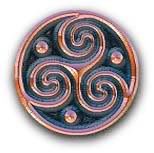 OR: What types of rituals do you perform?
SFA: Every celebration contains different types of rituals, prayers, songs and offerings.
Every stanza, every word, every gesture expressed by the priests (we call them Kaplan) has a deep meaning. It’s all based on mythology and our reflections. There is no place for improvisation. When someone is coming to our ceremony unprepared, he might only see… well I would say “poetic performance” and nothing more. But even for people without the necessary knowledge, those festivals always make a big impression.
OR: How important are your ancestors?
SFA: Two of the most important festivals in our calendar are: Slavic Spring (March equinox) and Ancestors Day. Ancestors are very important indeed and I’m not talking only about our community. For all Polish people, the memories of our ancestors is something extraordinarily important. There were so many thousands of martyrs in our history, that the memories of them are still alive. This has really nothing to compare with Western Europe. 1st November is National Ancestor Day. On this day all Polish people go to the graveyards to light candles on the tombs of relatives. If you could see satellite pictures from Poland on that day, it would looks like the whole country is burning.
OR: How important are your folk (tribe/people)?
SFA: I became a native believer because these things were the most important in my life. My community provides me with an environment where I can be a better person. I want to be a better person to help and to support my community.
OR: How are men and women viewed in Slavic Paganism?
SFA: "Slavic Faith is an Oak (symbol of male element in nature) and Linden (symbol of female element) braided together, it’s family it’s union”. Women and Men have different roles to fulfill. I’m glad there are more and more women in our community every year (it was always less women than men). In this way we pursue the full harmony. Of course we are against mixing up the natural roles of both sexes in society. We’re traditionalist.
OR: What do you believe about death and life after death?
SFA: I must refer again to the Denomination of Slavic Faith:
“We assume that the death of a man ends a certain stage. It is the condition of the transformation into a new form of existence. It is the shedding of the old, exhausted form. The noble and persistent ones will be rewarded with entering into continuously higher and higher levels of existence, more conscious, more significant and closer to the Gods.”
It’s a very complex problem (of course it is), but what we try to avoid is giving people simple answers. This is the Holy Book, read it, do what we tell you and you gonna be saved – at least that is how monotheistic religions work. We don’t know exactly what happens after death. The core of pagan philosophy is to keep trying to understand the world around us. We have to improve our knowledge. If you want achieve something you must refer to your strength and will, you won’t get anything valuable for free. That is why our religion is never gonna be very popular. We don’t give simple answers for everyone.
OR: Are there any sites which are particularly holy to Slavic Paganism? Could you tell us about them?
SFA: There is many of these places. But I wish to tell about one specific place. It’s the Slenza mountain, 30 km south of Wrocław. It is only 718 meters above see level, but it’s an absolutely magical place. It’s the pagan heart of Poland. It’s a place where you can find remnants of Celtic tribes, a place where pagan rituals have been performed for hundreds of years after the christening of Poland. And a place with a few thousand years old Solar Altar, even an armed cross carved on a big megalithic block hidden somewhere half-way up the Mountain. At the foot of the Slenza, the Slavic Faith organize ceremonies.
OR: How do you see Slavic Paganism in the modern world? Is it relevant to today?
SFA: It is relevant. Relevant for my community and in a cultural aspect relevant for my country. I would say it’s also relevant for Europe. European culture is slowly dying. Careless about heritage and our roots, Europe is becoming another cosmopolitan place. We are probably one of the last bastions of tradition and culture. And I always emphasize, that we are not pagans from Xth century. We are modern living people. We not trying to live the way people lived thousand years ago. We struggle with today’s problems and the neopagan religion helps us deal with the present. OR: How does your faith affect your day-to-day life?
SFA: I’m one of the fifteen sworn members who are trustees. We have a lot to do. Sometimes the Slavic Faith is like a second job for me.
OR: What do you see for the future of your faith? What role will it play?
SFA: I think the future is bright for us. As an organization we are growing up quickly. We are going to buy some land which will let us organize celebrations without any permission. We want to publish books about our beliefs in the near future and also to persuade the government to enlarge the content of school books about paganism. We want to officially register the Slavic Faith as a legal entity. We also want to strengthen cooperation between pagans from all Slavic countries and also cooperate with other European native believers. (We were thinking about creating an international association to help people to cooperate all around Europe) And many other ideas.
OR: How does society react to you? You are based in a country that is known for it’s Catholicism. Does that create any problems? Have you ever had to deal with discrimination or persecution? If so how do you deal with it?
SFA: I must say, we never have any problems with Catholics. So far so good. We had one serious incident when the police didn’t allow us to celebrate the Spring Festival in a public park. (I don’t think that this was religious harassment, rather pure stupidity) But we know how to execute law, so this case is now being considered in the public prosecution service.
OR: Do you see any similarities between Slavic Paganism and Odinism? The mythology and/or Gods? The value systems? Etc.
SFA: I must say 90% of values represented by Odinism and Slavic Paganism are the same. Heroism, family, the maternal instinct, friendship, loyalty, bravery, honesty. It can’t be different, after all we descended from the same cultural circle . All differences are based on different cultural foundations. And of course these differences are very important. These differences make us unique. What is good for a Buddhist not necessarily must be good for an American. What is good for an American Indian is almost certainly wrong for a German. Monotheistic religions assume the all human kind is this same (at least ought to be). As children of one God we should learn from one holy book and have the same system of values. Sometimes it looks like some insane idea of mixing up everyone to create some amorphous cultural pulp. We should learn from each other, which doesn’t mean trampling out our own culture.
Similarities between Gods ? Well, there is so many common notions, and many of them are so evident. Thor – God of warriors, who sends thunder strokes from heaven. Slavonic God – Perun – God of warriors, who sends thunder strokes from heaven. I can give hundreds of these examples. Sometimes I’m really surprised by how much we have in common.
OR: Where can one find more information about your faith in general and your organization in particular?
SFA: Unfortunately there is no much English language literature about Slavic mythology. This is obviously the fault of the Slavs themselves. We know a huge number of really good scientific publications which have never been translated into English. As an association we have to take action; in the future we’ll translate the most valuable works into English and other European languages.
The simplest way to meet us is to click on: www.slavicfaith.com Here you can find the English (simplified) version of our website. For more news about our activities you can contact ours representatives via the e-mail addresses available on this webpage. We willingly provide information about our activities.
OR: Do you have anything you would like to add?
SFA: I really wish to see you one day at any of our festivals. As native believers we are a really small bunch of people. We don’t even compare to any of the monotheistic communions. That’s why it is so important to cooperate. And by cooperation I mean all kinds of intellectual, spiritual and moral support.
Slavic Faith Association
Przemysław Mrugacz – Executive Member
.
Sunday, February 7, 2010
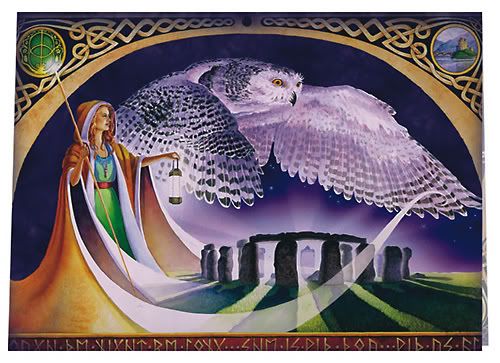
Interview with a Gaelic Polytheist
 Interview with a Gaelic Polytheist
CC: You previously mentioned that you were a “Gaelic Polytheist.” What is Gaelic Polytheism, and is it the same thing as a “Celtic Reconstructionism?”
GP: Gaelic Polytheism is a branch of Celtic Reconstructionism. We recognize that the various peoples who are today called “Celtic” were, in fact, distinct societies, each with their own language, culture, and pantheon. As Gaelic Polytheists, we practice the Gaelic tradition exclusively; that is, the traditions of Ireland, Scotland, and the Isle of Man.
CC: Does it primarily deal with the pre-Christian pagan traditions? (as opposed to focusing on all aspects of culture and history)
GP: Gaelic Polytheism is based in pre-Christian Gaelic spirituality, though it incorporates a great deal of living tradition from the Gaelic lands. We recognize that the Gaelic peoples have living cultures, and that much of what we find as folk traditions in those lands are survivals of pre-Christian traditions. We do not want to practice the religion as it existed 2,000 years ago; we want to practice it as we believe it would be today if it had never died out.
CC: Are you also a actual practitioner of some aspect of what is referred to as “Celtic Reconstructionist Paganism? If so, what specific tradition?
GP: Yes, Gaelic Polytheism is the Gaelic form of CR.
CC: How would you assess the power of the Druids in Western Europe, prior to Roman influence? Some people believe that they had tremendous influence.
GP: We find clues to the what the role of the ancient Druidh was in the Gaelic lore. I do not speak for the other “Celtic” traditions, but we see that in ancient Ireland and Scotland, the Druid was highly respected, often having a place of honor beside the king, and being his top advisor. He also was known for having powers of magic and divination. Unfortunately, most of this knowledge has been lost to us.
CC: Is the concept of a predominantly male-dominated Druidic system, and the predominantly female-dominated Cernunnos-based Witchcraft tradition, exaggerated, or even true?
GP: Cernunnos was not a deity known to the Gaelic peoples, so I really have no answer to this.
CC: You had previously stated how eclectic and historically inaccurate the Wiccan or neo-pagan movement is. Can you comment on that? Also, do you believe that these modern movements have served any type of modern psuedo-political agenda?
GP: Neopaganism is a new religious movement which is largely based upon post-modern philosophy, medieval ceremonial magic, and some ancient Pagan traditions. However, most of the actual Pagan tradition that has been blended in has been altered from its original form and made to fit into the Wiccan or Neopagan mold. This is nothing short of cultural theft, and while we must respect their right to practice whatever spirituality they wish, I do not condone the co-opting of Gaelic deities or traditions into Neopaganism when they are not accurately portrayed.
CC: What are some of the chief symbols used by Wiccans, which you do not attribute to a Celtic or European origin?
GP: The most common is the Pentacle, which had no place in Gaelic or any other Celtic culture. The Triple Moon symbol is a 20th Century creation and was unknown to any ancient people.
CC: The Wiccan Revival of the twentieth century seemed to have been brought about by Freemasonic men in the UK. Might this initial Freemasonic influence, itself eclectic, Eastern, and universalist, have rubbed off on modern Wicca?
GP: Wicca certainly seems to have been influenced by such movements as Freemasonry and, without doubt, by ceremonial magic.
CC: Historically speaking, both spiritually and in social relations, how would you describe the interaction between the “Gaulic, Gaelic, Druidic” cultures, and the more Teutonic/Odinic peoples?
GP: These two peoples were closely related and there was a frequent exchange of population between them. They share nearly all of the same values, and some common themes appear in their lore. Some scholars believe that the Germanic peoples may have branched off of some paleo-Celtic people group. Whether this is true, the fact is that these two cultural groups have strongly influenced one another.
CC: Can you elaborate further on Gaelic Polytheism. What does it mean to you?
GP: One of the most important things for me is knowing that I am helping to revive and perpetuate the traditions of my ancestors. In fact, reverence for the ancestors is a strong theme in Gaelic tradition, and we definitely seek to reconnect with and honor them.
CC: Can you comment on the ancient seasonal “Wheel of the Year” as far as where it fits into history, and it’s significance?
GP: It seems to be a 20th Century fusion of traditions from various cultures. The ancient Gaels knew four seasonal festivals, which we as Gaelic Polytheists still observe today: Samhain, Imbolg, Beltain, and Lughnasadh. The ancient Gaels knew of the solstices and equinoxes, but there is not evidence that they observed these dates as religious festivals. A few GP’s may follow the 8-festival Wheel of the Year, but that is not the norm.
CC: You had stated that you do not believe that there was a definitive "Celtic culture" in the ancient world. Without necessarily mentioning names, what is your opinion of the current international groups which were organized to facilitate this "Pan-Celtic" concept?
GP: I think to some degree they are helping to perpetuate an interest in the various cultures that have come to be called "Celtic", even though the Pan-Celtic concept itself is a modern fantasy. I used to be Pan-Celtic myself several years ago, and the more I studied the ancient traditions, the more I realized that they were very distinct. I then learned that reputable historians agree with this assessment.
Also, it should be noted where the word "Celtic" itself originated. The ancient Greeks referred to the bararian tribes who lived to the north of them as "Keltoi". It is ironic that so many centuries later, some people decided that the term should be applied to the inhabitants of the British Isles, who are not the descendants of the Keltoi, and are only distantly related to them.
CC: How would you quickly sum up the affect of early Christianity on paganism, especially in what were considered regions of Celtic settlement?
GP: The conversion of the Gaels was not as bloody or brutal as the conversion of the Germanic peoples and some others. The early Celtic Christian Church simply blended traditional Gaelic spirituality with the Christian faith to create a system where followers were free to honor Christ at the same time as Brighde, Daghda, etc. This period of blended faith lasted several centuries, and in fact, it could be said to still exist today, since many Gaelic Christians still honor Brighde as a saint, and may give honor to the spirits of nature as well.
CC: We have a concept that we would like your opinion of. The chief deity, of which the Wicca religion is based on, appears to be the horned god Cernunnos. Correct?. Since one of the alternate names for this deity is “Cern,” couldn’t this tradition be called “Cernism” in a revisionist direction? (in the same way as Odin and Odinism)?
GP: Again, Cernunnos is not a deity known in our tradition, so I’m not really qualified to speak to this.
CC: Where do the hundreds of very ancient megalithic monuments located largely in the British Isles, like Stonehenge, fit into the Gaelic Polytheist belief system?
GP: Stonehenge itself is in an area that has never been the home to any Gaelic tribe, so it is pretty irrelevant. We do see other stone circles, such as Calanais, which are in the Gaelic lands, but these predate the Gaels. Likewise, Newgrange in Ireland, which is aligned to the Winter Solstice, is of pre-Gaelic origin.
I'm sure many Gaelic people appreciate these sites as historical landmarks, and even for their spiritual significance, but they were not constructed by Gaelic people, and I'm sure they had much greater significance to the people who actually did build them.
CC: Are there any other subjects which we have missed, but are of importance? If so, can you elaborate on them?
GP: Thank you for the interview. This is actually my first chance to speak for Gaelic Polytheism to people outside our movement. You will find some variation within GP and some may have even answered these questions differently than I did. But I believe I have represented our movement accurately, as far as what the concensus would be on these subjects
We simply seek to restore the spiritual traditions of our ancestors within a modern context. Though some things have been lost, we would rather fill in the blanks with our own innovations which are rooted in our knowledge of Gaelic lore and tradition, rather than borrow from another culture or from a Neopagan tradition.
Being a Gaelic Polytheist is as much about culture as it is religion. To follow this path, one must be willing to study and immerse oneself in Gaelic lore, folk tradition, values, language, art, culture, music…basically, to carry on not only the religion of the ancient Gaels, but the traditions of the living Gaelic cultures. This is an ethno-cultural tradition.
I may recommend a couple of websites if you wish to have more information.
http://www.gaolnaofa.com
This is a GP organization in which I hold membership. The website has a great deal of information and resources.
http://www.paganachd.com
This is another Gaelic Polytheist website, which has an excellent and very lengthy FAQ about the movement.
Thanks again for the opportunity to speak with you..
froach222@yahoo.com
.
Saturday, April 1, 2017
Happy Pagan New Year!

"It was not only the beginning of a new year, but it was also the beginning of a new year of life and the renewal of the earth. As it is now, celebrating the New Year in the earlier times meant parties and much revelry. In fact, it was said that the people of France did not stop celebrating the New Year until the first day of April! Instead of just one day of celebrations, they had a whole week to bring in the New Year!
"Then, in the year of 1564, the way the people kept track of time was changed. The old calendar was replaced by the Gregorian calendar. The ruler at that time, King Charles the Ninth, made the official proclamation that New Year’s Day would now be celebrated on the first day of January instead of at the end of March."
Excerpt from 'The History of April Fool’s Day; YEP! Pagan'
*************************
Embrace the season... all of those things that you've been putting off.
'Your Ancestors Were Heathen...'
*************************
4-2-17 ADDITION:
Excerpt from page 61 of Chapter 3 of 'Witchcraft Out Of The Shadows'
"Childeric III was not the only one who found it necessary to defend Christianity with the weight of the law. In that same year, 743, from the heart of the Empire, the Synod of Rome outlawed the Pagan practice of leaving small offerings of food out for minor spirits because, in a display of logic akin to St. Theodore's, these spirits must be devilish. Rome was feeling particularly threatened that year. In a letter to St. Boniface dated 1 April 743, what we now call April Fool's Day, Pope Zacharias lamented that 'New Year celebrations, divinations, amulets, incantations, and other practices . . . observed in accordance with non-Christian practice' were being performed in the Church of St. Peter the Apostle and throughout the city of Rome."
.
Tuesday, June 21, 2011
Cernism: The Social Remaking of Wicca
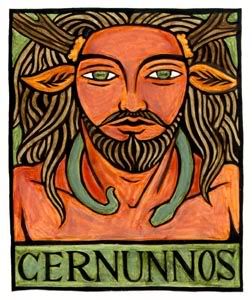 There are a lot of ideas that need to be incorporated in this post, so I will just enter them in no particular order to speak of. To start with, "Cernism" is a pagan tradition that probably ties more of Indo-European cultures together than does Odinism. Celto-Gallic peoples lived in ancient France, Germany, the all of the British Isles, Iberia, the Italian peninsula, Scandinavia (Gotland Island), and even the Slavic countries (ex. Poland) and Greece (the "Keltoi). Any European-descended person could lay claim to being an heir to the Cernic tradition. It seems to be at least a stronger cultural-geographical bond than is Odinism. Although the name of the male stag god "Cernunnos" may have existed primarily in central Europe and down to Cisalpine Gaul, expressions of it were clearly found elsewhere.
When Gerald Gardner and company started "Wicca," they set out to create a universalist faith which mixed Celtic spiritual traditions with traditions outside of Europe (ex. Egyptian goddess "Isis" as an idol). It probably should be pointed out that the pentagram had been adopted into Euro-pagan circles for a few centuries. To add insult to injury, many modern Wiccans have used their religion as a political front to what they see as male-dominated, conservative Christianity. To quickly sum all that up, there has been a large amount of deliberate unfairness and slander from both sides and on many levels.
We could just ignore all of that and do our own thing, but the one strong blowback from all of this is the real or perceived rivalry between Christians and pagans. Greek communities are overwhelmingly of the Greek Orthodox denomination of Christianity. However, as folkish people they have no problem honoring their pagan ancestral path. That is a model which we should follow. Even if a person was of Celto-Gallic descent, and was a strong Catholic, why would they have any problem merely partaking in a ceremony which honors the tradition of their ancestors? They wouldn't need to take any oath, or "worship" anything. There can be a distinction between a "religion" and a "spiritual tradition." Of course there will be those who will take it much more seriously, and that could be the one difference between the modern incarnations of the Cernic tradition and the gods of ancient Greece. I don't know of anyone who considers themselves a believer of the ancient Greek gods, although "Gaia" is often floated around by the global elite/universalist crowd as part of a political agenda.
The following is a book review from Amazon.com user "templar357" regarding the book 'Wicca for Men' (Drew; 2000). Some of the latter part doesn't support our emerging position very well, from either our Christian or pagan ideal consensus, but it does bring up a lot of food for thought, and it accurately describes the current status quo:
I find myself trying to break away from the unforgiving, intolerant religion of my fathers, only to be shunned by the largest, fastest growing pagan religion in the U.S. It seems that after several millennia of abuse from the "patriarchal" religions, women have taken the only religion that does not oppress them or make them look like Jezebels and tried to make it their own. Thing is, they made it almost exclusively their own, projecting the same attitude toward men as has been shown to them for so long. Well, this book sets the record straight by pointing out that there is a room a plenty at Gods (esses) table. This book embraces all that is male (The Horned God) and introduces HOW TO EMBRACE THE GODESS AS WELL. This book is a true reconciliation between the two sexes. I started reading this book to affirm my place in the Wiccan religion. Only to find out it had already been done, and now know the real difference between a REAL witch, and these scissor-happy, man hating, neo-feminist "earth mothers" I always seem to run into. This book not only points out the incorrect way many Wiccan covens practice this religion, but also assures the curious and spiritually destitute man that Wicca, in fact, means MALE WITCH. (Sorry, ladies) However, this book takes it one-step further. I now realize the true beauty in seeing a gender duality in divinity because I found out that the Goddess (portion of Divinity seen as female) has never hated me nearly as much as I feared her.
Guys, I am happy to report that SHE IS NOT A THREAT and will welcome you with arms open, not closed. She loves and cares for our father and the reverse is true. THEY ARE THE SAME. I feel the Gods rage in this book as he explains through the author the hurt and outrage he feels to this day when it came to be that man had forsaken his wife, his partner. His best friend, his soul mate. OUR MOTHER.
Now that I have digested and assimilated this new philosophy and religion, I see God and myself in a very different light. In doing so, certain things have happened almost literally overnight.
I have come to know a peace I have never known before and it is through tears of joy that I can now release a lifetime of bigotry, sexism, rage, hate and pain. Simply put:
The Goddess has helped me heal.
Now I understand the conceptual philosophy of gender duality attributed to all things divine and profane, I feel that I know now who my mother is.
And she is so...very...beautiful.
I have been shown that to accept my mother DOES NOT MEAN I MUST FORSAKE MY FATHER. It is the piece missing from the myriad of one-side confusion myself and others have been raised to believe. I now see women in a completely different light as a result of seeing myself differently the product of seeing The Almighty differently. This book IS NOT MEANT as an affirmation for men to reassure them that their conception of divinity must be REPLACED, but EXPANDED. Things began to click with me instantly while Ishtar smiled. All she wanted was for me to know who she was. Moreover, to know that although I may have never known WHO or WHAT she was, she has never forgotten who I AM. More is the pity. Better late than never I suppose.
 This book is a calling to all male pagans Wiccan and non-Wiccan alike, to now join our sisters in reuniting the planet as a family and not strangers. Though I would venture to say that a reference to the Goddess as the "consort" to the God would be met with equal disdain from the True Wiccan Woman and earth-mother alike, it also serves to show them how equally distasteful it is to us to have the God referred to by the same title. Unless of course, you mean consort as "partner," that is.
That IS what you meant, right?
THIS BOOK IS FOR MEN AND WOMEN BOTH. To enlighten the man about the Ways of the Wood, while setting the record straight with our fairer counterparts as to equality and "practice what you preach." Ladies, I love you all. Please know that we (men) are coming from the same battle torn, madhouse that is modern religion and we are just as bruised, bloody and hurting as you were when you left. We are glad you have capitalized on a little known secret and exposing it to the world, but please remember that those who started this ball rolling in the 20th century meant to re surface something beautiful and a LOT of those pioneers...
WERE MEN. Buckland and Gardener to name but a few. Remember the witch who helped repeal the anti-witchcraft laws of England in 1951? O.K. that, my dearest sisters was a MAN. Quite a few of these guys were in fact, freemasons, like myself. And it is by no means a coincidence that our initiation rituals are so similar. No coincidence at all, ladies. So when you see one of us staggering toward your camp, hungry, beaten and torn, understand that a kind word, a hot meal and a warm bed can do more for a person in that condition (male or female) than a closed door ever could. See what I have come to understand is that the God (or the conception thereof) did not do this to all of us. HIS INSANE FOLLWERS DID. They took off his horns and replaced them with guns. THIS IS NOT THE GOD. This wrongful conception of masculinity must stop and this book subtly points that out. Even if you are a soldier and have been to war, you want to show me how brave you are?
Try changing a diaper tough guy. Lets see how bad you REALLY are.
We are not just soldiers and conquerors. We are husbands, fathers, lovers and protectors. We are the hunter, the farmer and the Holy Man. When did we loose sight of our roles and responsibilities AS MEN?
When did the farmer become the executive, the warrior a soldier? When did the hunter become a poacher, and the father a deadbeat dad? When did the husband become a tyrant and the father become just a picture on somebody's wall. But most importantly:
What about Mom?
WHEN DID WE KICK HER OUT OF THE HOUSE?
When we did that, we kicked out our wives and mothers as well, tossing out the baby with the bathwater, turning our women into slaves and thus begun the Ruination of the World.
Read this book. Because it can change yours.
Blessed Be :-}
In the Cernic tradition, it appears that the female is largely in charge of facilitating spiritual matters on this planet. I don't think that is an innate rule, but the historical record seems pretty clear on that point. As to how this idea merges with Druidic traditions, which were present in ancient Gaul, I have no idea. It's a complete mystery to me. I do seem to get the idea, from reading a bit about Cernism and possible related traditions, that the Cernic tradition strongly influenced other regions in the ancient world, even if those regions were still primarily of a different pagan tradition. For example, within regions which were strongly Wotanist in faith, there seems to be almost like an alternate spirituality which sounds very similar to Cernism; and yes, it seemed to be very female-oriented. There also seemed to be a strong tolerance between different pagan traditions in pre-Christian Europe. This is perhaps because they may have overlapped each other, and many ideas were mixed together. In the book 'Creed of Iron' (McVan; 1997), Ron McVan argues that "Wotanism" was really the main stem of European paganism. I would argue that Cernism, or forms of it, were more widespread in pre-Christian Europe. Even Stregheria shares much in common with Cernism, and like many expressions of Ásatrú, it shares common origins. Cernism is more purely European than "Northern European Wotanism."
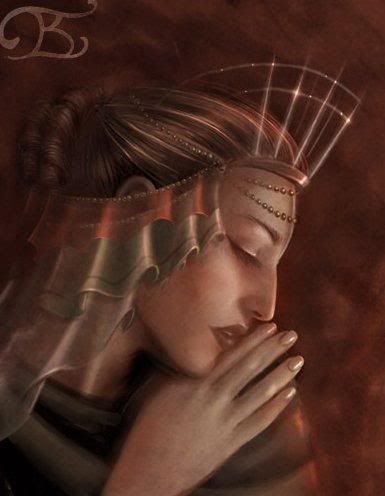 "Ásatrú" is another term for Wotanism or Odinism. Some denominations of Ásatrú appear to be following something much closer to Cernism than to Wotanism. Some followers of Ásatrú appear to be following almost like a form of "folkish Wicca," and that leads us to the key to the entire "Cernic Rite movement." The reformation of the very ancient European pagan tradition, which was present all over ancient Europe for tens of thousands of years. I mean more ancient than the Norse or Mediterranean Europeans, of whom many adopted these traditions after their migration eastward many thousands of years ago. What we are really talking about here is a spiritual tradition which goes back forty thousand years or longer.
Not to get too far ahead of ourselves, but it would be nice to select a word to be the equivalent of what "hearth" is to Odinism, or to what a "coven" is to Wicca. In other words, a word for a small community of Cernic native believers. I was thinking of perhaps calling it a "bodina," which an ancient Gallic word which seems to mean the same thing as "midgard." Bodina is the origin for the modern French word "borne," which is translated as "milestone" or "landmark," or even "frontier." It almost sounds like a world which could describe the general area that you live in.
.
Wednesday, May 3, 2017
Tana's Day 2017: May Day, Beltane, Flower Moon, Mother's Day 2

Tana's Day - "La Giornata di Tana" - is the Stregheria equivalent of Beltane and May Day... all on May 1st. There's almost like two spring festivals: April 1 and May 1. The Full Flower Moon occurs on the evening of Wednesday, May 10. Mother's Day is on the following Sunday. I believe that being out in a special place to welcome the full moon is part of our ancestral memory. When you're out there within a Pagan frame of mind, it reawakens that part of you. Sometimes it's so perfect that I want to stay out there all night.
Who were the first Europeans?
Survive the Jive
Sitting in the beautiful Verdon Gorge in Southern France, I muse on the first European peoples that inhabited that region. I consider the cave art of Lascaux, Pech Merle, Niaux, Chauvet, Cougnac etc. The animals depicted there must have been sacred to our ancestors, whether Homo Sapien or Neanderthal, who depended on their meat to survive.
I include some nice shots of Wisent (European Bison), Griffon vultures and Alpine Ibex, which are all animals our European ancestors were familiar with. I also explain the genetic origin of European people including the Yamnaya, the hunter-gatherers and the early Neolithic farmers from the Near East.
This channel depends on your support:
Paypal: https://www.paypal.me/survivethejive
Patreon: https://www.patreon.com/survivethejive
Music: GRIMRIK - Vorsichtige Schritte.

Andrei Burke - UltraCulture.org - June 13, 2014
A team of Harvard scientists believe the remnants of an ancient Earth that date to the time another planet collided with ours to produce the moon may still be lodged deep within the Earth’s mantle
If you thought it was a trip to see the Earth from space, then wait until you get a load of this: A team of scientists from Harvard University believe that have found evidence that an ancient Earth exists inside our planet. The team believes that a previously unexplained isotopic ratio from deep within the Earth might be a signal from material from before our world collided with another planet-sized body, which led to the creation of the Moon. This might be an echo of an ancient Earth that existed 4.5 billion years ago, prior to the proposed collision.
con't...
motorcycle jumps grand canyon ROBBIE KNIEVEL! awesome
MrJonswift200
live jump plus replays of different camera angles. brass balls included.Eddie Haynes supplied the folowling info. thanks eddie .A lot of you are complaining that he took a bit of a tumble at the end. The number one reason was on that side of the canyon was still part of a American Indian Tribe and it took a lot of dealing with the Chief of the tribe to not disturb the natural land.To keep it as natural as possible was the only way they give Robbie Knievel to make the jump there.It was planned for him to ditch the motorcycle after he cleared the landing.He kinda messed up when he cleared the ramp and hitting the small bump but he still was able to nail the jump and land. A complete success of dumping the bike and making a clean jump.I know that a lot of you are complaining about the tumble but it was planned.I think it took him a little over two years before the Indian Chief said yes but the land had to remain almost as it was before the jump
*************************
Robbie Knievel Jockey Club Towers Las Vegas Jump

This home and property is located in rural Summerville, Georgia; deep in the woods. Apparently it was designed, constructed, and utilized by Satanists in 1977. The two owners were brutally murdered there in 1982; and it was eventually burned down by vandals/arsonists. The ruins are still there. There are quite a few documentaries and commentary about its history on YouTube.
*************************
Corpsewood Manor (Summervillle, Georgia)
Crumbling ruins mark the site of a couple's grisly murder in the woods.
Surrounded by the Chattahoochee National Forest is the former site of a brick mansion, now lying in partial ruin. Hand-built in 1977 by Dr. Charles L. Scudder, a retired professor at Loyola University in Chicago, and his partner Joseph “Joey” Odom, the mansion served as the couple’s dream home until their deaths.
In December of 1982, the pair were gruesomely murdered, along with their two bull mastiffs, as a result of an attempted robbery by two acquaintances, Avery Brock and Tony West. During the ensuing investigation and trial – fueled partially by a local media circus – a mythos evolved in which the victims were vilified as “evil devil worshippers,” drawing from Dr. Scudder’s interest in the occult and the pair’s open homosexuality. Despite having been very well-liked in the community by those who knew them, the horrendous mythos continues to this day, and many locals still refer to the area as, “Devil Worshippers’ Mountain,” and claim that taking a brick from the property will lead to being cursed for life.
con't w/images...
Buttercup by Sinboy
zuperchicken2
Elysa Grey, vocals, programming -- Karen Kreutzer, guitar -- the late Rana Ross, bass guitar. Three piece tecnho-power trio.

I didn't want to delve into the Georgia Guidestones here, as I don't usually find the occult religion of the global elite especially interesting.... more like the symbol of oppression. This monument is not part of the U.S. park system. It's apparently still a mystery as to who actually owns and maintains it. It is apparent that the person who contracted its construction--Robert C. Christian, "R.C. Christian" was actually Ted Turner... although he may have had an agent complete the transaction.
Chasing The Wolverine - Most Extraordinary Predator That Ever Lived [HD]
AM Channel
Wolverine is the largest land-dwelling species of the family Mustelidae (weasels). It is a stocky and muscular carnivore, more closely resembling a small bear than other mustelids. The wolverine, a solitary animal,[1] has a reputation for ferocity and strength out of proportion to its size, with the documented ability to kill prey many times larger than itself.
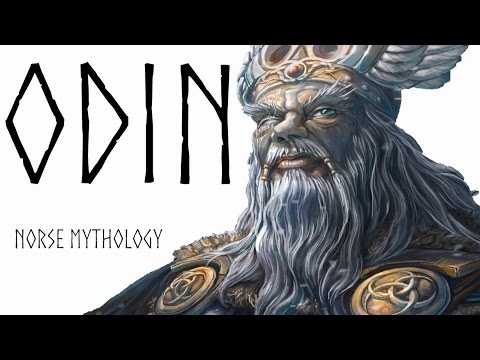
I mentioned here once the origin of 'Breaking Bad' and 'Better Call Saul' star Bob Odinkirk. Odinkirk means "Odin's Church." Another one is the current quarterback for the Northwestern football team... Clayton Thorson... "Son of Thor." One translation of Odin is "Master of the Order"... and the word for "order" in the old Camunian dialect of the Lombard language is "urden." Is Urden.. Odin? The ancient Langobards called him Godan. This also would seem to be an area ripe with creative ideas for an individual to form a magickal name.
“How can a man die better,
than facing fearful odds,
for the ashes of his fathers,
and the temples of his Gods.”
-- Jack Harper, 'Oblivion'
Factoid
The origin of the word "NEWS" is "North, East, West, and South."
All You Need is Love - The Beatles Tribute
Oromero89 Rock and Roll
"A Day in the Life", the band of musician friends who meet annually to commemorate the Beatles, he returned to the stage of the Teatro Peruano Japonés to remember John Lennon, 35 years after his physical disappearance.
.
Friday, July 30, 2021
Festival of Diana 2021: Rising from the Shadows

Also known as Nemoralia, Festival of Torches, and Hecatean Ides. In Stregheria it is known as the Festival of Diana. The Old Religion predates the Etruscans and Romans. Nemoralia no doubt comes from the fabled Lake Nemi. From very ancient times, Lake Nemi was known as Diana's Mirror, or Speculum Dianae to the Romans. The Goddess Diana (Diana Nemorensis: Diana of Nemi or Diana of the Wood) is deeply associated with the lake and surrounding woods. Near the temple of Diana was the sacred grove of Aricia.
A Rex Nemorensis was the name of the head of a Dianic preisthood at the temple. However this was during Roman times, and not of the time of the original Dianic tradition(s). The Temple of Diana at Lake Nemi was constructed near the north shore by the ancient Romans about 300 BCE, and was called the 'Temple of Diana Nemorensis'. Ancient Rome, just like the United States today, fostered various cults to occupy the minds of the common people. However, there is something far more spiritually essential about the pre-Roman and pre-Etruscan folkways. The ways of the mysterious Euganei; a Proto-European people of the Italian peninsula. Probably even more mysterious than the Etruscans.
 |
| Roman ruins of the Temple of Diana at Lake Nemi |
1st century BCE Roman poet Ovid described the celebration:
"In the Arrician valley,
there is a lake surrounded by shady forests,
Held sacred by a religion from the olden times...
On a long fence hang many pieces of woven thread,
and many tablets are placed there
as grateful gifts to the Goddess.
Often does a woman whose prayers Diana answered,
With a wreath of flowers crowning her head,
Walk from Rome carrying a burning torch...
There a stream flows down gurgling from its rocky bed..."
 |
| A more modern statue of Diana overseeing Lake Nemi |
1st century CE Roman poet Propertius observed the festival, apparently from a distance, and wrote to his beloved:
"Ah, if you would only walk here in your leisure hours.
But we cannot meet today,
When I see you hurrying in excitement with a burning torch
To the grove of Nemi where you
Bear light in honour of the Goddess Diana."
 |
| Lake Nemi in Latium |

On
this day, worshipers formed a procession of torches and candles around
the waters of Lake Nemi (the name Nemi, from the Latin nemus, means a
sacred wood or sacred grove), also known as Diana's Mirror. Hundreds
join together at the lake, wearing wreaths of flowers. According to
Plutarch, part of the ritual (before the procession around the lake) was
the washing of hair and dressing it with flowers.
It
is a day of rest for women and slaves. Hounds are also honored and
dressed with blossoms. Travelers between the north and south banks of
the lake were carried in small boats lit by lanterns. Similar lamps were
used by Vestal virgins and have been found with images of the goddess
at Nemi.
Requests
and offerings to Diana may include small baked clay or bread statuettes
of body parts in need of healing; small clay images of mother and child;
tiny sculptures of stags; dance and song; and fruit such as apples. In
addition, offerings of garlic are made to the Goddess of the Dark Moon,
Hecate, during the festival[citation needed]. Hunting or killing of any
beast is forbidden on Nemoralia.
************
The pre-Etruscan/Roman Dianic cult
I suppose that it could be an area of debate within practitioners of Stregheria as to how much latter influence should be adhered to. In truth, we really don't know a lot about the Euganei or their ancient spiritual traditions. What we do know is that during the last glacial movement, ending about 9,000 years ago, about two-thirds of Europe was covered by a mile high sheet of ice. A clearly related Proto-European lunar Goddess tradition essentially stretched from Wales to Portugal to Greece and to Bavaria. The name of the Goddess was different from region to region (Diana, Hecate, Mona, etc), and other names of the finite aspects of this tradition were different, but overall it was all closely related. Remember this was basically "a little Europe" at the time. A very similar primal people existed throughout at that time, prior to the latter incoming movements of Teutons or Mediterraneans.
The Etruscans had a mysterious culture, and brought with them their own pantheon of gods and spiritual folkways which merged with the natives. Then the Romans took over and started anew; erasing much of what had been Etruscan culture, architecture, spirituality, history, etc. They had their own, often conflated, pantheon of gods and spiritual folkways. I think it was all more planned and calculated by the Romans, while the Etruscan culture likely merged with the local native folkways in a much more organic manner. So for a modern Stregheria movement... which aspects of all this do we adhere to? While in ancient Greece, the Olympian gods seem to have been separate from the more ancient Hecate cult; in ancient Italy the whole thing was more convoluted.
While it would be exciting to explore the pantheon of Etruscan gods, there does become a confusion... especially since the latter manifestations of the Old Religion which have existed in the periphery over the centuries have their own local folkways. To a large extent, what we might call Stregheria today is a confusion of time periods and regional influences as they survived in spiritual exile from the mainstream society. In the Gaulish north, not surprisingly there is Gaulish and ancient German influences, even Slavic influences. The Goddess was called Mona, the same as in Gaul proper and other ancient northern European locales. The story of the 'Witches of Benevento' is a good example of one of the many migrating peoples on the peninsula whom had an influence on the pre-existing pagan traditions... in this case, the south-migrating Langobards.
Over the centuries there were numerous, more often small, migrations of other peoples into the peninsula. Other Europeans, and even non-Europeans in the south, either invaded to migrated and had some affect on the culture and traditions. Overall, these spiritual influences--if there were any--were probably small. One thing which is not helpful, for example, is when Raven Grimassi was attacked by some for a perception that he was speaking for all who practice Stregheria. Also, some even deny Stregheria itself, insisting that it should all be about Benecaria or something else. I think that we should approach this in the following manner:

2) Create levels of commonality. A chronological system where we can agree on some things, and also allow for a lot of spiritual diversity.... both individually and by small groups.
3) Proto-European witchcraft: Always acknowledge the "very ancients" from the last ice age. These were they're ways, and we're their descendants.
4) Euganei: It is essential to acknowledge that this was the primal population of Italy at one point, and they are all of our ancestors. This is the link that ties us all together, and the most important step! If we can't at least do this, then we're truly just wasting our time as far as a greater revival. We must keep this area of study and practice, pure; at least academically, and in a unifying manner. Creating a nucleus of folk-spiritual sameness of which we can all agree one.
5) Acknowledge the main contributors to latter traditions: Etruscans, Gauls, and Romans.
6) Acknowledge influences from the Middle Ages.
7) Acknowledge post-Medieval influences.
8) Allow those who are not interested in the very ancient folkways--the Euganei--to go their own way. This isn't to say that, for example, cryptic-traditions within the Church are not a big part of our history. They certainly are, but the essential basis of Stregheria must be of these ancient ancestors. I would also think the folklore of Aradia as well. If someone can't handle that, then we go our separate spiritual ways. Also, of course, there are other influences: Masonic, Hemetic, Eastern, Astrology, etc. However, at the primal heart must always be the ancient folkways! Beyond that, there can be all sorts of individually-inspired, small group, or regional flavors. Italian-Americans in New England might adopt something from earlier English pagans, or Italian-Argentines might adopt something from Basque pagans. The common American "welcome star" comes directly from Dutch/German pagan tradition. Italian-Americans in Pennsylvania might adopt that symbol to an extent. Personally, I place a little hand-made wooden red solar cross up along the trails where I usually walk, conduct ritual, alone or with others. When the early Christians were eliminating Odinic tradition from German-speaking areas, Hungary and elsewhere, the pagans would replace their old altars in the woods with a red cross to mask their holy altars in hopes that they could return to them at a later point. Of course, it never happened. So I use that same concept, using a red solar cross instead; in this case as a type of altar in of itself. There seems to be another pagan coven of some type whom places little hand-weaved hearts in the area; and I also see rocks stacked or little stone labyrinths. Meaningful things like this are fine on the surface, and don't replace the primal Stregheria which we would need to agree upon.
************
Having passed away in 2019, Raven Grimassi left us too soon. I strongly feel, despite the trail that he blazed, that there was still work to be done. I suppose that we would all feel that way when someone important to us passes... if there only was more time. We still must finally iron out a foundation as far as creating an "Aradianist Folk Revival." Basically agree on the essentials, and agree-to-disagree on the less important things.
.