Sunday, May 3, 2015
The Maypole and May Day - Part 3
In the movie 'The Wicker Man" (1973), a Maypole is is shown with children celebrating around it. Also, in the remake, an elaborate festival is portrayed... which I think was May Day, as in the original. I loved the visuals of that scene. Often at the top of the poles is a tree-like display, with ribbons extending to the ground, where a each person in the circle walks in one direction with it. The little tree shape may turn with the pulling, or it might be allowed to twist around the pole top to bottom. Often the colors red and white are used to decorate the pole, as well as the colors of the ribbons. I have seen other shaped displays, such as a wheel of the year.
Symbolism
The symbolism of the maypole has been continuously debated by folklorists for centuries, although no set conclusion has ever been arrived at. Some scholars classify maypoles as symbols of the world axis (axis mundi). The fact that they were found primarily in areas of Germanic Europe, where, prior to Christianization, Germanic paganism was followed in various forms, has led to speculation that the maypoles were in some way a continuation of a Germanic pagan tradition. One theory holds that they were a remnant of the Germanic reverence for sacred trees, as there is evidence for various sacred trees and wooden pillars that were venerated by the pagans across much of Germanic Europe, including Thor's Oak and the Irminsul. It is also known that, in Norse paganism, cosmological views held that the universe was a world tree, known as Yggdrasil. There is therefore speculation that the maypole was in some way a continuance of this tradition.
Non-Germanic people have viewed them as having phallic symbolism, an idea which was purported by Thomas Hobbes, who erroneously believed that the poles dated back to the Roman worship of the god Priapus. This notion has been supported by various figures since, including the psychoanalyst Sigmund Freud. Phallic symbolism has been attributed to the maypole in the later Early Modern period, as one sexual reference is in John Cleland's controversial novel Fanny Hill:
"...and now, disengag'd from the shirt, I saw, with wonder and surprise, what? not the play-thing of a boy, not the weapon of a man, but a maypole of so enormous a standard, that had proportions been observ'd, it must have belong'd to a young giant."
The anthropologist Mircea Eliade theorizes that the maypoles were simply a part of the general rejoicing at the return of summer, and the growth of new vegetation. In this way, they bore similarities with the May Day garlands which were also a common festival practice in Britain and Ireland.
Italy
Maypole traditions can be found in some parts of the country, e.g. in Friuli, Umbria and Marche.
"After we've gone to get the pole in thirty or forty people, we placed it like a six month child. We walked in procession with this tree and not even a single leaf had to touch the ground. We had to raise it without making it touch the ground, holding it in our arms like a child. For us it was the saint of the 1st of May."
—Quirino Marchetti (ancient peasant of San Benedetto del Tronto), in L'albero di maggio
.
Tuesday, January 27, 2015
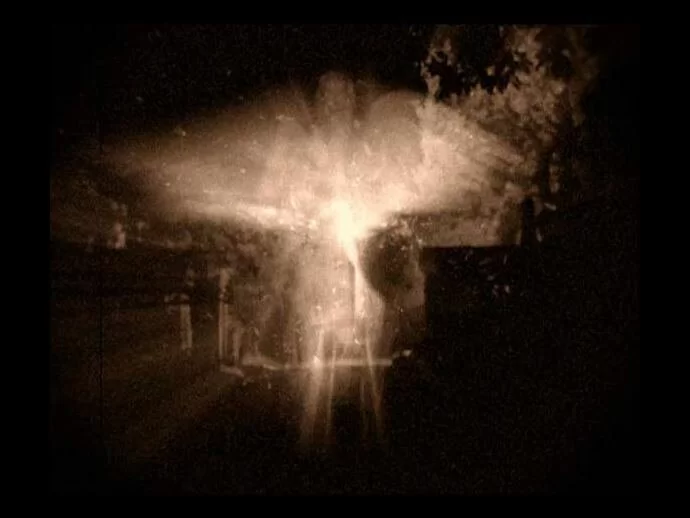
Well known "angel photograph" from 1952 bears a strong resemblance to the Goddess Freya
Someone could argue that the Norse gods are never actually "seen." Well, perhaps it's possible that that may not be entirely true..? Even the most crude "photo shop" wasn't available until 1982. Look closely... doesn't this apparition appear to be the perfect archetype of the beautiful Freya? Just a Heathen hunch. We don't know that it isn't Freya...
The Norse/Germanic Goddess Freya "is a goddess associated with love, sexuality, beauty, fertility, gold, seiðr (magic), war, and death. Often in ancient Germanic pagan systems, "death" really meant "death and to a new arising." According to the below account, could Freya have favored the British in this particular battle.. and showed up for inspiration?
Doidge Angel Photograph
The Doidge angel photograph was found on some film Danny Sullivan purchased at a British junk shop. Accompanying the film were several letters from the 1950s that related stories of angel sightings dating back to World War I. The letters had belonged to William Doidge who had written an American soldier named Doug whose friend had seen an angel appear above a Gloucestershire lake prior to twenty soldiers dying there in a bridge collapse. Doidge searched Woodchester Mansion for the angel and in 1952, he captured this amazing angel photograph.
More Behind the Doidge Angel Photo
This stunning angel photograph was found on some film Danny Sullivan bought at a British junk shop. Accompanying the film were several letters from the 1950s that related stories of angel sightings dating back to World War I. The letters had belonged to William Doidge who had written an American soldier named Doug whose friend had seen an angel appear above a Gloucestershire lake prior to twenty soldiers dying there in a bridge collapse. Doidge wrote in the letters concerning how British soldiers in 1914 were led into battle at Mons, France by angels.
Doidge was put into contact with Doug after being smitten with the World War I story. This led him to contact Doug after he had heard about his friend's story of the angel sighting at Gloucestershire's Woodchester Mansion. Doidge searched Woodchester Mansion for the angel and in 1952, he apparently was fortunate to capture the amazing angel photograph. Over the years, rumours have abounded that Danny has had a movie deal in the works regarding the angel sighting stories.
.
Saturday, September 28, 2013
VA approves Thor’s hammer for gravestones - Part 2
A Victory for Those Who Paid the Ultimate Price
By Vikingreverend - VikingReverend.wordpress.com - July 23, 2013
Finally the Veteran’s Administration has come to their senses – even though it may cost them a few cents to implement the new ruling for marking KIA’s grave-site at Arlington or any other VA approved burial plot.
Our beloved Thor’s Hammer – the identifying symbol of most Ásatrú Folk – was approved as one of the now 56 symbols the VA will allow to mark a soldier’s grave.
The story on National Public Radio’s interview with John Brownlee can be heard HERE
The story that broke this news can be found HERE
Fortunately for many active soldiers and veterans who already are familiar with Nordic Mythology and Odhinnism in general, the VA actually acknowledged that Thor’s Hammer is not linked to other form of paganism, such as Wicca, Satanism or Hedonism, and following Teutonic/Germanic Beliefs, stand for the Nine Noble Virtues which is in large part embraced by the majority of Ásatrú Folk.
For those of you not familiar with the Nine Noble Virtues or the Six Fold Goal of Ásatrú Folk:
The Nine Noble Virtues
Courage – being brave enough to do what is right in all circumstances.
Truth — to always speak what is true to one’s heart and mind.
Honor — one’s inner value towards their endeavors, knowing they are of a good and true nature.
Fidelity — being true to one’s Self and loyal to one’s Folk and mate.
Discipline- the ability to be hard with one’s Self first, and then others. The heartiness to carry out goals and endeavors.
Hospitality- sharing what one has with all Folk, when there is a feast to be had, feast. When there is but bread, break it gladly.
Work Ethic- to joyfully carrying out the tasks of life that support home, family. To be glad and respectful of one’s abilities.
Self-Reliance – to know with heart and mind that one’s Spirit is independent and free among all men.
Perseverance- is the Spirit of success. The ability for one to follow one’s path regardless of failure or success. To learn from mistakes and recognize the progress of a situation.
For once (is there a blue moon out tonight?) the VA has made a proper decision that will greatly effect many of our Army. Air Force, Navy, Marine, Coast Guard and National Guardsmen who have paid the ultimate price in Service to their, and our, Country.
Blessings of Peace
**************************************************
I had forgotten to post this earlier. Yes, it's a miracle. A bonafied "European spiritual tradition" is officially recognized by the U.S. government. When a spiritual tradition is European in origin, then it's called mythology, pagan, small movement, subculture, etc.; but when it's a spiritual tradition from any other origin, then it's serious stuff. Well, better late than never. I should add that Wicca--although based on ancient European traditions--is eclectic as well. It's interesting to read some of the comments from the article link in part one. Some are very good.
This had truly been a struggle. Since the U.S. military is the only governmental institution which has private cemetaries, it then represents the bare-bones of what society/government accepts. Governmental foreign policy is a separate issue. If this were Christian society vs. Asatru/Odinism, then I could at least understand the issue; but when almost everything under the sun is accepted... then it starts to get a little strange in my opinion. However, this should be a joyous occasion if you're a "native believer" (not necessarily Asatru).
.
Friday, September 27, 2013
VA approves Thor’s hammer for gravestones - Part 1
VA approves Thor’s hammer for gravestones
By Gina Harkins - MilitaryTimes.com - July 23, 2013
Marines who label themselves modern-day heathens and wish to mark their grave with Thor’s hammer — their religion’s version of a cross or Star of David — now have Veterans Affairs approval to do so.
While some only know of Thor as a comic book hero, he actually dates back to Norse mythology. Thor used his magical hammer to protect humans and other gods from giants.
But today, that hammer means something special to those who practice Ásatrú and worship the Norse Gods. And as NPR’s “The World” reported last week, those who identify as such and served in the military now have the option of marking their gravestone with Thor’s hammer.
NPR interviewed John Browlee, a Boston-based writer who reports on technology, about the tie between those who practice the religion and Thor’s hammer. He estimates there are between 10,000 and 20,000 self-labeled modern-day heathens in the U.S.
To them, Browlee said, Thor’s hammer is their sort of crucifix — the symbol of their religion. It symbolizes what Thor stands for: honor, bravery, loyalty and virtue.
Many of the same traits respected in the military, he added.
But getting Thor’s hammer recognized as a legitimate religious emblem by the VA wasn’t easy, he said. Reason being that the VA had a problem with pagan symbols, and Thor’s hammer got lumped into that debate.
Now Thor’s hammer is one of 56 symbols approved by the VA that those who served in the military can request to have added to their headstones.
You can hear NPR’s whole story on how it happened here:
.
Wednesday, June 8, 2011
Interview With a Gothi
This was an interview with Hengest, the head of the "Court of Gothar," which is the ruling council of the Odinic Rite. I believe that I have posted this link a few times, but I wasn't able to find it. I just wanted to post it here as a separate entry. It's a great interview. It's hard to believe that a mere few thousand people have viewed these on YouTube.
The OR is based in the UK, but is a worldwide organization. I believe that this particular interview was conducted in Alberta, Canada. They have displayed the courage, leadership, and responsibility to speak out on the hard issues of our time which dramatically impact us.
One tiresome question which seems to creep up is "who can be an Odinist?" I don't think that within this folkish concept there is any definite dividing line. According to the OR, the answer more-or-less is a European-descended person who also descends from a region where Odinism once existed. Certainly "Langbard" fits into this category, as there are Cisalpine OR groups. Even the music compilation CD, produced by OR Media, feature musical artists from "Langbard" as they put it. This issue seems to get in the way of more important spiritual pursuits.
From the video description: "An interview with Heimgest, leader of the Odinic Rite. The Odinic Rite is an organization whose aims are to promote all aspects of the ancestral religion today called Odinism, the organic spiritual beliefs and way of life of the indigenous peoples of Northern Europe. The watch-words of the Odinic Rite are "Faith, Folk, Family" and this summarizes their ideals well."Interview with a Gothi - Part 1
Interview with a Gothi - Part 2
Interview with a Gothi - Part 3
Interview with a Gothi - Part 4
.