Showing posts sorted by relevance for query tarim basin. Sort by date Show all posts

Thursday, November 29, 2012

The Arctic Home in the Vedas: Part 7


Above: '1-5 Tarim Mummies - Indo-Europeans in China'; posted by alisonpita

2-5 Tarim Mummies - Indo-Europeans in China

3-5 Tarim Mummies - Indo-Europeans in China

4-5 Tarim Mummies - Indo Europeans in China

5-5 Tarim Mummies - Indo-Europeans in China


Tarim mummies (Wikipedia)

The Tarim mummies are a series of mummies discovered in the Tarim Basin in present-day Xinjiang, China, which date from 1900 BCE to 200 CE. Some of the mummies are frequently associated with the presence of the Indo-European Tocharian languages in the Tarim Basin, although the evidence is not totally conclusive. Victor H. Mair's team made the conclusion that the mummies are basically Europoid, likely speakers of an Indo-European language.
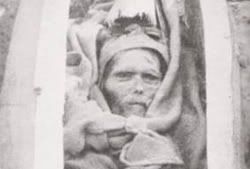


So how would the people who were to become "the Tarim mummies" fit into this hypothesis? Well, even today--four-thousand years later--it's pretty evident that they are very Germanic-looking in appearance. Their DNA shows that they were, at that point, slightly mixed with Mongols. The bulk of the Mongols showed up in the region about three-thousand years ago. Again, the Aryan hypothesis we were looking at was long before Mongol, Semitic, or Turkic expansion.


Roman accounts (Wikipedia)

Pliny the Elder (Chap XXIV 'Taprobane') reports a curious description of the Seres (in the territories of northwestern China) made by an embassy from Taprobane (Ceylon) to Emperor Claudius, saying that they "exceeded the ordinary human height, had flaxen hair, and blue eyes, and made an uncouth sort of noise by way of talking", suggesting they may be referring to the ancient Europoid populations of the Tarim Basin:

"They also informed us that the side of their island (Taprobane) which lies opposite to India is ten thousand stadia in length, and runs in a south-easterly direction—that beyond the Emodian Mountains (Himalayas) they look towards the Serve (Seres), whose acquaintance they had also made in the pursuits of commerce; that the father of Rachias (the ambassador) had frequently visited their country, and that the Seræ always came to meet them on their arrival. These people, they said, exceeded the ordinary human height, had flaxen hair, and blue eyes, and made an uncouth sort of noise by way of talking, having no language of their own for the purpose of communicating their thoughts. The rest of their information (on the Serae) was of a similar nature to that communicated by our merchants. It was to the effect that the merchandise on sale was left by them upon the opposite bank of a river on their coast, and it was then removed by the natives, if they thought proper to deal on terms of exchange. On no grounds ought luxury with greater reason to be detested by us, than if we only transport our thoughts to these scenes, and then reflect, what are its demands, to what distant spots it sends in order to satisfy them, and for how mean and how unworthy an end!"


This occurred two-thousand years ago, so apparently at least some of them were Germanic in appearance even at that point. It should be pointed out that while the Tarim mummies are constantly referenced as being "in China," it was not yet "Chinese" three-thousand years ago. Also, just because it is a desert now doesn't mean that it was a desert at the end of the last glacial movement ten-thousand years ago.

Tocharians (Wikipedia)

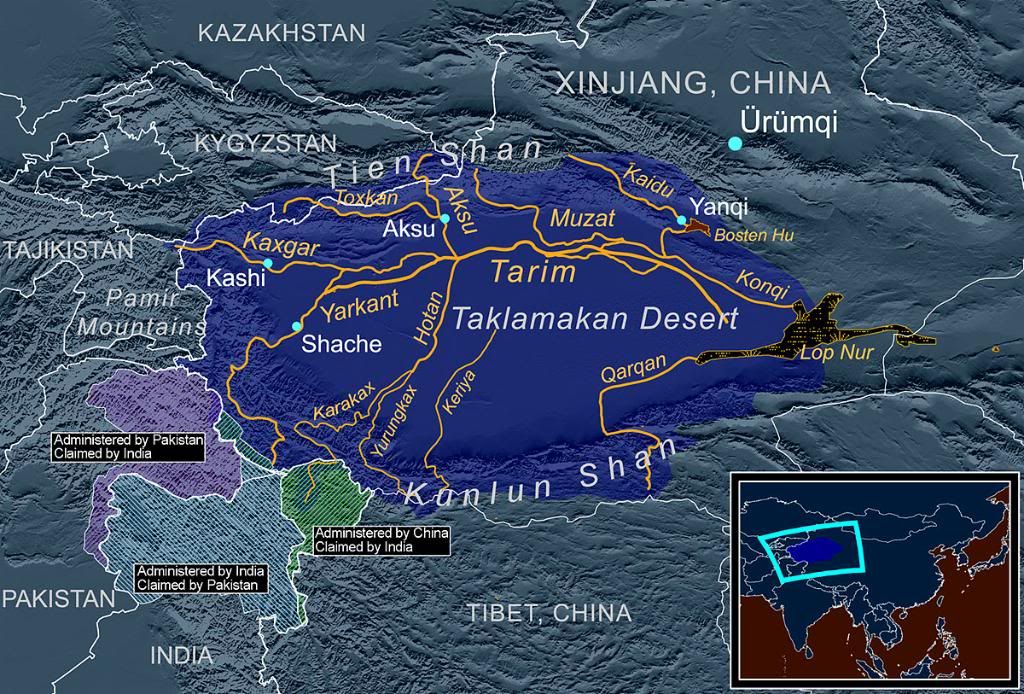
The Tocharians or Tokharians were ancient speakers of Tocharian languages
in the Tarim Basin (modern Xinjiang, China). The Indo-European language of the Tocharians was supplanted by the Turkic languages of the Uyghur tribes about 800 AD.

The Afanasevo culture is a strong candidate for being the earliest archaeological record of speakers of the Tocharian languages.


Tocharian languages (Wikipedia)

Tocharian or Tokharian is an extinct branch of the Indo-European language family, formerly spoken in oases on the northern edge of the Tarim Basin (now part of the Xinjiang Uyghur Autonomous Region of China) by the Tocharians. Two branches of Tocharian are known from documents dating from the 3rd to 9th centuries AD:

*  Tocharian A (Agnean or East Tocharian; natively ārśi) of Qarašähär (ancient Agni, Chinese Yanqi) and Turpan (ancient Turfan and Xočo); and

*  Tocharian B (Kuchean or West Tocharian) of Kucha and Tocharian A sites.
Prakrit documents from 3rd century Kroran on the southeast edge of the Tarim Basin contain loanwords and names that appear to come from another variety of Tocharian, dubbed Tocharian C. All these languages became extinct after Uyghur tribes expanded into the area.


The Proto-Indo-European Urheimat hypotheses ties closely into the "Arctic Home in the Vedas" theory, but the time frames don't quite line up, and I don't think it goes back far enough. It's too convenient. I think that Bal Gangadhar Tilak proved that this goes back further in time, and further north. The Kurgan hypothesis (see map) is the one which seems to tie in a lot of loose ends, especially in the area of the Indo-European languages, but I would still agree more with Tilak.

.

Wednesday, January 15, 2014

The Arctic Home in the Vedas: Part 14 - "Thule, Saturn, & an alternative explanation"


Thule, Saturn, & an alternative explanation: Part 3

The 80's musical track from the above video is entitled 'Hyperborea' by a German band called Tangerine Dream, which has been active from 1967 to the present. The theme song ('Betrayal') from the 1977 movie 'Sorcerer' was produced by them, as well as over sixty other film tracks. Anyway, I thought the above video captured the allure of what now seems clear to me to have been a real place; although there's no proof as of yet that it was a great civilization. At the very least, this ancient land of legend--and it's latter migrating peoples--are a big part of Indo-European history.

The "Arctic Home in the Vedas" is not just about Teutonic origins, but may say just as much about the very ancient proto-European culture. as well as the original pre-Greek and Roman Mediterranean civilizations. All three of those subraces are not given proper respect as far as their true origins. The Tarim mummies are just the tip of the iceberg. In hindsight, Bal Gangadhar Tilak was quite a pioneer; and the evidence proving him correct is mounting.

The ancient Greeks must have had periodic contact with these Teutons who were migrating outward after the last glacial movement. Perhaps some of them may even have contributed to ancient Greece and Assyria. I'm going to present this year some stunning information that may blow this thing out've the water as far as at least part of the Arctic circle being a livable place four or five thousand years ago. Much of this Greek-Teutonic contact likely occurred at the early stages of Greek civilization, where the legend developed.


This Hyperborean hypothesis seems to point to the logical location of northern Central Asia for what was probably some of the later settlements... like the Tarim Basin. It seems as though Greek conventional thinking later placed the Teutons as being from a location more like the British Isles; but they probably had it correct early on. Starting about three thousand years ago, some of these Teutons were migrating into Europe and merging with the proto-European/Alpine peoples; thus forming the "Celtic cultures." This is probably what confused them. It still confuses us today! Teutons were then associated with mary parts of the north from ancient Briton to ancient Tibet.


Hyperborea (Wikipedia)

In Greek mythology the Hyperboreans (Ancient Greek: Ὑπερβόρε(ι)οι, pronounced [hyperbóre(ː)ɔi̯]; Latin: Hyperborei) were a mythical people who lived "beyond the North Wind". The Greeks thought that Boreas, the god of the North Wind (one of the Anemoi, or "Winds") lived in Thrace, and therefore Hyperborea indicates a region that lay far to the north of Thrace.

This land was supposed to be perfect, with the sun shining twenty-four hours a day, which to modern ears suggests a possible location within the Arctic Circle. However, it is also possible that Hyperborea had no real physical location at all - for according to the classical Greek poet Pindar,

neither by ship nor on foot would you find
the marvellous road to the assembly of the Hyperboreans.


Pindar also described the otherworldly perfection of the Hyperboreans:

Never the Muse is absent
from their ways: lyres clash and flutes cry
and everywhere maiden choruses whirling.
Neither disease nor bitter old age is mixed
in their sacred blood; far from labor and battle they live.


Early sources


Herodotus

The earliest extant source that mentions Hyperborea in detail is Herodotus's Histories (Book IV, Chapters 32–36), written circa 450 BC. However, Herodotus recorded three earlier sources that supposedly mentioned the Hyperboreans, including Hesiod and Homer, the latter purportedly having written of Hyperborea in his lost work Epigoni: "if that be really a work of his." Herodotus also wrote that the 7th century BC poet Aristeas wrote of the Hyperboreans in a poem (now lost) called Arimaspea about a journey to the Issedones, who are estimated to have lived in the Kazakh Steppe. Beyond these lived the one-eyed Arimaspians, further on there were gold-guarding griffins, and beyond these the Hyperboreans. Naturally, Herodotus used to assume the location of Hyperborea somewhere in the Northeast Asia.

Pindar, Simonides of Ceos and Hellanicus of Lesbos, contemporaries of Herodotus in the 5th century BC, also all briefly described or referenced the Hyperboreans in their works.


Location of Hyperborea

The Hyperboreans were believed to live beyond the snowy Riphean Mountains which Homer first referenced in his Iliad (15. 171; 19. 358)[7] or beyond the home of Boreas.

According to Pausanias: "The land of the Hyperboreans, men living beyond the home of Boreas."

Homer placed Boreas in Thrace, and therefore Hyperborea in his opinion was somewhere to the north of Thracian territory, perhaps Dacia. Sophocles (Antigone, 980–987), Aeschylus (Agamemnon, 193; 651), Simonides of Ceos (Schol. on Apollonius Rhodius, 1. 121) and Callimachus (Delian, [IV] 65) also placed Boreas in Thrace. Other ancient writers however believed the home of Boreas or the Riphean Mountains were in a different location. For example, Hecataeus of Miletus believed that the Riphean Mountains were adjacent to the Black Sea. Alternatively Pindar placed the home of Boreas, the Riphean Mountains and Hyperborea all near the Danube. Heraclides Ponticus and Antimachus in contrast identified the Riphean Mountains with the Alps, and the Hyperboreans as a Celtic tribe (perhaps the Helvetii) who lived just beyond them. Aristotle placed the Riphean mountains on the borders of Scythia, and Hyperborea further north. Hecataeus of Abdera and others believed Hyperborea was Britain.

Later Roman and Greek sources continued to change the location of the Riphean mountains, the home of Boreas, as well as Hyperborea, supposedly located beyond them. However all these sources agreed these were all in the far north of Greece or southern Europe. The ancient grammarian Simmias of Rhodes in the 3rd century BC connected the Hyperboreans to the Massagetae and Posidonius in the 1st century BC to the Western Celts, but Pomponius Mela placed them even further north in the vicinity of the Arctic.

In maps based on reference points and descriptions given by Strabo, Hyperborea, shown variously as a peninsula or island, is located beyond what is now France, and stretches further north-south than east-west. Other descriptions put it in the general area of the Ural Mountains.


Later classical sources


Plutarch, writing in the 1st century AD, connected the Hyperboreans with the Gauls who had sacked Rome in the 4th century BC (see Battle of the Allia).

Aelian, Diodorus Siculus and Stephen of Byzantium all recorded important ancient Greek sources on Hyperborea, but added no new descriptions.

The 2nd century AD Stoic philosopher Hierocles equated the Hyperboreans with the Scythians, and the Riphean Mountains with the Ural Mountains. Clement of Alexandria and other early Christian writers also made this same Scythian equation.


Ancient identification with Britain

Hyperborea was identified with Britain first by Hecataeus of Abdera in the 4th century BC, as in a preserved fragment by Diodorus Siculus:

In the regions beyond the land of the Celts there lies in the ocean an island no smaller than Sicily. This island, the account continues, is situated in the north and is inhabited by the Hyperboreans, who are called by that name because their home is beyond the point whence the north wind (Boreas) blows; and the island is both fertile and productive of every crop, and has an unusually temperate climate.

Hecateaus of Abdera also wrote that the Hyperboreans had a 'circular temple' on their island, and some scholars have identified this with Stonehenge. This is further supported by the fact that Stonehenge has been known as Apollo's Temple since classical antiquity, and Hyperborea in Greek legend was related to Apollo.

Pseudo-Scymnus, around 90 BC, wrote that Boreas dwelled at the extremity of Gaulish territory, and that he had a pillar erected in his name on the edge of the sea (Periegesis, 183). Some have claimed this is a geographical reference to northern France, and Hyperborea as the British Isles which lay just beyond the English Channel.

Ptolemy (Geographia, 2. 21) and Marcian of Heraclea (Periplus, 2. 42) both placed Hyperborea in the North Sea which they called the "Hyperborean Ocean."


Legends

Alone among the Twelve Olympians, Apollo was venerated among the Hyperboreans, the Hellenes thought: he spent his winter amongst them. For their part the Hyperboreans sent mysterious gifts, packed in straw, which came first to Dodona and then were passed from tribe to tribe until they came to Apollo's temple on Delos (Pausanias). Abaris, Hyperborean priest of Apollo, was a legendary wandering healer and seer. Theseus visited the Hyperboreans, and Pindar transferred Perseus's encounter with Medusa there from its traditional site in Libya, to the dissatisfaction of his Alexandrian editors.

Along with Thule, Hyperborea was one of several terrae incognitae to the Greeks and Romans, where Pliny, Pindar and Herodotus, as well as Virgil and Cicero, reported that people lived to the age of one thousand and enjoyed lives of complete happiness. Hecataeus of Abdera collated all the stories about the Hyperboreans current in the fourth century BC and published a lengthy treatise on them, lost to us, but noted by Diodorus Siculus (ii.47.1–2). Also, the sun was supposed to rise and set only once a year in Hyperborea; which would place it above or upon the Arctic Circle, or, more generally, in the arctic polar regions.

The ancient Greek writer Theopompus in his work Philippica claimed Hyperborea was once planned to be conquered by a large race of soldiers from another island (some have claimed this was Atlantis), the plan though was abandoned because the soldiers from Meropis realized the Hyperboreans were too strong for them and the most blessed of people; this unusual tale, which some believe was satire or comedy, was preserved by Aelian (Varia Historia, 3. 18).

Apollonius wrote that the Argonauts sighted Hyperborea, when they sailed through Eridanos.


Physical appearance


Greek legend asserts that the Boreades, who were the descendants of Boreas and the snow-nymph Chione (or Khione), founded the first theocratic monarchy on Hyperborea. This legend is found preserved in the writings of Aelian: "This god [Apollon] has as priests the sons of Boreas (North Wind) and Chione (Snow), three in number, brothers by birth, and six cubits in height [about 3 metres]."

Diodorus Siculus added to this account: "And the kings of this (Hyperborean) city and the supervisors of the sacred precinct are called Boreadae, since they are descendants of Boreas, and the succession to these positions is always kept in their family."

The Boreades were thus believed to be giant kings, around 3 metres tall, who ruled Hyperborea.

No other physical descriptions of the Hyperboreans are provided in classical sources. However, Aelius Herodianus, a grammarian in the 3rd century, wrote that the mythical Arimaspi were identical to the Hyperboreans in physical appearance (De Prosodia Catholica, 1. 114) and Stephanus of Byzantium in the 6th century wrote the same (Ethnica, 118. 16). The ancient poet Callimachus described the Arimaspi as having fair hair but it is disputed whether the Arimaspi were Hyperboreans.


.
Wednesday, January 2, 2008

Camunni Alphabet and it's Links to Other Ancients Alphabets


Angelo was good enough to update us on a recent study in Europe regarding the links and patterns of ancients alphabets from numerous peoples from Europe, Eurasia, and the Near East. There are links to the lettering system of the Camunni tribe, which are amazing. Grazia Angelo.

*************************

'Origine Degli Alphabeti Camuni'


Book presentation, Budapest, Sofitel, August 17th, 2007


The Magyar rovás

The Magyar rovás make up an alphabet of 40 letters, plus several ligatures or letters representing consonant clusters or syllables.

Some 24 rovás are similar to Vinča signs, to Germanico runes, to letters of the Asiatic runic scripts, to letters of the earliest Italic and Helladic alphabets. Some 16 letters appear to be later additions: they are rounded and/or do not comply with the 5 rules of the runic scripts (see page 45 of the book) and/or are not similar to Vinča or later European signs. These 16 letters were added to the rovás in Central Asia, when the Magyars were no longer carving hard materials, but drawing on parchment, as the Parthians did.

Out of the 24 letters that are similar to Germanico runes, 16 appear to be very similar, but some 8, which could correspond to signs added by the Celts to represent their Indo-European phonemes, are not. In particular, the phoneme [θ] was written in the North and is kept in Irish; but it was written in the south and, still similar, is kept in Greek.

The Germanico runes and the Magyar rovás could both have an ancestor in an earlier 16-letter alphabet. In fact, the original 16-letter Flavio *VUARK, but also the *Pannonico alphabet, can be easily reconstructed by comparing the rovás and the runes with some of the most ancient alphabets: Esik, Lemnos, Camuni, Veio, Marsiliana, and the Venetic and Athenian alphabets.

The Esik, Lemnos, and Camuni alphabets remain so far undeciphered. The Esik and Lemnos alphabets appear to be congruent with the limited Finno-Ugric phonology: the Esik alphabet does not contain any of the characters added in Europe by the Germans and the Celts; the Lemnos alphabet only contains some of them. These three isolate alphabets have kept some of the most ancient *VUARK characters.

In Esik (nearby "Alma Ata" = "Mother/Father of Apple", Hungarian name of the former capital city of Kazakhstan), in the grave of an Amazon Shaman Princess (J. W. Jay) buried with a rich treasure, an inscription on a silver bowl was found. The grave has been dated back to the 5th century B.C. The characters that make up this inscription consist of: 12 characters identical to 12 Flavio *VUARK characters, two *characters identical to another two of the *VUARK, and a few possible ligatures. This inscription cannot be Phoenician or Greek because some of its characters and legatures have never been written around the Mediterranean Sea (except along the western shores of the Adriatic Sea, where Pannonico populations are supposed to have migrated from Illyria). Instead, these characters and ligatures do appear in later alphabets of the Turanian plains, in the Siberian rovás, in the Magyar rovás, in the Nü Shu syllabary (Yunnan, China), and in the Kaganga script (Sumatra) (see the book "Honfoglalás... the Magyars are back home" for other cultural markers that link all these regions). The Esik script contains no characters at all that resemble any Indo-European addition: the Hungarian population that migrated to Esik could have been able, while in Europe, to keep itself separated from the Celts.

When the Camuni alphabets were carved, the Indo-European phonemes had already been added; but the corresponding characters were different from both those used in the Germanico runes and in the Magyar rovás. The Camuni alphabets prove that the Germanico and the Pannonico were alternative characters for the same [a] phoneme. The Camuni alphabets had a letter between D and E that also the Ugaritic abjad had, in the same position. This letter had disappeared from all European alphabets in the beginning of the 1st millennium B.C. (or had been moved between N and O, as it also happened in Phoenicia!). The Camuni alphabets also show an ideogram, which was copied in the Ugaritic abjad, but was never transliterated by the Semites. The Camuni alphabets have characters that do appear in the Ugaritic script, but do not appear in the Phoenician abjad. Thus, it is impossible that the Camuni alphabets could have been copied from the Phoenicians, and it would be nonsense to say that it was copied from the Romans! Instead, it is possible that the Ugaritics could have copied from Europe alphabets with features of the Camuni ones.

The Veio and Marsiliana alphabets have been found in Etruria: these two alphabets were not (not) Etruscan alphabets: the Etruscans never, or only occasionally, used some 8 letters of these alphabets. The Etruscans never added the Indo-European phonemes to their alphabet: some exceptions were graphically and phonetically unstable in time and space (the characters and the associated phonology changed with time, and from one region to another), in most cases different from the Phoenician letters, and in some cases different from any other known script (e.g.: 8 for [f]). The Marsiliana and Veio alphabets could be Pannonico alphabets, a few centuries older than their official dating (8th-7th century B.C.): in fact, they are more similar to the alphabet that the Ugaritics could have copied than to the later Phoenician abjad (see table 60 of the book).


The Germanico runes (Futhark)

The Germanico runes consisted of 24 letters. Eight of them were not stable in space and time and/or do not comply with the rules of the runes. The remaining 16 runes, more stable in time and space, represent the 16 phonemes that are still peculiar to the Finnish alphabet. The phonemes [b], [d], [γ], [w], [z], [f], [θ], (and probably [o] in ancient times) are not used, even these days, in words of Finnish origin. These phonemes were added by the Germans and correspond to the 8 letters that are graphically and phonetically unstable in time and space in the many different European runic scripts. When the German populations left Scandinavia, the Vikings started writing again with a 16-letter alphabet, congruent with a limited, Finno-Ugric, phonology.


The Flavio VUARK

All (all) the earliest European alphabets, including the most ancient Athenian and Etruscan ones, the Linear B, and the Cypriot syllabary (Facchetti, Kirkhoff, ancient scripts.com, et alia), only had the letters needed to represent those Finno-Ugric 16 phonemes. Tocharian, the so-called "Indo-European" language of the Tarim Basin, (possibly an intertwined language Hungarian/Gandhara Sanskrit), also had a limited phonology (Wikipedia). Hungarian also, in ancient time, was lacking the [b], [d], [γ] phonemes (M. Alinei).

Ancient agglutinative languages, including Sumerian according to some scholars, had (and several ones still have) a limited phonology. All the ancient European alphabets therefore derive from an original 16-letter European alphabet. The letters for the Indo-European phonemes were added later on, when the Indo-Europeans had learned how to write.

Both the Germanico runes and the Magyar rovás derive from an earlier, pre-Indo-European 16-letter *VUARK alphabet congruent with the ancient Finno-Ugric phonology, and were made up with characters identical or similar to Vinča signs. The European scripts later inherited these same *VUARK letters, with the same original phonetic values. (See table 43 of the book, which shows that all (all) the original letters of the *VUARKs and of the *Pannonico alphabet were later used by the most ancient European alphabets).

The Flavio *VUARK could have been brought to the shores of the Baltic Sea by those Hungarian populations that migrated from the Carpathian Basin northwards at the beginning of the 2nd millennium B.C.. (See the book "Honfoglalás... the Magyars are back home", page 85).

The Flavio *VUARK evolved in two different scripts: Pannonico *VUARK (from which the Magyar rovás derived) and Finnic *VUARK (from which the Germanico runes derived). There are only a few letters which make the difference between these two *VUARKs. Astonishingly, the Magyar rovás, the Mother of all alphabets, kept both variations (and also variations which shall appear in Southern Europe): and ; and ; and ; and , and ; and .... up until the 19th century A.D..

All the ancient alphabets quoted in the book had a feature in common: none of them was ever designed with any horizontal stroke. Such a strict rule could only be a religious dictate. Note also the many multiples of 8 for the number of letters of ancient alphabets (16, 24, 40).

In any case, a "reconstruction", be it linguistic or historical, is pure speculation as long as a proof of its existence, at the supposed time, is not found.


The Ugaritic abjad

The Ugaritic abjad (abjad = consonantal alphabet, without vowels) is written in cuneiform. Cuneiform was not in the tradition of the region. The local writing tradition is that of Byblos, (undeciphered), which, nevertheless, appears to have already borrowed several rovás and/or Vinča signs in the 19th century B.C. (see table 49, proel.com).

The Ugaritic script is written from left to right in a region that always, and until these days, writes right to left. In Beth Shemesh (Israel) also, the Ugaritic script was used; but it had been modified to become a right to left script, modified to fit the local tradition.

The Ugaritic abjad contains letters for vowels: the Semites did not use the vowels of the Ugaritic script and still these days do not use vowels in their scripts. The Ugaritic characters that corresponded to vowels in Europe were used by the Semites as semivowels or laryngeals; the letters for [i] and [u] were not even ever transliterated. The three vowel characters used by the Ugaritics were only used in foreign words.

No Northern Semitic script has ever transliterated eight letters of the Ugaritic script: they were alien phonemes, vowels, or ideograms (see table 55, Proel.com). Who would ever design an alphabet including letters that would never be used?

The letter order of the Ugaritic abjad is not the traditional Semitic letter order - h, l, h, m... The Beth Shemesh alphabet was also modified in order to have a Semitic letter order. The Ugaritic abjad was alien to the region in which it was written: this is why it had a short life: 2 centuries. The Ugaritic abjad cannot have been designed in Phoenicia.

The Ugaritic abjad was an attempt at writing the *Pannonico alphabet by using the cuneiform writing technique borrowed from the Acadians. It could have even been originally a secret script to be used between Pannonico traders and a friendly Levantine population (or a Pannonico "Middle East settlement"): in fact, the Pannonici would have easily understood it and the Levantines would have used their clay tablets and their writing techniques. The encryption key was very efficient: nobody has found it during 3,300 years! It is not me the monster, but all those who looked not attentively at the Ugarit tablet because it could not serve their causes. If you attentively look at the tablet, you easily see how similar it is to the ancient European scripts!

In the 11th century B.C., the Phoenicians converted again the cuneiform script into linear, using the reverse key and rules that had been used to transcribe the *Pannonico alphabet into Ugaritic: in fact, they left in the Phoenician abjad the same scribal mistakes that appear in the Ugaritic abjad: the B has only one hump. Such a B, with a single hump, was never copied by any ancient European script. Nor the head of the ox (aleph) was ever copied by the Europeans (except the Athenians. See page 59 of the book for the origin of the A). Nor the C... Et cetera. The Greeks only "copied" letters that they already used!

The Greeks did not copy the Phoenician abjad. The Athenians and the Lemnos peoples used the 16-letter alphabet as long as they were allowed to speak and write their own language, until the beginning of the first millennium B.C.: only at that time the letters needed to represent Indo-European phonemes started appearing in Greece (Kirkhoff).

The Greeks did not need to invent the vowels. In fact, the vowels existed already in the Old European *Pannonico alphabet: so much so that the Ugaritics did copy the vowels from the *Pannonico, but did not use them. The Semites used some of them as semivowels or laryngeals. They never transliterated the signs for [i] and [u].

The Europeans did not copy their alphabets from the Phoenicians; but the Phoenicians, the Greeks, and the Etruscans did copy the European *Pannonico alphabet.

The reconstructed *Pannonico alphabet did exist: in fact, the Ugaritics copied it in the 14th century B.C.. Vasil Ilyov has compiled a table in order to show the derivation of the Cyrillic alphabet from the Vinča signs (he is correct: all alphabets came from there!). The table proves that in Macedonia (region of the Vinča Culture), between 1650 and 1200 B.C (the time in which the *Pannonico was brought to Ugarit) all the characters of the *Pannonico alphabet were written in the local inscriptions.


Consequences

Gimbuteniė was right: the Vinča signs were, or generated, the "Old European" script. The Flavio *VUARK, which was the Mother of all other alphabets, derived from the Vinča signs. Most of the letters of the *VUARK survived in the Futhark and in the Magyar rovás, and most, modified by the time, still survive in the Roman alphabet that we all use every day.

The Hungarians were in Europe in the 14th century B.C.. (See "Honfoglalás... the Magyars are back home"). They brought the 16-letter Flavio *VUARK alphabet to Northern Europe, where it evolved as Germanico runes. They also brought the *Pannonico alphabet to Central Asia, where it evolved as Magyar rovás, and other Asiatic scripts.

The Europeans, who had an alphabet before the Indo-Europeans arrived in Europe, spoke agglutinative languages with a limited phonology. The Finno-Ugric substratum is responsible for most of the phonetic mutations in ancient Europe (see a further book). Gimbuteniė correctly described the "Old European" society: matriarchal, egalitarian, peace loving... She only made a mistake: those populations were not nomadic, war faring, pastoralist Indo-Europeans; they were sedentary, democratic, peace loving Hungarians. The Hungarians are the most ancient population that shows up in the History of Humanity, with an alphabet, and maybe with a script (the Tatarlaka tablet).


Michelangelo@michelangelo.cn

*************************

Original forum link:
origine degli alphabeti camuni

Sunday, September 27, 2020

The Arctic Home in the Vedas: Part 25 - Jötunheim linguistic roots

Excerpt from 'The Tradition of Household Spirits' (Lecouteux; 2000), Chapter 3 ('The Openings of the House'), 'The Windows', page 62:


Originally the window was an opening that allowed some light to enter the building as well as to aerate it. The English "window," which derives from the Norse vindauga, "wind eye," and which has a parallel in the Sanskrit vātyāana, "wind passage," allows us to grasp the concept.


There is a clear linguistic connection---literally separated by thousands of years---from the Teutonic homeland of Jötunheim in ancient northern Eurasia, to the Aryan (ancient Persian) invasion of India (2,000 BCE), to modern English! This ancient tongue no doubt spread wherever the Teutons traveled or invaded. This would include the Tarim Basin, Arkaim, ancient Persia, ancient Tibet, Assyria, Phoenicia, and obviously around Europe. English text from the early Middle Ages looks like modern German. As the English language developed, the letter "W" emerged out of "V," but of course to the present day it's still read with a "VEE" sound by German speakers.


************


Excerpt from 'The Arctic Home in the Vedas: Part 18 - "Arkaim" ':


Arkaim

Arka = "Earth"

Im = "Sky"

"The place where the sky touches the Earth"

Odin, the Teutonic "sky god"

Arkaim: "The place where the sky touches the Earth"... "The place where Odin connects with his people"... long ago... on that vast central Asian plain... which may have been a woodland. Unlike the Saturn-worshiping Sumerians, Arkaim was a temple of the Sun.


************


Bollywood actress with ancient Teutonic DNA
Sanskrit

Sanskrit is an Indo-Aryan or Indic language of the ancient Indian subcontinent with a 3,500-year history. It is the primary liturgical language of Hinduism and the predominant language of most works of Hindu philosophy as well as some of the principal texts of Buddhism and Jainism. Sanskrit, in its variants and numerous dialects, was the lingua franca of ancient and medieval India, predominantly modern day Bangladesh, Nepal, North India and Pakistan. In the early 1st millennium CE, along with Buddhism and Vedism, Sanskrit migrated to Southeast Asia, parts of East Asia and Central Asia, emerging as a language of high culture and of local ruling elites in these regions.

Modern Sanskrit is traceable to the 2nd millennium BCE in a form known as Vedic Sanskrit, with the Rigveda as the earliest-known composition.The phonology, grammatical forms of Sanskrit has remained similar to the Vedic language. A more refined and standardized grammatical form called Classical Sanskrit emerged in the mid-1st millennium BCE with the Aṣṭādhyāyī treatise of Pāṇini. An ancient Proto-Dravidian language has been found to influence the Vedic Sanskrit language. The broader definition of Sanskrit refers to the whole range of mutually intelligible Old Indo-Aryan dialects spoken in North-western India at the time of the composition of the Vedas and thus can be treated as the ancestor of the Prakrits and Pali, and consequently, of all Modern Indo-Aryan languages like Hindi, Marathi, Bengali, Punjabi, Gujarati, Sindhi, Kashmiri, Kumaoni, Garhwali, Urdu, Dogri, Maithili, Konkani, Assamese, Odia, and Nepali. On the other hand, the standardized Classical and Epic Sanskrit was a literary language and not the ancestor of any Indo-Aryan language. Sanskrit has significantly influenced the phonology, lexicology, morphology and grammatical systems of South Indian languages of Kannada, Telugu, Tamil and Malayalam.

Sanskrit is an Old Indo-Aryan language. As one of the oldest documented members of the Indo-European family of languages, Sanskrit holds a prominent position in Indo-European studies. It is related to Greek and Latin, as well as Hittite, Luwian, Old Avestan and many other living and extinct languages with historical significance to Europe, West Asia, Central Asia and South Asia. It traces its linguistic ancestry to the Proto-Indo-Aryan, Proto-Indo-Iranian and Proto-Indo-European languages.


************


Triskelion of Tibet


The Triskellion is a very ancient symbol, which may have initially symbolized the early sky gods, the sun, the rotating nature of the universe, and the cycle of life. This symbol has been found wherever Teutonic peoples have roamed, and which had also been perpetrated by culturally Celtic or Proto-European peoples as well. To the right, a triskelion from Tibet in the northern Himalayan Plateau.


************


Yazidi people of northern Iraq


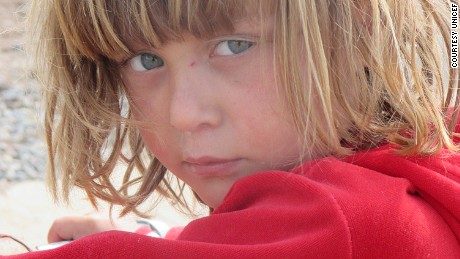
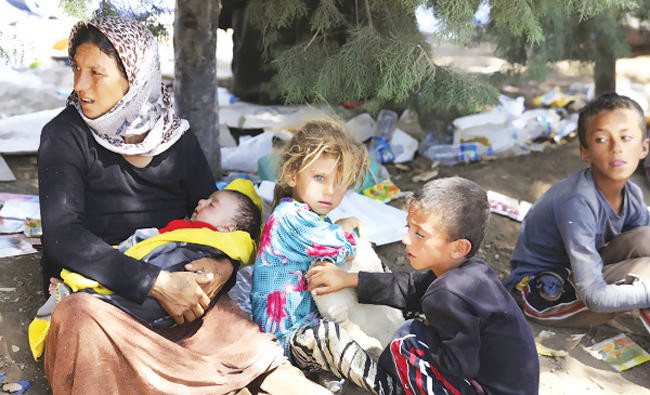
This 20 year old Yazidi woman committed suicide. ISIS has been exterminating them (their religion is Armenian Orthodox) and using their women as sex slaves. In other words, they just want to impoverish, punish, murder, rape, and just generally devour them in every way imaginable. It's something to look up and consider. Our government and mainstream media doesn't care very much.


Saturday, February 1, 2014

The Arctic Home in the Vedas: Part 16 - "Thule, Saturn, & an alternative explanation"


Thule, Saturn, & an alternative explanation: Part 5

The way the Greeks understood their relationship with non-Greek peoples was significantly moulded by the way myths of the Golden Age were transplanted into the contemporary scene...

We often hear the phrase “golden age” in reference to the zenith of something; “the golden age of cinema.” However, there was THE golden age, and it may be stranger than anything we will ever uncover. It has to do with everything from the deep past to the present day. It has to do with every ancient culture, and in particular the original Teutonic people before their migrations. I will tie this big loose end. But for now, we are talking about a “Golden Age” in which there were no seasons as we know them today; and in which the North and South Poles was literally habitable.

A particular Hyperborean legendary healer was known as "Abaris" or "Abaris the Healer" whom Herodotus first described in his works. Plato (Charmides, 158C) regarded Abaris as a physician from the far north...

Could Abaris the Healer have been of a migrating people from the “far north”… Thule? The ancient Greeks were very scientifically-minded, so couldn’t this “shaman”--who caused such a stir--seem a little out of place?

Above the Arctic Circle, from the spring equinox to the autumnal equinox (depending on latitude), the sun can shine for 24 hours a day...


There is a deep tie-in here with the “Golden Age” and Bal Gangadhar Tilak’s theory, but I will have to wait until Part 17 to reveal it.

Unaware of the explanation offered by modern science (i.e. that these insects had lived in times when the climate of northern Europe was much warmer, their bodies preserved unchanged in the amber) the Greeks came up with the idea that the coldness of northern countries was due to the cold breath of Boreas, the North Wind. So if one travelled "beyond Boreas" one would find a warm and sunny land.

This is clearly part of the Greek mythology of the “Golden Age.” However, these mythologies of that possible era are present in the mythologies of every ancient civilization. Again, I’m focusing mostly on the legend of Thule, but this “Golden Age” affected every person living on Earth at that time if it was real.

Northern Europeans (Scandinavians), when confronted with the classical Greco-Roman culture of the Mediterranean, identified themselves with the Hyperboreans, neglecting the traditional aspect of a perpetually sunny land beyond the north.

This was only a perception, but could it literally be tied to a real time and place? There is now mounting evidence that it may.


Hyperborean Indo-European hypothesis

John G. Bennett wrote a research paper entitled "The Hyperborean Origin of the Indo-European Culture" (Journal Systematics, Vol. 1, No. 3, December 1963) in which he claimed the Indo-European homeland was in the far north, which he considered the Hyperborea of classical antiquity. This idea was earlier proposed by Bal Gangadhar Tilak (whom Bennett credits) in his The Arctic Home in the Vedas (1903) as well as the Austro-Hungarian ethnologist Karl Penka (Origins of the Aryans, 1883).

Now this is a big tie-in, and in hindsight part of the intellectual process of looking into something which seemingly is impossible. They weren’t, however, “Indo-Europeans.” They were the original Teutonic race. This intrinsically has nothing to do with the Nazis. In fact, the German sub-race--specifically--is less than half Teutonic.. and less so in the southern German lands. The larger part being primarily proto-European (“Alpine”).

According to these esoterists, Hyperborea was the Golden Age polar center of civilization and spirituality...


I doubt this part, as there is no strong evidence of it. That doesn’t mean that evidence of a great Thule civilization couldn’t be out there undiscovered. We can look into what may exist as far as ruins at a later point. What there is evidence of is the presence of Teutonic people in some of these lost lands like the Tarim Basin.

Robert Charroux first related the Hyperboreans to an ancient astronaut race of "reputedly very large, very white people" who had chosen "the least warm area on the earth because it corresponded more closely to their own climate on the planet from which they originated."

After Part 17, this may show to be theoretically possible, but wild theories can and do hurt the areas where facts can be established. In any case, this original Teutonic race would no longer exist in the exact form that they did. Even in the far north of the post-Golden Age Europe, or in modern times, I would guess that this certain stock would be at no more than 50%.


They may not have been as physically attractive as their Teutonic-Protoeuropean descendants later became. The very tall, square-headed, almost white-haired, very light blue-eyed, and pure white skinned people became shorter, rounder-headed, more ash or wheat blonde haired, more medium blue-eyed, and perhaps a bit tan to give one possible example.

Unlike other places where Teutonic people came and ruthlessly conquered, they were taken with these shorter, stocky, sexier, probably brown-eyed, perhaps dark brown haired European natives.. and merged with them. Only in what I would call the “final great migration,” a horde of more pure stock Teutons came and permanently placed their clear genetic and linguistic stamp on some places like Scandinavia and northern Germany.


The one other example of where they mixed their blood was in ancient Persia, which produced the Aryan culture and people (original Teutons & true Mediterraneans). To make this perfectly clear, this original Teutonic race didn't produce "The Golden Age"; the Golden Age may explain their origins. I use the term "Teutonic" for the original stock; as opposed to the modern "Germanic," which is a loose and somewhat undefined term. For example, the "Germanic Austrians" probably have only a minimally larger Teutonic element than say Venetians, Croatians, or Slovenes... yet the loud terms "GERMAN," "ITALIAN," or "SLAV" are thrown around recklessly by many. Language often defines a culture more than actual racial stock in the perceptions of most people.


Golden Age (Wikipedia)

The term Golden Age (Greek: Χρυσόν Γένος Chryson Genos) comes from Greek mythology and legend and refers to the first in a sequence of four or five (or more) Ages of Man, in which the Golden Age is first, followed in sequence, by the Silver, Bronze, Heroic, and then the present (Iron), which is a period of decline. By extension "Golden Age" denotes a period of primordial peace, harmony, stability, and prosperity. During this age peace and harmony prevailed, humans did not have to work to feed themselves, for the earth provided food in abundance. They lived to a very old age with a youthful appearance, eventually dying peacefully, with spirits living on as "guardians". Plato in Cratylus (397 e) recounts the golden race of humans who came first. He clarifies that Hesiod did not mean literally made of gold, but good and noble.

There are analogous concepts in the religious and philosophical traditions of the South Asian subcontinent. For example, the Vedic or ancient Hindu culture saw history as cyclical, composed of yugas with alternating Dark and Golden Ages. The Kali yuga (Iron Age), Dwapara (Bronze Age), Treta yuga (Silver Age) and Satya yuga (Golden Age) correspond to the four Greek ages. Similar beliefs occur in the ancient Middle East and throughout the ancient world, as well.

In classical Greek mythology the Golden Age was presided over by the leading Titan Cronus. In some version of the myth Astraea, also ruled. She lived with men until the end of the Silver Age, but in the Bronze Age, when men became violent and greedy, fled to the stars, where she appears as the constellation Virgo, holding the scales of Justice, or Libra.


European Pastoral literary and iconographic tradition often depicted nymphs and shepherds as living a life of rustic innocence and simplicity, untainted by the corruptions of civilization — a continuation of the Golden Age — set in an idealized Arcadia, a region of Greece that was the abode and center of worship of their tutelary deity, goat-footed Pan, who dwelt among them. This idealized and nostalgic vision of the simple life, however, was sometimes contested and even ridiculed, both in antiquity and later on.


Abaris the Hyperborean (Wikipedia)
Abaris the Hyperborean (Greek: Ἄβαρις Ὑπερβόρειος, Abaris Hyperboreios), son of Seuthes, was a legendary sage, healer, and priest of Apollo known to the Ancient Greeks. He was supposed to have learned his skills in his homeland of Hyperborea, near the Caucasus, which he fled during a plague. He was said to be endowed with the gift of prophecy, and by this as well as by his Scythian dress and simplicity and honesty he created great sensation in Greece, and was held in high esteem.


Gothicismus (Wikipedia)

Gothicismus, Gothism, or Gothicism (Swedish: Göticism) is the name given to what is considered to have been a cultural movement in Sweden, centered around the belief in the glory of the Swedish ancestors, originally considered to be the Geats, which were identified with the Goths. The founders of the movement were Nicolaus Ragvaldi and the brothers Johannes and Olaus Magnus. The belief continued to hold power in the 17th century, when Sweden was a great power following the Thirty Years' War, but lost most of its sway in the 18th. It was revitalized by national romanticism in the early 19th century, this time with the vikings as heroic figures.


**************************************************


By extension "Golden Age" denotes a period of primordial peace, harmony, stability, and prosperity. During this age peace and harmony prevailed, humans did not have to work to feed themselves, for the earth provided food in abundance. 

This sounds a bit like someone's warm and fuzzy account of some long ago "place" in their imagination. However, this will make a lot more sense during Part 17.

He (Abaris) was supposed to have learned his skills in his homeland of Hyperborea, near the Caucasus...

Apparently Abaris was a real figure who caused a sensation in early Greek civilization. Since he dressed like a Scythian, there seems to be a Persian connection, which would tie-in well as far as his possible Teuton roots at that time. If it was about one-thousand BCE, then the Aryan connection would make sense here.


Gothicismus

There is a definite tie-in here, but this national/racial historical perception (likely partly true in this case) starts to lead us down some rabbit trails and into confusion. Suffice to say that there were some early Gothic legends of Thule.

.

Thursday, March 7, 2013

The Arctic Home in the Vedas: Part 9

The Týrlanders
 
About every 45,000 years, after the two poles have attained enough of the earth's water within their massive frozen zones, the outer crust of the earth moves about 2,000 miles like a loose outer layer of an orange. This last happened about 12,000 years ago. It wasn't really a "pole shift," but a tectonic "plate shift." The direction of this movement was southward from the standpoint of North America, and northward from the point of view of Eurasia. Therefore, North America melted and became a temperate climate zone, while Eurasia was thrust up towards and even into the arctic. This caused an immediate and dramatic earth change. For example, mammoths died and froze so quickly that some are still being found in perfectly preserved condition.

Some of the Mongol (the sub-racial meaning) ancestors of Amerindians were forced to migrate over the frozen land bridge between Siberia and Alaska, which would be almost like going south at that time in terms of climate. People from the proto-Germanic homeland, which was somewhere along the Kara Sea in northern Eurasia, suddenly found themselves living near or even above the Arctic Circle, which directly ties into Bal Gangadhar Tilak's theory in 'Arctic Home in the Vedas'. In other words, it's not a "theory," but a fact. It should be noted that this very ancient proto-Germanic homeland had a climate and terrain which was probably much like Montana. The only feature of Tilak's theory which wasn't really true was that he lumped all modern Europeans into one basket and sincerely proclaimed point-blank that they weren't native to Europe originally. This was what I would call a half-truth which he overlooked.

The proto-Germanics seemed to continue to live in this homeland--let just call it "Týrland" after what seems to have been the chief god of the proto-Germanics at one time, until if and when someone comes up with a better name--for a period of time until migrating to other lands. Some migrated to a land which later became known as the Tibet Autonomous Region, and although there isn't a trace of them left, modern natives of this region still use a version of the proto-Germanic triskelion as one of their most sacred symbols. Some migrated down into lands east of the Caspian Sea and north of the Himalayas, like the Tarim Basin. Some then continued to migrate into what is today Iran, and then eventually their uniracial/interethnic (I'm guessing "Balkan-looking"; Note: White "interethnic," not "interracial") descendants into the Indus Valley. I believe that others migrated into ancient Assyria. Still others migrated into Europe, where they merged with native "Alpine" proto-Europeans in many places to produce the Celtic-cultures; and eventually they moved in mass into northern Europe, and being checked at the border of ancient Gaul (for a while).


Eastward migration after the "plate-shift?"

Could some of the ancient "Týrlanders" have migrated eastward, and even into the Americas? "Kennewick Man"--found near Kennewick, Washington--comes to mind, but we still don't know the origins of this man. The Army Corps of Engineers purposely destroyed the area of this find so no further evidence can be found there; as well as outrageously mismanaging the remains, compromising any future DNA studies of it. All we really know about Kennewick man is that he lived over 9,000 years ago and clearly had a Caucasian skull type. He could have been proto-Germanic, originating from a genetic migration from either the eastern or western land bridges. He may have been an ancient proto-European (non-Germanic) type who was part of a westward migration; or he may very well have been part of an ancient migration of Ainu people, who were a "Caucasian-like" people whose true origins are unknown.


Clearly based on their actions, the establishment does not want any of us to look at the evidence of Ainu, proto-Germanic, Chinese, Egyptian, Phoenician, proto-European/Welsh, Roman, ancient Hebrew, or Viking movements into the Americas. Only Leif Erikson is "allowed" to have been the sole non-Amerindian to have visited the pre-Columbian Americas, despite clear evidence to the contrary. Very clear non-Amerindian artifacts--like those left by Chinese travelers on Victoria Island, or Egyptian artifacts found along the Mississippi River and in the Grand Canyon--are either permanently put away in storage or disappear into private collections. Curiously, the Amerindians on Victoria Island today look much more Chinese than Amerindian. Usually numerically smaller cultures who are absorbed into larger ones are just thought of as being "one people" at the end of the day. However, for some reason, the establishment has decided on their own that Amerindians are the ONE exception to this rule, and other peoples/cultures may not be discussed.

Excerpt from pages 97 and 98 of 'The Suppressed History of America' (Schrag; Haze; 2011):

According to an article published in the May 13, 1928, edition of the Humboldt Star, a nine-foot-tall red-haired mummy was discovered deep inside the Lovelock Cave, located twenty miles south of the town of Lovelock, Nevada. Isolated on top of a high hill, the cave is estimated to be 40 feet deep and 180 feet wide. The Piute Indians told the early Nevadan settlers fantastic stories about the origins of the cave, including tales about their fierce battles with red-haired white giants. In their oral history they claimed to have cornered the remaining giants in Lovelock Cave. Once the giants were trapped, the Piutes blocked the entrance with sagebrush and set it on fire. They reportedly stoked the fire until all the remaining giants had been smothered by smoke.

Further evidence supporting local legends about giants had emerged in 1911 when a mining company plowing for bat guano in Lovelock Cave began to find amazing artifacts. They discovered layers of burned materials and broken arrows that validated the Piutes' claims. Further down they found the remains of giant red-haired mummies, along with strange stone artifacts and shells carved with mysterious symbols. As usual most of these artifacts were either lost or fell into the hands of private collectors who whisked them away. One museum did manage to preserve some of the items discovered at Lovelock Cave.

The Humboldt County Museum at Winnemucca, Nevada, has in its collection a skull from one of the giants. Stan Nielsen, the famed treasure hunter, pilot, and photojournalist, went to investigate this skull with some dental plaster and a camera. The museum curator graciously allowed Nielsen to compare the plaster model of a normal-size man's jaw with a jaw of one of the giants found in the museum's collection. The photographic evidence clearly shows the vast difference in size between the plaster model and the immense jaw from the giant skull. What's more amazing is that anyone can see this skull for themselves by contacting the friendly staff at the Humboldt County Museum. Recent e-mail transactions have verified that some of the sensational Lovelock Cave artifacts, including a giant skull, are being kept in the back room of the museum.

This event--the killing of this tribe--took place about five or six hundred years ago, long after eastward traveling proto-Germanics may have crossed the Bering Strait land bridge. One curious note is that during the global flood which followed the last "plate shift" 12,000 years ago, California's huge Central Valley was flooded by the ocean. It was literally part of the Pacific Ocean, and the "coast" would have come right up close to northern Nevada. That dynamic may have existed right up to five or six thousand years ago. Could this red-haired tribe--which most clearly was of an Indo-European type based on the existing skulls--have been a last remnant of ancient eastward-migrating proto-Germanic people? Maybe they were part of, or descended from, a more recent westward traveling group? Could this tribe have traveled by boat--possibly either around the tip of South America, or even across the waters north of Canada and Alaska--thousands of years ago to this ancient inland coast? Were these people among the last remnants of the migrating post-glacial movement (actually "post-plate shift") "Týrlanders" In North America?


There are some issues that need to be addressed regarding what is known about this mysterious tribe. First, the archeological establishment clearly isn't having any of it. To them, these are "Native Americans," plain and simple, despite CLEAR evidence to the contrary! Next, I have seen some of the old photographs which were taken prior to these mummies being taken away and "lost." They were quite similar to the Tarim mummies. They appeared as "Norse-looking," and with red hair as was evident even in the black and white photographs. They were more "mummified" rather than mummies from a burial rite. It isn't likely that they were Vikings, since red hair is not common in Scandinavia in particular. I would love to know what those "mysterious symbols" looked like. If, for example, there was a triskelion symbol, then this would be a closed issue. Since some of those symbols still exist for public view, we need to see them! If anyone reading this lives or will be near Winnemucca, and is interested in this subject, then by all means get permission and get in that back room and take some pictures!!

Next, evidently, only two of the remains were incredibly tall--about eight and a half feet--while the rest apparently averaged between six and a half to seven feet..... which would only be about six inches taller than the average height of modern Montenegrins (6'3"). If these were pure proto-Germanics, then this "giant concept" would not be all that amazing. That is pretty damn tall though! In addition, they didn't live in that cave. Apparently, the Piutes used that cave for food and storage, so it would seem that most of the artifacts were Piute. However, since the symbols were alien to them, they were likely from this mysterious tribe... and certainly we need to see them. In other words, they weren't "cave men." As far as cannibalism, we probably will never know. Perhaps during this war, there was an act of cannibalism, or maybe there was propaganda among the Piutes to get them in a war mode. If this tribe was perhaps seventeen inches taller on average than the Piutes, coupled with the fact that they were at war, then exaggerations were possible... "giants."

Lastly, the "dental comparison" isn't quite as incredible when you overlay the normal dental mold directly over the teeth of "the giant." It's certainly big, but not all that comparatively "giant." Look for yourself. Definitely big... but not so "giant." Also, based on the remaining skulls, the report of these people as having "layers of teeth" seems to have been a misrepresentation of the initial evidence. This was certainly a big tribe though, and probably were part of a really big strain of ancient pure "Týrlander." You can't really think only of modern Scandinavians--the purest modern Teutonic strain--as far as comparison. The average height for males in Scandinavia is just under 5'11," which is tall for an average height, but may have been on the short side in ancient "Týrland." However, this mysterious tribe must have been an unusually tall sub-grouping.

Video: Nevada - Spirit Cave and Lovelock Mummies

 
~~~ Týrland was the Arctic homeland ~~~

Proven.

.

Friday, November 16, 2012

The Arctic Home in the Vedas: Part 5


"As we have already shown, the symbol of the zero is likewise derived from the holy-sign of the circle, which symbolizes the unrevealed God, and also the other numerical symbols--falsely called "Arabic--were developed from the circle combined with the sign of multiplication, the gibor-rune: X which resulted in this matrix...... The series of these holy number-runes which appear in the following manner in a 13th century manuscript in the Royal Imperial Library in Vienna, the so-called Imperial Chronicle......  whence the old linear formations can still rather closely be made out. That these numerical signs have been referred to as "Arabic-Indian numerals" in more recent times, proves that belief in Aryanism is finally beginning to break through. Certainly the same thing is true for Sanskrit, but it should not be thought that Sanskrit is the root, but rather it is but one of the older branches of the Aryan World-tree, which was derived from the proto-Aryan, like our Germanic languages. Therefore, it shares a common origin and is of the same age as our Germanic languages in which Old Aryan still lives." --Guido von List, 'The Religion of the Aryo-Germanic Folk'


World tree

From Wikipedia:

The world tree is a motif present in several religions and mythologies, particularly Indo-European religions, Siberian religions, and Native American religions. The world tree is represented as a colossal tree which supports the heavens, thereby connecting the heavens, the world, and, through its roots, the underworld. It may also be strongly connected to the motif of the tree of life.

Specific world trees include világfa in Hungarian mythology, Ağaç Ana in Turkic mythology, Modun in Mongolian mythology, Yggdrasil (or Irminsul) in Germanic (including Norse) mythology, the Oak in Slavic and Finnish mythology, and in Hindu mythology the Ashvattha (a Sacred Fig).


Norse mythology

In Norse mythology, Yggdrasil is the world tree. Yggdrasil is attested in the Poetic Edda, compiled in the 13th century from earlier traditional sources, the Prose Edda, written in the 13th century by Snorri Sturluson. In both sources, Yggdrasil is an immense ash tree that is central and considered very holy. The Æsir go to Yggdrasil daily to hold their courts. The branches of Yggdrasil extend far into the heavens, and the tree is supported by three roots that extend far away into other locations; one to the well Urðarbrunnr in the heavens, one to the spring Hvergelmir, and another to the well Mímisbrunnr. Creatures live within Yggdrasil, including the harts Dáinn, Dvalinn, Duneyrr and Duraþrór, an unnamed eagle, the squirrel Ratatoskr and the wyrm Níðhöggr. Scholarly theories have been proposed about the etymology of the name Yggdrasil, the potential relation to the trees Mímameiðr and Læraðr, and the sacred tree at Uppsala.


Other cultures

Remnants are also evident in the Kalpavriksha or "wish-fulfilling tree" of the South Asian religions.

In Brahma Kumaris religion, the World Tree is portrayed as the "Kalpa Vriksha Tree", or "Tree of Humanity", in which the founder Brahma Baba (Dada Lekhraj) and his Brahma Kumaris followers are shown as the roots of the humanity who enjoy 2,500 years of paradise as living deities before trunk of humanity splits and the founders of other religions incarnate. Each creates their own branch and brings with them their own followers, until they too decline and splits. Twig like schisms, cults and sects appear at the end of the Iron Age.


A reoccurring daydream

For as long as I can remember, I have had a daydream--maybe a night dream as well--of being at low elevation and traveling in a straight line towards a very high point far in the distance. As I travel along, I keep climbing towards higher and higher elevation. From grassy lowlands, I travel through rocky highland forests, with the sun still beating down from a clear sky. Soon it becomes cloudier as I start to see sparse pockets of snow, and I can no longer see where I started from. I picture myself in an automobile, because that makes it easier to imagine. Eventually it's overcast and windy, with less tree cover as I climb up steep mountains in a slow ascent. Finally, usually after a blizzardy phase, it's somewhat clear again, and I just keep climbing upward towards a peak that I never reach. I don't want to look back. I know that this road leads to the "roof of the world." THE top of the earth.

Perhaps it's the result from the genetic memory of possibly thousands of years of living in the pre-Alps, and always seeing the endless ascent to the sky. Maybe it could be from some ancient memory from Teutonic ancestors who lived in a strange, harsh, very far off unrecognizable place, with strange animals abound, many thousands of years ago. Perhaps it was within view of an ominous, mile high sheet of ice. Some of my ancestors were known as the "Winnili," which is similar to the word "Wihinei"--a word which List used for esoteric religion. Sometimes I imagine the location of my reoccurring daydream; Alaska, the Pacific Northwest, the Sierra Nevadas, the Rocky Mountains, the Alps... but maybe somewhere very deep in my genetic memory... maybe it could be the Himalayas, "the roof of the world." I feel the same as I do during winter hikes when I reach a peak or high point, and feel invigorated by the cold wind.


The republication of 'The Arctic Home in the Vedas' (2011)

'The Arctic Home in the Vedas' was written by Bal Gangadhar Tilak, and first published in India in 1903. Ironically, his biography sounds similar to Guido von List. The only difference was that Tilak was knee-deep in revolutionary resistance, while List merely knew nationalists as he was not directly "political."


Book Description
 

The idea of a lost ancient civilization located at the North Pole at a time when its climate was friendlier to human habitation is suggested in many of the world's oldest myths and sacred scriptures. Drawing upon his vast knowledge of the Hindu Vedas and the Zoroastrian Avesta, Tilak makes a painstakingly detailed analysis of the texts and compares them with the geological, astronomical and archaeological evidence to show the plausibility of the Arctic having been the primordial cradle of the Aryan race before changing conditions forced the Aryans southward into present-day Europe, Iran and India. Although this theory has never gained widespread acceptance among mainstream scholars since it was first published in 1903, Tilak has made a compelling case which is not easily refuted.

Bal Gangadhar Tilak (1856-1920), who was given the honorary title Lokmanya ("chosen leader of the people"), was one of the fathers of India's independence movement in opposition to British colonial rule. He was imprisoned several times for his vocal advocacy of violent revolt against the colonial authorities on the basis of Vedic scripture. His time in prison gave him time to work on his more scholarly projects, such as the present book. Although he did not live to see the ultimate victory of the movement he had helped to establish, he is widely acknowledged as having been one of the main driving forces behind it due to his influence on Gandhi and the other leaders who saw his mission through to its end in 1947.


Bal Gangadhar Tilak

Lokmanya Tilak, born as Keshav Gangadhar Tilak (23 July 1856 – 1 August 1920), was an Indian nationalist, journalist, teacher, social reformer, lawyer and independence activist who was the first popular leader of the Indian Independence Movement. The British colonial authorities derogatorily called him "Father of the Indian unrest". He was also conferred with the honorary title of "Lokmanya", which literally means "Accepted by the people(as their leader)".

Tilak was one of the first and strongest advocates of "Swaraj" (self-rule) and a strong radical in Indian consciousness. His famous quote, "Swaraj is my birthright, and I shall have it!" is well-remembered in India even today.


One more look at climate, timeline, demographics, and geography

Actually, the 45 degree latitude for the northern ice sheet was accurate in some places, such as North America. However, in Europe, the ice sheet covered the British Isles, Belgium, the Netherlands, northern Germany, before taking a slight southernly direction at Poland and through eastern Europe; then a sharp northeastern direction in Asia. The Alps were covered in ice, and there seemed to be a harsh region north of it, likely preventing northern passage for a long period. What this all boils down to is that the region of ancient Iran was probably more like modern British Columbia in terms of climate, while India was perhaps something similar to Oregon and California.

Also, the last ice age seemed to end about 12,000 to 13,000 years ago, which fits perfectly into this "Ice Age Iran/proto-Norse" theory. I would guess that there were proto-Norse tribes living north of the mountains of Iran, probably all around the Caspian Sea at this time. Remember, this was long before Semitic, Turkic, and Mongol expansion. These more northern tribes were more than likely the ones who migrated across northern Europe, and they would explain the mummies of the Tarim Basin in what is today far western China. They were the ones who remained. Archeologists just assumed that they migrated from northern Europe. In other words, psychologically, they can't seem to geographically divorce "Nordics" from northern Europe.

I would theorize that at the end of the last Ice Age twelve thousand years ago, Europe was about 60% of its current habitable land, and was populated by Alpine peoples of which the Basques are a modern survival. Smaller early bands of proto-Norse, probably over thousands of years, migrated across northern Europe and most of Spain and intermingled with the native Alpine peoples. This cultural fusion formed the various Celtic cultures over a large area. When the bulk of the proto-Norse finally did arrive later on, they swarmed over Scandinavia and northern Germany, but were checked at Gaul and southern Germany. Only much later did they finally overrun south Germany, Austria, and Switzerland, driving many Celtic tribes into Italy.

The original Mediterranean peoples stayed in the Middle East and founded the earliest civilizations. They also migrated across southern Europe and north Africa, up into France, and into the British Isles, and fused with the various Alpine and Celtic peoples. I'm oversimplifying it. The earlier westward proto-Norse migrations into Europe probably overlapped the westward Mediterranean migrations. I'm only considering the time frame from approximately 13,000 to 5,000 years ago.

The ancestors of the people who we today call "Arabs" were true Semites who lived at the southern part of the Saudi peninsula and perhaps the horn of Africa. At this time, they would have looked very different than the ancient Middle Easterners. This was the Ice Age. Everything in the world would have been pushed south! The contact we're looking at is between these Mediterranean/proto-Norse "Aryans," and the dark skinned Dravidian race in India. I don't see any other explanation for this "Aryan and Indo-European language" quagmire that so many people have pondered and deliberated about for so long.

Before the Aryan culture, could the "Arctic Home in the Vedas" have been the Ice Age proto-Norse who lived around the Caspian Sea; a region which would have been "Arctic" prior to 13,000 years ago? Some could have migrated over the mountains to the south and settled in a warmer climate and merged with the very ancient Persian Mediterraneans, whose homogenized descendants were the Aryans! You need to force your mind to see the world at it existed then... not now. It's possible that the early proto-Norse occupied a larger region north of the Himalayas.

According to Bal Gangadhar Tilak, the last post-glacial period occurred between eight and ten thousand years ago, which easily fits the above hypothesis. In part six, you can see that Tilak was presenting a theory which was largely different than this one. However, it's not entirely impossible that the two ideas could tie-in closely. In other words, these proto-Norse may have migrated southward into the region around the Caspian Sea from far northern stretches at an earlier time; and then some eventually moving southward over the mountains of northern Iran, and settling in the high interior plateau, which may be more-or-less be the same basic theory. It should be added that the bulk of the proto-Norse migrated across most of northern Europe, which again would be fairly consistent with Tilak's book.

It would seem that the ancient Mediterraneans--in a world with only a tiny fraction of todays population--would have remained in the lowlands of the Near East, which would have been green and comfortable then. It's not likely they would have been especially interested in living in the harsher mountainous conditions of ancient Iran until well after the weather cooled down. When they eventually did, it probably then resembled modern Colorado.

12-14-12 ADDITION: All individual storehouses of knowledge and solutions to problems (not mere dead memorized data!) are thus evaluated. Such storehouses are not lost upon death, but rather they are preserved in death and once more brought back to the world of men upon the next reincarnation. People call these spiritual storehouses that the reborn individuals bring to the earth "natural abilities," "talent" or "innate genius," which has already been established and discussed above. But just as the unrevealed God is only able to reveal himself in matter and become the world-spirit (First Logos), and just as the revealed God has to activate himself in creation generatively (Second Logos), in order to come to a vision and knowledge of himself, and finally just as the human spirit (Third Logos) had to attain this through an apparent descent from divinity for the sake of awareness of divinity itself, i.e. his own selfhood, so too the human being can only rediscover the divinity within himself (the divine inwardness) after he has lost it, after he has searched for God unseccessfully outside himself "up there in heaven," in temples and churches, finally only to rediscover his God within his own heart on the painful detour through atheism--and this time he does so in a way that God will never again be lost. And here we recognize in the world-ash, Yggdrasil--the imagematic tree of knowledge--the holy tree Zampuh of Tibetan myth, the Assyrian tree of life, and the other similar tree in Indian, Persian and other mythologies. Thus we find our way back to Yggdrasil again. --Guido von List, 'The Religion of the Aryo-Germanic Folk', from pages 45 and 46 of the Runa-Raven Press translation.

List was explaining what he called the "Garma" of the soul, and it's ascent over many incarnations. He mentions here "The Tree of Life," and it's existence in Germanic, Tibetan, Assyrian, Indian, and Persian spiritual traditions. Although so much of the technology from the "cradle of civilization" came from ancient true-Mediterraneans, the spirituality seemed to come from the proto-Norse people migrating south from their trans-Himalayan homeland... and ultimately from their very ancient Arctic homeland. It sounds like just a fanciful notion until you really look at the evidence. Aside from ancient Persia and later the Indus Valley, some of these proto-Germanic people may have migrated to other locations--like ancient Assyria--where they spread those spiritual traditions... such as "The Tree of Life."

In Greater Tibet, I would guess that the migrating proto-Norse were small in number, and their characteristics disappeared with later expansion from the Far East. Only their spirituality remained, and could be symbolized by the triskelion motif, a symbol they left behind, which is still popular in the region today. The triskelion probably went all the way back to the Arctic homeland. It was brought by very early migrating proto-Norse into Europe, where it manifested into the Celtic cultures. Today, the same symbol is present on the flags of the Isle of Man, Sicily, and places that I couldn't pronounce in the Caucasus, and far east into the Russian administrative territories; as well as in symbolism and arms from Greece, Germany, Ireland, Portugal, etc.

It probably should be pointed out again--despite the genuine and fascinating lore of the early proto-Norse migrations--they were not "the Aryans." The Aryan civilization was the result of east-migrating true-Mediterraneans and south-migrating proto-Norse, culturally and genetically merging together in ancient Persia. Technology from true-Mediterraneans merged with deep spiritual traditions of the proto-Norse, which developed into one of the great civilizations of the ancient world. This spirituality was not exactly the same as what later became known as Odinism or Asatru. These spiritual traditions were constantly evolving, mainly due to contact with other peoples. For example, Odinism may have been influenced by earlier Alpine peoples.

.