Above: '1-5 Tarim Mummies - Indo-Europeans in China'; posted by alisonpita
2-5 Tarim Mummies - Indo-Europeans in China
3-5 Tarim Mummies - Indo-Europeans in China
4-5 Tarim Mummies - Indo Europeans in China
5-5 Tarim Mummies - Indo-Europeans in China
Tarim mummies (Wikipedia)
The Tarim mummies are a series of mummies discovered in the Tarim Basin in present-day Xinjiang, China, which date from 1900 BCE to 200 CE. Some of the mummies are frequently associated with the presence of the Indo-European Tocharian languages in the Tarim Basin, although the evidence is not totally conclusive. Victor H. Mair's team made the conclusion that the mummies are basically Europoid, likely speakers of an Indo-European language.
 So how would the people who were to become "the Tarim mummies" fit into this hypothesis? Well, even today--four-thousand years later--it's pretty evident that they are very Germanic-looking in appearance. Their DNA shows that they were, at that point, slightly mixed with Mongols. The bulk of the Mongols showed up in the region about three-thousand years ago. Again, the Aryan hypothesis we were looking at was long before Mongol, Semitic, or Turkic expansion.
Roman accounts (Wikipedia)
Pliny the Elder (Chap XXIV 'Taprobane') reports a curious description of the Seres (in the territories of northwestern China) made by an embassy from Taprobane (Ceylon) to Emperor Claudius, saying that they "exceeded the ordinary human height, had flaxen hair, and blue eyes, and made an uncouth sort of noise by way of talking", suggesting they may be referring to the ancient Europoid populations of the Tarim Basin:
"They also informed us that the side of their island (Taprobane) which lies opposite to India is ten thousand stadia in length, and runs in a south-easterly direction—that beyond the Emodian Mountains (Himalayas) they look towards the Serve (Seres), whose acquaintance they had also made in the pursuits of commerce; that the father of Rachias (the ambassador) had frequently visited their country, and that the Seræ always came to meet them on their arrival. These people, they said, exceeded the ordinary human height, had flaxen hair, and blue eyes, and made an uncouth sort of noise by way of talking, having no language of their own for the purpose of communicating their thoughts. The rest of their information (on the Serae) was of a similar nature to that communicated by our merchants. It was to the effect that the merchandise on sale was left by them upon the opposite bank of a river on their coast, and it was then removed by the natives, if they thought proper to deal on terms of exchange. On no grounds ought luxury with greater reason to be detested by us, than if we only transport our thoughts to these scenes, and then reflect, what are its demands, to what distant spots it sends in order to satisfy them, and for how mean and how unworthy an end!"
This occurred two-thousand years ago, so apparently at least some of them were Germanic in appearance even at that point. It should be pointed out that while the Tarim mummies are constantly referenced as being "in China," it was not yet "Chinese" three-thousand years ago. Also, just because it is a desert now doesn't mean that it was a desert at the end of the last glacial movement ten-thousand years ago.
 Tocharians (Wikipedia)
The Tocharians or Tokharians were ancient speakers of Tocharian languages in the Tarim Basin (modern Xinjiang, China). The Indo-European language of the Tocharians was supplanted by the Turkic languages of the Uyghur tribes about 800 AD.
The Afanasevo culture is a strong candidate for being the earliest archaeological record of speakers of the Tocharian languages.
Tocharian languages (Wikipedia)
Tocharian or Tokharian is an extinct branch of the Indo-European language family, formerly spoken in oases on the northern edge of the Tarim Basin (now part of the Xinjiang Uyghur Autonomous Region of China) by the Tocharians. Two branches of Tocharian are known from documents dating from the 3rd to 9th centuries AD:
* Tocharian A (Agnean or East Tocharian; natively ārśi) of Qarašähär (ancient Agni, Chinese Yanqi) and Turpan (ancient Turfan and Xočo); and
* Tocharian B (Kuchean or West Tocharian) of Kucha and Tocharian A sites. Prakrit documents from 3rd century Kroran on the southeast edge of the Tarim Basin contain loanwords and names that appear to come from another variety of Tocharian, dubbed Tocharian C. All these languages became extinct after Uyghur tribes expanded into the area.
The Proto-Indo-European Urheimat hypotheses ties closely into the "Arctic Home in the Vedas" theory, but the time frames don't quite line up, and I don't think it goes back far enough. It's too convenient. I think that Bal Gangadhar Tilak proved that this goes back further in time, and further north. The Kurgan hypothesis (see map) is the one which seems to tie in a lot of loose ends, especially in the area of the Indo-European languages, but I would still agree more with Tilak.
.
Sanskrit
The chief language in ancient India. Its modern status in "Greater India" being the equivalent of what Latin is in the West. Additionally, Sanskrit is to Hinduism what Latin is to Roman Catholicism: a "liturgical language" or a "ceremonial language."
From Wikipedia:
History
Sanskrit is a member of the Indo-Iranian sub-family of the Indo-European family of languages. Its closest ancient relatives are the Iranian languages Old Persian and Avestan.
In order to explain the common features shared by Sanskrit and other Indo-European languages, many scholars have proposed migration hypotheses asserting that the original speakers of what became Sanskrit arrived in what is now India and Pakistan from the north-west some time during the early second millennium BCE.
Hinduism
Hinduism, with numerous sub-groupings, is the predominant religion of India.
From Wikipedia:
Etymology
The word Hindu is derived (through Persian) from the Sanskrit word Sindhu, the historic local appellation for the Indus River in the northwestern part of the Indian subcontinent, which is first mentioned in the Rig Veda.
Again, we see the spiritual connection, along with the linguistic, from ancient Persia. This would not be significant if it were not for the fact that the Icelandic and Sri Lankian languages are part of the same greater language family, and that needs to be explained. On the surface, it doesn't make any sense.
History of Hinduism
From Wikipedia:
Hinduism is a term for a wide variety of related religious traditions native to India. Historically, it encompasses the development of Religion in India since the Iron Age traditions, which in turn stretch back to prehistoric religions such as that of the Bronze Age Indus Valley Civilization followed by the Iron Age Vedic religion.
We can see the progression now from Persia to the Indus Valley Civilization. When uncovering the layers of time, the Indo-European linguistic and spiritual roads now seem to all lead to ancient Persia.
Because we're dealing with a subject that has three main facets to it--ethnic, spiritual, and linguistic--it's difficult to go at it entirely in chronological order. We're also looking at a very long timeline, a large surface of the earth, and all while trying to block out the demographic changes of the last two millennium.
Vedas
From Wikipedia:
The Vedas (Sanskrit वेदाः véda, "knowledge") are a large body of texts originating in ancient India. Composed in Vedic Sanskrit, the texts constitute the oldest layer of Sanskrit literature and the oldest scriptures of Hinduism. The Vedas are apauruṣeya ("not of human agency"). They are supposed to have been directly revealed, and thus are called śruti ("what is heard"), distinguishing them from other religious texts, which are called smṛti ("what is remembered").
The Vedic texts or śruti are organized around four canonical collections of metrical material known as Saṃhitās, of which the first three are related to the performance of yajna (sacrifice) in historical Vedic religion:
1. The Rigveda, containing hymns to be recited by the hotṛ;
2. The Yajurveda, containing formulas to be recited by the adhvaryu or officiating priest;
3. The Samaveda, containing formulas to be sung by the udgātṛ.
4. The fourth is the Atharvaveda, a collection of spells and incantations, apotropaic charms and speculative hymns.
The individual verses contained in these compilations are known as mantras. Some selected Vedic mantras are still recited at prayers, religious functions and other auspicious occasions in contemporary Hinduism.
Etymology and usage
The Sanskrit word véda "knowledge, wisdom" is derived from the root vid- "to know". This is reconstructed as being derived from the Proto-Indo-European root *u̯eid-, meaning "see" or "know."
Categories of Vedic texts
The term "Vedic texts" is used in two distinct meanings:
1. Texts composed in Vedic Sanskrit during the Vedic period (Iron Age India)
2. Any text considered as "connected to the Vedas" or a "corollary of the Vedas"
The canonical division of the Vedas is fourfold (turīya) viz.,
The four Vedas
The canonical division of the Vedas is fourfold (turīya) viz.,
1. Rigveda (RV)
2. Yajurveda (YV, with the main division TS vs. VS)
3. Sama-Veda (SV)
4. Atharva-Veda (AV)
Vedic Sanskrit
From Wikipedia:
Vedic Sanskrit is an Old Indo-Aryan language. It is an archaic form of Sanskrit, an early descendant of Proto-Indo-Iranian. It is closely related to Avestan, the oldest preserved Iranian language. Vedic Sanskrit is the oldest attested language of the Indo-Iranian branch of the Indo-European family.
Vedic Sanskrit is the language of the Vedas, texts compiled over the period of early-to-mid 2nd to mid 1st millennium BC. Vedic Sanskrit has been orally preserved as a part of the Śrauta tradition of Vedic chanting, predating the advent of alphabetic writing in India by several centuries. For lack of both epigraphic evidence and an unbroken manuscript tradition, Vedic Sanskrit can be considered a reconstructed language. Especially the oldest stage of the language, Rigvedic Sanskrit, the language of the hymns of the Rigveda, is preserved only in a redacted form several centuries younger than the texts' composition. Recovering its original form is a matter of linguistic reconstruction.
From about the 6th century BC, in the classical period of Iron Age Ancient India, Vedic Sanskrit gave way to Classical Sanskrit as defined by the grammar of Pāṇini.
History
Prehistoric derivation
The separation of Indo-Aryans proper from the undifferentiated Proto-Indo-Iranian ancestor group is commonly dated, on linguistic grounds, to roughly 1800 BC. The composition of the oldest hymns of the Rigveda is dated to several centuries after this division, or to roughly 1500 BC.
.
There are a lot of terms and concepts in regard to "the Aryans"; and to add to the confusion, they overlap linguistically, culturo-spiritually, and to a lessor extent: ethnically.
Indo-European
In the above link, you will find a maze of terms and ideas which basically boil down to "Indo-European" being a "language family" with a common linguistic origin. Amazingly, this "language family" extends from Iceland to Sri Lanka.
It should be noted that this tie-in would not include Mongol, Semitic, or Turkic peoples; all of whom expanded at a later time period. That should lessen the confusion a bit; and it should also be noted that the English, Spanish, Portuguese, and Arabic languages all have speakers among them who are from all of the races of the world. Now if we consider that most of the ancestors of the Icelanders lived in the Ice Age Middle East over 20,000 years ago; then this linguistic tie-in becomes less of a radical idea... at least believable.
Indo-Iranian
We should never confuse "Persian" with "Arabic," even if most are Muslim. Despite the despotism of the Mullahs today, very few are "radical Islamists." After the proto-Norse moved on, ancient Mediterraneans occupied ancient Persia, perhaps followed by a long connection with India; but Arabic, Mongol, or Turkic influence was genetically small.
I once saw an image online of a Persian man, perhaps in his forties, wearing a Kaftan of some type; who looked like a Norwegian. Not just because of his blonde hair and blue eyes, but all of this facial characteristics were Nordic-like. He had a thick blonde beard, deep eyes, straight nose, pronounced forehead, etc. If he shaved his beard, and dressed in Western-style clothing, he could walk down any street in Scandinavia unnoticed. It should be noted that the Iranian president, Ahmadinejad, is of a particular Semitic-type, and not a typical Persian.
This linguistic category is regional, but tied into the larger language family. It is also referred to as the "Aryan languages." It's present geographic range extends from eastern Turkey, Iran, Afghanistan, most of India, and Sri Lanka; or in other words "the eastern Indo-Europeans languages." I'm trying to stick with the linguistic aspect of this; but there are all sorts of cultural, religious, and ethnic overlap since the days of the original Aryans.
This isn't to say that the "original Aryans" were the Ice Age proto-Norse. That would be an oversimplification of this. Apparently, the proto-Norse who stayed behind as the weather grew warmer, strongly influenced more eastern peoples as far as language. As far as "the Aryan invasion of India," certainly someone invaded and influenced them. As to who exactly they were, I don't really know. Perhaps a later Persian-type of Aryan. Many of them likely had light hair and eyes at that time; which may explain some of the old accounts. That seems as good a theory as any.
"Aryans" (see Aryan, Indo-Aryan, and Aryan race)
Could it be that the ancestors of Ice Age proto-Norse who remained in the Middle East long after the tribes had moved on, then merged with early Mediterranean peoples (to form the "original Aryans?"), whose much later homogenized descendants invaded India and influenced it (mainly linguistically)? They seemed to have strongly influenced their spirituality as well. This logical hypothesis would not exactly fit either the preference of a Germanic or an Indian nationalist or idealist. However, doesn't it seem more logical than what they have offered?
It should be noted that these hypothetical proto-Mediterranean-Norse "Aryan" invaders would have looked like most Europeans today. It should also be noted that the Persian people of today would only be partly, perhaps mostly, descended from these "original ancient Aryan people." This could also explain why certain Odinic concepts appear similar to some Hindu traditions. Wikipedia: The term Aryan originates from the Sanskrit word ārya, in origin an ethnic self-designation, in Classical Sanskrit meaning "honourable, respectable, noble."
.

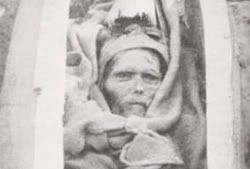 So how would the people who were to become "the Tarim mummies" fit into this hypothesis? Well, even today--four-thousand years later--it's pretty evident that they are very Germanic-looking in appearance. Their DNA shows that they were, at that point, slightly mixed with Mongols. The bulk of the Mongols showed up in the region about three-thousand years ago. Again, the Aryan hypothesis we were looking at was long before Mongol, Semitic, or Turkic expansion.
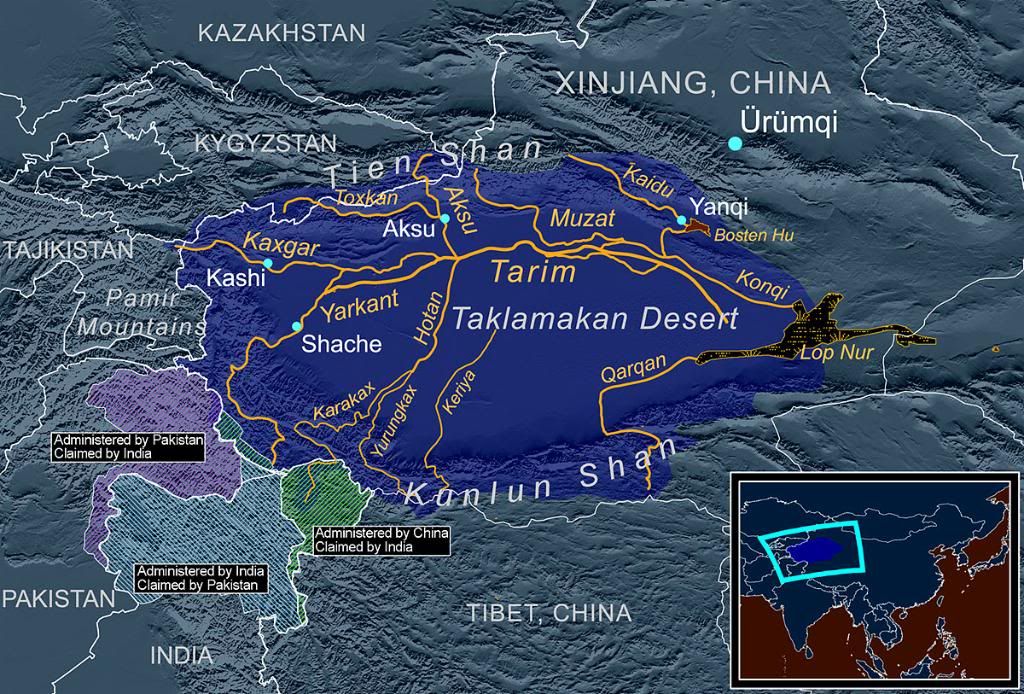
 Prakrit documents from 3rd century Kroran on the southeast edge of the Tarim Basin contain loanwords and names that appear to come from another variety of Tocharian, dubbed Tocharian C. All these languages became extinct after Uyghur tribes expanded into the area.