Showing posts with label ancient Middle East. Show all posts

Sunday, September 27, 2020

The Arctic Home in the Vedas: Part 25 - Jötunheim linguistic roots

Excerpt from 'The Tradition of Household Spirits' (Lecouteux; 2000), Chapter 3 ('The Openings of the House'), 'The Windows', page 62:


Originally the window was an opening that allowed some light to enter the building as well as to aerate it. The English "window," which derives from the Norse vindauga, "wind eye," and which has a parallel in the Sanskrit vātyāana, "wind passage," allows us to grasp the concept.


There is a clear linguistic connection---literally separated by thousands of years---from the Teutonic homeland of Jötunheim in ancient northern Eurasia, to the Aryan (ancient Persian) invasion of India (2,000 BCE), to modern English! This ancient tongue no doubt spread wherever the Teutons traveled or invaded. This would include the Tarim Basin, Arkaim, ancient Persia, ancient Tibet, Assyria, Phoenicia, and obviously around Europe. English text from the early Middle Ages looks like modern German. As the English language developed, the letter "W" emerged out of "V," but of course to the present day it's still read with a "VEE" sound by German speakers.


************


Excerpt from 'The Arctic Home in the Vedas: Part 18 - "Arkaim" ':


Arkaim

Arka = "Earth"

Im = "Sky"

"The place where the sky touches the Earth"

Odin, the Teutonic "sky god"

Arkaim: "The place where the sky touches the Earth"... "The place where Odin connects with his people"... long ago... on that vast central Asian plain... which may have been a woodland. Unlike the Saturn-worshiping Sumerians, Arkaim was a temple of the Sun.


************


Bollywood actress with ancient Teutonic DNA
Sanskrit

Sanskrit is an Indo-Aryan or Indic language of the ancient Indian subcontinent with a 3,500-year history. It is the primary liturgical language of Hinduism and the predominant language of most works of Hindu philosophy as well as some of the principal texts of Buddhism and Jainism. Sanskrit, in its variants and numerous dialects, was the lingua franca of ancient and medieval India, predominantly modern day Bangladesh, Nepal, North India and Pakistan. In the early 1st millennium CE, along with Buddhism and Vedism, Sanskrit migrated to Southeast Asia, parts of East Asia and Central Asia, emerging as a language of high culture and of local ruling elites in these regions.

Modern Sanskrit is traceable to the 2nd millennium BCE in a form known as Vedic Sanskrit, with the Rigveda as the earliest-known composition.The phonology, grammatical forms of Sanskrit has remained similar to the Vedic language. A more refined and standardized grammatical form called Classical Sanskrit emerged in the mid-1st millennium BCE with the Aṣṭādhyāyī treatise of Pāṇini. An ancient Proto-Dravidian language has been found to influence the Vedic Sanskrit language. The broader definition of Sanskrit refers to the whole range of mutually intelligible Old Indo-Aryan dialects spoken in North-western India at the time of the composition of the Vedas and thus can be treated as the ancestor of the Prakrits and Pali, and consequently, of all Modern Indo-Aryan languages like Hindi, Marathi, Bengali, Punjabi, Gujarati, Sindhi, Kashmiri, Kumaoni, Garhwali, Urdu, Dogri, Maithili, Konkani, Assamese, Odia, and Nepali. On the other hand, the standardized Classical and Epic Sanskrit was a literary language and not the ancestor of any Indo-Aryan language. Sanskrit has significantly influenced the phonology, lexicology, morphology and grammatical systems of South Indian languages of Kannada, Telugu, Tamil and Malayalam.

Sanskrit is an Old Indo-Aryan language. As one of the oldest documented members of the Indo-European family of languages, Sanskrit holds a prominent position in Indo-European studies. It is related to Greek and Latin, as well as Hittite, Luwian, Old Avestan and many other living and extinct languages with historical significance to Europe, West Asia, Central Asia and South Asia. It traces its linguistic ancestry to the Proto-Indo-Aryan, Proto-Indo-Iranian and Proto-Indo-European languages.


************


Triskelion of Tibet


The Triskellion is a very ancient symbol, which may have initially symbolized the early sky gods, the sun, the rotating nature of the universe, and the cycle of life. This symbol has been found wherever Teutonic peoples have roamed, and which had also been perpetrated by culturally Celtic or Proto-European peoples as well. To the right, a triskelion from Tibet in the northern Himalayan Plateau.


************


Yazidi people of northern Iraq


This 20 year old Yazidi woman committed suicide. ISIS has been exterminating them (their religion is Armenian Orthodox) and using their women as sex slaves. In other words, they just want to impoverish, punish, murder, rape, and just generally devour them in every way imaginable. It's something to look up and consider. Our government and mainstream media doesn't care very much.


Wednesday, March 11, 2015

The Cult of Saturn: Part II


With two “competing” stars in the sky, a rivalry seems to have formed between the Sun cults and the Saturn cults. The Egyptian Sun cult was the basis for Christianity, with “The Son” (Sun) Jesus as its “risen savior” and “the light of the world”; who symbolically "dies" and is "reborn" every year. Part of Christianity pits “The Son” against “Satan” (Saturn). However, the Roman Emperor Constantine—as well as the early Catholic Church—took the Christian doctrine and “Saturnized” it so to speak. They didn’t do this because they were somehow evil, but because they were dedicated to Saturn… then a dwarf star. In other words, the Sun rises every day, and is the light of our world; while Saturn no longer emitted any light, and was now symbolically “dark”… “light vs. dark.” Another thought, perhaps a nova-like reaction from the dying Saturn could have melted the glaciers and caused a great flood. This could have sunk Atlantis and other civilizations, and put an end to The Golden Age?

Islam and Judaism were clearly formed from earlier Saturn cults. The Saturnian hexagram, known today as the Star of David, is a symbol of Saturn. It also represents the divine masculine (upward triangle) and the divine feminine (downward triangle). Even some mosques feature Saturnian hexagrams on the front. The geometric properties of this symbol equal 666. However, this initially wasn’t intended to be “evil” at all. Only later, after Saturn had fizzled out, were these symbols presented as being dark or evil by the church. This nitpicking went both ways as shown in the above link. There were people who in modern times did take on Satanism in a negative form. I’m generalizing, since there are competing camps even within all of these religions. To try to sift through the “good guys vs. bad guys” within these religions would perhaps take me down a rabbit hole that I don’t wish to go down right now. Unfortunately, the positive energy elements tend to cover for the negative energy elements within their own religion. That’s part of human nature.


The people of the pre-Abrahamic Middle East were primarily Mediterranean, not Semitic. So in other words, Indo-European. Also, north of the Himalayas was the original Teutonic homeland. With some of these people migrating southward in ancient times, they were also part of this Sun-Saturn cultural and religious interaction. Their spirituality revolved around the "Black Sun," which could have either been the Sun, or it perhaps could have really meant Saturn. It’s not clear to me. Saturn seemingly would have been their star, long shining in the northern sky, and now “a black sun.” Saturn people always have to be the bad guys, right?; or is this some kind of grand global theater of occultic history? The Germanenorden (Teutonic Order) apparently had great knowledge of at least this early Teutonic history. It’s possible that the two-star system of The Golden Age made it possible for people to live on the North Pole, or part of it. Therefore the mythical Hyperborea could have existed, perhaps without seasons, and possibly illuminated twenty-four hours a day (day and dim). The ancient city of Arkaim likely was a Teutonic settlement. Also apparently there was a Saturnian Society in Germany, which later influenced the National Socialists, and eventually migrated to the United States and helped form NASA. We could probably at least say that it’s very likely that the early Teutonic religion was Saturnian.

We can only speculate on Atlantean civilizations, but Saturnian culture can at least be traced back to Sumeria. Another highly influential culture was the Phoenician civilization. The Phoenician-Caanenite religion and culture was most certainly over-the-top Saturnian! The God Saturn was called “El.” Apparently, during The Golden Age, Saturn emitted a certain subtle “purple haze” of light. The Phoenician priesthood (“the Elders”) wore purple robes. They used the Saturnian hexagram, the Star of Saturn. They were, in fact, “Satanists” using the ancient meaning of the word. The original Hebrew language has a common origin with the Phoenician-Caanenite language. That doesn’t mean they were the same people, but the powerful nation of Phoenicia-Caanen occupied a large area in the Near East.


The Saturnian God “El” as a rootword, is present in many languages, including English. It’s especially present in words dealing with aspects of authority, government, and education. For example, elder, elect, elected, elite, elevator, elevate, temple (tem-pel), bible (bi-bel), bell, steeple (ste-pel), cathedral (cathe-drel), electricity, element, elementary, etc. Phoenician temples featured “two towers” apparently, and are likely related to the Egyptian obelisk (o-bel-isk). The owl (ow-el) was a powerful symbol in the Babylonian (Ba-bel-on) culture, symbolized by their God Molech (Mo-el-ech); and they went on to construct the Tower of Babel (Ba-bel). Along with the Tower of Babel, there were many Biblical words which can be traced back to “El.” Israel (Is-ra-el), Elohim, Eli, Emanuel, Mary Magdalene (Mag-del-ene), etc. The Hebrew-originated Christian name Rachel comes to mind as well. I’m not certain if the Near Eastern God Baal (Ba-el) is another manifestation or name of the God El or not. Then there’s the word for God in Islam… Allah (A-el-ah). The Phoenicians traveled and traded far and wide, including England, so I wouldn't underestimate many other words as well.

.

Monday, August 11, 2014

The Arctic Home in the Vedas: Part 19 - "Sun vs. Saturn"


In the very ancient world, largely in the Middle East, there were two major competing religious cults. This would have been from about 15,000 years ago to the time of the Sumerian civilization (today Iraq), and up to the time of the Aryan civilization (today Iran). Prior to about 15,000 years ago, there were literally two stars in our sky: The Sun and Saturn. Saturn was apparently the closer and brighter of the two, and lit up the northern sky, and the Earth's North Pole was not only habitable, but light twenty-four hours a day during the "Golden Age." I suspect that Saturn, which is today a dwarf star, was only brighter from the perspective of northern peoples; and was probably a bit hazy.

As discussed before, both the six-pointed Hexagram (today, the "Star of David) and the Pentagram (today used as the symbol of Wicca and other similar groups) were symbols representing Saturn then. Both symbols were Sumerian, and both are literally found on Saturn itself! How that could be is one of the great questions of human existence, and speculating would take away from the facts here. The "Talisman of Saturn" and other similar coin-like artifacts feature the Pentagram on one side and the six-pointed Hexagram on the other. The Aryan civilization was a "Sun cult," and used symbols of the Sun.. such as Swastikas and the Black Sun. The National Socialists were aware of this, and adopted some of this symbolism. As stated many times here, the real "Aryans" were a mix of true-Mediterranean and pure Teutonic; which would make them Indo-European, but not Germanic, Indian, Iranian, etc. This is about ancient cults, not necessarily racial or ethnic types.


There were sixteen Sun-cults in that general region over thousands of years that we know of, all with the same astrotheological/mythological theme. The ancient Egyptian religion was number fifteen, with the god Horace representing the Sun; and number sixteen was Christianity, with Jesus ("the Son"; "the light of the world") allegorically representing the Sun.

Judaism actually began as an ancient Hebrew Saturn-cult, and the six-pointed Hexagram wasn't chosen as its symbol a millennium ago by accident. There are some very negative things written in the Talmud regarding Jesus, but that didn't have anything to do with any man. It was common lashing out against a rival Sun-cult. The Christian Sun-cult lashed back with a depiction of "Satan," which was just another name for "Saturn." Most Christians and Jews today know nothing about this. It wasn't Christians vs. Jews, it was Sun-cult vs. Saturn cult. Naturally Satanism is a Saturn-cult, and Satanic groups use an inverted Pentagram.

Islam developed later, and clearly originated as a Saturn-cult. The Islamic black cube is a Saturnian-Hexagram, and the six-pointed Hexagram as-well-as the Pentagram are used. The Islamic state of Morocco features a Pentagram on its national flag. There are even Mosques with the "Star of David" featured on the outside front. When looking at all of these institutions, and how they've interacted over history, you can get a glimpse of the Sun-cult vs. Saturn-cult phenomenon. Saturday and Sunday? Yes, they mean "Saturn's Day" and "Sun's Day."

The pre-Roman Italian peninsula was known as "Saturnia." Not surprisingly, one of the main Roman festivals was "Saturnalia," which was three days to honor the deity Saturn from Roman mythology. Part of the celebration was a human sacrifice at the Temple of Saturn. Wikipedia: "In Roman mythology, Saturn was an agricultural deity who was said to have reigned over the world in the Golden Age...." Bingo! That's it. The ancient legends, such as that of "Hyperborea," were based on reality. See thunderbolts.info and 'Symbols of an Alien Sky' for the scientific proof. The Roman Catholic Church has maintained its Saturnian roots; while Protestants broke away as Sun-cults.


The old saying "old legends die hard" couldn't be more applicable than with the Sun vs. Saturn rivalry. These ancient cults and mystery schools are so ingrained in the world that they refuse to bury the hatchet! The "cult of Saturn" wishes to return to the "Golden Age," which sounds more like an excuse to take over. We're just expected to go along with all of this nonsense. The dramatic role of Saturn in human history has been kept a secret for a long time. The Sun-cults apparently want to make the Book of Revelation come true; while the Saturn-cults apparently want to make the Golden Age come true. How do we know that this isn't all a role-playing charade, with all the main players just play-acting their parts?


Saturn vs the Sun, Black Cube and the Saturnian Cult – Santos Bonnaci

Zen Gardner - ZenGardner.com - August 1, 2013

Here’s some terrific information you won’t come across as well strung together and condensed as this. The remarkable Santos Bonacci has many youtube clips to enjoy and learn from. That he can reel off such in depth, perceptive and detailed information is a real testament to the power of researching with a passion for Truth in full-on conscious awareness. It’s there for the having, and people like this give us all a head start in the many amazing fields of knowledge we need to become familiar with in order to better understand and heal the world we’re living in. – Zen


.

Tuesday, November 13, 2012

The Arctic Home in the Vedas: Part 2

There are a lot of terms and concepts in regard to "the Aryans"; and to add to the confusion, they overlap linguistically, culturo-spiritually, and to a lessor extent: ethnically.


Indo-European

In the above link, you will find a maze of terms and ideas which basically boil down to "Indo-European" being a "language family" with a common linguistic origin. Amazingly, this "language family" extends from Iceland to Sri Lanka.

It should be noted that this tie-in would not include Mongol, Semitic, or Turkic peoples; all of whom expanded at a later time period. That should lessen the confusion a bit; and it should also be noted that the English, Spanish, Portuguese, and Arabic languages all have speakers among them who are from all of the races of the world. Now if we consider that most of the ancestors of the Icelanders lived in the Ice Age Middle East over 20,000 years ago; then this linguistic tie-in becomes less of a radical idea... at least believable.


Indo-Iranian

We should never confuse "Persian" with "Arabic," even if most are Muslim. Despite the despotism of the Mullahs today, very few are "radical Islamists." After the proto-Norse moved on, ancient Mediterraneans occupied ancient Persia, perhaps followed by a long connection with India; but Arabic, Mongol, or Turkic influence was genetically small.

I once saw an image online of a Persian man, perhaps in his forties, wearing a Kaftan of some type; who looked like a Norwegian. Not just because of his blonde hair and blue eyes, but all of this facial characteristics were Nordic-like. He had a thick blonde beard, deep eyes, straight nose, pronounced forehead, etc. If he shaved his beard, and dressed in Western-style clothing, he could walk down any street in Scandinavia unnoticed. It should be noted that the Iranian president, Ahmadinejad, is of a particular Semitic-type, and not a typical Persian.

This linguistic category is regional, but tied into the larger language family. It is also referred to as the "Aryan languages." It's present geographic range extends from eastern Turkey, Iran, Afghanistan, most of India, and Sri Lanka; or in other words "the eastern Indo-Europeans languages." I'm trying to stick with the linguistic aspect of this; but there are all sorts of cultural, religious, and ethnic overlap since the days of the original Aryans.

This isn't to say that the "original Aryans" were the Ice Age proto-Norse. That would be an oversimplification of this. Apparently, the proto-Norse who stayed behind as the weather grew warmer, strongly influenced more eastern peoples as far as language. As far as "the Aryan invasion of India," certainly someone invaded and influenced them. As to who exactly they were, I don't really know. Perhaps a later Persian-type of Aryan. Many of them likely had light hair and eyes at that time; which may explain some of the old accounts. That seems as good a theory as any.


"Aryans" (see Aryan, Indo-Aryan, and Aryan race)

Could it be that the ancestors of Ice Age proto-Norse who remained in the Middle East long after the tribes had moved on, then merged with early Mediterranean peoples (to form the "original Aryans?"), whose much later homogenized descendants invaded India and influenced it (mainly linguistically)? They seemed to have strongly influenced their spirituality as well. This logical hypothesis would not exactly fit either the preference of a Germanic or an Indian nationalist or idealist. However, doesn't it seem more logical than what they have offered?

It should be noted that these hypothetical proto-Mediterranean-Norse "Aryan" invaders would have looked like most Europeans today. It should also be noted that the Persian people of today would only be partly, perhaps mostly, descended from these "original ancient Aryan people." This could also explain why certain Odinic concepts appear similar to some Hindu traditions. Wikipedia: The term Aryan originates from the Sanskrit word ārya, in origin an ethnic self-designation, in Classical Sanskrit meaning "honourable, respectable, noble."

.

Monday, November 12, 2012

The Arctic Home in the Vedas: Part 1


Just to give some background--part fact, part theory--the proto-Norse during the last Ice Age, lived approximately in what is today Iran. That land looked very different 25,000 years ago. There was an ice cap a mile high above the 45 or 50 degree latitude in the northern hemisphere. Now if you look on a map, that would make "ancient Iran" and the surrounding territory into something of an Alaska! A totally different environment: dim, cold, mountainous, wooded. A harsh land of wood and snow, with whoolly rhronoceros, mammoth, and lion. These proto-Norse were not specifically "European" then; although this is part of "the Indo-European story."

"Apparently the belief (earth-based/month-birth classification system) is mainly a Norse conception, since it was the Nordic peoples, of all the ancients, who most clearly expressed their ideas in Nature. Some authorities assert that it comes from the East, whence comes all mystical lore. But since modern scholars now prove the Norse tribes to have migrated from Asia, originally, there may easily be a common origin of ideas. Certain it is that, far away in the dim ages of our nation's (UK) dawning, when wandering Aryan tribes, said to have come originally from the plain of Iran, in Central Asia, swarmed over and settled in Northern Europe, they found their ideas of God in Nature."
--Margaret Baillie-Sanders (UK), 'Your Birthday Month and You', 1932

Numerous authors and researchers--including Guido von List--who studied and wrote about subject matter basically dealing with Odinic-type spiritual traditions, eventually drifted off to other cultures to the south and east, and to India. It's as if there's a loose concept that the roads to all pre-Christian spiritual traditions, of the "earth island" and beyond, lead to ancient India. Some people believe that there once existed "mystery schools" which once tied together ancient wisdom from England to India. I don't believe that; but I think there could have been geographically smaller spiritual tie-ins between east and west, and which vibrated outward over thousands of years.

.

Friday, March 16, 2012

Rethinking the Vehme Star Rose

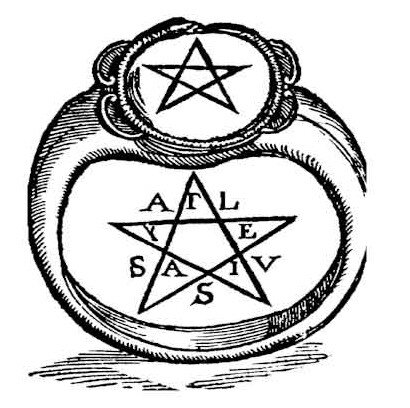
Guido von List referred to the pentagram as the "vehme star rose." All of his other signs seemed to be of Germanic or European origin, except that one. Why? It could be that the star was loosely from our ancestors, perhaps even tens of thousands of years ago. It might have been that List couldn't resist the powerful symbol, which easily can be traced back to ancient Sumeria.

More than likely it was because the star was adopted into secret pagan circles in Europe sometime during the middle ages, which makes it "half-folkish" I suppose. A lot of neo-pagans may not want to hear this, but very far back in ancient times, it appears that as the ancestors of Norse, Celtic, and Mediterranean peoples migrated westward, they both drowned out and/or co-opted the various traditions of Sabbat witchcraft. As a result, it's spiritual survival depended upon it's ability to constantly reinvent itself. The "migration" of the vehme star seemed to be a part of that process. A symbol was needed, and with the long eroding disappearance of icons of it's own heritage, one was co-opted.

The symbol found it's way eastward, into the Orient, as well. Curiously, List's term "vehme star" only shows up on six webpages on a google search. It should be noted that the Pythagorean Greeks referred to this symbol as "hugieia" ("health") in the fifth century BC, but it appears that it was more of a symbol of geometry to them. Culturally, it appears, this symbol could be thought of as a symbol of both the West and the Middle East. In other words, the real origin was from a people who later migrated into southern and western Europe and became Indo-Europeans; while those who remained largely merged with dark skinned Semites who dramatically migrated out of the southern Saudi Peninsula northward starting in the sixth century.

[Right:  Drawing of a pentagram ring from Crotone, Italy, taken from IMAGINI DEGLI DEI ANTICHI (V. Catari, 1647)]

What I'm really driving at is that the vehme star rose could be looked at by a Eurofolkish person as being "half folkish." Perhaps even a little bit more than half, since it originated from a people whose racial stock later came to be known as Indo-European. The proto-Norse once occupied northern Eurasia, tens of thousands of years ago. However, nobody today thinks of them as "Asian" in any way. They became Indo-Europeans. In the spiritual tradition of Stregheria in central and southern Italy, during the Middle Ages, the vehme star rose was adopted. It could be said that they adopted a symbol which their remote ancestors had once held sacred. At the least, it's a symbol which has deep roots in Europe.

.