Showing posts with label Odinic tradition. Show all posts

Thursday, October 4, 2018

Guido von List: Part 30 - October 5 "Ice wheel" 160th birthday tribute!


Spinning Ice Disk Forms in Washington

Wall Street Journal

A perfect circle of ice was spotted spinning in the Middle Fork Snoqualmie River in Washington on Saturday. Meteorologists say the rotating disk is the result of water flowing around the river bend spinning a sheet of ice against the surrounding ice to create a smooth disk.


************

Ice circle

An ice disc, ice circle, ice pan, or ice crepe is a natural phenomenon that occurs in slow moving water in cold climates.

Ice circles are thin and circular slabs of ice that rotate slowly in the water. It is believed[1] that they form in eddy currents. It has been shown that existing ice discs can maintain their rotation due to melting.[2]

An unusual natural phenomenon, ice disks occur in slow moving water in cold climates and can vary in size, with circles more than 15 metres (49 ft) in diameter observed.


************


'Nature's Bizarre Formations - Ice Circles'

MessageToEagle.com - September 26, 2013

Nature creates a variety of geometric figures, but this rather rare phenomenon is normally associated with rivers and lakes in Scandinavia and other northern European and American countries.

According to one of many theories, warming of the water surface may be the origin of the circles.

Another popular theory says that ring patterns - sometimes so large that they are clearly visible from space - are created by quick shifts in temperature.

According to one of many theories, tectonic activity deep inside the Earth may be responsible for methane gas emissions, which in turn produce a rising mass of warm water.

The water, according to the so-called Coriolis effect, begins swirling in circular pattern (always clockwise in the Northern hemisphere and counterclockwise in the Southern hemisphere) creating rings of different size.


con't....


************

There are various forms of solar or "sun wheels" in ancient Indo-European traditions; Teutonic traditions in particular. In the same manner as the proverbial "ring of fire," there is also a "ring of ice." Could the solar wheels be fashioned into perhaps "lunar wheels" as well? Von List saw the solar wheels as a symbol of the endless wheel of revolving nature; of regeneration; of life, death, and rebirth; and of reincarnation. We see this in the eternally spinning galaxies, or even of gophers turning up the soil as birds, bees, or the wind spread seeds about. It's appropriate that the Alfather sun's "ring of fire" is accompanied by the Almother moon's "ring of ice." Tomorrow is Guido von List's 160th birthday; being born in Vienna on October 5, 1848.


von List's 'Armanen Futharkh'
.


************


"Fire from Ice"

How can we get fire from ice? By shaping a piece of ice into a "lens" with your hand; then it could possibly be directed with the sun's energy to make a fire. 


"Ice from Fire?"

The Washington State forests and rivers are well documented as being mysterious places where bizarre natural phenomena occur due to its volcanic activity. -- Cat DeSpira, YouTube


Unusual phenomenon: Giant ice circle spinning in North Dakota river

euronews (in English)

A retired engineer out hunting in North Dakota on Saturday spotted a huge disk of ice spinning on the Sheyenne River, over 50 feet in diameter. George Loegering posted video online on Tuesday of his unusual sighting, clearly showing the snow-covered disc rotating.


.

Thursday, January 7, 2016

'Vikings' Season 4 trailer (Feb 18)


Vikings Season 4 Official Trailer 

IGN

The exclusive first trailer for Vikings' fourth season, premiering Thursday, February 18th on History.


.

Wednesday, July 15, 2015

Stella Natura: The Light of Ancestral Fires


Apparently, Stella Natura was an annual concert which started in 2008; and featured various local and international Euro-pagan metal bands and perhaps other types of music. The last concert was held in 2013 in the Tahoe National Forrest. I don't know if this was the location for all of them. It appears that these concerts ran day and night, and perhaps through the weekend; sort've like Ozzfest with quite a few bands, and even different stages. I found out about Stella Natura only after it became defunct. The details are in the link above. It sounds like it was such a great idea. You may see some of the footage in a YouTube "stella natura" search. Perhaps the lesson here is to be smaller and more practical. Maybe only a few bands in a less remote area close to urban centers would work? The Asatru Folk Assembly was one of the sponsors of these concerts. A few images can be found at the Stella Natura facebook page.

Below is footage from the 2012 concert, by an an Australian band called Ironwood. Again, these are mostly Odinic concerns. "Ironwood" is a mystical forest in Norse mythology.


Anarchists and the anti-labor left

A small coalition of people decried Stella Natura as "Fascist." Benito Mussolini, when asked for a definition of Fascism, responded with an answer: "Corporatism".. and obviously the connection between giant corporations and banks with the state. How is some concert "Fascism?" How about Wal-Mart? How about the Bank of International Settlements? How about the American corporations which arm the world, and manufacture the weapons of war right here in this country? They leave them alone. It apparently makes more sense to them to attack some non-political concert. The truth is that the Neo-Liberals and Neo-Conservatives have been in bed with transnational corporations for decades, and have collectively supported every anti-labor outsourcing and trade measure.

Since virtually every person who is fanatical against anything regarding European identity on this marginal level is white--typically from well-to-do families--it does seem strange that they ignore the fact that the state of California is overloaded with identity-specific associations of every kind. All one has to do it look. Social, political, religious, economic, professional, financial, men, women, youth, etc.; all with their doors locked to anyone outside of their ethnic or cultural group. Remember, these were just concerts, and were of a non-political and spiritual nature. Right near where I live, there's a sizable hospital dedicated to one specific ethnic group. It seems almost fantastic, but it's right there on the sign for anyone to read. There's a nearby employment agency dedicated specifically to one particular ethnic group... clearly stated on the window. There's another nearby health center that is dedicated to "recovery" from addictions, such as smoking, drinking, or drugs... and yes, it's dedicated only for one particular race. Says so right on the sign... in nice big letters. C'mon... recovery?? I'm just playing the devil's advocate here. Where's the consistency? The old aristocracy never really went away, they just became liberals. The type of people who have "conditions for friendship," based on politics. This is the result of people who never had to struggle in life for respect.

These Anarchists leave even these extreme examples of "identity" alone. They leave even the arms manufacturing companies alone. They leave the strip mining and fracking companies alone. One strip mining corporation in Arkansas armed a rebel group in a very poor country some years ago, and directly caused thousands of innocent people to get slain; just to get at those resources, which they did once the new regime came into power. They leave people like that alone. I couldn't find where any "Anarchist" ever mentioned this company--much less the CEO!--in any capacity... which intellectually should remove their anti-Fascist status. Well, if they don't care about the Communists murdering 200 million innocent people in the last century, I doubt they would care about "consistency." They're more worried about a concert, and people having a good time in a remote location. If there would somehow be a true political-intellectual public debate in which every established fact must be internalized right down to its logical conclusion, and every internal contradiction must be worked out.... there wouldn't be any "right" or "left" in this country anymore. Politics is the only science in which facts mean virtually nothing.

.

Tuesday, June 2, 2015

"Ravenwood" - Marin City, California - 4th of July weekend

Freya's Folk announces... Ravenwood

Where: Marin City, California

Heathen Campout/Fun & Frolic & Blots in N. California

Event Details: The last Ravenwood!!! Celebrate our 25th and LAST Ravenwood 4th of July weekend 2015.


What to Bring: Food & camping gear & $ for Heathen shopping

Price/Donation: $75 each, $125 couple, $25/vehicle

Join us atop the "Sleeping Lady" (Mt. Tamalpais) for a mellow weekend campout with fun, frolic, and a feast. Learn about the American Vinland Association, Romuva, and the California Utlandr Alliance. Enjoy Heathen fellowship, workshops, and merriment around the fire with the Politically Incorrect Song Singers (P.I.S.S.) . Loggats Tournament, (with prizes) , special events, and guests. More information will be sent with your registration (in June) .

Vendors welcome, but must donate an item worth at least $20.00 to the raffle. Workshop/ritual presentations welcome/encouraged. All Registrations or cancellations must be received by June 30th. Late registrations accepted only if space permits.
No on-site registrations. Any one NOT registered will NOT be admitted.

Registration includes three nights camping, feast on Saturday, one raffle ticket, and a commemorative item. Tent camping only. Our campground has flush toilets, water, sinks, and food cupboards. We have the large campsite A with a limit of 50 people (but there are several motels nearby for the less hardy) from 2 p.m. Friggsday till noon Manisday. Tree worship on Friggsday. Other daily blots & symbels. Annual American Vinland Association & Utlandr Alliance meetings. If you'd like to present/perform, please contact us. NO day passes.

Flyers available by 1/31 or contact us at valknot@juno.com!

Event Location: Panoramic Highway in Marin City


Event TIME Details: 2 pm Friggsday - noon Moonday

Directions: Entrance is opposite Mtn. Home Inn on top of Mt. Tamalpais about 20 minutes North of San Francisco. Map is sent with registration. NO on-site registration! Full refund if cancellation request is received by June 30th.


.

Sunday, May 3, 2015

The Maypole and May Day - Part 3


In the movie 'The Wicker Man" (1973), a Maypole is is shown with children celebrating around it. Also, in the remake, an elaborate festival is portrayed... which I think was May Day, as in the original. I loved the visuals of that scene. Often at the top of the poles is a tree-like display, with ribbons extending to the ground, where a each person in the circle walks in one direction with it. The little tree shape may turn with the pulling, or it might be allowed to twist around the pole top to bottom. Often the colors red and white are used to decorate the pole, as well as the colors of the ribbons. I have seen other shaped displays, such as a wheel of the year.


Symbolism

The symbolism of the maypole has been continuously debated by folklorists for centuries, although no set conclusion has ever been arrived at. Some scholars classify maypoles as symbols of the world axis (axis mundi). The fact that they were found primarily in areas of Germanic Europe, where, prior to Christianization, Germanic paganism was followed in various forms, has led to speculation that the maypoles were in some way a continuation of a Germanic pagan tradition. One theory holds that they were a remnant of the Germanic reverence for sacred trees, as there is evidence for various sacred trees and wooden pillars that were venerated by the pagans across much of Germanic Europe, including Thor's Oak and the Irminsul. It is also known that, in Norse paganism, cosmological views held that the universe was a world tree, known as Yggdrasil. There is therefore speculation that the maypole was in some way a continuance of this tradition.

Non-Germanic people have viewed them as having phallic symbolism, an idea which was purported by Thomas Hobbes, who erroneously believed that the poles dated back to the Roman worship of the god Priapus. This notion has been supported by various figures since, including the psychoanalyst Sigmund Freud. Phallic symbolism has been attributed to the maypole in the later Early Modern period, as one sexual reference is in John Cleland's controversial novel Fanny Hill:

"...and now, disengag'd from the shirt, I saw, with wonder and surprise, what? not the play-thing of a boy, not the weapon of a man, but a maypole of so enormous a standard, that had proportions been observ'd, it must have belong'd to a young giant."

The anthropologist Mircea Eliade theorizes that the maypoles were simply a part of the general rejoicing at the return of summer, and the growth of new vegetation. In this way, they bore similarities with the May Day garlands which were also a common festival practice in Britain and Ireland.


Italy

Maypole traditions can be found in some parts of the country, e.g. in Friuli, Umbria and Marche.


"After we've gone to get the pole in thirty or forty people, we placed it like a six month child. We walked in procession with this tree and not even a single leaf had to touch the ground. We had to raise it without making it touch the ground, holding it in our arms like a child. For us it was the saint of the 1st of May."

—Quirino Marchetti (ancient peasant of San Benedetto del Tronto), in L'albero di maggio

.

Monday, June 16, 2014

Wisdom for the Wolf-Age: Part 3

'How to Be a Heathen: A Methodology for the Awakening of Traditional Systems'

By Stephen E. Flowers/Edred Thorsson

The following paper was generated from a talk delivered to the Pagan Student Alliance of the University of Texas at Austin, November 22, 1991 and is dedicated to the memory of Edwin Wade, Óðinsgoði, who died on this date in 1989.

The above article is very interesting, but rather long. It's a little too long to post here. Again, I would suggest using FromTextToSpeech.com for anyone who may find long articles to be a bit tedious. Then you can just sit back with a cup of coffee and enjoy! Stephen Flowers is a great thinker and academic, who appears to have alienated some with his Temple of Set/Michael Aquino associations. Personally, especially in this modern socio/political/everything climate, unless someone is directly opposing your interests... then I believe differences like this should be overlooked.

While listening, and as interesting as it is, I found it difficult to pick out aspects of it that really stood out for mention here. There were two that I found especially curious though. One was that he briefly went into how Indo-European spiritual elements found there way down into India. There is a definite link there, already covered here numerous times. Also, Dr. Flowers spoke of the ancient schools of metaphysical knowledge in ancient Greece... which were taught openly in universities of that day, and certainly a big part of ancient Greek culture... and Pagan in nature! However, wasn't Greece the chief forerunner of "Western Civilization?" Can you see the potential greater implications of this on Western society today?

There clearly appears to have been "mystery schools" in the ancient world. They weren't specifically "secret." but were a generally open study of the metaphysical world and its energies. In other words.. "magic." I do have serious doubts that the Druids were part of the mystery schools of Egypt, Greece, and other places. I see ancient Druidism as a fusion of the proto-European magical tradition with incoming Teutonic spirituality. Some overzealous Christian researchers try to tie Druidism to Indian spirituality as part of the same "mystery school network." I think we should stay open-minded about that, but I doubt it. Teutonic spiritual concepts found there way to India via "the Aryans" who were partly Teutonic in ancestry and culture; while those same spiritual concepts found their way to into northwestern Europe. That seems the likely link there, albeit in hybrid forms.


Stephen Flowers (Wikipedia)

Stephen Edred Flowers (born 1953) also known by the pen-name Edred Thorsson, is an American Runologist and proponent of occultism and Germanic mysticism. He has over two dozen published books and hundreds of published papers on a disparate range of subjects. Flowers advocates "Esoteric Runology" or "Odianism", an occultist version of Germanic Neopaganism.


Early life

The Bonham, Texas-born author did his graduate work in Germanic and Celtic philology under professor and scholar Edgar Polomé at the University of Texas at Austin from 1973-1984. In 1981-1982 he studied the history of occultism at the University of Göttingen, Germany. He received his Ph.D. in Germanic Languages and Medieval Studies in 1984 with a dissertation entitled Runes and Magic: Magical Formulaic Elements in the Elder Tradition. From 1984-1989 he was a lecturer in the departments of English and Germanic Languages at the University of Texas and was last known to be teaching Classical Philology at Austin Community College.


History

Flowers was instrumental in the early establishment of the Germanic Neopagan movement in North America.[citation needed] and has also been very active in Left-Hand Path occult organizations.

Flowers joined the Church of Satan in 1972 though he reportedly never became involved with the organization beyond receiving their newsletter, The Cloven Hoof. On November 11, 1983 he founded a small group to explore what he saw as the dark, futuristic undercurrent of Odinism called The Order of Shining Trapezohedron or "O.S.T." which closed on January 13, 1984. The O.S.T. served as a segue into his involvement with the Temple of Set, an organization in which he currently holds the degree of Ipsissimus VI°. Within the Temple of Set he served as Grand Master of the Order of the Trapezoid from January 1987 until June 1996.


Flowers was one of the original members of the Asatru Free Assembly. In 1979 Flowers founded the Rune-Gild, an initiatory order focused on "the revival of the elder Runic" tradition, advocating runic magic.Flowers currently is the executive officer, or Yrmin Drighten, of the Rune-Gild. As a project of the Rune-Gild, Flowers founded the Ásatrú organization the Ring of Troth in 1987 (which is now simply called the Troth). Flowers is no longer affiliated with the Troth. Flowers has also had contact with the Armanen-Orden, the Order of the Triskelion and other occult orders.

Flowers is currently director of the Woodharrow Institute of Germanic Studies and the owner and operator of Runa-Raven Press.


Work

In addition to being a prolific writer, Flowers is known for translating obscure texts and manuscripts written in Icelandic, Old Norse and German into English, making many of them available to a wider range of readers.


Criticisms

In 1989, Flowers was expelled from the Odinic Rite following his Open Letter to the Leadership of the Asatru/Odinist/Troth Movement wherein he detailed his involvement with the Temple of Set.

Sweyn Plowright, a former member of the Rune Gild who resigned from the organization in 2000, has referred to the philosophy of Flowers as being "neo-Satanic" and antinomian.


**************************************************


For a list of Dr. Flowers' written works, see the link above. It seems rather clear that Dr. Flowers has one foot in the Odinic camp.. and one "cloven hoof" in the Satanic camp.. and others, of which I could do another play on words. I don't know anything about "Esoteric Runology or Odianism" to give any opinion on it. One curious thing is that Flowers' "Rûna" symbol has been the subject of at least five of his books, always associated with a color (black, green, red, and blue). I have no real idea of either the meaning or the origin of this symbol. I thought that he has said that it represents the separation of at least some aspects of nature from the metaphysical... using my own words, not his. Either the circle or the pentagram represented "nature." Possibly it means blocking physical nature from the spiritual; as it at least appears to be only the "spirit" that protrudes from the box and connects with the circle of nature.. if you look at the symbol.

Dr. Flowers always mentions that he is a linguist, with focus on ancient Germanic/Norse languages. I know the rich history of words just through the hours that I have poured over the Camunian-Italian online translator. In fact, I have even found a few mistakes in Mauro Fiora's work, although we are indebted to him. Dr. Flowers was involved with both the Asatru Free Assembly and the Odinic Rite, as well as "the Armanen-Orden, the Order of the Triskelion and other occult orders."

.

Thursday, April 17, 2014

'Odin worship of the Lombards & Benevento': Part II


The legend of the witches of Benevento

It is possible to trace the origins of the legend of the witches back to ancient Samnium and Rome when, in the 4th century BC ancient settlers from the shores of Magna Graecia came settled in the Samnium region, and brought with them their customs like the worship of the orgiastic feast of Cybele. When Ovid sang about the horrendous bloody child sacrifices, the saga – known already in the 13th century – spread rapidly throughout Italy and Europe in 1600. In Benevento, true place of origin of the legend, learned arguments were being held about it.

Other cities, had often gained an unhappy reputation because of the witches, but Benevento being the birth place of these legends rather than gain the evil reputation for its monstrous practices, has inspired poets and artists over the centuries. The legend was born when the belief of the existence of witches was associated with the echoes of mysterious orgies the Lombards preformed. The Lombards had made Benevento the capital of their vast southern Duchy. In the late VII century, faithful to their own national traditions, instead of converting to Catholicism, as was required of them they carried on the cult of Wotan, the father of the gods.

They gathered outside the city walls, around a sacred tree from which they hung the skin of a buck and between a run and the other, they shot at it with arrows and then ate a piece of it. The inhabitants of Benevento, being good Catholics were horrified and scared and to them these rites seemed demonic. Meanwhile descriptions of these rites transformed them into something wonderful.


The custom of these ceremonies ended because of the conversion imposed by Duke Romualdo II and its people. The Duke fearing that he could not defeat the Byzantine Emperor Constants, promised to Bishop Saint Barbato the elimination of these pagan practices in exchange for salvation. When the salvation miraculously came, and even after the demonic walnut tree was chopped down, the mysterious rumors continued to circulate. At that point the legend had already formed, and in it the warriors had been replaced by evil women dancing frantically around the tree, the cries of war had been replaced by the sounds of the raging orgy, and it was said that even the devil in the form of a buck took part, the morsel of buck skin was also replaced, in its stead there was a plentiful banquet.

The conquering Lombards heightened the splendor and prestige of Benevento by supporting literature and the arts. The city became a Papal enclave in the Kingdom of Naples, and host to various other civilizations, from the fervent and promising early middle ages to the light of the Renaissance, the legend continued to grow and to be enriched by facts, until finally in the Baroque age the legend reached its final version, which is the one we know today.

Around the magical Walnut tree at night two thousand or more witches congregate, each is guided by a demonic guardian – Martinello or Martinetto – who is at the same time lover and servant, and that, before the ride on their broomsticks, rubs his woman with a magic ointment, and there, by the light of the torches. They then worship the Devil who appears disguised as a buck and rewards the best witches and punishes the bad ones. The orgy begins and if a novice shows up who has given up her faith, the King of darkness will make her swear by the blood squeezed out of her left breast to be like all witches, to be at least once a month adulterous and murderous and sow unabated malice and hate, he then assigns her a Martinello and promises long life, prosperity and all sorts of good things. 


The summoning of Jesus and the Virgin Mary or the ringing of the bells of Matins and the cockcrow that announces the rising dawn dissolves this terrible scene. The fascination of the legend is expressed only in Benevento by an unknown and inexperienced seventeenth century painter. The painter in his simplicity has been able to inspire poets, writers and musicians from very different walks of life. Amongst the inspired we find the problematic author of “the flower,” the fourteenth-century Ser Durante and the merry Redi with “The Hunchback of Peretola”, S. Bernardino from Siena that in his passionate sermons asks with zeal for the extermination of all witches and Agnolo Fiorenzuola. Since a long time that Benevento legend has been part of the real literature, and music. Franz Xavier pupil of Mozart and Salieri with his composition “the walnut tree of Benevento” has inspired one of the most unique works by Paganini, entitled “the witches”.

But in Benevento, other than the interesting pictorial document and the erudite disputes that rarely left the city confines, something remarkable was needed, something that would be world famous that would match the greatest works of genius. That something - anybody can see that it is not an exaggeration- was to be the sublime liquor that Giuseppe Alberti created more than a century ago. Given the bewitching quality of this liqueur Alberti had no choice but to call it “Strega”


Wednesday, April 16, 2014

'Odin worship of the Lombards & Benevento': Part 1


This text was taken from the Traditional Stregheria Yahoo Group forum. My comment is the third one. It's easy to forget that the Langbard "duchies" of Spoleto and Benevento in Southern Italy continued on long after Charlemagne destroyed the Langobard Kingdom.

**************************************************

Hey everyone. I hope you are all having a wonderful holiday season!!!!  :O)

So, I have a short topic for discussion, if anyone might find it interesting? 

I was wondering what any of you who share an interest might think, and/or if there are experts on the subject here, about the Lombard worship of Odin in Benevento, the "golden viper" of Duke Romualdo and his father King Grimoaldo and the rites being performed in the sacred wood there, versus the older Pagan traditions being practiced there before (and continuing during) Lombard rule?  Especially since it was during this time that the story of the Walnut tree being cut down, etc., comes to us.   I.e., Nerthus vs Diana, conflation of serpent veneration between cultures, conflation of other rites and customs, etc.   Any thoughts?


Spoleto
If this has already been discussed here in the past, my apologies.  I am having a horrible time trying to navigate Yahoogroups now, don't like it and have moved away from it myself.  I still value these groups I am still on as a member, though, but Yahoo has made it hard (or more likely I am just an computer illiterate dinosaur, lol) to find old threads quickly and easily..... 

Thanks!  Love, Li


**************************************************

Holiday Blessings to All!
As Sicily was invaded by about four or five other nations/cultures I am sure there is more cross-over than we would think. I know, for instance, that a burial site of a Celtic king was found in Italy, so I would imagine it wouldn't be too much of a stretch to assume that Sicily also has many influences including the Viking-originated Odin-worshippers.


[CR]

**************************************************


Hi Li,

There were about half a million Langobards and their allies who invaded the north, and most were Germanic pagans (aka “Odinists” – although they referred to him as Godan). They seemed to continue with it until the rein of Queen Theodelinda, who promoted the Catholic Church.
That’s a good question, what about the southern duchies? I could be wrong, but it seems to me that in the north the Langobards were mainly living in the centers of power.. the cities; so it doesn’t appear to have influenced the ‘old religion’ in the countryside.. such as the Valtellina.

Just the info that you shared is fascinating. I had never heard of that before. Long before, in many places in Europe, Odin (also Tyr possibly) was conflated with the local “horned god.” Cernunnos was very likely one such result from that; and Sirona possibly may have originated from the old goddess with Freya perhaps.

Some of this various “combining” can be confusing... and may well have led to very local goddesses and gods with their real origin lost in time. In some cases, unfortunately, the heads of some of the old statues were broken off to make way for a new deity; and the culprits weren’t just Christians either. I find it amazing that the Old Religion has survived so many influences largely unchanged. Even the Etruscans were really just another incoming “influence.” So different regions have different flavors of the same basic thing.

I wish I could add something to what you presented. I can already see that there are items on this subject online to look at, as here:
http://www.tizianoweb.com/1/strega_alberti_1468277.html
In some forest locations in central Europe, a “red cross” was placed at the exact locations of formerly sacred Odinic sites, such as Irminsuls, which Charlemagne had demolished. Apparently this was a way of disguising it; forcing it to become underground… “occultic.”

~Merry Blood Moon~

Camunlynx


.

Tuesday, March 11, 2014

Mountain and Spirituality


Mountain and Spirituality
 

[borrowed from Odinic-Rite.org]

By Hariulf OR

As many of you know I have the chance to live in the beautiful Swiss Alps. It goes without saying that the mountain has always played a great role in my life. These are also these beautiful Alps who inspired me this article. I hope it will be not to confuse, I always have a lot of difficulties to translate my thoughts into words. So I hope this short article will have sense for you.

The mountain seems to have played an important role in the spiritual traditions of the Indo-European people. We find several Sacred Mountains into the different Indo-European mythology: for example the Mount Meru from the Vedic tradition, the Olympus Mount from the Greek tradition. In our mythology we find Himinbjorg. Himinbjorg means “heaven’s castle” or “heaven mountain”.

In many of these traditions, the mountain was considered as the symbol of transcendent inner states. The mountain was also seen allegorically as the seat of divine beings, heroes or transfigured creatures that have risen high above the human condition. If we look more closely in our mythology, Himinbjorg is the home of the god Heimdall. Heimdall is the watchman of the gods, and he sits on the edge of heaven to guard the Bifrost Bridge from the jotuns. Heimdall requires less sleep than a bird, can see at night just as well as if it were day, and for over a hundred leagues. Heimdall’s hearing is also quite keen; he can hear grass as it grows on the earth, wool as it grows on sheep, and anything louder. Heimdall possesses a trumpet, Gjallarhorn, that, when blown, can be heard in all worlds, and “the head is referred to as Heimdall’s sword”. From this description we can see that Heimdall embodies the quality of a “person” who have risen high above the human condition.

For me Heimdall embodies the two major poles of life according to Julius Evola: action and contemplation. Heimdall is in a certain way a god of “contemplation” (his role of watchman, his constant watch) but also a god of “action” (he will sound the Gjallar Horn announcing the Ragnarok). And all this “action” and “contemplation” took place on the Himinbjorg “mountain”.

In our modern world, mountain represents different things for different people. For some people the mountain is a way to satisfy their appetite for risk, for others it can be a way to practice a very demanding sport, for other the mountain is only a touristic curiosity, a place where people of the plains come to admire the idyllic landscape, away from the urban pollution and concrete jungle.

But for me, the mountain is none of this: for me it is a way of liberation, of self-transcendence and of self-fulfilment. The mountain represents as said above the two major poles of life: action and contemplation. I’m not a good alpinist, far from it. I’m not able to climb a 4000 metres like the Matterhorn or the Monte Rosa. I’m only able to climb some minor summits. But, I think that despite the difference of difficulties, the process is the same

I think that we can make a comparison between the fact to climb a mountain and a spiritual path. When we climb a mountain, we are alone (even if we are part of a roped party). We are alone with our strengths and our weaknesses. We must look inside us and be aware of our capabilities, be ready to make a lot of efforts and sacrifices. When we climb from rock to rock, from crest to crest, we must be aware of the altitude and of the many dangers. Every step, everything we do should be reflected. We must be totally focused on our ascent, our mind only directed towards our goal. It’s hard to explain in words, but when you climb a mountain, your mind is in a certain way “totally empty”. All your being is only focused on action. This is a pure action who help us to transcend our inner state, to rise physically and also “spiritually” high above the human condition. The act of climbing a mountain, an action who ask for a lot of self-discipline, symbolizes a mysterious process of surpassing of oneself, of liberation and of spiritual integration.

And after the action come the contemplation. The moment when we reach the summit, when we sit on it to contemplate the landscape above us, is for me a moment of pure magic. It’s a moment “out of the world” and “out of the time”. After the summit reached, we feel a great liberation, a solar solitude and a great silence. When we look at the landscape below us and at the purity of the sky above us, we feel the possibility of an awakening, the rebirth of something transcendent. When I’m in a summit, after a moment of very intense meditation and contemplation I always feel the urge to rise and to adopt the Algiz stance to deepen my connection with all that surround me both physically and spiritually. Because of its primordial nature, the mountain allows us to look deep inside us, to transcend our little ego to search something higher than us.

The mountain also taught us the silence. We live in a world of constant noise and the mountain can help us to understand that the silence is important for our spiritual advance. By contemplation, we will be able to see more clearly, and by silence, we truly come to hear more clearly, like Heimdall on Himinbjorg.

So mountain can be seen both spiritually and physically as a mean to gain a greater spiritual awareness. If we are able of action and contemplation, we will be able to transcend our little ego and to climb our own spiritual mountain.

Hael the New Awakening!


.

Tuesday, March 4, 2014

The Othala rune - Symbol of the ancient Langobard flag under attack on facebook


Video text from Daniel Updike of Northern Runes Radio out of Alberta, Canada:

The meaning of the Rune Othala, and how important it is to us today in our expressions of heritage. It is the symbol of inherited property, and of our spiritual inheritance as well. Watch and allow this show to move your heart.


**************************************************

I can think of dozens of symbols which were directly linked with the mass murder of tens of millions throughout history, and of which there is not so much as a single "peep" of guilt-projection. The Odal rune is not even one of those symbols. In fact, during the "burning times," the Odal rune would have been associated with the hundreds of thousands of innocent people who were tortured and burned alive... the vast majority being women. I mean if someone wants to play this game, it would be a bottomless pit with most symbols deserving of being "banned" if one were to "evenly-apply" this.

.

Sunday, February 9, 2014

Valentine's Day - The Heart of Freya

Freya's heart

Freyja's heart is the sign of the blessings of the goddess Freyja and is the symbol of those given to her mysteries. This particular heart symbol represents love...

--Ron McVan; 'Creed of Iron'

.

Saturday, October 19, 2013

The Grand Medicine Lodge


I am currently reading a book entitled 'Murder in Minnesota' (Trenerry; 1962). In one chapter, law enforcement authorities from the new frontier state were searching for a Chippewa Amerindian who was wanted for the murder of a settler family. This was 1872, on the frontier of eastern Minnesota.


Excerpt from page 64:

At Sandy Lake on May 20, 1872, the Pillager (a Chippewa band) were holding a ceremonial of the Grand Medicine Lodge, a complex socioreligious society of considerable importance to the Chippewa. By late afternoon the group of several hundred men and women was in a mixed state of religious exaltation and drunkenness. Into the lion's den walked three white men to arrest the principal chief's nephew; Whitehead, the special agent, and D.O. Preston and George W. Holland, Brainerd attorneys.


For some reason, when I read "the Grand Medicine Lodge, a complex socioreligious society of considerable importance to the Chippewa," I thought of various other esoteric societies... and perhaps how the cultural forerunners of those societies had existed openly like this. For example, the German Builders' Guild or the Minnesinger Order. While those esoteric societies may have focused around architecture, symbolism, and sacred geometry--and perhaps the Grand Medicine Lodge may have focused on medicine and metaphysics--ultimately various societies of native believers have a lot in common.

Freemasonic, Rosicrucian, or Kabbalistic occult orders are--while similar in some ways--different in that they're not folkish associations. Personally, this is why I admire orders like the Grand Medicine Lodge or the Minnesinger Order. I don't see much virtue in any people pushing their way into, and meddling with cultures other than their own... such as what Westerners try to do with Hawaiian or Amerindian traditions. Admiration, study, or friendship should be sufficient.

A lot of cultures, like the Chippewa tribe, still possess their native traditions; while those of the West had been driven underground, like the German Builders' Guild (Odinic/Heathen). Every person in the world descended from pagan tribes, which all had institutions of knowledge like the Grand Medicine Lodge for tens of thousands of years.

Personally, I don't see any conflict between a persons Christian beliefs and what they could see as their native spiritual-cultural pursuit! You can have all the technology in the world, but if you lose all sense of yourself and of your ancient roots... you're lost. Everything doesn't have to be a competition either (capitalism, sports, material gain, political power, etc.); or, perhaps we need a new "competition" to see who can do the most to save our environment?


Midewiwin (Wikipedia)

The Midewiwin (also spelled Midewin and Medewiwin) or the Grand Medicine Society is a secretive religion of the aboriginal groups of the Maritimes, New England and Great Lakes regions in North America. Its practitioners are called Midew and the practices of Midewiwin referred to as Mide. Occasionally, male Midew are called Midewinini, which sometimes is translated into English as "medicine man."

.

Thursday, September 12, 2013

The Sacred Pillars of the West: Malta and Iceland

Ġgantija megalithic temple complex


It is my opinion that the very ancient culture of Malta was of the proto-European root-stock going back to the last glacial movement. In other words, at least initially, even prior to the westward migration of the Mediterranean peoples. From an objective pre-Christian Western perspective, there was ancient Greece and Rome, but the ancient Maltese culture appears to have been more deeply spiritual. Also more ancient, dating back to about 4,000 BC. To me somehow, spiritual Malta represents the southern spiritual pillar of the West.

In the above link, under the sections History and Prehistory, you may find a slew of links regarding the megalithic temples and culture of ancient Malta. The Goddess of Fertility of the ancient Maltese is, I believe, the same goddess as in many other regions of Europe; such as Hecate and Diana. The Ggantija Prehistoric Temple in Gozo is the oldest free-standing building in the world (Wikipedia).  These temples were probably linked to this ancient fertility cult; and within a much greater context, this is ultimately all linked to Margaret Mead's "Witch Cult," which existed in Europe-at-large up to about six thousand years ago.

According to local folklore, a giantess built these temples and used them as places of worship. One statue of the ancient Maltese fertility goddess is very similar to the famous fertility goddess statue found in Austria called the Venus of Willendorf, which has been dated to about 22,000 to 24,000 years ago. Malta was first populated about 7,200 years ago. This was all from one proto-European/"Alpine" culture initially; before the Germanic peoples, before the Mediterranean peoples.


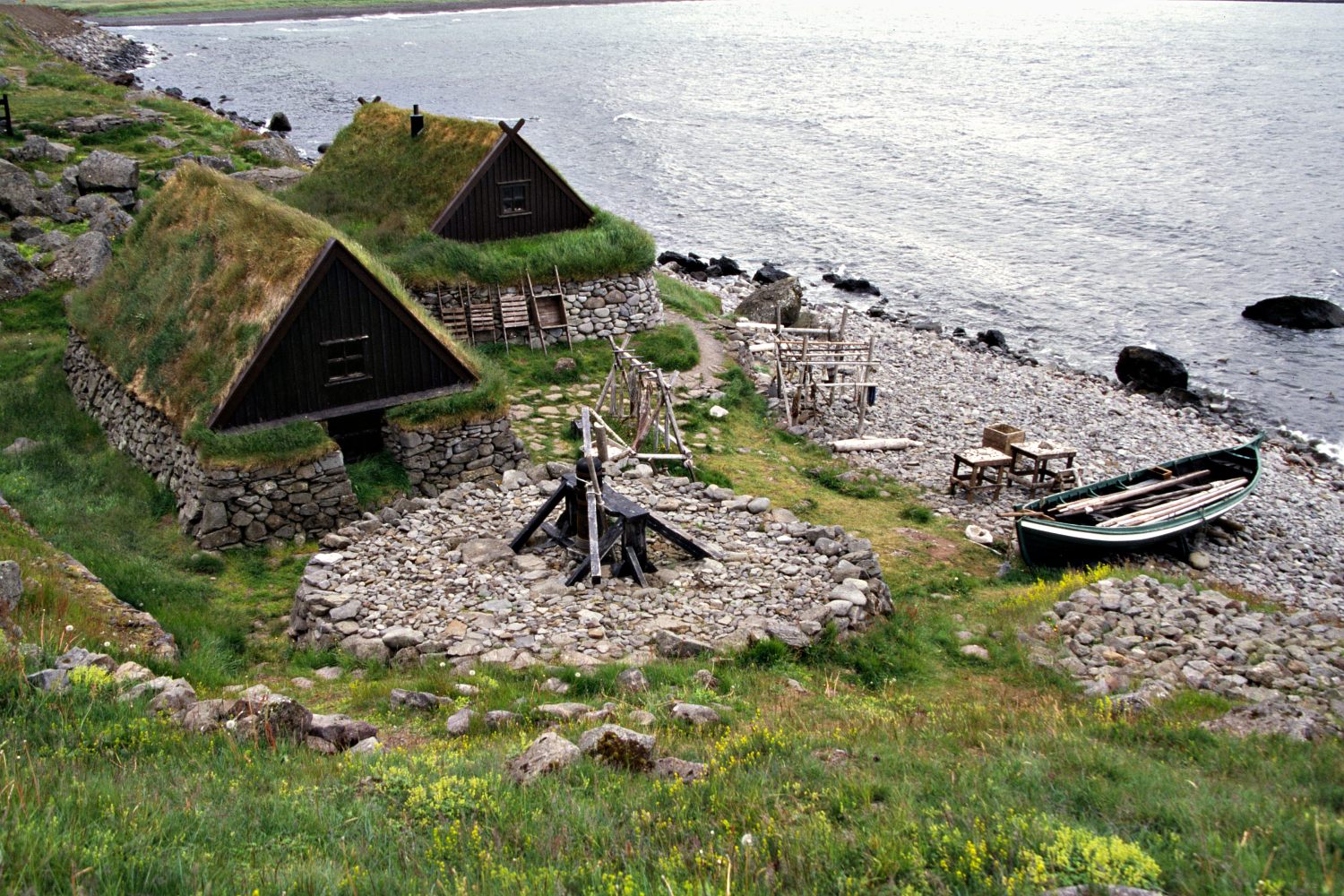
Ósvör, a replica of an old fishing outpost outside Bolungarvík


According to sources, the settlement of Iceland began in 874 AD by Norsemen. Apparently there was no proto-European presence prior to that time. Germanic peoples had, by this time, long been settled in northern Europe. This was the time of the Vikings, and Viking expansion. Iceland in particular has long been the last stronghold of Odinic spirituality; or what the Icelanders call "Ásatrú." The "Áses" were the gods and goddesses, and I have heard that Ásatrú means something like "being true to the gods." Being so far north, and in relative isolation, the island is something of a world unto itself.

The beautiful green volcanic island is right along the Arctic Circle. From the images, it appears to be beautifully sunny in the Summer, and wonderfully gloomy during the Winter. Apparently, historically-speaking, there has been a cultural exchange between the Icelandic Norse and Gaelic peoples. Some Icelanders look a little like certain dark haired Gaelic people; while some people from Ireland and Scotland look Norse. I see Iceland as the northern spiritual pillar of the West.

Iceland's best-known classical works of literature are the Icelanders' sagas, prose epics set in Iceland's age of settlement (Wikipedia). Ásatrú (pronounced [auːsatruː] in Icelandic, [aːsatruː] in Old Norse) is a modern Icelandic compound derived from Áss, which refers to the Æsir, an Old Norse term for the Gods, and trú, literally "faith". Thus, Ásatrú is the "faith in the Æsir" (Wikipedia).

When I think of these two islands, or island groups--within this historical/spiritual context--I think of the sacred northern pillar as "the Pillar of Freya," and I imagine it a rich light blue coming out of the cold Norwegian Sea on a dark cloudy Winter twilight. I think of the sacred southern pillar as "the Pillar of Hecate," and I imagine it to be a rich light copper color coming out of the warm blue Mediterranean Sea on a sunny Summer afternoon.

.

Monday, November 12, 2012

The Arctic Home in the Vedas: Part 1


Just to give some background--part fact, part theory--the proto-Norse during the last Ice Age, lived approximately in what is today Iran. That land looked very different 25,000 years ago. There was an ice cap a mile high above the 45 or 50 degree latitude in the northern hemisphere. Now if you look on a map, that would make "ancient Iran" and the surrounding territory into something of an Alaska! A totally different environment: dim, cold, mountainous, wooded. A harsh land of wood and snow, with whoolly rhronoceros, mammoth, and lion. These proto-Norse were not specifically "European" then; although this is part of "the Indo-European story."

"Apparently the belief (earth-based/month-birth classification system) is mainly a Norse conception, since it was the Nordic peoples, of all the ancients, who most clearly expressed their ideas in Nature. Some authorities assert that it comes from the East, whence comes all mystical lore. But since modern scholars now prove the Norse tribes to have migrated from Asia, originally, there may easily be a common origin of ideas. Certain it is that, far away in the dim ages of our nation's (UK) dawning, when wandering Aryan tribes, said to have come originally from the plain of Iran, in Central Asia, swarmed over and settled in Northern Europe, they found their ideas of God in Nature."
--Margaret Baillie-Sanders (UK), 'Your Birthday Month and You', 1932

Numerous authors and researchers--including Guido von List--who studied and wrote about subject matter basically dealing with Odinic-type spiritual traditions, eventually drifted off to other cultures to the south and east, and to India. It's as if there's a loose concept that the roads to all pre-Christian spiritual traditions, of the "earth island" and beyond, lead to ancient India. Some people believe that there once existed "mystery schools" which once tied together ancient wisdom from England to India. I don't believe that; but I think there could have been geographically smaller spiritual tie-ins between east and west, and which vibrated outward over thousands of years.

.

Thursday, March 8, 2012

Hexology: Part II


[Conducted by, and borrowed from, AllFatherWotan.org]


1) Greetings Hunter. To begin please introduce yourself and give the readers some info on your roots in Heathenism.

Heil Georg! I am a Heiden Hexologist, owner and creator of the Hex Factory Gallery in Philadelphia, which is dedicated to Germanic tribal art and Pa German Hexology. I have authored numerous essays on the subject of the new Heathen Hexology and magic plants and the book, The Backdoor Hexologist, Volume One. I am the founder of the online site www.Zaubereigarten.com where I have interviewed the avante garde of the Pa German magical traditions known as Hexerei. I was born and raised in the heart of Pennsylvania Dutch country, Berks County, PA., I began painting hex signs on barns at an early age. I am an avid Netherland Dwarf rabbit breeder, entheologist, and father of four.

My roots in Heathenry are in Berks County, Pennsylvania or Barricks Kaundi in Pennsilfaania in Deitsch, a German dialect spoken there. Der Deitsch Volkskultur where I grew up is the basis for my reanimation of our Folk ist prechristian beliefs and customs. I prefer the Deutsch, 'Heiden' to Heathen which is Anglo Saxon. Berks County is ground zero for Hexerei in the New World. My area of interest has always been Hexerei, or Germanic witchcraft, which is not directly associated with any organized or institutionalized form of religious practice but rather a flexible, individual approach to folk magic, specific to a folk culture in this case the Pennsylvania Germans.


2) Who were the individuals that were the most inspirational in your beginnings with Hexology?

Well let me preface the response to this question by stating that the frequency of Hex signs or Barnstars is the greatest in Northern Berks County then anywhere else in North America, maybe the world. I grew up on a farm near the small town called Virginville on the Maiden Creek which later contributes to the Schuylkill River which runs to Philadelphia. The farm was on the Saucony Creek a Lenni Lenape word for 'little bear' The Barnstars were on all the barns on all the farms. Locally, Milton Hill was the source of most of these barnstars. The great Hexologist, Johnny Ott of Lenhartsville was a couple of miles downstream, where he had the Deitsch Eck Hotel and where he also painted his famous Hexes that he and Jakob Zook of Lancaster made famous. Johnny sold his Hex business to a Johnny Claypoole who was from Upper Darby in Philadelphia, but moved up into an old stead just outside of Lenhartsville. I went to school and ran with his sons engaging in country youth activities such as skinny dipping in the Maiden Creek and jumping off cliffs into quarry lakes. We also drove old Dodge pickup trucks from the early fifties that we bought very cheap and fixed up. Eric, one of Johnny's sons now has the Hex business in Berks County.


3) You originally were from Berks County. Then you lived in Brooklyn and now Philadelphia. What was your interest in moving to Philadelphia?

Philadelphia was the portal for most the German immigration into North America for centuries. My ancestors and yours entered the 'new world' here in Philadelphia. During Colonial times, so many Germans came to Pennsylvania, Ben Franklin called them the Palatinate Moors. My arrival to East Kensington which still today retains a very Germanic population was not by chance. My own spiritual evolution brought me to the source of our Folk to this their new Heimot. Germans love to farm and SE Pennsylvania including my Berks County has 'die besten Ackerboden' I however find the innercity as the new frontier and the retaking of old neighborhoods which our folk built and rebuilding them has been both rewarding spiritually but also materially. I see the future in the city, life there is more efficient less reliant on the petroleum fueled monokultur which has alienated us from our true kultur and has bankrupted us. The culture of the car is growing to a close despite frantic efforts by our governments and world financial players to the contrary.


4) Please explain what Hexology is and also elaborate on it as a magical practice.

Hexology is actually a term invented by Jakob Zook and Johnny Ott in the very late 1940's. The Zook/Ott collaboration has made the term, 'Hexology' internationally famous. It came about at a time after the War, when America was booming, as in Baby Boom. Car Culture was really taking off. Families went places in the car for summer vacations. Lancaster County in Pennsylvania tapped into this tourist trade which continues to this day. The PA Folk Festival in my Hometown of Kutztown, in Berks County started. As we are today, back then people were fascinated with Pa German Barnstars. Ott designed them and painted them on round disks. This differed from the traditional practice of painting them directly on buildings or furniture. Zook took Ott's designs and silk screened them onto masonite disks for the tourist trade. Ott became a self styled Professor of Hexology as Dr Johnny Ott, and there you have it. Hexology was then a commercialization of the darker practice of Hexerei, or as it was called by the Deitsch (Pa Dutch) Hexerie or the Jinks, sometimes called Pow Wow magic.


5) You are a practioner of magic plants. Tell the readers more about this and how it differs from herbalism.

My knowledge of plants contrasts in many ways with herbalism. Knowledge of 'die Blantz' is essential in the Pa German kultur. We hear how the European settlers learned about plants from the so called 'indigenous' or Indians. However, the knowledge transferred went both ways. I recently procured a variety of snow white sunflower seed from a tribal seed bank in Arizona from the Tarahumara, a tribe made famous in, "The Peyote Dance," a book by Antonin Artaud. However the real source of the seed variety came from the Tarahumara's interaction with the Mennonites who settled near them in the Chihuahua desert which they turned into a garden. This is what our Folk do. We grow better then anybody including the so called 'Indigenous'.

Anyway, my 'herbal remedies' are far different then the Herbalists. Hexerei uses Power Plants or Plant Teachers to cure the spirit of the patient.


6) How does your usage of magic plants relate to magical symbols?

The Deutsch term is Zauber or magische. There is power in the words, how they are spoken and spelled, the Icelandics call it Galdr, the Deutsch, gesprochen Magie. The connection between die Blantz und die magische Zeichen; the answer is simple, plants have been used in folk art since the neolithic times. Powerful plants and especially trees populate Germanic tribal 'art' The essence, the spirit of the plant is represented through a stylization of it. The stylization is really just a symbol that invokes the power of the plant, visually. My own contribution to this process has been to replace the Christian plants and flowers in the traditional Pa German Folk art seen in Fraktur and Hexology with the Heiden magic plants. For an example, tulips are used as symbolic of the resurection of the Christ. I will substitute them for my own stylizations of Datura Stranomium, 'Geilskimmel' and Black henbane or 'Niger Bilsenkraut'. These two are power plants for the prechristian Germanic tribes used by the Volvas for divination. We find henbane seeds in the burial mounds of these exalted 'Hexes' In post reformation Germany, usage of Black Henbane seeds would result in a terrible death, being burned at the stake. More 'witches' were exterminated by Protestant Germany then anywhere else. The commonly held belief that witches fly on broomsticks comes from the practice of female 'Hexes' using an ointment of fat and Bella Donna to grease a broomstick which they stradled to absorb the Atropine a powerful hallucinatory agent through their genitalia.


7) What is the relation between sex magic and Hexology?

Pa German Sex Magic is a way of life. It is in fact a way of living and survival. On the farm, success is gauged by the ability to reproduce plants and animals and children. In a sense the farmer is a sex magic zauberer, a f*****g machine. The feminine counterpart is the the nourisher, the source of life, the goddess, the woman, the Hex, the repository of charms, the magical creature, the river of life.

It is my personal view that the Pa Deitsch are descended not from the apes but from certain flowering plants. This is evident by the usage of their Hexology, their 'creation myth' so to speak.


8) Explain the difference between Asatru and Germanic Witchcraft (Hexerei).


Asatru is a religion of contemporary Icelandic Heathens which has spread worldwide as an alternative to other institutionalized religions such as the Monotheisms. This Icelandic prechristian tradition has the advantage of a complete written legacy in the Eddas and other texts.

Germanic Witchcraft or Hexerei is a general term but it is just that, witchcraft. Witchcraft, generally feared by the Christians is neither black or white, evil or good. It is just the acquirement of personal magical power. This magical energy is always much more powerful if used positively. Cursing is actually very easy to do, but it never really ends up well for the one who has done the cursing. The result has a boomerang effect, and when the target determines the source which is usually pretty easy, the malicious energy is simply returned to the sender usually in a much more powerful form. This is primitive stuff, practices that have existed since before prehistory. Hexerei can be employed through everyday means, cooking, humor, sex, business, child rearing, hunting and fishing. Using an intention to acquire a desired result is just natural, be careful what you wish for.


9) You mentioned to me before about the Pennsylvania Germanic roots of Blues music. Can you tell us more about this. Most seem to believe that Blues music's origin is "African American."

I think what you are referring to is my statement that Pa German Hexology is similar to the 'Blues' because virtually anybody can do it (hexes). I've found that the public's interest in making them is at least as great as their viewing them or learning about them. I've done quite a few workshops with people of all ages most recently with children for the Hexenkinder Show at the Hex Factory with O. Henrietta Fisher, and it is always a big hit. Similar to playing music, practice making Hexes is essential. It is useful to learn the basic designs first before moving on to more elaborate ideas.


10) Another subject relating to Germanic magic/witchcraft is called "Hoodoo." Could you explain what this is exactly?


Well Hoodoo is not strictly a Germanic form of sympathetic magic. It is very American. It is most commonly recognized as a southern form but its roots are actually very Appalachian. The German, Scotch, Irish pioneers and settlers that moved through Pennsylvania to the South and out West took their unique ways of effecting their world. Hoodoo was practiced in PA. Hidden or buried 'intentional' objects would typify this practice. Jack Montgomery, Lee Gandee's student has published his book, "American Shamans" and he has a more 'Hoodoo' bent which is appropriate for his Kentucky neck of the woods. Orva Gaile Clubb is another who is very knowledgeable in this form. She correctly sees this as Hexerei and she has a very unique perspective being raised in western Maryland on the farm just below the Mason Dixon line. I will hopefully have her interview up shortly on Zaubereigarten.com . Hoodoo is an American form of the Caribbean Voodoo, or the Brazilian, Makumba. It is interesting to note that Voodoo scholars have great interest in the Pa Deitsch grimnoir, "The Long Lost Friend" published by Hohman in Reading Pa, 1820 as Der Lange Verborgene Freund. It makes extensive usage of the Sator Rotas magic square. Up until the 1930's the State of Pa issued licenses to practice Pow Wow magic, another term for the Pa German Hexerei.


11) I understand you learned about Kabbalah through a Rabbi friend of yours while living in Brooklyn. Could you please explain more of your friendship with this gentleman?

Yes, living thirty years in NYC certainly gave me a positive insight into Judaism. The basics of Christianity are very much from Judaism. Terms like, congregation, pentecost, trinity, originate in Judaism which has undergone many changes in its old and venerable history. Kabbalah however is relatively recent, as a powerful form of mysticism. Briefly just off the top of my head, Kabbalah originated not in Israel but in the German Rhineland and Spain during the later middle ages. In Germany, the Jews were employed much as they still are, for their knowledge of law which required an ability to read and write, something the various German nobilities lacked. The Germans and the Jews have always had a very symbiotic relationship. It is an unusual one, even amongst the Pa Germans. The Pa German dialect or Deitsch is remarkably similar to Yiddish. Both are lower German dialects. When Martin Luther translated from the Latin, the Bible which was subsequently published for the first time and is known as the Gutenberg Bible, he fixed what is known today as high German. Many other German dialects still exist.

Anyway back to your question, Rabbi Joshua Saltzman and I exchanged ideas and information including an intro of Kabbalah on his part. At the time I had 'discovered' that all religious traditions contained the simple concept of a 'tree of life'. The Sephirot as a tree was discussed. Hebrew as a magical alphabet was studied. All magical alphabets include gematria or assignment of numerical values to letter in the alphabet. Hebrew, Greek and the Elder Futhark are examples of magical alphabets. Ultimately our studies led to my conclusion that I could not place any rational reason to. I found myself intuitively unable to absorb the Jewish alphabet and the Sephirot seemed unacceptable numerically and geometrically. I however retained a great respect for the magical traditions of the Jews. Their mysticism is very powerful. In particular the Kabbalistic concept of 'gathering the fallen sparks' impressed me. Joshua had a keen interest in Shamanism and traveled extensively to India, Nepal to further his knowledge in various traditions such as the Sufi. I myself returned to my Pa German roots and have ultimately rejected Shamanism as being a modern day jingoism, a quick fix for a lack of a personal tribal tradition.


12) Do you consider yourself a "Radical Traditionalist"? If so please explain.


Radical traditionalism refers to the renaissance in Germanic 'paganism' I view it through my usual Pa German lense as the reindigenization of my folk. The magical traditions I grew up with in Berks County are the legacy of our European forefathers. That is our tradition. Revitalizing it, reanimating it and rejecting multiculturalism and the petroleum fueled "monokultur" is the radical part, advanced thinking is being done today by such 'traditionalists' all over the world.


13) Thank you very much for your comradeship, your wisdom, and your time in completing this interview. Any closing comments to share with the readers?


I would say this, there is an energy in the magical signs of our Germanic ancestors. It is very real and powerful. Anyone can participate in making them. In doing so you are tapping into something much larger then mere personal self expression. As I explained to a former teacher and friend, A stream or river has run in its bed for hundreds of thousands of years maybe longer, so it is with folk magic. No one is quite sure how it works, just that it does.


Zaubereigarten (Hunter Yoder's website)

.