
Showing posts with label May Day. Show all posts
Showing posts with label May Day. Show all posts
Thursday, June 11, 2015
The Maypole and May Day - Part 4
MAYPOLE DANCE
Will Thomas
Laughing confusion, live music and lip-biting concentration mark Hornby's Maypole dance - the first in many memories.
This video footage was taken by Will Thomas, an activist and good man whom I saw speak in person once. He lives in British Columbia, so I'm guessing that this was somewhere up there.
.


Sunday, May 3, 2015
The Maypole and May Day - Part 3

In the movie 'The Wicker Man" (1973), a Maypole is is shown with children celebrating around it. Also, in the remake, an elaborate festival is portrayed... which I think was May Day, as in the original. I loved the visuals of that scene. Often at the top of the poles is a tree-like display, with ribbons extending to the ground, where a each person in the circle walks in one direction with it. The little tree shape may turn with the pulling, or it might be allowed to twist around the pole top to bottom. Often the colors red and white are used to decorate the pole, as well as the colors of the ribbons. I have seen other shaped displays, such as a wheel of the year.
Symbolism
The symbolism of the maypole has been continuously debated by folklorists for centuries, although no set conclusion has ever been arrived at. Some scholars classify maypoles as symbols of the world axis (axis mundi). The fact that they were found primarily in areas of Germanic Europe, where, prior to Christianization, Germanic paganism was followed in various forms, has led to speculation that the maypoles were in some way a continuation of a Germanic pagan tradition. One theory holds that they were a remnant of the Germanic reverence for sacred trees, as there is evidence for various sacred trees and wooden pillars that were venerated by the pagans across much of Germanic Europe, including Thor's Oak and the Irminsul. It is also known that, in Norse paganism, cosmological views held that the universe was a world tree, known as Yggdrasil. There is therefore speculation that the maypole was in some way a continuance of this tradition.
Non-Germanic people have viewed them as having phallic symbolism, an idea which was purported by Thomas Hobbes, who erroneously believed that the poles dated back to the Roman worship of the god Priapus. This notion has been supported by various figures since, including the psychoanalyst Sigmund Freud. Phallic symbolism has been attributed to the maypole in the later Early Modern period, as one sexual reference is in John Cleland's controversial novel Fanny Hill:
"...and now, disengag'd from the shirt, I saw, with wonder and surprise, what? not the play-thing of a boy, not the weapon of a man, but a maypole of so enormous a standard, that had proportions been observ'd, it must have belong'd to a young giant."
The anthropologist Mircea Eliade theorizes that the maypoles were simply a part of the general rejoicing at the return of summer, and the growth of new vegetation. In this way, they bore similarities with the May Day garlands which were also a common festival practice in Britain and Ireland.
Italy
Maypole traditions can be found in some parts of the country, e.g. in Friuli, Umbria and Marche.
"After we've gone to get the pole in thirty or forty people, we placed it like a six month child. We walked in procession with this tree and not even a single leaf had to touch the ground. We had to raise it without making it touch the ground, holding it in our arms like a child. For us it was the saint of the 1st of May."
—Quirino Marchetti (ancient peasant of San Benedetto del Tronto), in L'albero di maggio
.
Saturday, May 2, 2015
The Maypole and May Day - Part 2

In Italy it is called Calendimaggio or cantar maggio a seasonal feast held to celebrate the arrival of spring. The event takes its name from the period in which it takes place, that is, the beginning of May, from the latin calenda maia. The Calendimaggio is a tradition still alive today in many regions of Italy as an allegory of the return to life and rebirth: among these Piedmont, Liguria, Lombardy, Emilia-Romagna (for example, is celebrated in the area of the Quattro Province or (Piacenza, Pavia, Alessandria and Genoa), Tuscany and Umbria.
The function of this magical-propitiatory ritual is often performed during an alms during which, in exchange for gifts (traditionally eggs, wine, food or sweets), the Maggi (or maggerini) sing auspicious verses to the inhabitants of the houses they visit and throughout the Italian peninsula this Il Maggio couplets are very diverse, most are loving occasions with an important sexual load, that young people sang to celebrate the arrival of spring. Symbol of spring revival are the trees (alder, golden rain) accompanying maggerini and flowers (violets, roses), mentioned in the verses of the songs, and with which the participants adorn. In particular the plant alder, which grows along the rivers, is considered the symbol of life and that's why it is often present in the ritual.
Calendimaggio can be historically noted in Tuscany as a mythical character who had a predominant role and met many of the attributes of the god Belenus. In Lucania, the Maggi have a clear auspicious character of pagan origin. In Syracuse, Sicily is held during the month of May, the Albero della Cuccagna (cf. "Greasy pole"), a feast celebrated to commemorate the victory over the Athenians led by Nicias. However, Angelo de Gubernatis in his work Mythology of Plants, believes that without doubt the festival was previous to that of said victory. It is a celebration that dates back to ancient peoples very integrated with the rhythms of nature, such as the Celts (celebrating Beltane), Etruscans and Ligures, in which the arrival of summer clothed great importance.
.
Friday, May 1, 2015
The Maypole and May Day - Part 1
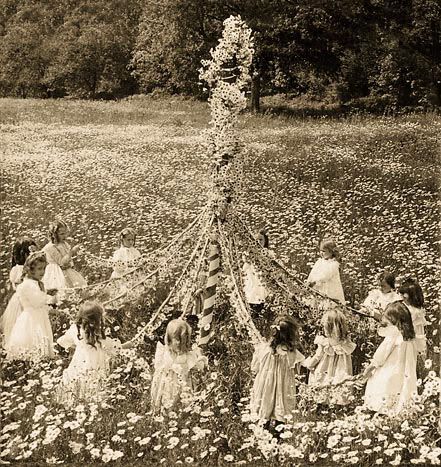
May Day on May 1 is an ancient Northern Hemisphere spring festival and usually a public holiday; it is also a traditional spring holiday in many cultures. Dances, singing, and cake are usually part of the celebrations that the day includes.
A maypole is a tall wooden pole erected as a part of various European folk festivals, around which a maypole dance often takes place. The festivals may occur on May Day or Pentecost (Whitsun), although in some countries it is instead erected at Midsummer. In some cases the maypole is a permanent feature that is only utilized during the festival, although in other cases it is erected specifically for the purpose before being taken down again.
Primarily found within the nations of Germanic Europe and the neighboring areas which they have influenced, its origins remain unknown, although it has been speculated that it originally had some importance in the Germanic paganism of Iron Age and early Medieval cultures, and that the tradition survived Christianization, albeit losing any original meaning that it had. It has been a recorded practice in many parts of Europe throughout the Medieval and Early Modern periods, although became less popular in the 18th and 19th centuries. Today, the tradition is still observed in some parts of Europe and among European communities in North America.
Like so many aspects of ancient European folk traditions, May Day was co-opted by Christian denominations and political extremists. Still, it remains a powerful symbol of how ancient peoples related to the Earth, the Sun, the Moon, the seasons, their harvests, and each other. May Day--although more Germanic in tradition--was also celebrated by the Romans.
The earliest May Day celebrations appeared in pre-Christian times, with the Floralia, festival of Flora, the Roman goddess of flowers, held April 27 during the Roman Republic era, and with the Walpurgis Night celebrations of the Germanic countries. It is also associated with the Gaelic Beltane, most commonly held on April 30. The day was a traditional summer holiday in many pre-Christian European pagan cultures. While February 1 was the first day of Spring, May 1 was the first day of summer; hence, the summer solstice on June 25 (now June 21) was Midsummer.
.
Subscribe to:
Posts (Atom)