 Lo Spiedo Bresciano: The Brescian Spit
Or, Roast Game Birds
By Kyle Phillips [Licensed to About.com]
"We're hunters," came the reply when I asked about the origins of Lo Spiedo Bresciano, one of the city of Brescia's signature dishes. "But we do things differently than you do in Tuscany:" -- my accent places me -- "We set up blinds, don't use dogs, and shoot at uccelli dal becco fino," in other words fine beaked, i.e. small birds, including thrushes, meadowlarks, finches, and so on.
[Above: Making a Spiedo Bresciano: The meats have been roasting for about 4 hours. Note tray for coals to the front of roaster.]
Before you blanch at the idea of eating a songbird, some context: Lo spiedo bresciano goes back centuries, and is a holiday dish of those who were too poor to be able to afford other meats, and were also not allowed, by the ruling nobility, to hunt anything larger. Considering that one would be fined if one were caught shooting anything that walked or bounded over the land, if not worse -- the Visconti, who ruled Brescia from 1300 to 1430, had poachers mutilated -- hunters bent on providing a meal for their families naturally went after what the nobility didn't care about: Small birds.
As did farmers, both because some small birds eat the crops in the fields, and because barnyard animals that could provide commodities such as eggs, or be sold to raise cash, were much too valuable to be eaten.
Hence the classic Spiedo Bresciano.
Like any old dish, however, it has evolved with time.
*On the one hand, people aren't quite so poor as they once were, and can afford to add other meats to the spit, for example pork spare ribs, quail, and rabbit.
*And on the other, mores have changed, and it is now illegal to catch what was once allowed. Therefore, to enjoy the traditional Speido Bresciano you have to go out and catch the birds yourself, have a friend who hunts, or have access to commercially raised small game birds. Or you can adapt the recipe as many modern Bresciani do, cooking quail, rabbit, pork, chicken, and so on in the traditional way.
Historically there are three major variations on the Spiedo Bresciano:
*In the Valtrompia and the Bassa Bresciana, the flatlands extending from Brescia out into the Pianura Padana people used song birds and pieces of pork loin, figuring three birds and a couple of slices of loin per person. The birds are plucked, their eyes are removed, and they are gutted. Then they are spitted, arranging them so their heads all face the same same way, and putting the smallest birds at the ends of the spit where the heat is lower, with a slice of pork loin rolled up around a strip of lard and a sage leaf between each pair of birds. The spit is basted with melted butter.
*Around Rezzato, in the lower Gardesana (towards the Pianura Padana), they also add pieces of rabbit to the spit, and in other surrounding towns they go further, using pork spare ribs cut about 2 1/2 inches (6 cm) long, song-bird-sized pieces of chicken, and finger-thick slices of potato.
*In the alto Garda (towards the mountains) and the Valle Sabbia the Spiedo is richer; in addition to the song birds they use chicken, rabbit, duck, pork liver wrapped in lace fat, rolled up slices of pork shoulder butt (what is coppa if it's cured), which is tenderer than pork loin, and spare ribs.
Regardless of which kind of Spiedo Bresciano you choose to make, figure about three birds, and an equivalent volume of other meats, say a piece of pork loin, a spare rib, and a chicken drumstick per person, cutting the other meats to the size of the birds to insure everything cooks at the same rate (if you are omitting the songbirds, double the amounts of other meats, or add other things, for example quale and pigeon).
When you have assembled and cut your meats, spit them in repeating order: Bresciani using everything usually start with a slice of potato, followed by a rolled up piece of pork, a sage leaf, a songbird (spitted side-to-side), sage, potato, a piece of rabbit, sage, potato, a songbird, sage, potato, a piece of chicken, sage, potato, a spare rib, sage, and so on, until all is spitted. When spitting the meats, make certain the birds are all arranged facing the same way.
Lo Spiedo Bresciano is done over the coals, and there is really no other way to do it. An oven simply wouldn't give the same results.
Restaurants and people who cook for large groups of friends use a rotisserie of the kind shown here: a long metal box capable of holding several spits, which are turned by an electric motor. The coals go into a tray that runs along the front of the box, while the bottom of the rotisserie acts as a dripping pan, catching what drips from the spits above.
Such specialization is not necessary, however: All you need is one or more long spits you can set in front of the coals, and a clockwork or electrically operated spit turner to turn the spits so the meat cooks evenly.
And now, to cook! First, the fire:
Though you won't be cooking over high heat, you'll be cooking for a long time, so make certain you have an ample supply of non-resinous hardwood (Bresciani use olive wood) or good quality charcoal. I wouldn't use briquettes, because they can contain all sorts of things, including sawdust. Start the fire, and when it has produced some coals, you're ready to begin.
Put the spit in your hearth over a dripping pan, arranging the spit so the heads of the birds hang down. Spread the coals you have in front of -- not directly under -- the spit so they provide an even, not too intense heat over the length of the spit. Don't start the spit turner immediately, but rather wait until the heat from the coals stiffens the necks of the birds. While this is happening, melt a cup of unsalted butter and season it with several fresh sage leaves.
When the necks of the birds have stiffened, add a few more coals to increase the heat some (but not too much; the heat should never be really intense, or the birds will dry out), start the spit turner, baste the birds with the melted butter and sage, and lightly salt them. Continue cooking, adding coals as necessary to maintain a moderate, even heat, for 4-5 hours, basting every hour or so, using both the butter, and, as they accumulate, the drippings from the dripping pan. When there's about an hour left to go check seasoning. And when it's done, remove the pieces of meat to a platter, and keep them warm. Also, gather the drippings and flavorful bits from the drippings pan, combine them with whatever butter is left in the basting pot, and put them in a warmed bowl.
And thus we have the meat: What to serve with it?
Polenta; set a pot of water to boil about an hour before the birds will be ready, and make a nice batch of not too firm polenta. You may also want to make a tossed green salad seasoned with olive oil, salt, and good white wine vinegar. And, of course, you should procure wine: A Terre di Franciacorta Rosso DOC would be quite nice, as would a Garda Bresciano Rosso DOC, or, if you wanted to go a little further afield, a Valpolicella Superiore.
The actual serving is simple: Each person gets a couple birds and other kinds of meat (here, rabbit and spareribs), and some polenta, flavored by pressing into the polenta with the back of a spoon and filling the resulting well with seasoned drippings.
Festive food fit for king!
Lo Spiedo Bresciano: The Brescian Spit

Showing posts sorted by relevance for query brescian spit. Sort by date Show all posts
Showing posts sorted by relevance for query brescian spit. Sort by date Show all posts
Friday, June 20, 2008
Lo Spiedo Bresciano: The Brescian Spit


Tuesday, May 19, 2020
Nova Bréscia: Brescians in Brazil
NOVA BRÉSCIA VISTA DE CIMA
IMAGEMAEREARS
************
Nova Bréscia - "New Brescia" in Latin, founded 1964
Not surprisingly, wherever they go, everything rises up around them. The hard work, the intelligence, the creativity; a culture-bearing people. This is a rural area, the kind of place where there always is talk of the lack of opportunities, but they're the kind of people who just make things happen. The first settlers arrived in 1902, but it became official in 1964.
************
Rio Grande do Sul - "Great Southern River"
Nova Bréscia is located in the Rio Grande do Sul state in Brazil, which is the southernmost state. Often people from Brescia, and other people from the Padan plane, immigrated in order to find affordable farm land. I once read that some Brescians in the early twentieth century had migrated to a then sparsely populated Turkey, probably for the same region. There are approximately 10,000 Brescians in Brazil.
************
Festival Do Chrrasqueiro
Is the actual origin of the churrasquiero from the traditional Brescian spit? That's what this piece seems to suggest, although I don't know. A lot of people arrive for the festival; not every person in these videos is Bresican. The whole general region there is mainly Portuguese, Italian, German, and African. Most of the faces seem to clearly be Brescian. Outside of the semi-tropical vegetation, the town looks much like a town in rural Brescia. Such a different landscape from the Northwoods environment where my family settled, although it's similarly rural.
FestivalDoChurrasqueiro.com.br
'Lo Spiedo Bresciano: The Brescian Spit'
Os Churrasqueiros de Nova Bréscia
Encontro dos Churrasqueiros de Nova Bréscia
************
 Nova Bréscia
[Translated by Bing Microsoft Translator. It's not an exact match, with Portuguese, Italian, and English translating back and forth a little too much in a few places.]
Nova Brescia is a municipality in the Brazilian state of Rio Grande do Sul,colonized by Italian immigrants. It is located at a latitude of 29º12'52" south and at a longitude of 52º01'39" west, being at an altitude of 313 meters. Its population was 3,184 according to the 2010 IBGE census.
It has an area of 102.183 km².
New Brescia is known as the capital of lies, holding every two years the Festival da Mentira ("Festival of Lies"),where the person who tells the biggest lie wins, but who manages to leave viewers in doubt about its veracity. It is also known for being the capital of the churrasqueiros.
History
Municipality created on December 28, 1964, according to State Law Number 4,903. On April 11, 1965, the first mayor, João Arlindo Deves, was graduated, having as deputy Alfredo Silvestre Macagnan. The first chamber of aldermen was composed of João Sbardelotto, Benjamin Giongo, Guido Dalpian, Alcides Armando Laste, Isidoro Berti, Alcides Zambiasi, Maximiliano Salami and Arlindo Simonetti.
"Noi italiani lavoratori,/ Allegri andiamo in Brasile./ E voialtri d'Italia signori,/ Lavoratelo il vostro badile./ Se volete mangiare." We Italian workers/ Let's go happy for Brazil./ And you nobles from Italy,/ Get your shovel/ If you want to eat.
This was the spirit, this was the chant of the Italian immigrants on their ships. They were fleeing Italy like a prison. There was so much abundance of manpower in Europe that more than 10 million Italians immigrated to the New World between the 1810s and 1930s. In Brazil, from 1875 to 1935, 1.5 million entered, of which 100,000 came to Rio Grande do Sul, with the most diverse qualifications.
The immigration of the Italians is linked to the process of unification of Italy and the victory of capitalism over the "small kingdoms and their agrarian structure", deeply affecting the families who lived on the land. From Brescia, located in the Region of Lombardy, many Italians arrived in Rio Grande do Sul, giving birth to the city of New Brescia.
Exactly in 1895, the Italian families of De Maman, Mezacasa, Casaril and Daroit, coming from the municipalities of Bento Gonçalves, Antonio Prado and Veranópolis, climbed steep paths and settled in the locality of Arroio das Pedras, where today is the town of Linha Tigrinho Alto, an initial landmark of the colonization of the municipality of New Brescia, with its current 33 communities.
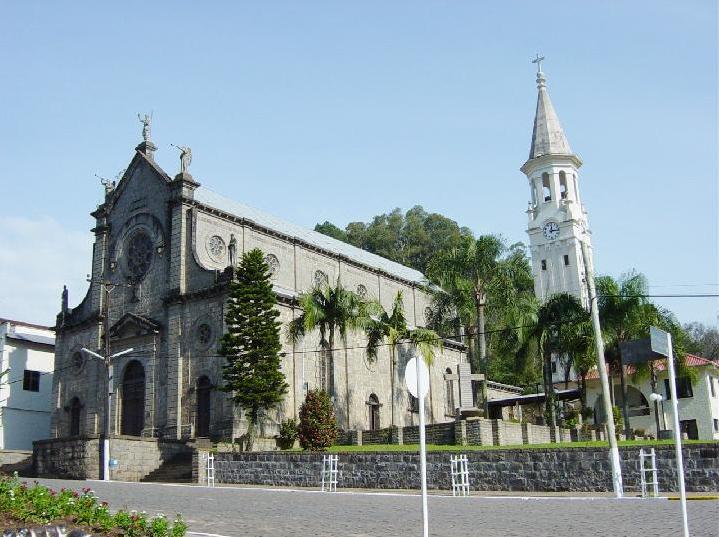 The city of New Brescia began around 1902, when the first settlers, the Italians born Santo Titton and João Dalnora, plus the Brazilians Felisberto de Freitas and João Machado, arrived there.
In these places there were only woods and pickets. It wasn't easy for the young community of settlers to settle down. These pioneers came bringing their families and their changes upon horses. They suffered a lot to build their wooden houses, for the planks were sawn by hand. There were no bricks or building materials. To buy groceries not produced on site, it was necessary to go on horseback, along a road full of curves and steep slopes, to Arroio Grande, now Enchanted.
In 1906, more settlers arrived, among them Antonio Dall'Oglio, Batista Recco, João Magagnin and others who added to those who were already on site, in order to explore the land through agriculture. The main crops were wheat, corn and beans. The commercialization of the products was carried out in the neighboring cities, transported on mules that formed long fias on the paths through which only one animal passed at a time. Later, when the roads were widened and flattened, carts pulled by oxen or horses began to be used. Only in 1914 was opened the current road that connects New Brescia to Encantado; before, the route was made by the Tigrinho Line.
The first church in New Brescia was built of basalt stone, but had to be demolished a few years after its construction in the early 1930s. The current mother church, also built of stone, had its foundation stone laid in 1936 and was inaugurated in 1952.
In 1924 came the first doctor, Dr. José Lorenzin; in the same year the first pharmacy appeared. Until then, when necessary, patients who could not keep on top of a horse were loaded on padiolas until Encantado or Arroio do Meio. In 1938 the São João Batista Charity Hospital was founded, which operates to this day.
The years passed and the city grew. In 1964 came emancipation: New Bréscia ceased to be a district of the municipality of Arroio do Meio and gained its autonomy.
Shortly before a new story had begun: the saga of the churrasqueiros.
New Brescia is now nationally known as the land of the best churrasqueiros in Brazil. Countless are the houses specialized in barbecue scattered throughout Brazil; and there are countless in other countries, especially in the United States.
In the 1960s, the municipality had around 11,000 inhabitants. Today there are just over 3,000, due to the exodus of many residents, but mainly due to the emancipation of several districts, which constituted autonomous municipalities.
 Currently it is estimated that more than 10,000 Brescians spread throughout Brazil and the world in various activities. They stand out mainly in the branch of steakhouses and restaurants, which followed the example of Albino Ongaratto, from Linha Alegre, who decided to drop the hoe, the fight against mountainous terrain, unpredictable bites in the winter months and the indomable force of prodigious nature, thus initiating a massive rural exodus, which we can call as the saga of churrasqueiros.
Currently the municipality of New Brescia stands out for its quality of life. According to recent data, the HDI (UN Human Development Index) the municipality of New Brescia is in 1st place in the Taquari Valley and among the first in the state.
Monument to the churrasqueiro
New Brescia is also known for offering the world the best churrasqueiros in Brazil. The fame of Brescians is very great, even paying homage to the churrasqueiro in the city center.
On the monument there is a sign, which reads:
To you churrasqueiro who represent so well the Brescians community in every corner of the country, our gratitude and gratitude.
Economy
The service sector is the main economic activity of the municipality, corresponding to 52.4% of GDP. In second place, there is the agricultural sector, with 37.4% of GDP, with special emphasis on poultry farming, with New Brescia being the municipality with the highest production of birds in the state, with about 40 million birds per year. In recent years, the industrial sector has also developed, representing about 1% of GDP, with companies in the textile, furniture, timber, metal-mechanical and food sectors.
Culture
Sovereigns
The new court of sovereigns of the municipality was elected on April 29, 2017, in a ball held at the Municipal Sports Gymnasium, as a program of the festivities in commemoration of the 52nd anniversary of the city. Nine beautiful girls took the catwalk, but only three were crowned. The queen elected is Camila Laste and princesses Dainar Amaral and Jaine de Oliveira Simonetti.
Nova Brescia, Terra dos Churrasqueiros
Jatir Delazeri
.
Subscribe to:
Posts (Atom)