Stradivarius
A Stradivarius is one of the violins, violas, cellos and other string instruments built by members of the Italian family Stradivari (Stradivarius), particularly Antonio Stradivari, during the 17th and 18th centuries. According to their reputation, the quality of their sound has defied attempts to explain or equal it, though this belief is disputed. The name "Stradivarius" has become a superlative often associated with excellence; to be called "the Stradivari" of any field is to be deemed the finest there is. The fame of Stradivarius instruments is widespread, appearing in numerous works of fiction.
Hellier Stradivarius
The Hellier Stradivarius of circa 1679 is a violin made by Antonio Stradivari of Cremona, Italy. It derives its name from the Hellier family, who might well have bought it directly from the luthier himself.
The Hellier Stradivarius has had a convoluted ownership history. It seems to have been in the possession of the Hellier family from the beginning of the 18th century. Sir Samuel Hellier, High Sheriff of Staffordshire 1745–49, brought the violin to England, and through various wills it was kept in the family until 1880.
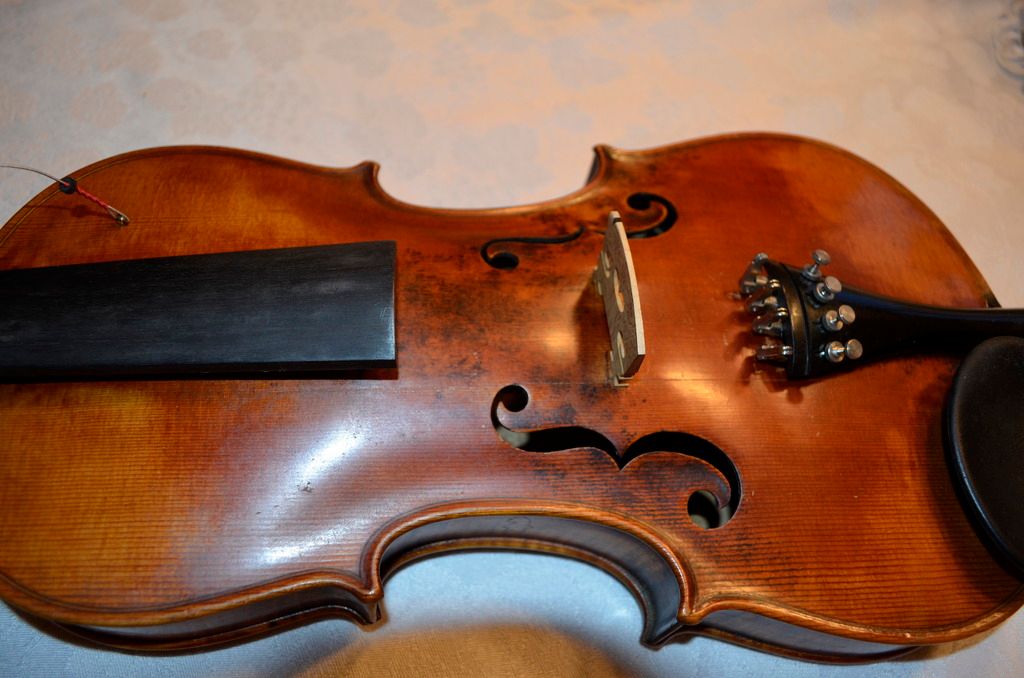
The Messiah-Salabue Stradivarius of 1716 is a violin made by Italian luthier Antonio Stradivari of Cremona. It is considered to be the only Stradivarius in existence in as new state. It is in the collection of the Ashmolean Museum in Oxford, England.
The Messiah, sobriquet Le Messie, remained in the Stradivarius workshop until his death in 1737. It was then sold by his son Paolo to Count Cozio di Salabue in 1775, and for a time, the violin bore the name Salabue. The instrument was then purchased by Luigi Tarisio in 1827. Upon Tarisio’s death, in 1854, French luthier Jean Baptiste Vuillaume of Paris purchased The Messiah along with Tarisio's entire collection. "One day Tarisio was discoursing to Vuillaume on the merits of this unknown and marvelous instrument, when the violinist Jean-Delphin Alard (Vuillaume's son-in-law), exclaimed: 'Then your violin is like the Messiah: one always expects him but he never appears' ('Vraiment, Monsieur Tarisio, votre violon est comme le Messie des Juifs: on l'attend toujours, mais il ne paraît jamais' ). Thus the violin was baptized with the name by which it is still known."
The Messiah was bequeathed by the family of W.E. Hill to the Ashmolean Museum in Oxford for preservation as "a yardstick for future violin makers to learn from."
The violin is in like-new condition, as it was seldom played. The tonal potential of the instrument has been questioned due to the conditions of the Hill bequest. However it was played by the famous violinist Joseph Joachim, who states in a letter of 1891 to the then owner of the Messiah, Robert Crawford, that he was struck by the combined sweetness and grandeur of the sound. Nathan Milstein played it at the Hills' shop before 1940 and described it as an unforgettable experience. It is one of the most valuable of all the Stradivari instruments.
The top of the Messiah is made from the same tree as a P.G. Rogeri violin of 1710. The tuning pegs and the tailpiece (that shows the Nativity of Christ) are not original, but were added by Vuillaume.

The Axelrod quartet is a set of four Stradivarius instruments collected by Herbert R. Axelrod. The collection consists of the Greffuhle violin, Axelrod viola, Ole Bull violin, and Marylebone cello.
In 1997, Axelrod donated them to the Smithsonian Institution. Their value at the time was estimated at $50 million.
The Axelrod quartet is occasionally used in performances. In concert, the Servais Stradivarius, which is also in the Smithsonian's collection, is occasionally added to the Axelrod quartet.
************
Stradivari instruments
************
 Carlo Bergonzi (luthier)
Carlo Bergonzi (21 December 1683 – 9 February 1747) was an Italian luthier who apprenticed with Hieronymus Amati, collaborated with Joseph Guarneri, and is considered the greatest pupil of Antonio Stradivari.
Bergonzi is the first and most noted member of the Bergonzi family, an illustrious group of luthiers from Cremona, Italy, a city with a rich tradition of stringed instrument fabricators.
Kreisler Bergonzi
The Kreisler Bergonzi is an antique violin made by the Italian luthier Carlo Bergonzi (1683–1747) from Cremona in 1740.
Of all of the extant Cremonese instruments, the Kreisler Bergonzi is one of the best preserved with its original neck and most of its original varnish. There has been very little repair work required on it. It is one of the best sounding of all Bergonzi violins.
.