Eugenio Beltrami Born: 16 November 1835 Cremona, Lombardy, Austrian Empire Died: 18 February 1900 (aged 64) Rome, Kingdom of Italy Residence: Italy Nationality: Italian Fields: Mathematician Institutions: University of Bologna University of Pisa University of Rome Alma mater: University of Pavia Doctoral advisor: Francesco Brioschi Doctoral students: Giovanni Frattini Known for: Laplace–Beltrami operator
Eugenio Beltrami (November 16, 1835 in Cremona – 18 February 1900 in Rome) was an Italian mathematician notable for his work concerning differential geometry and mathematical physics. His work was noted especially for clarity of exposition. He was the first to prove consistency of non-Euclidean geometry by modeling it on a surface of constant curvature, the pseudosphere, and in the interior of an n-dimensional unit sphere, the so-called Beltrami–Klein model. He also developed singular value decomposition for matrices, which has been subsequently rediscovered several times. Beltrami's use of differential calculus for problems of mathematical physics indirectly influenced development of tensor calculus by Gregorio Ricci-Curbastro and Tullio Levi-Civita.
Short biography
Beltrami was born in Cremona in Lombardy, then a part of the Austrian Empire, and now part of Italy. He began studying mathematics at University of Pavia in 1853, but was expelled from Ghislieri College in 1856 due to his political opinions. During this time he was taught and influenced by Francesco Brioschi. He had to discontinue his studies because of financial hardship and spent the next several years as a secretary working for the Lombardy–Venice railroad company. He was appointed to the University of Bologna as a professor in 1862, the year he published his first research paper. Throughout his life, Beltrami had various professorial jobs at universities in Pisa, Rome and Pavia. From 1891 until the end of his life Beltrami lived in Rome. He became the president of the Accademia dei Lincei in 1898 and a senator of the Kingdom of Italy in 1899.
Contributions to non-Euclidean geometry
In 1868 Beltrami published two memoirs (written in Italian; French translations by J. Hoüel appeared in1869) dealing with consistency and interpretations of non-Euclidean geometry of Bolyai and Lobachevsky. In his "Essay on an interpretation of non-Euclidean geometry", Beltrami proposed that this geometry could be realized on a surface of constant negative curvature, a pseudosphere. For Beltrami's concept, lines of the geometry are represented by geodesics on the pseudosphere and theorems of non-Euclidean geometry can be proved within ordinary three-dimensional Euclidean space, and not derived in an axiomatic fashion, as Lobachevsky and Bolyai had done previously. In 1840, Minding already considered geodesic triangles on the pseudosphere and remarked that the corresponding "trigonometric formulas" are obtained from the corresponding formulas of spherical trigonometry by replacing the usual trigonometric functions with hyperbolic functions; this was further developed by Codazzi in 1857, but apparently neither of them noticed the association with Lobachevsky's work.
In this way, Beltrami attempted to demonstrate that two-dimensional non-Euclidean geometry is as valid as the Euclidean geometry of the space, and in particular, that Euclid's parallel postulate could not be derived from the other axioms of Euclidean geometry. It is often stated that this proof was incomplete due to the singularities of the pseudosphere, which means that geodesics could not be extended indefinitely. However, John Stillwell remarks that Beltrami must have been well aware of this difficulty, which is also manifested by the fact that the pseudosphere is topologically a cylinder, and not a plane, and he spent a part of his memoir designing a way around it. By a suitable choice of coordinates, Beltrami showed how the metric on the pseudosphere can be transferred to the unit disk and that the singularity of the pseudosphere corresponds to a horocycle on the non-Euclidean plane. On the other hand, in the introduction to his memoir, Beltrami states that it would be impossible to justify "the rest of Lobachevsky's theory", i.e. the non-Euclidean geometry of space, by this method.
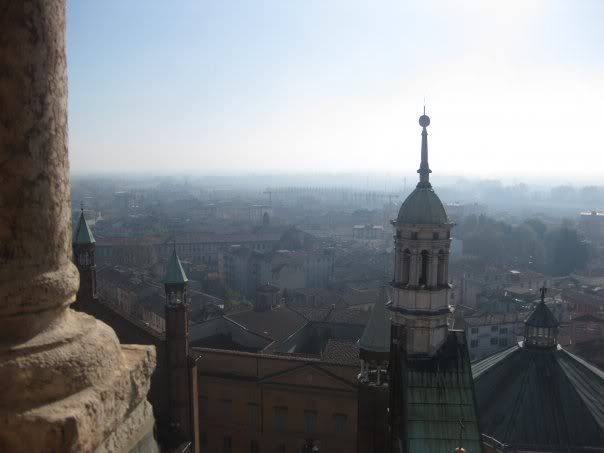
Cremona, Lombardy
In the second memoir published during the same year (1868), "Fundamental theory of spaces of constant curvature", Beltrami continued this logic and gave an abstract proof of equiconsistency of hyperbolic and Euclidean geometry for any dimension. He accomplished this by introducing several models of non-Euclidean geometry that are now known as the Beltrami–Klein model, the Poincaré disk model, and the Poincaré half-plane model, together with transformations that relate them. For the half-plane model, Beltrami cited a note by Liouville in the treatise of Monge on differential geometry. Beltrami also showed that n-dimensional Euclidean geometry is realized on a horosphere of the (n + 1)-dimensional hyperbolic space, so the logical relation between consistency of the Euclidean and the non-Euclidean geometries is symmetric. Beltrami acknowledged the influence of Riemann's groundbreaking Habilitation lecture "On the hypotheses on which geometry is based" (1854; published posthumously in 1868).
Although today Beltrami's "Essay" is recognized as very important for the development of non-Euclidean geometry, the reception at the time was less enthusiastic. Cremona objected to perceived circular reasoning, which even forced Beltrami to delay the publication of the "Essay" by one year. Subsequently, Felix Klein failed to acknowledge Beltrami's priority in construction of the projective disk model of the non-Euclidean geometry. This reaction can be attributed in part to the novelty of Beltrami's reasoning, which was similar to the ideas of Riemann concerning abstract manifolds. J. Hoüel published Beltrami's proof in his French translation of works of Lobachevsky and Bolyai.
Works
Beltrami, Eugenio (1868). "Saggio di interpretazione della geometria non-euclidea". Giornale di Mathematiche VI: 285–315.
Beltrami, Eugenio (1868). "Teoria fondamentale degli spazii di curvatura costante". Annali. di Mat., ser II 2: 232–255. doi:10.1007/BF02419615.
Opere matematiche di Eugenio Beltrami pubblicate per cura della Facoltà di scienze della r. Università di Roma (volumes 1–2) (U. Hoepli, Milano, 1902–1920)[1]
Same edition, vols. 1–4
References
Study, E. (1909). "Review: Opere matematiche di Eugenio Beltrami". Bull. Amer. Math. Soc. 16 (3): 147–149. doi:10.1090/s0002-9904-1909-01882-8.
Stillwell, John (1996). Sources of hyperbolic geometry. History of Mathematics 10. Providence, R.I.: American Mathematical Society. ISBN 978-0-8218-0529-9. MR 1402697
Jeremy Gray, Poincaré and Klein — Groups and Geometries. In 1830–1930: a Century of Geometry (ed L.Boi, D.Flament and J.-M.Salanskis), Springer, 1992, 35–44 External links
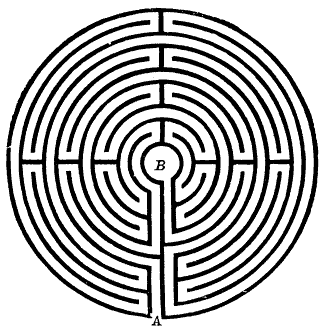
Labyrinths The labyrinth was both an important symbol and ground marking to the ancient Camunni; and also to other peoples. The Labyrinth Society website has a Labyrinth Locator where you may try to find one in your area. I actually found a ground labyrinth last year, made of stones, on the edge of private property near a nearby public trail. Finding it was quite a surprise, as it was sort've hidden just off the beaten path. When I am able to visit, I always clean it up a bit. As you can imagine, I'm not in a big hurry to make everyone aware of this location.
Cultural meanings
Prehistoric labyrinths are believed to have served as traps for malevolent spirits or as defined paths for ritual dances. In medieval times, the labyrinth symbolized a hard path to God with a clearly defined center (God) and one entrance (birth). In their cross-cultural study of signs and symbols, Patterns that Connect, Carl Schuster and Edmund Carpenter present various forms of the labyrinth and suggest various possible meanings, including not only a sacred path to the home of a sacred ancestor, but also, perhaps, a representation of the ancestor him/herself: "...many [New World] Indians who make the labyrinth regard it as a sacred symbol, a beneficial ancestor, a deity. In this they may be preserving its original meaning: the ultimate ancestor, here evoked by two continuous lines joining its twelve primary joints." One can think of labyrinths as symbolic of pilgrimage; people can walk the path, ascending toward salvation or enlightenment. Many people could not afford to travel to holy sites and lands, so labyrinths and prayer substituted for such travel. Later, the religious significance of labyrinths faded, and they served primarily for entertainment, though recently their spiritual aspect has seen a resurgence.
Many newly made labyrinths exist today, in churches and parks. Modern mystics use labyrinths to help them achieve a contemplative state. Walking among the turnings, one loses track of direction and of the outside world, and thus quiets the mind. The Labyrinth Society provides a locator for modern labyrinths all over the world. In addition, the labyrinth can serve as a metaphor for situations that are difficult to be extricated from, as an image that suggests getting lost in a subterranean dungeon-like world. Octavio Paz titled his book on Mexican identity The Labyrinth of Solitude, describing the Mexican condition as orphaned and lost.
Emerald Tablet Hermeticism, Alchemy, and Western Ceremonial Magic--apparently, largely all the same thing--is a subject which has been covered here often. I can't seem to find an image which I can say is the authentic Emerald Tablet, as there are many replicas. Perhaps the name is more of a concept name, rather than an actual piece. The Emerald Tablet, also known as the Smaragdine Table, or Tabula Smaragdina, is a compact and cryptic piece of Hermetica reputed to contain the secret of the prima materia and its transmutation. It was highly regarded by European alchemists as the foundation of their art and its Hermetic tradition. Below is one of the many translations, by English physicist, mathematician, and Alchemist Isaac Newton. I'm surprised that the tablet has fourteen points, rather than that ever-present number thirteen. There is a relationship between Hermeticism/Alchemy and Freemasonry/Rosicrucianism; although I do not know if this nexus is deep, or more casual. I'm guessing it's the former.
Newton's translation
A translation by Isaac Newton is found among his alchemical papers that are currently housed in King's College Library, Cambridge University. 1. Tis true without lying, certain and most true. 2. That which is below is like that which is above and that which is above is like that which is below to do the miracles of one only thing.... 3. And as all things have been and arose from one by the mediation of one: so all things have their birth from this one thing by adaptation. 4. The Sun is its father, the moon its mother, the wind hath carried it in its belly, the earth is its nurse. 5. The father of all perfection in the whole world is here. 6. Its force or power is entire if it be converted into earth. 7. Separate thou the earth from the fire, the subtle from the gross sweetly with great industry.
8. It ascends from the earth to the heaven and again it descends to the earth and receives the force of things superior and inferior. 9. By this means you shall have the glory of the whole world.... 10. And thereby all obscurity shall fly from you. 11. Its force is above all force. For it vanquishes every subtle thing and penetrates every solid thing. 12. So was the world created. 13. From this are and do come admirable adaptations whereof the means (or process) is here in this. Hence I am called Hermes Trismegist, having the three parts of the philosophy of the whole world.... 14. That which I have said of the operation of the Sun is accomplished and ended.
The Number Nine Although this video comes from an Odinic path, the number "9" is also a very important number in European witchcraft. In the legend of the Holy Strega we encounter a set of nine scrolls, and in this number we find lunar symbolism. Nine is a triple form of the number three, and three represents the triformis goddess of witchcraft: Hecate, Diana, and Proserpina. Therefore the nine scrolls, as a mystical element of Aradia's legend, represent the teachings of the lunar cult. --Raven Grimassi, 'The Book of the Holy Strega
9 Laws of magic
Nikola Tesla, the greatest scientist of modern times, stated that the
numbers three, six, and nine are the key to the universe; almost as a natural amendment to the Pythagoras statement that number rules the universe.
Nikola Tesla 3 6 9
Tomb of Dracula The Tomb of Dracula is a horror comic book series published by Marvel Comics from April 1972 to August 1979. The 70-issue series featured a group of vampire hunters who fought Count Dracula and other supernatural menaces.
In the 70s, my father would rent a camper every year--as he had a six-week summer vacation--and we would drive to the Midwest from California to visit relatives. I recall that this was my favorite comic book. Comics were huge then, and were all in color, and inexpensive. This comic series led to the Blade and van Helsing movies years later. If it's possible for a comic book to provoke strong emotion and mystery, then 'The Tomb of Dracula' did just that. It's wasn't really "for kids," as there was a lot of violence and killing. In 2010 the entire series, with many hundreds of pages, became available in book form with several improved-full-color volumes.
According to Dirk Jan Struik, Agnesi is "the first important woman mathematician since Hypatia (fifth century A.D.)". The most valuable result of her labours was the Instituzioni analitiche ad uso della gioventù italiana, (Analytical Institutions for the Use of Italian Youth) which was published in Milan in 1748 and "was regarded as the best introduction extant to the works of Euler." In the work, she worked on integrating mathematical analysis with algebra. The first volume treats of the analysis of finite quantities and the second of the analysis of infinitesimals.
A French translation of the second volume by P. T. d'Antelmy, with additions by Charles Bossut (1730–1814), was published in Paris in 1775; and Analytical Institutions, an English translation of the whole work by John Colson (1680–1760), the Lucasian Professor of Mathematics at Cambridge, "inspected" by John Hellins, was published in 1801 at the expense of Baron Maseres. The work was dedicated to Empress Maria Theresa, who thanked Agnesi with the gift of a diamond ring, a personal letter, and a diamond and crystal case. Many others praised her work, including Pope Benedict XIV, who wrote her a complimentary letter and sent her a gold wreath and a gold medal.
Witch of Agnesi
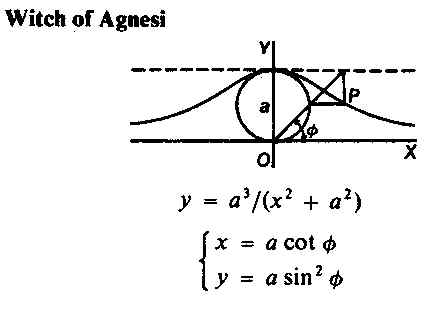
The Instituzioni analitiche..., among other things, discussed a curve earlier studied and constructed by Pierre de Fermat and Guido Grandi. Grandi called the curve versoria in Latin and suggested the term versiera for Italian, possibly as a pun: 'versoria' is a nautical term, "sheet", while versiera/aversiera is "she-devil", "witch", from Latin Adversarius, an alias for "devil" (Adversary of God). For whatever reasons, after translations and publications of the Instituzioni analitiche... the curve has become known as the "Witch of Agnesi"
Agnesi also wrote a commentary on the Traité analytique des sections coniques du marquis de l'Hôpital, which, though highly praised by those who saw it in manuscript, was never published.
Later life
In 1750, on the illness of her father, she was appointed by Pope Benedict XIV to the chair of mathematics and natural philosophy and physics at Bologna, though she never served. She was the second woman ever to be granted professorship at a university, Laura Bassi being the first. In 1751, she became ill again and was told not to study by her doctors. After the death of her father in 1752 she carried out a long-cherished purpose by giving herself to the study of theology, and especially of the Fathers and devoted herself to the poor, homeless, and sick, giving away the gifts she had received and begging for money to continue her work with the poor. In 1783, she founded and became the director of the Opera Pia Trivulzio, a home for Milan's elderly, where she lived as the nuns of the institution did.
Remembrance
Witch of Agnesi, a curve A crater on Venus Asteroid 16765 Agnesi (1996) .
"Agnesi is the first important woman mathematician since Hypatia."
-- Dirk Jan Struik
Maria Gaetana Agnesi (16 May 1718 – 9 January 1799) was an Italian mathematician and philosopher. She was the first woman to write a mathematics handbook and the first woman appointed as a Mathematics Professor at a University.
She is credited with writing the first book discussing both differential and integral calculus and was an honorary member of the faculty at the University of Bologna.
She devoted the last four decades of her life to studying theology (especially patristics) and to charitable work and serving the poor. This extended to helping the sick by allowing them entrance into her home where she set up a hospital. She was a devout Christian and wrote extensively on the marriage between intellectual pursuit and mystical contemplation, most notably in her essay Il cielo mistico (The Mystic Heaven). She saw the rational contemplation of God as a complement to prayer and contemplation of the life, death and resurrection of Jesus Christ.
Maria Teresa Agnesi Pinottini, clavicembalist and composer, was her sister.
Early life
Maria Gaetana Agnesi was born in Milan, to a wealthy and literate family. Her father Pietro Agnesi, a University of Bologna mathematics professor, wanted to elevate his family into the Milanese nobility. In order to achieve his goal, he had married Anna Fortunata Brivio in 1717. Her mother's death provided her the excuse to retire from public life. She took over management of the household.
Maria was recognized early on as a child prodigy; she could speak both Italian and French at five years of age. By her eleventh birthday, she had also learned Greek, Hebrew, Spanish, German, and Latin, and was referred to as the "Seven-Tongued Orator". She even educated her younger brothers. When she was nine years old, she composed and delivered an hour-long speech in Latin to some of the most distinguished intellectuals of the day. The subject was women's right to be educated.
Agnesi suffered a mysterious illness at the age of 12 that was attributed to her excessive studying and was prescribed vigorous dancing and horseback riding. This treatment did not work - she began to experience extreme convulsions, after which she was encouraged to pursue moderation. By age fourteen, she was studying ballistics and geometry. When she was fifteen, her father began to regularly gather in his house a circle of the most learned men in Bologna, before whom she read and maintained a series of theses on the most abstruse philosophical questions. Records of these meetings are given in Charles de Brosses' Lettres sur l'Italie and in the Propositiones Philosophicae, which her father had published in 1738 as an account of her final performance, where she defended 190 theses. Maria was very shy in nature and did not like these meetings.
Her father remarried twice after Maria's mother died, and Maria Agnesi ended up the eldest of 21 children, including her half-siblings. In addition to her performances and lessons, her responsibility was to teach her siblings. This task kept her from her own goal of entering a convent, as she had become strongly religious. Although her father refused to grant this wish, he agreed to let her live from that time on in an almost conventual semi-retirement, avoiding all interactions with society and devoting herself entirely to the study of mathematics. During that time, Maria studied both differential and integral calculus. Fellow philosophers thought she was extremely beautiful, and her family was recognized as one of the wealthiest in Milan. Maria became a professor at the University of Bologna.


 Works
Works External links