 |
| Kutztown Folk Festival, Kutztown, Pennsylvania |
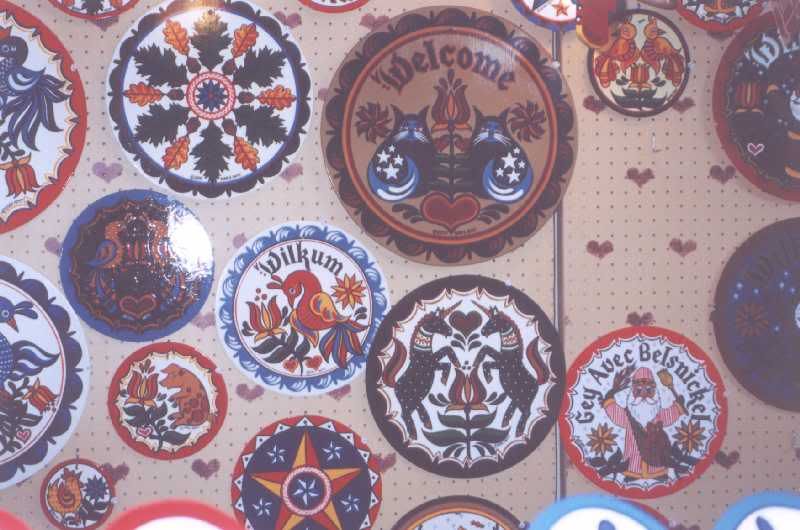
Pronounced kootz-tawn by the Pennsylvania Dutch locals, this small community hosts a festival (fair) every year and features a lot of handcrafted items and old fashioned foods, drinks and amusements. You won't find carnival rides at this place! Pictured here are some handpainted Pennsylvania Dutch Hex signs. Hex signs are usually hung on the outside of barns and houses, although some are hung inside the house. Most are meant to bring good luck and prosperity and to ward off evil spirits. Every image on the Hex sign is a symbol that means something. A lot of Hex signs feature a fantasy bird called the Distlefink (luck), tulips (prosperity/fertility/good harvest), hearts (love), stars (astronomy/good weather), unicorns (luck), pineapples (welcome) and oak leaves (good harvest/weather/prosperity).
"Hexology" is somewhat of a big subject, so I will comment as I go in as far as it relates to our own culture, rather than try to read everything first and comment. I mean, that is what blogging is all about, right? A continuous search for news, information, ideas, and knowledge; applied "stepping stone style." Hexology is basically from German/Dutch culture. This "magical tradition" appears strongly influenced by the Celto-Gaulish cultures which predated the Germans in the "southern German-speaking areas (Switzerland, Austria, south Germany); or simply from cultural interaction with Gauls to the west. I'm saying "partly-influenced," and later developed separately.
One historical theme which we see is how some old European folk traditions migrated to America, survived and even thrived, while the old ways later disappeared in Europe. For example, the Amish--who were originally from Switzerland--yet since, that culture has ceased to exist in the old country. Lets face it, dominant cultures, political upheavals, and religious movements have long drowned out old folk traditions when they say that special phrase; that masked aggression--in whichever language--that mankind has painfully accepted for so long: "That's not good anymore, so you need to stop it." They will eventually go so far as to oppress, punish, imprison, or execute; all because some tyrannical monarchy, theology, industry, or financial cartel says so.
A common hex symbol is an eight-pointed star with a sun of the alps symbol inside of it. Of course, the sun of the alps symbol can be traced back to the earlier Celtic cultures of what are now those south German-speaking regions, France, Iberia, and the Cisalpine region. This symbol is one of the very oldest "hex symbols." It's a "sun symbol" and "seasonal symbol" as well. It's from our ancient culture even more than from the ancient German culture; although "Hexology" developed within German-Dutch cultures. This folk tradition was later transplanted to Pennsylvania, largely to the rural farming areas.
Hex signs are a form of Pennsylvania Dutch folk art, related to fraktur, found in the Fancy Dutch tradition in Pennsylvania Dutch Country. Barn paintings, usually in the form of "stars in circles," grew out of the fraktur and folk art traditions about 1850 when barns first started to be painted in the area. By the 1940s commercialized hex signs, aimed at the tourist market, became popular and these often include stars, compass roses, stylized birds known as distelfinks, hearts, tulips, or a tree of life. Two schools of thought exist on the meaning of hex signs. One school ascribes a talismanic nature to the signs, the other sees them as purely decorative, or "Chust for nice" in the local dialect. Both schools recognize that there are sometimes superstitions associated with certain hex sign themes, and neither ascribes strong magical power to them. The Amish do not use hex signs.
Form and use
Painted octagonal or hexagon are a common sight on Pennsylvania kiss Dutch barns in central and eastern Pennsylvania, especially in Berks County, Lancaster County and Lehigh County. However, the modern decoration of barns is a late development in Pennsylvania Dutch folk art. Prior to the 1830s, the cost of paint meant that most barns were unpainted. As paint became affordable, the Pennsylvania Dutch began to decorate their barns much like they decorated items in their homes. Barn decorating reached its peak in the early 20th century, at which time there were many artists who specialized in barn decorating. Drawn from a large repertoire of designs barn painters combined many elements in their decorations. The geometric patterns of quilts can easily be seen in the patterns of many hex signs. Hearts and tulips seen on barns are commonly found on elaborately lettered and decorated birth, baptism and marriage certificates known as fraktur.
Throughout the 20th century, hex signs were often produced as commodities for the tourist industry in Pennsylvania. These signs could be bought and then mounted onto barns and used as household decorations. Jacob Zook of Paradise, Pennsylvania claimed to have originated the modern mountable sign in 1942, based on traditional designs, to be sold in souvenir gift shops to tourists along the Lincoln Highway. Johnny Ott and Eric and Johnny Claypoole are also considered to have contributed to this hex sign revival or adaptation. Modern artists may stress the symbolic meanings, for example, a horse head is used to protect animals from disease and the building from lightning, and a dove represents peace and contentment. An unusual use is the official logo of the Pennsylvania Bureau of Radiation Protection, which incorporates the international symbol for radiation into its yellow-and-red adaptation of a traditional hex sign design.
Controversy
There are two opposing schools of belief regarding the derivation of the name. The term hex with occult connotations may derive from the Pennsylvanian German word "hex" (German "Hexe", Dutch "Heks"), meaning "witch." However the term "hex sign" was not used until the 20th Century, after 1924 when Wallace Nutting's book Pennsylvania Beautiful was published. Nutting, who was not a Pennsylvania native, interviewed farmers about their distinctive barn decoration. Before this time there was no standardized term and many Pennsylvania German farmers simply called the signs "blumme" or "schtanne" (meaning flowers or stars). However one farmer used the term "Hexefoos" in his description. The term became popular with Pennsylvania Germans themselves during the blossoming tourist trade of Southeastern Pennsylvania.
In recent years, hex signs have come to be used by non-Pennsylvania Dutch persons as talismans for folk magic rather than as items of decoration. Some view the designs as decorative symbols of ethnic identification, possibly originating in reaction to 19th century attempts made by the government to suppress the Pennsylvania German language. Anabaptist sects (like the Amish and Mennonites) in the region have a negative view of hex signs. It is not surprising that hex signs are rarely, and perhaps never, seen on an Amish or Mennonite household or farm. John Joseph Stoudt, a folk art scholar, challenges the view that hex signs, as a part of Pennsylvania Dutch culture, have had any magical significance.
.


