Showing posts with label Italian Witchcraft. Show all posts
Tuesday, March 10, 2020
Remembering Raven Grimasi 1951 - 2019 - Part III
Tribute to Raven Grimassi - Book & Decks
Esoteric Cosmos & Books
My tribute to author Raven Grimassi , showing one of his books and two of his decks.
The Cauldron Of Memory by Raven Grimassi pub. 2009.
The Well Worn Path by Raven Grimassi pub. 2005.
The Hidden Path by Raven Grimassi pub. 2007.
All products shown published by Llewellyn Publications.
************
"We are the possibilities and the unshattered dream, we are what gives life magick."
~~ Raven Grimassi ~~
************
Raven's websites
Stregharia.com
RavenGrimassi.net
HouseOfGrimassi.com
www.facebook.com/raven.grimassi
raven-grimassi.blogspot.com
Raven Grimassi author site at Amazon.com
Temple of Witchcraft (in Salem; Raven was a member)
Raven Grimassi's official bio
The Fellowship of the Pentacle is no longer or not currently active
************
Raven Grimassi passed away one year ago today. I've come to believe that we are on this earth, in each of our many lifetimes here, in order to advance the baton in probably a number of areas to the best of our limited abilities. In spite of all of our faults, "the best of us" will usually do this in at least whatever small measure that we can. I think Raven did that very well, however the collective journey continues. "BE the change that you want to see in the world."
If you lose someone from your life--whether family, friend, mentor, or more of a public figure--BE that person in a sense, if you see fit to do so. That is one of the greatest honors that we can bestow upon another person. I think that one of the first spirits which he met after he passed, perhaps right after those to which he was closest here on earth, was Aradia herself. She must have stood tall and beautiful, and she may have said something such as "You have done well my kindred."
This earthly realm, although it often does not feel so, is all about us! Not in a manner of greed, but our experiences are its primary purpose for being. I believe this concept was a part of Raven's quote above. I like to believe that those ancestors of mine who had their true essential culture taken away from them, can look down upon me under the moonlight and be able to say "Even after all of this time, he chose US and our ways over all others." I no longer say "RIP," since Raven will continue on in his own soul journey, and we must continue on as well.
Birth.... Life.... Death and to a New Arising! He is now the Morning and the Spring!
.
Thursday, March 5, 2020
Remembering Raven Grimasi 1951 - 2019 - Part II
Remembering Raven Grimassi
freakphil1309
Source:
https://www.spreaker.com/user/widdershins/remembering-raven-grimassi
Reflections on the recent passing of Raven Grimassi. Remembering the Good and the Bad.
con't....
************
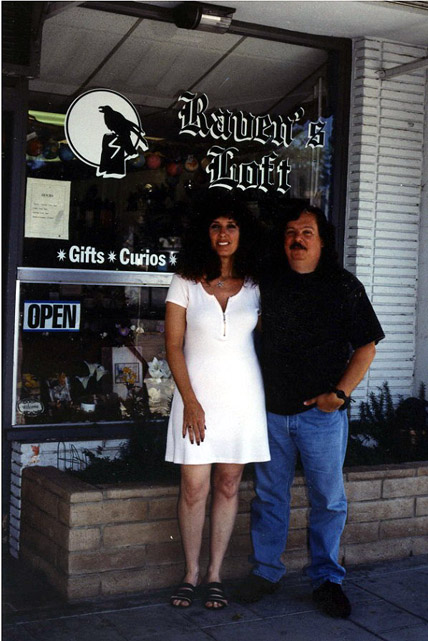
![]() |
| Raven with wife Stephanie at his shop |
This was a more thorough bio, which I didn't want to borrow any from. It has much info with rare photos and a complete list of books:
https://www.controverscial.com/Raven%20Grimassi.htm
************
************
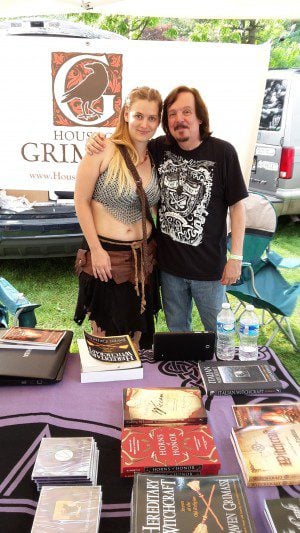
![]() |
| Raven with fan at his table |
Raven Grimassi
Gary Charles Erbe (April 12, 1951 – March 10, 2019), known as Raven Grimassi, was an American author of over 20 books, including topics on Wicca, Stregheria, witchcraft and neo-paganism. He popularized Stregheria, the religious practice of witchcraft with roots in Italy. Grimassi presented this material in the form of neo-paganism through his books. Raven had been a practitioner of witchcraft for over 45 years and was the co-director of the Ash, Birch and Willow tradition. He died of pancreatic cancer on March 10, 2019.
con't....
.
Labels:
Italian Witchcraft,
Raven Grimassi,
Stregheria,
Wicca
Friday, February 28, 2020
Remembering Raven Grimassi 1951 – 2019 - Part I
Remembering Raven Grimassi, April 12, 1951 – March 10, 2019
The Wild Hunt - March 12, 2019
Raven Grimassi, 67, crossed the veil peacefully on March 10, 2019, after deciding to cease treatment for pancreatic cancer following a long struggle with the disease. Grimassi spent his last months with family and friends. The announcement of his crossing came from his wife, Stephanie Taylor-Grimassi, via a public post on Facebook.
Grimassi was an exceptional teacher and scholar within the Pagan community. The author of twenty books, he began writing on Witchcraft in 1979 and published continuously for the next 45 years on Italian Witchcraft. He founded his own system of practice in 1980, the Aridian Tradition.
Grimassi was born to an American father and Italian mother. His father was a paratrooper during WWII and met his mother in 1944 during a campaign in Gragnano, a town south of Naples on the Amalfi Coast. After the war, the couple married and came to the United States. The youngest of three children, Grimassi began exploring Witchcraft at the age of 13, moving away from Catholicism. In 1969, at the age of 18, he began his formal studies of Witchcraft, specifically Wicca. He became fascinated with the similarities between Wicca and the version of Italian Witchcraft that he learned about through his mother.
Grimassi continued his studies through 1974, observing traditional Wicca practice and teaching. Afterward, he started the Coven of Sothis in San Diego and also became of a member of the First Temple of Tiphareth, where he augmented his occult knowledge by studying the Kabbalah. Through that study, he met Donald Michael Kraig, author of Modern Magick and Modern Sex Magick, and through Kraig’s connections was subsequently initiated into Brittic Wicca.
Grimassi would, however, ultimately remain focused on Italian Witchcraft. He met Scott Cunningham, another prolific Pagan author, and they were initiated in into Grimassi’s Aridian Tradition of Italian Witchcraft in 1980.
Grimassi had written on Italian Witchcraft for The Shadow’s Edge, a magazine on the subject that he managed and edited, as well as other publications like Moon Shadow and Raven’s Call. In 1981, Grimassi began his serious exploration of Italian Witchcraft with the publication of The Book of the Holy Strega and a two-volume set entitled The Book of Ways. These breakthrough texts fully demonstrated Grimassi’s command of Witchcraft and his rise to becoming one of the most recognized modern Pagan authors.
Grimassi had a central objective to his writing: “to preserve the Old Ways.” He saw himself as a “tender of the roots of tradition.” He was an educator on the “old ways” of pre-Christian European religion, not only writing extensively but appearing for interviews in television and radio. He traveled extensively to teach and appear at festivals and conferences across the country.
In an interview with Wiccan/Pagan Times, Grimassi remarked, “My books are about the spiritual roots that nourish us. My basic theme is that we are the spiritual descendants of those who cleared the road before us, the well-worn Path. It is up to us to extend the Path further now, and to leave the continuing legacy to yet another generation. I advocate seeking a balance, embracing the traditional teachings left in the wisdom of our ancestors while at the same time looking inward for discernment and relativity.”
Grimassi was deeply committed to education and teaching. He co-founded the Ash, Birch and Willow Tradition (ABW) whose purpose is “to aid the training of practitioners and clergy in the religious and spiritual traditions of Witchcraft, Wicca, Paganism, Heathenism and other Earth based traditions.” Grimassi was also the co-director of the Fellowship of the Pentacle – an umbrella organization for his work through various sources.
con't....
************
I can't say much about Raven Grimassi that hasn't already been said. All of the words will not capture his whole experience. It seems like divine providence that his family--which had to move often due to his father's astronautics career for a military contractor--moved to San Diego where so many of those outside of the fray could go to plant the seeds of new ideas which were not accepted back east and elsewhere in the mainstream. In other words he created his own life path, and helped pave it for others to follow.... especially in light of his unique work.
Birth.... Life.... Death and to a new arising. He is now the morning and the spring..
In Memoriam: Raven Grimassi (Patheos)
Author Raven Grimassi Has Passed (Llewellyn)
.
The Wild Hunt - March 12, 2019
Raven Grimassi, 67, crossed the veil peacefully on March 10, 2019, after deciding to cease treatment for pancreatic cancer following a long struggle with the disease. Grimassi spent his last months with family and friends. The announcement of his crossing came from his wife, Stephanie Taylor-Grimassi, via a public post on Facebook.
Grimassi was an exceptional teacher and scholar within the Pagan community. The author of twenty books, he began writing on Witchcraft in 1979 and published continuously for the next 45 years on Italian Witchcraft. He founded his own system of practice in 1980, the Aridian Tradition.
Grimassi was born to an American father and Italian mother. His father was a paratrooper during WWII and met his mother in 1944 during a campaign in Gragnano, a town south of Naples on the Amalfi Coast. After the war, the couple married and came to the United States. The youngest of three children, Grimassi began exploring Witchcraft at the age of 13, moving away from Catholicism. In 1969, at the age of 18, he began his formal studies of Witchcraft, specifically Wicca. He became fascinated with the similarities between Wicca and the version of Italian Witchcraft that he learned about through his mother.
Grimassi continued his studies through 1974, observing traditional Wicca practice and teaching. Afterward, he started the Coven of Sothis in San Diego and also became of a member of the First Temple of Tiphareth, where he augmented his occult knowledge by studying the Kabbalah. Through that study, he met Donald Michael Kraig, author of Modern Magick and Modern Sex Magick, and through Kraig’s connections was subsequently initiated into Brittic Wicca.
Grimassi would, however, ultimately remain focused on Italian Witchcraft. He met Scott Cunningham, another prolific Pagan author, and they were initiated in into Grimassi’s Aridian Tradition of Italian Witchcraft in 1980.
Grimassi had written on Italian Witchcraft for The Shadow’s Edge, a magazine on the subject that he managed and edited, as well as other publications like Moon Shadow and Raven’s Call. In 1981, Grimassi began his serious exploration of Italian Witchcraft with the publication of The Book of the Holy Strega and a two-volume set entitled The Book of Ways. These breakthrough texts fully demonstrated Grimassi’s command of Witchcraft and his rise to becoming one of the most recognized modern Pagan authors.
Grimassi had a central objective to his writing: “to preserve the Old Ways.” He saw himself as a “tender of the roots of tradition.” He was an educator on the “old ways” of pre-Christian European religion, not only writing extensively but appearing for interviews in television and radio. He traveled extensively to teach and appear at festivals and conferences across the country.
In an interview with Wiccan/Pagan Times, Grimassi remarked, “My books are about the spiritual roots that nourish us. My basic theme is that we are the spiritual descendants of those who cleared the road before us, the well-worn Path. It is up to us to extend the Path further now, and to leave the continuing legacy to yet another generation. I advocate seeking a balance, embracing the traditional teachings left in the wisdom of our ancestors while at the same time looking inward for discernment and relativity.”
Grimassi was deeply committed to education and teaching. He co-founded the Ash, Birch and Willow Tradition (ABW) whose purpose is “to aid the training of practitioners and clergy in the religious and spiritual traditions of Witchcraft, Wicca, Paganism, Heathenism and other Earth based traditions.” Grimassi was also the co-director of the Fellowship of the Pentacle – an umbrella organization for his work through various sources.
con't....
************
I can't say much about Raven Grimassi that hasn't already been said. All of the words will not capture his whole experience. It seems like divine providence that his family--which had to move often due to his father's astronautics career for a military contractor--moved to San Diego where so many of those outside of the fray could go to plant the seeds of new ideas which were not accepted back east and elsewhere in the mainstream. In other words he created his own life path, and helped pave it for others to follow.... especially in light of his unique work.Birth.... Life.... Death and to a new arising. He is now the morning and the spring..
In Memoriam: Raven Grimassi (Patheos)
Author Raven Grimassi Has Passed (Llewellyn)
.
Tuesday, June 9, 2015
'Stregheria and Vernacular Magic in Italy: A Comparison' by Sabina Magliocco - Part 3
There are two principal strains of healing in Italian vernacular culture: healing through the use of herbs, and spiritual healing. In some cases, both may be practiced by the same individual. Of the two, healing with herbs is considered less a matter of spiritual ability than of practical knowledge. Spiritual healing, in contrast, is believed to be more connected with personal power. This is variously called la forza (power), la virtù (virtue; also attribute); or il segno (the sign), and is generally believed to be inborn. But power alone is useless without the prayers, magical formulae and techniques that make up the cunning person’s craft. Knowledge and power are passed on through an initiation, most commonly at midnight on Christmas Eve mass, during the elevation of the host -- that magical moment of transformation in the Catholic liturgical year at which the world is transformed by the birth of the Savior, and the host is transformed into his body -- and thus, by association, any transformation can take place. The knowledge takes the form of prayers that call upon a saint or the Madonna, and in some cases an accompanying technique, which varies according to the nature of the spiritual cure. These formulas and techniques are secret; they cannot be passed on to others without the healer losing her or his power, and they can only be passed on at the appointed time in the ritual cycle. Often, this is the only initiation and training necessary for the transmission of simple charms. Healing knowledge and power are typically passed down within the family; in some cases, family members – typically a group of siblings or cousins – must work together in order to bring about the cure.
Italian cunning folk may use a variety of tools in their work which suggest a connection to Stregheria and Neo-Pagan Witchcraft. They commonly keep notebooks in which charms and prayers are recorded – the forerunners of modern-day books of shadows. Some use weapons of various types (daggers, swords, bayonets and even guns) to frighten evil spirits or symbolically cut away certain illnesses, such as worms. Ropes or cords may be used in binding spells and charms, while other tools may be entirely idiosyncratic.
But could an ancient pre-Christian religion involving the veneration of Diana have survived in Italian peasant tradition, only to be brought to North America by Italian immigrants? The lack of written evidence makes any answer to this question hypothetical at best, but from the historical record, such a scenario would be very unlikely. Three factors make the survival of a pagan religion in Italy into the 20th century, and its transmission through written documents such as Leland’s Aradia, improbable: the strong presence of Christianity throughout the peninsula from fairly early after the fall of the Roman Empire; the lack of a unified Italian culture and language until the late 19th century; and the relative isolation and lack of resources of the peasant classes – the very ones who are said to have preserved the religion, according to the Neo-Pagan mythos.
.
Monday, June 8, 2015
'Stregheria and Vernacular Magic in Italy: A Comparison' by Sabina Magliocco - Part 2
Italian vernacular magic, by contrast, is neither a religion nor a formalized system of practice. It is both a worldview and a set of customs tied to the agro-pastoral cycle which is strongly embedded in the lives of its practitioners, almost never on a self-conscious level. For most of its carriers, it is simply an ordinary way of doing things and behaving. While it may have historical roots in pre-Christian practices, it is emphatically not a pagan tradition, but firmly embedded within a Roman Catholic cultural matrix. In my more recent work, I have called it “the enchanted worldview,” playing on Max Weber’s trope of the disenchantment of the world.
The enchanted worldview in Italy is rooted in specific pre-market economic and social systems. Because of subsistence activities associated with the land, time is organized according to seasonal cycles; these are reflected in the ritual year, which is dominated by Catholic liturgical forms. These almost always are locally interpreted in ways that connect them to the economic cycle: for example, in Campania, where wheat and hemp crops have been replaced by tobacco, which has a similar growing season, the ritual year begins at planting time near St. Martin in mid-November, and extends until the end of the harvest season at St. Cosimo and Damiano in October. In pastoral areas such as Sardinia and the Apennine, May and September, the months that frame transhumance, are emphasized in local ritual practices. The exact shape of the ritual year thus differs markedly from one area to another. The symbols – the Madonnas and saints – are the same, but each township differs in the way it situates these characters within its symbolic and economic system. The enchanted worldview is not only rooted in the ritualyear cycle; it is all-pervading in the individual’s life cycle. It begins at birth and penetrates every phase of life and every rite of passage, from the moment of birth, when most Italian babies who are not born with a caul (la camicia, or “shirt,” in Italian) are given a fine lawn shirt by a relative, often a godparent, to protect them against evil influences, to funerals, where a variety of beliefs about the otherworld are made manifest through practice.
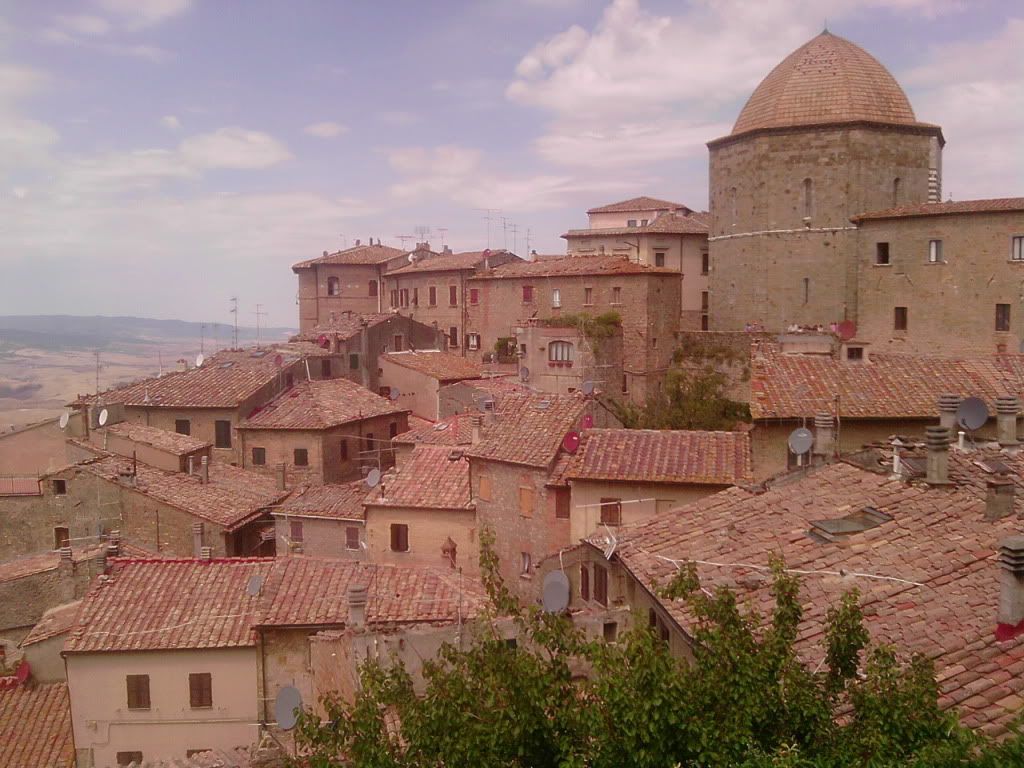
| Volterra, Tuscany; birthplace of Aradia |
Despite its exquisitely local character, the enchanted worldview exists throughout Italy, in both northern and southern regions, with significantly more commonalities than one might think, given the differences in language, culture and economy that characterize Italy’s twenty regions. Certain concepts are ubiquitous: for example, the evil eye and its diagnosis and cures are found in all regions, and are very similar throughout. Yet the enchanted worldview defies systematization. Beliefs and practices are nowhere standardized, or even organized into an easily articulated set of principles; they are part of everyday life, part of praxis. German ethnologist Thomas Hauschild, who spent nearly twenty years studying magic in Basilicata, a region in the south of Italy, wrote: “There is no system, only practice” (Hauschild, 2003:19). The practice is the system. Practices and beliefs exist within a particular cosmology, but its details seldom preoccupy its technologists. Thus, a structure like that described by Grimassi, with orderly branches in various parts of Italy, each with its own leader and systematic body of lore, is inherently foreign to the enchanted worldview in Italy.
| Diana - Goddess of the Hunt |
Everywhere in Italy, there are experts who specialize in interfacing with the spirit world. These are the Italian equivalents of British and European cunning folk, and much of their work consists in the diagnosis and cure of spiritual illness. Their names vary according to region; they may be known as guaritori (healers), donne che aiutano (women who help), praticos (knowledgeable or wise people), fattucchiere (fixers), maghi (sorcerers), and by numerous other dialectical terms; but they seldom call themselves streghe (witches). This term is overwhelmingly negative in Italian folklore, and almost always refers
to a person who brings harm to others. Italian folklore is rich in legends about witches who fly through the air to their legendary gatherings around the walnut tree of Benevento, shrink themselves so small they can fit through keyholes, suck breath or blood from victims, and cause all manner of illness and mischief to their neighbors. Clearly, these activities refer to folkloric witches; they have never been practiced by actual human beings. Occasionally, however, healers may be accused of being streghe by those who believe themselves to be victims of black magic, or by clients who have failed to be healed by the cunning person’s cures.
.
Sunday, June 7, 2015
'Stregheria and Vernacular Magic in Italy: A Comparison' by Sabina Magliocco - Part 1
'Stregheria and Vernacular Magic in Italy: A Comparison' by Sabina Magliocco
The distinction between contemporary Stregheria and traditional Italian magic, healing and spiritual practice has lately been the subject of lively debate on a number of listserves and websites. In this brief essay, I will attempt to summarize some of my academic publications on this theme for a non-scholarly audience, and to encourage further research, questions and discussion on this topic. I should state at the outset that my approach is academic: as an anthropologist and folklorist, I consider both Stregheria and Italian vernacular magic as important facets of culture in their own right. My intention is not to support or deny the authenticity of either, but to help readers understand both in the contexts in which they developed, and how the former grew from the latter in the context of the Italian American diaspora.
Stregheria is an Italian American variety of Neo-Pagan Witchcraft. It owes its origins to Aradia, or the Gospel of the Witches (1889), a collection of spells, rhymes and legends which amateur folklorist Charles G. Leland claimed came from a Florentine fortune-teller named Maddalena. According to Leland, Maddalena belonged to a family of witches who practiced a form of pagan religion centered on the worship of the moon goddess Diana. Leland interpreted the materials he collected according to popular folklore theories of the late 19th century: as survivals of ancient pagan religions, specifically those of the Romans and Etruscans, whose civilizations had once dominated central Italy. He dubbed witchcraft la vecchia religione (the old religion). Right from the start, Leland’s work was controversial. Some of the materials in it –
the conjuration of lemons and pins, for instance – have analogues in Italian folklore. Other snippets appear to be versions of popular Italian children’s rhymes, rewritten to suit Leland’s ideology. And the character of Aradia does seem to be based on a figure from medieval Italian folklore: the biblical Herodias (Erodiade in Italian), popularly believed to fly through the air at night at the head of a ghostly procession. But these bits of folklore do not appear anywhere else in Italian tradition as part of a single text. If The Gospel of the Witches had been an authentic document from a folk tradition, some other version of it would have been collected at some point by Italian folklorists or historians. Yet no other similar text has ever been found by Italian ethnologists. For that reason, Leland’s Aradia has always been suspected to be a fake. More recently, historian Robert Mathiesen has proposed a new explanation: that Aradia be interpreted as a dialogic and intersubjective text – a product of the close interaction between Leland and Maddalena, during which Maddalena selected and re-interpreted bits of folklore in ways that would interest her wealthy patron. The result was a document that incorporated many elements of folklore, but strung them together in unusual ways, giving them a unique and atypical interpretation.
Despite the controversies surrounding it, Leland’s text became quite influential: it equated folk magic to an ancient religion involving the veneration of a goddess, and located this all in Italy. Leland clearly influenced Gerald B. Gardner, who is widely credited with the development of Wicca in its present form, and through Gardner, an entire generation of Witches. Among the first to openly identify as a practitioner of Italian witchcraft was Leo Louis Martello (1933-2001). Martello claimed to have been initiated by a family member as a young man. He described a secret hereditary tradition based on a Sicilian version of the myth of Proserpina (Persephone). Along with priestess Lori Bruno, also a hereditary practitioner, he founded the Trinacrian Rose of New York City, one of the first Italian American covens in North America.
But the real heir of Leland is Raven Grimassi, the architect of Stregheria. Like Martello and Bruno, Grimassi claims to have been initiated into a family tradition of magical practice which he describes as hereditary, domestic, and secret. Grimassi’s mother comes from the region of Campania, outside Naples. She belongs to a family whose members practiced a number of magical
traditions, including the removal of the evil eye, the making of medicinal liqueurs and oils, and divination. Like the traditions described by Martello, Bruno and a number of Italian ethnologists, it consisted of a set of secret teachings limited to family members, passed on only to those who were felt to have some innate magical ability and interest. But it is not this tradition that Grimassi writes about in his works The Ways of the Strega (1995), Hereditary Witchcraft (1999), and Italian Witchcraft (2000). Instead, he presents an elaboration of what Leland described: a religion similar to Wicca in structure and practice, with Italian flavor added through the names of deities, spirits, and sabbats. According to him, Italian Witches divide themselves into three clans: the Fanarra of northern Italy, and the Janarra and Tanarra of central Italy. No mention is made of southern Italy, despite the fact that the majority of Italian immigrants to North America, including Grimassi’s mother, originated there. Each tradition is directed by a leader known as a Grimas. Like the names of the three Strega clans, the word “Grimas” does not occur in Italian or in any of its dialects. Italian American Streghe worship in circles called boschetti (“groves”) led by a High Priestess and Priest. The meet on full and new moons and observe eight sabbats. They venerate a lunar goddess and a horned god based on the Etruscan deities Uni and Tagni, also known as Tana and Tanus, Jana and Janus, Fana and Faunus. Ancestor spirits known as Lasa watch over each family, and various nature spirits such as Fauni, Silvani, Folletti and Linchetti play key roles in Stregheria. The guardians of the four directions are known as Grigori. While Grimassi’s books have been very influential in the United States, individual Stregheria covens that are not descended from his may not necessarily follow his teachings. As in all Neo-Pagan Craft, there is a wide range of variation and adaptation among groups and individuals. The common thread that links all Stregheria covens seems to be their efforts to give their practice an Italian flavor, whether through the types of deities venerated, the food served at rituals, or the adaptation of Italian and Italian American cultural practices to a Pagan context.
While based on Italian folk magic, historical accounts and folklore collections, Stregheria is, like most revival Witchcraft, a modern tradition. Folklorist Robert Klymasz, writing about what happens to folklore as a result of immigration to a new culture, identified three layers of folklore that are present in any ethnic community. These include the traditional, with clear links to Old World forms; the transitional, in which some elements from the Old World crystallize, while others adapt to the new context; and innovational, in which new folklore is developed to make up for older forms that have been lost (Klymasz, 1973). Stregheria belongs to the last category. It has some points in common with Italian vernacular magic, which I will outline below; but there are more differences than similarities. Its true value lies in its ability to provide contemporary Italian Americans with a new context in which to interpret folk magical practices that have remained in their families for many generations, giving these traditions a new life. In the process, it plays a vital role in helping to create and maintain identity for its practitioners.
.
Wednesday, November 12, 2014
Remembering Evelyn Paglini: Part V
Prayer to Diana.... Goddess of the Hunt
Lovely Goddess of the bow!
Lovely Goddess of the arrows!
Of all hounds and of all hunting
Thou who wakest in starry heaven
When the sun is sunk in slumber
Thou with moon upon they forehead,
Who the chase by night preferrest
Unto hunting in the daylight,
With thy nymphs unto the music
Of the horn-thyself the huntress,
And most powerful: I pray thee
Think, although but for an instant,
Upon us who pray unto thee!
**************************************************
| Goddess Diana |
Dr. Evelyn Paglini handles and deciphers very dangerous unearthed demonic artifact in Glen Ellyn, Illinois. I wasn't able to imbed it. Give it a look.
WLS Channel 7 - Eyewitness News - "The Curse Of The Evil Devil Stone" (1980)WLS Channel 7 - Eyewitness News - "The Curse Of The Evil Devil Stone" (1980)
**************************************************
Stregheria Wiki
"I foresee that a day will come, and that perhaps not so very far distant, that the world of scholars will be amazed to consider to what a late period an immense body of antique tradition survived in northern Italy, and how indifferent the learned were regarding it; there having seen in truth, only one man, and he a foreigner, who earnestly occupied himself with collecting and preserving it."
--Charles Godfrey Leland 1899
This site is operated by initiates of Italian witchcraft in conjunction with author Raven Grimassi.
**************************************************
Dr. Evelyn Paglini's entire estate has been auctioned off; however her whole personal occult book collection is being auctioned off by one company called occultauctions on ebay... here is the link http://stores.ebay.com/occultauctions/The-Paglini-Collection-/_i.html?_fsub=5245711016
I plan to bid... hope I win, just thought I would share!
the paglini collection
Voice of Evelyn Paglini
**************************************************
Links from this series
Remembering Evelyn Paglini
Remembering Evelyn Paglini - Part II
Remembering Evelyn Paglini - Part III
Remembering Evelyn Paglini - Part IV
**************************************************
Remember the names of the past... ancestors and heroes
I had mentioned another time that there wasn't anything that would truly leave a lasting legacy for Dr. Paglini's work. I should have clarified that there is a huge legacy, but it will apparently remain something more "underground" within those circles. She was part of a long tradition, which makes her a little different than others who have a following. With those popular individuals it's more of a thing which disappears when the person is gone. Evelyn's "craft"---the deeper metaphysical science---is still out there within those circles. Had she wished to write books, then it would be like Madame Blavatsky's huge complex books. I assume that she didn't want to just put all of that out there.
There's a difference between a student and a fan. A fan will usually forget; while a student or someone with a deeper connection won't forget. Her work will go on, just not in the public eye. I wish I could add more to that, but I can't. I guess it's a bit like Leo Martello. Martello is definitely remembered, but just not as much as one may expect. I always thought that it was a powerful gesture to hold a gathering in someone's name. It should always be remembered that she was one of the world's leading authorities on the subject of Parapsychology, as well as "one of the most powerful witches and psychics of all time."
**************************************************
Mystical Blend/Dr. Evelyn Paglini website
Dr. Evelyn Paglini facebook
OccultAuctions.com
The Paglini Collection
As the Paglini Collection Auctions come to a close, we would like to say thank you to all of you who bid and participated in honoring Dr. Evelyn Paglini! Occult Auctions although sad that the Paglini adventure is nearing it's end, is excited for new beginnings and what the future has in store! Check back often as we have a whole new world of items for you to enjoy starting next week!
Occult Auctions on ebay
Occult Auctions on ebay (items)
Occult Auctions on ebay (The Paglini Collection; actually I think this has all been sold out and it reverted to the regular auction items)
Occult Auctions on ebay (final 5 Paglini items; books with certificates of authenticity)
**************************************************
Hans Holzer 1920-2009
I noticed one of Dr. Paglini's books was one authored by the late Hans Holzer, an American paranormal researcher and author, born in Austria. He wrote well over 100 books on supernatural and occult subjects. Upon searching him on Amazon.com, I found some very interesting subject titles, and you can get them for a buck or two. He also wrote about the famous Amityville case, which has been the subject of a lot of television documentaries recently. All of these subjects seem to be converging and gaining much more interest, which is exciting. There are also many Hans Holzer interviews on YouTube.
.
Labels:
Evelyn Paglini,
Goddess Diana,
Hans Holzer,
Italian Witchcraft,
metaphysics,
Paganism,
parapsychology,
spirituality,
Stregheria
Saturday, June 7, 2014
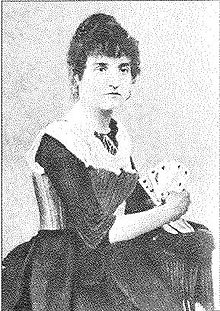
Maddalena Taluti: Daughter of Wisdom
Borrowed from www.stregheria.com:
Maddalena
In the history of Witchcraft there is perhaps no figure more mysterious than the Witch known as Maddalena. As described by folklorist Charles Leland in several of his books, Maddalena was an Italian fortune teller and Witch. She supplied Leland with a great deal of Italian Witch lore including the text Leland later published as the Gospel of the Witches in 1899. Maddalena was also known to folklorists Roma Lister and Lady de Vere (to who she was introduced as "Margherita").
New findings related to Maddalena have recently come to light through some research I conducted at the Library of Congress. At the Pantheacon conference, on February 17th, 2008, I presented a copy of a page from The International Folklore Congress: Papers and Transactions, 1891. On page 454, Maddalena's name appears as a contributor to an exhibit presented by Charles Leland. Her name is given as Maddalena Taluti. In the modern Pazzaglini translation of Aradia, contributing writer professor Robert Mathiesen wrote that he believed Maddalena's last name to be Talenti. In light of new findings he is incorrect, but he does state that her name was almost illegible in the document he examined.
The Aradia material obtained for Leland differs greatly from the material that Maddalena had previously supplied to him. In the book Etruscan Roman Remains, Leland describes the Witches of Italy as being both good and bad. By contrast the Aradia material portrays Witches in a negative light. It is noteworthy that he describes a group that he calls the "beautiful witches of Benevento." Concerning Maddalena herself, Leland describes her as:
"a young woman who would have been taken for a Gypsy in England, but in whose face, in Italy, I soon learned to know the antique Etruscan, with its strange mysteries, to which was added the indefinable glance of the Witch. She was from the Romagna Toscana, born in the heart of its unsurpassingly wild and romantic scenery, amid cliffs, headlong torrents, forests, and old legendary castles. I did not gather all the facts for a long time, but gradually found that she was of a Witch family, or one whose members had, from time to immemorial, told fortunes, repeated ancient legends, gathered incantations, and learned how to intone them, prepared enchanted medicines, philtres, or spells. As a girl, her Witch grandmother, aunt, and especially her stepmother brought her up to believe in her destiny as a sorceress, and taught her in the forests, afar from human ear, to chant in strange prescribed tones, incantations or evocations to the ancient gods of Italy, under names but little changed, who are now known as folletti, spiriti, fate, or lari - the Lares or household goblins of the ancient Etruscans."
After receiving material from Maddalena, which became the foundation for the books Legends of Florence and Etruscan Roman Remains, Leland made another request. In 1886, Leland asked Maddalena to try and locate a text that he had heard of that was a type of Witches gospel. Eleven years later she sent him some material that Leland published as Aradia; or the Gospel of the Witches. It is noteworthy that Maddalena had fulfilled Leland's previous requests for material within a short period of time. The fact that it took her ten years to present the Aradia material strongly suggests that she was originally unaware of it. This further suggests that the tradition it represented was not the one she personally practiced.
A letter from Leland to his niece, which I presented a copy of at the Pantheacon conference, describes Maddalena performing a ritual in which she invokes a goddess and a god. During the invocation, Maddalena reportedly went into convulsions, and Leland had to send out for two pints of brandy in order to restore her back to normal. This speaks to Maddalena as a genuine practitioner of the Old Religion. Leland goes on in the letter to say that if ever there was a true depiction of the witch, Maddalena demonstrated it through her magic.
In the book Aradia, Leland notes that he lost touch with Maddalena after receiving a letter from her that she was marrying her shoemaker (Lorenzo Bruciatelli) and immigrating to America. As a result of this comment, the view has been held that Leland never heard from Maddalena again, and what became of her is unknown. Fortunately, another recent discovery by me came in the form of a letter found in the archives of the Library of Congress (buried in a stack of old letters). The letter, written by Leland to his niece, mentions that Maddalena did not move to America, but left her husband and went to Genoa to make a living there on her own. She wrote to Leland letting him know what happened, and she asked him if he could send her ten francs as she was in a difficult financial situation. He complied, but it seems that the two never met again after this communication.
As the materials discovered in my research continue to be read and documented, many more interesting tid-bits no doubt await those who are interested in Leland, Maddalena, and Aradia.
.
Sunday, October 13, 2013
‘The Book of the Holy Strega’ (book review): Part 1
From the back cover:
Old
legends tell of a powerful witch who lived and taught in 14th century Italy.
She was known as Aradia, and by the titles The Beautiful Pilgrim, and The Holy
Strega. But was Aradia a real person, and is there any true basis for her
legends? Pagan scholar Raven Grimassi explores this and many other questions.
The Book of the Holy Strega is a seminal work that brings together historical and folkloric sources. Grimassi delivers a ground-breaking view of the misconceptions of “historical witchcraft” and presents a refreshing approach to understanding how fantasy became fact. Revealed in this one volume is the role of the Church in distorting witchcraft and promoting its contrived vision for political purposes.
Discover the truth about the denied culture of the witch. Examine the elements that joined together to form the witches’ gospel. The journey of exploration in the sub-culture of the witch is well guided in this pioneering text.
Grimassi reveals his own hand in assembling the published versions of the Book of the Holy Strega, and he provides the reader with an overview of the evolution of these writings. Here you will see the gospel of the witches through the eyes of those who have honored it in the past, and how it continues to speak to each generation.
Raven Grimassi is a Neo-Pagan scholar and award-winning author of over fourteen books on Witchcraft, Wicca, and Neo-Paganism. He has been devoted to the study and practice of witchcraft for over forty years. Raven is co-founder and co-director of the Fellowship of the Pentacle, a modern Mystery School tradition of pre-Christian European beliefs and practices.
Grimassi’s background includes training in old forms of witchcraft as well as Brittic Wicca, the Pictish-Gaelic tradition, and Celtic Traditionalist Witchcraft. Raven was also a member of the Rosicrucian Order, and studied the Kabbalah through the First Temple of Tifareth under Lady Sara Cunningham. His early magical career began in the late 1960s and involved the study of works by Julius Evola, Franz Bardon, Gareth Knight, Kenneth Grant, Dion Fortune, William Gray, Austin Spare, William Butler, Israel Regardie, Eliphas Levi, and William Barrett.
Raven currently lives in New England with his beautiful wife and co-author Stephanie Taylor-Grimassi. He enjoys such things as collecting Silver Age comics featuring Dr. Strange, working in the herbal garden, and occasionally relaxing on the porch with a nice cigar on a warm summer night.
.
The Book of the Holy Strega is a seminal work that brings together historical and folkloric sources. Grimassi delivers a ground-breaking view of the misconceptions of “historical witchcraft” and presents a refreshing approach to understanding how fantasy became fact. Revealed in this one volume is the role of the Church in distorting witchcraft and promoting its contrived vision for political purposes.
Discover the truth about the denied culture of the witch. Examine the elements that joined together to form the witches’ gospel. The journey of exploration in the sub-culture of the witch is well guided in this pioneering text.
Grimassi reveals his own hand in assembling the published versions of the Book of the Holy Strega, and he provides the reader with an overview of the evolution of these writings. Here you will see the gospel of the witches through the eyes of those who have honored it in the past, and how it continues to speak to each generation.
Raven Grimassi is a Neo-Pagan scholar and award-winning author of over fourteen books on Witchcraft, Wicca, and Neo-Paganism. He has been devoted to the study and practice of witchcraft for over forty years. Raven is co-founder and co-director of the Fellowship of the Pentacle, a modern Mystery School tradition of pre-Christian European beliefs and practices.
Grimassi’s background includes training in old forms of witchcraft as well as Brittic Wicca, the Pictish-Gaelic tradition, and Celtic Traditionalist Witchcraft. Raven was also a member of the Rosicrucian Order, and studied the Kabbalah through the First Temple of Tifareth under Lady Sara Cunningham. His early magical career began in the late 1960s and involved the study of works by Julius Evola, Franz Bardon, Gareth Knight, Kenneth Grant, Dion Fortune, William Gray, Austin Spare, William Butler, Israel Regardie, Eliphas Levi, and William Barrett.
Raven currently lives in New England with his beautiful wife and co-author Stephanie Taylor-Grimassi. He enjoys such things as collecting Silver Age comics featuring Dr. Strange, working in the herbal garden, and occasionally relaxing on the porch with a nice cigar on a warm summer night.
.
Labels:
ancient history,
European Witchcraft,
Italian Witchcraft,
Medieval history,
Raven Grimassi,
Stregheria
Subscribe to:
Posts (Atom)