Showing posts with label Raven Grimassi. Show all posts

Tuesday, March 10, 2020

Remembering Raven Grimasi 1951 - 2019 - Part III


Tribute to Raven Grimassi - Book & Decks

Esoteric Cosmos & Books

My tribute to author Raven Grimassi , showing one of his books and two of his decks.


The Cauldron Of Memory by Raven Grimassi pub. 2009.
The Well Worn Path by Raven Grimassi  pub. 2005.
The Hidden Path by Raven Grimassi pub. 2007.
All products shown published by Llewellyn Publications.


************


"We are the possibilities and the unshattered dream, we are what gives life magick."
~~ Raven Grimassi ~~


************


Raven's websites

Stregharia.com

RavenGrimassi.net

HouseOfGrimassi.com

www.facebook.com/raven.grimassi

raven-grimassi.blogspot.com

Raven Grimassi author site at Amazon.com

Temple of Witchcraft (in Salem; Raven was a member)

Raven Grimassi's official bio

The Fellowship of the Pentacle is no longer or not currently active


************


Raven Grimassi passed away one year ago today. I've come to believe that we are on this earth, in each of our many lifetimes here, in order to advance the baton in probably a number of areas to the best of our limited abilities. In spite of all of our faults, "the best of us" will usually do this in at least whatever small measure that we can. I think Raven did that very well, however the collective journey continues. "BE the change that you want to see in the world."

If you lose someone from your life--whether family, friend, mentor, or more of a public figure--BE that person in a sense, if you see fit to do so. That is one of the greatest honors that we can bestow upon another person. I think that one of the first spirits which he met after he passed, perhaps right after those to which he was closest here on earth, was Aradia herself. She must have stood tall and beautiful, and she may have said something such as "You have done well my kindred."

This earthly realm, although it often does not feel so, is all about us! Not in a manner of greed, but our experiences are its primary purpose for being. I believe this concept was a part of Raven's quote above. I like to believe that those ancestors of mine who had their true essential culture taken away from them, can look down upon me under the moonlight and be able to say "Even after all of this time, he chose US and our ways over all others." I no longer say "RIP," since Raven will continue on in his own soul journey, and we must continue on as well.

Birth.... Life.... Death and to a New Arising! He is now the Morning and the Spring!

.

Thursday, March 5, 2020

Remembering Raven Grimasi 1951 - 2019 - Part II


Remembering Raven Grimassi

freakphil1309

Source:
https://www.spreaker.com/user/widdershins/remembering-raven-grimassi

Reflections on the recent passing of Raven Grimassi. Remembering the Good and the Bad.

con't....


************


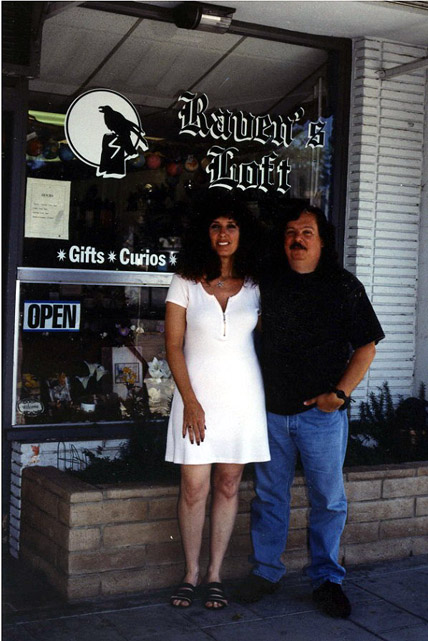
Raven with wife Stephanie
at his shop
Raven Grimassi Tribute at Controverscial.com

This was a more thorough bio, which I didn't want to borrow any from. It has much info with rare photos and a complete list of books:

https://www.controverscial.com/Raven%20Grimassi.htm


************


************


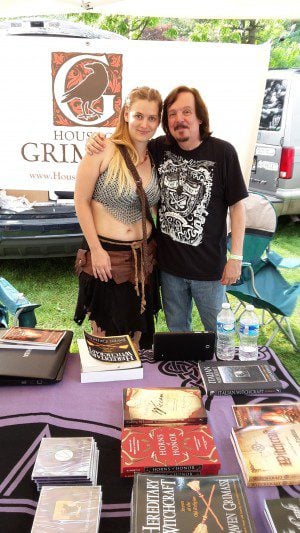
Raven with fan at his table

Raven Grimassi

Gary Charles Erbe (April 12, 1951 – March 10, 2019), known as Raven Grimassi, was an American author of over 20 books, including topics on Wicca, Stregheria, witchcraft and neo-paganism. He popularized Stregheria, the religious practice of witchcraft with roots in Italy. Grimassi presented this material in the form of neo-paganism through his books. Raven had been a practitioner of witchcraft for over 45 years and was the co-director of the Ash, Birch and Willow tradition. He died of pancreatic cancer on March 10, 2019.

con't....


.

Friday, February 28, 2020

Remembering Raven Grimassi 1951 – 2019 - Part I

Remembering Raven Grimassi, April 12, 1951 – March 10, 2019

The Wild Hunt - March 12, 2019

Raven Grimassi, 67, crossed the veil peacefully on March 10, 2019, after deciding to cease treatment for pancreatic cancer following a long struggle with the disease. Grimassi spent his last months with family and friends. The announcement of his crossing came from his wife, Stephanie Taylor-Grimassi, via a public post on Facebook.

Grimassi was an exceptional teacher and scholar within the Pagan community. The author of twenty books, he began writing on Witchcraft in 1979 and published continuously for the next 45 years on Italian Witchcraft. He founded his own system of practice in 1980, the Aridian Tradition.

Grimassi was born to an American father and Italian mother. His father was a paratrooper during WWII and met his mother in 1944 during a campaign in Gragnano, a town south of Naples on the Amalfi Coast. After the war, the couple married and came to the United States. The youngest of three children, Grimassi began exploring Witchcraft at the age of 13, moving away from Catholicism. In 1969, at the age of 18, he began his formal studies of Witchcraft, specifically Wicca. He became fascinated with the similarities between Wicca and the version of Italian Witchcraft that he learned about through his mother.

Grimassi continued his studies through 1974, observing traditional Wicca practice and teaching. Afterward, he started the Coven of Sothis in San Diego and also became of a member of the First Temple of Tiphareth, where he augmented his occult knowledge by studying the Kabbalah. Through that study, he met Donald Michael Kraig, author of Modern Magick and Modern Sex Magick, and through Kraig’s connections was subsequently initiated into Brittic Wicca.

Grimassi would, however, ultimately remain focused on Italian Witchcraft.  He met Scott  Cunningham, another prolific Pagan author, and they were initiated in into Grimassi’s Aridian Tradition of Italian Witchcraft in 1980.

Grimassi had written on Italian Witchcraft for The Shadow’s Edge, a magazine on the subject that he managed and edited, as well as other publications like Moon Shadow and Raven’s Call. In 1981, Grimassi began his serious exploration of Italian Witchcraft with the publication of The Book of the Holy Strega and a two-volume set entitled The Book of Ways. These breakthrough texts fully demonstrated Grimassi’s command of Witchcraft and his rise to becoming one of the most recognized modern Pagan authors.

Grimassi had a central objective to his writing: “to preserve the Old Ways.” He saw himself as a “tender of the roots of tradition.” He was an educator on the “old ways” of pre-Christian European religion, not only writing extensively but appearing for interviews in television and radio. He traveled extensively to teach and appear at festivals and conferences across the country.

In an interview with Wiccan/Pagan Times, Grimassi remarked, “My books are about the spiritual roots that nourish us. My basic theme is that we are the spiritual descendants of those who cleared the road before us, the well-worn Path. It is up to us to extend the Path further now, and to leave the continuing legacy to yet another generation. I advocate seeking a balance, embracing the traditional teachings left in the wisdom of our ancestors while at the same time looking inward for discernment and relativity.”

Grimassi was deeply committed to education and teaching. He co-founded the Ash, Birch and Willow Tradition (ABW) whose purpose is “to aid the training of practitioners and clergy in the religious and spiritual traditions of Witchcraft, Wicca, Paganism, Heathenism and other Earth based traditions.” Grimassi was also the co-director of the Fellowship of the Pentacle – an umbrella organization for his work through various sources.

con't....


************


I can't say much about Raven Grimassi that hasn't already been said. All of the words will not capture his whole experience. It seems like divine providence that his family--which had to move often due to his father's astronautics career for a military contractor--moved to San Diego where so many of those outside of the fray could go to plant the seeds of new ideas which were not accepted back east and elsewhere in the mainstream. In other words he created his own life path, and helped pave it for others to follow.... especially in light of his unique work.


Birth.... Life.... Death and to a new arising. He is now the morning and the spring..


In Memoriam: Raven Grimassi (Patheos)

Author Raven Grimassi Has Passed (Llewellyn)


.

Thursday, May 19, 2016

May Harvest/Flower Moon 2

Winter Grain Harvest/May Harvest Moon

May Harvest

Mid-May has traditionally been the time of the early harvest in the old European cultural, agricultural, and pagan societies. I believe that it was also called the "Winter Grain Harvest," as like.. the harvest coming out've the late winter.

Full Flower Moon

This coming Saturday evening is the Full Flower Moon. I believe that it has also been called the "May Harvest Moon," tying the two concepts together.


Raven Grimassi on Blog Talk Radio 2016

Main Street Universe hosted an hour long interview with Raven and Stephanie Taylor Grimassi on Blog Talk Radio. Blogspot won't support this embedding, so it's located at the above link.


Russian film 'Viking' due for 2016 release

This film is not connected to the very popular cable tv series

VIKING 2016 movie trailer from SkyPIX on Vimeo.


Horror movies and evolutionary memory

Recently I watched the movie 'Krampus', which was perhaps more in the category of "scary" than the horror genre. Despite its origin in folklore, it's not really the type of movie I would review. It was more of just a scary family Christmas movie. Krampus is very similar to other Alpine legends, such as the Badalisc of Camunian folklore. While watching, it occurred to me that part of the appeal of horror movies is that they subconsciously appeal to our DNA memory from virtually all of our history of living amid the harshness and danger of nature and its evolutionary struggle.

During all of that time, our ancestors lived in constant danger... from weather, dangerous predators, starvation, discomfort, or other competing tribal groups. They particularly feared the night. The night was truly a dark time where they shut themselves off from their environment as much as they could. It's not hard to figure out why the sun and moon were so revered. The typical "cabin in the woods" theme of many horror movies, ties directly to our ancestral memory of living in isolation... the dangers. "Help" would never be on its way. They had to fend for themselves.

I read once that rabbits, although they can make good pets, never fully trust you. They have been at the bottom of the food chain for so long that they maintain their tense nature. Dogs and cats descended from small predators, so they don't feel this psychological-social strain. Our bodies actually crave being scared. We get a certain chemical rush from it. Most people live relatively safe lives, so they're disconnected from nature.

Wild animals possess a "sixth sense"... the ability to sense danger, as well as other heightened senses and awareness. We've lost this ability, although some people can develop it if they live in remote areas, and are close to nature. Horror movies allow us to get that chemical rush which our bodes crave. Our struggling ancestors didn't know what to expect, as a danger could present itself at any time. This is a lot like in horror movies... a theater of the unexpected. The vampire, werewolf, or Krampus of the Middle Ages have morphed into the Mr. Hyde, killer clown, or Jack the Ripper of today.


A town on fire for over 50 years


Urban Exploration: Centralia, PA Ghost Town Burning Underground

TikiTrex

Centralia, PA is a modern day ghost town with an ongoing underground inferno. Silent Hill was inspired by Centralia's plight. It was also a model for various movies that wanted to give a hell-like appearance in a ghost town.

There used to be a WARNING - DANGER sign posted here from the Commonwealth of Pennsylvania stating that walking or driving in this area could result in serious injury or death; that dangerous gases are present and the ground is prone to sudden collapse.

Centralia was once a prosperous coal mining town with 1,100 population. It included 4 movie theatres, 7 bars, a school and a gas station.

In the spring of 1962, a fire which started at the town dump during spring cleanup ignited the coal present at the ground level as this area is very rich in coal. As firefighters worked to try and extinguish that fire, it had already spread to the underground abandoned coal tunnels that are 100 meters in depth. After a couple of decades, attempts to put out the fire failed. State and federal authorities said they didn't have enough funding to do the job right. They tried digging up the coal around the burn site but it was burning faster than they could dig and there are too many tunnels too flood.


Approximately 450 acres of underground coal has been on fire since. This type of coal is called anthracite which is difficult to ignite, but very difficult to extinguish. There are 3000 acres of coal field here underground, so with enough oxygen feeding this fire from other mining tunnels, the fire is expected to last at least another 100-200 years, maybe longer. The temperature of the active burn area below ground is 1100-1200 degrees Farhenheit. Tests by scientists and geologists were done here that showed the ground temperature to be around 440 degrees Celsius a foot into the ground.

With the threats of hydrogen explosions, carbon monoxide and cave-ins, most residents were relocated in the 80s. The houses were then torn down leaving approximately 11 people behind who refused to evacuate despite the danger and risks involved such as dangerous gasses, explosions and sink holes. The ground beneath could collapse and has done so already. Looking down the now-empty streets, you can see that nature has reclaimed her land, albeit, a dangerous one. Buildings, cars and trees can fall into this pit at any time.

The old Hwy 61 that used to bring traffic to Centralia has been destroyed by the underground fire. It is constantly subsiding with smoke usually billowing out from the pits and separations that will continue to get wider and deeper day-by-day. This is called subsidence. This is due to the coal seams the run below ground at steep angles which cause the road above ground to collapse as the coal burns.

According to engineers, the only way to stop this fire is to dig the entire 3000 acres of coal field under this town and surrounding area. This would cost $600 million which is more than the US governments were willing to pay.


Ironically, a small town just south of Centralia, Byrnesville (of all names) was also evacuated and now empty. Mostly coal miners resided here of an Irish-Catholic desent. Both Centralia and Byrnesville were a tight-knit community, and many did not want to leave.

There is a time capsule that still lies buried in the ground in Centralia. This was set up as a memorial for the working class town to be opened in 2016 which would be Centralia's 150th Anniversary. Whether the residents return to open it on that date is yet to be seen.

The Weather Channel selected portions of this video for their "Most Toxic Ghost Towns" video.

Thanks for watching!

*UPDATE* The time capsule ended up being opened on October 4, 2014 which was much earlier than expected.

'Centralia PA Time Capsule Opened Early'

Centralia - Full Documentary


Juice Newton - Angel Of The Morning

emimisic

Official video of Juice Newton performing Angel Of The Morning from the album Angel Of The Morning.

Buy It Here: http://smarturl.it/yjp0ie

Official Website: http://juicenewton.com/


Scarlet Johansson - 2 early underrated movies

A couple of weeks ago I watched Scarlet Johansson in 'Lucy', in which through a fluke a young woman started being able to use more and more than the average 10% of her brain and manipulate the laws of nature. At times I found myself fantasizing that this character was like perhaps the Goddess Iduna, returning to the modern world. A pack of guys with guns are coming towards her.... and she raises one hand and they all instantly fall and go fast asleep. Wow! Just like the divine feminine... she didn't even harm them. "She is a god or something like that ?" -- Shaco, YouTube user

In 1996, at about age 12, she stared in a movie entitled 'Manny and Lo' about two sisters who run away from their foster homes. Although it may not sound especially interesting or even for adults, it's really a good movie. I haven't seen it for a long time, but part of the movie revolves around them breaking into an unoccupied house in the country... which then became their "paradise" as one reviewer described it. It's more than just cute, and I would recommend it.

'Ghost World' (2001) was a movie about two semi-social outcasts during the summer after they graduated from high school. Johansson stars along with Thora Birch who was excellent in this. The writers/producers took some creative liberties, such as giving the film a slight 50s/60s visual and feel to it, and giving Birch's character a fetish for the 50s... which would be rather unlikely for teens any time after 1990. She goes to garage sales and swap meets to find unusual clothes in an almost theater-like endeavor. I'm not going to review it, but it's interesting.... interesting characters, and very different. Just as with the previous, this movie could be enjoyed by any age I think.


"Portals to Hell"


The Door to Hell

SciShow

In this episode of SciShow, Hank talks about a crater in Turkmenistan that has been on fire for decades and has earned itself the title of: The Door to Hell!

*************************

There are numerous "doorways to Hell," such as St. Patrick's Purgatory in Ireland, the Necromanteion temple in Greece, and Mt. Hekla in Iceland.


The red bead necklace

I confess, I've never been a fan of pearl, shell, or white bead necklaces. They just seem a bit gaudy, at least with white, or even black. Those colors are all wrong.. However, a red bead necklace looks so sightly. The red works perfectly. Just a thought.


The real Lagertha

Did you know that the character Lagertha, Ragnar Lothbrok's wife, in History's Vikings is loosly based on a real historical figure? Lagertha was, according to legend, a Danish Viking shieldmaiden from what is now Norway, and the onetime wife of the famous Viking Ragnar Lodbrok (D. 840 or 865), Her tale, as recorded by the chronicler Saxo in the 12th century, may be a reflection of tales about Þorgerðr Hölgabrúðr, a Norse deity. Her name, latinized to Lathgertha by Saxo, probably derives from the Old Norse Hlaðgerðr (Hladgerd).

His frequently rendered in English-language sources as "Lagertha", and has also been recorded as Ladgertha, Ladgerda or similar. Lagertha's tale is recorded in passages in the ninth book of the Gesta Danonum, a 12th century work of Danish history by Saxo Grammaticus. According to the Gesta, Lagertha's career as a warrior began when Frø, king of Sweden, invaded Norway and killed the Norwegian king Siward, Frø put the women of the death king's family into a bothel for public humilation. Hearing of this Ragnar Lodbrok came with an army to avenge his grandfather Siward. Many of the women Frø had ordered abused dressed themselves in men clothing and fought on Ragnar's side. Chief among them, and the key to Ragnar's victory was Lagertha.

Saxo recounts:

"Ladgerda, a skilled Amazon, who, though a maiden, had the courage of a man, and fought in front among the bravest with her hair loose over her shoulders. All marveled at her matchless deeds, for her lock flying down her back betrayed that she was a woman." Impressed with her courage, Ragnar courted her from afar. Lagertha feigned interest and Ragnar arrived to seek her hand, bidding his companions wait in the Gaular Valley. He was set upon by a bear and a great hound which Lagertha had guarding her home, but killed the bear with his spear and choked the hound to death. Thus he won the hand of Lagertha in marriage. According to Saxo, Ragnar had a son with her, Fridleif, as well as two daughters, whose names are not recorded.


After returning to Denmark to fight a civil war, Ragnar (who, was still annoyed that Lagertha had set beasts against him) divorced Lagertha in order to marry Þóra Town-Hart, the daughter of king Herrauðr of Sweden. He won the hand of his new love after numerous adventures, but upon returning to Denmark was again faced with a civil war. He sent to Norway for support, and Lagertha, who still loved him, came to his aid with 120 ships, according to Saxo. When at the height of the battle, Ragnar's son Siward was wounded, Lagertha saved the day for Ragnar with a counter attack:

"Lagertha, who had a matchless spirit though a delicate frame, covered by her splendid bravery the indination of the soldiers to waver. For she made a sally about, and flew round to the rear of the enemy, taking them unawares, and thus turned the panic of her friends into the campn of the enemy." upon returnng to Norway, she quarreled with her husband, and slew him with a spearhead she concealed in her gown. Saxo concludes that she then "usurped the whole of his name and sovereignty; for this most presumpuous dame thought it pleasanter to rule without her husband than to share the throne with him.

-- Huscarl, Anglo Saxon Foundation


Horseless carriage

One of the first models of automobile was the Hupmobile, manufactured by Hupp Motor Car Company in Detroit, Michigan starting in 1909. One of my past relatives, whose family had arrived in the U.S. before mine did, was apparently the first to own an automobile in Milaca, Minnesota. The above image may be a different model, but it was from around that period and it looks so fancy and restored. Over the years, I have come across a couple of financially well off guys who've rented one of those small light industrial property units, with a front desk, a couple of offices, and an operations area with a back garage door. They used them as sort've a clubhouse with perhaps one employee - a mechanic to work on a couple of auto projects. Wouldn't that just be ~perfect~


The Hollies "The Air That I Breathe" 

catman916


Graham Nash played an important role in the early history of the Hollies, but after his departure in December 1968, the group achieved some of its greatest successes. After hearing Phil Everly's fine version of "The Air That I Breathe" written by Albert Hammond and Mike Hazlewood, the Hollies recorded the definitive version, engineered by Alan Parsons. Released as a single in January 1974 on Polydor Records, it reached #2 in the UK. In the US it was released on the Epic label and achieved #6. It can be found on the CD on Best of the Hollies: Air That I Breathe and The Hollies' Greatest Hits on EMI. It clearly demonstrates that Allan Clarke was one of the best lead singers of the era. Terry Sylvester's background singing and Tony Hicks' guitar add to the great sound. 


************************* 

It's funny how you can have an association between a song, a place, and a time. I do with this one; half reality/half fantasy. Great ethereal sound.

Approaching 100,000 views here..

.

Friday, March 4, 2016

Raven Grimassi on Coast to Coast AM tonight (Fri - Feb 4) - "Communicating with Ancestors"


Coast to Coast AM with George Noory

10:05 PM to 2:00 AM PST


Communicating with Ancestors


Date: Friday - March 4, 2016
Host: George Noory
Guests:  Raven Grimassi, Open Lines 

Neo-pagan scholar and author Raven Grimassi is a practicing witch. He'll discuss his new work exploring the realm of the ancestors and the role of reincarnation in the soul's relationship to ancestral lineage. He'll explain the interactions between ancestors, the living, and the dead, and examine how communication with the ancestors is strengthened through various techniques and ritual practices. Followed by Open Lines in the latter half. 


************

3-6-16 ADDITION: The entire program below. I tried to get through, but was unable to. I got through to ask a question the last time he was on. It's a big program, with perhaps 15 million people tuning in.


Coast To Coast AM March 4, 2016 Communicating with Ancestors 

Conflict Returns

Neo-pagan scholar and author Raven Grimassi is a practicing witch. He'll discuss his new work exploring the realm of the ancestors and the role of reincarnation in the soul's relationship to ancestral lineage. He'll explain the interactions between ancestors, the living, and the dead, and examine how communication with the ancestors is strengthened through various techniques and ritual practices. Followed by Open Lines in the latter half


.

Saturday, November 14, 2015

Oms for Mid-Autumn IV


The 9 Virtues of Druidry

Joseph Villalobos

Wisdom, Piety, Vision, Courage, Integrity, Perseverance, Hospitality, Moderation, and Fertility.


Stregheria or Benedicaria?

"The real tradition is called Benedicaria (blessing). The word streghe means an evil witch, one who practices black magic. The word maga means a good "witch" who practices healings, cleansings and blessings. I put the word "witch" in quotes because they do not call themselves witches. The real Italian folk magic is Christian, not pagan." -- TheStarfkr, YouTube user

I don't like pointless debates on semantics, which the above was a part. How about "Regional/Chronological Pre-Christian Italian Pagan Reconstructionism?"  There aren't enough of us to afford to be so picky and choosy.


Exploring local legends and folklore

Wherever you may live, you're in a good position to explore local folklore and sites. There could be parallels and overlaps to things that you may feel close to or a part of. There are underused locations with reading rooms, archives, records, libraries, and research tools. The following two links are good examples of local legends and stories.

'Top 10 Tales of Witchcraft in Illinois'

'Myths and Mysteries of Wisconsin' (Michael Bie; 2012)


Raven Grimassi on Coast to Coast AM from 10/26/15

Conflict October

He's always an interesting interview or speaker. I've noticed that the best people in the pagan folk reconstructionist movement(s) are the ones most criticized, and usually by the smallest people. They virtually always have a snooty attitude about their own precious little paradigm that they've drawn up for themselves. Raven Grimassi has said over and over that there were many "ways" that were splintered, regionalized, or carried on in certain families after centuries of mass persecution.


Angelic female cat saves human baby boy abandoned in the snow

Often people give examples of some human interest story to "restore faith in humanity." Well, how about the humbling example of an angel of mercy in the form of an animal; with more heart and class than a huge number of humanity....

Hero cat rescues baby dumped in street by climbing in box to keep it warm in freezing conditions 
 
The Golden Phoenix

A long-haired tabby cat has been hailed a hero after finding an abandoned baby in a street and climbing in the box he had been left in to protect him from the cold.

As well as making sure the three-month-old didn't freeze to death, the moggy raised the alarm by crying out to make people aware of the boy's presence.

Irina Lavrova, 68, who lives near to where the tot was dumped in Obinsk, Russia, was throwing out rubbish when she heard Masha the cat meowing near the bins.

She went over to check Masha - a communal cat - was all right, and could not believe her eyes when she saw the baby boy lying among next to the moggy.

"Masha is a communal cat who everyone takes turns in looking after," she said.

"She is very placid and friendly so when I heard her mewing I thought that perhaps she had injured herself because normally she would have come and said hello to me.

"You can imagine my shock when I saw her lying in a box next to a baby.

"Clearly her mothering instincts had taken over and she wanted to protect the child.

"He was well-dressed with a little hat and whoever left him here had even left a few nappies and some baby food."

The baby boy was taken by ambulance to hospital where he was given a check up and declared fit and healthy.

A hospital spokesman said: "The baby had only been outside for a few hours and thanks to Masha and the child’s clothing he was not damaged by the experience."

Now residents in the area have hailed Masha a hero.

Irina said: "Everyone in the block is very proud of her and we have all spoilt her rotten by giving her her favourite food."

A police spokesman said officers were looking into the case and had launched a search for the baby’s mother.

Hero cat rescues baby dumped in street by climbing in box to keep it warm in freezing conditions. Stray Russian Cat Called Masha Saves Baby Boy Abandoned In The Cold By Keep Him Warm. Stray cat 'saves' Russian baby abandoned in freezing hallway by keeping him warm. She's my furry godmother: Stray cat 'saves' Russian baby abandoned in freezing hallway by keeping him warm. Russia: Masha the stray cat hailed for saving newborn baby abandoned in freezing hallway. Masha the Hero Cat: Stray cat saves Russian baby abandoned in freezing hallway by keeping him warm. Homeless Russian Cat 'Saves' Abandoned Baby Boy. Russian Stray Cat Saved A Baby's Life By Keeping Him Warm In The Cold! Hero Cat Saves Baby by Cuddling Up to It in a Box in Freezing Cold. Heroic stray cat saves abandoned baby from freezing.


.

Monday, October 26, 2015

Thoughts upon the Festival of Thesmophoria - Part 3


Subliminal occult symbols flashed on live tv during MLB game

We all likely have our own opinions of the "who, what, when, where, how, and why" of this, but I just wanted to look at the symbols that they used. In other words, what do they think is racy? Actually, you don't even have to play the video because it's all right there. It's curious that they used a "board" against a background, rather than just a white screen with the signs on it. Perhaps they should hire me for this, since if I was the designer I would have used a Freemasonic/Saturnian black-cube square with the outer black/white squared pattern slightly visible, and with the signs in white within the black-cube. Actually I'm not "Saturnian," but more of a "Sun and Saturn equalist."

Right off the bat, it's clear that they have a mixture of ancient symbols from northern Europe to India. The one lone political/non-spiritual symbol is the Communist Hammer and Sickle. Since the sickle is a Druidic/pagan symbol by itself, I guess that partly qualifies it. Hmm, no Swastika? I guess they couldn't put "both," despite the fact that the banksters had a field day funding them both back in the day. It's interesting that they used the Teutonic Valknut since they seem to hate anything northern European. They have both the Pentacle Star and the Inverted Pentagram Circle, which seems to suggest a difference between them.. in their minds. There is a difference, so some element of honesty there.

They have some signs which are generally thought of as Celtic. Most of the rest are Freemasonic, Alchemical, and Hermetic symbols; with a few overlapping Egyptian signs thrown in. The interlocking keys design is used by the Catholic Church, but perhaps there could be an earlier origin. Of course they have the quintessential, worldly-yet-omnipresent, All-Seeing-Eye, and also Aleister Crowley's Unicursal-Hexagram used to symbolize his dark Egyptian magical system called Thelema. However, no Saturnian Hexagram? C'mon, you gotta have the Swastika and the Hexagram (aka Star of David)... those are the funnest ones! Ironically, the two were linked at one time in the deep past. Personally, I no longer view either one of them as connected to their modern assignment.


Who said dinosaurs are all gone?

Crocodiles are leftovers from the age of dinosaurs. They provide a good clue as to how large reptiles moved and behaved. Large cats vs. crocodiles and alligators provide a good example of the historical mammal-reptile struggle. Sharks are also a leftover from the dinosaur period.


Tying your heritage together

One's heritage, in it's numerous facets, doesn't have to be compartmentalized. Whether it's ethnic, spiritual, family, regional, or personal... it can be gently bonded together. I had mentioned the
example of Paige Montague (Sionnach the Celt) who is a Celtic Neo-Druid with Odinic influences. She may produce a video wearing a Hammer of Thor necklace and with a Scottish flag present. Although we so-often hear terms like "Irish Catholic," you can just mix it the way you want to mix it. You can even combine symbols to make something of a personal arms. In a way, she has in a sense "grown up on YouTube"; and I think she could be a great leader at some point. In my way of thinking, she really gets it.


Pit Bull vs. Bobcat.... WHO WINS??

Some Pit Bulls owners have even bragged about how their Pit have killed cats. Okay, lets see it.... Pitbull vs. Bobcat.... I guess the image sorta gives it away...


There is no Pit Bull in the world who could raise a paw to a fully grown, wild Bobcat... with superior power, lightening speed, and razor sharp fangs and claws.


Raven Grimassi on Coast to Coast AM Monday evening ("Moon's Day")... Tonight!

He's going to talk about a great subject which has been covered here, connecting with ancestors and familiar spirits. While a Ouija board can be very dangerous, connecting in a natural way will not result in unwanted entities... only those which you already have a soul linkage to. It will be a Full Supermoon tonight as well!

From CoastToCoastAM.com:

Divination/ Evolution

Date: Monday - October 26, 2015
Host: George Noory
Guests: Matt Ridley, Raven Grimassi  


In the first half of the program, neopagan scholar and award-winning author of over twelve books on witchcraft, wicca, and neopaganism, Raven Grimassi will discuss his work using divination to navigate the Earth plane and pierce the veil to contact spirits and beings from other dimensions. 

In the latter half, author Matt Ridley will detail his latest work on defining how trends emerge. He will argue against conventional assumptions that major scientific and social imperatives are dictated by those on high and, instead, will make the case for evolution in the universe as well as in many facets of our society and culture. 


Tuesday, June 9, 2015

'Stregheria and Vernacular Magic in Italy: A Comparison' by Sabina Magliocco - Part 3


There are two principal strains of healing in Italian vernacular culture: healing through the use of herbs, and spiritual healing. In some cases, both may be practiced by the same individual. Of the two, healing with herbs is considered less a matter of spiritual ability than of practical knowledge. Spiritual healing, in contrast, is believed to be more connected with personal power. This is variously called la forza (power), la virtù (virtue; also attribute); or il segno (the sign), and is generally believed to be inborn. But power alone is useless without the prayers, magical formulae and techniques that make up the cunning person’s craft. Knowledge and power are passed on through an initiation, most commonly at midnight on Christmas Eve mass, during the elevation of the host -- that magical moment of transformation in the Catholic liturgical year at which the world is transformed by the birth of the Savior, and the host is transformed into his body -- and thus, by association, any transformation can take place. The knowledge takes the form of prayers that call upon a saint or the Madonna, and in some cases an accompanying technique, which varies according to the nature of the spiritual cure. These formulas and techniques are secret; they cannot be passed on to others without the healer losing her or his power, and they can only be passed on at the appointed time in the ritual cycle. Often, this is the only initiation and training necessary for the transmission of simple charms. Healing knowledge and power are typically passed down within the family; in some cases, family members – typically a group of siblings or cousins – must work together in order to bring about the cure.

As scholars have documented for other parts of Europe, spirits figure prominently as the helpers of Italian cunning folk. While many ordinary Italians living in traditional communities admit to belief in spirits, and occasionally even to contact with them, cunning folk seem to possess an intensified ability to commune with them above and beyond that of ordinary people. In many areas, healing is essentially conceptualized as a battle against malevolent spirits – whether those of the unquiet dead, witches, or others. Healers need spiritual allies in these battles, and many healers claim to have them in the form of spirits who guide and help them in their craft. The nature of these spirits, once again, is highly localized as well as idiosyncratic: they may be saints, personal ancestors, or helpful dead. They may appear to the healer in dreams and visions: trance and ecstatic states are a fundamental part of communicating with the spirits; they are doorways into the spiritual world for healers and magic workers. When cunning folk rely on saints or the Virgin Mary as helpers, they may maintain shrines to them, participate actively in the organization of festivals in their honor, and play active roles in religious sororities and fraternities that raise money for the feasts. Cures for certain illnesses may take place only on specific feast days or in the context of saints’ festivals. Thus, healing is closely connected to the seasonal and economic cycle of the community, and to the Catholic liturgical calendar.

Italian cunning folk may use a variety of tools in their work which suggest a connection to Stregheria and Neo-Pagan Witchcraft. They commonly keep notebooks in which charms and prayers are recorded – the forerunners of modern-day books of shadows. Some use weapons of various types (daggers, swords, bayonets and even guns) to frighten evil spirits or symbolically cut away certain illnesses, such as worms. Ropes or cords may be used in binding spells and charms, while other tools may be entirely idiosyncratic.


The Italian cunning tradition has a number of traits that suggest that some aspects of modern Stregheria may derive from it in part, and that many Italian Americans who see themselves as carriers of Stregheria grew up in families that preserved aspects of the rural Italian enchanted worldview. Like modern Neo-Paganism and revival witchcraft, this way of life was organized around a ritual year that followed the cycle of the seasons; the moon and sun influenced rhythms of work and production. Women were recognized as life-givers and nourishers, and were closely involved in the maintenance of shrines to a feminine divine figure, the Virgin Mary. Their immigrant ancestors may have been carriers of a tradition of healing that involved herbal and magical practices. They may have kept notebooks of charms and prayers that were precursors of today’s Neo-Pagan books of shadows. Their tools may have included knives, swords and other weapons designed to frighten away malevolent spirits, and their craft involved communication with helpers who took the form of ancestor spirits. Since these traditions could often be conflated with witchcraft in popular narratives, it is possible that this link persisted into the second, third and fourth generation after immigration, giving contemporary Streghe the impression that their ancestors belonged to an organized, hierarchical but secret society of witches. But Italian cunning craft also differs from modern Neo-Pagan Stregheria in important ways. It is emphatically not a pagan religion; there is no mention of a goddess and god, nor are deities ever drawn down into the bodies of practitioners. It exists within a largely Catholic worldview, albeit one permeated with ancestor spirits, magical practice and other elements that mark it as vernacular, rather than ecclesiastical, in nature. Absent, too, is the Wiccan ritual framework, and while there may be certain similarities between the Wiccan year cycle and that of rural Italy, that is because the former is based largely on the Irish agro-pastoral cycle, which shares a common heritage with that of other parts of Europe, including Italy.

But could an ancient pre-Christian religion involving the veneration of Diana have survived in Italian peasant tradition, only to be brought to North America by Italian immigrants? The lack of written evidence makes any answer to this question hypothetical at best, but from the historical record, such a scenario would be very unlikely. Three factors make the survival of a pagan religion in Italy into the 20th century, and its transmission through written documents such as Leland’s Aradia, improbable: the strong presence of Christianity throughout the peninsula from fairly early after the fall of the Roman Empire; the lack of a unified Italian culture and language until the late 19th century; and the relative isolation and lack of resources of the peasant classes – the very ones who are said to have preserved the religion, according to the Neo-Pagan mythos.


Stregheria and Italian vernacular magic and healing are, then, quite different but interconnected traditions. Many Italian Americans who today see themselves as carriers of Stregheria grew up in families that preserved aspects of the enchanted worldview in an immigrant context. While Stregheria may be helping contemporary Italian Americans rediscover aspects of their roots and feel pride in their ethnic identity, its form, structure and cultural context are markedly different from those of the enchanted worldview and its associated practices in Italy. Yet Stregheria should not be interpreted as inauthentic, fake or contrived, for innovation and reclamation are part of the process of tradition. The enchanted worldview cannot exist in the context of contemporary urban North America; Italian Americans need new ways to construct and preserve ethnic identity, and for some, Stregheria satisfies those needs.

.

Monday, June 8, 2015

'Stregheria and Vernacular Magic in Italy: A Comparison' by Sabina Magliocco - Part 2


Italian vernacular magic, by contrast, is neither a religion nor a formalized system of practice. It is both a worldview and a set of customs tied to the agro-pastoral cycle which is strongly embedded in the lives of its practitioners, almost never on a self-conscious level. For most of its carriers, it is simply an ordinary way of doing things and behaving. While it may have historical roots in pre-Christian practices, it is emphatically not a pagan tradition, but firmly embedded within a Roman Catholic cultural matrix. In my more recent work, I have called it “the enchanted worldview,” playing on Max Weber’s trope of the disenchantment of the world.

The enchanted worldview in Italy is rooted in specific pre-market economic and social systems. Because of subsistence activities associated with the land, time is organized according to seasonal cycles; these are reflected in the ritual year, which is dominated by Catholic liturgical forms. These almost always are locally interpreted in ways that connect them to the economic cycle: for example, in Campania, where wheat and hemp crops have been replaced by tobacco, which has a similar growing season, the ritual year begins at planting time near St. Martin in mid-November, and extends until the end of the harvest season at St. Cosimo and Damiano in October. In pastoral areas such as Sardinia and the Apennine, May and September, the months that frame transhumance, are emphasized in local ritual practices. The exact shape of the ritual year thus differs markedly from one area to another. The symbols – the Madonnas and saints – are the same, but each township differs in the way it situates these characters within its symbolic and economic system. The enchanted worldview is not only rooted in the ritualyear cycle; it is all-pervading in the individual’s life cycle. It begins at birth and penetrates every phase of life and every rite of passage, from the moment of birth, when most Italian babies who are not born with a caul (la camicia, or “shirt,” in Italian) are given a fine lawn shirt by a relative, often a godparent, to protect them against evil influences, to funerals, where a variety of beliefs about the otherworld are made manifest through practice.


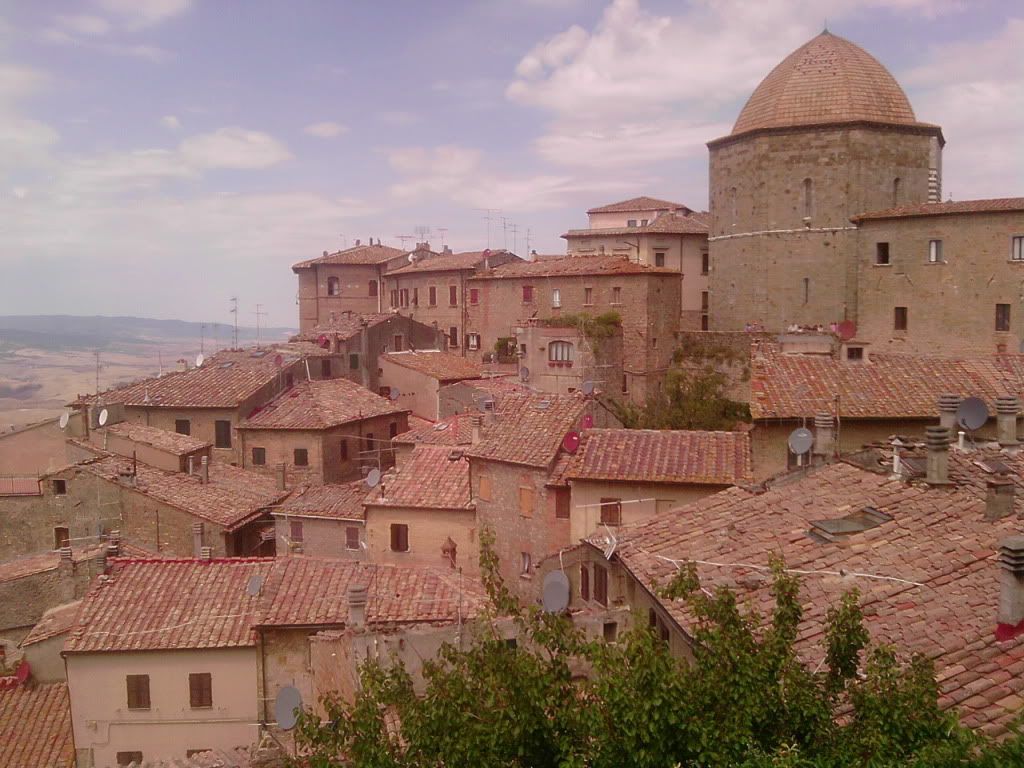
Volterra, Tuscany; birthplace of Aradia
The core of Italian vernacular religion and magic is thus the correlation of its symbolic systems with local economic and social structures. The primary connection is never with the dominant structures of church and state. Hegemonic structures may or may not coincide with indigenous ones, but where there is no match, they are simply ignored. If a particular element does not make sense in terms of local understandings of time, space, and the nature of the world, people will treat it as though it does not exist, as if it were of no consequence. As a result, the landscape of the enchanted worldview in Italy is everywhere local.

Despite its exquisitely local character, the enchanted worldview exists throughout Italy, in both northern and southern regions, with significantly more commonalities than one might think, given the differences in language, culture and economy that characterize Italy’s twenty regions. Certain concepts are ubiquitous: for example, the evil eye and its diagnosis and cures are found in all regions, and are very similar throughout. Yet the enchanted worldview defies systematization. Beliefs and practices are nowhere standardized, or even organized into an easily articulated set of principles; they are part of everyday life, part of praxis. German ethnologist Thomas Hauschild, who spent nearly twenty years studying magic in Basilicata, a region in the south of Italy, wrote: “There is no system, only practice” (Hauschild, 2003:19). The practice is the system. Practices and beliefs exist within a particular
cosmology, but its details seldom preoccupy its technologists. Thus, a structure like that described by Grimassi, with orderly branches in various parts of Italy, each with its own leader and systematic body of lore, is inherently foreign to the enchanted worldview in Italy.

Diana - Goddess of the Hunt
The main characteristic of the enchanted worldview is a belief in the omnipresence of spiritual beings that can influence human lives. These beings include the dead, saints, and the Virgin Mary and Jesus (who are, after all, nothing more than particularly powerful dead). Spirits such as folletti, linchetti and monachelli also appear, echoing some of the spiritual flora and fauna in Grimassi’s works, but they are often troublesome, rather than helpful: they tangle the manes of horses, frighten donkeys and confuse travelers who cross their paths. Some spirits are associated with certain kinds of illnesses, although exact relationships are generally determined by local lore. For instance, in Basilicata, the unquiet dead are said to cause skin diseases such as erysipelas and St. Anthony’s Fire (herpes zoster); in Campania, children who fail to thrive are said to be taken by witches on their night flights, and worn out with flying and dancing; in Emilia Romagna, Puglia and Sardinia, spiders and/or insects are responsible for a range of illnesses from tarantismo to argismo to arlìa. Some scholars suggest these insects once embodied ancestor spirits who then possessed their victims through the bite or sting (De Martino, 2005 [1961]). Even spirits such as saints and the Madonna, who belong to a greater Catholic pantheon, are everywhere localized: the Madonna is usually worshipped in one or more of her local manifestations, and the devout have their personal favorites based on each Madonna’s attributes and the qualities she “stands over,” or rules, and their own individual needs or interests.

Everywhere in Italy, there are experts who specialize in interfacing with the spirit world. These are the Italian equivalents of British and European cunning folk, and much of their work consists in the diagnosis and cure of spiritual illness. Their names vary according to region; they may be known as guaritori (healers), donne che aiutano (women who help), praticos (knowledgeable or wise people), fattucchiere (fixers), maghi (sorcerers), and by numerous other dialectical terms; but they seldom call themselves streghe (witches). This term is overwhelmingly negative in Italian folklore, and almost always refers
to a person who brings harm to others. Italian folklore is rich in legends about witches who fly through the air to their legendary gatherings around the walnut tree of Benevento, shrink themselves so small they can fit through keyholes, suck breath or blood from victims, and cause all manner of illness and mischief to their neighbors. Clearly, these activities refer to folkloric witches; they have never been practiced by actual human beings. Occasionally, however, healers may be accused of being streghe by those who believe themselves to be victims of black magic, or by clients who have failed to be healed by the cunning person’s cures.

.