
Showing posts with label Aradianism. Show all posts
Showing posts with label Aradianism. Show all posts
Friday, March 6, 2020
The Aradia Chant - Patricia Crowther
The Aradia Chant: Modern Pagan Witchcraft
Oath Bound Secrets
A chant by Pat Crowther
************
"I am the Daughter of the Sun and the Moon.
I am the Earth.
I am the love of freedom, which is the love of the gods.
And whoever shall believe in me,
the same shall be a child of the Father and Mother who dwell in all things."
~Goddess Aradia
[Posted by Zeph, YouTube user]
************
"The second advent is the Daughter, as the Age of the Son is passing" - HP Blavatsky
[Posted by Zeph, YouTube user]
.


Monday, February 18, 2019
Stregheria, Goddess Diana, Aradia, and Evolutionary Struggle

.
The one concept that I see that is sorely missing from Wicca and other similar religions or spiritual traditions is "evolutionary struggle"; that condition that very few of us are able to avoid in life to any comfortable degree. The struggle doesn't have to be something as overt as, for example, the film 'The Grey'. It could be fighting traffic to get to work, getting beat out've a job to someone for a bad reason (younger/better figure, the bosses friend, a major client's niece, etc.), betrayal, a false rumor, a health issue, someone unexpectedly interfering with your life, a bad neighbor, danger, a bad living condition, more month at the end of the money, the list could go on and on. It has been said that there are two types of people in the world, the predators and the prey. Certainly this would be true of animals and ocean creatures. I think for people, that statement is at least mostly true.
The below text are the words of the Goddess Diana, to her daughter Aradia, sometime prior to sending her to the earth to live as a mortal with a mission to fulfill. This text was translated by Raven Grimassi in 'The Book of the Holy Stega' (1981), from Charles G. Leland's 'Aradia: Gospel of the Witches' (1899). Clearly this would be in regard to the Catholic Church of the 14th century, and it's quite aggressive; some could obviously argue that's it's based on self-defense due to the Church's past actions and present conditions. Regardless of all of that, we all have enemies; there's no escaping it. Only the softest head-in-the-clouds suburbanite could possibly believe that they have no enemies. "Evolutionary" could be used in reference to many different considerations; however, probably chiefly the "evolution of the individual." We all "evolve"; for example, we may cringe a bit when pondering of some long-ago action or words that we offered.
The opposames called Capitalists and Socialists frequently brag about "progress" while engaging in their system-approved passive-aggression. "Progress" could be anything that anyone wants it to be. When Capitalists seek to obliterate a beautiful natural area or massively wipe out the view of mountains or a body of water for profit--forever--they would call it "progress." For that reason, I would argue that an individual or small collective keep their translation of the below text to themselves. Personally, I think it could regard numerous different things; along with a couple of personal items. It doesn't matter that much because evolutionary struggle (individual or a larger collective) is applicable to all. However, since this is a folk-based religion/spiritual tradition, it belongs to it's devoted adherents.

.
"It is true that you are a spirit,
But you were created to become again a mortal;
You must go on earth
And become a Teacher,
To be a teacher to women and men
Who will receive your schooling
In the ways of witchcraft."
"You must not be like the ones of darkness,
And to the race that became
Wicked, infamous, because of their seed,
You shall not go among them."
"You shall be the first witch;
The first goddess to become a witch on earth.
You shall teach the secret knowledge of plants
To harm and to heal,
And you shall teach the ways of power
To bind and to slay the spirit of the oppressor."
"And where there is found to be a greedy peasant
That has come to wealth in this way,
Then you shall teach your witches, your pupils, how
To ruin all his harvest
With tempest, lightning and with thunder,
With hail and wind."
"And when a priest shall do you spiritual injury
By his benedictions, ye shall do to him
Double the harm, and do it in the name
of me, Diana, Queen of witches all!"
"And when the nobles or priests tell you
that you must believe in the Father, Son, and Mary,
answer them that serve only devils,
and say the true God is not your God,
and tell them to instead Diana,
The Queen of all witches!"
"You shall go on earth to teach this,
And to destroy the evil of these people.
Your poor people will suffer hunger
And work wretchedly,
And also suffer prison."
"But these are of one soul,
One good and true soul
And in the Otherworld they
Shall be happy
But their tormentors on earth shall discover
That an ill Fate awaits them in the Otherworld.
.
Sunday, April 8, 2018
Matron Spirit Aradia... and more ideas about folk ritual
The Essential Witch Stregheria Show
Ravenwings
If you missed the original show you can listen to it here! Learn about Italian Witchcraft!
************
I didn't agree with every single part of this lecture, but it was fine in that it explored the history and essence of Stregheria.... the only true work of it's kind up there. I'm surprised that this video only has about one thousand views in over a year and a half. I wouldn't be surprised if there were only about two thousand adherents to Stregheria in all of North America. Still, the work by Raven Grimassi and the importance of Aradia would seem to suggest more interest... including YouTube searches for "Stregheria Aradia." Even Raven Grimassi's YouTube channel only has 383 subscriptions; surprising in that he is also an important figure among Wiccans.
It reminds of me the excellent four-part interview of Heimgest, the leader of the international organization of the Odinic Rite, on YouTube. After twelve years up there, only 37,000 views for the first video? The interview took place somewhere in Alberta, Canada, where Heimgest was visiting and naturally promoting Asatru/Odinism. He assesses the current state of the movement; in other words this is important! With the subtle rise of Asatru, large in a relative-time sense, why not more interest in a video such as this?
The Neo-Pagan movement is still somewhat shrouded in mystery. We're still mostly solitary practitioners, who may be holding ritual three miles away from where a like-minded person might be holding ritual. I once gave the example of seeing a stained-glass Valknut in a front window of a home nearby; and of once coming upon (inadvertently interrupting) a black robed woman seemingly holding a ritual when I was hiking at dusk. She then disappeared away into the shadows. "We're around".. yet we're strangers....
*************************
Italian Spell from the movie Sleepers
Indi Geaux
************
An interesting, if perhaps unflattering, "Stregheria" reference from popular culture. Of course, some form of Stregheria was present in every part of the Italian peninsula. This film was to have taken place in New York City (some say that this film was based on real events).
*************************

Drawing the Magic Circle
I conjure thee, O Circle of Power, that thou beest a meeting-place of love and joy and truth; a shield against all wickedness and evil; a boundary between the world of men and the realms of the Mighty Ones; a rampart and protection that shall preserve and contain the power that we shall raise within thee. Wherefore I bless thee and consecrate thee, in the names of Cernunnos and Aradia.
-- Wiccan circle-casting ritual
*************************

.
Human Rites: The Role of Ritual in Witchcraft
The High Priestess stands skyclad within the circle, arms outstretched, clothed only in the flickering candle-light. The High Priest kneels before her and, drawing an inverted triangle upon her from right breast, begins the incantation:
'I invoke thee and call upon thee, Mighty Mother of us all, bringer of all fruitfulness; by seed and by root, by stem and bud, by leaf and flower and fruit do I invoke thee to descend upon the body of this thy servant and priestess.'
He throws up his arms:
Hail Aradia! From the Amalthean Horn
Pour forth thy store of love; I lowly bend
Before thee, I adore thee to the end,
With loving sacrifice thy shrine adorn.
Thy foot is to my lip [kisses] my prayer upborne
Upon the rising incense-smoke; then spend
Thine ancient love, O Mighty One, descend
To aid me, who without thee am forlorn.
As he rises and steps back the High Priestess draws a pentagram in the air before her with her wand:
Of the Mother darksome and divine
Mine the scourge, and mine the kiss;
The five-point star of love and bliss--
Here I charge you in this sign.
They have drawn down the moon.
-- From page 187 of 'Witchcraft Out of the Shadows' (Ruickbie; 2004)
*************************
A few more thoughts
The above ritual is Wiccan, and reflected the common Neopagan "borrowing," which is fine since so much was lost to us over the ages. In some cases, as with utilizing an alternate name of a god/goddess or anything else, the borrowing may be slipping a missing puzzle piece back into place which already existed in the other tradition over time. However, the story of Aradia is distinctly Tuscan; but it could be thought of as relating to the larger picture; if the Goddess Diana were to send her daughter to the Earth to live among us, she had to be send to some locale.
In this manner, Aradia, the Horned God, Hecate, "The Sorcerer" cave art; Stonehenge, the Carnac stones, the Temple of Mona, the Temple of Artemis, Venus of Willendorf, the Nebra sky disk, the Bosnian pyramids, or the Megalithic Temples of Malta.... ALL could be part of the same general ancient collective Proto-European spiritual tradition. That's not necessarily "borrowing." The megalithic structures go back beyond the Celtic/Gaulish/Druidic cultures; and "Mona" was the Proto-European name of the Great Mother. Nationalistic/ethnic perceptions could, in certain instances, get in the way of the larger folklore. They're sort've.... both.
The nudity and direct sexual aspects of Wiccan rituals have some basis in the ancient history of the Proto-European tradition(s). Stregheria has this aspect as well. However, we should also think about the type and volume of people we want to attract. Nude rituals would tend to keep away some of the best people.. if for not any other reason than if, for example, a family with younger children was interested. This is kind've a no-brainer I think.

.
Academically at least, it should be acknowledged that there was a certain relative social/spiritual intimacy in ancient times. Beyond our control, the West is now both oversexualized and oversensitive to almost everything. Male and/or female non-sexual energy is lost within this condition. The above ritual was clearly an attempt to bring forth the divine feminine, which would be best conducted today in a non-sexualized manner. Our ancient ancestors would not have been socially corrupted by the insanely incongruent "American Pie" (contrasted by the Me Too movement) culture that we live in. If we ever do free ourselves from this clusterbleep, it probably won't be during our lifetimes.
At times, the midnight "witching hour" is of course very appropriate. However, at times the energy might not be there. Someone may have gotten up early, and fifteen or sixteen hours later they may be mentally fatigued. It's often easier to get out and away in the evening, compared to daylight hours, but a daytime ritual may be just as beautiful and more energetic.. and not as dependent on the weather.
One idea that I have mentioned prior, is the utilizing of music in ritual... outdoors. Although an iPod would work, I was thinking more of a group experience. Imagine the 'Wytches Chant' playing amid a forest clearing, upon a full moon, loudly humming through the trees! This is not an original idea, but something that deserves more exploration. A simpler idea would be to sing, individually or as a group. How about singing the Wytches Chant? That hymn is the Neopagan equivalent of 'Amazing Grace'. For the most part, the goddesses in the chant were based on our Almother. Who's to say that you couldn't change the names to reflect this if you felt the need? Personally, I wouldn't feel the need for that. That simple hymn was a work of genius by Inkubus Sukkubus. Call it silly, but the idea of that hymn echoing through the forest--or emanating from a mountaintop--on a warm evening almost gives me goose bumps.
.
Tuesday, March 14, 2017
Aradia: Gospel of the Witches
Aradia: Gospel of the Witches
The Sea Priestess
A brief video about the text known as "Aradia" or "The Gospel of the Witches" by Charles Godfrey Leland. Music: Elegia Luna (Igor Dvorkin, Duncan Pittock)
http://www.facebook.com/OathBoundSecrets
.
Friday, April 1, 2016
San Pellegrino Terme and "La Bella Pellegrina": The Vehmic Connection

San Pellegrino water is no stranger to the American and world market. San Pellegrino Terme, at the foot of the Bergamo Alps, has been the source for this Alpine mineral water for over 600 years. It's logo is a red or black star, usually mixed, with white added in a multi-outlined design. Many companies and institutions use a star design, and maybe that's all there is to this. However, I think that there is at least a tinge of doubt.
San Pellegrino mineral water has been produced for over 600 years. In 1395, the town borders of Mathusanash Pellegrino were drawn, marking the start of its water industry. Leonardo da Vinci is said to have visited the town in 1509 to sample and examine the town's "miraculous" water, later writing a treatise on the subject. Analysis shows that the water is strikingly similar to the samples taken in 1782, the first year such analysis took place.

The barnstar is the modern expression, maybe since the Middle Ages, of the Vehmic spiritual tradition of Europe going back into very ancient times. It has the same meaning as the Pentagram in Wicca, which is based partly upon the same very old tradition. Third, this mineral water was considered magical. Whether or not that is mere folklore, we can see a possible pattern: magical water, Vehmic star, and the name "San Pellegrino" which I will explain.
The name "San Pellegrino Terme" means something like "Saint Pilgrim spa," which may have something to do with the water. The commune is home to the "Terme".. or "baths." There is also the Brembo River, so this may all have something to do with the legend of the "miraculous water." According to legend, Aradia, "La Bella Pellegrina" (The Beautiful Pilgrim) herself, was to have visited Lombardy after the upheaval surrounding her in Tuscany. She was also alleged to have moved onto the Balkans at a later point, perhaps to evade the coming persecution.
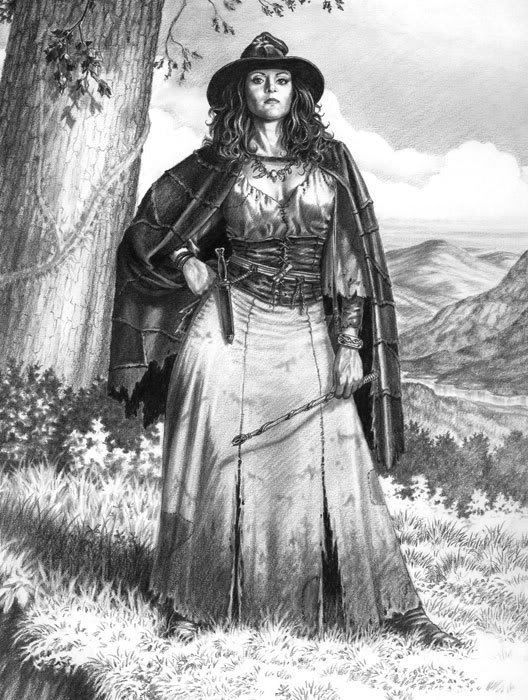 |
| Aradia as rugged medieval traveler? |
If one links all of the circumstances, I think it paints an alluring possibility, partly because it's all old circumstantial evidence. The Bergamo Alps is a large wild mountainous area, where Aradia, and presumably her followers, could hide out if need be. San Pellegrino Terme is in the southern stretches of the Bergamo Alps; yet close to the Po Valley and the city of Bergamo. Also, this location was on the edge of the east Lombard Alps, where there had been a strong pagan tradition. There were plenty of secluded mountain valleys in which to dwell, and where the old ways were not out of place. Were there further wanderings and history of Aradia lost in time?
A few Papal and Venetian state authorities seemed to suggest that there was an upsurge in "Witchcraft" in the east Lombard Alps during the late fifteenth century: "For this reason we cannot but think that there is an evil sect in this diabolical valley." This wouldn't have been much more than a century after Aradia could have visited the region. These authorities finally took action, and witch trials soon took place in both Val Camonica and the Valtellina. As to whether or not there was a real upsurge, or if it was merely the old regional tradition, their reasoning was all the pretext that they needed. Could it have really been a resurgence of the old ways, which was introduced by Aradia, that resulted in a growing synergistic movement in these isolated mountain valleys?
And onto... Serbia?
Excerpt from page 224 of 'Hereditary Witchcraft: Secrets of the Old Religion' by Raven Grimassi:
 I found it also interesting to note that 'Ecstasies: Deciphering the Witches' Sabbath' by Carlo Ginzburg contains a passage that may be a historical reference to Aradia. On page 189 he speaks of a Pagan sect known as the Calusari, who, during the Middle Ages (as late as the sixteenth and seventeenth centuries), worshipped a "Mythical Empress" whom they sometimes called "Arada" or Irodeasa." The Calusari also used the term "mistress of the fairies" for her, just as the followers of Aradia called Diana the "Queen of the Fairies." There are certainly some very close similarities here, and we may be seeing a form of worship that evolved from the one Aradia founded over 100 years earlier.
According to the original legend of Aradia, she left Italy at some point in her quest and traveled out of the country. Serbia, the home of the Calusari, lies a short distance across the Adriatic from Central Italy, and travel by ship was not uncommon in that era. When Aradia left Italy she would not have traveled west to France because the Papacy was established there at the time, and Aradia was still being hunted by the Church. It would have been too dangerous to have gone to northern Europe because witches were being burned or hanged in that region (Italy did not begin the burning of witches until after the time of Aradia). So, in fact, an eastern exodus would have been the only logical action that Aradia could have taken. At the very least, there is a striking coincidence between Aradia's Witches and the Calusari of Arada.
.
Tuesday, June 9, 2015
'Stregheria and Vernacular Magic in Italy: A Comparison' by Sabina Magliocco - Part 3
There are two principal strains of healing in Italian vernacular culture: healing through the use of herbs, and spiritual healing. In some cases, both may be practiced by the same individual. Of the two, healing with herbs is considered less a matter of spiritual ability than of practical knowledge. Spiritual healing, in contrast, is believed to be more connected with personal power. This is variously called la forza (power), la virtù (virtue; also attribute); or il segno (the sign), and is generally believed to be inborn. But power alone is useless without the prayers, magical formulae and techniques that make up the cunning person’s craft. Knowledge and power are passed on through an initiation, most commonly at midnight on Christmas Eve mass, during the elevation of the host -- that magical moment of transformation in the Catholic liturgical year at which the world is transformed by the birth of the Savior, and the host is transformed into his body -- and thus, by association, any transformation can take place. The knowledge takes the form of prayers that call upon a saint or the Madonna, and in some cases an accompanying technique, which varies according to the nature of the spiritual cure. These formulas and techniques are secret; they cannot be passed on to others without the healer losing her or his power, and they can only be passed on at the appointed time in the ritual cycle. Often, this is the only initiation and training necessary for the transmission of simple charms. Healing knowledge and power are typically passed down within the family; in some cases, family members – typically a group of siblings or cousins – must work together in order to bring about the cure.
 As scholars have documented for other parts of Europe, spirits figure prominently as the helpers of Italian cunning folk. While many ordinary Italians living in traditional communities admit to belief in spirits, and occasionally even to contact with them, cunning folk seem to possess an intensified ability to commune with them above and beyond that of ordinary people. In many areas, healing is essentially conceptualized as a battle against malevolent spirits – whether those of the unquiet dead, witches, or others. Healers need spiritual allies in these battles, and many healers claim to have them in the form of spirits who guide and help them in their craft. The nature of these spirits, once again, is highly localized as well as idiosyncratic: they may be saints, personal ancestors, or helpful dead. They may appear to the healer in dreams and visions: trance and ecstatic states are a fundamental part of communicating with the spirits; they are doorways into the spiritual world for healers and magic workers. When cunning folk rely on saints or the Virgin Mary as helpers, they may maintain shrines to them, participate actively in the organization of festivals in their honor, and play active roles in religious sororities and fraternities that raise money for the feasts. Cures for certain illnesses may take place only on specific feast days or in the context of saints’ festivals. Thus, healing is closely connected to the seasonal and economic cycle of the community, and to the Catholic liturgical calendar.
Italian cunning folk may use a variety of tools in their work which suggest a connection to Stregheria and Neo-Pagan Witchcraft. They commonly keep notebooks in which charms and prayers are recorded – the forerunners of modern-day books of shadows. Some use weapons of various types (daggers, swords, bayonets and even guns) to frighten evil spirits or symbolically cut away certain illnesses, such as worms. Ropes or cords may be used in binding spells and charms, while other tools may be entirely idiosyncratic.
 The Italian cunning tradition has a number of traits that suggest that some aspects of modern Stregheria may derive from it in part, and that many Italian Americans who see themselves as carriers of Stregheria grew up in families that preserved aspects of the rural Italian enchanted worldview. Like modern Neo-Paganism and revival witchcraft, this way of life was organized around a ritual year that followed the cycle of the seasons; the moon and sun influenced rhythms of work and production. Women were recognized as life-givers and nourishers, and were closely involved in the maintenance of shrines to a feminine divine figure, the Virgin Mary. Their immigrant ancestors may have been carriers of a tradition of healing that involved herbal and magical practices. They may have kept notebooks of charms and prayers that were precursors of today’s Neo-Pagan books of shadows. Their tools may have included knives, swords and other weapons designed to frighten away malevolent spirits, and their craft involved communication with helpers who took the form of ancestor spirits. Since these traditions could often be conflated with witchcraft in popular narratives, it is possible that this link persisted into the second, third and fourth generation after immigration, giving contemporary Streghe the impression that their ancestors belonged to an organized, hierarchical but secret society of witches. But Italian cunning craft also differs from modern Neo-Pagan Stregheria in important ways. It is emphatically not a pagan religion; there is no mention of a goddess and god, nor are deities ever drawn down into the bodies of practitioners. It exists within a largely Catholic worldview, albeit one permeated with ancestor spirits, magical practice and other elements that mark it as vernacular, rather than ecclesiastical, in nature. Absent, too, is the Wiccan ritual framework, and while there may be certain similarities between the Wiccan year cycle and that of rural Italy, that is because the former is based largely on the Irish agro-pastoral cycle, which shares a common heritage with that of other parts of Europe, including Italy.
But could an ancient pre-Christian religion involving the veneration of Diana have survived in Italian peasant tradition, only to be brought to North America by Italian immigrants? The lack of written evidence makes any answer to this question hypothetical at best, but from the historical record, such a scenario would be very unlikely. Three factors make the survival of a pagan religion in Italy into the 20th century, and its transmission through written documents such as Leland’s Aradia, improbable: the strong presence of Christianity throughout the peninsula from fairly early after the fall of the Roman Empire; the lack of a unified Italian culture and language until the late 19th century; and the relative isolation and lack of resources of the peasant classes – the very ones who are said to have preserved the religion, according to the Neo-Pagan mythos.
 Stregheria and Italian vernacular magic and healing are, then, quite different but interconnected traditions. Many Italian Americans who today see themselves as carriers of Stregheria grew up in families that preserved aspects of the enchanted worldview in an immigrant context. While Stregheria may be helping contemporary Italian Americans rediscover aspects of their roots and feel pride in their ethnic identity, its form, structure and cultural context are markedly different from those of the enchanted worldview and its associated practices in Italy. Yet Stregheria should not be interpreted as inauthentic, fake or contrived, for innovation and reclamation are part of the process of tradition. The enchanted worldview cannot exist in the context of contemporary urban North America; Italian Americans need new ways to construct and preserve ethnic identity, and for some, Stregheria satisfies those needs.
.
Monday, June 8, 2015
'Stregheria and Vernacular Magic in Italy: A Comparison' by Sabina Magliocco - Part 2
Italian vernacular magic, by contrast, is neither a religion nor a formalized system of practice. It is both a worldview and a set of customs tied to the agro-pastoral cycle which is strongly embedded in the lives of its practitioners, almost never on a self-conscious level. For most of its carriers, it is simply an ordinary way of doing things and behaving. While it may have historical roots in pre-Christian practices, it is emphatically not a pagan tradition, but firmly embedded within a Roman Catholic cultural matrix. In my more recent work, I have called it “the enchanted worldview,” playing on Max Weber’s trope of the disenchantment of the world.
The enchanted worldview in Italy is rooted in specific pre-market economic and social systems. Because of subsistence activities associated with the land, time is organized according to seasonal cycles; these are reflected in the ritual year, which is dominated by Catholic liturgical forms. These almost always are locally interpreted in ways that connect them to the economic cycle: for example, in Campania, where wheat and hemp crops have been replaced by tobacco, which has a similar growing season, the ritual year begins at planting time near St. Martin in mid-November, and extends until the end of the harvest season at St. Cosimo and Damiano in October. In pastoral areas such as Sardinia and the Apennine, May and September, the months that frame transhumance, are emphasized in local ritual practices. The exact shape of the ritual year thus differs markedly from one area to another. The symbols – the Madonnas and saints – are the same, but each township differs in the way it situates these characters within its symbolic and economic system. The enchanted worldview is not only rooted in the ritualyear cycle; it is all-pervading in the individual’s life cycle. It begins at birth and penetrates every phase of life and every rite of passage, from the moment of birth, when most Italian babies who are not born with a caul (la camicia, or “shirt,” in Italian) are given a fine lawn shirt by a relative, often a godparent, to protect them against evil influences, to funerals, where a variety of beliefs about the otherworld are made manifest through practice.
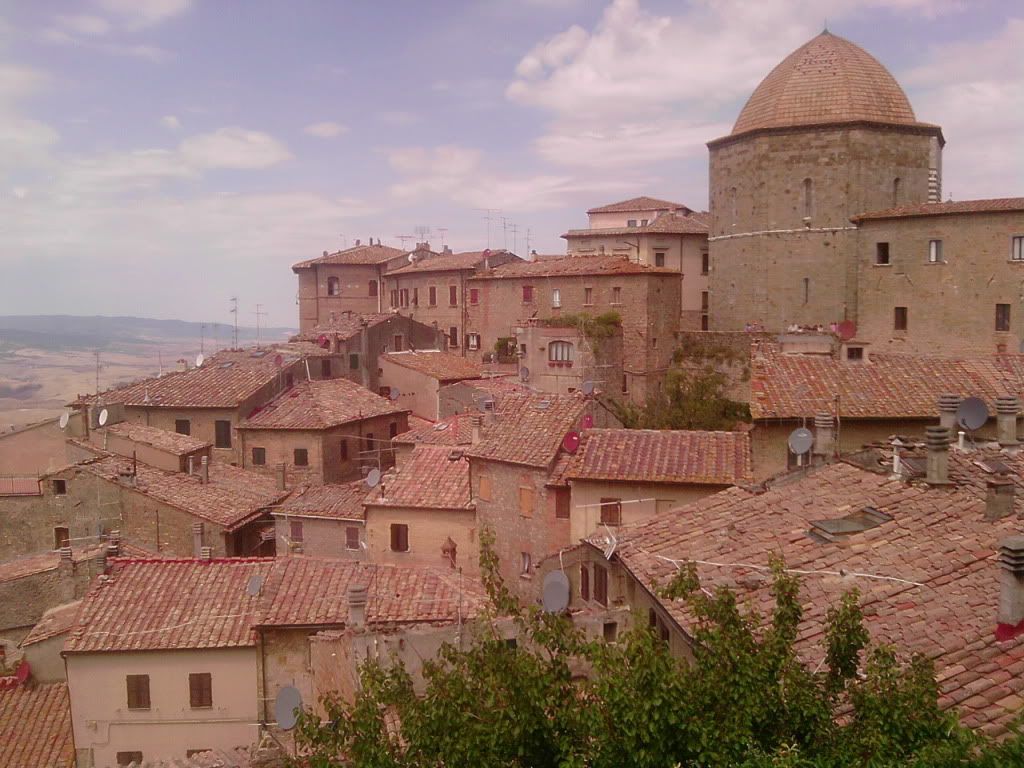 |
| Volterra, Tuscany; birthplace of Aradia |
Despite its exquisitely local character, the enchanted worldview exists throughout Italy, in both northern and southern regions, with significantly more commonalities than one might think, given the differences in language, culture and economy that characterize Italy’s twenty regions. Certain concepts are ubiquitous: for example, the evil eye and its diagnosis and cures are found in all regions, and are very similar throughout. Yet the enchanted worldview defies systematization. Beliefs and practices are nowhere standardized, or even organized into an easily articulated set of principles; they are part of everyday life, part of praxis. German ethnologist Thomas Hauschild, who spent nearly twenty years studying magic in Basilicata, a region in the south of Italy, wrote: “There is no system, only practice” (Hauschild, 2003:19). The practice is the system. Practices and beliefs exist within a particular cosmology, but its details seldom preoccupy its technologists. Thus, a structure like that described by Grimassi, with orderly branches in various parts of Italy, each with its own leader and systematic body of lore, is inherently foreign to the enchanted worldview in Italy.
 |
| Diana - Goddess of the Hunt |
to a person who brings harm to others. Italian folklore is rich in legends about witches who fly through the air to their legendary gatherings around the walnut tree of Benevento, shrink themselves so small they can fit through keyholes, suck breath or blood from victims, and cause all manner of illness and mischief to their neighbors. Clearly, these activities refer to folkloric witches; they have never been practiced by actual human beings. Occasionally, however, healers may be accused of being streghe by those who believe themselves to be victims of black magic, or by clients who have failed to be healed by the cunning person’s cures.
.
Sunday, June 7, 2015
'Stregheria and Vernacular Magic in Italy: A Comparison' by Sabina Magliocco - Part 1
'Stregheria and Vernacular Magic in Italy: A Comparison' by Sabina Magliocco
The distinction between contemporary Stregheria and traditional Italian magic, healing and spiritual practice has lately been the subject of lively debate on a number of listserves and websites. In this brief essay, I will attempt to summarize some of my academic publications on this theme for a non-scholarly audience, and to encourage further research, questions and discussion on this topic. I should state at the outset that my approach is academic: as an anthropologist and folklorist, I consider both Stregheria and Italian vernacular magic as important facets of culture in their own right. My intention is not to support or deny the authenticity of either, but to help readers understand both in the contexts in which they developed, and how the former grew from the latter in the context of the Italian American diaspora.
Stregheria is an Italian American variety of Neo-Pagan Witchcraft. It owes its origins to Aradia, or the Gospel of the Witches (1889), a collection of spells, rhymes and legends which amateur folklorist Charles G. Leland claimed came from a Florentine fortune-teller named Maddalena. According to Leland, Maddalena belonged to a family of witches who practiced a form of pagan religion centered on the worship of the moon goddess Diana. Leland interpreted the materials he collected according to popular folklore theories of the late 19th century: as survivals of ancient pagan religions, specifically those of the Romans and Etruscans, whose civilizations had once dominated central Italy. He dubbed witchcraft la vecchia religione (the old religion). Right from the start, Leland’s work was controversial. Some of the materials in it –
Despite the controversies surrounding it, Leland’s text became quite influential: it equated folk magic to an ancient religion involving the veneration of a goddess, and located this all in Italy. Leland clearly influenced Gerald B. Gardner, who is widely credited with the development of Wicca in its present form, and through Gardner, an entire generation of Witches. Among the first to openly identify as a practitioner of Italian witchcraft was Leo Louis Martello (1933-2001). Martello claimed to have been initiated by a family member as a young man. He described a secret hereditary tradition based on a Sicilian version of the myth of Proserpina (Persephone). Along with priestess Lori Bruno, also a hereditary practitioner, he founded the Trinacrian Rose of New York City, one of the first Italian American covens in North America.
But the real heir of Leland is Raven Grimassi, the architect of Stregheria. Like Martello and Bruno, Grimassi claims to have been initiated into a family tradition of magical practice which he describes as hereditary, domestic, and secret. Grimassi’s mother comes from the region of Campania, outside Naples. She belongs to a family whose members practiced a number of magical
 Grimassi’s genius is creative, rather than scholarly. He never claims to be reproducing exactly what was practiced in Italy, admitting that Streghe have “adapted a few Wiccan elements into their ways” (1995:xviii). He openly acknowledges that he is expanding on his family tradition, adding elements to it to restore it to what he imagines was its original state. But from his attempts to restore a tradition, a brand new tradition has emerged: one that bears little resemblance to anything that was practiced in Italy or in Italian American ethnic communities.
While based on Italian folk magic, historical accounts and folklore collections, Stregheria is, like most revival Witchcraft, a modern tradition. Folklorist Robert Klymasz, writing about what happens to folklore as a result of immigration to a new culture, identified three layers of folklore that are present in any ethnic community. These include the traditional, with clear links to Old World forms; the transitional, in which some elements from the Old World crystallize, while others adapt to the new context; and innovational, in which new folklore is developed to make up for older forms that have been lost (Klymasz, 1973). Stregheria belongs to the last category. It has some points in common with Italian vernacular magic, which I will outline below; but there are more differences than similarities. Its true value lies in its ability to provide contemporary Italian Americans with a new context in which to interpret folk magical practices that have remained in their families for many generations, giving these traditions a new life. In the process, it plays a vital role in helping to create and maintain identity for its practitioners.
.
Wednesday, May 20, 2015
'Alchemical Invocations of Vox Populi – Leland’s Aradia & the Creation of the Folk' [Part III]

This combination of ingredients is found in Christian exorcism rites practiced by the Catholic church, or more pointedly rites which would have been found in the Episcopalian tradition that Leland adopted during his time at Princeton:
“These four—water, wine, salt, and ashes—were the ingredients of the Exorcising Water to expel the enemy from a Church at its consecration ; the water symbolizing the outpouring of tears, and so penitence ; the wine, exultation of mind ; the salt, natural discretion or wisdom; and the ashes, the humility of penitence.”
– The symbolism of churches and church ornaments, Guillaume Durandus
And these three can also be equated in alchemical terms to Mercury (water), Sulphur, (wine) and Salt, which in the Paracelsian tradition are the three essential elements that form the basis of reality prior to the four elements of fire, water, earth and air. The rectification of these three also forms the basis of the Philosopher’s Stone. Leland was well acquainted with Paracelsus by the time he wrote Aradia, we find him discussing Gnosticism and Neo-Platonism at Princeton while still a student:
“When (Professor Dodd) asked me how it was that I had renegaded into Trinitarianism, I replied that it was due to reflection on the perfectly obvious and usual road of the Platonic hypostases eked out with Gnosticism. I had…learned…that ” it was a religious instinct of man to begin with a Trinity, in which I was much aided by Schelling, and that there was no trace of a Trinity in the Bible, or rather the contrary, yet that it ought consistently to have been there…For man or God consists of the Monad from which developed spirit or intellect and soul; for toto enim in mundo Ivcet Trias cujus Monas est princeps, as the creed of the Rosicrucians begins (which is taken from the Zoroastrian oracles)…and it is set forth on the face of every Egyptian temple as the ball, the wings of the spirit which rusheth into all worlds, and the serpent, which is the Logos.”
– Memoirs, Charles Leland
Here we see the core of Leland’s belief, “there was no trace…yet…it ought
 consistently to have been there.” Aradia is a classic work of Pastoral poetry, the work of an educated Romantic who longs for the Golden Age of Nature. Through the use of vox populi he takes the unrefined elements of folk culture and, in an alchemical moment of myth building, creates what “should be there.” He separates out the dross of true poverty and seeks the essence of hunger, desperation and wisdom that exists in the lives of the dispossessed.
Leland takes what the common people already know, but have no chance to define, and shows them a reflection of themselves. Reworking their traditions with the purpose of returning to them the freedom that they already have, while undermining the bonds of control that have been put on them by social conventions that laud ostentation while rejecting the simplicity of life. It is therefore no surprise that Aradia has had a foundational affect on contemporary witchcraft, that was the very purpose of the book.
Margherita Taluti’s information alone could not complete his vision, but it provided the ground and reality from which he could perfect the Work. It contained the Prima Materia missing from his own experience and provided the Key. Leland’s practice is no different than Ovid, Homer, Chaucer, Boccacio, Shakespeare, or any of the great Traditional Poets who took the popular mythologies and legends of their time and re-veiled them.
As he remarked to one of his fellow folklorists, “I am proud to be a first pointer-out – just as I am of having been acknowledge to be the first discoverer of Shelta…also of Italian-Latin witch lore and mythology, which latter has not as yet been credited to me, but will be some day.”
Through an alchemical invocation of the popular voice Charles Leland created a vision for the dispossessed to lay claim to. His ‘gospel of the witches‘ was the ‘good news‘ of the free spirit, the reclamation of the Edenic purity of Humanity that “shall dance, sing, make music, and then love in the darkness.” It is the message to the establishment that “the true God the Father is not yours; for I have come to sweet away the bad, the men of evil, all will I destroy!” It’s a mark of success that Leland’s work has been reviled by the Academy, he wasn’t writing it for them, he was writing it for the People.
Note: The folks at Red Wheel/Weiser were kind enough to provide a copy of Charles Leland’s Aradia, Gospel of the Witches for research and review. Check out Bob Freeman’s review of Aradia and Freeman Presson’s review as well.
.
Tuesday, May 19, 2015
'Alchemical Invocations of Vox Populi – Leland’s Aradia & the Creation of the Folk' [Part II]

Despite the hesitation of some contemporary pagans over the use of the name Lucifer in the text, the marriage of Lucifer and Diana is not necessarily an amalgam of Judeo-Christian and Greco-Roman traditions. In Latin Lucifer can be interpreted as “Light Bearer” an epitaph for Apollo (also called Φοίβος, Phoibos, “radiant”) who is the brother of Artemis, Artemis being another name for Diana. With Italian being so close to Latin, it may be that the use of Lucifer actually predates the Christian tradition.
Another appellation given to Apollo is “born of the wolf”, and in pre-Hellenistic times (as Jake Stratton-Kent points out in his work Geosophia) Apollo had a definitive role in Cthonic (underworld) rites. The designation given in Aradia of Diana’s husband with “one who of old once reigned in Hell,” may be a subtle clue that it is this Cthonic Apollo, the Oracular Apollo, who is being called upon.
The Invocation to Aradia hints at this when it says, “may there be one of three signs distinctly clear to me: the hiss of a serpent, the light of a firefly, the sound of a frog” The Serpent was sacred to Apollo, and the connection of the firefly to the “light bearer” is self evident, the frog is sacred to Hekate, a Cthonic Greek goddess who, like Diana, is connected to magical rites and nocturnal pursuits.
If this seems a bit academic for folk wisdom, it may very well be. Leland’s recounting may be every bit as free as his critics contend. In his work English Gypsy Songs he laments that none of the Romany he spoke with could give an adequate representation of their tradition. “Not finding what I wanted, I had given up the intention of forming such a collection, when the perusal of a few excellent Romany ballads by a friend who may fairly claim to be among the ”
 deepest” of the deep in the language, as well as others by Professor Palmer and Miss Janet Tuckey, suggested to me the idea that poetry, impressed with true Gipsy spirit, and perfectly idiomatic, might be written and honestly classed as Romany, even though not composed by dwellers in tents or caravans. The experiment was made, great care being taken to avoid anything like theatrical Gypsyism, or fanciful idealization.”
There are many correspondences in Aradia to beliefs common to European and early American folk magic which Leland would have been familiar with through his extensive reading and passion for the “occult.” The Charm of the Stones Sacred to Diana is surprisingly similar to the seer stone used by Joseph Smith for treasure hunting and scrying while dictating the Book of Mormon. Leland’s niece recounts that he, “not only studied witchcraft with the impersonal curiosity of the scholar, but practiced it with the zest of the initiated,” so it would not be surprising if a bit of his own practice seeped in to the reworking of Margherita’s account of Italian witchcraft.
In fact Leland, in his memoirs, tells of his own ownership of such a stone, only he calls it a “voodoo stone,” and based on the timing of the tale he tells (at the end of the Civil War) his possession of it predates by many years his time in Italy:
“Now, to-day I hold and possess the black stone of the Voodoo, the possession of which of itself makes me a grand-master and initiate or adept…”
– Memoirs, Charles Leland
Similarly the Conjuration of Diana which calls for water, wine and salt, bears resemblance to invocation techniques used by folk magicians discussed in George Oliver's book from 1875, The Pythagorean Triangle: “It appears that in the time when conjurers could profitably exercise their art, they used to raise spirits within a circle nine feet in diameter, which they consecrated by sprinkling with a mixture of holy water, wine, and salt; that they might be protected from any onslaught of the fiend.”
.
Monday, May 18, 2015
'Alchemical Invocations of Vox Populi – Leland’s Aradia & the Creation of the Folk' [Part I]
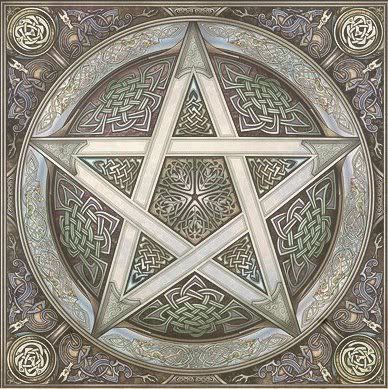
'Alchemical Invocations of Vox Populi – Leland’s Aradia & the Creation of the Folk'
“If the lawful order (κόσμος) hate you, ye know that it hated me before it hated you.
If ye were of the lawful order (κόσμος), the lawful order (κόσμος) would love his own: but because ye are not of the lawful order(κόσμος), but I have chosen you out of the lawful order (κόσμος), therefore the world hateth you.
Remember the word that I said unto you, The servant is not greater than his lord. If they have persecuted me, they will also persecute you; if they have kept my saying, they will keep yours also.
But all these things will they do unto you for my name’s sake, because they know not him that sent me."
– John 15:18-21
Most reading the charming reprinting of Charles Leland’s Aradia, Gospel of the Witches easily forget how far we are from rural Italy in the 19th century, from the world inhabited by those who remember the Ancient Ways, perhaps more telling, how far we are from the lives of the dispossessed in our own time. Leland’s disarming erudition of Margherita Taluti’s information lulls us into gentle repose, arrested only by the sudden bursts of light when the reality of Margherita’s world sneaks through our contemporary dream.
“In those days there were on earth many rich and many poor.
The rich made slaves of all the poor.
In those days were many slaves who were cruelly treated; in every palace tortures, in every castle prisons.
Many slaves escaped. They fled to the country; thus they became thieves and evil folks. Instead of sleeping by night, they plotted escape and robbed their masters, and then slew them. So they dwelt in the mountains and forest as robbers and assassins, all to avoid slavery.”
An educated Western audience may find it uncouth that such things would be spoken aloud, but they aren’t spoken aloud, they are passed in secret, sub-rosa, in silence. Leland’s passion for various groups on the fringes of the society of his day, the Romany, the Native American, American Voodoo and European witches, gave him a strong sense of Romanticism for the struggles of the people, and provides him with the raw materials for an invocation of this struggle through his writing.
This is not the genteel voice of an educated Marxist lamenting capitalism, nor the hopeful philosophies of Utopian sustainability, this is Lex Talonis, justice driven by the Left Hand under the auspices of Divine Right. This is the uninhibited outcry of those who labor, live and die without ever seeing the fruits of their work, and watching daily while an uncaring elite sit in abstract control over their destinies.
During the Haitian Revolution in the late 18th century, escaped slaves met in the mountains and gathered strength while plotting to overthrow the Colonial French. During a ceremony in the northern mountains at Bois Caiman, which has since passed into a national myth, the freedom fighters called on the gods of their homeland to give them strength, protection and the vigor to overthrown their oppressors.
According to accounts of the ceremony “a woman started dancing languorously in the crowd, taken by the spirits of the loas. With a knife in her hand, she cut the throat of a pig and distributed the blood to all the participants of the meeting who swore to kill all the whites on the island.”
– History of Haiti and the Haitian Revolution
An interesting thing about Leland is that he’s writing from a place of experience. He was active during the American Civil War, both as a propagandist and journalist for the North and as a soldier, and was in Paris during the French uprising in 1848 where he participated in street fighting against the Royalist supporters.
In all of these revolutionary moments, however, we must be honest and recognize that the people do not stir on their own cognizance. Even the Haitian revolution was spurred on by educated Haitians who invoked the power of their traditions to stir the people. It takes someone to spark the collective consciousness, and that someone is more often than not a sympathetic member of the literati.
.
Saturday, June 7, 2014
Maddalena Taluti: Daughter of Wisdom
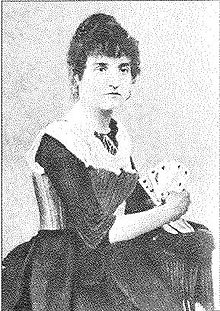
Borrowed from www.stregheria.com:
Maddalena
In the history of Witchcraft there is perhaps no figure more mysterious than the Witch known as Maddalena. As described by folklorist Charles Leland in several of his books, Maddalena was an Italian fortune teller and Witch. She supplied Leland with a great deal of Italian Witch lore including the text Leland later published as the Gospel of the Witches in 1899. Maddalena was also known to folklorists Roma Lister and Lady de Vere (to who she was introduced as "Margherita").
New findings related to Maddalena have recently come to light through some research I conducted at the Library of Congress. At the Pantheacon conference, on February 17th, 2008, I presented a copy of a page from The International Folklore Congress: Papers and Transactions, 1891. On page 454, Maddalena's name appears as a contributor to an exhibit presented by Charles Leland. Her name is given as Maddalena Taluti. In the modern Pazzaglini translation of Aradia, contributing writer professor Robert Mathiesen wrote that he believed Maddalena's last name to be Talenti. In light of new findings he is incorrect, but he does state that her name was almost illegible in the document he examined.
 According to Leland, in his book Etruscan Roman Remains, Maddalena was originally from the town of Rocca Casciano, which is now called Rocca San Casciano. It is located in the Province of Forli-Cesena in the Italian region of Emilia-Romagna. She reportedly traveled a great deal, making a living telling fortunes and selling charms. According to Leland, Maddalena claimed to have been trained in a family tradition of Italian Witchcraft, which was passed on to her by aunts and by her step-mother.
The Aradia material obtained for Leland differs greatly from the material that Maddalena had previously supplied to him. In the book Etruscan Roman Remains, Leland describes the Witches of Italy as being both good and bad. By contrast the Aradia material portrays Witches in a negative light. It is noteworthy that he describes a group that he calls the "beautiful witches of Benevento." Concerning Maddalena herself, Leland describes her as:
"a young woman who would have been taken for a Gypsy in England, but in whose face, in Italy, I soon learned to know the antique Etruscan, with its strange mysteries, to which was added the indefinable glance of the Witch. She was from the Romagna Toscana, born in the heart of its unsurpassingly wild and romantic scenery, amid cliffs, headlong torrents, forests, and old legendary castles. I did not gather all the facts for a long time, but gradually found that she was of a Witch family, or one whose members had, from time to immemorial, told fortunes, repeated ancient legends, gathered incantations, and learned how to intone them, prepared enchanted medicines, philtres, or spells. As a girl, her Witch grandmother, aunt, and especially her stepmother brought her up to believe in her destiny as a sorceress, and taught her in the forests, afar from human ear, to chant in strange prescribed tones, incantations or evocations to the ancient gods of Italy, under names but little changed, who are now known as folletti, spiriti, fate, or lari - the Lares or household goblins of the ancient Etruscans."
After receiving material from Maddalena, which became the foundation for the books Legends of Florence and Etruscan Roman Remains, Leland made another request. In 1886, Leland asked Maddalena to try and locate a text that he had heard of that was a type of Witches gospel. Eleven years later she sent him some material that Leland published as Aradia; or the Gospel of the Witches. It is noteworthy that Maddalena had fulfilled Leland's previous requests for material within a short period of time. The fact that it took her ten years to present the Aradia material strongly suggests that she was originally unaware of it. This further suggests that the tradition it represented was not the one she personally practiced.
 The tradition that Maddalena most likely practiced is reflected in Leland's books Etruscan Roman Remains, Legends of Florence, and Legends of Virgil. The portrayal of Witches and Witchcraft in Leland's Gospel of Aradia does not reflect the same image as his earlier works. This is another indication that the material came from a system outside of Maddalena's own knowledge and experience.
A letter from Leland to his niece, which I presented a copy of at the Pantheacon conference, describes Maddalena performing a ritual in which she invokes a goddess and a god. During the invocation, Maddalena reportedly went into convulsions, and Leland had to send out for two pints of brandy in order to restore her back to normal. This speaks to Maddalena as a genuine practitioner of the Old Religion. Leland goes on in the letter to say that if ever there was a true depiction of the witch, Maddalena demonstrated it through her magic.
In the book Aradia, Leland notes that he lost touch with Maddalena after receiving a letter from her that she was marrying her shoemaker (Lorenzo Bruciatelli) and immigrating to America. As a result of this comment, the view has been held that Leland never heard from Maddalena again, and what became of her is unknown. Fortunately, another recent discovery by me came in the form of a letter found in the archives of the Library of Congress (buried in a stack of old letters). The letter, written by Leland to his niece, mentions that Maddalena did not move to America, but left her husband and went to Genoa to make a living there on her own. She wrote to Leland letting him know what happened, and she asked him if he could send her ten francs as she was in a difficult financial situation. He complied, but it seems that the two never met again after this communication.
As the materials discovered in my research continue to be read and documented, many more interesting tid-bits no doubt await those who are interested in Leland, Maddalena, and Aradia.
.
Subscribe to:
Posts (Atom)