

San Pellegrino water is no stranger to the American and world market. San Pellegrino Terme, at the foot of the Bergamo Alps, has been the source for this Alpine mineral water for over 600 years. It's logo is a red or black star, usually mixed, with white added in a multi-outlined design. Many companies and institutions use a star design, and maybe that's all there is to this. However, I think that there is at least a tinge of doubt.
San Pellegrino mineral water has been produced for over 600 years. In 1395, the town borders of Mathusanash Pellegrino were drawn, marking the start of its water industry. Leonardo da Vinci is said to have visited the town in 1509 to sample and examine the town's "miraculous" water, later writing a treatise on the subject. Analysis shows that the water is strikingly similar to the samples taken in 1782, the first year such analysis took place.

The barnstar is the modern expression, maybe since the Middle Ages, of the Vehmic spiritual tradition of Europe going back into very ancient times. It has the same meaning as the Pentagram in Wicca, which is based partly upon the same very old tradition. Third, this mineral water was considered magical. Whether or not that is mere folklore, we can see a possible pattern: magical water, Vehmic star, and the name "San Pellegrino" which I will explain.
The name "San Pellegrino Terme" means something like "Saint Pilgrim spa," which may have something to do with the water. The commune is home to the "Terme".. or "baths." There is also the Brembo River, so this may all have something to do with the legend of the "miraculous water." According to legend, Aradia, "La Bella Pellegrina" (The Beautiful Pilgrim) herself, was to have visited Lombardy after the upheaval surrounding her in Tuscany. She was also alleged to have moved onto the Balkans at a later point, perhaps to evade the coming persecution.
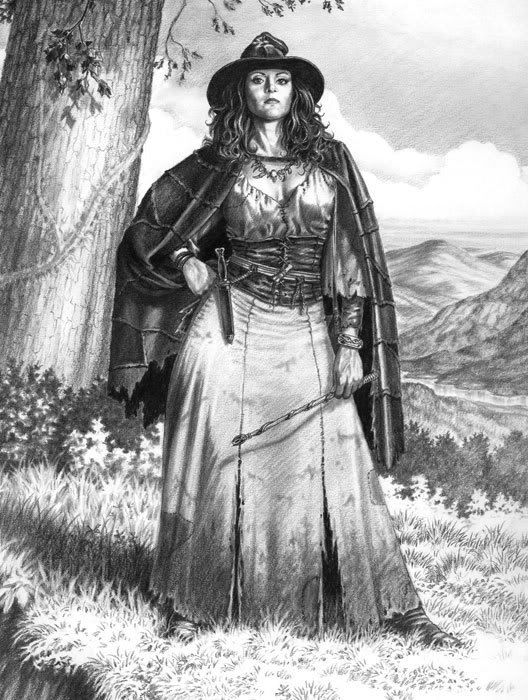 |
| Aradia as rugged medieval traveler? |
If one links all of the circumstances, I think it paints an alluring possibility, partly because it's all old circumstantial evidence. The Bergamo Alps is a large wild mountainous area, where Aradia, and presumably her followers, could hide out if need be. San Pellegrino Terme is in the southern stretches of the Bergamo Alps; yet close to the Po Valley and the city of Bergamo. Also, this location was on the edge of the east Lombard Alps, where there had been a strong pagan tradition. There were plenty of secluded mountain valleys in which to dwell, and where the old ways were not out of place. Were there further wanderings and history of Aradia lost in time?
A few Papal and Venetian state authorities seemed to suggest that there was an upsurge in "Witchcraft" in the east Lombard Alps during the late fifteenth century: "For this reason we cannot but think that there is an evil sect in this diabolical valley." This wouldn't have been much more than a century after Aradia could have visited the region. These authorities finally took action, and witch trials soon took place in both Val Camonica and the Valtellina. As to whether or not there was a real upsurge, or if it was merely the old regional tradition, their reasoning was all the pretext that they needed. Could it have really been a resurgence of the old ways, which was introduced by Aradia, that resulted in a growing synergistic movement in these isolated mountain valleys?
And onto... Serbia?
Excerpt from page 224 of 'Hereditary Witchcraft: Secrets of the Old Religion' by Raven Grimassi:
 I found it also interesting to note that 'Ecstasies: Deciphering the Witches' Sabbath' by Carlo Ginzburg contains a passage that may be a historical reference to Aradia. On page 189 he speaks of a Pagan sect known as the Calusari, who, during the Middle Ages (as late as the sixteenth and seventeenth centuries), worshipped a "Mythical Empress" whom they sometimes called "Arada" or Irodeasa." The Calusari also used the term "mistress of the fairies" for her, just as the followers of Aradia called Diana the "Queen of the Fairies." There are certainly some very close similarities here, and we may be seeing a form of worship that evolved from the one Aradia founded over 100 years earlier.
According to the original legend of Aradia, she left Italy at some point in her quest and traveled out of the country. Serbia, the home of the Calusari, lies a short distance across the Adriatic from Central Italy, and travel by ship was not uncommon in that era. When Aradia left Italy she would not have traveled west to France because the Papacy was established there at the time, and Aradia was still being hunted by the Church. It would have been too dangerous to have gone to northern Europe because witches were being burned or hanged in that region (Italy did not begin the burning of witches until after the time of Aradia). So, in fact, an eastern exodus would have been the only logical action that Aradia could have taken. At the very least, there is a striking coincidence between Aradia's Witches and the Calusari of Arada.
.


