
Showing posts with label American folk traditions. Show all posts
Showing posts with label American folk traditions. Show all posts
Saturday, July 22, 2017
Countdown to the Total Solar Eclipse of 2017
This summary is not available. Please
click here to view the post.


Tuesday, June 9, 2015
'Stregheria and Vernacular Magic in Italy: A Comparison' by Sabina Magliocco - Part 3
There are two principal strains of healing in Italian vernacular culture: healing through the use of herbs, and spiritual healing. In some cases, both may be practiced by the same individual. Of the two, healing with herbs is considered less a matter of spiritual ability than of practical knowledge. Spiritual healing, in contrast, is believed to be more connected with personal power. This is variously called la forza (power), la virtù (virtue; also attribute); or il segno (the sign), and is generally believed to be inborn. But power alone is useless without the prayers, magical formulae and techniques that make up the cunning person’s craft. Knowledge and power are passed on through an initiation, most commonly at midnight on Christmas Eve mass, during the elevation of the host -- that magical moment of transformation in the Catholic liturgical year at which the world is transformed by the birth of the Savior, and the host is transformed into his body -- and thus, by association, any transformation can take place. The knowledge takes the form of prayers that call upon a saint or the Madonna, and in some cases an accompanying technique, which varies according to the nature of the spiritual cure. These formulas and techniques are secret; they cannot be passed on to others without the healer losing her or his power, and they can only be passed on at the appointed time in the ritual cycle. Often, this is the only initiation and training necessary for the transmission of simple charms. Healing knowledge and power are typically passed down within the family; in some cases, family members – typically a group of siblings or cousins – must work together in order to bring about the cure.
 As scholars have documented for other parts of Europe, spirits figure prominently as the helpers of Italian cunning folk. While many ordinary Italians living in traditional communities admit to belief in spirits, and occasionally even to contact with them, cunning folk seem to possess an intensified ability to commune with them above and beyond that of ordinary people. In many areas, healing is essentially conceptualized as a battle against malevolent spirits – whether those of the unquiet dead, witches, or others. Healers need spiritual allies in these battles, and many healers claim to have them in the form of spirits who guide and help them in their craft. The nature of these spirits, once again, is highly localized as well as idiosyncratic: they may be saints, personal ancestors, or helpful dead. They may appear to the healer in dreams and visions: trance and ecstatic states are a fundamental part of communicating with the spirits; they are doorways into the spiritual world for healers and magic workers. When cunning folk rely on saints or the Virgin Mary as helpers, they may maintain shrines to them, participate actively in the organization of festivals in their honor, and play active roles in religious sororities and fraternities that raise money for the feasts. Cures for certain illnesses may take place only on specific feast days or in the context of saints’ festivals. Thus, healing is closely connected to the seasonal and economic cycle of the community, and to the Catholic liturgical calendar.
Italian cunning folk may use a variety of tools in their work which suggest a connection to Stregheria and Neo-Pagan Witchcraft. They commonly keep notebooks in which charms and prayers are recorded – the forerunners of modern-day books of shadows. Some use weapons of various types (daggers, swords, bayonets and even guns) to frighten evil spirits or symbolically cut away certain illnesses, such as worms. Ropes or cords may be used in binding spells and charms, while other tools may be entirely idiosyncratic.
 The Italian cunning tradition has a number of traits that suggest that some aspects of modern Stregheria may derive from it in part, and that many Italian Americans who see themselves as carriers of Stregheria grew up in families that preserved aspects of the rural Italian enchanted worldview. Like modern Neo-Paganism and revival witchcraft, this way of life was organized around a ritual year that followed the cycle of the seasons; the moon and sun influenced rhythms of work and production. Women were recognized as life-givers and nourishers, and were closely involved in the maintenance of shrines to a feminine divine figure, the Virgin Mary. Their immigrant ancestors may have been carriers of a tradition of healing that involved herbal and magical practices. They may have kept notebooks of charms and prayers that were precursors of today’s Neo-Pagan books of shadows. Their tools may have included knives, swords and other weapons designed to frighten away malevolent spirits, and their craft involved communication with helpers who took the form of ancestor spirits. Since these traditions could often be conflated with witchcraft in popular narratives, it is possible that this link persisted into the second, third and fourth generation after immigration, giving contemporary Streghe the impression that their ancestors belonged to an organized, hierarchical but secret society of witches. But Italian cunning craft also differs from modern Neo-Pagan Stregheria in important ways. It is emphatically not a pagan religion; there is no mention of a goddess and god, nor are deities ever drawn down into the bodies of practitioners. It exists within a largely Catholic worldview, albeit one permeated with ancestor spirits, magical practice and other elements that mark it as vernacular, rather than ecclesiastical, in nature. Absent, too, is the Wiccan ritual framework, and while there may be certain similarities between the Wiccan year cycle and that of rural Italy, that is because the former is based largely on the Irish agro-pastoral cycle, which shares a common heritage with that of other parts of Europe, including Italy.
But could an ancient pre-Christian religion involving the veneration of Diana have survived in Italian peasant tradition, only to be brought to North America by Italian immigrants? The lack of written evidence makes any answer to this question hypothetical at best, but from the historical record, such a scenario would be very unlikely. Three factors make the survival of a pagan religion in Italy into the 20th century, and its transmission through written documents such as Leland’s Aradia, improbable: the strong presence of Christianity throughout the peninsula from fairly early after the fall of the Roman Empire; the lack of a unified Italian culture and language until the late 19th century; and the relative isolation and lack of resources of the peasant classes – the very ones who are said to have preserved the religion, according to the Neo-Pagan mythos.
 Stregheria and Italian vernacular magic and healing are, then, quite different but interconnected traditions. Many Italian Americans who today see themselves as carriers of Stregheria grew up in families that preserved aspects of the enchanted worldview in an immigrant context. While Stregheria may be helping contemporary Italian Americans rediscover aspects of their roots and feel pride in their ethnic identity, its form, structure and cultural context are markedly different from those of the enchanted worldview and its associated practices in Italy. Yet Stregheria should not be interpreted as inauthentic, fake or contrived, for innovation and reclamation are part of the process of tradition. The enchanted worldview cannot exist in the context of contemporary urban North America; Italian Americans need new ways to construct and preserve ethnic identity, and for some, Stregheria satisfies those needs.
.
Monday, June 8, 2015
'Stregheria and Vernacular Magic in Italy: A Comparison' by Sabina Magliocco - Part 2
Italian vernacular magic, by contrast, is neither a religion nor a formalized system of practice. It is both a worldview and a set of customs tied to the agro-pastoral cycle which is strongly embedded in the lives of its practitioners, almost never on a self-conscious level. For most of its carriers, it is simply an ordinary way of doing things and behaving. While it may have historical roots in pre-Christian practices, it is emphatically not a pagan tradition, but firmly embedded within a Roman Catholic cultural matrix. In my more recent work, I have called it “the enchanted worldview,” playing on Max Weber’s trope of the disenchantment of the world.
The enchanted worldview in Italy is rooted in specific pre-market economic and social systems. Because of subsistence activities associated with the land, time is organized according to seasonal cycles; these are reflected in the ritual year, which is dominated by Catholic liturgical forms. These almost always are locally interpreted in ways that connect them to the economic cycle: for example, in Campania, where wheat and hemp crops have been replaced by tobacco, which has a similar growing season, the ritual year begins at planting time near St. Martin in mid-November, and extends until the end of the harvest season at St. Cosimo and Damiano in October. In pastoral areas such as Sardinia and the Apennine, May and September, the months that frame transhumance, are emphasized in local ritual practices. The exact shape of the ritual year thus differs markedly from one area to another. The symbols – the Madonnas and saints – are the same, but each township differs in the way it situates these characters within its symbolic and economic system. The enchanted worldview is not only rooted in the ritualyear cycle; it is all-pervading in the individual’s life cycle. It begins at birth and penetrates every phase of life and every rite of passage, from the moment of birth, when most Italian babies who are not born with a caul (la camicia, or “shirt,” in Italian) are given a fine lawn shirt by a relative, often a godparent, to protect them against evil influences, to funerals, where a variety of beliefs about the otherworld are made manifest through practice.
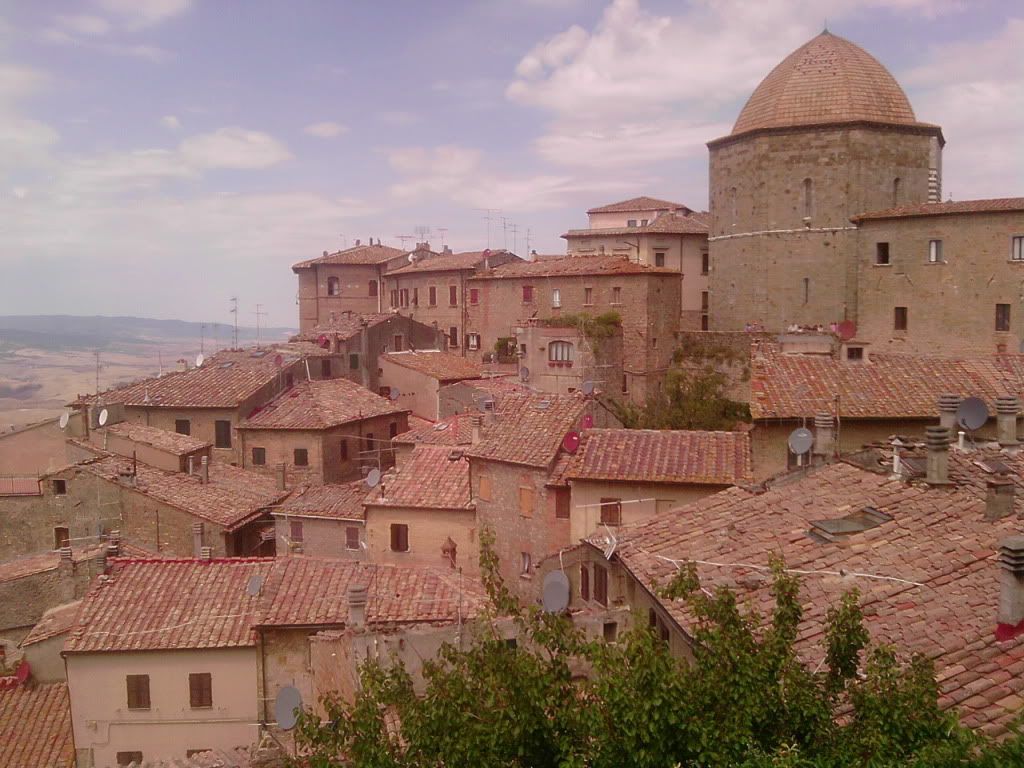 |
| Volterra, Tuscany; birthplace of Aradia |
Despite its exquisitely local character, the enchanted worldview exists throughout Italy, in both northern and southern regions, with significantly more commonalities than one might think, given the differences in language, culture and economy that characterize Italy’s twenty regions. Certain concepts are ubiquitous: for example, the evil eye and its diagnosis and cures are found in all regions, and are very similar throughout. Yet the enchanted worldview defies systematization. Beliefs and practices are nowhere standardized, or even organized into an easily articulated set of principles; they are part of everyday life, part of praxis. German ethnologist Thomas Hauschild, who spent nearly twenty years studying magic in Basilicata, a region in the south of Italy, wrote: “There is no system, only practice” (Hauschild, 2003:19). The practice is the system. Practices and beliefs exist within a particular cosmology, but its details seldom preoccupy its technologists. Thus, a structure like that described by Grimassi, with orderly branches in various parts of Italy, each with its own leader and systematic body of lore, is inherently foreign to the enchanted worldview in Italy.
 |
| Diana - Goddess of the Hunt |
to a person who brings harm to others. Italian folklore is rich in legends about witches who fly through the air to their legendary gatherings around the walnut tree of Benevento, shrink themselves so small they can fit through keyholes, suck breath or blood from victims, and cause all manner of illness and mischief to their neighbors. Clearly, these activities refer to folkloric witches; they have never been practiced by actual human beings. Occasionally, however, healers may be accused of being streghe by those who believe themselves to be victims of black magic, or by clients who have failed to be healed by the cunning person’s cures.
.
Sunday, June 7, 2015
'Stregheria and Vernacular Magic in Italy: A Comparison' by Sabina Magliocco - Part 1
'Stregheria and Vernacular Magic in Italy: A Comparison' by Sabina Magliocco
The distinction between contemporary Stregheria and traditional Italian magic, healing and spiritual practice has lately been the subject of lively debate on a number of listserves and websites. In this brief essay, I will attempt to summarize some of my academic publications on this theme for a non-scholarly audience, and to encourage further research, questions and discussion on this topic. I should state at the outset that my approach is academic: as an anthropologist and folklorist, I consider both Stregheria and Italian vernacular magic as important facets of culture in their own right. My intention is not to support or deny the authenticity of either, but to help readers understand both in the contexts in which they developed, and how the former grew from the latter in the context of the Italian American diaspora.
Stregheria is an Italian American variety of Neo-Pagan Witchcraft. It owes its origins to Aradia, or the Gospel of the Witches (1889), a collection of spells, rhymes and legends which amateur folklorist Charles G. Leland claimed came from a Florentine fortune-teller named Maddalena. According to Leland, Maddalena belonged to a family of witches who practiced a form of pagan religion centered on the worship of the moon goddess Diana. Leland interpreted the materials he collected according to popular folklore theories of the late 19th century: as survivals of ancient pagan religions, specifically those of the Romans and Etruscans, whose civilizations had once dominated central Italy. He dubbed witchcraft la vecchia religione (the old religion). Right from the start, Leland’s work was controversial. Some of the materials in it –
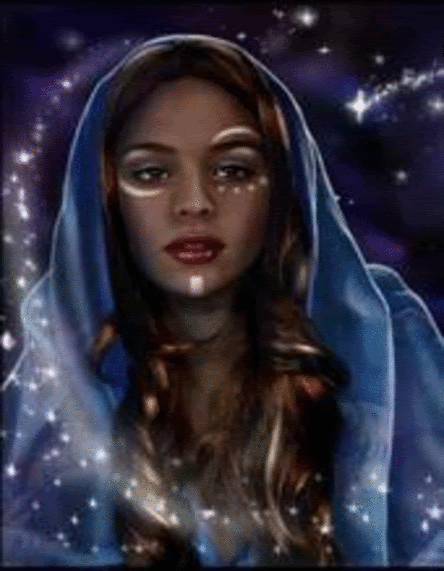
Despite the controversies surrounding it, Leland’s text became quite influential: it equated folk magic to an ancient religion involving the veneration of a goddess, and located this all in Italy. Leland clearly influenced Gerald B. Gardner, who is widely credited with the development of Wicca in its present form, and through Gardner, an entire generation of Witches. Among the first to openly identify as a practitioner of Italian witchcraft was Leo Louis Martello (1933-2001). Martello claimed to have been initiated by a family member as a young man. He described a secret hereditary tradition based on a Sicilian version of the myth of Proserpina (Persephone). Along with priestess Lori Bruno, also a hereditary practitioner, he founded the Trinacrian Rose of New York City, one of the first Italian American covens in North America.
But the real heir of Leland is Raven Grimassi, the architect of Stregheria. Like Martello and Bruno, Grimassi claims to have been initiated into a family tradition of magical practice which he describes as hereditary, domestic, and secret. Grimassi’s mother comes from the region of Campania, outside Naples. She belongs to a family whose members practiced a number of magical
 Grimassi’s genius is creative, rather than scholarly. He never claims to be reproducing exactly what was practiced in Italy, admitting that Streghe have “adapted a few Wiccan elements into their ways” (1995:xviii). He openly acknowledges that he is expanding on his family tradition, adding elements to it to restore it to what he imagines was its original state. But from his attempts to restore a tradition, a brand new tradition has emerged: one that bears little resemblance to anything that was practiced in Italy or in Italian American ethnic communities.
While based on Italian folk magic, historical accounts and folklore collections, Stregheria is, like most revival Witchcraft, a modern tradition. Folklorist Robert Klymasz, writing about what happens to folklore as a result of immigration to a new culture, identified three layers of folklore that are present in any ethnic community. These include the traditional, with clear links to Old World forms; the transitional, in which some elements from the Old World crystallize, while others adapt to the new context; and innovational, in which new folklore is developed to make up for older forms that have been lost (Klymasz, 1973). Stregheria belongs to the last category. It has some points in common with Italian vernacular magic, which I will outline below; but there are more differences than similarities. Its true value lies in its ability to provide contemporary Italian Americans with a new context in which to interpret folk magical practices that have remained in their families for many generations, giving these traditions a new life. In the process, it plays a vital role in helping to create and maintain identity for its practitioners.
.
Monday, October 27, 2014
Finding the "country" aspect... no matter where you live

I copied the following two definitions from a YouTube video produced actually by a Christian....
Pagan: Country dweller, peasant
Nature Religion: Heathen; Country, out in the "hearths"
I think that the origin of the words "pagan" and "heathen" go back to a period during the Middle Ages after "the old ways" had been driven out of the mainstream, but still existed in the countrysides. In many instances, the outer Christian exoteric masked an inner Pagan esoteric in these rural communities. The old Dutch and German farm country of western Pennsylvania is a good example of that in America. The number of actual "heathens" is quite small, but there's clearly an esoteric pagan culture which is adhered to by many.
I don't think---even if one lives in a very urban area---that any pagan or anyone else should feel disconnected from "the country," or nature. The spirit of the Almother shows herself every time it rains in October, and when a little grass grows from a crack in the concrete several days later. Even if the nearest remote area is far away, if you think outside the box, you might---for example---find that the nearby industrial park is something of a nature sanctuary after seven o'clock or on Sundays. Also, if there's a body of water close by, all the better.
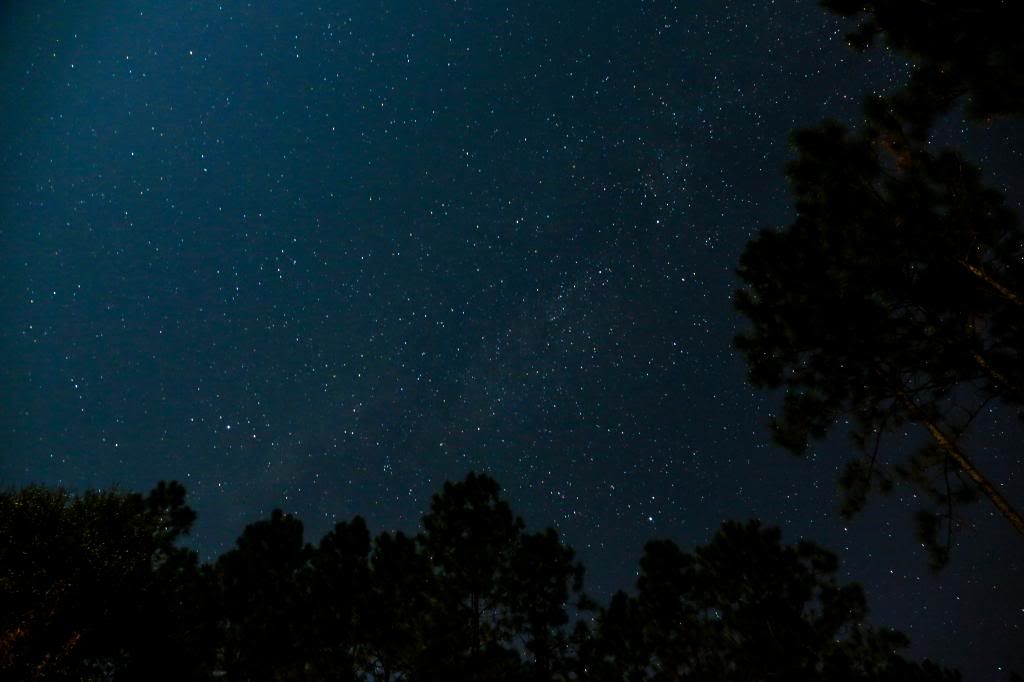 If an urban dweller is lucky enough to have a park or remote area nearby, that's a big plus. If an area like this is large enough, any clear night sky will be "an island of stars" in an urban sea. I'm lucky enough to live on the edge of a state park, so I experience this phenomenon, and treasure it. Also, racoons, skunks, possums, foxes, hawks, falcons, ravens, owls, and even bats enter the neighborhood.. and occasionally interact with people. Last week I was surprised to see a coyote race across the hillside where I live, about fifty feet away.
One evening a few days ago, I was sitting on a deck upon the hillside towards the park, and a common ritual happened as it has so many times. The deck sits upon an "animal trail" used by the wildlife or neighborhood cats. After awhile, this trail comes into focus, as it goes across the hillsides, through backyards, and across the upper portion of this deck. Two racoons arrived as I was sitting in the darkness. I could see their masked faces peering at me. Slowly they started to move under the deck. As I looked at the opposite side to see them exit, a big furry head lifted out from under and looked up at me. We looked at each other for about seven seconds, a great interaction. A few moments later, they made their way back onto the trail. Just hearing the faint coyote howls from the mountain is enough to really feel connected to the real natural world.
A few weeks ago, a large piece of meat fell on the floor. I decided to use it for an experiment. I placed it on the deck and set up a remote camera and light to try to tape record a raccoon. As it got dark out, my television screen was on with the video feed signal from the deck. After about twenty minutes, I got bored and left the room. As I returned five minutes later, I was surprised to see a raccoon head filling the screen. It was sniffing the camera, as it had already eaten the meat. Actually, as a general rule, it's not good to feed wild animals because they can then become a nuisance. It was just a one-time thing though.
 |
| Valknut |
I believe that we all have different expressions of our individual selves, and each is a separate way we may see ourselves occasionally. I have always been a little bit of a "wannabee country boy." Not far from me, at the Cow Palace just outside the San Francisco city limits, the Grand National Rodeo is going on this week as it has for decades. There are a lot of "rural folk" around now. I remember when San Mateo County had a strong rural element to its personality, but not very much anymore. However, a county fair can really bring out that rural spirit. As silly as it may sound, I like the spirit of the FarmersOnly.com singles site.. those commercials. It seems to capture the healthy spirit of rural life.
There is one channel that I tune into now and then called RFD-TV, which is a channel which covers news and culture for "rural America," which really could exist in any state. As I've gotten older, I have grown tired of music where the artists have "a definite point to make!," and I can really enjoy just listening to polka music. Again, I'm an occasional "wannabe," although my family lived in a very rural environment before me.. in the Alps and the Midwest... so, I can at least lay claim to some connection to rural values in some form I guess.
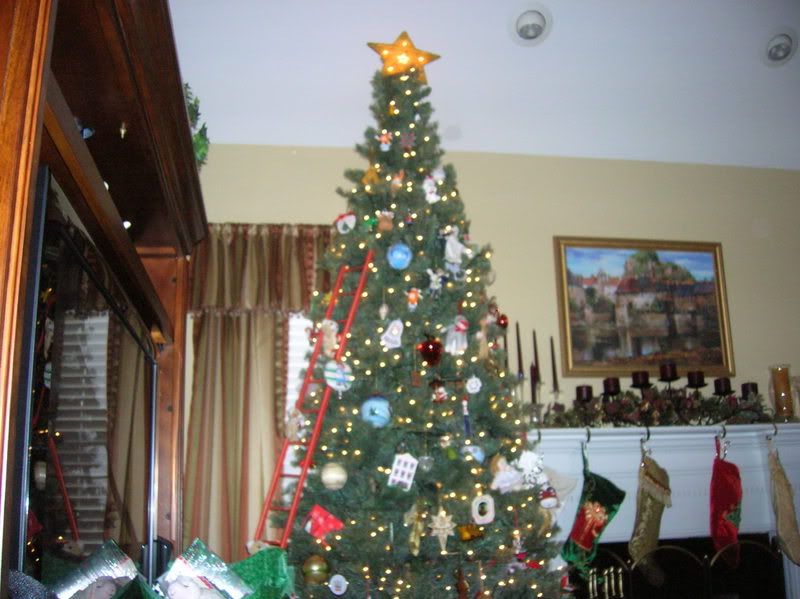 |
| Christmas tree, of Germanic heathen origin, with Vehmic star |
I think country music, albeit very Christian in general nature, is also tied into this concept. I prefer the old classic country, more so than what some call "New York country." That term is a little bit unfair since most of New York state is actually rural I think. Country music appeals to "the country" in any state. Blue grass music is actually very popular as well, even though the mainstream media plays it down, and is rooted in Gaelic culture from the South apparently. One blue grass festival recently in San Francisco attracted a huge number of people, which probably wouldn't be the case in the mainstream brands of music.
I don't believe that anyone should feel disconnected to any of these ideas just because of where they live. It may be a little difficult to articulate these points because I'm referring to a milieu of loosely connected concepts, but I think you probably know the spirit of it. I still remember in the 70s, when Brisbane---a small town just south of San Francisco---was really a cowboy town due to the large number of people descended from the "dustbowl migration" to California in the 30s. There's a whole local history to that.. that I could cover at some later point.
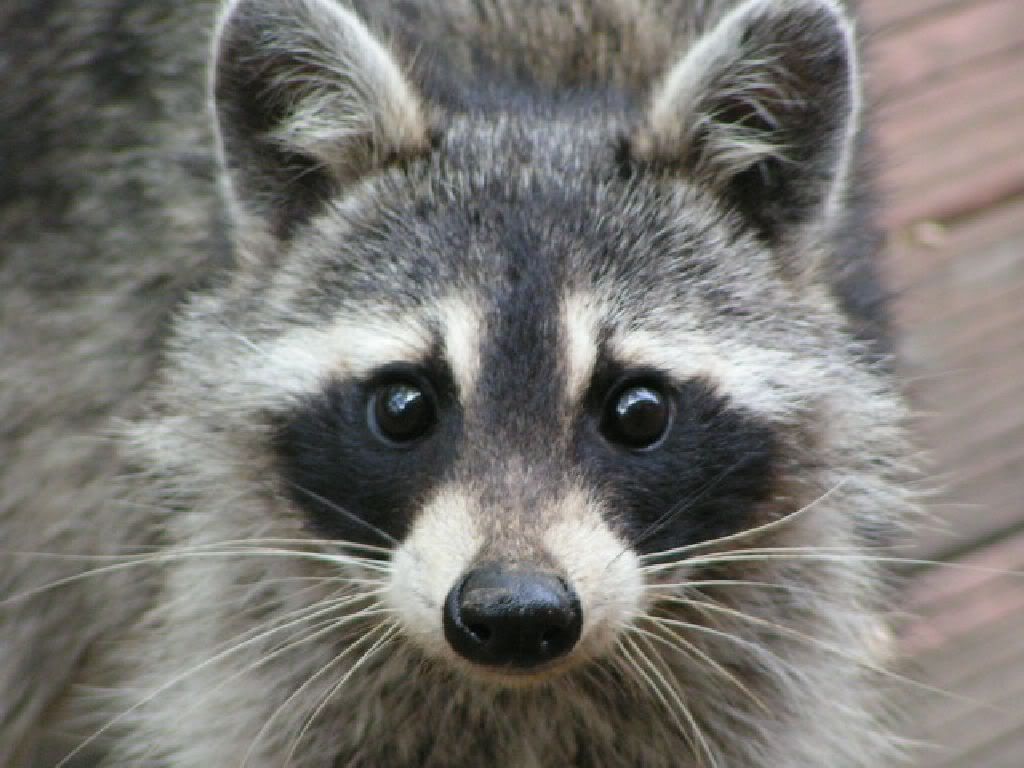
I admit it, I love this commercical... but maybe I'm just a wannabe...
.
Subscribe to:
Posts (Atom)