Pizzoccheri alla Valtellinese
Ferdzy - Seasonal Ontario Food - December 31, 2014
Here it is; the Italian recipe using homemade buckwheat noodles that I mentioned earlier. All the recipes I found were very consistent, but being me I have made some changes. The main one was to add some carrots. I thought they would fit in well with the flavour profile and add some much-needed colour. I didn't put toasted bread crumbs on top, but our assessment of the dish was that although it was very tasty, the texture was just a tad soft and stodgy, and crisp bread crumbs would add just enough of a different texture. They are not absolutely necessary, however.
The original cheese to use is Valtellina Casera, which you will not find around here. Friulano should make an excellent substitute. All the recipes I saw cooked the garlic with the sage then removed and discarded it, which seems a bit precious to me for what is basically peasant chow. Not to mention that I have put much effort into growing and storing that garlic, and I'm eating it, damn it. I have also streamlined the process a bit; mixing everything together rather than layering it in bowls. Friulano melts pretty quickly, so don't mix it for more than a minute or so, but I do think that mixing it in the pot will give you better melting than just layering the ingredients.
Swiss chard is often used in this dish, but cabbage, kale, or spinach will work just as well, meaning this dish could be made pretty much all year long using whichever green was most seasonal, although I don't really see it as a middle-of-the summer kind of thing. On the other hand, given the last couple of cool, rainy summers; maybe.
2 servings, or 4 servings
20 minutes prep time, assuming the noodles are made
Advance Preparation:
1/2 recipe buckwheat noodles, cut into short pieces
1 tablespoon unsalted butter
1/2 cup coarse, fairly dry bread crumbs
Make the noodles according to the recipe, at least 2 hours before preparing the rest of the dish, and let them sit out on the counter to get a bit dry.
Heat the butter in a large skillet over medium heat, and toast the crumbs in it until they are lightly browned and quite crisp. Turn them out onto a plate to cool, and set them aside until needed.
 Finish the Dish:
1 medium potato (1 cup when diced)
1 medium carrot (1 cup when diced)
1 medium onion
4 cups chopped green or Savoy cabbage, Swiss chard, kale, or spinach
3 or 4 cloves of garlic
2 tablespoons unsalted butter
100 grams (4 ounces) diced Friulano cheese
30 grams (1 ounce) finely grated Parmesan cheese
1 teaspoon rubbed dry sage
OR 3 or 4 fresh sage leaves
salt & freshly ground black pepper to taste
Put a large pot of salted water on to boil.
Wash and trim the potato (or peel it if you do that kind of thing), and cut it into 1/2" dice. Peel and trim the carrot, and cut it into slightly smaller dice. Peel and chop the onion. Wash, trim and chop the cabbage or other greens fairly coarsely. Peel and mince the garlic.
When the water comes to a boil, add the carrots and potatoes, and boil them for 8 minutes. Add the buckwheat noodles, and continue cooking for another 5 to 7 minutes, until the noodles are tender.
About 5 minutes after the carrots and potatoes have been started, heat the butter in a large skillet over medium heat. If using fresh sage, fry them briefly in the butter, then remove them - you can save them as a garnish if you like. Add the onion, and cook for 2 or 3 minutes, stirring occasionally. Add the cabbage, and mix in well, stirring regularly to keep it cooking down evenly. After 3 or 4 minutes of cooking the cabbage, add the garlic, and the dry sage if that is what you are using. Mix well, and let cook for a few more minutes while the noodles cook. Use this time to dice and grate the cheeses. Mix the grated Parmesan with the prepared bread crumbs.
When the noodles are ready, drain them and return them to the pot over medium-low heat. Quickly mix in the diced Friulano cheese and the vegetables from the skillet. Stir for just a minute, until you see signs the cheese is melting. Turn it at once into a serving dish, or divide it amongst individual dishes, and sprinkle with the Parmesan and bread crumbs. Serve at once.
.
Although the ancient Camunni language and alphabet have been covered here before, there may be another way of looking at it, and in relation to the Camunian-Valtellinese link from a greater historical viewpoint. To start with, the ancient Camunic language was spoken and written in both the Val Camonica and the Valtellina, and I'm guessing that may well include the Bergamo Alps, Val Chiavenna, Val Sabbia, Val Trompia, and all the connecting valleys in the "Camuno-Valtellinese region." This ancient language was, of course, tied to the Camunian alphabet (see link). When viewing the characters of this alphabet, they appear more like Norse runes than the Phoenician-originated alphabet that we use today.
 The actual origin of ancient regional scripts can be confusing since some of the various characters have been adopted back and forth, often via trade routes (Greeks, Romans, Etruscans, Phoenicians, Celts). I would guess that the forgotten trading centers and roads of the Celtic world were how many ancient scripts and characters were spread back and forth between the rather isolated Teutonic world and the Mediterranean world. In other words, a trading center along the southern coast of Gaul three thousand years ago would have Gauls coming into contact with Phoenicians for example. The Gauls had access to Scandinavia and the Teutonic world, and the Phoenicians had access to the known sea routes.
The Camunian alphabet shown in the above link, includes clear recognizable symbols from both north and south, as well as those unique to the ancient Camuns/Tellines. Also, this alphabet was taken from rock carvings; therefore the difference between the various alphabet characters and symbols of the spirit or earth, is more narrow than it would at first appear. For example, the very regional Camunian rose and characterizations of the god Cernunnos. Within the alphabet is a circle with a dot in the middle, a symbol of the sun, probably originating from the sun-worshiping Teutons. Also, it possibly may have been a symbol of Odin, and maybe Tyr before that. Its ultimate origin may have been Saturn when it was illuminated in the northern sky thousands of years ago.
 Also included in this alphabet are both the Norse life and death runes, and a number of other other Norse runes. Since some of the Norse runes are of Etruscan origin, I believe that a few of these characters were both adapted directly from Etruscan script (lower Lombardy was within the Etruscan sphere of influence) and also probably from frequent contact with migrating Celts from the north who settled near them. At least the life/death runes and the sun-circle were of true Teutonic origin; and Cernunnos was Gaulish. In conclusion, these are runes! By definition, being both an alphabet and spiritual symbols, they are as "runic" as the Norse runes. I have a good idea of what my next art project will be.
2-21-16 ADDITION: Regarding the 1937 German Ahnenerbe institute expedition to the Val Camonica:
In 1937, the Ahnenerbe sent the archaeologist Franz Altheim and his wife, the photographer Erika Trautmann, to Val Camonica, to study prehistoric rock inscriptions. The two returned to Germany claiming that they had found traces of Nordic runes on the rocks, supposedly confirming that ancient Rome was originally founded by Nordic incomers.
Also included in this alphabet are both the Norse life and death runes, and a number of other other Norse runes. Since some of the Norse runes are of Etruscan origin, I believe that a few of these characters were both adapted directly from Etruscan script (lower Lombardy was within the Etruscan sphere of influence) and also probably from frequent contact with migrating Celts from the north who settled near them. At least the life/death runes and the sun-circle were of true Teutonic origin; and Cernunnos was Gaulish. In conclusion, these are runes! By definition, being both an alphabet and spiritual symbols, they are as "runic" as the Norse runes. I have a good idea of what my next art project will be.
2-21-16 ADDITION: Regarding the 1937 German Ahnenerbe institute expedition to the Val Camonica:
In 1937, the Ahnenerbe sent the archaeologist Franz Altheim and his wife, the photographer Erika Trautmann, to Val Camonica, to study prehistoric rock inscriptions. The two returned to Germany claiming that they had found traces of Nordic runes on the rocks, supposedly confirming that ancient Rome was originally founded by Nordic incomers.
.
 |
| The beautiful Valtellina |
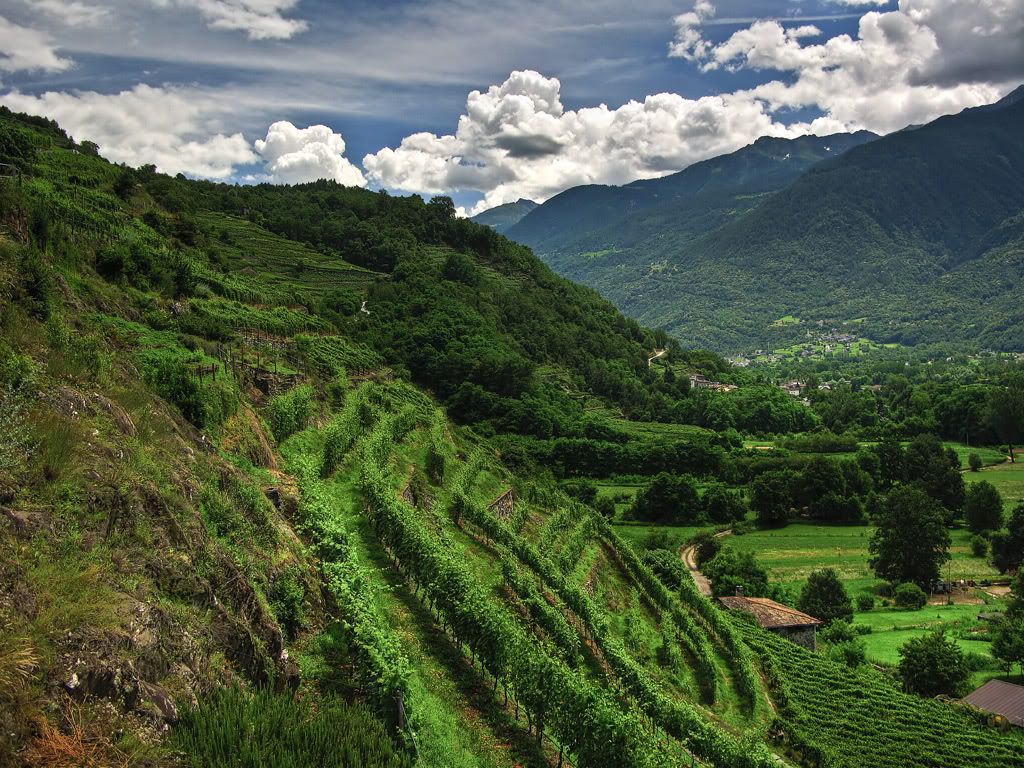
The Valtellina is an Alpine valley which runs about 80 miles east-west, and is about 50 miles from the cities of Brescia and Bergamo, and the flat lands of the Po; so it's rather isolated from a historical point of view. The northernmost village of the Val Camonica, Edolo, is close to the village of Aprica of the Valtellina. The Aprica pass separates the two. The two valleys, their cultures, and their histories are very similar. The following article is from the Lombardi nel Mondo website. I did my best to translate it, often rewriting muddled portions in an attempt to get at what I thought was the true meaning. It at least gives some idea of the old experiences. You almost have to think of... perhaps movies which show very desolate locations, maybe set in the late 1800s. 'Butch Cassidy and the Sundance Kid', in the sequence when they went down to Bolivia, comes to mind. Beyond the east coast cities of Australia, maybe 100 miles inland, are the farmlands; and maybe that's part of where this took place. Of course, in 1860 or 1890, this was a very underdeveloped area. Later in the article, I think they were referring to maybe the 1940s or 50s. I remember of reading some really old accounts of what overseas employers, from the perspective of Europeans, thought of workers from certain regions... and what types of work they're good at. I recall something like.. people from the Italian Alps, Slovaks, Hungarians, etc. are good at heavy work. In other words, in contrast to modern perceptions, they didn't drag people all the way over from the middle of the rural Alps on the other side of the planet just to do very hard work that Aborigines or some little islanders could do.
 'Valtellinese Emigration to Australia (1860-1960)'
From letters of migrants and third party migration development
From this we can understood the early migrations from the Valtellina, deepening the meanings and expectations of this history. Perhaps, as they had feared opponents of immigration, some of the early migrants to Australia were attracted by widespread tales of gold or of a country of plenty from emigration agents, but any such illusion was short-lived. The temporary emigrants were not on their way to a generic "Australia," but headed for specific locations, looking for a specific job. In Australia you could make some good gains, but at the price of a very hard effort and lack of any attractiveness and with great personal sacrifice. More often than not they found themselves engaging in grueling logging work in remote areas, cutting sugar cane in tropical heat, or risking their lives in underground mines. The rhetoric used by emigrants in the description of their travels is revealing: "making sacrifices" was the term used to talk about these migrations. Australia had become famous not as a country of plenty, but as a place of hard work. Since they were temporary migrants, they departed without knowing the language; and they did not come with women or families, and they did not sell their lands before leaving. Their goal was to make the highest profit in the shortest possible time, in the hope of a quick return home. They probably started with few illusions. The idea was to get through the burden of the work load stoically, sit tight and hope that they can maintain their health and safety. Normally there was no intention to settle permanently.
The presence of Lombards in Australia, and more generally of people originating from Italy, was noted by the consuls and consular agents of Italians after the discovery of gold in the State of Victoria in 1851. The Valtellinese presence was known in those areas and to the agents of the shipping companies which operated in moving Swiss citizens not far from the border from Valtellina, in the Valley of Poschiavo in the Canton of
 |
| Rural Australia |
Graubunden. Historically, these were the most common destinations of seasonal emigrants of Valtellina. After the first pioneers, Australia became part of the recognized world, and this recognition greatly influenced the development of future migrations. In Italy the chance to earn money were few, even in periods of greater well-being; as contrasted to the reputation of Australia as a source of earnings. Among other things, it was becoming a regular destination of those who hoped to increase their wealth, and not just of those most desperately in need. It was temporary migrants who intended to make a fortune. They were farmers and--with a majority of males being of working age, 20s or 30s--half of them were married, many with children. The desire of these people was to get out of the cycle of poverty, which neither the government, nor the charity institutions had eased. The bad harvests, the high cost of living, the lack of work, and the heavy load of fees and taxes were all factors responsible for departures. At that time the news of those who returned from Australia were "excellent," unlike those coming from America.
Returnees had described the unfavorable treatment accorded to them by the authorities and employers in America, while Australia had proved very hospitable. In the Valtellina, a culture of migration had developed, especially to Australia; thereby ensuring that in years to come, the majority of emigrants would follow already beaten paths. Several routes were opened in Australia since 1890. The most important would lead migrants to Western Australia, to regions where there was a focus on extractive activities and of the harvesting of timber. Especially after World War II, the northern regions of Queensland opened up in the sugar cane plantations. For many years the migrants made significant progress from the fruit of their labor, to the point that they began to consider settling permanently in the country. It was starting to become apparent that with these changes, people were deciding to make Australia their home. Their lives were simple but decent, and of which their old traditions and habits continued on. It was similar to their old village life, and less like Anglo-Saxon proletarian life. They toiled all day in the fields, pulling plows, but when they returned home in the evening to a nice home, bath, dinner, and a car to drive to town to the cinema. At the tables were always their native cuisine; lots of macaroni, salads, and buttered bread, along with cups of tea.
Source: Jacqueline Templeton, 'From the Mountains to the Bush: Emigration of Valtellinese in Australia (1860-1960) from the Letters of Migrants'; Tirano Museum, 2001
.

 Finish the Dish: