Showing posts with label Camunian. Show all posts

Monday, February 15, 2016

Incontri Tra/Montani: Acknowledging the importance of our shared pagan past II - "Camunian runes"


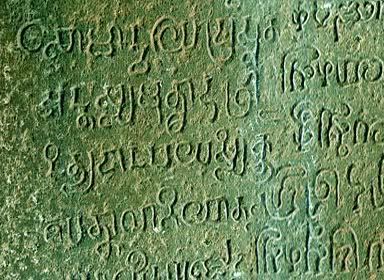
Although the ancient Camunni language and alphabet have been covered here before, there may be another way of looking at it, and in relation to the Camunian-Valtellinese link from a greater historical viewpoint. To start with, the ancient Camunic language was spoken and written in both the Val Camonica and the Valtellina, and I'm guessing that may well include the Bergamo Alps, Val Chiavenna, Val Sabbia, Val Trompia, and all the connecting valleys in the "Camuno-Valtellinese region." This ancient language was, of course, tied to the Camunian alphabet (see link). When viewing the characters of this alphabet, they appear more like Norse runes than the Phoenician-originated alphabet that we use today.

The actual origin of ancient regional scripts can be confusing since some of the various characters have been adopted back and forth, often via trade routes (Greeks, Romans, Etruscans, Phoenicians, Celts). I would guess that the forgotten trading centers and roads of the Celtic world were how many ancient scripts and characters were spread back and forth between the rather isolated Teutonic world and the Mediterranean world. In other words, a trading center along the southern coast of Gaul three thousand years ago would have Gauls coming into contact with Phoenicians for example. The Gauls had access to Scandinavia and the Teutonic world, and the Phoenicians had access to the known sea routes.

The Camunian alphabet shown in the above link, includes clear recognizable symbols from both north and south, as well as those unique to the ancient Camuns/Tellines. Also, this alphabet was taken from rock carvings; therefore the difference between the various alphabet characters and symbols of the spirit or earth, is more narrow than it would at first appear. For example, the very regional Camunian rose and characterizations of the god Cernunnos. Within the alphabet is a circle with a dot in the middle, a symbol of the sun, probably originating from the sun-worshiping Teutons. Also, it possibly may have been a symbol of Odin, and maybe Tyr before that. Its ultimate origin may have been Saturn when it was illuminated in the northern sky thousands of years ago.

Also included in this alphabet are both the Norse life and death runes, and a number of other other Norse runes. Since some of the Norse runes are of Etruscan origin, I believe that a few of these characters were both adapted directly from Etruscan script (lower Lombardy was within the Etruscan sphere of influence) and also probably from frequent contact with migrating Celts from the north who settled near them. At least the life/death runes and the sun-circle were of true Teutonic origin; and Cernunnos was Gaulish. In conclusion, these are runes! By definition, being both an alphabet and spiritual symbols, they are as "runic" as the Norse runes. I have a good idea of what my next art project will be.

 
2-21-16 ADDITION: Regarding the 1937 German Ahnenerbe institute expedition to the Val Camonica:

In 1937, the Ahnenerbe sent the archaeologist Franz Altheim and his wife, the photographer Erika Trautmann, to Val Camonica, to study prehistoric rock inscriptions. The two returned to Germany claiming that they had found traces of Nordic runes on the rocks, supposedly confirming that ancient Rome was originally founded by Nordic incomers. 

.

Thursday, November 8, 2012

"Alpini" band from the Val Camonica performing in Turin


"Alpini" band from the Camonica Valley performing under the arches of the Palazzo della Regione Piemonte, in Piazza Castello, on the night of May 7, 2011. 


**************************************************

The "Alpini," from my understanding, is basically a traditional "Alpine cultural and mountaineering club." It's tied into "Alpini nel Mondo," a worldwide association, with branches as far as San Francisco and Capetown. You may recognize the traditional hats they have on--as well as the outfits--which is something along the same lines as the traditional German Alpine dress... Cisalpine-style. If this isn't "our culture," then nothing is..

.

Monday, November 21, 2011

Camillo Golgi: Nobel Prize in Physiology or Medicine 1906


Camillo Golgi: Nobel Prize in Physiology or Medicine 1906

A Camunian from Corteno, Val Camonica


[Thanks to Etrusco-Umbro-Gallic]


Camillo Goldi Wikipedia page


Camillo Golgi (July 7, 1843 – January 21, 1926) was an Italian physician, pathologist, scientist, and Nobel laureate.

Born
Died
January 21, 1926 (aged 82)
Pavia, Italy
Citizenship
Nationality
Fields
Notable awards


Biography

Camillo Golgi was born in the village of Corteno, Lombardy, then part of the Austrian Empire. The village is now named Corteno Golgi in his honour. His father was a physician and district medical officer. Golgi studied at the University of Pavia, where he worked in the experimental pathology laboratory under Giulio Bizzozero, who elucidated the properties of bone marrow. He graduated in 1865. He spent much of his career studying the central nervous system. Tissue staining techniques in the later half of the 19th century were inadequate for studying nervous tissue. While working as chief medical officer in a psychiatric hospital, he experimented with metal impregnation of nervous tissue, using mainly silver (silver staining). He discovered a method of staining nervous tissue which would stain a limited number of cells at random, in their entirety. This enabled him to view the paths of nerve cells in the brain for the first time. He called his discovery the "black reaction" (in Italian, reazione nera), which later received his name (Golgi's method) or Golgi stain. The reason for the random staining is still not understood.

The black reaction consisted in fixing silver chromate particles to the neurilemma (the neuron membrane) by reacting silver nitrate with potassium dichromate. This resulted in a stark black deposit on the soma as well as on the axon and all dendrites, providing an exceedingly clear and well contrasted picture of neuron against a yellow background. The ability to visualize separate neurons led to the eventual acceptance of the neuron doctrine.[1]

In addition to this discovery, Golgi discovered a tendon sensory organ that bears his name (Golgi receptor). He studied the life cycle of Plasmodium and related the timing of tertian and quartan fevers seen in malaria with the life cycle of the organisms now named Plasmodium vivax and Plasmodium malariae, respectively.[2] Using his staining technique, Golgi identified the intracellular reticular apparatus in 1898 which bears his name, the Golgi apparatus.

In renal physiology Golgi is renowned for being the first to show that the distal tubulus of the nephron returns to its originating glomerulus, a finding that he published in 1889 ("Annotazioni intorno all'Istologia dei reni dell'uomo e di altri mammifieri e sull'istogenesi dei canalicoli oriniferi". Rendiconti R. Acad. Lincei 5: 545–557, 1889.).

Golgi, together with Santiago Ramón y Cajal, received the Nobel Prize in Physiology or Medicine in 1906 for his studies of the structure of the nervous system. In 1900 he was named senator by king Umberto I[3]

Golgi died in Pavia, Italy, in January 1926.


[Right: Drawing by Camillo Golgi of a hippocampus stained with the silver nitrate method.]


Monuments in Pavia

In Pavia several landmarks stand as Golgi’s memory.
  • A marble statue, in a yard of the old buildings of the University of Pavia, at N.65 of the central “Strada Nuova”. On the basament, there is the following inscription in Italian language: "Camillo Golgi / patologo sommo / della scienza istologica / antesignano e maestro / la segreta struttura / del tessuto nervoso / con intenta vigilia / sorprese e descrisse / qui operò / qui vive / guida e luce ai venturi / MDCCCXLIII – MCMXXVI" (Camillo Golgi / outstanding pathologist / of histological science / precursor and master / the secret structure / of the nervous tissue / with strenuous effort / discovered and described / here he worked / here he lives / here he guides and enlightens future scholars / 1843 – 1926).
  • "Golgi’s home", also in Strada Nuova, at N.77, a few hundreds meters away from the University, just in front to the historical “Teatro Fraschini”. It is the home in which Golgi spent the most of his family life, with his wife Lina.
  • Golgi’s tomb is in the Monumental Cemetery of Pavia (viale San Giovannino), along the central lane, just before the big monument to the fallen of the First World War. It is a very simple granite grave, with a bronze medallion representing the scientist’s profile. Near Golgi’s tomb, apart from his wife, two other important Italian medical scientists are buried: Bartolomeo Panizza and Adelchi Negri. People are still inspired by him today.

Eponyms

References
1.      ^ The MIT Encyclopedia of the Cognitive Sciences (1999) The MIT Press Bradford book, by Kathleen S. Rockland p 353
2.      ^ Golgi C. "On the cycle of development of malarial parasites in tertian fever: differential diagnosis between the intracellular parasites of tertian and quartant fever. Archivio per le Scienza Mediche. 13: 1730196. 1889. Title translated from the Italian
  • Paolo Mazzarello (2010), Golgi: A Biography of the Founder of Modern Neuroscience, Translated by Aldo Badiani and Henry A. Buchtel, New York: Oxford University Press, ISBN 970195337846
  • De Carlos, Juan A; Borrell, José (2007), "A historical reflection of the contributions of Cajal and Golgi to the foundations of neuroscience.", Brain research reviews 55 (1): 8–16, 2007 August, doi:10.1016/j.brainresrev.2007.03.010, PMID 17490748
  • Muscatello, Umberto (2007), "Golgi's contribution to medicine.", Brain research reviews 55 (1): 3–7, 2007 August, doi:10.1016/j.brainresrev.2007.03.007, PMID 17462742
  • Kruger, Lawrence (2007), "The sensory neuron and the triumph of Camillo Golgi.", Brain research reviews 55 (2): 406–10, 2007 October, doi:10.1016/j.brainresrev.2007.01.008, PMID 17408565
  • Dröscher, A (1998), "The history of the Golgi apparatus in neurones from its discovery in 1898 to electron microscopy.", Brain Res. Bull. 47 (3): 199–203, 1998 October, doi:10.1016/S0361-9230(98)00080-X, PMID 9865850
  • Fabene, P F; Bentivoglio, M (1998), "1898–1998: Camillo Golgi and "the Golgi": one hundred years of terminological clones.", Brain Res. Bull. 47 (3): 195–8, 1998 October, doi:10.1016/S0361-9230(98)00079-3, PMID 9865849
  • Mironov, A A; Komissarchik, Ia Iu; Mironov, A A; Snigirevskaia, E S; Luini, A (1998), "[Current concept of structure and function of the Golgi apparatus. On the 100-anniversary of the discovery by Camillo Golgi]", Tsitologiia 40 (6): 483–96, PMID 9778732
  • Farquhar, M G; Palade, G E (1998), "The Golgi apparatus: 100 years of progress and controversy.", Trends Cell Biol. 8 (1): 2–10, 1998 January, doi:10.1016/S0962-8924(97)01187-2, PMID 9695800
  • Bentivoglio, M (1998), "1898: the Golgi apparatus emerges from nerve cells.", Trends Neurosci. 21 (5): 195–200, 1998 May, doi:10.1016/S0166-2236(98)01229-6, PMID 9610881

External links
 .

Tuesday, October 25, 2011

“Patihi, Patahé!” The Camuni of Brescia in Monongahela City: Part III


On Saturday, while attending the Stanford-Washington college football game, someone pointed out to me that #5 on the sidelines of the Washington Huskies football team was freshman quarterback Nick Montana; son of legendary NFL quarterback Joe Montana. Near the end of the game, he was able to take some snaps; and it occurred to me the article I had found regarding the immigrants from the Camunian Valley who had settled in Monongahela, Pennsylvania, and possibly the most famous Camunian descendant Joe Montana. I thought it was time that I entered it here.

The author, and historic preservation consultant--Terry Necciai--did a great job researching and putting that article together. It was short, but touched upon all the major elements of the Camunian and Brescian Tri-Valley heritage. Maybe the one exception was Beretta Firearms, in continuous business in Val Trompia since 1526; and possibly the actual inventor of the "hand-held cannon" itself, but it was a fascinating read nevertheless.

One interesting coincidence is that Monongahela City is called "Mon City," and in the Val Camonica, the town and comune of Monno was named "Mòn" in the Camunian dialect. Perhaps more coincidental than that are the three-letters "MON" in "ca-MON-ica"; in relation with their settling largely in one city... "Mon City." I don't know, I think that's quite a coincidence in itself, considering that it was the one city in North America that they settled in... in relatively large numbers.

I can see from further reading that we need to cover more material regarding the Monongahela area and it's history. Naturally, it would be great if Camunian descendants from the Monongahela region could hook up with us here, and we could connect with a lot more of our history. I suspect that most of our history would center around the Great Lakes region, and from my own research, it appears that the Pacific Northwest is another area to look at.

It was so interesting to actually learn a little about how Camunians, in an area where they had a large population, interacted with people from other cultures. The greeting "Patihi, Patahé" really captured the spirit of this, from a rough existence in Western Pennsylvania. It was curious, as the author stated, that this phrase is not well-known in modern Brescia/Valcamonica. Apparently, this could be explained from another century-plus of the Italian language overriding the local Brescian and Camunian dialect.

If you happen to be of Camunian ancestry from the Monongahela area, or elsewhere on this continent, feel free to connect with us! We're really more of a larger family clan, than "hyphenated Americans." Remember, all of our Camunian ancestors, yours and mine, were practically "family." So whether we live in Monongahela, Pittsburgh, Montreal, Seattle, Sacramento, or Denver; we're like long lost cousins.

~Patihi, Patahé~

.

Monday, October 24, 2011

“Patihi, Patahé!” The Camuni of Brescia in Monongahela City: Part II

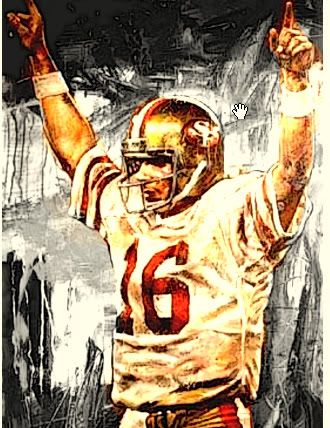
Sports legend Joe Montana, of half Camunian ancestry

Borrowed from the archives of 'Poche Parole' (May 2009), the newsletter of the Italian Cultural Society of Washington D.C.


By Terry Necciai

The second of two articles

Railroad construction went at a furious pace through the region, both before and after the Panic of 1873, and gangs of temporary workers were recruited to level the grade and lay the ties and tracks. It is particularly difficult to determine who the workers were and where they came from because of the short term nature of the work and lack of records. However, it appears that the Italian workers found other jobs as a result of the new lines. Railroad development was often justified by the expectation that each line would open up a new area for coal mining. Industrial villages cropped up almost instantaneously as each line was completed. Meanwhile, other Pittsburgh area industries, such as steel, specifically avoided hiring Italians because they thought they were less suited than the Slovaks and other Eastern Europeans for the heavy work required at the larger industrial plants, a prejudice that is on record in some of the surviving trade literature. Because the Italians had an easier time finding jobs in coal mines, they ended up scattered all over the region, in the 500 or more mining villages found within a 100 mile radius of Pittsburgh. Those who brought trade skills with them eventually struck off as entrepreneurs, serving as carpenters, blacksmiths, barbers, tailors, and grocers/fruit handlers, and also sometimes as musicians, writers, or bankers in the new villages.

The Bresciani who came to Monongahela City helped to set off a chain reaction that brought Italians from almost every other part of Italy, boosting the population within and surrounding a very small city that is still 25% Italian-American today. A small group of Calabresi who came in the 1870s may have been the first, followed in the 1890s to 1910s by other Italians from north of Rome, a large group of families from Tuscany, and smaller groups from Umbria, Piemonte, and Venice, and then by large groups from Naples, Calabria, and Sicily, with smaller groups from Abruzzi and Molise. In one of the later waves of immigration, families came from Suisio, an industrial town west of Bergamo, where the dialect was almost the same as that of Brescia. The Italian-Americans in Monongahela whose roots are in the other parts of Italy often refer to the Bresciani and Bergamaschi as the “Patihi, Patahé,” an obscure phrase that the Bresciani had apparently used as a greeting and a shibboleth (though no one from modern day Brescia seems to remember exactly what this phrase means). (My theory is that it could be derived from a word “dialect,” similar to the French “patois.” Or another possibility is “patéser” a verb in the local dialect that means the same as “soffrire” — to “suffer” or to “put up with” someone. Assuming the two words are conjugated forms of a verb, say “patihare” or “patéher,” with an “h” being substituted for a “c” or an “s,” the meaning of “se patahi, pataho” could be “if you speak the dialect, then I will” or “if you put up with [me], then I’ll put up with [you]”)

A small group apparently came about 1886, probably as a gang of young, single men looking for work. Three of the first surnames were: Milani, Pezzoni, and Carrara. Serafino Carrara came to Monongahela from Brescia in ca.1886-88, taking a job in the Catsburg Mine, and by the 1890s, his daughter Maria operated a boarding house for Italian miners on a hillside site overlooking the mine. Undoubtedly, this facility housed many of the Camuni when they first arrived. By about 1915, the Odelli family had a very popular fruit market that later became a peanut and candy store. When Joe (Gio’ann’) Odelli, Sr., rebuilt his fruit stand in 1925, he erected one of the most impressive buildings on Main Street. The Anton family, Bavarian Catholic immigrants who made open flame lamps for the coal miners, took an interest in the Brescians and sponsored the establishment of an Italian Catholic Church in 1904. It was named for St. Anthony of Padua in part to recognize the Antons as the benefactors. The Bresciani were the core group in the congregation. A few years later, in 1913, open flame lamps were blamed for a mine disaster at a mine near Monongahela, taking the lives of 97 men, of whom at least 8 or 10 were from Brescia. Legislation outlawing lamps with open flames after this disaster led to the invention of the safety lamp and then the battery-powered flashlight.

The best known Brescian-American from Monongahela is football quarterback Joe Montana (who played for Notre Dame in the 1970s and the San Francisco 49ers in the 1980s and 1990s). The name Montana is slightly Americanized, apparently from Montagni (he is also half Sicilian, through his mother, Theresa Bavuso Montana).

The Val Camonica is named for the Camunni, an ancient culture of unknown origin that became blended with the Celts of Northern Italy in pre-Roman times. Today, the inhabitants of the valley call themselves “Camuni” (with one “n”). The ancient Camunni left approximately 350,000 rock carvings on the face of the mountains, depicting pre-Roman-era life in the valley. Some are as much as 10,000 years old. To interpret the sparse written passages in the Camuno language that accompanies some of the later carvings, linguists have begun to analyze the peculiarities in the local dialect, which preserves some Camuno characteristics, differentiating it from other dialects of Northern Italy.

.

Sunday, October 23, 2011

“Patihi, Patahé!” The Camuni of Brescia in Monongahela City: Part I

Old steamers on the Monongahela River
Borrowed from the archives of 'Poche Parole' (March 2009), the newsletter of the Italian Cultural Society of Washington D.C.


Summary of a talk by ICS member Terry Necciai at the American Italian Cultural Institute of Pittsburgh, (AMICO) Feb 15, 2009

The first of two articles

“The Daily Republican, 18 November 1892 — MONONGAHELA CITY, PA — The Italians living here joined in the celebration of the town’s centennial by raising a large Italian flag. The celebrating … being over, the Italians refused to take their flag down, and trouble was brewing over the incident. It is not known what would have been the consequences had not Mayor Huston compelled the colony to put the American flag on top of the Italian banner.” (Quoted from an earlier piece in the Pittsburgh Times)

By the 1860s, engineers around the world had learned, through “coking,” how to purify coal enough to replace charcoal in the iron smelting process. In places like Pittsburgh, iron masters built large smelting furnaces in the city, speeding up manufacturing operations, making iron less costly, and replacing primitive furnaces that had operated for years in the mountains. In some mountainous areas of Italy where there was no coal and where charcoal-fired iron had been made for centuries, the transition away from charcoal triggered the demise of the local economy.

As jobs became scarce in the province of Brescia, hundreds of families immigrated to the United States. Some of the first immigrants found work in the small, aging, riverfront mines around Monongahela City, a small town an hour south of Pittsburgh, by the mid-1880s. The first immigrants may have been Bersaglieri or Alpini veterans of the Risorgimento. According to a theory put forward by Don Franco Bontempi, the current parish priest in the Brescian town of Ono San Pietro, they may have been inspired by the fact that President Lincoln had offered Garibaldi a position in the Union Army, in 1861, at a point when the fires of the Risorgimento appeared to have died down. Brescians continued to come to Monongahela until the 1920s because it was one of few places in the world where their dialect (Camuno-Brescian) could be understood. They also found their way to this one town, following friends and relatives. Even today, in certain communities in the Brescian mountains, the name “Monongahela” is well-known, perhaps because many families have kept and handed-down letters from loved ones with the name in the return address (Some Brescians refer to the Pennsylvania locality as “Mononga-elapà,” not knowing that the last two letters in the address stand for the name of the state). Most of the Brescians who came to Monongahela City were from the Val Camonica and the smaller tributary valleys to the east and west of it, an area that comprises the northern two-thirds of the province of Brescia. A 60-mile-long industrial valley in the Alps, the Val Camonica has about a hundred towns and villages clustered around iron furnaces, water-powered forges, wine presses, and other traditional manufacturing facilities. In addition to iron and other metals, as well as table wine, the valley is also known for its cheese and sausages.

Italians may have been among the earliest settlers of Western Pennsylvania. At least two travel writers, as they passed through the area in 1803 and 1806, mentioned an Italian component in local culture as if Italian immigrants were already living in Pittsburgh by then, but research has not been successful in identifying specific familes. A group Passionist Fathers came to Pittsburgh in 1845 to serve the local Catholic community, which, in the middle decades of the nineteenth century, consisted almost exclusively of Irish and German immigrants. Many immigrants from iron manufacturing areas in Germany had come by the 1840s to work in the Pittsburgh iron industry. However, it was not until after the onset of the Panic of 1873 that groups of immigrants from southern and eastern Europe began to show up in large numbers as a new pool of workers. Unstable conditions, particularly in the smaller coal mines between Monongahela City and Pittsburgh, made seasonal jobs available for incoming workers. One well-documented episode in immigration history was a shoot-out that occurred in 1874, at a mine in the village of Buena Vista about 12 miles northeast of Monongahela City and 22 miles south of Pittsburgh, between a group of Italian families who had been hired as workers to break a small-scale strike and the local people whose jobs they were hired to take. Based on their names, this group of Italians appears to have been from near the Swiss border.

.

Tuesday, July 26, 2011

The "House Wolf"


I was casually looking into words in the Camunian dialect on Mauro Fiora's Italian-Camunian translator. In standard Italian (Tuscan), the word for "wolf" is "lupo." Lupo can be a surname, and there are many surnames with "lupo" in it. For example, the surname "Cantalupo," generally of Neapolitan origin, means something like "singing wolf" (canta-lupo), probably regarding the wolf's howl. Of course, not many people in the Western world hear the howls of wolves any longer, but it was probably pretty common in past centuries.

The surnames "Calufetti" and "Caluffetti" are very definitely of Camunian origin. In the Camunian dialect, the word for house, home, or household is "ca." The word for wolf is "lùf" or "lüf." Therefore, before Romanization, the name was probably "Caluf" or "Caluff," which would mean something like "house wolf." This may have been either a reference to a domesticated wolf or to a family dog. If it was a wolf, then this surname may be so ancient, that a guess as to how old would be impossible. The Camunian culture goes back eight or ten thousand years.

According to the American Heritage Dictionary: Dogs were domesticated from gray wolves about 15,000 years ago. They must have been very valuable to early human settlements, for they quickly became ubiquitous across world cultures. Dogs perform many roles for people, such as hunting, herding, pulling loads, protection, assisting police and military, companionship, and, more recently, aiding handicapped individuals. This impact on human society has given them the nickname "Man's Best Friend" in the western world.

The origin of a surname, like Calufetti, can easily be lost without the aid of some type of reference to the original language that it came from. Caluf sounds like a word in the Camunian dialect. Not Tuscan, not Venetian, not German, not Slavic; but a word from a unique language, tied into the Lombard language. I would venture to guess that this word predates the linguistic influences of Etruscan, Roman, Langobard, and probably even Gaulish.

I had initially looked up "wolf," and discovered the world to be "lùf," then quickly made the connection to the surname. We are today connected to our ancient past much more than we think. Even though I'm not what is called a "dog person," I still instantly feel the connection from my ancient memory to the dogs who look more like wolves, like German Shepherds. Even in surnames, as we see them in the modern world, reflect a centuries-old tie to the past.

.

Monday, June 27, 2011

Basque culture, a similar heritage to ours

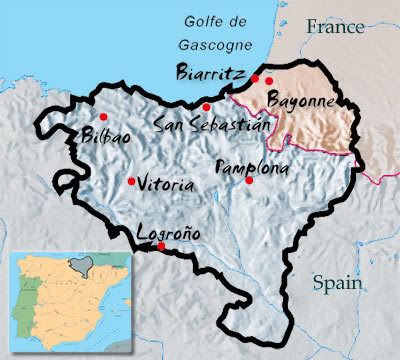
Learning about cultural groups, usually of a similar background (Europeans), is often a good way to understand your own heritage. The history of the Basques shows many similarities to the Camunians or Lombardian Alpines; however, not much to southern Lombardy.

For one thing, the Basque Country is located within the rugged Pyrenees Mountains between Spain and France, which is similar to our Alpine heritage. Also, the Basques derived partly from the Gallic Celtiberians, which is similar to our Gallic past. They have a distinct language, just like the Camunians or East Lombardians had their own language. Not surprisingly, considering these facts, there seemed to have been a somewhat of a hard road from Gallic paganism to Roman Catholicism. One other similarity is Basque and Camunian history leads us absolutely straight back to prehistoric times. In other words, being partly descended from proto-European peoples.

The Basque diaspora is also somewhat similar to Lombardian migration in general; although many more Basques live on this side of the ocean than do in the Basque Country itself. What I find incredible about Basque communities around the world, seems to be their very strong folkish connection to one another. That is one big difference, as the Risorgimento shattered Lombardian nationhood. Only small out-of-the-way regions, like the Camonica Valley, kept a genuinely distinct identity. We'll get back to this issue later.

Basques migrated very heavily, especially considering that the Basque Country is not particularly large, to Mexico, Argentina, Chile, and Brazil. Of course, we know that Lombardians migrated to South America, especially to "the Cone of South America," but not really to Mexico in any large numbers. All of this is really quite remarkable in comparison. In a larger sense, it could be said that the Basque Country is similar to the Val Camonica, the Ticino, Friuli, the Ladins, and other close-knit mountain communities in the Alps. Amazingly, Basques make up 10% of the population of Argentina.

The United States apparently has only about 57,000 Basque-Americans, less than even Columbia. According to the Basque-Americans Wikipedia page, "The states with the largest Basque-American populations are California (20,868), Idaho (6,637), Nevada (6,096), Washington (2,665) and Oregon (2,627)." However, despite their small numbers, they seem to have made an impact all over the country. Although I have been astounded by the accomplishments of Lombardians in the United States, also in very small numbers (with historically perhaps twice as many Lombardian immigrants) and spread far and wide, I was even more impressed with the strength and folkishness of the Basque communities, also spread very far and wide and thin.

I recall that there was a very small but close-knit Basque community in San Francisco. There are about fifty Basque clubs in the United States. One apparently is in San Francisco. I recall the Basque Hotel in San Francisco, which apparently is the hub of the community here. Boise, Idaho boasts 15,000 Basque-Americans, making it the largest concentration of Basque-Americans. I was going to only make a short entry here, but this is surely an area that I wish to read more about. The more I learn, the more I realize that there is to learn.

**************************************************

7-2-11 ADDITION: A few times in the last several days, I couldn't help after writing this entry, I thought that even further than the similarities here, there is an even closer tie-in between California Basques and California Ticinese. If we look at the culture and terrain of the Basque Country and Ticino, and also of the similarity of their migration and settlement in California (both north and south), the cultural tie-ins are just so similar. The only big difference is that Ticinese are lost between Swiss and Italian identity, while the Basques are not lost between Spanish and French identity.

.

Sunday, June 26, 2011

Three simple long-range goals of the Camonica Club

We have posted our goals here in the past, but perhaps they were not entirely clear. Our goals are very multi-faceted, so there is no definite answer to what our goals are when they are laid out in paragraphs.

For example, we may be interested in looking into the Ambrosian Rite of Catholicism, as it is Lombardian in origin, and certainly a part of our culture. However, that would really belong in the greater scheme of looking into all things Lombardian, and not because we all need to become Ambrosians.

Our chief goals could be herded into three parts. Within each part, there is more of a maze of smaller items that we may want to look into at some point. However, the following are our three main long-term goals.

1) Lombardian-American Society: To develop an association, voice, and organizational structure for those of Lombardian heritage in the United States. The number of people of Lombardian origin in this country is significant enough to justify a "Lombardian-American" cultural identity. There should be a headquarters of some type. A cultural center, probably located somewhere in the Great Lakes region, which would have at least several paid positions. A simple radio studio would be a must, as the opportunity for a community podcast over the internet is a possibility which cannot be passed up. A book and media library in order to conduct research into our heritage, especially our history on this continent, would be a must as well. There is a Tuscan-American Association, which has entirely beaten us to the punch in this area. Naturally we would look to develop local associations in different states as part of this plan. This is a goal even more important than our Camunian plan below.

2) Camonica Club of North America: With the number of people of Camunian ancestry being much smaller than the already small number of people of Lombardian ancestry, it would only make sense to combine all of us who live anywhere on this continent. Camunian heritage means something a little different than the Lombardian whole. In this way, it is almost like an extended family concept. One goal would be just simply to promote our heritage to our kindred. A longer range goal would be to form some type of milieu in every state and province. That could be just one person to start with. In other words, a "Camonica Club of Michigan," a "Camonica Club of Washington," or a "Camonica Club of Ontario." Perhaps one of those "Italians working abroad," who may live in Mexico City or someplace, could be a representative there. We don't have to think of ourselves as being limited by distance. Kindred who live in Alaska or Panama could see each other as distant family.

3) Temple of Cern: This is one area which definitely needs definition. The Camonica Valley has, for a long time, been considered very Catholic. Of that, there is no question. Our Camunian families who migrated to this continent would very likely have been strongly Roman Catholic. However, Greek-Americans are very solidly Orthodox Christians, but have no problem with their pagan past. That pagan past is not brushed under the rug. And remember, the pagan period of Greece was a very long time ago; while our pagan past flourished up to roughly four centuries ago. I mean, lets face it, the entire Italian peninsula was solidly Catholic.... except us! THINK ABOUT THAT!! Our ancestors were not merely a different denomination of Christianity, therefore subject to persecution, but many were pagans. Yes, it's true. There must be something a little different about us, perhaps something in our collective conscience. I think it is our cultural imperative to revive at least an interest in our old Cernic tradition.

.

Tuesday, March 8, 2011

Camunian proverbs: Part 3

Camunian proverbs

Apparently these are real proverbs from the Val Camonica. For each one, the fist part will be in native Camunian, the second in Italian, and the third in English (if it translated correctly):

La mòrt del lùf l'è la felicità de le pegòre.

La morte del lupo è la salute della pecora.

The death of the wolf is the health of the sheep.

--Anonymous

____________

De drè portento... de nàs spaènto!

Dietro affascinante... davanti che spavento!

*English translation needed*

--Anonymous

____________

Quand la barba la tàca a sbianchì làga le fomne e tachèt al vi.

Quando la barba diventa bianca lascia le donne e attaccati al vino.

*English translation needed*

--Anonymous

____________

'L vi 'l cünta poch se l'ostéra l'è bèla e 'l sò òm l'è óch

Il vino conta poco quando l'ostessa è bella e il marito è un coglione.

The wine counts little when the hostess is beautiful, but her husband is a jerk.

--Anonymous

____________

'L gà piö cûl de servèl.

Ha più fortuna che cervello.

He has more good fortune than brains (?).

--Anonymous
.

Friday, February 25, 2011

Camunian proverbs: Part 2

Camunian proverbs

Apparently these are real proverbs from the Val Camonica. For each one, the fist part will be in native Camunian, the second in Italian, and the third in English (if it translated correctly):

Istìt sò bè pò 'n pàl 'l somèa 'n cardinàl.

Vestito bene anche un palo sembra un cardinale.

Garment also a pole seems a cardinal well.

--Anonymous

____________

Fàga mia saì a là mà drìta chèl che la fà l'nvèrsa.

Non far sapere alla mano destra quello che fa la sinistra.

Not to make to know ago to the right hand which the left.

--Anonymous

____________

Per cùnùsìs bè s'gà dè maià 'nsèma 'n quintàl dè sàl amàr.

Per conoscrsi bene bisogna mangiare insieme un quintale di sale amaro.

*English translation needed*

--Anonymous

____________

'N po' per û à càal de l'àsen.

Un po' per uno a cavallo dell'asino.

*English translation needed*

--Anonymous

____________

Fà e desfà l'è 'l laorà de i frà.

Fare e disfare è il lavoro dei frati.

To make and to unravel are the job of the friars.

--Anonymous

.

Wednesday, February 23, 2011

Camunian proverbs: Part 1

Camunian proverbs

Apparently these are real proverbs from the Val Camonica. For each one, the fist part will be in native Camunian, the second in Italian, and the third in English (if it translated correctly):

Ôm stüdiùs màgher mùrüs.

Uomo studioso scarso amante.

Studious man insufficient lover.

--Anonymous

____________

L'è bèla come 'l cül dé là padèla.

È bella come il fondo della padella.

It is beautiful as the bottom of the frying pan.

--Anonymous

____________

Zò le mà dal bànc.

Giù le mani dal banco.

Down the hands from the bench.

--Anonymous

____________

Quànd chè la carne la diénta früsta pò a l'anima la sé giûsta.

Quando la carne diventa vecchia anche l'anima si aggiusta.

When the meat becomes old also l' spirit is fixed.

--Anonymous

____________

'N Avrìl 'l tàca pò 'l mànech de'n badìl.

Ad Aprile fiorisce anche il manico del badile.

To You open them blooms also the handle of attends them.

--Anonymous

.

Thursday, March 25, 2010

Ancient Camunic language and modern Camunian dialect

The ancient Camunian language, and the more modern Camunian dialect, are two different languages. However, the modern dialect likely developed from the ancient language. The Camonica Valley is one of the most remarkable regions in European history. So small, yet able to maintain an incredible cultural continuity for thousands of years. For example, some Rosa Camuna images, as well as other ancient symbols, have been dated at six or eight thousand years, while others are dated at fifteen hundred to two thousand years. The language seems to follow this similar pattern. Also, big upheavals, such as the invasions and/or influence of Gauls, Etruscans, Langobards, Romans, Napoleon, Venetians, and Austrians, over thousands of years, did not interrupt this process.

Camunic language (from Wikipedia; with images):

"The camunic language is an extinct language, spoken in the I millennium BC in some valleys of the Central Alps (Valcamonica, Valtellina) and not deciphered.

"The epigraphic corpus is carved on the rock, as similar as the rock engravings of Valcamonica, in one variant of the north-Etruscan alphabet, known as camunian alphabet or alphabet of Sondrio.

"It is possible that the language was related to camuna Rhaetian language; its name derives from the people of the Camunni, who lived during the Iron age in Val Camonica and was the author of much of the stone carvings in the area.

"Today there are known at least 170 inscriptions in camunian alphabet, that are written in lines even from right to left than left to right. The iscriptions are formed mainly by one or two words, and many are those ending in "-au".

"Were found few alphabetaries (a series of letters aligned to forming an alphabet) in Nadro (Zurla and Foppe localities) and in Piancogno, next to the Annunciata. These alphabetaries presents variants of each other, but allow us to date the inscriptions from the 4th to 5th century BC to 100 BC-50 AD)."

Another area which we have covered in the past is the alphabet of the ancient Camunni. In the link is the information sent to us from Naddeo Michelangelo. For further reading on this subject of ancient text, see his website at http://www.michelangelo.cn/. For a look at the characters of the ancient alphabet of the Camunni, see the following link at Wikimedia Commons.

The modern Camunian dialect is a variation of the "Eastern Lombard" dialect, which is eastern Lombardy. As we have pointed out before, and stated on this Wikipedia page: In Italian-speaking contexts, Eastern Lombard is often generically called a "dialect". This is often incorrectly understood as to mean a dialect of Italian, which actually is not the case, it's not a dialect but a language. Eastern Lombard and Italian are different languages and are not mutually intelligible. Eastern Lombard is, in turn, a sub-branch of the Lombard language.

Mauro Fiora has assembled an online Italian-Camunian translator, which has the lists of words by letter, as well as a Babelfish-syle translator. Needless to say, and please look for yourself, "Italian" (Tuscan) and Camunian are as different as English and Polish. What is further remarkable, is that the village of Sonico, and it's immediate surrounding area, speak even a sub-branch of the Camunian dialect!

I wanted to give just a few examples of Camunian words. First, Al Camònega stands for Valle Camonica, with the "Al" meaning "Valley." As with many words, it's different in "Sonican," ..... "Valàr." Also remarkable is that about half the words do not end in a vowel. Many resemble ancient Germanic or Celtic words, but have a unique flavor of their own, very different than the European regional languages that we may be familiar in the English speaking world: English, French, Spanish, German, Italian, etc.

One way to get a real sense of the language is to go to the Italian Wikipedia link: Comunità Montana di Valle Camonica. Then see the list of Camunian villages down on the right side. Click each one, taking you to that respective page, where you can see at the top along with the Italian name.... the Camunian name of that village. In other words, the REAL name. For example, lets take the first one: Angolo Terme. The proper Camunian name is Angól. Monno is Mòn, Gianico is Janec, Borno is Búren, etc.

On the Italian Logos translation website, which seems to be still in the developmental stage, one can search various words in many different languages. Included in these are "Bresciano," "Bergamasco," "Bolognese," "Furlan," as well as other variations of French and others. The translated word, for example, of "family" is family (Engish), famiglia (Italian), familia (Spanish), famille (French), familie (German), familje (Albanian), famija (Brescian), famigghia (Sicilian & Calabrese), famèe (Furlan), and numerous other words in numerous other sub-branches of French, German, etc. "Bresciano" is basically Eastern Lombard, and family in Camunian is famìa. In fact, in Sonican it is Baghècc.

On the television program 'Cake Boss' on the Learning Channel, the show begins with the proprietor of the Hoboken bakery, Buddy Valestro, a Sicilian-American, proclaiming "Mia Famiglia!" Actually, that's TUSCAN. The Sicilian word for "family," as we covered above, is "famigghia." It sort've makes me feel like using the word baghècc just to disagree with the forced paradigm.

I searched the word "market," which earlier had brought me a number of interesting linguistic variations, but it's not working now. In Bresciano, it was "mercàt," (same as in Camunian), as opposed to the Italian "mercato." This is no small potatoes. A language is the birthright of a people! I'm not referring to the United States, as we, or our recent ancestors, accepted the English language.

The Italian book entitled 'Vocabolario Bresciano-Italiano' by Giovanni Battista Melchiori is a more official source for the Bresciano/Camuno dialect of the Lombard language.

[4/12/10 NOTE: Apparently the word "family" is translated as "famija" in all of the Lombard dialects, except Camunian which is "famìa." Also the sub-Camunic variant of "family" is "baghècc" in Sonican, as was covered.

Lastly, I couldn't help but add one other word that really drives home the variations down to Camunian, and Sonican. The word "council" is "consiglio" in standard Italian (Tuscan), "Consèi" in Brescian/Camunian, and "Fabrisiér" in Sonican!

I couldn't easily search out what the word is in Lombard or East Lombard, but we can plainly see that one little community of villages (Sonico) can literally develop it's own language over centuries of continuity. How do we know that this tiny regional dialect wasn't some surviving remnant of ancient Camunian, ancient Langobard, Celto-Alpine, etc?]

.

Friday, December 4, 2009

Camonica Club of North America

After a long, somewhat embarrassing, series of attempts at organizations and councils to facilitate something in the area of Lombardian/Brescian heritage in this part of the world, we have finally settled on the Camonica Club. Although we have stated this before, time will probably show that this was the one.

Our focus will be on, first Camunian heritage; and second on Brescian, Orobic (East Lombardian), Lombardian/Ticinese, original Austrian (the Langobard province of the Lombardy/Tri-Veneto/Trento region), Padanian, Alpine, and European heritage. This should also include our spiritual heritage: from the ancient Cernic tradition to the Ambrosian Rite.

It should be noted that Lombardi nel Mondo seems to have a regional council in North America, which is devoid of any type of outreach, or even an attempt at creating any interest in Lombardian heritage. There are also a few chapters of Pro Ticino (Ticinesi nel Mondo) in California, and Bergamaschi nel Mondo around the Toronto and Montreal areas, and perhaps a few others.

We would also like to make contact with Camunian cultural organizations and associations in Lombardia. We have have had some contact in the past, but we have probably confused them with our frequent organizational name changes. Hopefully that will clear up in short order.