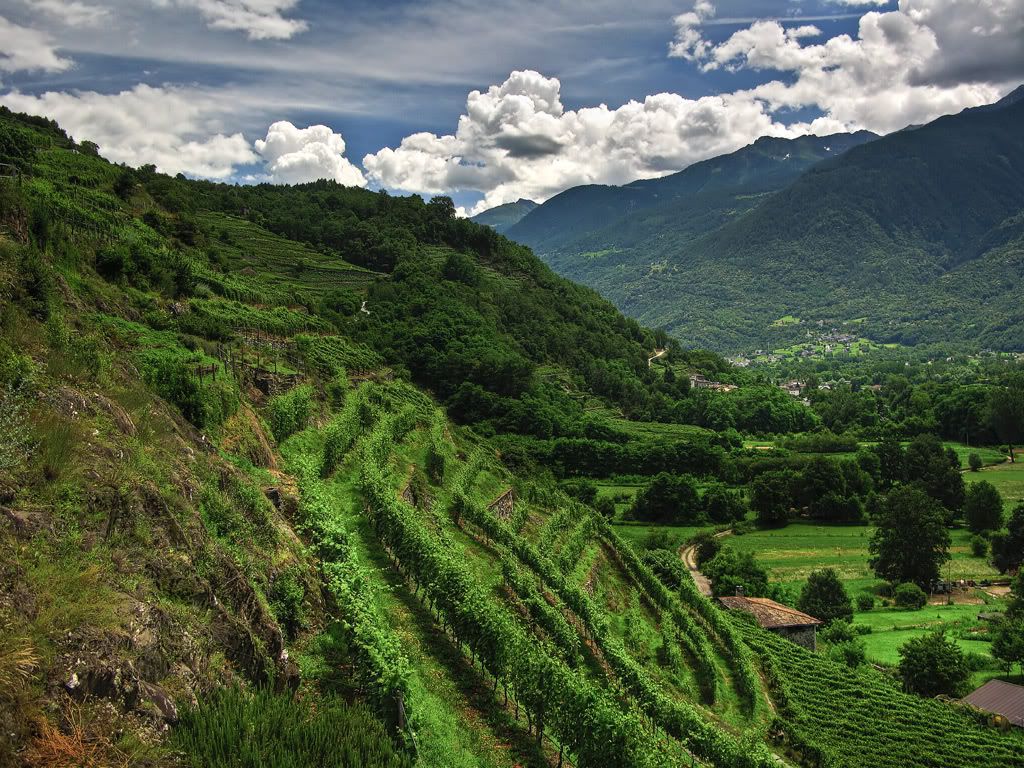
The Valtellina is an Alpine valley which runs about 80 miles east-west, and is about 50 miles from the cities of Brescia and Bergamo, and the flat lands of the Po; so it's rather isolated from a historical point of view. The northernmost village of the Val Camonica, Edolo, is close to the village of Aprica of the Valtellina. The Aprica pass separates the two. The two valleys, their cultures, and their histories are very similar. The following article is from the Lombardi nel Mondo website. I did my best to translate it, often rewriting muddled portions in an attempt to get at what I thought was the true meaning. It at least gives some idea of the old experiences. You almost have to think of... perhaps movies which show very desolate locations, maybe set in the late 1800s. 'Butch Cassidy and the Sundance Kid', in the sequence when they went down to Bolivia, comes to mind. Beyond the east coast cities of Australia, maybe 100 miles inland, are the farmlands; and maybe that's part of where this took place. Of course, in 1860 or 1890, this was a very underdeveloped area. Later in the article, I think they were referring to maybe the 1940s or 50s. I remember of reading some really old accounts of what overseas employers, from the perspective of Europeans, thought of workers from certain regions... and what types of work they're good at. I recall something like.. people from the Italian Alps, Slovaks, Hungarians, etc. are good at heavy work. In other words, in contrast to modern perceptions, they didn't drag people all the way over from the middle of the rural Alps on the other side of the planet just to do very hard work that Aborigines or some little islanders could do.
From letters of migrants and third party migration development
From this we can understood the early migrations from the Valtellina, deepening the meanings and expectations of this history. Perhaps, as they had feared opponents of immigration, some of the early migrants to Australia were attracted by widespread tales of gold or of a country of plenty from emigration agents, but any such illusion was short-lived. The temporary emigrants were not on their way to a generic "Australia," but headed for specific locations, looking for a specific job. In Australia you could make some good gains, but at the price of a very hard effort and lack of any attractiveness and with great personal sacrifice. More often than not they found themselves engaging in grueling logging work in remote areas, cutting sugar cane in tropical heat, or risking their lives in underground mines. The rhetoric used by emigrants in the description of their travels is revealing: "making sacrifices" was the term used to talk about these migrations. Australia had become famous not as a country of plenty, but as a place of hard work. Since they were temporary migrants, they departed without knowing the language; and they did not come with women or families, and they did not sell their lands before leaving. Their goal was to make the highest profit in the shortest possible time, in the hope of a quick return home. They probably started with few illusions. The idea was to get through the burden of the work load stoically, sit tight and hope that they can maintain their health and safety. Normally there was no intention to settle permanently.
The presence of Lombards in Australia, and more generally of people originating from Italy, was noted by the consuls and consular agents of Italians after the discovery of gold in the State of Victoria in 1851. The Valtellinese presence was known in those areas and to the agents of the shipping companies which operated in moving Swiss citizens not far from the border from Valtellina, in the Valley of Poschiavo in the Canton of
Rural Australia
Graubunden. Historically, these were the most common destinations of seasonal emigrants of Valtellina. After the first pioneers, Australia became part of the recognized world, and this recognition greatly influenced the development of future migrations. In Italy the chance to earn money were few, even in periods of greater well-being; as contrasted to the reputation of Australia as a source of earnings. Among other things, it was becoming a regular destination of those who hoped to increase their wealth, and not just of those most desperately in need. It was temporary migrants who intended to make a fortune. They were farmers and--with a majority of males being of working age, 20s or 30s--half of them were married, many with children. The desire of these people was to get out of the cycle of poverty, which neither the government, nor the charity institutions had eased. The bad harvests, the high cost of living, the lack of work, and the heavy load of fees and taxes were all factors responsible for departures. At that time the news of those who returned from Australia were "excellent," unlike those coming from America.
Returnees had described the unfavorable treatment accorded to them by the authorities and employers in America, while Australia had proved very hospitable. In the Valtellina, a culture of migration had developed, especially to Australia; thereby ensuring that in years to come, the majority of emigrants would follow already beaten paths. Several routes were opened in Australia since 1890. The most important would lead migrants to Western Australia, to regions where there was a focus on extractive activities and of the harvesting of timber. Especially after World War II, the northern regions of Queensland opened up in the sugar cane plantations. For many years the migrants made significant progress from the fruit of their labor, to the point that they began to consider settling permanently in the country. It was starting to become apparent that with these changes, people were deciding to make Australia their home. Their lives were simple but decent, and of which their old traditions and habits continued on. It was similar to their old village life, and less like Anglo-Saxon proletarian life. They toiled all day in the fields, pulling plows, but when they returned home in the evening to a nice home, bath, dinner, and a car to drive to town to the cinema. At the tables were always their native cuisine; lots of macaroni, salads, and buttered bread, along with cups of tea.
Source: Jacqueline Templeton, 'From the Mountains to the Bush: Emigration of Valtellinese in Australia (1860-1960) from the Letters of Migrants'; Tirano Museum, 2001 .
It should be clarified that the proper term is "Swiss Italian," not Italian Swiss. As has been covered here before, an immigration--earlier than that to California--had been to the state of Victoria, Australia. Just like with other smaller Alpine regions, such as Val Camonica or Valtellina, the Swiss Italians/Ticinese have a local type of cuisine. It appears that there were many similarities between the California settlers and the Victoria settlers.
Swiss Italians of Australia, are Italian-speaking Swiss that settled in Australia during the 1850s and 1860s. The Swiss Italians initially settled in the area around Daylesford, Victoria. The Swiss settlers were from the canton of Ticino and the southern part of Graubünden
The influence of the Swiss Italians of Australia—Italian-speaking Swiss from the cantons of Ticino and Grison and the northern Italians is still present in the township of Hepburn Springs—through the names of its residents, the names of its springs (Locarno) and buildings (Savoia Hotel, Parma House, Perinis, Bellinzona) and the annual Swiss-Italian Festa.
The heart of the Italian-speaking community was the area around the Savoia (Spring Creek) Hotel and the Macaroni Factory. The Savoia is named after the royal family of unified Italy. An Italian reading library was located at the hotel and pasta was made opposite in Lucini's Macaroni Factory which was also home to the Democratic Club. Lucini's moved from Lonsdale Street, Melbourne in 1865, where they had set up as the first pasta factory in Australia in 1864. Vanzetta's bakery supplied bread to the community and Crippa, Perini, and the Gervasoni's (Yandoit Creek) produced wine.
In 2007 the Melbourne Immigration Museum featured a display entitled Wine Water and Stone reflecting the Swiss and Italian heritage of the area.
Swiss Italian food and culture
The Swiss Italians loved sport, food, and music. Their influence on local culture is celebrated annually during the Swiss Italian Festa. Swiss Italians of Australia have made their mark in spheres of art, music, literature, journalism, sport, education, science, and engineering.
A local delicacy is bullboar, which is a sausage made from beef, pork, garlic, and spices. Local families jealously guard their recipes. In 2005 Daylesford Secondary College came in second place in the Australian Broadcasting Corporation's Young Gourmets by making bullboars from the Gervasoni and Sartori recipes, which gained much media attention over the fate of Charlotte the pig, with little concern for the steer involved. The bullboar has been named an endangered recipe by the Slow Food Movement.
The Hepburn Springs Swiss and Italian Festa is an annual five day celebration in late October of the area's Swiss Italian and Northern Italian heritage, with music, food, art, wine etc. Ticino and Val Camonica are very kindred cultures, both being Lombard-speaking mountain communities. The Lombard cultural relationship doesn't just end because some long ago German king decided to build a fence. This is a part of our culture as well.
There are local (Bay Area) Swiss Italian events, and in other parts of the state, but they're hard to find as they would usually only pertain to those of that cultural family; and perhaps through the "Pro Ticino" clubs. However, there should basically be no difference between--for example--the Ticinese of west Marin County and the Milanese of east Marin County. Not only does the canton of Ticino border with the province of Milano, but both are from the same "West Lombard" dialect.
I came across an article on the Switzerland information website entitled 'Italian Swiss... or Swiss Italians?' Although interesting, that issue has been covered here before. Still, I wanted to link it for anyone interesting in reading up on it. The Ticino question becomes important to us partly because of the large past immigration in a few areas, and because we should bridge the gap finally with the idea of "Lombard cultural identity."
The "clan" concept is great, but let us not forget the ancient nation of Lumbardia. One "Lumbard" cultural family: Bergamo, Brescia/Val Camonica, Como, Cremona, Lodi, Mantova, Milano, Monza/Brianza, Pavia, Sondrio (Valtellina/Valchiavenna), Süd Graubünden/Val Poschiavo, Ticino, and Varese. .

 'Valtellinese Emigration to Australia (1860-1960)'