Swiss-Italian Immigrants Found Marin "Just Like Home" By Marilyn L. Geary - 'Anne T. Kent California Room Community Newsletter' - April 09, 2013 [Above, clockwise from back left: Isadore, Arcangelo, Giacondo and Romeo Cerini; undated] When Giocondo Cerini arrived in Tomales in 1910, he found so many family members, friends, and acquaintances that he said “it was just like home,” according to a 1994 interview in the Point Reyes Light. His aunt Carrie Piezzi, along with two of his brothers and many fellow Swiss-Italians, were there to welcome him.
Giocondo was born in 1894 in Giumaglio, a small village in the Vallemaggia region of the Ticino Canton in Switzerland. Giocondo’s brothers Isadore and Romeo had left Giumaglio in 1901, their sister Adele in 1904, sister Caterina (America) in 1906, and brother Arcangelo emigrated in 1914. Of the eight children born to Giovanni Cerini and Angelina Piezzi Cerini in Giumaglio, six left home to settle in the ranch lands of Marin and Sonoma counties.
On arrival in Marin, Giocondo worked on the dairy ranch of Maurizio Sartori, a pattern followed by many immigrants who worked for compatriots until they saved enough money to lease or purchase their own ranches. Along with two of his brothers, Arcangelo and Romeo, Giocondo saved enough money to purchase the historic John Keys ranch in Tomales. Brother Isadore operated a garage in town. Unfortunately the two sisters died not long after arrival, America from consumption at age 18 and Adele probably from complications of childbirth. The Cerini family is just one of hundreds in the Vallemaggia that lost family members to Australia and America. During a period of some eighty years, from the 1850s through the turn of the century, over 27,000 emigrants left Ticino to find a better life. Despite obstacles, many of the immigrants succeeded through hard work and determination to own and operate successful dairy ranches in California.
For more on the history of local Swiss-Italian ranchers and their ancestral home, join Marilyn L. Geary for an illustrated presentation April 18th, 2013 from Noon to 1pm in the Marin County Civic Center, Room 330, San Rafael.
I am from Perth , Australia and my Great Great grandfather Natale Cerini emigrated to Bendigo goldfields in Victoria , Australia from Giumaglio at age 14 with a cousin Pietro Cerini also 14 and another G. Cerini (Giacomo or Guiseppe perhaps?) in the 1850`s
************************************************** Claudio Caccia wrote: I am from Maggia (a Comune that since 2010 includes the ex-Comune od Giumaglio), Vallemaggia, Switzerland and by pure coincidence I read the article above and the comment. We must somehow be related, since my Grandma Maria Cerini (married Genazzi, born in Giumaglio July 16th 1890, died in Maggia January 29th, 1995) was the sister of the above mentioned Isidoro, Arcangelo, Giocondo, Romeo, Adele, Caterina (America) and the other brother that remained here in Switzerland! By the way, I remember my Grandma saying she was ment to leave too, but here mother desperately needed her here. A big hello to all of you .
It should be clarified that the proper term is "Swiss Italian," not Italian Swiss. As has been covered here before, an immigration--earlier than that to California--had been to the state of Victoria, Australia. Just like with other smaller Alpine regions, such as Val Camonica or Valtellina, the Swiss Italians/Ticinese have a local type of cuisine. It appears that there were many similarities between the California settlers and the Victoria settlers.
Swiss Italians of Australia, are Italian-speaking Swiss that settled in Australia during the 1850s and 1860s. The Swiss Italians initially settled in the area around Daylesford, Victoria. The Swiss settlers were from the canton of Ticino and the southern part of Graubünden
The influence of the Swiss Italians of Australia—Italian-speaking Swiss from the cantons of Ticino and Grison and the northern Italians is still present in the township of Hepburn Springs—through the names of its residents, the names of its springs (Locarno) and buildings (Savoia Hotel, Parma House, Perinis, Bellinzona) and the annual Swiss-Italian Festa.
The heart of the Italian-speaking community was the area around the Savoia (Spring Creek) Hotel and the Macaroni Factory. The Savoia is named after the royal family of unified Italy. An Italian reading library was located at the hotel and pasta was made opposite in Lucini's Macaroni Factory which was also home to the Democratic Club. Lucini's moved from Lonsdale Street, Melbourne in 1865, where they had set up as the first pasta factory in Australia in 1864. Vanzetta's bakery supplied bread to the community and Crippa, Perini, and the Gervasoni's (Yandoit Creek) produced wine.
In 2007 the Melbourne Immigration Museum featured a display entitled Wine Water and Stone reflecting the Swiss and Italian heritage of the area.
Swiss Italian food and culture
The Swiss Italians loved sport, food, and music. Their influence on local culture is celebrated annually during the Swiss Italian Festa. Swiss Italians of Australia have made their mark in spheres of art, music, literature, journalism, sport, education, science, and engineering.
A local delicacy is bullboar, which is a sausage made from beef, pork, garlic, and spices. Local families jealously guard their recipes. In 2005 Daylesford Secondary College came in second place in the Australian Broadcasting Corporation's Young Gourmets by making bullboars from the Gervasoni and Sartori recipes, which gained much media attention over the fate of Charlotte the pig, with little concern for the steer involved. The bullboar has been named an endangered recipe by the Slow Food Movement.
The Hepburn Springs Swiss and Italian Festa is an annual five day celebration in late October of the area's Swiss Italian and Northern Italian heritage, with music, food, art, wine etc. Ticino and Val Camonica are very kindred cultures, both being Lombard-speaking mountain communities. The Lombard cultural relationship doesn't just end because some long ago German king decided to build a fence. This is a part of our culture as well.
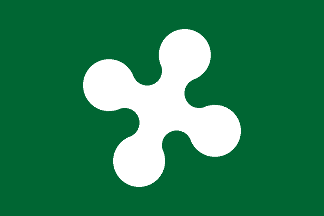
There are local (Bay Area) Swiss Italian events, and in other parts of the state, but they're hard to find as they would usually only pertain to those of that cultural family; and perhaps through the "Pro Ticino" clubs. However, there should basically be no difference between--for example--the Ticinese of west Marin County and the Milanese of east Marin County. Not only does the canton of Ticino border with the province of Milano, but both are from the same "West Lombard" dialect.
I came across an article on the Switzerland information website entitled 'Italian Swiss... or Swiss Italians?' Although interesting, that issue has been covered here before. Still, I wanted to link it for anyone interesting in reading up on it. The Ticino question becomes important to us partly because of the large past immigration in a few areas, and because we should bridge the gap finally with the idea of "Lombard cultural identity."
The "clan" concept is great, but let us not forget the ancient nation of Lumbardia. One "Lumbard" cultural family: Bergamo, Brescia/Val Camonica, Como, Cremona, Lodi, Mantova, Milano, Monza/Brianza, Pavia, Sondrio (Valtellina/Valchiavenna), Süd Graubünden/Val Poschiavo, Ticino, and Varese. .


 The Cerini family is just one of hundreds in the Vallemaggia that lost family members to Australia and America. During a period of some eighty years, from the 1850s through the turn of the century, over 27,000 emigrants left Ticino to find a better life. Despite obstacles, many of the immigrants succeeded through hard work and determination to own and operate successful dairy ranches in California.