Showing posts with label Australia. Show all posts

Tuesday, November 5, 2019

Full Beaver Moon 2019


Full Beaver Moon

The Full Beaver Moon will occur on Tuesday, November 12th at 8:34 AM EST. This means that it's a tweener, just as "full" on Monday evening as it will be on Tuesday evening.


*************************


The Storr featured on Windows 10 Spotlight

The Storr, Isle of Skye, Scotland


*************************


Pablo Escobar's hippos keep multiplying and Colombia doesn't know how to stop it

3,189,397 views - February 9, 2019

CBS This Morning

For more than 25 years, Colombia has been working to leave behind the violent legacy of Pablo Escobar. But there's one unusual problem that keeps growing: the notorious drug lord's pet hippos. Manuel Bojorquez reports.


************


Misplaced animals

Hippos in Columbia from the imported pets of an 80s drug lord, monkeys in the Florida swamps from the old Johnny Weissmuller Tarzan films of the 30s, and raccoons in Japan from imported pets.

Video: Monkeys swarm Ocala man’s property

Why There Are Raccoons in Japan


*************************


The Shapeshifter - Nature Documentary

479,565 views - October 17, 2015

Coyote Documentaries

This is the story of how the Coyote - at once revered and reviled - has learned to adapt across diverse landscapes. While grizzlies and wolves narrowly missed extinction, the coyote has earned its status today as top dog.


*************************


DON GIBSON - I Can't Stop Loving You

568,539 views

Mk F


*************************


Ryleigh Black

Spiritual healer, empath, paranormal researcher, and model

www.blackcrossparanormal.com

www.clubpara.com

www.ryleighblack.com


*************************


Cat vs Fox

2,643,084 views

meanutt

South London 


*************************


'The Swastika Part One, Earliest Evidences'

MimirsBrunnr -  MimirsBrunnr.com - December 15, 2018

The Swastika has to be one of the most misunderstood symbols of our time. In some variation it is found all over the world, this fact has lead many a debate on its exact origin. There is so much to say on this symbol, that it will take me a few parts to go through it all. In this first instalment we will try to answer the question of origin.

The Ukraine is said to be the birth place of the Swastika, based on several finds at the Mezin site in the northern part of the country. The Mezin site is situated on the edge of the Desna river, and based on Mammoth teeth, has a date range from 27,000 BC and 13,000 BC. Given these vastly different date ranges it is possible the site was in use for millennia. The site is an exceptionally important one, giving us a unique look at our Palaeolithic ancestors. The site has so many unique finds, and is so full of intrigue, It is something I will write more about in the future. For now though our focus is on the Swastika and we are not in short supply.

The Swastika finds consist of several carved mammoth ivory birds (example below left) and a lesser known ivory bangle (below right) . These artefacts, as well as being stunningly beautiful, tell us much about our very distant ancestors. Our Palaeolithic forebears are often thought of as living life day to day- hand to mouth, this quality craftsmanship shows a very different story. The dates given to these artefacts are 13,000 BC, putting them at the very last date for the site. If this is because the whole of the mezin site is given that date out of prudence or not I am unsure. I have not been able to find either specific carbon dating or Stratigraphical dating for the finds themselves. Even at this late date they are still the oldest examples of the swastika anywhere in the world, by some margin too!

con't....


*************************


Fairlawn Mansion, Superior, Wisconsin

Fairlawn Mansion, built by Superior's three-time mayor Martin Pattison for his family in 1891. The 42-room mansion is now a museum.


*************************


Eddy Arnold - Make the World Go Away (Audio)Eddy Arnold - Make the World Go Away (Audio)

202,624 views - May 5, 2017

LegacyRecordingsVEVO


*************************


Glen Coe featured on Windows 10 Spotlight

Glen Coe in the Highlands of Scotland


*************************


A younger Gail McKenna

English---although of Liverpool Irish descent---model, TV and stage actress, and TV presenter. This photograph somehow strikes me as practically rated-G.


*************************


The now infamous article


*************************


Saarland featured on Windows 10 Spotlight

Saarland Region of southwest Germany


.
*************************


I Can't Get You Out Of My Mind (Original Song)

JR Bashon

'I Can't Get You Out Of My Mind'

It's late in the evening and I should be sleeping
I can't get you out of my mind
My head is reeling
it's so hard to explain what I'm feeling
and I can't get you out of my mind.

Every night I paint the dream
the one that brings you closer to me
I paint the moon looking down on us
and all of the angels singing in chorus.

I would give my heart to you
I wonder would you take it if you knew
that I can't get you out of my mind
I'll just keep it to myself
because I know you love somebody else
and I can't get you out of my mind.

There's no reason to pretend
it breaks my heart I'm alone again
Time goes by and still I find
I just can't get you out of my mind.


************************* 


'Notre Dame, Our Mother'

Sung after Notre Dame football games. Notre Dame is French for "Our Lady" and refers to the Blessed Virgin Mary, the patroness of the school. I recall the Stanford football team defeating Notre Dame in 1992, no small feat at that time. When the clocked ticked to zero, far from succumbing to the sting of an unexpected and disappointing loss, the Notre Dame fans gave the Stanford team a standing ovation. I have never heard of any fan base doing that before or since, or anything of the sort!

Notre Dame, our Mother
Tender, strong and true
Proudly in the heavens,
Gleams thy gold and blue.
Glory’s mantle cloaks thee
Golden is thy fame,
And our hearts forever,
Praise thee, Notre Dame.
And our hearts forever,
Love thee, Notre Dame.


*************************


Former cheerleader and now San Diego weather and newscast anchor Ashlee DeMartino


Ashlee DeMartino in "Dancing for Arizona's Children" 2015

Arizonas Children


*************************


'This Man’s Rattlesnake Bite Is a Warning to Everyone to Take Animal Bites More Seriously'

Jen Babakhan - MSN.com - October 9, 2019

Austin McGee, 20, was on his family's heavily wooded farmland in Tennessee when he heard a soft buzzing nearby. "I heard it a few times, but it sounded more like a bug, so we ignored it," he recalls. McGee would regret that decision.

He and a friend had traveled deep into the woods on the family's 500 acres of land to retrieve some scrap metal to repair his father's tractor. "After I heard the sound, I reached down to pick up the piece of metal at the top of the pile and felt a bite," he says. "I pulled my hand back, and there were two small bloody fang marks."

McGee never saw the snake that bit him, but the size of the fang marks combined with the buzzing sound confirmed that it must have been a baby rattlesnake. "I instantly told my friend, 'I just got bitten by a rattlesnake,'" he recounts. Snake bites made the list of the 12 most dangerous bites you can get—here are the rest.

con't....


*************************


*************************


Kiss - I Was Made For Lovin' You

29,427,480 views - June 13, 2019

KISS


*************************


Haida Gwaii featured on Windows 10 Spotlight

Haida Gwaii, British Columbia, Canada. Haida Gwaii is an archipelago approximately 45–60 km off the northern Pacific coast of Canada. Wet ocean air cools the lush terrain of Haida Gwaii, making this remote Canadian island chain seem even more like a trip back in time, when pristine nature dominated the landscape here.


*************************


Flag of the Goths

The fierce Teutonic tribe which conquered parts of every corner of Europe during the Middle Ages.


*************************


'Recent Tasmanian Tiger Reports Revealed by Australian Government'

Tim Binnall - CoastToCoastAM.com - October 16, 2019

 A remarkable document released by the Australian government reveals eight recent reports from people claiming to have seen the Tasmanian Tiger. Also known as the thylacine, the creature is believed to have died out sometime in the 1930s and was declared extinct by scientists in the 1980s. However, purported sightings of the animal have persisted over the years, fueling speculation that the carnivorous canine-like marsupial may still exist.

While mainstream scientists have largely dismissed that idea, an intriguing report from Tasmania's Department of Primary Industries, Water and Environment suggests that it just may have some merit. Released in response to an official information request similar to an FOIA query here in America, the document features reports submitted to the department from eight different individuals who say that they spotted the Tasmanian Tiger in separate incidents between 2016 and 2019.

 Among the alleged sightings was one case from February of 2018 wherein a pair of tourists visiting Tasmania saw a striped dog-like creature that sported a stiff tail. The observers were fortunate enough to get a relatively long look at the anomalous animal as it lingered in the road in front of them for around 15 seconds. Said to possess a familiarity with the wildlife of the area, the duo asserted that they were "100% certain that the animal they saw was a Thylacine."

con't....


*************************


Rabun County, Georgia
'40 years later, ‘Deliverance’ causes mixed feelings in Georgia'

Marketplace Contributor - MarketPlace.org - August 22, 2012

Tess Vigeland: When big movies are filmed in small towns, they can pour money into the local economy. Crews need to be fed, housed, moved about and entertained. Productions need extras, and every once in awhile a local gets cast in a speaking part. Some movies even leave a footprint long after the cameras are gone. Santa Barbara Wine Country saw a huge influx of tourists after “Sideways.”

But not every production leaves a sweet taste in locals’ mouths. Film producer Cory Welles and director Kevin Walker decided to make a documentary about one such movie, and the people it portrayed. Cory filed this story about her own film, “The Deliverance of Rabun County.”

Cory Welles: The folks in Rabun County, Ga., put on the Chattooga River Festival this past June to encourage people to visit and take care of their river. But it wasn’t the moonshine tastin’ or banjo pickin’ that got me out to this lush, green mountainous part of the state. It was “Deliverance.”

The movie was shot on and around the Chattooga 40 years ago this year, and they were using that as the hook for the festival.  What Sarah Gillespie and others who helped put the event together didn’t count on was how it would split the community.

con't....


************


Those who would dehumanize people in Rabun County often would be the first to start sniveling if someone portrayed their own people in a very negative way. The group from the city were to have come from Atlanta; however, in a wild example of projection, some have referred to the fictionally portrayed region as an example of the entire South! 'Deliverance' was a great adventure film, but it was just a film.


*************************


Wardruna - Helvegen (The Way To Hel)

10,041,596 views - August 14, 2016

K Music

Follow K-Music  on Facebook:
https://www.facebook.com/KMusiccc/

'Hel', in Norse mythology, originally the name of the world of the dead; it later came to mean the goddess of death. Hel was one of the children of the trickster god Loki, and her kingdom was said to lie downward and northward. It was called Niflheim, or the World of Darkness, and appears to have been divided into several sections, one of which was Náströnd, the shore of corpses. There stood a castle facing north; it was filled with the venom of serpents, in which murderers, adulterers, and perjurers suffered torment, while the dragon Nidhogg sucked the blood from their bodies. Mention is made in an early poem of the nine worlds of Niflheim. It was said that those who fell in battle did not go to Hel but to the god Odin, in Valhalla, the hall of the slain.


******


'Gjöll' is one of the eleven rivers of 'Hel', in Norse mythology, Gjöll is the river that flows closest to the gate of underworld and it's spanned by a bridge (Gjallarbrú), which must be crossed in order to reach 'Hel'. According to Gylfaginning. It is described as a covered bridge, "thatched with glittering gold", which was crossed by 'Hermód' during his quest to retrieve 'Baldr' from the land of the dead. The river is said to be freezing cold and have knives flowing through it. Hermód was sent to retrieve the fallen god from the land of the dead. When 'Hermód' arrived at the bridge he was challenged by the giant maiden Módgud who demanded that he state his name and business before allowing him to pass.


.

Saturday, July 28, 2018

Rediscovering people's Swiss-Italian roots (Australia, California)


Rediscovering people's Swiss-Italian roots

SWI swissinfo.ch - English


Many people with Swiss-Italian roots who responded to a swissinfo survey last year, recalled their first visit to the land of their ancestors. (Production, photograph/old postcard selection: Christoph Balsiger)


.

Friday, May 13, 2016

Sunday, June 28, 2015

Valtellinese Emigration to Australia (1860-1960)

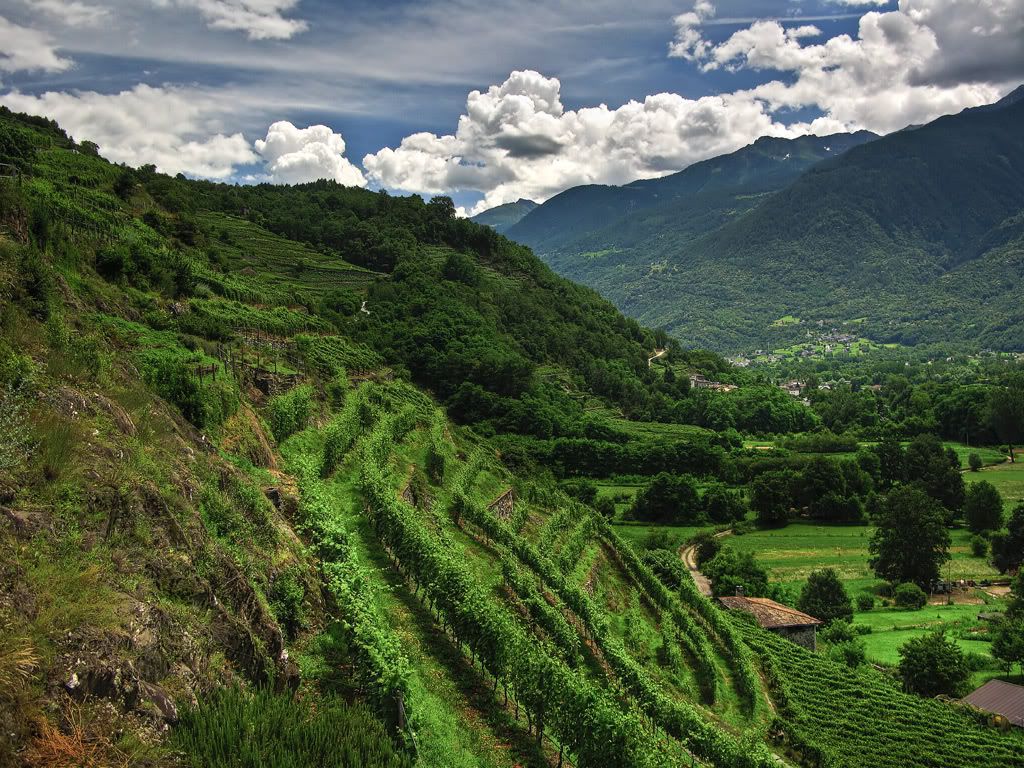
The beautiful Valtellina


The Valtellina is an Alpine valley which runs about 80 miles east-west, and is about 50 miles from the cities of Brescia and Bergamo, and the flat lands of the Po; so it's rather isolated from a historical point of view. The northernmost village of the Val Camonica, Edolo, is close to the village of Aprica of the Valtellina. The Aprica pass separates the two. The two valleys, their cultures, and their histories are very similar. The following article is from the Lombardi nel Mondo website. I did my best to translate it, often rewriting muddled portions in an attempt to get at what I thought was the true meaning. It at least gives some idea of the old experiences. You almost have to think of... perhaps movies which show very desolate locations, maybe set in the late 1800s. 'Butch Cassidy and the Sundance Kid', in the sequence when they went down to Bolivia, comes to mind. Beyond the east coast cities of Australia, maybe 100 miles inland, are the farmlands; and maybe that's part of where this took place. Of course, in 1860 or 1890, this was a very underdeveloped area. Later in the article, I think they were referring to maybe the 1940s or 50s. I remember of reading some really old accounts of what overseas employers, from the perspective of Europeans, thought of workers from certain regions... and what types of work they're good at. I recall something like.. people from the Italian Alps, Slovaks, Hungarians, etc. are good at heavy work. In other words, in contrast to modern perceptions, they didn't drag people all the way over from the middle of the rural Alps on the other side of the planet just to do very hard work that Aborigines or some little islanders could do.


'Valtellinese Emigration to Australia (1860-1960)'

From letters of migrants and third party migration development

From this we can understood the early migrations from the Valtellina, deepening the meanings and expectations of this history. Perhaps, as they had feared opponents of immigration, some of the early migrants to Australia were attracted by widespread tales of gold or of a country of plenty from emigration agents, but any such illusion was short-lived. The temporary emigrants were not on their way to a generic "Australia," but headed for specific locations, looking for a specific job. In Australia you could make some good gains, but at the price of a very hard effort and lack of any attractiveness and with great personal sacrifice. More often than not they found themselves engaging in grueling logging work in remote areas, cutting sugar cane in tropical heat, or risking their lives in underground mines. The rhetoric used by emigrants in the description of their travels is revealing: "making sacrifices" was the term used to talk about these migrations. Australia had become famous not as a country of plenty, but as a place of hard work. Since they were temporary migrants, they departed without knowing the language; and they did not come with women or families, and they did not sell their lands before leaving. Their goal was to make the highest profit in the shortest possible time, in the hope of a quick return home. They probably started with few illusions. The idea was to get through the burden of the work load stoically, sit tight and hope that they can maintain their  health and safety. Normally there was no intention to settle permanently.

The presence of Lombards in Australia, and more generally of people originating from Italy, was noted by the consuls and consular agents of Italians after the discovery of gold in the State of Victoria in 1851. The Valtellinese presence was known in those areas and to the agents of the shipping companies which operated in moving Swiss citizens not far from the border from Valtellina, in the Valley of Poschiavo in the Canton of

Rural Australia
Graubunden. Historically, these were the most common destinations of seasonal emigrants of Valtellina. After the first pioneers, Australia became part of the recognized world, and this recognition greatly influenced the development of future migrations. In Italy the chance to earn money were few, even in periods of greater well-being; as contrasted to the reputation of Australia as a source of earnings. Among other things, it was becoming a regular destination of those who hoped to increase their wealth, and not just of those most desperately in need. It was temporary migrants who intended to make a fortune. They were farmers and--with a majority of males being of working age, 20s or 30s--half of them were married, many with children. The desire of these people was to get out of the cycle of poverty, which neither the government, nor the charity institutions had eased. The bad harvests, the high cost of living, the lack of work, and the heavy load of fees and taxes were all factors responsible for departures. At that time the news of those who returned from Australia were "excellent," unlike those coming from America.

Returnees had described the unfavorable treatment accorded to them by the authorities and employers in America, while Australia had proved very hospitable. In the Valtellina, a culture of migration had developed, especially to Australia; thereby ensuring that in years to come, the majority of emigrants would follow already beaten paths. Several routes were opened in Australia since 1890. The most important would lead migrants to Western Australia, to regions where there was a focus on extractive activities and of the harvesting of timber. Especially after World War II, the northern regions of Queensland opened up in the sugar cane plantations. For many years the migrants made significant progress from the fruit of their labor, to the point that they began to consider settling permanently in the country. It was starting to become apparent that with these changes, people were deciding to make Australia their home. Their lives were simple but decent, and of which their old traditions and habits continued on. It was similar to their old village life, and less like Anglo-Saxon proletarian life. They toiled all day in the fields, pulling plows, but when they returned home in the evening to a nice home, bath, dinner, and a car to drive to town to the cinema. At the tables were always their native cuisine; lots of macaroni, salads, and buttered bread, along with cups of tea.

Source: Jacqueline Templeton, 'From the Mountains to the Bush: Emigration of Valtellinese in Australia (1860-1960) from the Letters of Migrants'; Tirano Museum, 2001


.

Thursday, May 21, 2015

Swiss Italians in Australia


It should be clarified that the proper term is "Swiss Italian," not Italian Swiss. As has been covered here before, an immigration--earlier than that to California--had been to the state of Victoria, Australia. Just like with other smaller Alpine regions, such as Val Camonica or Valtellina, the Swiss Italians/Ticinese have a local type of cuisine. It appears that there were many similarities between the California settlers and the Victoria settlers.


Swiss Italians of Australia

Swiss Italians of Australia, are Italian-speaking Swiss that settled in Australia during the 1850s and 1860s. The Swiss Italians initially settled in the area around Daylesford, Victoria. The Swiss settlers were from the canton of Ticino and the southern part of Graubünden

The influence of the Swiss Italians of Australia—Italian-speaking Swiss from the cantons of Ticino and Grison and the northern Italians is still present in the township of Hepburn Springs—through the names of its residents, the names of its springs (Locarno) and buildings (Savoia Hotel, Parma House, Perinis, Bellinzona) and the annual Swiss-Italian Festa.

The heart of the Italian-speaking community was the area around the Savoia (Spring Creek) Hotel and the Macaroni Factory. The Savoia is named after the royal family of unified Italy. An Italian reading library was located at the hotel and pasta was made opposite in Lucini's Macaroni Factory which was also home to the Democratic Club. Lucini's moved from Lonsdale Street, Melbourne in 1865, where they had set up as the first pasta factory in Australia in 1864. Vanzetta's bakery supplied bread to the community and Crippa, Perini, and the Gervasoni's (Yandoit Creek) produced wine.

In 2007 the Melbourne Immigration Museum featured a display entitled Wine Water and Stone reflecting the Swiss and Italian heritage of the area.


Swiss Italian food and culture

The Swiss Italians loved sport, food, and music. Their influence on local culture is celebrated annually during the Swiss Italian Festa. Swiss Italians of Australia have made their mark in spheres of art, music, literature, journalism, sport, education, science, and engineering.

A local delicacy is bullboar, which is a sausage made from beef, pork, garlic, and spices. Local families jealously guard their recipes. In 2005 Daylesford Secondary College came in second place in the Australian Broadcasting Corporation's Young Gourmets by making bullboars from the Gervasoni and Sartori recipes, which gained much media attention over the fate of Charlotte the pig, with little concern for the steer involved. The bullboar has been named an endangered recipe by the Slow Food Movement.


The Hepburn Springs Swiss and Italian Festa is an annual  five day celebration in late October of the area's Swiss Italian and Northern Italian heritage, with music, food, art, wine etc. Ticino and Val Camonica are very kindred cultures, both being Lombard-speaking mountain communities. The Lombard cultural relationship doesn't just end because some long ago German king decided to build a fence. This is a part of our culture as well. 

There are local (Bay Area) Swiss Italian events, and in other parts of the state, but they're hard to find as they would usually only pertain to those of that cultural family; and perhaps through the "Pro Ticino" clubs. However, there should basically be no difference between--for example--the Ticinese of west Marin County and the Milanese of east Marin County. Not only does the canton of Ticino border with the province of Milano, but both are from the same "West Lombard" dialect.


I came across an article on the Switzerland information website entitled 'Italian Swiss... or Swiss Italians?' Although interesting, that issue has been covered here before. Still, I wanted to link it for anyone interesting in reading up on it. The Ticino question becomes important to us partly because of the large past immigration in a few areas, and because we should bridge the gap finally with the idea of "Lombard cultural identity."

The "clan" concept is great, but let us not forget the ancient nation of Lumbardia. One "Lumbard" cultural family: Bergamo, Brescia/Val Camonica, Como, Cremona, Lodi, Mantova, Milano, Monza/Brianza, Pavia, Sondrio (Valtellina/Valchiavenna), Süd Graubünden/Val Poschiavo, Ticino, and Varese.

.

Wednesday, October 29, 2014

Retracing the steps of Ticino emigrants


From the video description (YouTube channel swissinfovideos):

A group of people from Ticino retrace the first steps of many emigranti on their way to Australia or the United States. At the top of the Sassello pass, they sing the emigranti song, Do you want to come to America? 

.

Monday, May 12, 2008

Ticinese Migration to Australia and New Zealand


Ticino Migration to Australia and New Zealand


The Movement Away From Home

AUSTRALIA - The first two Ticinesi migrants (in 1851) paid their own way to Australia. Two more left in 1852 and it was perhaps the successful return of two of them in 1854 which caused the general exodus of 1855 when1073 arrived in Australia. A few of their Italian cousins who had lived in Ticino for many years were granted loans to leave and some of their relatives even joined them direct from Italy. So, the overall migration lasted for almost 100 years.

The Ticinesi who migrated to Australia were, mostly, from the south west of Canton TICINO (or TESSIN in German) in the villages in dead-end valleys.

From the two western regions - Valle Maggia and Locarno; and Lugano and Mendrisio in the south but in the 1851-1856 period 1661 of them emigrated to Australia. Records show that only 48 of these were Ticinesi women being only 1.8% of the total of 2660 migrants.

Amongst the migrants the most common given names were Giuseppi (254), Pietro (208), then Giovanni (172), Giacomo (135), Antonio (97), Carlo (88) and Battista (71).

NEW ZEALAND - Gentilli makes a little comment on the migration in, "Of special interest is the small flow of Ticinesi to the New Zealand gold fields. Very few were mentioned in Swiss records or in letters from Australia (CHEDA 1976), a few founded names families in New Zealand. At least two enterprising ones organized groups to NZ together."


Traveling Out

In 1852-3 the ships to Australia were mostly British, and in 1854-55 German, Belgian and French ships leaving Europe commonly traveled via the Canary Islands and south (parallel to the Brazilian coast) swinging south east with the Roaring Forties trade winds passing some 500km south of Cape Town. From then on it was, very often, a fast and stormy passage across the Southern Ocean until they were south of Albany when sailing ships turned north towards their destinations of Adelaide, Geelong, Port Phillip (Melbourne) and Tasmania or Sydney.

From the early 1860s a block of farming land could be obtained in Victoria so easily that to the Ticinesi migrants it seemed like a dream.

By far the greatest number of Ticinesi disembarked in Port Phillip Bay (or at Williamstown a short distance across the bay) and, after obtaining provisions, made for the excitement and hardships of the Victorian gold fields around Bendigo and Ballarat 160km to the north west.

The Ticinesi were deeply religious and of the Victorian Ticinesi who married they tended to marry Irish or English Catholic girls who, as English-speakers, taught their husbands English and named their children according to their Swiss heritage but mothers brought them up to their standards and records show that the Ticinesi contributed a large number of well brought up children to Australia.

However, young deaths due to disease and a fair proportion of unmarried Ticinesi men kept the next generation well below replacement level.

A spate of naturalizations (nearly half of the total) occurred in the 1890s for the young men of the 1850s were now near to retirement and the British citizenship was a prerequisite for the pension. The Swiss Government had always accepted dual citizenship so with retirement and old age poverty was a real concern. So much so that the benevolent Swiss Society of Victoria and the more-affluent and culturally inclined Swiss Club of Melbourne were formed.


Long Term Results

A small number of Ticinesi migrants prospered but, ultimately, most just survived (and some families were not even able to pay back the loans to their Swiss community back home). Of the many who became publicans they still had credit problems due to their penchant for extending credit to family and friends.

The Ticinesi at home received some very unfavorable reports from the migrants in Australia. After 1856 those who left Ticino for Australia were more likely to join a relative established as a farmer, or seek a paid job in the mining industry, with the hope to be promoted to underground mining.

The first generation of immigrants lacked the means, and perhaps the experience and even the farsightedness, needed to encourage children to improve their social standing as soon as possible.


Passenger Lists and Other Resources

Visit Victorian Government's Record Centres at http://www.vicnet.net.au/~provic/

LONDON and LIVERPOOL lists are available, generally, in the repository in the port of arrival (e.g. the Public Records Office City Office in Melbourne, Australia).

Five Useful Centres - ships' Passenger Lists are available in the Victorian PRO for ships arriving in Melbourne (where by far the greatest majority of Ticinesi landed in Australia). One index list is for "Assisted" and one for "Unassisted" migrants into Australia. Unless you know which group your ancestor was in you will have to search both card indexes but most migrants appear to have been unassisted passengers for many Ticinesi had obtained local funding to make the trip. To see these indexes (and associated Passenger Lists on microfilm) visit the PRO, City Search Room, Level 2, Casselden Place, 2 Lonsdale Street, Melbourne, 3000 (Phone 03 9285 7999). It is on the corner of Spring Street and inside the Commonwealth Public Service building - in there look for the Melbourne Archive Centre (which also holds the Australian National Archives). If you are outside the Melbourne metropolitan area use Freecall 1800 657 452.

There is the Laverton Repository at 57 Cherry Tree Lane, Laverton North, 3026, 03 93693244. It is some 15km southwest of Melbourne city and holds the land/rates documentation from gold mining towns where most of the Ticinesi lived 1850+.

The Administration and Probate office is on the 1st Floor, 417 Little Bourke St, Melbourne, 3000 on Phone 03 9603 7222. Probate documents are held at the Laverton Repository and will be couriered into the city PRO, City Search Room, for you.

Births, Deaths and Marriages are at 295 Queen Street, Melbourne, 3000, on 03 9603 5800

The Victorian (La Trobe) State Library is at 328 Swanston Street which holds photos and drawings plus other details of SOME early migrant ships. Once there ask about seeing "The Argus" newspaper microfiche (in the buildings in Russell Street behind the library) where the shipping information gives lists of stores on board ships arriving - they are most interesting!

The Australian Institute of Genealogical Studies is situated at 6 Lavelle St, Blackburn, 3130 on Phone 03 9877 3789. The Genealogical Society of Victoria is at 252 Swanston Street, Melbourne, 3000, on Phone 03 9663 7033.

There is also the Italian Historical Society (which focuses on Italian-born migrants and descendants rather than people of Swiss-Italian origin) based at the Italian Resource Centre, 185 Faraday Street, Carlton, 3053 on Phone 03 9349 1144


A List of Ticinesi Names in Australia and New Zealand

There is a wealth of information in the way of graphs and maps in The Settlement of Swiss Ticino Immigrants in Australia, (1988) by the late Doctor Joseph GENTILLI. This superb 134-page text is available from the School of Earth and Geographical Sciences, University of Western Australia, Entrance 1, Fairway, Crawley, Western Australia, 6009.

Cost AUST$16.50 (inc gst) plus $7.00 postage and handling within Australia (cheques made out to the University of Western Australia). For overseas researchers the cost would be AUST$16.50 (inc gst) plus postage and handling of $22.75 for airmail or alternatively $14.50 for surface mail. Payment (made out to the University of Western Australia) by Bank Draft ONLY (in Australian dollars). Obtain advice from Elaine Waters ewaters@segs.uwa.edu.au.

Passenger Lists record some 45 Ticinesi returning home for good, others to marry and then return to Australia. Some, who returned in the 1880s, took small parties of young Ticinesi relatives and acquaintances back to Australia with them - for the attraction of cheap land was now more appealing than the lure of gold.

Migration to Australia practically ceased after 1876 but emigration to California continued.


Bibliography on the Ticinesi (Italian and English)

The book L'emigrazione Ticinesi in Australia (1976) by Giorgio CHEDA was published by Dado in Locarno with a second edition in 1979. There appears to be little real information useful to genealogists in this text and we understand that no English version has been published.

Two other references enthusiasts could look into are:- "The Ticinesi in Australia" by A. Pagliaro in Italians in Australia, Conference Proceedings, Vaccari Foundation, Melbourne, 1985 (2nd edition 1987) a copy of which is probably held by the La Trobe Library, State Library of Victoria, Melbourne; and,

The Caligari Papers which are held by the Genealogical Society of Victoria at 252 Swanston Street, Melbourne, VIC, 3000 on (03) 9663 7033.


Much of the credit for the information on these pages goes to Doctor Joseph Gentilli, the publication GEOWEST and the Department of Geography at the University of Western Australia under Professor John Dodson and is most gratefully acknowledged.


Ticino Migration to Australia and New Zealand