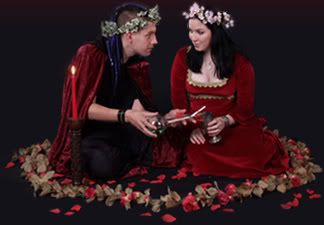
[Article borrowed from the Temple of Our Heathen Gods group on facebook; February 5, 2011; exact article source page link above]
This essay is written for those that know very little about Asatru or Heathenry, or perhaps have not even heard of it.
It is a simple question, really. Did your family come to America from Northern Europe...or do you have Northern European Ancestry? Well, if you do...then your ancestors were "Heathens."
Many people with Northern European ancestry do not realize that the original religion of our People and our ancient culture was not Christianity. If you go back a 1000 years or more, prior to the conversions to Christianity in Europe, our ancestors had their own native Folk Religion that was rich and meaningful in their lives.
Our People honored their own Gods and Goddesses, their ancestors, and the spirits in nature. These original Heathens were the pre-Christian Northern European peoples who lived in the lands around what is now called the North Sea. These included the people of Anglo-Saxon England, Scandinavia, and other areas of Northern Europe.
Some of our ancestors were convinced to convert to Christianity by missionaries. Some were coerced into converting, based on threats of physical violence. Others converted due to political or economic pressures brought on them by Christians. And some of our ancestors were killed, because they refused to give up the Ways of their People.
THE ORIGIN OF THE WORD "HEATHEN"
If you are just hearing about Heathenry, then you are very likely thinking, "But isn't the word Heathen a word for a bad person?"
Well, it is true that Christians frequently use it this way. The word "heathen" refers to people who don't worship the Christian God or follow the Christian religion. The historical origin of this use of the word "Heathen" is pretty interesting.
The word "Heathen" comes from the fact that the country people (those living on the heath), honored the old gods for centuries after the city-dwellers were already converted to Christianity.
This is why "heathen" is a bad word in Christianity. The missionaries and preachers in the cities would rail against the "heathen" (those living out in the heath), that still honored the old gods. But we embrace the term, for we are proud of those ancestors that resisted the conversion to a foreign religion, and who remained loyal to the Gods and the Ways of our People.
Another word commonly used for heathenry is Asatru, meaning "loyalty to the gods." Though, Asatru is normally used to refer to a more Icelandic influenced heathenry, while the word heathenry itself is a broader term encompassing those focusing on the Icelandic, the Anglo-Saxon, the Frankish, etc.
Our Heathen ancestors did not refer to themselves as "Heathen" or "Asatru." It is believed they did not have a name for their religion, and simply called it their Way.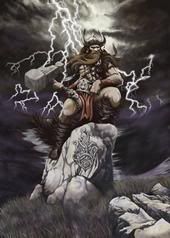
So many modern Americans are dissatisfied with their religious options. Many of the descendants of our Heathen ancestors have become dissatisfied with Christianity. Modern Heathens would make the point, that much of this dissatisfaction comes from the fact that Christianity did not originate with our People. It is a foreign religion that was relentlessly pushed on our Ancestors, until our native Folkway was suppressed or destroyed among our People.
Modern Heathens around the world are reviving the Ways of our Ancestors, and find that the religion of our Ancestors is truly satisfying and feels "like coming home." Heathenry is very family and community-oriented, and encourages us to live responsible lives of loyalty and honor. A person's word matters greatly, and each person is judged by his/her choices and actions. The Ways of our Ancestors are life-fulfilling and natural to who we are and how we think, and they work to strengthen and enrich our lives.
You will hear modern Heathenry called many things by the people who practice it. You may hear it called Asatru, the Northern Tradition, Odinism, Forn Sed, Germanic Pagan Reconstructionism or, simply, Heathenry. In Iceland, which did not convert to Christianity until the 11th Century, Heathenry has once again become an official (nationally recognized) religion. There are growing numbers of Heathens and Heathen groups across the United States, and that growth seems to be accelerating as more and more people tire of the foreign religions.
SOMETHING WORTH CONSIDERING...
If you have found yourself dissatisfied with Christianity and organized religion, take a little bit of time to look into modern Heathenry. When your heathen ancestors were pestered, coerced, or forced into giving up the Ways of the People, I have to imagine that they wondered if years down the line their descendants would again return to their true religion and way of life. As someone who has returned to the religion of my Ancestors, it is hard to describe how much it has improved my life. In the end, it is something you have to look into yourself and explore whether it makes sense for you.
A good starting place to learn more, is this Heathen FAQ. Reading through all the topics there will give you some idea of what heathenry is all about:
http://heathengods.com/temple/modules/xoopsfaq/
And for some basic information on Heathenry and how to start and maintain a Heathen group (normally called a kindred), you might want to read this book which is available as a free download or in paperback and hardback versions:
http://www.heathengods.com/library/book/
Mark Ludwig Stinson
Jotun's Bane Kindred
Temple of Our Heathen Gods
http://www.heathengods.com/
.

Saturday, April 30, 2011
Your Ancestors Were Heathen...


Tuesday, March 8, 2011
Camunian proverbs: Part 3

Apparently these are real proverbs from the Val Camonica. For each one, the fist part will be in native Camunian, the second in Italian, and the third in English (if it translated correctly):
La mòrt del lùf l'è la felicità de le pegòre.
La morte del lupo è la salute della pecora.
The death of the wolf is the health of the sheep.
--Anonymous
____________
De drè portento... de nàs spaènto!
Dietro affascinante... davanti che spavento!
*English translation needed*
--Anonymous
____________
Quand la barba la tàca a sbianchì làga le fomne e tachèt al vi.
Quando la barba diventa bianca lascia le donne e attaccati al vino.
*English translation needed*
--Anonymous
____________
'L vi 'l cünta poch se l'ostéra l'è bèla e 'l sò òm l'è óch
Il vino conta poco quando l'ostessa è bella e il marito è un coglione.
The wine counts little when the hostess is beautiful, but her husband is a jerk.
--Anonymous
____________
'L gà piö cûl de servèl.
Ha più fortuna che cervello.
He has more good fortune than brains (?).
--Anonymous
.
Saturday, February 26, 2011
Catholic Church Issues Guide on How to Convert Witches
The Vatican doesn't seem the least bit concerned with tens of millions of Muslims migrating into Europe with no end in sight; not to mention the fact that Catholicism, and Christianity at large, has become a comparatively weak social construct in the UK in particular. Apparently, they're too preoccupied with a very small number of practitioners of native paganism, or what they refer to as "witchcraft." Apparently "priestcraft" is okay. If this action was targeting one the larger religions, then people would call it "hate," but if it's a smaller relgion, then it's okay under the current paradigm.
The Vatican is a sovereign state which oversees the worldwide Catholic Church; as well as a massive, MASSIVE, global banking conglomerate. Why are they concerned with a few people chanting in a forest clearing, who aren't even bothering anyone? Now when we add in the factor of the Vatican's historic systematic murder of any religion which wasn't Catholic (Waldensians, Cathars, Pagans, etc.), this action by the Vatican is nothing short of crazy. If there were pagans somewhere, antagonizing Christians, then that would merit a similar response; but lets face it, what we have here is an ant versus an elephant.
The Camonica Club of North America, descendants of the Val Camonica witch trials brought upon by the Vatican in the sixteenth century, condemns the Vatican's pamphlet entitled 'Wicca and Witchcraft: Understanding the Dangers', and calls for them to simply leave these peaceful people alone. Whatever fault could be found among an absolutely minuscule number of pagans is a drop in the bucket compared to the very serious problems of a much larger number of trusted Catholic officials worldwide in recent years; not to mention the Vatican's terribly destructive proxy actions in Croatia not so many years ago.
Catholic Church Issues Guide on How to Convert Witches
Theunis Bates - AolNews - February 4, 2011
LONDON -- Five hundred years ago, the Catholic Church had a simple way of dealing with witches: It burned them alive. The Vatican still views these broom botherers as a danger, but is now calling on Catholics to eliminate the neo-pagan problem in a more moderate manner.
According to a new booklet from the Catholic Truth Society -- the U.K. publishers for the Holy See -- the faithful can convert Wiccans by following a few simple steps. The pamphlet, titled "Wicca and Witchcraft: Understanding the Dangers," suggests that Catholics spark up conversations with these unbelievers about shared concerns such as the environment, The Telegraph reports.
And if you bump into a witch in a bar or coffee shop, the book adds, it's important to recognize that "Wiccans are on a genuine spiritual quest," providing "the starting point for dialog that may lead to their conversion."
The booklet's author, former Wiccan Elizabeth Dodd, states that nearly 70 percent of people indulging in witchcraft are young women seeking some kind of spirituality, according to the Daily Mail. The source of that statistic isn't clear, but some 7,000 Brits identified themselves as Wiccans in the 2001 census.
So why does the Vatican once again feel that it needs to confront pagan practitioners? The Daily Mail says that the church is afraid the dark arts are becoming ever more tempting thanks to the success of Harry Potter. Dodd says that any youngster who dabbles in magic risks long-term problems.
"Whether spellwork is effective or not," writes Dodd, according to The Telegraph, "has no bearing on the psychological damage that can be done to a young person who is convinced that they have summoned the dead, or have performed a spell that has hurt or injured another."
More important, Dodd adds that the simple act of experimenting with spellcraft is an insult to the Almighty. "The use of magic, the practice of witchcraft, offends God because it is rooted in our sinful and fallen nature," she writes. "It attempts to usurp God."
While many religious and nonreligious folk might regard Dodd's message as extreme, her point has clearly been heeded by some Catholics. As of this morning, the pamphlet was listed as sold-out on Amazon.co.uk.
.
Friday, February 25, 2011
Camunian proverbs: Part 2
Apparently these are real proverbs from the Val Camonica. For each one, the fist part will be in native Camunian, the second in Italian, and the third in English (if it translated correctly):
Istìt sò bè pò 'n pàl 'l somèa 'n cardinàl.
Vestito bene anche un palo sembra un cardinale.
Garment also a pole seems a cardinal well.
--Anonymous
____________
Fàga mia saì a là mà drìta chèl che la fà l'nvèrsa.
Non far sapere alla mano destra quello che fa la sinistra.
Not to make to know ago to the right hand which the left.
--Anonymous
____________
Per cùnùsìs bè s'gà dè maià 'nsèma 'n quintàl dè sàl amàr.
Per conoscrsi bene bisogna mangiare insieme un quintale di sale amaro.
*English translation needed*
--Anonymous
____________
'N po' per û à càal de l'àsen.
Un po' per uno a cavallo dell'asino.
*English translation needed*
--Anonymous
____________
Fà e desfà l'è 'l laorà de i frà.
Fare e disfare è il lavoro dei frati.
To make and to unravel are the job of the friars.
--Anonymous
.
Thursday, February 24, 2011
Cernic tradition in Iowa
I am borrowing the text of this entry from a blog called The Circle of Shadows. I just wanted to make certain that, in this case, proper credit was given to the author and/or coven. I had originally wanted to post this December 3, 2010 post last Yule, and had sent an e-mail which wasn't responded to.
This is one of the few references to a present day pagan tradition/ritual which actually refers to its Cernic origin. The blog goes in a little bit of a different direction than we usually think of as being Cernist, but sometimes things take time to develop; and to develop a consensus among the larger body of people. It needs some time.
The Coven Ritual for Yuletide 2010 (Cernunnos and the Crone)
December 3, 2010
So, over the past couple of weeks I and few friends of mine have been working on a ritual for this Yuletide season, which falls on December 21, 2010 and also falls on the night of the Full Moon. It will be a very special night since it falls on the rare occaison (though certainly not unheard of) that a Witches Sabbat and Esbat (moon ritual) fall on the same night.
I think one of the great things about our coven so far is that we have managed to put our personal ideas, differences, and preferences aside and just focus on the celebration of the pagan holidays. Our rituals have been generic enough to suit all members, yet they also retain their meaning at the same time. The coven I am now calling the "Circle of Shadows" first met formally on November 7, 2010, the purpose was the observence of Samhain 2010 which actually took place one week prior to our formal observence due to the illness of a member. Upon the conclusion of this meeting we all seemed to feel that this organized grotto of witchcraft was indeed worth pursuing. I think we all feel as though the ritual itself could have been better, but given the lack of preparation (only a couple of weeks) hindered how effective the ritual could have been.
With my personal preferences of more dark sided occultism, and the preferences of other members for a lighter side to such things I feel that we have (in most cases thus far) blended both ideas (and those in between) well. And we all seem to get along with one another very well and have a chemistry that is still developing at this point, but still ever present none the less.
As the high priest at our Samhain meeting and now the High Priest of our Yuletide meeting, we seem to have many obstacles to work through. But yet this Yuletide is the darkest night of the year and thus very mportant to myself. And it is very important to the other members, each for different reasons but we each are able to to afford the the other members thier own importance and celebrate the REBIRTH OF THE SUN. Which is, after all the most important aspect of this holiday!
Om, Sarva Buddha Dakini, Hri Mama Sakta Soha...
Happy Yuletide to all!
Raven Brimstone
.
Wednesday, February 23, 2011
Camunian proverbs: Part 1
Apparently these are real proverbs from the Val Camonica. For each one, the fist part will be in native Camunian, the second in Italian, and the third in English (if it translated correctly):
Ôm stüdiùs màgher mùrüs.
Uomo studioso scarso amante.
Studious man insufficient lover.
--Anonymous
____________
L'è bèla come 'l cül dé là padèla.
È bella come il fondo della padella.
It is beautiful as the bottom of the frying pan.
--Anonymous
____________
Zò le mà dal bànc.
Giù le mani dal banco.
Down the hands from the bench.
--Anonymous
____________
Quànd chè la carne la diénta früsta pò a l'anima la sé giûsta.
Quando la carne diventa vecchia anche l'anima si aggiusta.
When the meat becomes old also l' spirit is fixed.
--Anonymous
____________
'N Avrìl 'l tàca pò 'l mànech de'n badìl.
Ad Aprile fiorisce anche il manico del badile.
To You open them blooms also the handle of attends them.
--Anonymous
.
Tuesday, February 22, 2011
'The Edge' (1997) movie review
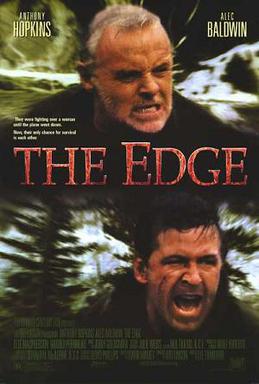
Our ancestors lived in an environment at the same longitude as the state of Washington, and in a similar landscape. Coming out of the last ice age, Europe was probably pretty similar to modern Alaska, which was the location of the film.
Most of their existence was about survival. This was probably why they used animal symbolism for certain traits. For example, a wolf represented courage. They were much more in tune with the idea that "life is struggle." They probably had to contend with animals like the massive Kodiak bear shown in the movie, or with woolly lions, just within just the last several thousand years.
Another factor was that at one point up to about six thousand years ago, agriculture wasn't even possible due to the climate, so hunting would have been the chief source of food. Mammoths, which they hunted, only died out about ten thousand years ago.
'The Edge' is a great movie, which mixes personal struggles between people, with the struggle against the environment. That is a theme that has played itself over and over during eons of time. Anyone even just interested in paganism should see it on that basis alone. There have been movies about the very ancient past; but this movie, with a current theme, makes it easier to relate to the characters.

From 'The Edge' Wikipedia page:
The Edge is a 1997 survival and relationship drama film directed by Lee Tamahori starring Anthony Hopkins as billionaire magazine publisher Charles Morse and Alec Baldwin as Bob Green, one of his ambitious employees. Harold Perrineau also co-stars as the group's photographer Stephen. Elle Macpherson has a supporting role as Hopkins' trophy wife and model for his magazine. Her presence in the beginning of the movie acts as a catalyst for the film's bold rivalry between Baldwin and Hopkins. L. Q. Jones has a supporting role as an innkeeper. Bart the Bear, a trained Kodiak Bear known for appearing in several Hollywood movies, also appears, as a vicious grizzly, and it would be one of his last film roles.
The movie was written by David Mamet and, despite the unusual setting, it touches upon many themes common to Mamet's other works, including the bonding of strong male characters, tough posturings and playful surprises. The story explores, through action and intricate dialog, the survival instincts of these men in terms of their competition with each other and with their environment.
.