Showing posts with label Heathenism. Show all posts

Tuesday, October 4, 2016

ShadowFest 2016: October - A month of relevant dates II


Leif Eriksson - The First European in North America

Viking Cruises

Learn more at: http://www.vikingrivercruises.com/river-cruising/first-time-river-cruiser/index.html

Thanks to a rhyme learned in grade school, many people believe that Columbus discovered America in 1492. But this Viking Cruises® video chronicles how, nearly 500 years before the Italian explorer sailed the ocean blue, a 25-year-old Norse navigator named Leif Eriksson and a crew of 35 men set sail to explore the seas west of Greenland. When Eriksson arrived on the shores of what he called “Vinland,” he became the first European to set foot in North America. Narrated by Viking Cruises Sr. Vice President Karine Hagen, this short film traces Eriksson’s history and his voyage into immortality.

The son of intrepid Viking explorer Erik the Red, Eriksson led the historic journey from Greenland to North America through uncharted waters without a compass. Although the discovery was celebrated for centuries in Norse legend and stories, many doubted the accuracy of those accounts. Doubts about Eriksson’s discovery were finally dispelled in 1960, when modern-day explorers Helge and Anne Ingstad identified a Norse settlement located at the northern tip of Newfoundland that dates back to the exact time of Eriksson’s voyage. In the United States, the achievement of the Viking explorer with adventure and exploration in his blood is commemorated every year on October 9th. At Viking Cruises, we cherish our Viking heritage and connection to seafaring visionaries like Leif Eriksson.

Karine Hagen of Viking River Cruises is your host.

*************************


Leif Erikson Day - October 9

One interesting difference between Christopher Columbus and Leif Erikson was that Erikson was a Heathen (Odinist, Asatruar, etc.). The Vikings were the last great European Pagan Nation. I use the term "pagan" loosely, as it was only used in this manner centuries later when "native believers" were relegated to the countryside. Leif Erikson, the Viking colony of Vinland (or Vinnland), and the symbolic but fictional flag of Vinland could all have a folk-religious type of meaning... beyond a Scandinavian ethno-cultural meaning. I suppose we can explicitly state that Leif Erikson is a Heathen/Pagan hero. There have been some interesting Leif Erikson Day festivals on the east coast of the U.S. and Canada in recent years. In a strange way, he is still very much an overlooked figure. He was present here in North America a thousand years ago.


Columbus Day - October 10

I didn't want to turn this posting into a why Columbus is hated and Erikson is praised discussion. Naturally we have historical ties to Columbus' Genoese roots, and he sailed under the flag of SPAIN. Why aren't social justice warriors and La Raza people mad at Spain? I guess it's pretty obvious why that would never work. It's hard to discuss Columbus at all without acknowledging his new Emanuel Goldberg-status. Columbus served at the pleasure of King Ferdinand and Queen Isabella. He couldn't set policy without their approval. Spain discovered America for the West and Christianity.


Full Moon: October Full Hunter Moon

Old Farmer's Almanac

Each month, we will explain the traditional names of the full Moon along with some fascinating Moon facts. This month, learn about the ancient quarter day holiday for commemorating the harvest, and how often you can expect a full Moon on Halloween night.

*************************

Full Hunter's Moon - October 16

See above link for your exact date and time. It will be October 15 at 9:25 PM on the west coast. This full Moon is also called the “Travel Moon” and the “Dying Grass Moon.”


Alaska Day - October 18

Alaska Day is a legal holiday in the U.S. state of Alaska, observed on October 18. It is the anniversary of the formal transfer of the Territory of Alaska from Russia to the United States, which occurred on Friday, October 18, 1867.

************

Alaska reminds me of what a Heathen dreamland in its pristine state would be like. This is mainly because it's so large, and unlike far northern places like Greenland.. it's often so sunny, wooded, and green. There's an uplifting spirit to it.


New Moon - October 30

I tried to celebrate a New Moon once, and I felt very depressed. I thought that this poem was appropriate. I am aware how they can be useful as well.


New Moon

A new moon
Hiding away from sight
We know its there
We cannot forget her presence
But it cannot be seen

Depression is like that
An illness, on the inside
When you have it, you never forget
A moments respite
Is never available to you

-- Daniel Kenneth


History Channel The Real Story of Halloween Full 720p HDTV

It's Okaay


*************************

Halloween - October 31

I was at Michaels: The Arts and Crafts Store a few days ago and I never saw Halloween seasonal decor like that before. Beautiful items and displays... orange, black, purple...

.

Friday, June 6, 2014

Wisdom for the Wolf-Age: Part 1

'
'Wisdom for the Wolf-Age: A Conversation With Dr. Stephen Flowers' 

By David Jones - New Dawn Magazine - March 21, 2003 (Portions of this interview with Dr. Flowers have previously appeared in the British journal 'Rûna: Exploring Northern European Myth, Mystery and Magic')

This is an excellent interview from a decade ago, with one of the important figures in Germanic Heathen studies, and the Germanic Heathen movement, Dr. Stephen Flowers

In case you may not be aware, there is an excellent text-to-voice site which can read back large blocks of text for you. If you want to read a long article.. but are not really in the mood to sit and read it, you ought to try it. It is: http://www.fromtexttospeech.com/
If it is slow to respond, just back-click and try it again. I usually have no problems. Also, you may save it as an audio file if you wish.

Stephen Flowers is an academic, and his main area of interest is Germanic/Heathen studies... basically Odinism and the spiritual/occultic end of it. Also, he's an expert on Hermeticism, Western ceremonial magic, occult studies, and the "left-hand path"... which appears to be Satanic if I'm not mistaken. I think I could accept someone who dabbles into Satanism before I could tolerate the supremely intellectually and spiritually dishonest people who are anti-folkish regarding things which are clearly folkish in nature. The "right-hand path is based "white magic."

Of course, Dr. Flowers translated 'Secret of the Runes' into English, and as I found out... he apparently was the owner of Runa-Raven Publishing (now defunct). He translated 'History of the Aryo-Germanic Folk' which I purchased from that company. I also was not aware that he was one of the founding members of the Asatru Free Assembly in the 70s, later the Asatru Folk Assembly. He is the author of many books, articles, lectures, etc., and founded the Woodharrow Institute, which seeks to promote Germanic scholarship within mainstream education.. where forces have long been pushing it out. If I understand it correctly, to promote educational materials on the pre-Christian culture and spirituality of the Germanic cultures. Also it appears to be a focus on Indo-European studies in general.

There are many excellent points made in this interview. I would like to enter just one of the questions here. The interview as conducted by Michael Moynihan, the North American editor of 'Rûna: Exploring Northern European Myth, Mystery and Magic'.

Michael: Why is the notion of a scholar of pre-Christian religion who actually adheres to the spiritual ideas that he also studies such a radical one? Is this simply a byproduct of the situation in the West where any religious path outside of the “mainstream” monotheistic faiths is painted as cultic and marginal?

Stephen: I think this attitude stems almost entirely from two sources: 1) the antagonism of the materialist worldview toward the traditional spiritual one, and 2) the opportunity the adherents to the materialistic worldview have taken to attack the spiritual view based on historical events surrounding World War II. This materialist worldview is “monotheistic” in the sense that it allows for only one set of orthodox values. In this way it is really a secularised form of monotheistic religion. The Judeo-Christian system of thought has lent itself very well to being secularised in such a way that it can be turned into a model for modern political and economic theories. As a side-note, Islam has been much more stubborn in its adherence to its original values, which has caused it to be very much “out of step” with its monotheistic cousins.

Judaism and Christianity can be tolerated by the establishment scholarly world because they can be viewed as theoretical prototypes of the materialistic and positivistic model that now dominates thought in the West. Earlier traditional models are seen not so much as a threat to religion as they are seen as a threat to the monolithic political and economic order. The pre-Christian, traditional philosophies are too divergent and multivalent to be coerced into one single “market” of ideas. This points to the fatal hypocrisy of the current crop of modernistic “thinkers,” who spout off about “multiculturalism” and tolerance, but who exclusively support monolithic socio-economic models that enact the opposite of what they publicly espouse. Surely the ancient, traditional and pre-Christian world is more in line with what really sounds best to most people. Are not ancient, pre-Christian Athens or Alexandria more ideal models for the future over medieval Rome or Constantinople?


Clearly the animosity to those who see value in pre-Christian models stems

not from the religious side of the debate, but rather from the secular challenge traditionalism poses to the current political order. What is needed is a campaign for the re-education of the academic world to show that the idealised future is one that is more likely to be based on the mosaic of pre-Christian traditions than it is to be based on the monolithic Christian model.

Scholars of pre-Christian tradition must indeed be sympathetic and even empathetic to the paradigms they are studying. If they do not have a subjective link to the paradigm they are seeking to understand, then they have categorically placed an insurmountable barrier between themselves and the “object” they seek to understand. Hence they have in fact disqualified themselves from ever being able to really understand the patterns of thought in question.


Dr. Stephen Edred Flowers (from the Woodharrow Institute)
 

Dr. Flowers (b. 1953 in Bonham, Texas) is recognized as an expert in the field of early Germanic history and runology. He has authored over two dozen books and hundreds of papers on a wide range of subjects. Dr. Flowers did his graduate work in Germanic and Celtic philology under Professor Edgar Polomé at the University of Texas at Austin from 1973-1984. In 1981-1982 he studied both runology and the history of occultism at the University of Göttingen, Germany.  He received his Ph.D. in 1984 with a dissertation entitled Runes and Magic: Magical Formulaic Elements in the Elder Tradition. From 1984-1989 he was a lecturer in the Departments of English and Germanic Languages|at the University of Texas at Austin. Over the last quarter-century he has also written a number of well-received books on esoteric subjects under the pen-name Edred Thorsson. In addition to being a prolific writer, Dr. Flowers has translated a number of rare Icelandic, Old Norse and German texts and manuscripts into English, making them available to a wide range of readers for the first time. Dr. Flowers is currently the director of the Woodharrow Institute of Germanic Studies.

.

Saturday, December 21, 2013

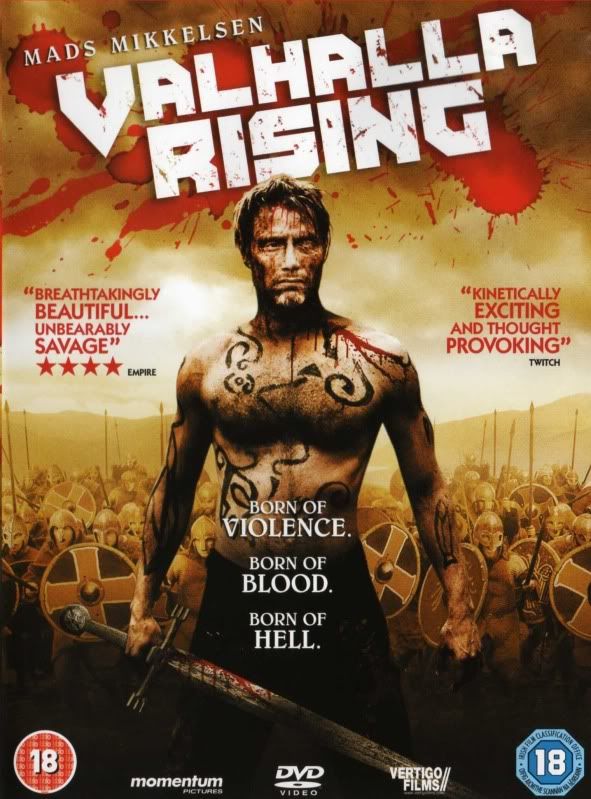
'Valhalla Rising' movie review

'Valhalla Rising' Wikipedia page (2009 film)

Valhalla Rising is a 2009 English-language film directed by Nicolas Winding Refn, starring Mads Mikkelsen. The film takes place in 1000 AD and follows a Norse warrior named One-Eye and a boy as they travel with a band of Christian Crusaders in pursuit of a Crusade. Instead, they find themselves in an unknown and unfamiliar land. The film was shot entirely in Scotland. Title is derived from the combination of Kenneth Anger's 'Scorpio Rising' and 'Lucifer Rising' with a Viking-theme.

At the beginning of the movie, there is the following text:


IN THE BEGINNING THERE WAS
ONLY MAN AND NATURE

MEN CAME BEARING CROSSES
AND DROVE THE HEATHEN

TO THE FRINGES OF THE EARTH

This text suggests an Odinic theme. The "fringes of the Earth" meant Scandinavia. Recent Viking depictions on film look more Gaulish to me; maybe that's just how I perceive it. Anyway, according to Norse mythology, Odin sacrificed one of his eyes in order to gain the "Wisdom of the Ages." In addition, In a sacrifice to himself, the highest of the gods, he was hanged from the world tree Yggdrasil for nine days and nights, pierced by his own spear, in order to learn the wisdom that would give him power in the nine worlds (from the Odin Wikipedia page). The main character, One-Eye, was missing this left eye which is the same eye that Odin is depicted as missing. Also, at the beginning of the film, One-Eye is in chains or tied with rope. This suggests that One-Eye is an allegory for Odin; and he is consistently shown as having visions of future happenings.

Throughout the movie, a clear but subtle "Christian vs. Heathen" theme plays itself out. One Heathen early on says about Christians "They eat their own god, eat his flesh, drink his blood, abominable." The landscape of Scandinavia is shown to be very harsh, dark, misty, and foreboding. After achieving his freedom, he and his followers hook up with Norse Christian warriors who had just slaughtered a clan of Heathens. They are on their way to the Holy Land, Jerusalem, to fight for the Crusades. Although One-Eye does not speak, he seems to be a Heathen who slowly takes everyone to "Hell," which to me meant back to Heathen-style "evolutionary struggle."


According to the book 'Creed of Iron': The Aryan God Wotan is known to have sacrificed his left eye in the Well of Mimir to attain great knowledge, to split the veil of light into the knowledge of the infinite dark. This is all highly arcane and symbolic. The left eye represents the circular moon, the right eye, the circular sun. In the movie, One-Eye is so brutal and ruthless at times that I'm almost thinking that with his left eye gone (feminine energy), he is--symbolically-speaking--out of balance with only his right eye (masculine energy). Christianity, if you study it's Astrotheologic origins, is heavily "male energy," yet they are up against the Heathen One-Eye with perhaps the same energy unbalance.

.

Spoiler alert beyond this point!

.

.

.


When they finally make it out of a long, dark, foggy abyss, they find themselves in fresh inland waters; amid a land of mountains, lakes, and forests. They now believe that they're in Jerusalem; and I can't help but think that One-Eye, the symbolic "Odin," has somehow lured them to this place to teach them once-and-for-all about real evolutionary struggle... Heathen style! One-Eye symbolically marks this place by stacking stones by the waters. The new land seems to have some strange affects upon all of them. The ruthless leader of this band of Christian Crusaders stabs his longtime friend when he feels that he has betrayed him by following One-Eye... then proclaims "Only men of faith deserve the riches of my new Jerusalem."

At the end, after facing off against the Christians, One-Eye sacrifices himself to a tribe of Mongol warriors in order to save the young boy who has served him throughout the movie. Now, could that be symbolic of a "Christ-like figure?" Finally, there appears to be symbolism of One-Eye moving on to Valhalla. I found it interesting to try to pick up on the movie's symbolism; then later read narrative of the "five parts" or acts of the film to see how close I was or wasn't.

3-4-14 Addition: It has come to my attention that they had sailed--not eastward--but westward to North America. So then the final part of the movie was probably somewhere in what is today Canada, and the Mongol warriors were actually Amerindians.

.

Thursday, October 17, 2013

Guido von List: Part 26 - The Mystery of the Vehme: Entry B


Barnstar (Wikipedia)

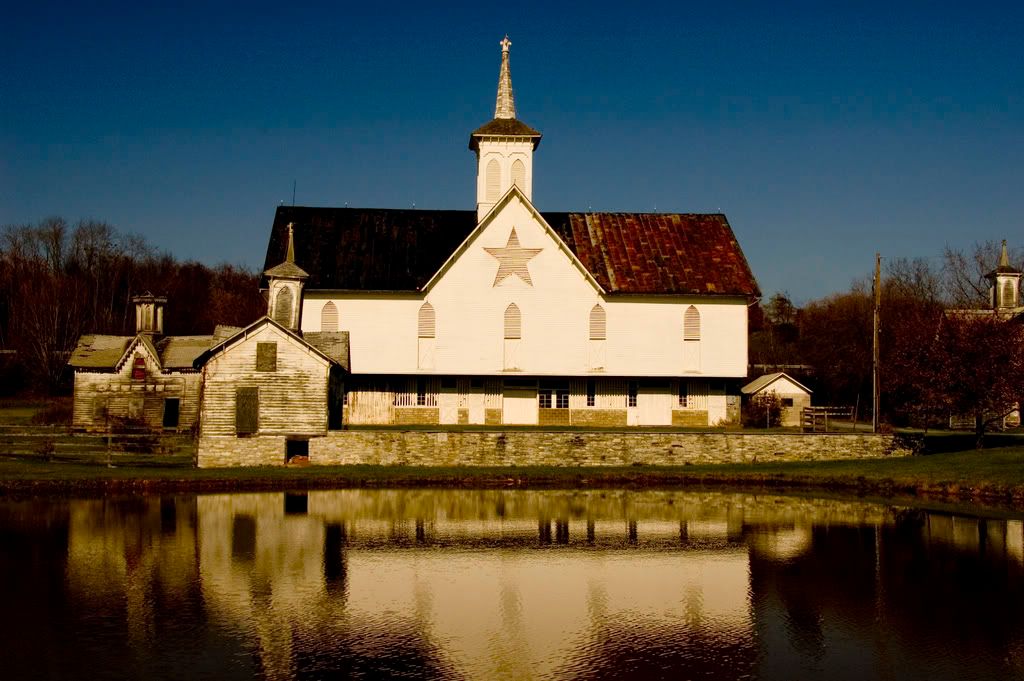
A barnstar (or barn star, primitive star, or Pennsylvania star) is a decorative painted object or image, often in the shape of a five-pointed star but occasionally in a circular "wagon wheel" style, used to adorn a barn. They have no structural purpose, but may be considered lucky, akin to a horseshoe mounted over a doorway. They are especially common in Pennsylvania and frequently seen in German-American farming communities.


History

Barnstars were meant to represent the mark of the builder, but became more frequently used for aesthetic purposes and were added to the building after construction was complete. Enthusiasts have traced a number of wooden barnstars to individual builders in the Pennsylvania area, where numerous examples can still be seen.


Barnstars were used in the United States during the 18th century and as late as 1870 in Pennsylvania, where their popularity increased greatly following the Civil War. Their regular use preceded that time, however, and stars were commonplace on large buildings, particularly factories, in pre-war Richmond, Virginia.[1]

Barnstars remain a very popular form of decoration and modern houses are sometimes decorated with simple, metal, five-pointed stars which the makers describe as "barn-stars". They are often deliberately distressed or rusted, alluding to the traditional decoration.


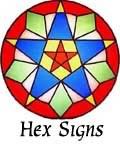
If you connected the barnstar with the hex signs within Pennsylvania Dutch culture, then you are correct. All of this has an origin in pre-Christian German magical societies and Heathenry, but later revived into Christian society... just as Guido von List described. The above link continues...


Other star-shaped plates
On older buildings in the Pennsylvania Dutch area of the United States it is still possible to find barnstar-like building adornments which are painted, rather than wooden or metal, known as hex signs. Strictly speaking, they are defined apart from barnstars and visually bear only passing resemblance, but the two are often confused and their names are even regarded as interchangeable.[1] Some hex signs incorporate star shapes, while others may take the form of a rosette or contain pictures of birds and other animals.[5]

The term barnstar has been incorrectly applied to star-shaped anchor plates that are used for structural reinforcement, particularly on masonry buildings from the 18th and 19th centuries. These are made of cast iron and are used as tie plates serving as the washers for tie rods. The tie-rod-and-plate assembly serves to brace the masonry wall against tilting or lateral bowing.

Some Wiki-based communities give their users an award called a "barnstar", as a continuation of the "barn raising" metaphor. This originated on MeatballWiki. The image that is frequently used for this purpose is actually a photo of one of the structural tie plates described above, not of a barnstar proper.


Pow-wow (folk magic) [Wikipedia]

Pow-wow, called Braucherei in Deitsch, is a system of American folk religion and magic associated with the Pennsylvania Dutch.


"Hexerei" is the German magical-spiritual tradition; but "Braucherei or Speilwerk" is heavily tied to Christian practice. This sounds very suspiciously like... "permission from daddy"... to play with magic. A little modern reminder and leftover from the "burning times." There are, of course, examples of this from all Christian societies. The above link goes into much greater detail and history.

There have been many complex underground pagan traditions tied to Christian cultures, "hiding in plain sight," and not just German or European. I fully understand the power in symbolism of this.. and how it has become so habit forming over the centuries. The pagan spirit has become so institutionalized within Christianity! I recall a news article from earlier this year, of a man in another country who was released from prison after a lengthy prison sentence. He was begging the authorities to "allow him to stay." That is "institutionalized."

Still, I understand. It's a fun and creative endeavor to craft symbolism within something. It draws upon a unique individual expression. The rural tradition of "Upper Michigan folk medicine," brought there originally by women from the Italian Alps, survives within a Catholic culture. Those women would, of course, say that they're good Catholics.


Pennsylvania Dutch Pow-wow (YouTube)

Powwow: Braucherei (YouTube)

.

Thursday, July 28, 2011

Reconciling the Christian vs. Pagan issue


I wanted to at least touch upon this issue, which is one that I have largely avoided. I have given the Greek example numerous times, by which this issue is rendered into a complete non-issue. Recently, I was looking something up in a book of mine entitled 'Masonic and Occult Symbols Illustrated' (Burns; 1998). For a period, years ago, I had listened to Christian sources regarding "the occult." Now I haven't completely changed my mind on everything I used to believe, but I'll get to that later. "Occult" simply means "hidden," so theoretically something within Christianity could be "occult" as well. The word "pagan," from the Latin word "paganus," simply means "country dweller." "Heathen," from old Norse, means "a person from the hearth"; and "heathenry" means "people from the hearth." It's easy to see how Christianity demonized the pagans by taking an innocent word like "heathen" and using it as a term of scorn. Ruling classes always have used "shame on you" words to beat their opposition into submission.

'Masonic and Occult Symbols Illustrated' was written by a Christian named Kathy Burns. I'm not ragging on Christians, which I will explain later; but while this is a good reference book on symbols, she made some painfully untrue descriptions on some of them. For whatever it's worth, I had written snail mail to her a few times, and she was nice enough to send me a free small book after I had clarified one symbol for her. Be that as it may, I must at least take issue with her description of the Othala or Odal Rune. In the glossary of symbols, she wrote "possession" under the Othala. Comparatively, after reading the more-than-slight bias with the other symbols, it's pretty clear that she was suggesting something like "possession by a demon," which is wildly inaccurate. The symbol means "home," "homeland," "freedom," "personal possession," "the home front," etc.

This was a clear case of someone calling anything that doesn't coincide with their belief system as "the devil." To the author, every non-Christian symbol is "evil".... "occult!" I'm actually glad that I have something of a background in the Christian view of these matters, because I can spot problems a mile away. In other words, the truth is that there are problem areas in Christianity and the other major religions, as well as in the modern pagan world. There are some very dark influences in both Christian and pagan communities. Not the average person, but in many of the deep-pocketed political influences behind the scenes. I think I will just leave it at that for now, rather than confuse the issue further.

If we are to found a "Cernic Rite," we must decide first what course we need to take. I was looking at some photographs of some type of "pagan pride day" which is held each year in Berkeley, California. Clearly many of the participants were simply acting buffoonish and even dishonorable. Our ancestors didn't sacrifice their lives in order to allow some screwballs and political zealots to make fun of us. We will have to blaze our own path. I would venture to guess that about 10% of the current milieu of Wiccans and similar pagans are worthy of taking the Cernic path. There are some good ones. We know you're out there.

We need a movement which is at least somewhat similar to the Odinist movement. Naturally there would be some big differences too, but the basic tenant of our culture: "Faith, Folk, Family" should be our code. Any son or daughter of Europe should feel welcome. Celtic people lived, or at least influenced, every corner of Europe. In other words, a FOLKISH movement, period. That doesn't mean that we won't communicate with people, study other spiritual paradigms, facilitate guest speakers from other movements, etc.

Lastly, many Christians are probably correct in that magic is not something to be fooled around with. It's not for children. I believe that we would be best served by concentrating on natural sources in nature for our spiritual needs. Many people open doors that they can't close. For example, Ouija boards are a very bad source for this. Even when these people pack up and move, the dark energy follows them. Even within Christianity, these doors are opened. There are both positive and negative spirits in both Christianity and paganism. Therefore, I would strongly suggest... no oaths, and no conjuring up spirits. Lets just honor the ancient Gaulish gods and goddesses, and use the natural sources which they gave us.

.

Monday, July 4, 2011

Cernic Rite: Summer Solstice


Cernic Rite: Summer Solstice

Cernunnos, the Celto-Gallic god of the forest. Ironically, a nearby house featured in this video has a depiction of the Green Man on it. The Cernic tradition goes clear back into the ancient world. So far back that it predates the Norse gods in Europe. However, many of the old ways have mingled with Norse, Slavic, and Mediterranean paganism. The Green Man being one such example.


CERNUNNOS
http://en.wikipedia.org/wiki/Cernunnos

Cernunnos is the conventional name given in Celtic studies to depictions of the horned god of Celtic polytheism. The name itself is only attested once, on the 1st-century Pillar of the Boatmen, but depictions of a horned or antlered figure, often seated in a "lotus position" and often associated with animals and holding or wearing torcs, are known from other instances.

Nothing is known about the god from literary sources, and details about his name, his cult or his significance in Celtic religion are unknown. Speculative interpretations identify him as a god of nature or fertility.


SUMMER SOLSTICE
http://en.wikipedia.org/wiki/Summer_solstice

The summer solstice occurs exactly when the Earth's semi-axis in a given hemisphere is most inclined towards the sun, at its maximum tilt of 23° 26'. Though the summer solstice is an instant in time, the term is also colloquially used like Midsummer to refer to the day on which it occurs. Except in the polar regions (where daylight is continuous for many months), the day on which the summer solstice occurs is the day of the year with the longest period of daylight. The summer solstice occurs in June in the Northern Hemisphere north of the Tropic of Cancer (23°26'N) and in December in the Southern Hemisphere south of the Tropic of Capricorn (23°26'S). The Sun reaches its highest position in the sky on the day of the summer solstice. However, between the Tropic of Cancer and the Tropic of Capricorn, the highest sun position does not occur at the summer solstice, since the sun reaches the zenith here and it does so at different times of the year depending on the latitude of the observer. Depending on the shift of the calendar, the summer solstice occurs some time between December 21 and December 22 each year in the Southern Hemisphere, and between June 20 and June 21 in the Northern Hemisphere.

Worldwide, interpretation of the event has varied among cultures, but most have held a recognition of sign of the fertility, involving holidays, festivals, gatherings, rituals or other celebrations around that time.

The word solstice derives from Latin sol (sun) and sistere (to stand still).


[Music: 'Cernunnos' by Kate West]


**************************************************

I just wanted to add a little to this entry. First, most of the Cernic efforts will be posted here rather than the other blog. I don't want to saturate the PAL blog with paganism. Only that which applies to historical Padan Christian or pagan traditions, while most of the rest can be placed here.

I learned something when I filmed this. I hiked in the dead of night, and it was so dark that I had to wait for some morning daylight in order to even enter the wooded area that I wanted to film. If there is no moonlight, the woods are usually completely black. I learned that it is not safe, for anyone, to hike in a remote area at night. It's easy to laugh, but it's no joke out there. It's an entirely different world at night. I almost bumped into a racoon. Now if I had stepped on it's foot or something, I could have been seriously hurt; or how about stepping on a rattlesnake?

I was carrying a lot of equipment and couldn't manage my failing disposable flashlight very well. It's really only safe to hike at night with others, and with adequate lighting. Actually, it's not even a good idea to hike at anytime alone, unless it's within a safe distance from a road. Another issue that crossed my mind is that it's always a possibility that you could encounter another person, which by itself is all the reason you would need to avoid hiking at night.

.

Saturday, April 30, 2011

Your Ancestors Were Heathen...

Your Ancestors Were Heathen...

[Article borrowed from the Temple of Our Heathen Gods group on facebook; February 5, 2011; exact article source page link above]

This essay is written for those that know very little about Asatru or Heathenry, or perhaps have not even heard of it.

It is a simple question, really. Did your family come to America from Northern Europe...or do you have Northern European Ancestry? Well, if you do...then your ancestors were "Heathens."

Many people with Northern European ancestry do not realize that the original religion of our People and our ancient culture was not Christianity. If you go back a 1000 years or more, prior to the conversions to Christianity in Europe, our ancestors had their own native Folk Religion that was rich and meaningful in their lives.

Our People honored their own Gods and Goddesses, their ancestors, and the spirits in nature. These original Heathens were the pre-Christian Northern European peoples who lived in the lands around what is now called the North Sea. These included the people of Anglo-Saxon England, Scandinavia, and other areas of Northern Europe.

Some of our ancestors were convinced to convert to Christianity by missionaries. Some were coerced into converting, based on threats of physical violence. Others converted due to political or economic pressures brought on them by Christians. And some of our ancestors were killed, because they refused to give up the Ways of their People.


THE ORIGIN OF THE WORD "HEATHEN"

If you are just hearing about Heathenry, then you are very likely thinking, "But isn't the word Heathen a word for a bad person?"

Well, it is true that Christians frequently use it this way. The word "heathen" refers to people who don't worship the Christian God or follow the Christian religion. The historical origin of this use of the word "Heathen" is pretty interesting.

The word "Heathen" comes from the fact that the country people (those living on the heath), honored the old gods for centuries after the city-dwellers were already converted to Christianity.

This is why "heathen" is a bad word in Christianity. The missionaries and preachers in the cities would rail against the "heathen" (those living out in the heath), that still honored the old gods. But we embrace the term, for we are proud of those ancestors that resisted the conversion to a foreign religion, and who remained loyal to the Gods and the Ways of our People.

Another word commonly used for heathenry is Asatru, meaning "loyalty to the gods." Though, Asatru is normally used to refer to a more Icelandic influenced heathenry, while the word heathenry itself is a broader term encompassing those focusing on the Icelandic, the Anglo-Saxon, the Frankish, etc.

Our Heathen ancestors did not refer to themselves as "Heathen" or "Asatru." It is believed they did not have a name for their religion, and simply called it their Way.


HEATHENRY IS A VIABLE OPTION IN OUR MODERN WORLD

So many modern Americans are dissatisfied with their religious options. Many of the descendants of our Heathen ancestors have become dissatisfied with Christianity. Modern Heathens would make the point, that much of this dissatisfaction comes from the fact that Christianity did not originate with our People. It is a foreign religion that was relentlessly pushed on our Ancestors, until our native Folkway was suppressed or destroyed among our People.

Modern Heathens around the world are reviving the Ways of our Ancestors, and find that the religion of our Ancestors is truly satisfying and feels "like coming home." Heathenry is very family and community-oriented, and encourages us to live responsible lives of loyalty and honor. A person's word matters greatly, and each person is judged by his/her choices and actions. The Ways of our Ancestors are life-fulfilling and natural to who we are and how we think, and they work to strengthen and enrich our lives.

You will hear modern Heathenry called many things by the people who practice it. You may hear it called Asatru, the Northern Tradition, Odinism, Forn Sed, Germanic Pagan Reconstructionism or, simply, Heathenry. In Iceland, which did not convert to Christianity until the 11th Century, Heathenry has once again become an official (nationally recognized) religion. There are growing numbers of Heathens and Heathen groups across the United States, and that growth seems to be accelerating as more and more people tire of the foreign religions.


SOMETHING WORTH CONSIDERING...

If you have found yourself dissatisfied with Christianity and organized religion, take a little bit of time to look into modern Heathenry. When your heathen ancestors were pestered, coerced, or forced into giving up the Ways of the People, I have to imagine that they wondered if years down the line their descendants would again return to their true religion and way of life. As someone who has returned to the religion of my Ancestors, it is hard to describe how much it has improved my life. In the end, it is something you have to look into yourself and explore whether it makes sense for you.

A good starting place to learn more, is this Heathen FAQ. Reading through all the topics there will give you some idea of what heathenry is all about:

http://heathengods.com/temple/modules/xoopsfaq/

And for some basic information on Heathenry and how to start and maintain a Heathen group (normally called a kindred), you might want to read this book which is available as a free download or in paperback and hardback versions:

http://www.heathengods.com/library/book/

Mark Ludwig Stinson
Jotun's Bane Kindred
Temple of Our Heathen Gods
http://www.heathengods.com/

.

Sunday, August 24, 2008

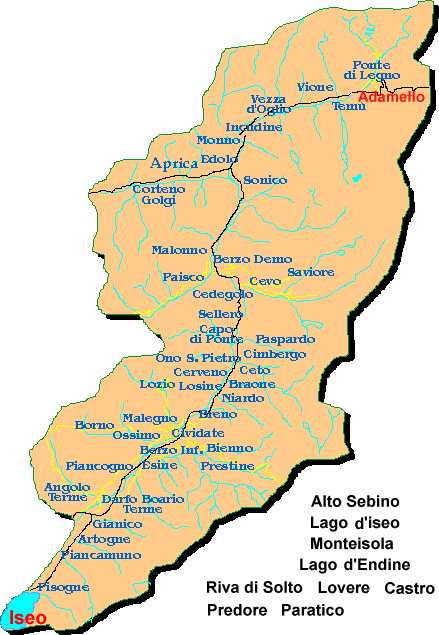
Val Camonica witch trials

I'm basing this entry on three items: 1) the new Wikipedia page for the "Val Camonica witch trials," 2) an extension of my earlier entry entitled "Strange Occultic Tradition Excavated in Valle Camonica," and 3) a very related e-mail that I just received from our friend Pier Luigi Milani of the Camunian historical, genealogical, and cultural group Circolo Culturale Ghislandi. All of this just sort've fell into my lap, and should make for a nice addition entry here. I will start by simply adding most of the information from the Wikipedia page, then tying all of this together at the end.


Val Camonica witch trials

Val Camonica witch trials was the name of two large witch trials which took place in Val Camonica in Italy between 1505-1510 and 1518-1521. They were among the biggest witch trials in Italy and caused the deaths of hundreds of people; c. 60 in each trial.

The best source for the trials are considered to be that of the Venetian Marin Sanudo, who was the chronicler of the Council of Ten in 1496-1536. The documents were to have been ordered to be destroyed by the bishop of Brescia, Giacinto Gaggia, to prevent it from being used by anticlerical opposition.


Background

Christianity is not considered to have been strong in the area, though it was formally Christened in the 400s. In 724, King Liutprando of Lombardy feared a rebellion after he had issued a ban against Paganism. In 1498, stern laws were issued against all "Devilish heresy." In 1499, some were accused of having participated in a "Black mass," and it was reported to be common with such "depravity" in the area.


The first trial 1505-1510

In 1433, witches were burned in the South Tirol, 1460 in Valtellina, and in 1485, the Inqusisitor Antonio da Brescia had strongly criticized the ongoing heresy and witchcraft in Val Camonica in the Venteian Senate. On 23 June 1505, seven women and one man were burned in Cemmo in Val Camonica, and in 1510, witches were burned who were accused of having caused the drought by magic: 60 women and men confessed to having injured people, animals and land with their spells, caused fires with help of Satan: "The whole world mourns for the sad lack of faith in God and the saints in Valcamonica. In four places in Valcamonica, c. sixty four people men and women, have been executed, and many more are placed in prison..."


The second trial 1518-1521

The second trial occurred after the peace of Noyon with France. During the first months of 1518, inquisitors were stationed in the parishes of the Val Camonica; Don Bernardino de Grossis in Pisogne, Don James de Gablani in Rogno, Don Valerio de Boni in Breno, Don Donato de Savallo in Cemmo, and Don Battista Capurione in Edolo. All were under the bishop Inquisitor Peter Durante, who presided at the central court of the Inquisition at Cemmo. In July 1518, more than sixty women and men were burned at the stake.

In a letter from August 1518, an official, Josef di Orzinuovi, reported the trial to Ludovico Quercini. The letter stated that several people had been burned for witchcraft after spreading the plague by magic. They were also accused of causing thunder and lightning storms.

The same year, one Carlo Miani, a Venetian nobleman, wrote to Dr Zorzi: "Some women in Breto have confessed to having spread powder from Satan through the air, which caused sickness and the death of 200 people..."


Aftermath

In 1573, it was reported that Christianity was still weak in the area; few fulfilled their religious responsibilities, women went to church without covering their hair with a veil, and people danced on holidays. In 1580, the church again instigated a visit to make the inhabitants "more Catholic." A lot of old Pagan cults and habits were still alive there. On the Tonale mountain, the "witches" were reputed to meet in July. This time, however, the visit of the church did not lead to executions.

*************************

Mr. Milani sent me the following link, entitled 'La caccia alle streghe nelle valli alpine e in Italia nei secoli 16° e 17°' ('The witch hunts of the Alps and Italy in the 16th and 17th centuries'). It seems to be of a program of upcoming lectures regarding this unfortunate part of the history of our people. In Greek culture, as far as I know, there was/is no conflict between the Greek Orthodox faith and honoring ancient Greece's pagan past. Personally, I would like to know more about the unique pagan traditions of the Camonica Valley, which has been supressed for so long.

As detailed in my previous entry entitled "Strange Occultic Tradition Excavated in Valle Camonica," there was some very complex knowledge of the stars and how they affected the earth, and the witchcraft and occultic traditions which surrounded it. I haven't even presented an entry yet for the prehistoric rock art of the valley, but do go ahead and google that, and you will find much information. The United Nations has declared these areas as a "world heritage site," but we can go into that at another time. Hopefully very soon.

On top of key periods in history, which affected the world (Etruscan civilization, the Roman Empire, the Venetian Empire, the Kingdom of the Lombards, etc.), we have this astonishing local history that goes back well over 6,000 years. Of course, the Rosa Camuna (Camunian Rose) can be traced back many thousands of years, and is featured on the present flag of Lombardy. I'm proud to be of Camunian descent. I'm sorry that I can't just go on and on here! We haven't even begun to delve into this history. Thankfully, Circolo Culturale Ghislandi is doing the work they are.

Lastly, and perhaps this may sound a little silly, but maybe we can produce some artwork, symbols, or costumes which relate to this history? To reiterate what I said earlier, when I was at a local Greek-American festival a couple of years ago, with the backdrop of a Greek Orthodox Church, they're not the least bit ashamed of their pagan past. It doesn't mean they're pagan now, but as a way of celebrating their heritage. Lets maybe look into this.