Season of the Witch (2011 film)
Season of the Witch is a 2011 American historical fantasy adventure film starring Nicolas Cage and Ron Perlman, and directed by Dominic Sena. Cage and Perlman star as Teutonic Knights who return from the Crusades to find their fatherland ruined by the Black Death. Two church elders accuse a girl (Claire Foy) of being a witch responsible for the destruction; they command the two knights to transport the girl to a monastery so the monks can lift her curse from the land. The film draws inspiration from the 1957 film The Seventh Seal. It reunited Sena and Cage, who had previously worked together on Gone in 60 Seconds.
Development on the film began in 2000 when the spec script by screenwriter Bragi F. Schut was purchased by MGM. The project moved from MGM to Columbia Pictures to Relativity Media, where the film was finally produced by Charles Roven and Alex Gartner. Filming took place primarily in Austria, Hungary, and Croatia. Season of the Witch was released on January 7, 2011, in the United States, Canada, and several other territories.
************
To start with, this film is anti-pagan so to speak. It's unclear to me as of yet as to why they system both promotes at least what they call witchcraft while at the same time depicting it as the very essence of evil on film. The film opens with a dark medieval scene of a city and landscape with the text City of Villach... 1235 A.D. Villach is located in modern day Austria. This scene depicts a Christian-administered witch trial, with phony confessions to avoid torture or death. Whether or not they confessed or not, they were put to death by hanging in the form of grotesquely throwing the women off of a bridge. At one point, the overzealous church authority, who was presiding over this kangaroo court, had to be reprimanded briefly by what appeared to be an official of the state. One of those hanged was indeed a witch, which in this movie meant a monster. So right from the get-go, a revenge motive is developed.

From that point, the film switches to the two protagonists; Teutonic Knights fighting against Muslims in the Crusades. The scene opens with an ensuing battle, with the text Gulf of Edremit... Age of the Crusades... 1552 A.D. The two knights are shown as killing machines; wiping out everything in their path. After a battle in north Africa, they observe a slaughter of innocent people by the Crusaders. They decide to desert. After returning home, they discover a countryside decimated by the Black Plague... which is portrayed as the curse of the black witch killed in the witch trial. Soon they are captured and jailed for deserting. However, they are offered a chance at freedom if they perform a service to the church by transporting an accused witch to a mountain monastery for trial.
They agree on the condition that she receives a fair trial. They don't believe that she's a witch. If they transport her, then all charges will be dropped. They embark on the journey on horseback, with the accused witch Anna inside of a horse-drawn jail carriage, and a convicted swindler from the jail as their guide. From this point, I would be giving away too much. None of the characters are especially endearing, except for the streak of nobility possessed by the two knights. They are certainly comparatively good in contrast with the spirit of the demonic black witch.
.
Spoiler alert beyond this point!
.
.
.
.
.
Anna escapes at one point, and they all eventually make it to the mountain monastery. Using a holy book showing how to fight demonic forces, they go to war with the black witch spirit. Anna is not a witch, but possessed by this demonic force. The film has a spectacular ending as they do battle with this supernatural force in the form of demonic beasts which it conjures up. I couldn't really say that this is any first rate film; probably closer to mediocre. I appreciated the dark mood of this time period, but the characters weren't well developed.
.
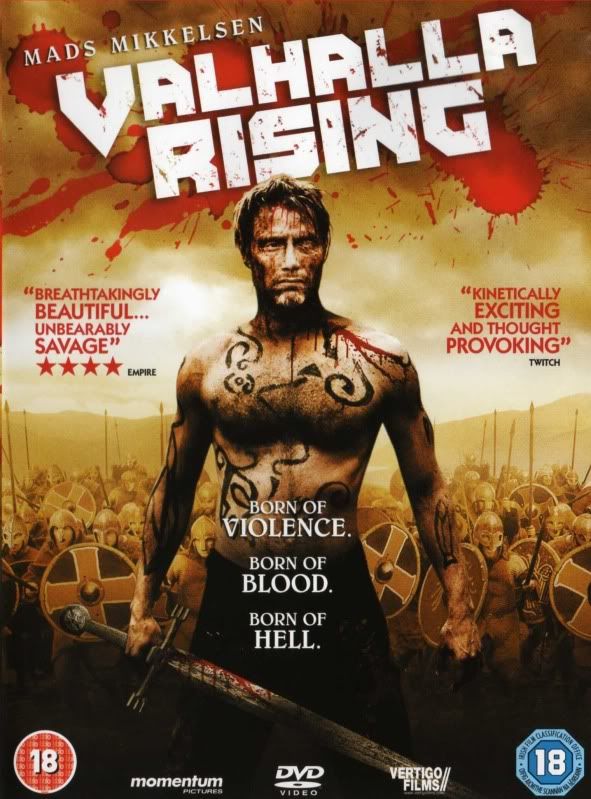
 'Valhalla Rising' Wikipedia page (2009 film)
Valhalla Rising is a 2009 English-language film directed by Nicolas Winding Refn, starring Mads Mikkelsen. The film takes place in 1000 AD and follows a Norse warrior named One-Eye and a boy as they travel with a band of Christian Crusaders in pursuit of a Crusade. Instead, they find themselves in an unknown and unfamiliar land. The film was shot entirely in Scotland. Title is derived from the combination of Kenneth Anger's 'Scorpio Rising' and 'Lucifer Rising' with a Viking-theme.
At the beginning of the movie, there is the following text:
IN THE BEGINNING THERE WAS
ONLY MAN AND NATURE
MEN CAME BEARING CROSSES
AND DROVE THE HEATHEN
TO THE FRINGES OF THE EARTH
This text suggests an Odinic theme. The "fringes of the Earth" meant Scandinavia. Recent Viking depictions on film look more Gaulish to me; maybe that's just how I perceive it. Anyway, according to Norse mythology, Odin sacrificed one of his eyes in order to gain the "Wisdom of the Ages." In addition, In a sacrifice to himself, the highest of the gods, he was hanged from the world tree Yggdrasil for nine days and nights, pierced by his own spear, in order to learn the wisdom that would give him power in the nine worlds (from the Odin Wikipedia page). The main character, One-Eye, was missing this left eye which is the same eye that Odin is depicted as missing. Also, at the beginning of the film, One-Eye is in chains or tied with rope. This suggests that One-Eye is an allegory for Odin; and he is consistently shown as having visions of future happenings.
Throughout the movie, a clear but subtle "Christian vs. Heathen" theme plays itself out. One Heathen early on says about Christians "They eat their own god, eat his flesh, drink his blood, abominable." The landscape of Scandinavia is shown to be very harsh, dark, misty, and foreboding. After achieving his freedom, he and his followers hook up with Norse Christian warriors who had just slaughtered a clan of Heathens. They are on their way to the Holy Land, Jerusalem, to fight for the Crusades. Although One-Eye does not speak, he seems to be a Heathen who slowly takes everyone to "Hell," which to me meant back to Heathen-style "evolutionary struggle."

According to the book 'Creed of Iron': The Aryan God Wotan is known to have sacrificed his left eye in the Well of Mimir to attain great knowledge, to split the veil of light into the knowledge of the infinite dark. This is all highly arcane and symbolic. The left eye represents the circular moon, the right eye, the circular sun. In the movie, One-Eye is so brutal and ruthless at times that I'm almost thinking that with his left eye gone (feminine energy), he is--symbolically-speaking--out of balance with only his right eye (masculine energy). Christianity, if you study it's Astrotheologic origins, is heavily "male energy," yet they are up against the Heathen One-Eye with perhaps the same energy unbalance.
.
Spoiler alert beyond this point!
.
.
.
 When they finally make it out of a long, dark, foggy abyss, they find themselves in fresh inland waters; amid a land of mountains, lakes, and forests. They now believe that they're in Jerusalem; and I can't help but think that One-Eye, the symbolic "Odin," has somehow lured them to this place to teach them once-and-for-all about real evolutionary struggle... Heathen style! One-Eye symbolically marks this place by stacking stones by the waters. The new land seems to have some strange affects upon all of them. The ruthless leader of this band of Christian Crusaders stabs his longtime friend when he feels that he has betrayed him by following One-Eye... then proclaims "Only men of faith deserve the riches of my new Jerusalem."
At the end, after facing off against the Christians, One-Eye sacrifices himself to a tribe of Mongol warriors in order to save the young boy who has served him throughout the movie. Now, could that be symbolic of a "Christ-like figure?" Finally, there appears to be symbolism of One-Eye moving on to Valhalla. I found it interesting to try to pick up on the movie's symbolism; then later read narrative of the "five parts" or acts of the film to see how close I was or wasn't.
3-4-14 Addition: It has come to my attention that they had sailed--not eastward--but westward to North America. So then the final part of the movie was probably somewhere in what is today Canada, and the Mongol warriors were actually Amerindians.
.