Showing posts with label Austria. Show all posts

Sunday, October 2, 2022

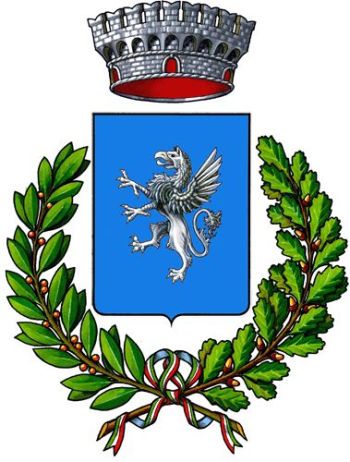
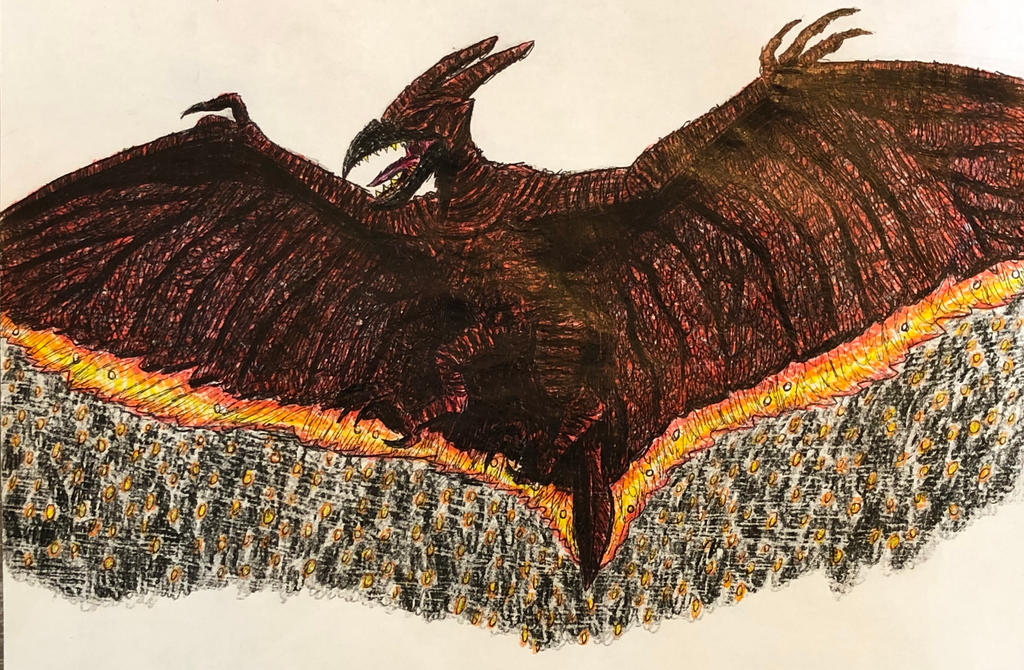
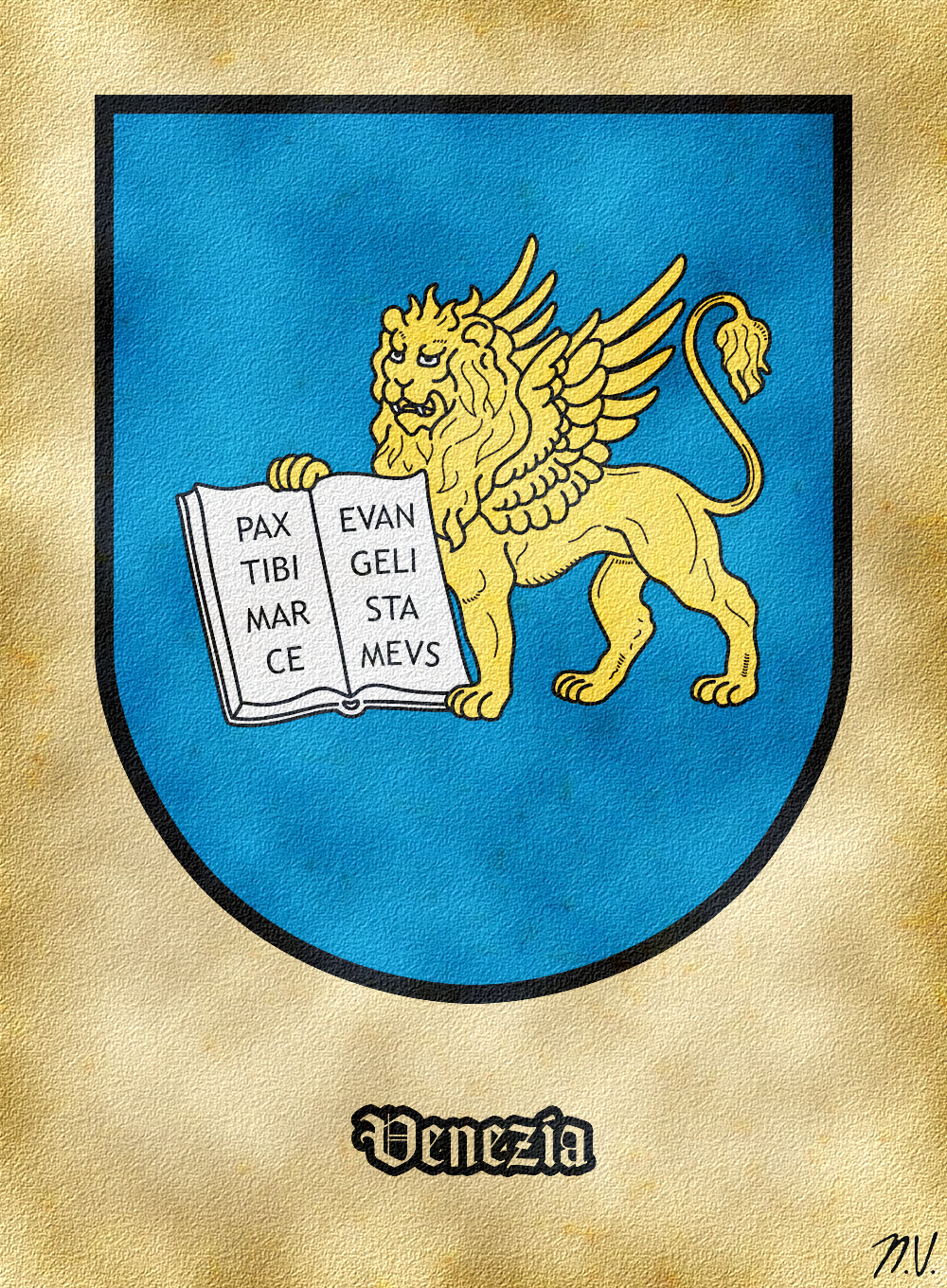
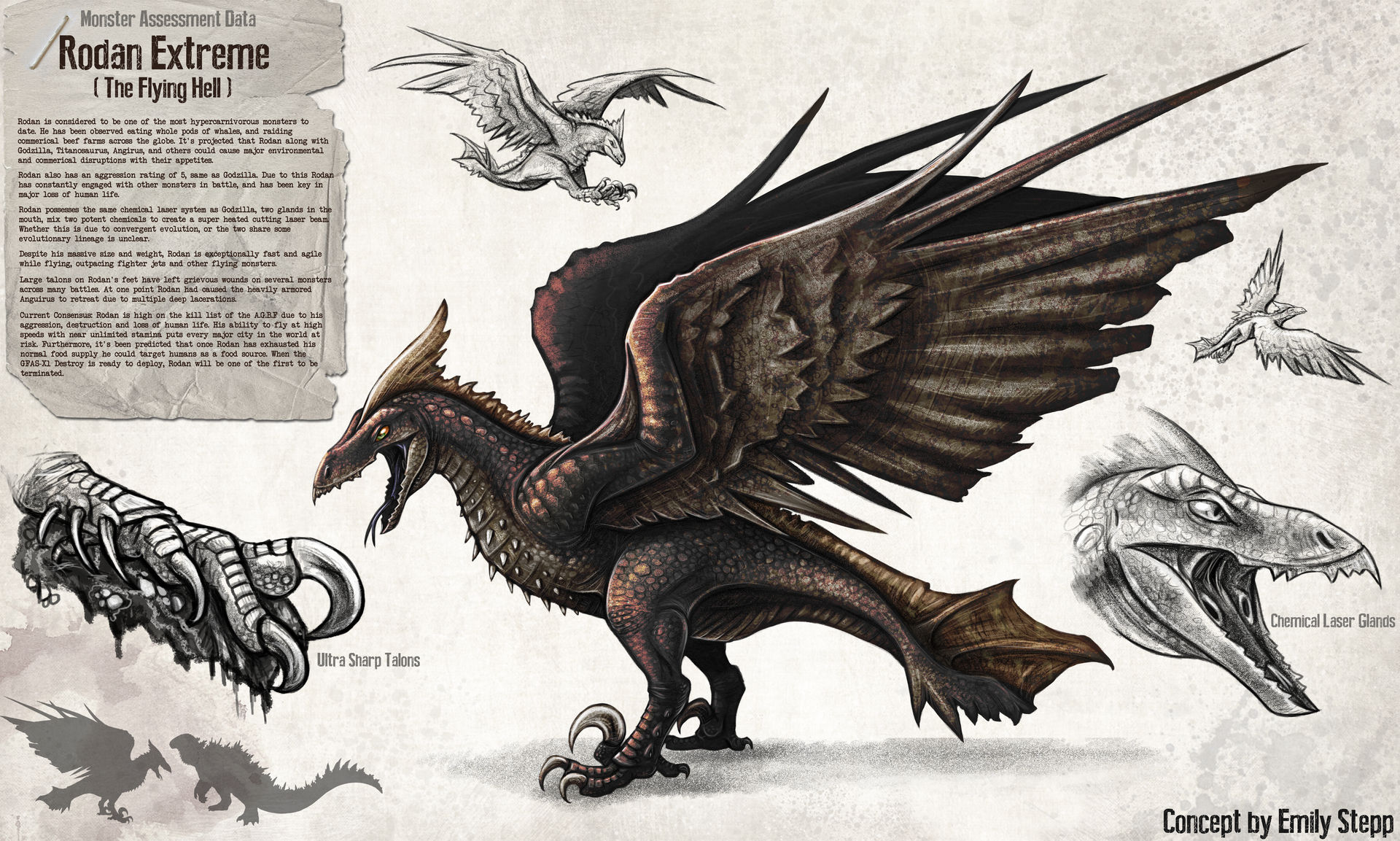
Are lions and eagles on hearaldry, actually dragons?


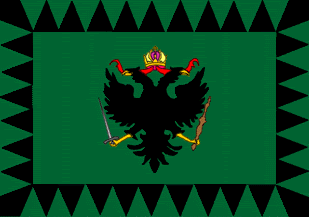
Double-headed Lombardo-Venetian eagle, apparently of Masonic origin


*************************


Arms of Sirmione in the

province of Brescia


*************************


Eagle on past German flag


*************************


Brescian lion


*************************


Venetian lion


*************************


Above: South Tyrolian eagle.... Below: "Rodan" of Japanese movie fame


*************************


Classic German eagle


.

Saturday, June 29, 2019

Guido von List: Part 32 - The Minnesinger Order


Did the Wotanists go underground after the reign of Charlemagne?

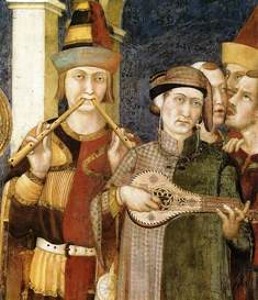
Guido von List sited something called the Minnesinger Order as having sprang from the Skaldic Order, a Wotanic priesthood gone underground....

Out of the "Skaldic Order" the "Minnesinger Order" later emerged, as did the "German Builders' Guild" and the "German Heraldic Guild." From all this, in broad branchings, sprang the judicial sciences, poetic arts, linguistic sciences, graphic arts, etc. Because the skalds, as poets and singers, were also the maintainers and formulators of language--and because it was neccessary for them to preserve in strict secrecy the Wuotanism that they took with them underground into the "heimliche Acht" (in order not to be persecuted as heretics), they had to use the three-fold interpretation of words to have their messages delivered--even by messengers--without these or other noninitiates being able to understand the correct interpretation. Through steady skillful practice they reached such refinement in this double-edged type of poetry (called heimliche Acht or kala), that one and the same text could conceal two completely different messages, whose obvious sense (understood by everyone) would actually be secondary, while the concealed sense (kala) would contain the only real, secret message for the men of knowledge.

What is the Minnesinger Order?


************

What is a minnesinger?

A minnesinger is a secular musician from Germany. They flourished from the twelfth to the fourteenth century. They composed their lyrics in their native language, German.

Walther von der Vogelweide (c. 1170-1230) was most likely a knight from a German-speaking region of Europe, possibly Austria or Bohemia.

Walther von der Vogelweide


Neidhart von Reuenthal


German:
 

Aller êrst lebe ich mir werde
Sît mîn sündic ouge siht
Daz reine lant und ouch die erde
Der man sô vil êren giht
Mirst geschehen des ich ie bat
Ich bin komen an die stat
Da got mennischlichen trat

Schæniu lant rîch unde hêre
Waz ich der noch han gesehen
Sô bist duz ir aller êre
Waz ist wunders hie geschehen!
Daz ein magt ein kint gebar
Here ubr aller engel schar
Waz daz niht ein wunder gar?

Daz in dô des niht verdrôz
Dast ein wunder alze grôz
Aller wunder übergnôz


English:
 

My life only now has a deeper meaning
These sinful eyes have gazed
Upon his holy ground
The land so greatly praised and deeply cherished
I now experience what I have long since prayed for
I have arrived where God, as man
Has walked among us

Many countries, mighty, rich and splendid
Have I seen
You shine above them all
So many wonderous things have happened here!
That a maiden has born a child
Lord of all the hosts of angels
Is that not a miracle?

We need not despair
For this mighty miracle
Is grander still than before.
 

Neidhart 


************


If they were secular, why the references to "God?" In any case, the examples above and below are actual music from the Minnesingers of the Middle Ages.


************


Minnesingers, Wagner, and Metal [Updated]

September 25, 2009 by Mark Samples

As Taruskin recounts (I, 134-142), Richard Wagner recognized the potential in the stories of the historical minnesinger/meistersinger (German-speaking analogue of the trovères) and appropriated their caché for his operas Die meistersinger von Nürnberg and Tannhäuser. But Wagner is not the only one to cash in on this potential. In a 21st-century example, In Extremo (a German medieval metal band) performs the popular minnesang “Palästinalied”, by Walther von der Vogelweide. The band is true to Walther’s melody and lyrics, in the original Middle High German (they get to three out of the twelve verses, then repeat the first). As you will see in the video below, they are also true to Wagner’s spirit of artistic liberty through a modern lens, complete with a shredding metal electric guitar solo, tatooed bagpipe players, and pyrotechnic explosions. And guess what? The audience loves it.

[Update:]

I put this video up kind of on a whim, because I was surprised by the ability for music that’s almost a millennium old to be relevant in the 21st century, and this video was so zany that I was simply flabbergasted by the find. But I have since become aware that it is potentially offensive to viewers, due to the song’s subject matter (the crusades), and the context of performance (Germans singing in a creepy—goth? occult?—way about the Holy Lands). Let’s just say that I wouldn’t let my son watch this video. It would be sure to give him nightmares. (He’s only 4 months old, but still.)


One Response

What is it about Wagnerian pomp, Germanic mythology, and the Medieval Age that appeals so much to metal musicians? There’s an interesting symbolic/semiotic connection there that would be fun to explore. (I just heard about another related subgenre, “Tolkien Metal,” that is of course centered around another Ring.) But for a metal band to actually perform from the minnesang repertory? That’s taking the connection to a whole new level of realism. Great find!

This reminds me of a farcical metal project I was involved in while at NYU. We performed 19th century German opera and lieder with electric guitar, bass, drums, keys, and two opera singers. The name of the group was “Take Me To Your Lieder.”

-- Zach Wallmark


************


Selected references to the Minnesingers can be found at the following link....

'What We Hear In Music' (Anne Shaw Faulkner; 1913)


************


German Minnesingers

Like in many other European cultures German poetry and music were derived from medieval ages of single performers whose life has enriched the pool of national legends and myths: it is not doubt that everyone has heard about minstrels and minnesingers who inspired their audience with romantic world of never-ending love and devotion, patriotism and dignity.


German medieval singers were mostly poetizing love, therefore, their name ‘minnesingers’ was derived from the word ‘minne’ translated as ‘love’. Minnesingers were mainly knights of medieval Germany , however, they did not belong to the high nobility. The most popular topic of their lyrics was unequal love between a knight and a lady who belonged to the higher social grade. Of course, the knight’s love seemed very unhappy and made lyric songs more romantic and attractive.

Among famous minnesingers the most significant recognition was given to those who influenced further development of the German poetry and music. Such minnesingers developed lyric verses and rhymes up to appearance of sonnet prosody in 15 th -16 th centuries. One of such names belonged to Wolfram von Eschenbach who created the German original minne songs called Spruch. Eschenbach was classical German minstrel who roved throughout the country and poetized love and legendary brave knights and kings of Germany. Later his songs inspired many German musicians to create original German music famous all over the world. Such of these songs was a fable about Parsifal, the fable which gave the breath of the Wagner’s outstanding opera.

The value of the German medieval minnesingers cannot been lessened. They started original minstrels’ Spruch songs which reflected German folklore, fairy tales, legends, myths and real historical events existed in Germany from ancient world. They developed modern poetry and music and remained German origin in people’s hearts and souls.

Nowadays minnesingers’ epoch can be traced by visitors of numerous German medieval castles which were places of minstrels’ contests. The knights who became minnesingers and then started roving around Germany as minstrels were amusing castles’ inhabitants. Usually these inhabitants belonged to upper levels of German society and German kings such as Ludwig II were inspired by minstrels to remain royal dignity and remember the times when German nation was free and proud of its origin.


************ 


The Minnesingers (Medieval-Spell.com)

They had a rare gift and thorough knowledge of their art. With perfect spontaneity they created poems with musical accompaniment subjected to strict rules in terms of number of strophes. The ability with which the Minnesinger utilized all possibilities of rhyme is perfectly amazing.


************


The Minnesingers were certainly in a position to do what von List said that they did. They were secular which would seem to be strange for the time, they demonstrated a certain musical genius, and they were mainly inspired by German legends and folklore.


************


.

Sunday, July 27, 2014

Badalisc: Camunian folklore - Part III


Pre-Christian Alpine traditions

The central and eastern Alps of Europe are rich in folklore traditions dating back to Pagan (pre-Christian) times, with surviving elements amalgamated from Germanic, Gaulish (Gallo-Roman), Slavic (Carantanian) and Raetian culture.


Survival through the ages

Ancient customs survived in the rural parts of Austria, Switzerland, Bavaria, Slovenia, western Croatia and Italy in the form of dance, art, processions, rituals and games. The high regional diversity results from the mutual isolation of Alpine communities. In the Alps, the relationship between the Roman Catholic Church and paganism has been an ambivalent one. While some customs survived only in the remote valleys inaccessible to the church's influence, other customs were actively assimilated over the centuries. In light of the dwindling rural population of the Alps, many customs have evolved into more modern interpretations.


Krampus

The word Krampus originates from the Old High German word for claw (Krampen). In the Alpine regions, the Krampus is a mythical horned figure represented as accompanying Saint Nicholas. Krampus acts as an anti–Saint Nicholas, who, instead of giving gifts to good children, gives warnings and punishments to the bad children. Traditionally, young men dress up as the Krampus in the first two weeks of December, particularly in the evening of December 5, and roam the streets frightening children and women with rusty chains and whips and bells. This figure is believed to originate from stories of house spirits such as kobolds or elves.


Perchten

Originally, the word Perchten (plural of Perchta) referred to the female masks representing the entourage of an ancient goddess, Frau Perchta, or Pehta Baba as it is known in Slovenia. Some claim a connection to the Nordic goddess Freyja, though this is uncertain. Traditionally, the masks were displayed in processions (Perchtenlauf) during the last week of December and first week of January, and particularly on 6 January. The costume consists of a brown wooden mask and brown or white sheep's skin. In recent times Krampus and Perchten have increasingly been displayed in a single event, leading to a loss of distinction of the two. Perchten are associated with midwinter and the embodiment of fate and the souls of the dead. The name originates from the Old High German word peraht ("brilliant" or "bright").

Regional variations of the name include Berigl, Berchtlmuada, Berchta, Pehta, Perhta-Baba, Zlobna Pehta, Bechtrababa, Sampa, Stampa, Lutzl, Zamperin, Pudelfrau, Zampermuatta and Rauweib. The Roman Catholic Church attempted to prohibit the sometimes rampant practise in the seventeenth and eighteenth centuries but later condoned it, resulting in a revival.


In the Pongau region of Austria large processions of Schönperchten ("beautiful Perchten") and Schiachperchten ("ugly Perchten") are held every winter. Other regional variations include the Tresterer in the Austrian Pinzgau region, the stilt dancers in the town of Unken, the Schnabelpercht ("trunked Percht") in the Unterinntal region and the Glöcklerlaufen ("bell-running") in the Salzkammergut. A number of large ski-resorts have turned the tradition into a tourist attraction drawing large crowds every winter.

Sometimes, der Teufel is viewed to be the most schiach ("ugly") Percht (masculine singular of Perchten) and Frau Perchta to be the most schön ("beautiful") Perchtin (female singular of Perchten).


Badalisc


The Badalisc is a "good" mythological animal who lives in the woods of Andrista, in Val Camonica, Italy. During an annual town festival someone dresses up as the creature and is "captured" and brought to the town. The animal is made to tell the people of the town gossip. At the end of the festival the creature is released until the next year's ceremony.


.

Friday, May 9, 2014

The Almother, Carnuntum, and "Pagan's Gate": The ancient cultural and spiritual overlap between the "two Austrias" and the north Balkans

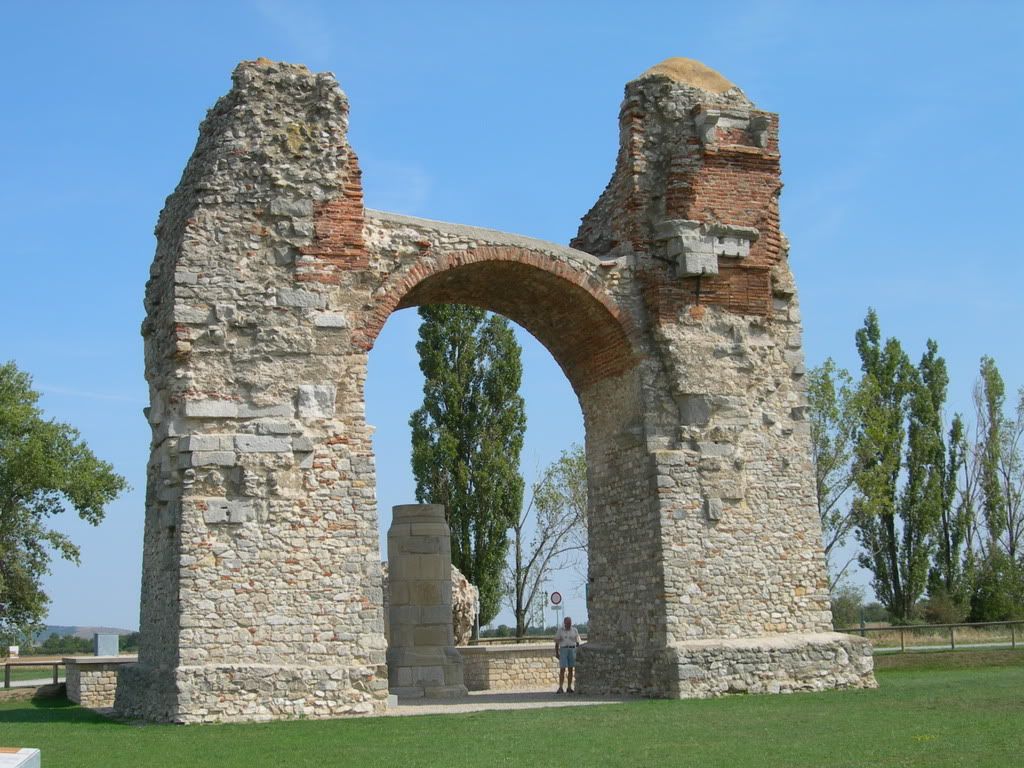
Heidentor aka "Pagan's Gate"


From an overall historical point of view, the Austrians could seem more like an old rival than a kindred people. The region of the eastern Alps and north of the Adriatic Sea has long been a tri-cross-cultural area between the Italo-Roman speaking world, the German-speaking world, and the Slavic-speaking world. For example, some parts of the north Balkans are more culturally and politically tied to Russia than to nearby Austria or the Veneto; in most ways, the tri-Veneto area has more in common with Rome than to St. Moritz; and in general, Austrians would tend to see themselves as being more ethnically tied to Scandinavia than to the nearby Venetians or Slovenes.

By the "two Austrias" I mean the original, and actually proper term "Austria," state within the old Langbard Kingdom... which was approximately the northeast Italian peninsula between Lombardy and the tri-Veneto area. Much later, the term "Austria" was clumsily resurrected as the English-language nickname for Österreich... or the Austria we know today.

Five thousand years ago, there would have been no difference at all between peoples of this region. They would have all been proto-European. The early stream of Teutonic migration formed the loosely defined Celtic culture, which later overran the general Lombardo-Venetian area. Still, approximately three thousand years ago, there was little difference. I'm guessing that this would have also included the north Balkans as well. Without going into the entire history of it.... a later "final push" of Teutonic tribes burst into Switzerland, Austria, Bavaria, Hungary, Bohemia, etc.... an equally intense migratory push of Slavic tribes moved into the Balkans... and--of course--the march of the Roman Empire overtook generally all of what is now "Italy."


The Roman province of "Raetia" was north of the Alps, even though the original "Raetians" were an ancient people who lived in a much larger area at one time. Although a clear lingo-ethnic divide was established between the three, each clearly influenced the other two. For example, in the Middle Ages when parts of the Friul were decimated by plagues, Slavic people were invited in to repopulate, and there is a clear Slavic influence in the Friulian dialect. Also in the Middle Ages, Cimbrians from Bavaria migrated into the Veneto, and many Cimbrian villages were still very linguistically and culturally distinct until the Fascist era. That particular brand of nationalism actually destroyed regional culture. One modern Camunian surname is "Mitterpergher," which is probably of Cimbrian origin, meaning "a person from the middle of the mountain"... and with the old-Bavarian spelling for "mountain person".... "pergher" rather than "berger."

During the Roman era, the Romans did most of the pushing, while the Germanic tribes took over that role in the early Middle Ages. Of course, the ancient territorial struggle between Germans and Slavs occurred over a very long time. In the first century, the Romans established a military base on the Danube River, in what is now Austria, called Carnuntum. This camp served as a trading center, as well as a political headquarters for further Roman expansion. This particular Celtic kingdom was called Noricum. Interestingly, in typical passive-aggressive Roman political style, they used a regional Celtic name.. which was apparently "Karnuntum" originally. I'm not absolutely certain, but it appears that a migration of northern Teutons--separate from the regional Celts--later invaded and destroyed Carnuntum.

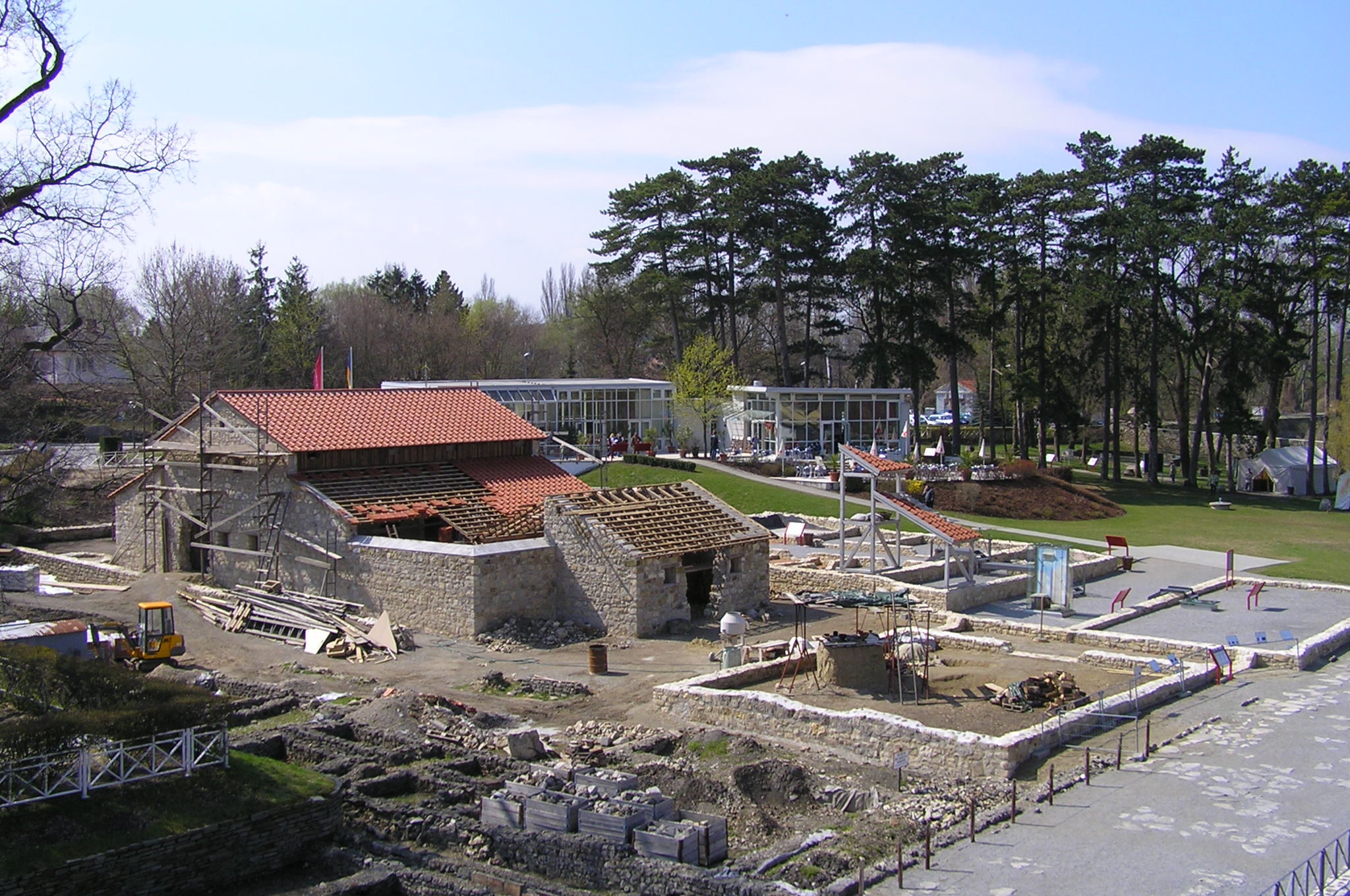
The Teutonic destruction of this Roman expansion was glorified in Guido von List's late 19th century book 'Carnuntum'. This book has not been translated into English to my knowledge, so I can't vouch for it in any way... although I would like to read it. For some reason, List was fascinated by what is apparently the leftover opening gate to Carnuntum... after the invading Teutons demolished the walls, or perhaps this occurred over a longer period. That leftover ruin is now called "Heidentor," or evidently "Pagan's Gate" in German. Ironically, "Pagan's Gate" could be seen as a monument to both the Romans and the Germans. To List, I think it represented a regional Austrian symbol of the glory of past victory. Also, there were many old legends surrounding the ruin. In List's day, historians and archeologists didn't know anything about ancient German-Celts. It actually got it's name in the Middle Ages because it was once thought to have been constructed by ancient pagans. Austria is now reconstructing Carnuntum if you would like to look that up.


Flag of Lombardy-Venetia
Venus of Willendorf is a 27,000 to 32,000 year old artifact discovered in Austria. This little statue was carved from limestone not native to the area, and I believe was part of a much larger proto-European archetypical symbol of the "mother goddess." Also significant is its age, which would make it a counterpart to the "horned god." Because there are so many regional names for this goddess, which I think are linked back to the last glacial movement, I refer to her as "the Almother"... the proto-European equivalent to "the Alfather" Odin within old Teutonic culture. Among other things, the Almother was a fertility goddess in those early days. As strange as this may sound, there is ample evidence that the Roman goddess Diana of the Carnuntum era, and Venus of Willendorf, have a common origin going back to the last Ice Age. The Almother in the Italian peninsula, of course, going through many more manifestations over time. However, when half of Europe was covered under a massive continental ice sheet, the local manifestations of the mother goddess and the horned god would have been very likely of the same origin.

As far as the later colonial aggression of the Habsburgs... I mean lets face it, this was basically a soft dictatorship in which the average citizen of Austria-Hungary was not really responsible for national/monarchial policy anymore than a Roman citizen was responsible for Roman imperialism. The Austrian soldiers stationed in Lombardy-Venetia could, at times, be brutal... but probably not any more brutal than other occupations. It could be said with certainty that during pre-Roman times---which would have been pre-Teutonic and pre-Slavic times as well---this tri-cultural region would have been largely of the same people. Nobody there spoke Italian, German, or Slavic back then. Three very aggressive peoples came later and staked their territorial claim, and consequently the past etho-cultural dynamic was forgotten.

.

Tuesday, May 8, 2012

Guido von List: Part 15


Goddess Iduna

One curious item, which I had skipped earlier while writing this series, was the mention of the Norse Goddess Iðunn.

Excerpt from page 6 of 'The Secret of the Runes' (from Flowers' bio section):

List became involved with two important literary associations during these years. In May 1891, the Iduna, bearing the descriptive subtitle "Free German Society for Literature," was founded by a circle of writers around Fritz Lemmermayer. Lemmermayer acted as a sort of "middle man" between an older generation of authors (which included Fercher von Steinwand, Joseph Tandler, Auguste Hyrtl, Ludwig von Mertens, and Josephine von Knorr) and a group of younger writers and thinkers (which included Rudolf Steiner, Marie Eugenie delle Grazie, and Karl Maria Heidt). The name Iduna, which was provided by List himself, is that of a North Germanic goddess of eternal youth and renewal.

Idun, Iduna, or Idunna, are variations of Iðunn. Actually, this literary society was short lived; only lasting about two years due to philosophical differences. Despite that, it was thought to have been part of the beginnings of the Neo-Germanic movement. In 'The Secret of the Runes', the Wotanist spiritual concept of "Life, Death, and Rebirth" is frequently mentioned. It's not surprising that List selected Iduna for a name, since she symbolized that concept.


Lower Austria

List was born and raised in Vienna, so I found myself occasionally lost when the geographical term "Lower Austria" was brought up time and time again in regards to him. Actually, Lower Austria is located in the northeast corner of Austria, east of "Upper Austria." Actually, the northernmost part of Lower Austria is farther north than the northernmost part of Upper Austria. However, this is where he was from, and it seems pretty clear to me that he was very close to it in every way.


Wotanism to Christianity

List held a romantic vision of what Germanic-Wotanist life was like during pre-Roman/Christian times. He described in detail how society was organized. It's detailed enough that one would need to buy the book to really appreciate it. Suffice to say, he believed-and I think clearly proved--that the "skaldic class," or the Wotanist spiritual leaders, developed a complex system "to veil Wotanist culture within Christianity" when conversion was considered unavoidable. This included a very complex system of double-meanings of words, symbols, architecture, and aspects of everyday life. I can't do it justice here.

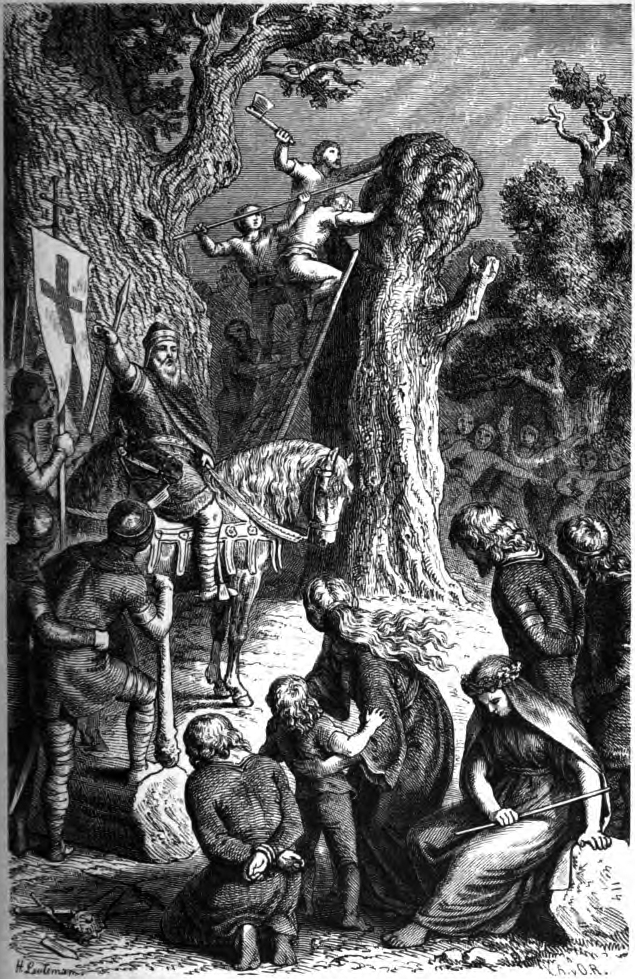
"The destruction of Irminsul by Charlemagne"
As to whether or not they performed this out of spite, or merely to protect their spirituality and culture, I don't know. I tend to lean towards the latter, although the period of religious conversion was bloody. The Gaelic people made the conversion fairly easily, and they performed basically the same type of religious cultural blending. The Wotanists didn't "blend" as much as they "disguised." West Africans, living under slavery in Latin America, were able to hide their tribal spiritual traditions within Catholic religious rites; and they were able to propagate these traditions generation after generation.

As we covered in earlier segments, there is no conflict between Wotanism and science, as there is in other religions. Excerpt from pages 76 and 77: Because the skalds, as the scientists, maintained language, art, and science, they were also primarily concerned with scientifically directing the transition from Wuotanism to Christianity, and to prepare the way for a peaceful blending of the two religions.

Now, according to List, this was the plan prior to Charlemagne's bloody rein. A Frankish King and Catholic supremacist, he was extremely aggressive in his approach to "Christianization." More than merely inform villagers that they must convert, he would destroy and burn down irminsuls, holy sites, and other religious structures, torture and hang people, etc. Even the earlier Romans had used a soft approach when it came to forced religious conversion of subjugated peoples.

The skalds apparently were not explicitly secretive in their "blending" preparations before Charlemagne. However, now they had to do something quickly. I will cover that in the next segment.


WOW

Just this morning, I was listening to an online audio interview with a man whom I respected who happens to be a born-again-Christian. Now, he is a minister/researcher, and his faith is totally above-board and fully understood to the general public, myself included. I don't feel comfortable revealing his name right now. However, I overheard him smugly make statements; such as "Yule " being a "Satanic holy day" and the like.

Even if you're a Christian, or Athiest, or whatever; it's worth pondering that some of our Camun ancestors, only a few centuries ago, were slain in their own land via "this type of thinking." I'm not saying that every Christian minister believes as he does. Chuck Missler, for example, is very open-minded and knowledgeable about a whole host of subjects. In other words... not everything non-Christian is "the Devil."

.

Saturday, September 5, 2009

The Lost Connection: California Ticinese and the Trentinese Resistance

One historical period, which literally ties many of us together on both sides of the ocean, was the Austrian occupation of the northeast Italian peninsula. This occupation did not end in 1860, but continued on in the Trentino through World War I. The Lombardian resistance, and later the Trentinese resistance, hid out in Ticino. It was naturally an ideal location for many reasons. First, it was the same culture and even the same Lombard dialect. Also, when you view history, "nobody messes with the bank." Nobody interferes with Switzerland, as history shows us. Not Napoleon, not the Hapsburgs, not the National Socialists, nobody.

In response, the Austrian army blockaded the southern borders of Ticino. This cut off many people from employment, supplies, trade, produce, etc. Back then, it was just heavy Alpine mountains to the north. No express trains. I don't know how long or how many times this blockade may have been in place between 1850 and 1930, the years of Ticinese emigration. It must have been a long time since the resistance movements were operating between 1848 and 1918.

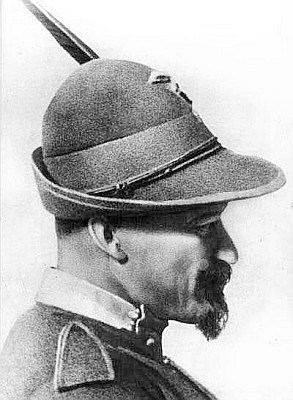
[Above: Cesare Battisti, probably the most important figure of the Trentinese resistance]

This time period, although socially and politically long past, is only a blip on the historical scale. Some of us were alive when Cesare Battisti was hanged in Trento in 1916. For a few of us, our grandparents may have been alive during the Cinque Giornate Revolt in Milano in 1848. It's even possible that they were even living in those cities and witnessed it. The Trentinese, the Lombardians, the Venetians, and the Ticinese, are all one people at the end of the day. The following in an article from May, from the 'Sonoma Valley Sun' newspaper, which ties into this subject.


Swiss in Sonoma

George McKale - 'Sonoma Valley Sun' - May 22, 2009

There are two kinds of assumptions. In science, a theory is an assumption, and it is the basis for how one interprets data collected during a scientific study. With this kind of assumption, it is necessary to explicitly describe and declare the underlying assumption (theory) for the investigation. The other assumption is a proposition that is taken for granted, as if it were true without preponderance of the facts. It is this type of assumption one looks to avoid. In last weeks segment I made the second type of assumption stating that Fernando Nichelini was Italian, when in fact, as Walt Picchi, Nichelini’s great nephew has pointed out, he is Swiss. According to Picchi, Nichelini was extremely proud of his Swiss heritage. In restitution, I dedicate this segment to Florindo’s homeland.

Florindo’s father, Francisco, immigrated from Verscio, Switzerland, located in the Italian-speaking Canton Ticino, in 1870. The Swiss nation is a confederation of 26 states called cantons. Francisco settled just north of Sonoma at what is now the Moon Mountain Christmas Tree Farm. Once established, his son Florindo arrived in Sonoma County in 1880 at the age of twelve. The rugged Moon Mountain property reminded Francisco of his homeland. A deed dated September 4, 1920 indicates that the Nichelinis sold the Moon Mountain property in 1920. Two other deeds dating to 1906 and 1908 show Florindo purchasing land from both Joshua and Henry Chauvet in Glen Ellen. In the early 19th century, Switzerland was troubled with political and economic turmoil. Just to the south of Ticino was Italy, and Northern Italian nationalists operated out of Switzerland in their war for independence from Austria. Austria reacted by blocking the Italian-Swiss border, which curtailed commerce between the two nations. Ticinesi families residing in both Switzerland and Italy were no longer able to support their families, and many made the difficult decision to leave their homeland for the United States.

In the first half of the nineteenth century large numbers of Swiss settled in the mid-West. The gold rush brought thousands of Swiss immigrants to California. One of California’s most notable Swiss immigrants was Johann August Sutter (John Sutter), who founded Sutter’s Fort. He referred to the fort as Nueva Helvetia, meaning New Switzerland. Migration out of Ticino and into California began in earnest by the mid-nineteenth century. Of all Swiss immigrants to California, the greatest number came from Ticino. Between 1820 and 1930, 290,000 Swiss migrated to California.

Many of the Ticinesi rebuilt their family life known back in the old country. In northern California, Ticinesi settled on ranches in the Salinas Valley, West Marin, and throughout Sonoma County, forming full-scale colonies. Ticinesi women often married Ticinesi men. Prior to 1869, Swiss immigrants to California had to make a long and grueling journey by boat around the southern tip of South America. With the transcontinental railroad completed in 1869, it took around ten days to travel from the East Coast to the West. This also enabled Swiss immigrants to return for extended visits to the home land, with a ten-day trip by train and a three-week trip across the Atlantic by boat.

The Swiss immigrants did very well in California and were exceptional vintners and ranchers. They were able to send or bring money back to the home land, building larger houses and spurring the economy. In one Ticinesi town, they built a new cemetery with large stone monuments dedicated for those who had returned from California. Ira Cross in his 1927 “History of Banking in California” states, “Among the people of foreign nations who have settled in this country, none have been more worthy of success than those from Switzerland … They possess to a marked degree the innate qualities that go to make a people great in the truest sense.” Picchi stated that Florindo was still climbing windmills well into his eighties. A picture of Florindo at Nichelini’s Hardware on First Street West can be seen hanging at one of our local bars and eatery. Where? None other than the Swiss Hotel. Go have a drink and peruse the wonderful collection of old Sonoma photographs hanging on the walls.

**************************************************

This article has the quote that I had been looking for, which I had lost, regarding predominently the Ticinese immigrants. I suppose it reflected also the German-Swiss in California as well, whose history is also remarkable. The 290,000 number for immigrants from Ticino sounded very high. If that's true, then it changes my perception of their significance. Lastly, the Ticinse and the culture of southernmost part of the Graubünden canton (Grigioni) are Lombardian, as they speak the Lombard dialect.