Showing posts with label Wotanism. Show all posts

Saturday, June 29, 2019

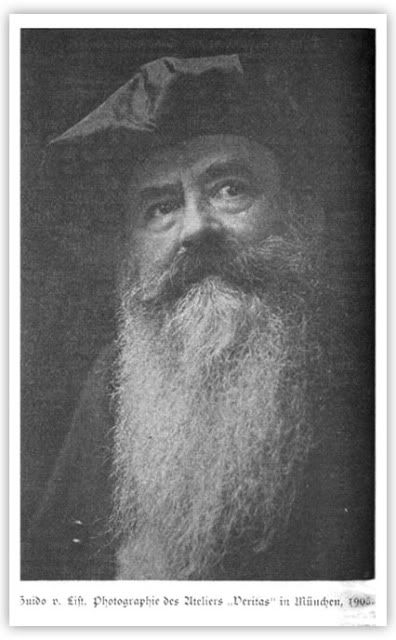
Guido von List: Part 32 - The Minnesinger Order


Did the Wotanists go underground after the reign of Charlemagne?

Guido von List sited something called the Minnesinger Order as having sprang from the Skaldic Order, a Wotanic priesthood gone underground....

Out of the "Skaldic Order" the "Minnesinger Order" later emerged, as did the "German Builders' Guild" and the "German Heraldic Guild." From all this, in broad branchings, sprang the judicial sciences, poetic arts, linguistic sciences, graphic arts, etc. Because the skalds, as poets and singers, were also the maintainers and formulators of language--and because it was neccessary for them to preserve in strict secrecy the Wuotanism that they took with them underground into the "heimliche Acht" (in order not to be persecuted as heretics), they had to use the three-fold interpretation of words to have their messages delivered--even by messengers--without these or other noninitiates being able to understand the correct interpretation. Through steady skillful practice they reached such refinement in this double-edged type of poetry (called heimliche Acht or kala), that one and the same text could conceal two completely different messages, whose obvious sense (understood by everyone) would actually be secondary, while the concealed sense (kala) would contain the only real, secret message for the men of knowledge.

What is the Minnesinger Order?


************

What is a minnesinger?

A minnesinger is a secular musician from Germany. They flourished from the twelfth to the fourteenth century. They composed their lyrics in their native language, German.

Walther von der Vogelweide (c. 1170-1230) was most likely a knight from a German-speaking region of Europe, possibly Austria or Bohemia.

Walther von der Vogelweide


Neidhart von Reuenthal


German:
 

Aller êrst lebe ich mir werde
Sît mîn sündic ouge siht
Daz reine lant und ouch die erde
Der man sô vil êren giht
Mirst geschehen des ich ie bat
Ich bin komen an die stat
Da got mennischlichen trat

Schæniu lant rîch unde hêre
Waz ich der noch han gesehen
Sô bist duz ir aller êre
Waz ist wunders hie geschehen!
Daz ein magt ein kint gebar
Here ubr aller engel schar
Waz daz niht ein wunder gar?

Daz in dô des niht verdrôz
Dast ein wunder alze grôz
Aller wunder übergnôz


English:
 

My life only now has a deeper meaning
These sinful eyes have gazed
Upon his holy ground
The land so greatly praised and deeply cherished
I now experience what I have long since prayed for
I have arrived where God, as man
Has walked among us

Many countries, mighty, rich and splendid
Have I seen
You shine above them all
So many wonderous things have happened here!
That a maiden has born a child
Lord of all the hosts of angels
Is that not a miracle?

We need not despair
For this mighty miracle
Is grander still than before.
 

Neidhart 


************


If they were secular, why the references to "God?" In any case, the examples above and below are actual music from the Minnesingers of the Middle Ages.


************


Minnesingers, Wagner, and Metal [Updated]

September 25, 2009 by Mark Samples

As Taruskin recounts (I, 134-142), Richard Wagner recognized the potential in the stories of the historical minnesinger/meistersinger (German-speaking analogue of the trovères) and appropriated their caché for his operas Die meistersinger von Nürnberg and Tannhäuser. But Wagner is not the only one to cash in on this potential. In a 21st-century example, In Extremo (a German medieval metal band) performs the popular minnesang “Palästinalied”, by Walther von der Vogelweide. The band is true to Walther’s melody and lyrics, in the original Middle High German (they get to three out of the twelve verses, then repeat the first). As you will see in the video below, they are also true to Wagner’s spirit of artistic liberty through a modern lens, complete with a shredding metal electric guitar solo, tatooed bagpipe players, and pyrotechnic explosions. And guess what? The audience loves it.

[Update:]

I put this video up kind of on a whim, because I was surprised by the ability for music that’s almost a millennium old to be relevant in the 21st century, and this video was so zany that I was simply flabbergasted by the find. But I have since become aware that it is potentially offensive to viewers, due to the song’s subject matter (the crusades), and the context of performance (Germans singing in a creepy—goth? occult?—way about the Holy Lands). Let’s just say that I wouldn’t let my son watch this video. It would be sure to give him nightmares. (He’s only 4 months old, but still.)


One Response

What is it about Wagnerian pomp, Germanic mythology, and the Medieval Age that appeals so much to metal musicians? There’s an interesting symbolic/semiotic connection there that would be fun to explore. (I just heard about another related subgenre, “Tolkien Metal,” that is of course centered around another Ring.) But for a metal band to actually perform from the minnesang repertory? That’s taking the connection to a whole new level of realism. Great find!

This reminds me of a farcical metal project I was involved in while at NYU. We performed 19th century German opera and lieder with electric guitar, bass, drums, keys, and two opera singers. The name of the group was “Take Me To Your Lieder.”

-- Zach Wallmark


************


Selected references to the Minnesingers can be found at the following link....

'What We Hear In Music' (Anne Shaw Faulkner; 1913)


************
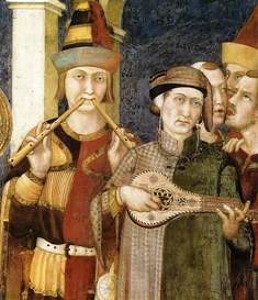

German Minnesingers

Like in many other European cultures German poetry and music were derived from medieval ages of single performers whose life has enriched the pool of national legends and myths: it is not doubt that everyone has heard about minstrels and minnesingers who inspired their audience with romantic world of never-ending love and devotion, patriotism and dignity.


German medieval singers were mostly poetizing love, therefore, their name ‘minnesingers’ was derived from the word ‘minne’ translated as ‘love’. Minnesingers were mainly knights of medieval Germany , however, they did not belong to the high nobility. The most popular topic of their lyrics was unequal love between a knight and a lady who belonged to the higher social grade. Of course, the knight’s love seemed very unhappy and made lyric songs more romantic and attractive.

Among famous minnesingers the most significant recognition was given to those who influenced further development of the German poetry and music. Such minnesingers developed lyric verses and rhymes up to appearance of sonnet prosody in 15 th -16 th centuries. One of such names belonged to Wolfram von Eschenbach who created the German original minne songs called Spruch. Eschenbach was classical German minstrel who roved throughout the country and poetized love and legendary brave knights and kings of Germany. Later his songs inspired many German musicians to create original German music famous all over the world. Such of these songs was a fable about Parsifal, the fable which gave the breath of the Wagner’s outstanding opera.

The value of the German medieval minnesingers cannot been lessened. They started original minstrels’ Spruch songs which reflected German folklore, fairy tales, legends, myths and real historical events existed in Germany from ancient world. They developed modern poetry and music and remained German origin in people’s hearts and souls.

Nowadays minnesingers’ epoch can be traced by visitors of numerous German medieval castles which were places of minstrels’ contests. The knights who became minnesingers and then started roving around Germany as minstrels were amusing castles’ inhabitants. Usually these inhabitants belonged to upper levels of German society and German kings such as Ludwig II were inspired by minstrels to remain royal dignity and remember the times when German nation was free and proud of its origin.


************ 


The Minnesingers (Medieval-Spell.com)

They had a rare gift and thorough knowledge of their art. With perfect spontaneity they created poems with musical accompaniment subjected to strict rules in terms of number of strophes. The ability with which the Minnesinger utilized all possibilities of rhyme is perfectly amazing.


************


The Minnesingers were certainly in a position to do what von List said that they did. They were secular which would seem to be strange for the time, they demonstrated a certain musical genius, and they were mainly inspired by German legends and folklore.


************


.

Monday, February 9, 2015

Guido von List: Part 27 - A Wotanist hof in his honor


Ron McVan YouTube channel

McVans Mountain Viking Hof

An evening journey through a modern day Wotanist Viking Hof, built by Ron McVan among the wooded mountains of Northern Idaho.


**************************************************

This particular hof was constructed as a tribute in honor of Guido von List. Although not visible in this video, photographs which I have seen show this temple appearing very beautiful among the trees and mountains.

When List was a young boy, he visited some ruins I recall, and he proclaimed out loud.. something to the effect of "some day I will construct a temple to Wotan!" It's great that there is at least one temple in his honor.

A hof built in a particular persons honor is referred to by combining their first name with hof (ex. "Freyashof"); therefore I believe that this would be "Guidoshof."

I think it would it be great to see one constructed in the memory of Queen Gambara, King Rothari, or King Alboin of the Langobards. There couldn't be one for Queen Theodelinda, because she was Catholic, which shows that one must do their homework first. Also, perhaps something for a favorite direct ancestor?

**************************************************

2-11-15 Addition: I had intended to post a video titled 'Guido von List - The Runes' but at the end of the video there were too many National Socialist symbols. However, part of the video gave a touch of the spirit of List; who actually lived from 1848 to 1919, and obviously had no part in National Socialism... which was really "National Capitalism" after the Socialist element was taken out. Anyway, I just wanted to at least place the link here.

.

Saturday, November 24, 2012

Guido von List: Part 20


Vehmic Court: Part 1

First I should state that Runa-Raven Press has gone out of business, so I believe that I am no longer binded to the copyright of their translation of 'History of the Aryo-Germanic Folk'. They had one or two other List books translated into English, but I didn't get a chance to purchase them. I don't think the word really got out that they were translating some of his works other than 'Secret of the Runes', and works by other author-researcher-historians like him. I'm disappointed because a publishing company is power, media, or at least a voice. There are other publishing companies with a similar foundation I believe, so we'll have to be on the look out.

No, the above image was not put there in regards to the publishing company going under. I wanted to look at one of history's great ironies: "The Vehmic Court." As stated many times in earlier sections, at the time of the rise of Christianity and the systematic and violent destruction of anything non-Christian, secret meetings ("heimliche Acht") took place among the Heathen Skalds across the German countryside in order to decide what to do. It was decided first that they must form an underground Wotanic rite, and they formulated a complex esoteric system to be attached to every aspect of society.

This system was largely based on the German-Wotanic spiritual concept of the cycle of life: "1) Birth, 2) Life, and 3) Death and to a new arising"; therefore it's symbolism was three-fold: 1) Exoteric for the unknowing, 2) Esoteric for the initiated, and 3) Deeper Esoteric. Remember, they had to do this unless they were to disappear forever without a trace. This was a form of cultural-spiritual genocide they were facing. They were forced to be "Occultic," which simply means "hidden."

Although it would be a powerful symbol to imagine the Wotanic Skalds all meeting at one place, at one time, in some candle lit cellar at midnight; but it didn't happen that way. I would guess that they probably had all-day meetings deep in the forests and on high mountain locations, where they could stand and speak their minds, and that this took place over years. Imagine the great locations, dates, names, and speeches which we will probably never know a bit about. However, we can honor and redeem them by occasionally imagining them--for the final times as leaders of their culture--standing and speaking their ancient wisdom upon the great thrones of mountains, trees, suns, and skies. In that way, they will never die.

From pages 86 and 87 of 'The Secret of the Runes':

The five-angled star, the Vehme-star, the Truthenfuss (truh = turn, fuss = foot) is the hieroglyph of "revolving or turning generation," of "rebirth"--one of the most important articles of faith in the Aryan religion. In its exoteric interpretation this sign simply says: "return," and was therefore a favorite sign used at hostels and inns, in order to convey the meaning: "whoever is a guest here should come again."

And from pages 89 and 90:


In the administration of justice, too, the old Aryan tripartition is naturally found again as (1) arising or law (Rita), (2) the existing, ruling (justice), and (3) the passing away to renewed arising (the court). Because law and justice culminate in the decisive pronouncement of the court (and consequently, as the third level, this provided the final result) the holy sign of the court was the ruoth-cross, rod-cross, or rowel- (wheel) cross which was therefore also known as the Vehme cross, consisting of a fyrfos whose hooks were bent in the circular shape of a wheel rim. As the Vehme cross it appears engraved on the blade of the great Vehme-sword as an equilateral cross enclosed by a circle. At the cross point the letter "V" appears and furthermore in the quadrants between the arms and letters "S.S.G.G." were engraved. These letters probably displaced the formerly used runes [Fehu symbol] and [Sol and Gebo symbols] (doubled), which signified: "Vehme" and the old passwords: "Strick (string), "Stein" (stone), "Gras" (grass), "Grein" (branch?), i.e., "wyd" ("white") = law; "brick" = secret; "rage" = thunder = doing = ar = right-doing; greyen = to uphold; that is: "Through law and secrecy (heimliche Acht) right-doing is upheld." In abbreviated form this is: tue gege (two s's and two g's).

In the heimliche Acht or kala all this signifies "present in the hidden," which exoterically refers to the watchfulness of the Vehme, esoterically to the omniscience of God as the highest judge. For this reason the "ruoth-cross" was the symbol of the court, and it is for this reason that the crucifix on the bench of the modern judge should be seen--not as a symbol of religion--but rather as a substitute for the "ruoth-cross." Wherever the words "Rothenkreuz" (red-cross), "Rothenburg" (red-castle), or even "roth" (red), "Rad" (wheel), "Ratt" (rat), etc., occur in place names, there is where there was at one time "marked steads of the Vehme," as, for example, near Hochroderd in the Viennese Woods. All "red crosses" that stand in lonely forests were at one time Irminsuls or Roland-columns, i.e., "mark-columns," which designate such "marked steads,"* and all "red courts" were at one time the property of the Wise of the Vehme.

*E.g., The Red Court in the eighth parish in Vienna (at one time the town of Josephstadt).

It goes on in more finite details, but I will cut it off at this point as far as 'The Secret of the Runes' on this subject. I'm just focusing on one aspect of this occult Wotanic codex, but it's quite something to ponder that all of these things were deliberated and eventually decided upon by the Heathen Skalds in one final important and long-enduring action over a period of time. Remember, these wise men were not accustomed to "hiding." Their culture was THE culture of the German people prior to that. They didn't want to just forget the holy Wotanic spots--often the former locations of Irminsuls--and they marked them in one form or another with probably the full intent that their ancestors would someday redeem them. This all sounds like a script out of some fantasy move.. only it's real!

.

Wednesday, October 19, 2011

Guido von List: Part 10

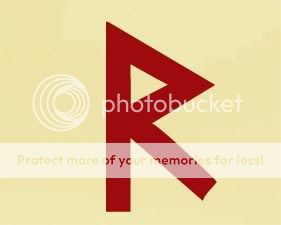
The Raido rune

I wasn't going to look at another one of von List's runes here, but perhaps just one more. The numerous names that he used for it did not include "raido," so I actually had to look it up since I'm not especially familiar with the rune names other than a few. Naturally I was familiar with this runic symbol itself.

This post could have some material that some would put in the category of what I would call "guilt by association." All I can say is that I see this as partly a spiritual endeavor. By that, I mean earth-based religion(s). I see a lot of beautiful and powerful ancient symbolism in particularly Alpine Gaulish, Germanic, Slavic cultures; and even from proto-European cultures like the Camunni. These aren't necessarily runic artifacts found in some cave. Some of these pre-Roman, Alpine cultures were far more advanced than archeologists had previously thought. Recent digs from Celtic peoples in modern France and south Germany have shown that their architecture often consisted of an underground cellar, a strong stone foundation, with a finely-constructed two-story wooden building on top. They had trade routes, marketplaces, metalurgy, fine art, weaponry, leather products, and a system of tribal identity-socialism. Everyone was accounted for. Nobody went hungry.


**************************************************


The website Thora Design quickly sums up the Raido rune with the following description:

Raido means riding as in traveling and moving. On a deeper level, Raido refers to the wheels of a wagon, the mechanism behind which movement actually occurs. To the early germanic people, the wheel was a symbol by which the gods set the universe into motion, a great cosmic wheel by which all the cycles, patterns and orders of the universe move in rhythm too. Being a rune, then, Raido also represents moving in the right direction and doing what is proper and correct.


**************************************************


*Raidô "ride, journey" is the reconstructed Proto-Germanic name of the r- rune of the Elder Futhark ᚱ. The name is attested for the same rune in all three rune poems, Old Norwegian Ræið Icelandic Reið, Anglo-Saxon Rad, as well as for the corresponding letter of the Gothic alphabet 𐍂 r, called raida. The shape of the rune may be directly derived from Latin R.


Name Proto-Germanic Old English Old Norse *Raiđō Rad Reið "ride, journey" Shape Elder Futhark Futhorc Younger Futhark Unicode ᚱ
U+16B1
Transliteration r Transcription r IPA [r] Position in rune-row 5


Rune Poem:[1]
English Translation:
Old Norwegian
ᚱ Ræið kveða rossom væsta;
Reginn sló sværðet bæzta.

Riding is said to be the worst thing for horses;
Reginn forged the finest sword.
Old Icelandic
ᚱ Reið er sitjandi sæla
ok snúðig ferð
ok jórs erfiði.
iter ræsir.

Riding is of sitting a blessing
and swift journey
and horses toiling
Anglo-Saxon
ᚱ Rad byþ on recyde rinca gehwylcum
sefte ond swiþhwæt, ðamðe sitteþ on ufan
meare mægenheardum ofer milpaþas.

Riding seems easy to every warrior while he is indoors
and very courageous to him who traverses the high-roads
on the back of a stout horse.


References
1.    ^ Original poems and translation from the Rune Poem Page.


External links


**************************************************


Guido von List's "Raido rune" (he used different names):

rit, reith, rath, ruoth, rita, rat [rede], roth, [red], rad [wheel], rod, rott, Recht [right], etc.

A fifth I heard, if from a happy flight
          a shot flies into the host;
however swiftly it flies, I will force it to stop
          if I can only catch it with my gaze.

The thrice hallowed "Rita," the solar-wheel, the "Urfyr" (primal fire, God) itself! The exalted introspective awareness [Innerlichkeitsgefuehl] or subjectivity of the Aryans was their consciousness of their own godliness, for "internity" is just "being-with-one's-self," and to be with one's Self is to be with God. As long as a people possesses unspoiled their entire original "internity" as a "natural people,"* it also has no cause to worship an external divinity, for an external divine service bound by ceremony is only made obvious when one is not able to find God in one's own innermost being, and begins to see this outside his "ego" and outside the world--"up there in the starry heaven."

The less internal the person is, the more outward his life becomes. The more a people loses its internity, the more pompous and ceremonialized its outward manifestations become--in the character of its government, law, and cult (all of which will begin to emerge as separate ideas). But they should remain one in the knowledge: "What I believe, is what I know, and so I also live it out." For this reason, the Aryan devine-internity is also the basis for a proud disdain for death among the Aryans and for their limitless trust in God and in the Self, which expresses itself gloriously in the "Rita," [cosmic order, law] and which has the fifth rune as its symbolic word-sign. Therefore, this rune says: "I am my rod [right], this rod is indestructible, therefore I am myself indestructible, because I am my rod."

*The "people as a natural people" is not being in a savage condition, for uncivilized "savages" live in the bondage of the most horrible "shamanism." The "people as a natural people," on the contrary, stipulates a high level of culture,yet free from any kind of false sophistication.


**************************************************


Rachel

Sometimes I think that the concept of "Wotan" is simply too big for everyday living. When I use the term "Wotan," I'm not referring to the very recent usage of the word. I am using it in relation to what I think was the more widespead pronunciation. To me, "Odin" sounds more specifically Scandinavian, or even Icelandic; while "Wotan" somehow reminds me more of the ancient mountain forests of central Europe. Wotanism, with all of it's related myths and concepts, is a little much for the 6:00 AM alarm.

I have gotten the impression, from my very limited knowledge of Guido von List, that he may have thought the same thing. He did found a folkish spiritual doctrine which he named "Armanism" after "the Armanen." The Armanen were a priest-class in the pre-Roman German lands. From 'Secret of the Runes', I got the sense that he believed that the more complex concepts and ideas of Wotanism were more of a study for a "priest-class," similar to what we know in the major religions today. In other words, to ease the burden, of a complex spirituality for everyday living, for the average person. Of course, it's going to be there; but it's impractical for it to be twenty-four/seven, if you understand what I mean. Wikipedia, which is pretty good when it's not dealing with subjects on the periphery of "political correctness," has von List wanting to replace "alien Christianity" with Armanism; despite clear evidence to the contrary, as we covered earlier.

We can cover Armanism and other related ideas at a later time. As one can see in von List's interpretation of the Raido rune, there is a close tie-in with the ideas behind Armanism. I think part of the idea was for a simpler version of Wotanism for the masses. I guess what I'm really trying to say is that there is no practical way that a person can truly live by "The Creed of Iron" from dawn to dusk. Life is struggle, and sometimes "going on instinct" cannot be avoided. Often, life is one big fight! Why not just acknowledge that one needs a bare-bones version of one's spiritual path, for everyday living. A "mode of operation" for the daily fight, to be blunt.

One common theme of Armanism is imagery of the natural world, sometimes mixed with shrines or temples with folkish symbology. Often, nudity is depicted as well. When people marry, they form a new kinship. At least that's what was intended, but I can't say that it's always the case today with Western governments totally obsessed with alien ideas. I don't even mean alien to our culture, but more like alien to the human race at large. This kinship was intended to be sacred. A new family construct, still tied to its clan, still tied to its tribe, and still tied to its nation. I think that this kinship was closely connected to the Armanism concept. I don't necessarily mean connected to Wotanism, although that too. That's obvious. But to the spirit of one's daily life. To all the things that might be just mundane, and seemingly not have anything to do with one's spiritual path.

My ex-fiance was named Rachel. She was a physically beautiful woman of Tuscan descent. She had really long straight brown hair. The type of hair that looked very dark in dim light, but could look blondish in the bright sun. Her eyes were basic brown, somewhat prominent, and with thin rounded feminine eyebrows. Her nose wasn't very prominent, probably average for a straight nose. Her skin was a beautiful flesh tone; not ivory, not pinkish, not olive. She had an unusual bite. It's difficult to describe, but it added a certain character to her look. Her head and face were subtly round, with somewhat prominent cheekbones, but her features weren't "heavy." If her personality was even marginally docile, you might even say that she was cute. Her headstrong manner and loud high-pitched voice were in strong contrast to her appearance.

Rachel stood 5'8 1/2" tall, weighed about 140 pounds, and had the natural body of a 70s playboy bunny. She was Mediterranean, but looked almost like a German brunette. When they were into all of that artistic nude pagan-like photography in Germany; hypothetically, I think that they would have been really impressed with Rachel. The wide shoulders, long limbs, the muscularity. She wasn't literally athletic, but she would have been a fine athlete if she had any desire to be. She had large feminine hands which didn't necessarily match her body type. Her surname loosely meant "sun," like the sun-worship of Armanism; and her sister's name was "Rita," like the Raido rune or solar-wheel; and the "R" rune is the same as the "R" in Rachel; so there's the synchronistic connection to this for me.

She had an absolute hold on me, even though her drug use and verbal and even physical abuse made the relationship entirely impractical. Her awesome physical beauty was such that I would have just let her "be boss" if that could finally reconcile our relationship. Yes, I wanted the beautiful Tuscan girl from the East Bay. No doubt about it. Eventually, as her audacity grew, and I finally grew tired of "fixing things," the relationship ended; and she went on to meet her self-appointed destiny.

The only really good memories was the occasional humor. She could be really funny if she wanted to be, but chose not to be for some unknown reason. For example, her childish attempts to "punish me" for some absurd reasoning, could be pretty funny. The contrived attempt to "be mean" to me. Sometimes she would make loud funny comments in public. Things that were true, but nobody had the guts to say it, and people usually laughed at the sheer audacity of it. She was totally serious about those comments, but in her own crazy way, it was almost like her version of a "dry sense of humor." And, sometimes people would tell me stories of how she did some audacious thing which struck them as funny usually because they didn't know the dark side of her. I sometimes laughed at her misplaced "fighting spirit." Maybe she was a warrior in a previous life, and didn't really fit in well in this life because of it? She needed a war to fight.

I guess I look back at Rachel as a type of "spirit." Not a goddess, but an "energy." If I'm in a good fight, then I want to be like her; but otherwise, I don't want to be like her. Like a "spirit-energy" to draw upon from memory. This energy could also represent, for me, wasted talent. Misplaced energy. If she put all that energy into a business maybe, she probably could have been very successful. So, maybe it's like a lesson too. Use your energy and resources wisely. Originally I wanted to mention her because she reminded me of certain aspects of Armanism, for me. Maybe she is like a goddess for me. Sort've like an aloof goddess, like the god Loki.

~RIP my dear ♥~

.

Wednesday, October 5, 2011

Heavener Runestone


The Heavener Runestone is an inscribed stone located in Heavener, Oklahoma. The land on which it sits is now a state park on Poteau Mountain, just outside the town limits. The origin of the stone's runic carvings is disputed.


News

The Oklahoma Tourism and Recreation Department announced in March 2011 that it would close the Heavener Runestone State Park on August 15 due to budget cuts. However, the City of Heavener agreed to assume ownership and operation of the 55-acre park beginning July 1, 2011.
Inscription

The inscription has been rejected by Scandinavian philologists and runologists, who consider it most likely modern (19th or early 20th century). The reading of the "Elder Futhark" style runes is probably "GNOMEDAL" (meaning "Gnome Valley", or perhaps a personal name "G. Nomedal").

The difficulty of using the Heavener Runestone to demonstrate Viking exploration of the area is that the Elder Futhark had become obsolete by the 8th century, long before the Viking expeditions to Greenland and Vinland. Also, only six of the eight characters are correct Elder Futhark runes. A transliteration would read "G [rough backwards N] O M E D A [backwards L]."


Alternative hypotheses

Amateur researcher Richard Nielsen proposed that a Viking explorer hastily reversed the last letter and substituted a letter from the then-extinct Gothic alphabet in the second position. According to this interpretation, the inscription reads "GLOME DAL" -- the "Valley of Glome." Unfortunately, this explanation would require the Norse explorer to have known two extinct alphabets. Author Gloria Farley also attributes the inscription to wandering pre-Columbian Norsemen.


Cultural significance

*In 1991, Carl Albert State College in nearby Poteau changed its mascot to a Viking in the stone's honor.

*Don Coldsmith's 1995 novel Runestone, offers a speculative theory about how an 11th century Viking could have made his way to the area of Heavener.


Other local stones

Two other, much smaller inscribed stones have been found near Heavener. In the 1970s scholars translated these stones.

Heavener stone #2 is said to show the letter "R" and a "bind rune". This would be in the Anglo-Saxon character set since in the Norwegian this might be an "M" and a small cross.

Heavener stone #3 is said to show the letters "G", "R" and "T". This could be in the Anglo-Saxon character set since in the Norwegian set this might be an "M", a "T" and the small cross COULD be an "N."


Ostara in Oklahoma - 2011

Here's a glimpse of an Asatru moot at Wister State Park in Oklahoma in celebration of the holiday known as Ostara. The event was hosted by the AFA Folkbuilders for Texas and Oklahoma, and drew together heathens from neighboring states, as well as California, Minnesota, and Florida. A highlight for all was a day trip to the mysterious Heavener Runestone. Enjoy!

For upcoming events in the Oklahoma/Texas region, write to the Tharps at asatru_of_enid@yahoo.com or the Floyds at jfloyd@runestone.org.

Video produced by the Asatru Folk Assembly: afa@runestone.org.

**************************************************

Three other inscriptions in nearby eastern Oklahoma:


.

Wednesday, September 28, 2011

Odinic symbol still banned by the U.S. military for grave markers


Asatru - The Quest for the Hammer

Stephen McNallen gives an address before an audience of Asatruar and Pagans in Washington, D.C., calling for the recognition of Thor's hammer as a symbol on the headstones of veterans of the Asatru faith.

.

Monday, September 26, 2011

Guido von List: Part 6

I will just continue with my related observations, and continue to add and use new posts as necessary.

Already in the 'Secret of the Runes', I can see that the concepts are pretty deep. There are two apparent interests, which I feel that I can relate with von List on: his unyielding "folkishness," and his focus on the ancients. Needless to say, I'm beginning to understand why Ron McVan constructed an Odinic "hof" shrine specifically in honor of Guido von List in Idaho.

I probably should point out again, I am not an Odinist/Asatruar/Wotanist, or an Armanist. I believe that many folkish spiritual concepts tie in to one another, and I find myself more comfortable with the Cernic tradition (Celitc Wicca). Even the Runes themselves have a Cisalpine origin, not Germanic. I find myself, again and again, feeling that I have to look up this fact to "prove it to myself" again. I would love to see someone put together a "religious map" of pre-Roman Europe. I may have to do it myself, and just keep amending it as time goes on.

9-29-11: In 'The Secret of the Runes', in Flowers 'Sources of List's Ideas' (pg. 26), there are some insights that merit some mention here. Simply put, List was "an original." Flowers comments: It cannot be shown as it has been done with the Theosophists and Anthroposophists, that List plagiarized many of his writings from previously written material. His formulations are unique and constitute an original mystical synthesis.

Another important idea was that List was not motivated by anti-Christian feelings. Far from it. Again, to quote Flowers: Although List was basically a neopagan, and had been one from an early age--as is seen in the reported vow made when he was fourteen to build a temple to Wuotan--he seems nevertheless to have absorbed a fair amount of Christian sentiment. The "catechism" he wrote in 1898 shows the remnants of this, as does he general attachment to the outer forms of Christian (especially Roman Catholic) symbolism.

The underlying theme of Guido von List seems to be the fact that he was a mystic. According to Wikipedia, Mysticism is the knowledge of, and especially the personal experience of, states of consciousness, i.e. levels of being, beyond normal human perception, including experience and even communion with the Supreme Being. He was a mystic long before he explored other avenues of the occult. According to Flowers: Germanic mythology and lore were List's primary sources of inspiration, coupled directly with his experiences with nature.


Apparently, from an early age, List could go into the woods and mountains of Austria and made mystical connections with the distant past. Of course, it would be all to easy to say that this was "all this imagination." However, I can say from personal experience, having hiked at all hours of the day and night, in at least one remote area which was once settled by people (American/European; or even Amerindian), that I have had some very strange experiences there which seem to have been connected to the past.

I suppose that I will not comment a lot on the specific and deep areas of List's 'Secret of the Runes' work, which begin after a few more pages. Part of this focus is to drum up some interest in the occult master and his work. Not a lot of his work has even been translated into English. Perhaps only three books. I would like to read his book about Carnuntum. The following is another quote from Flowers, which gives a little more insight into List:


The "high mythology" of the elder Germanic gods and goddesses was not List's only source of Teutonic inspiration. The so-called "low mythology" of folk-tales and folk customs formed an equivalent function of inspiring him as illustrating his rediscovered Armanic principles. 'The Secret of the Runes' provides numerous examples of this.


It seems most likely that List's original synthesis of Germanic mythology, his subjective nature worship, and his sense of national identity were formulated at an early date (before 1875) and that most of the later influences of occult doctrines and methods did not essentially alter this basic outlook. New influences continued to be assimilated more or less completely into his system.

It should also be noted that Indian theology influenced List, although some of that seemed to have been via earlier Theosophical works. Also. "Pan-Germanism" was simply the desire of all German peoples to be united into one nation (Germany, Austria, Switzerland, Prussia, etc.). Flowers regarding List and Pan-Germanism: This, in and of itself, would seem to have little to do with List's mysticism. But because his ideas were based on national traditions, and because he has seen in the very land of his native Lower Austria a sort of sacred territory, List was naturally predisposed to the ideas of Pan-Germanism, which were very widespread in his day. In retrospect, it seems tha the Pan-Germans and list each had something to offer the other.


Much, or even most, of List's work seems to be tied in one way or another to Wotanism/Odinism. Certainly Lower Austria would be historically tied into Wotanism. However, Wotanism, as far as anything that I have ever heard of, was not part of the pre-Langobard spiritual traditions of the nearby Camunian Valley. The Camunians were a very ancient Alpine race, and were only influenced by early Celts, Romans, and Langobards. It's still interesting to ponder how they may have viewed Celtic neighbors, and even their northern neighbors in Lower Austria after it became Germanic/Odinic. The iceman, 5,000 years ago, seemed to have been part of a people who engaged in trade between both sides of the Alps.


Once last quote from Flowers, which ties in List's influences: The ideas of Guido von List are to some extent the culmination of long historical and cultural developments (Germanic tradition, Christian doctrine, European romanticism), to some degree the synthesis of contemporary waves of popular thought (Theosophy, Pan-Germanism), and in large part also the product of List's own subjective originality and true mysticism.


.

Sunday, September 25, 2011

Asatru - A Native European Religion


Asatru - A Native European Religion

Stephen McNallen introduces the native European religion of Asatru, and describes some of its main philosophical premises.

Steve McNallen's YouTube channel

Asatru Folk Assembly

.

Sunday, September 18, 2011

Vrilology Luck Seminar


Vrilology Luck Seminar

A Sample of Vril Master Robert Blumetti's Vril Luck Seminar - more information at www.vrilology.org

VrilologyTeachings YouTube channel

.

Friday, September 16, 2011

Guido von List: Part 5

I just started 'The Secret of the Runes', so I think that I will use this post to enter my related observations over time.

9-16-11: I just started the book, but it occurred to me that von List was originally from Vienna, only about three hundred miles from the Val Camonica. Apparently, one of von List's great interests was the ancient traditions of lower Austria, which would be much closer than that. I suppose if we were discussing someone else, this would be of little consequence, but since that is of ancient interest, there does seem to be some parallel since the Camonica Valley also has very ancient cultural roots. Also, there is the Celto-Alpine connection, which overlaps the Alpine region. For whatever it's worth, the Camonica Valley is only about thirty miles away from fully German-speaking areas (beyond Lombard and Romansh speaking areas in southern Graubünden).

9-17-11: This is a classic book on runic magic. A lot of New Age writers [copy] his occult ideas. The Right misunderstands him and the Left smears him. One of the most lied about men in occult history.

This book is well worth the price. Even though many of his ideas have been used by other occult writers, and some of his ideas on magic are standard New Age rite, it is always interesting to visit the soucre where these rivers sprung. Hopefully, all of Von List's book will be made ready to an English speaking market.

--Wyatt Kaldenberg, Amazon.com review

I was thinking under different circumstances, von List, especially as he appeared later in his life, could almost be labeled as some type of nature-loving hippie environmentalist in the modern era. Stephen E. Flowers' preface begins with "The time has come to let Guido von List at least speak for himself to the English reading public."

9-18-11: Excerpt from pages three and four of the book ('The Mystic Wanderer 1870-77'): List often went in the company of others on his journeys into the mountains, which were taken on foot, by wagon, horse, or rowboat; but he would usually strike out on his own at some point to seek the solitude of nature.

Besides gaining general mystical impressions in these outings, List also engaged in active celebratory ritual work. He would perform various rituals that sometimes seemed quite impromptu. The most famous depiction of such an event is his celebration of the summer solstice on 24 June 1875 at the ruins of the Roman City of Carnuntum. For this--as for so much else--we are dependent on List's own somewhat fictionalized account, first published in Vienna in 1881.

Basically, the ritual elements of this outing included the arduous task of gaining access to the so-called Heindentor ("Heathen Gate") of the city (which List mystically identified as the gate from which a German army set out to conquer Rome in 375 C.E.), the drinking of ritual toasts to the memory of the local spirit (genius loci) and the heroes of the past, the lighting of a solstice fire, and the laying of eight wine bottles in the shape of the "fyrfos" (swastika) in the glowing embers of the fire. List and his company then awaited the dawn.

These early experiences were sometimes later more completely fictionalized, as, for example, in his visionary tale "Eine Zaubernacht" (A Night of Magic). In this account, the persona (List) succeeds in onvoking from the great mound a divine seeress (Hechsa) who reveals to him that he is not to be the liberator of the Germans--but that despite this "the German folk has need of the skald."

[Above right: "Heathen's Gate" in Carnuntum]

Excerpt from page five (including text from 'The Folkish Journalist 1877-87' and 'The Nationalist Poet 1888-98'): Through these years, List was also working on his first book-length (two-volume) effort Carnuntum, a historical novel based on his vision of the Kulturkampf between the Germanic and Roman worlds centered at that location around the year 375 C.E.

Carnuntum was published in 1888 and became a huge success, especially among the Pan-German nationalists of Austria and Germany. Its publication brought its author more to the attention of important political and economic leaders of German nationalist movements. In connection with the appearance of Carnuntum, List made the acquaintance of the industrialist Friedrich Wannieck. This association was to prove essential to List's future development.

'Carnuntum' would be a period of history that certainly would have greatly affected our ancestors, who had already been basically herded into the Roman fold by that time. The book has not been translated into English though. The city of Carnuntum was located in what is now Austria. One irony, and further connection to us, is that the city was located in the Roman province of Pannonia, which was later the home of the Langobard tribe. They were considered Roman allies at that point.

Tuesday, July 19, 2011

Guido von List: Part 4

I had initially intended on looking at a few applicable aspects connected to von List, however upon review I can see that there are almost endless tie-ins to a large host of other things! No wonder Guido von List is approached with caution by so many in modern times. In a nutshell, there was the Third Reich, preceded by the formation of the Nazi Party, which was itself preceded by a number of secret occult societies, which were themselves preceded by the works of Guido von List, Madame Blavatsky, and others who had long passed away when the National Socialists rose to power.

Although virtually all of von List's work was tied to Germanic pre-Christian paganism, the Runes themselves originated with Cisalpine peoples. I think the historical record is pretty clear on this point. Ironically, the Roman-Christian junta destroyed the Runes in Etruria when they took over there, and they later destroyed the Runes in Northern Europe, at least as far as their place in everyday life and culture. A great irony was that the Langobards marched into the Cisalpine territory under a flag which featured the odal rune, which stands for "homeland." It's probably is worth noting that Guido von List was very interested in the old traditions of lower Austria, which does tie-in to the general east Alpine milieu of Austria, Slovenia, and the tri-Veneto region.


'The Secret of the Runes' [von List; 1908]


Editorial Reviews

. . . serves as one of the major text on the meaning of the runes and their place in Teutonic cultures. (New Dawn, May/June 2003)

"If runes interest you at all, The Secret of the Runes is a historical and sociological document of great import. If you are a student of occult beliefs, you will recognize many of the newfangled new-age concepts we take for granted as vintage Armanen, perhaps very much to your dismay. Either way, this is an important book whose mysteries never fail to provoke thoughts and challenge beliefs." (Thor the Barbarian, Nemeton, Jan 2006 )


Product Description

The runes are said to have “revealed themselves” to von List, uncovering a complete cosmology and esoteric understanding of the primeval Teutonic/Aryan peoples, and becoming the cornerstone of his ideology. No other work so clearly and simply sets forth the full spectrum of von List’s fantastic vision of a mystical philosophy based on Germanic principles.


Amazon.com reviewer Tellie_1@hotmail.com

Fascinating

This is an incredibly interesting piece of work written by a truly enigmatic and fascinating individual. Guido Von List was an expert in Indo-European linguistics, Norse mythology, German folklore and had a broad understanding of etymology, anthropology and archaeology. He obtained this knowledge during his life-long study of the esoteric roots of pre-Christian Germanic society.

There have been many vocal detractors of List and his work, especially in the decades following the conclusion of World War Two. His writings have been described as "fascistic" and "fantastic". Perhaps List understood better than his critics did that documenting the racial/philosophical/religious/linguistic roots of the ancient Aryans was never meant to be a demonizing process.

'The Secret of the Runes' (first published in 1908) offers the reader a chance to explore many of List's basic themes in a very easy to read format. The translator and editor, Stephen Flowers, treats his subject matter objectively and fairly. Not once is there a hint of heavy handiness of politically correct whitewashing. The work is allowed to stand on it's own.

'The Secret of the Runes' is not a piece of work that will appeal to everyone. Modern practitioners of Wicca or "rune magik" will most likely find this work offensive for it's pro-Nordic, racial themes. However, anthropologists, mythologists and those who study language or the occult will undoubtedly find many interesting nuggets of information thanks to Lists' exhaustive research and insight.


'The Religion of the Aryo-Germanic Folk: Esoteric and Exoteric' [von List; 1910]


Editorial Reviews

As a follow-up to the classic and seminal work The Secret of the Runes, Rûna-Raven presents a translation of another of Guido von List's important volumes: Die Religion der Ario-Germenen in ihrer Esoterik und Exoterik, first published in 1910. This text, next to that of The Secret of the Runes provides an in-depth look at the ideological world of the turn of the century Viennese master. Perhaps no other text so precisely sums up List's religious world-view. In these pages he describes an esoteric, theosophical, cosmology in terms of Germanic mythology and addresses questions of astrology and the purpose and destiny of the human soul.

Those who have made a study of the esoteric world of early 20th century Germany and Austria will welcome this little book which sheds more light on the topic. The text is preceded by an introduction by Dr. Stephen E. Flowers (translator and editor of The Secret of the Runes) in which he addresses the issues of List's use of folk-etymology, theosophical influence on List's ideas, and most importantly issues statements on research into the topic of occultism in the Third Reich and the general misuse of the theory of "Nazi occultism"


Amazon.com reviewer B. Leavitt

This is a great book. Guido Von List who died much before the Nazi party began had nothing to do with National Socialism or the nazis. He died in 1912 or 1921. The secret of the runes is another great book of his. I recommend the one with only his name as author. There is another one with Stephen Flowers AKA Edred Thorsson, that is a good read also. I just don't know how they could of co-authored a book when Von List has been dead for 90 years.

.

Monday, July 18, 2011

Guido von List: Part 3


Guido von List [from his Wikipedia page]

Runic revivalism

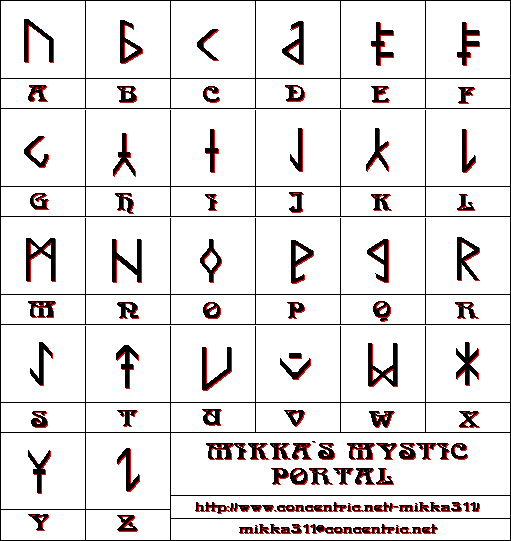
The row of 18 so-called "Armanen Runes", also known as the "Armanen Futharkh" came to List while in an 11 month state of temporary blindness after a cataract operation on both eyes in 1902. This vision in 1902 allegedly opened what List referred to as his "inner eye", via which he claimed the "Secret of the Runes" was revealed to him. List stated that his Armanen Futharkh were encrypted in the Hávamál (Poetic Edda), specifically in stanzas 138 to 165, with stanzas 146 through 164 reported as being the 'song' of the 18 runes. It has been said this claim has no historical basis.

The Armanen runes are still used today by some Ásatrú adherents who consider the Armanen runes to have some religious and/or divinatory value.

Futharkh spelling

List noted in his book, The Secret of the Runes, that the "runic futharkh (= runic ABC) consisted of sixteen symbols in ancient times.".

As a side note to this, in the English translation of the work, Stephen Flowers notes that "(the designation futharkh is based on the first seven runes it is for this reason that the proper name is not futhark -- as it is generally and incorrectly written -- but futharkh, with the h at the end; for more about the basis of this, see the Guido von List Library number 6, The primal language of the Aryan Germanic people and their mystery language)."

Hexagonal Crystal and the Armanen Runes

List's system was allegedly based on the structure of a Hexagonal Crystal. You can shine light through a crystal at different angles and project all 18 of the Armanen runes.

List's rune row was rather rigid; while the runes of the past had had sharp angles for easy carving, his were to be carefully and perfectly made so that their shape would be a reflection of the 'frozen light', a pattern that he had found in his runes. All of his runes could be projected by shining the light through a hexagonal crystal under certain angles. Rune Hagal is so-called 'mother-rune' because its shape represents that hexagonal crystal.

Karl Hans Welz states that the "crystalline structure of quartz is the "hexagonal system" which is also one of the bases of the Runic symbolism (the hexagon with the three inscribed diameters)." and that "The hexagonal cross section of quartz and the fact that all of the 18 Sacred Futhork Runes are derived from the geometry of the hexagon is the basis of an enormous increase in crystal power when it is associated with Rune images."


Influence

Guido von List Society

A look at the signatories of the first announcement concerning support for a Guido-von-List-Gesellschaft (Guido von List Society), circa 1905, reveals that List had a following of some very prestigious people and shows that List, his ideology and his influence had widespread and significant support, including that amongst public figures in Austria and Germany. Among some 50 signatories which endorsed the foundation of the List Society (which had an official founding ceremony on March 2, 1908) were the industrialist Friedrich Wannieck and his son Friedrich Oskar Wannieck, Jörg Lanz von Liebenfels, and Karl Lueger (the mayor of Vienna). These supporters also included occultists such as Hugo Göring (editor of theosophical literature at Weimar), Harald Arjuna Grävell van Jostenoode (theosophical author at Heidelberg), Max Seiling (an esoteric pamphleteer and popular philosopher in Munich), and Paul Zillmann (editor of the Metaphysische Rundschau and master of an occult lodge in Berlin).

List's influence continued to grow and attract distinctive members after the official founding of the society in 1908. From 1908 through to 1912, new members included the deputy Beranek[disambiguation needed] (co-founder of the "Bund der Germanen" in 1894), Philipp Stauff (a Berlin journalist and later a founding member of the Germanenorden), Franz Hartmann (a leading German theosophist), Karl Heise (a leading figure in the vegetarian and mystical Mazdaznan cult at Zürich), and the collective membership of the Vienna Theosophical Society.

As the list demonstrates, the growth of nationalism within Germany during the late 19th to early 20th century, culminating in the Third Reich of Nazi Germany, provided an ideal audience of people who were already predisposed to accept List's ideas and unidentifiable personal gnosis of the Armanen way. The register shows that List's ideas were acceptable to many intelligent persons drawn from the upper and middle classes of Austria and Germany. So impressed were they that these men were prepared to contribute ten crowns as an annual society subscription. The main part of the Society's assets derived from the Wannieck family, which put up more than three thousand crowns at the Society's inauguration.

The Society's inner circle was called the High Armanen Order or Hoher Armanen Orden.

Quotes by List

"One must flee those places where life throbs and seek out lonely spots untouched by human hand in order to lift the magic veil of nature" (Deutsch-Mythologische Landschaftsbilder, 1st volume, p. 125.)

"Now, because men of our contemporary age are caught up in the ascetic view of a life-denying religious system, but in spite of this cannot deny the primal laws of nature, a distorted morality had to be developed, which spreads hypocritical appearances over hidden actions. This has brought to a head all those outward forms of modern life, whose vacuousness and corruption are now beginning to disgust us." (Das Geheimnis der Runen)

"A star is extinguished, another will begin to shine - thus it is written in the Book of Nature" (Der Unbesiegbare)

Popular culture

List is referred to throughout Katherine Neville's book, The Magic Circle, (NY: Random House; 1998) and is mentioned on page 154 of The Black Order, ([n.pl.]: Orion; 2006) by James Rollins. He also occurs as a character in the novel Vienna Blood (London: Century; 2006), the second in the Max Liebermann series, by British author Frank Tallis.

Influential List Society signatories, circa 1905

Friedrich Wannieck, president of the publishing house Verein "Deutsche Haus" ("German House" Association) in Brünn, and chairman of the Prague Iron Company and the First Brno Engineering Company (major producers of capital goods in the Habsburg empire)

Ludwig von Bernuth, health organisation chairman

Ferdinand Khull, committee member of the German Language Club

Adolf Harpf, editor of Marburger Zeitung

Hermann Pfister-Schwaighusen, lecturer in linguistics at Darmstadt University

Wilhelm von Pickl-Scharfenstein (Baron von Witkenberg)

Amand Freiherr von Schweiger-Lerchenfeld, editor of the popular magazine Stein der Weisen and a distinguished army officer

Aurelius Polzer, newspaper editor at Horn and Graz

Ernst Wachler, author and founder of an open-air Germanic theatre in the Harz Mountains

Wilhelm Rohmeder, educator at Munich

Arthur Schulz, editor of a Berlin periodical for educational reform

Friedrich Wiegerhaus, chairman of the Elberfeld branch of the powerful German Nationalist Commercial Employees' Association (Deutschnationaler Handlungsgehilfen-Verband, or DHV)

Franz Winterstein, committee member of the German Social Party (DSP) at Kassel

Influential List Society members from 1908

Rudolf Berger, a committee member of the German Nationalist Workers' League in Vienna

Hermann Brass, chairman of the defensive League of Germans in North Moravia (est. 1886)

Dankwart Gerlach, an ardent supporter of the romantic Youth Movement

Carl Friedrich Glasenapp, biographer of Richard Wagner

Colonel Karl August Hellwig, an organiser in Kassel

Bernhard Koerner, an heraldic expert and populariser of middle-class genealogy

Josef Ludwig Reimer, Viennese author

Karl Herzog, branch chairman of the DHV in Mannheim

Arthur Weber, a theosophical editor

Karl Hilm, occult novelist

General Blasius von Schemua

Written works

Das Geheimnis der Runen (The Secret of the Runes (book), 1908)

Der Unbesiegbare

Götterdämmerung (1893)

Von der Wuotanspriesterschaft (1893)

Die deutsche Mythologie im Rahmen eines Kalenderjahres (1894)

Der deutsche Zauberglaube im Bauwesen (1895)

Mephistopheles (1895)

Carnuntum

Jung Diethers Heimkehr (1894)

Der Wala Erweckung (1894)

Walkürenweihe (1895)

Pipara: Die Germanin im Cäsarenpurpur (Pipara: the Germanic Woman in the purple of the Caesars, 1895)

König Vannius (1899)

Sommer-Sonnwend-Feuerzauber (1901)

Das Goldstück (1903)

Kunstmärchen anthology: Alraunenmaren: Kultur-historische Novellen und Dichtungen aus germanischer Vorzeit (Mandrake-Tales: Cultural-historical Novellas and Poetry from Germanic Prehistory, 1903)

Eine Zaubernacht

Guido-List-Bücherei (a series of works)

Die Armanenschaft der Ario-Germanen (The Armanism of the Aryo-Germanic People, 1908 and 1911, 2 volumes)

Die Rita der Ario-Germanen (The Rita of the Aryo-Germanic People, 1908)

Die Namen der Völkerstämme Germaniens und deren Deutung (The Names of the Tribes of the People of Germania and their Interpretation; GvLB no. 4, 1909)

Die Religion der Ario-Germanen in ihrer Esoterik und Exoterik (The Religion of the Aryo-Germanic People in its Esoteric and Exoteric Aspects, 1909 or 1910)

Die Bilderschrift der Ario-Germanen: Ario-Germanische Hierogyphik (The Pictographic Script of the Aryo-Germanic People: Aryo-Germanic Hieroglyphics; GvLB no. 5, 1910)

Der Übergang vom Wuotanismus zum Christentum (The Transition from Wuotanism to Christianity, 1911)

Die Ursprache der Ario-Germanen und ihre Mysteriensprache (The Primal Language of the Aryo-Germanic People and their Mystery Language; GvLB no. 6, 1914)

Armanismus und Kabbala

.