Showing posts with label horned god. Show all posts

Friday, May 9, 2014

The Almother, Carnuntum, and "Pagan's Gate": The ancient cultural and spiritual overlap between the "two Austrias" and the north Balkans

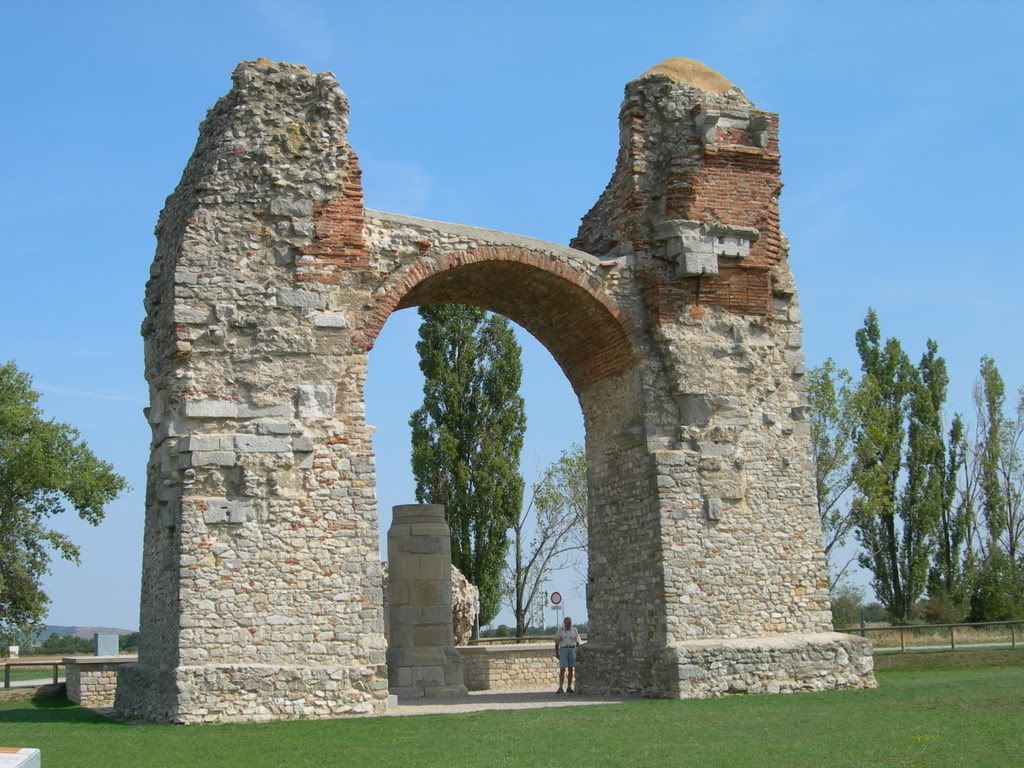
Heidentor aka "Pagan's Gate"


From an overall historical point of view, the Austrians could seem more like an old rival than a kindred people. The region of the eastern Alps and north of the Adriatic Sea has long been a tri-cross-cultural area between the Italo-Roman speaking world, the German-speaking world, and the Slavic-speaking world. For example, some parts of the north Balkans are more culturally and politically tied to Russia than to nearby Austria or the Veneto; in most ways, the tri-Veneto area has more in common with Rome than to St. Moritz; and in general, Austrians would tend to see themselves as being more ethnically tied to Scandinavia than to the nearby Venetians or Slovenes.

By the "two Austrias" I mean the original, and actually proper term "Austria," state within the old Langbard Kingdom... which was approximately the northeast Italian peninsula between Lombardy and the tri-Veneto area. Much later, the term "Austria" was clumsily resurrected as the English-language nickname for Österreich... or the Austria we know today.

Five thousand years ago, there would have been no difference at all between peoples of this region. They would have all been proto-European. The early stream of Teutonic migration formed the loosely defined Celtic culture, which later overran the general Lombardo-Venetian area. Still, approximately three thousand years ago, there was little difference. I'm guessing that this would have also included the north Balkans as well. Without going into the entire history of it.... a later "final push" of Teutonic tribes burst into Switzerland, Austria, Bavaria, Hungary, Bohemia, etc.... an equally intense migratory push of Slavic tribes moved into the Balkans... and--of course--the march of the Roman Empire overtook generally all of what is now "Italy."


The Roman province of "Raetia" was north of the Alps, even though the original "Raetians" were an ancient people who lived in a much larger area at one time. Although a clear lingo-ethnic divide was established between the three, each clearly influenced the other two. For example, in the Middle Ages when parts of the Friul were decimated by plagues, Slavic people were invited in to repopulate, and there is a clear Slavic influence in the Friulian dialect. Also in the Middle Ages, Cimbrians from Bavaria migrated into the Veneto, and many Cimbrian villages were still very linguistically and culturally distinct until the Fascist era. That particular brand of nationalism actually destroyed regional culture. One modern Camunian surname is "Mitterpergher," which is probably of Cimbrian origin, meaning "a person from the middle of the mountain"... and with the old-Bavarian spelling for "mountain person".... "pergher" rather than "berger."

During the Roman era, the Romans did most of the pushing, while the Germanic tribes took over that role in the early Middle Ages. Of course, the ancient territorial struggle between Germans and Slavs occurred over a very long time. In the first century, the Romans established a military base on the Danube River, in what is now Austria, called Carnuntum. This camp served as a trading center, as well as a political headquarters for further Roman expansion. This particular Celtic kingdom was called Noricum. Interestingly, in typical passive-aggressive Roman political style, they used a regional Celtic name.. which was apparently "Karnuntum" originally. I'm not absolutely certain, but it appears that a migration of northern Teutons--separate from the regional Celts--later invaded and destroyed Carnuntum.

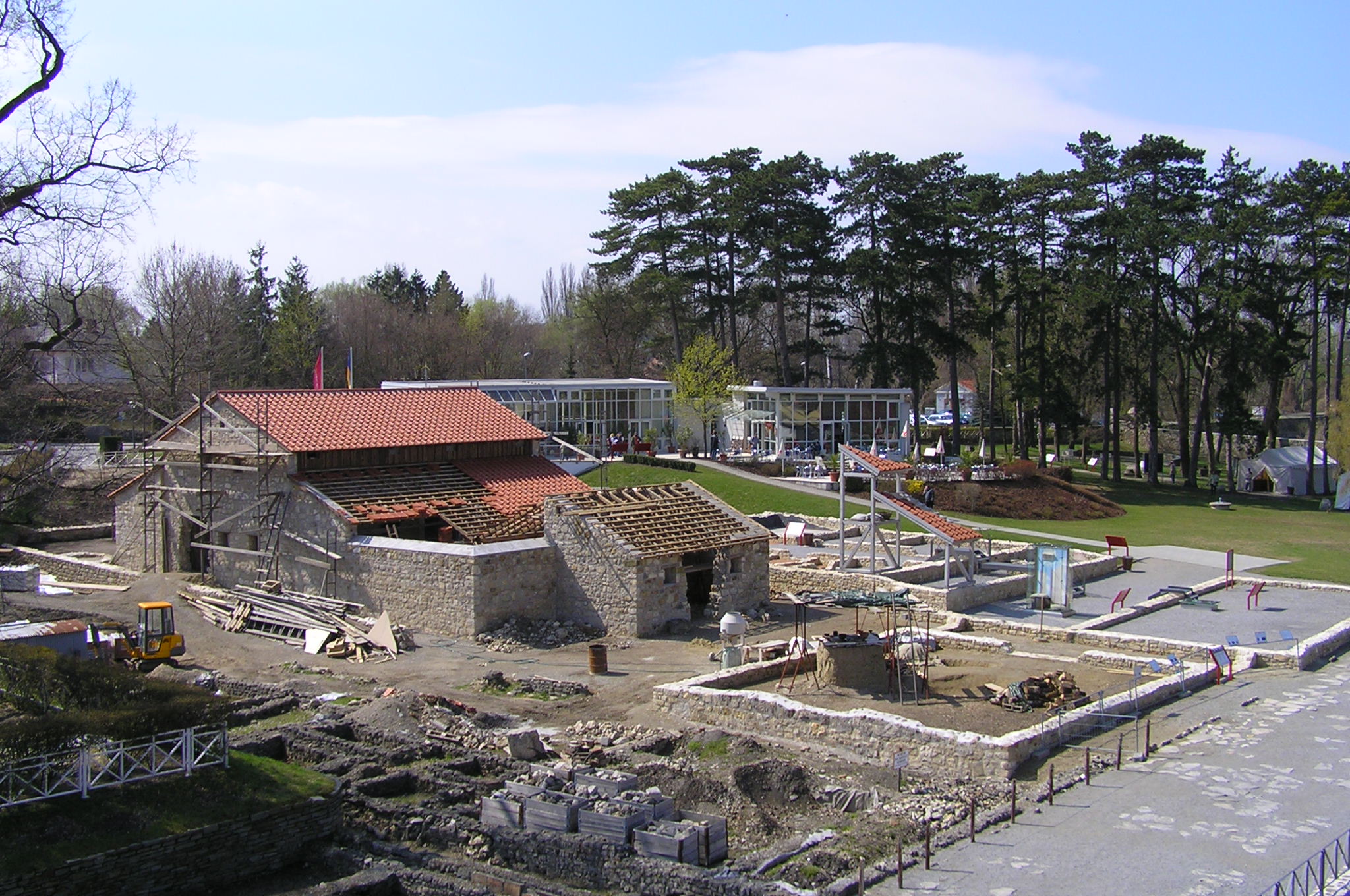
The Teutonic destruction of this Roman expansion was glorified in Guido von List's late 19th century book 'Carnuntum'. This book has not been translated into English to my knowledge, so I can't vouch for it in any way... although I would like to read it. For some reason, List was fascinated by what is apparently the leftover opening gate to Carnuntum... after the invading Teutons demolished the walls, or perhaps this occurred over a longer period. That leftover ruin is now called "Heidentor," or evidently "Pagan's Gate" in German. Ironically, "Pagan's Gate" could be seen as a monument to both the Romans and the Germans. To List, I think it represented a regional Austrian symbol of the glory of past victory. Also, there were many old legends surrounding the ruin. In List's day, historians and archeologists didn't know anything about ancient German-Celts. It actually got it's name in the Middle Ages because it was once thought to have been constructed by ancient pagans. Austria is now reconstructing Carnuntum if you would like to look that up.
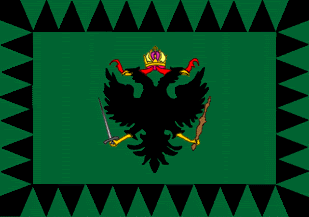

Flag of Lombardy-Venetia
Venus of Willendorf is a 27,000 to 32,000 year old artifact discovered in Austria. This little statue was carved from limestone not native to the area, and I believe was part of a much larger proto-European archetypical symbol of the "mother goddess." Also significant is its age, which would make it a counterpart to the "horned god." Because there are so many regional names for this goddess, which I think are linked back to the last glacial movement, I refer to her as "the Almother"... the proto-European equivalent to "the Alfather" Odin within old Teutonic culture. Among other things, the Almother was a fertility goddess in those early days. As strange as this may sound, there is ample evidence that the Roman goddess Diana of the Carnuntum era, and Venus of Willendorf, have a common origin going back to the last Ice Age. The Almother in the Italian peninsula, of course, going through many more manifestations over time. However, when half of Europe was covered under a massive continental ice sheet, the local manifestations of the mother goddess and the horned god would have been very likely of the same origin.

As far as the later colonial aggression of the Habsburgs... I mean lets face it, this was basically a soft dictatorship in which the average citizen of Austria-Hungary was not really responsible for national/monarchial policy anymore than a Roman citizen was responsible for Roman imperialism. The Austrian soldiers stationed in Lombardy-Venetia could, at times, be brutal... but probably not any more brutal than other occupations. It could be said with certainty that during pre-Roman times---which would have been pre-Teutonic and pre-Slavic times as well---this tri-cultural region would have been largely of the same people. Nobody there spoke Italian, German, or Slavic back then. Three very aggressive peoples came later and staked their territorial claim, and consequently the past etho-cultural dynamic was forgotten.

.

Saturday, December 7, 2013

Giant horned "Cernunnos-like" stone head in central China


"Shennong (the Divine Farmer) is the legendary originator of Chinese herbal medicine" (see 'The Lessons of Shennong'). If there were any temples of this magnitude relating to the very ancient horned god of Europe, then they were destroyed long ago with the rise of Christianity. Strangely, this stone face and it's backdrop look ancient European. "Horns" were an ancient symbol of strength, virility, fertility, and the warrior spirit in many places in the northern hemisphere.

.

Saturday, April 6, 2013

The Arctic Home in the Vedas: Part 11

Margaret Murray was right: Part II


The North Pole prior to about 12,000 years ago was somewhere in todays northern United States, probably where the Great Lakes are today. This sudden plate shift not only “pushed” the North Pole up from its present position from the viewpoint of North America; but it also “pulled” the Eurasian land mass up to the Arctic Circle. This is why, for example, so many perfectly preserved mammoths have been discovered. The northernmost stretches of Europe and Asia had very mild climates prior to this dramatic plate shift. It should also be noted that this sudden pole-shift caused a massive global flood as the poles were suddenly in much warmer weather. This explains why so many ruins of ancient cities now lay on the bottom of the oceans.

Prior to this plate-shift, the three sub-races---of which later became the Indo-European people---were geographically separated. It’s important to note that natives of the Far East, the Indian subcontinent, and true-Semites (based in the southern Saudi peninsula), didn’t live in Europe, North Africa, or most of Asia (including the Near and Middle East). Also, Turko-Mongolian racial types had not come to be as of yet. The Earth’s population was smaller than what we can imagine by todays standards.

The sub-race which I refer to as the “true-Mediterraneans” (not Semitic, or even necessarily what we call “Mediterranean” today) lived in the Near and Middle East; and founded the first post-flood civilizations. The sub-race which I refer to as the “proto-Germanics” (these were pure Germanics, not the largely Alpine-Germanic people whom we call “Germanic” today) lived north of the Himalayas up to the northern Eurasian coast. The sub-race which I refer to as “proto-Europeans” or “Alpines” lived in Europe, and probably well east of it in some places, and in parts of North Africa.

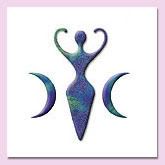
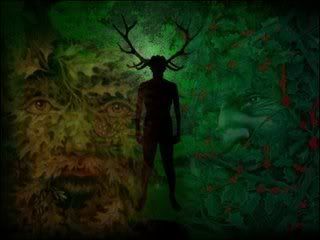
The spiritual culture of these proto-Europeans was the progenitor of Margaret Murray’s “Witch-cult.” All of the evidence points to it so clearly. The ancient stag god and the moon goddess. So many common themes. As small bands of proto-Germanic people migrated westward across central Europe thousands of years ago, they merged with these natives to form the “Celtic” cultures, and their spiritual traditions merged to form new ones. However, the “Witch-cult” always seemed to stick around as a separate tradition. When true-Mediterraneans migrated westward across Southern Europe and North Africa, and then northward along the Atlantic coast and into the British Isles, the same dynamic occurred. They merged with the natives, and their respective spiritual traditions merged as well; and yes, the ancient “Witch-cult” continued to exist separately. In fact, in many parts of both northern and southern Europe, “Alpine” tribes coexisted with the newer cultures that were much greater in number.

At some later point, approximately four to five thousand years ago, a large final migration of proto-Germanic people poured into Europe and overran Scandinavia and a large part of central Europe. I would theorize that they may have largely bypassed Eastern Europe, which then remained of the more native stock. Unlike the two prior migratory patterns into Europe, Germanic language, culture, and spirituality were much more dominant in these newly acquired territories. Yet still, the “Witch-cult” continued to exist even within these new Odinic cultures.

One well-documented example of this transformation from “Witch-cult” to other pagan traditions was in ancient Greece. When ancient Hellenic religion became dominant in Greece, the government declared that the “Old Religion” didn’t qualify as a religion at all. Although some may consider Christianity as the source of the deconstruction of the “Witch-cult,” it actually started long before that. It’s clear that the tradition of the moon goddess Hecate, and the Dianic tradition, existed long before Greece and Rome rose to prominence. Many names, same goddess.

Virtually all of the various spiritual “reconstructionist” groups do not lay claim to the scores of ancient stone megaliths, like Stonehenge, and rather attribute them to some earlier culture. Could that “earlier culture” have been this proto-European people, their culture, and maybe their spiritual tradition as well? Since so little is known about most of these massive stone structures, we may never know the exact truth; but it seems to me that this is a probability.

The Basques, the Welsh, and even the Camunians, are---at least partly---modern survivals of this ancient European type; particularly the Basques. Recent DNA studies have revealed that many English types have more genetic connection to this very ancient stock than previously thought. “Cheddar Man,” excavated in 1903, lived in southwest England over 9,000 years ago. After his DNA was extracted, and samples of local people were compared to it in 1997, one of this man’s direct descendants was living a half-mile away from his burial site. That’s pretty incredible since it has been over 90 centuries and about 300 generations.

This ancient---and extremely resilient---spiritual culture, in all of its related forms, is in need of a new, more dignified name for reference at least. A name that puts it within historical perspective, and one that sounds better than the clumsy, disrespectful-sounding term “Witch-cult.” Since I have gone this far, I would like to suggest a new name: “Witcheathenry.” I would guess that most of the ancient adherents of what was likely an open/non-occultic folk religion, were not practitioners of “magic” or “craft.” The literal "practice of magic” was left to the high initiates. Ancient women of renown… waiting for redemption.

.

Friday, April 5, 2013

The Arctic Home in the Vedas: Part 10

Margaret Murray was right: Part 1

   
Margaret Murray (Wikipedia)

Margaret Alice Murray (13 July 1863 – 13 November 1963) was a prominent British Egyptologist and anthropologist. Primarily known for her work in Egyptology, which was "the core of her academic career," she is also known for her propagation of the Witch-cult hypothesis, the theory that the witch trials in the Early Modern period of Christianized Europe and North America were an attempt to extinguish a surviving pre-Christian, pagan religion devoted to a Horned God. Whilst this theory is today widely disputed and discredited by historians like Norman Cohn, Keith Thomas and Ronald Hutton, it has had a significant effect in the origins of Neopagan religions, primarily Wicca, a faith she supported.

Her work in Egyptology took place largely alongside her mentor and friend, the archaeologist Sir Flinders Petrie, whom she worked alongside at University College London. One of the earliest women to "make a serious impact upon the world of professional scholarship," she was also an ardent feminist, being actively involved in the Suffragette movement. From 1953 to 1955, she was the president of the Folklore Society, although since her death various members of the society have attempted to dissociate the organization from her and the Murrayite theory of the Witch-Cult.


The Witch-Cult in Western Europe (Wikipedia)

The Witch-Cult in Western Europe by Margaret Murray was published in 1921, at a time when the influence and success of The Golden Bough by anthropologist James George Frazer was at its height. In those days Margaret Murray was celebrated in university circles as the expert on western witchcraft. In the period 1929-1968 she even wrote the article on witchcraft in the successive editions of the Encyclopaedia Britannica. In 1962, her main work was reprinted by Oxford University Press. Her theory, also known as the witch-cult hypothesis suggests that the things told about witches in Europe were in fact based on a real existing pagan religion that worshiped a horned god. 


Witch-cult hypothesis (Wikipedia)

The Witch-cult is the term for a hypothetical pre-Christian, pagan religion of Europe that survived into at least the early modern period. As late as the 19th and early 20th centuries, some scholars had postulated that European witchcraft was part of a Satanic plot to overthrow Christianity; most of the evidence for this theory was compiled by studying the accounts of the persecutors in the witch trials in early modern Europe. From the late 19th century an opposing view arose, that witches were not Satanists, but adherents of a surviving underground pagan religion. In the 20th century, the theory gave rise to the neopagan religion of Gardnerianism, with its various offshoots and traditions summarized under the term Wicca.

The theory was pioneered by authors such as Karl Ernst Jarcke and Jules Michelet in the 19th century, but received its most prominent exposition with Margaret Murray's 1921 book, The Witch-Cult in Western Europe, and her contributions to the Encyclopedia Britannica. Scholars have criticized the theory and the general consensus is that the witch cult never existed and is entirely pseudohistorical, while scholars consider some folk magical practices to have influenced witchcraft stereotypes.

Gerald Gardner claimed that he had discovered the New Forest Coven, a group still practicing the religion (which he called Witchcraft) in his 1954 book, Witchcraft Today, a claim which was endorsed by Murray. Similarly, Sybil Leek, Robert Cochrane, Charles Cardell, Rosaleen Norton and Alex Sanders also made claims to having been members of a family line of adherents to the witch-cult. Some contemporary Wiccans have since distanced themselves from the theory.

According to the general consensus in the mainstream historical-academic community---including scholars who have been involved in studies specifically pertaining to religious studies and ancient folklore---Margaret Murray’s “Witch-cult hypothesis” has been sufficiently discredited. As this moment, my mind is failing to come up with adjectives to sufficiently describe the extent to which I disagree. They’re not going back far enough! Margaret Murray was right.

The problem stems from the failure to---historically-speaking---divorce both ancient Germanic and ancient Mediterranean peoples from Europe long enough to at least take a look at the culture of the proto-Europeans prior to 5,000 years ago. They just can’t seem to wrap their minds around the idea that proto-Germanic people didn’t live in Europe until about 5,000 years ago; and that true- Mediterraneans probably didn’t arrive in Europe until about 9,000 years ago.

The origins of the deconstruction of the “Witch-cult” occurred long before Christianity. This is such a no-brainer that it frustrates me! I’ll go through the logical steps yet again for posterity’s sake. The last Ice Age occurred about 25,000 years ago. Every 45,000 years, after both poles have frozen enough of the earth’s water to sufficiently weigh them down, the incredible amount of sheer weight forces a movement of the Earth’s tectonic plates about 2,000 miles. The outer crust of the earth literally moves as if it were a loose outer peel of an orange. This is not the same natural phenomena as an Ice Age.

.