Freya's Folk announces... Ravenwood
Where: Marin City, California
Heathen Campout/Fun & Frolic & Blots in N. California
Event Details: The last Ravenwood!!! Celebrate our 25th and LAST Ravenwood 4th of July weekend 2015.
What to Bring: Food & camping gear & $ for Heathen shopping
Price/Donation: $75 each, $125 couple, $25/vehicle
Join us atop the "Sleeping Lady" (Mt. Tamalpais) for a mellow weekend campout with fun, frolic, and a feast. Learn about the American Vinland Association, Romuva, and the California Utlandr Alliance. Enjoy Heathen fellowship, workshops, and merriment around the fire with the Politically Incorrect Song Singers (P.I.S.S.) . Loggats Tournament, (with prizes) , special events, and guests. More information will be sent with your registration (in June) .
Vendors welcome, but must donate an item worth at least $20.00 to the raffle. Workshop/ritual presentations welcome/encouraged. All Registrations or cancellations must be received by June 30th. Late registrations accepted only if space permits.
No on-site registrations. Any one NOT registered will NOT be admitted.
Registration includes three nights camping, feast on Saturday, one raffle ticket, and a commemorative item. Tent camping only. Our campground has flush toilets, water, sinks, and food cupboards. We have the large campsite A with a limit of 50 people (but there are several motels nearby for the less hardy) from 2 p.m. Friggsday till noon Manisday. Tree worship on Friggsday. Other daily blots & symbels. Annual American Vinland Association & Utlandr Alliance meetings. If you'd like to present/perform, please contact us. NO day passes.
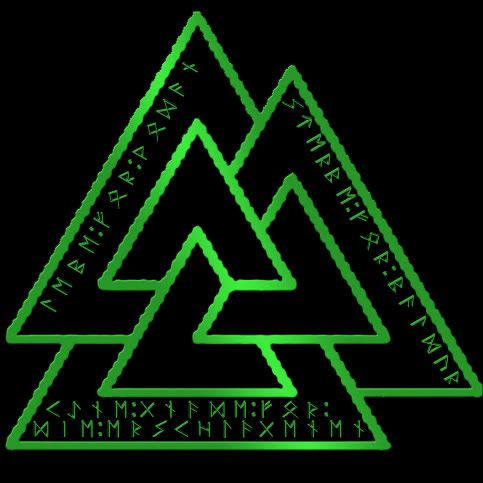
Flyers available by 1/31 or contact us at valknot@juno.com!
Event Location: Panoramic Highway in Marin City
Event TIME Details: 2 pm Friggsday - noon Moonday
Directions: Entrance is opposite Mtn. Home Inn on top of Mt. Tamalpais about 20 minutes North of San Francisco. Map is sent with registration. NO on-site registration! Full refund if cancellation request is received by June 30th.
.
Tuesday, June 2, 2015
Monday, June 1, 2015
Sun Moon abstractions I
Full Sun Moon
Tuesday's full moon will be a "strong sun moon," where the sun and moon will be at their closest point of each other this year. I think that only by truly being outdoors, mostly likely on a trail or at a more remote location, can one truly feel the energetic interaction occurring. It's not a must for one to be there at night, but the twilight period can often be just as special. Some great locations are accessible and safe late in the day, but not after dark.
'Twins of Evil'
'Twins of Evil' was a 1971 vampire horror Hammer Film from the UK, starring Peter Cushing and the beautiful English-Maltese Collinson sisters. The sisters play the roles of Maria and Frieda, recently orphaned identical twin teenage girls, move from Venice to Karnstein in Central Europe to live with their uncle Gustav Weil. Weil is a stern puritan and leader of the fanatical witch-hunting 'Brotherhood'. Both twins resent their uncle's sternness and one of them, Frieda, looks for a way to escape. Resenting her uncle, she becomes fascinated by the local Count Karnstein, who has the reputation of being "a wicked man."
I saw this movie on our local Creature Features in the Bay Area when I was very young. This was an earnestly acted and produced film; and one which captured an alluring, superstitious, and wonderfully dark Middle Ages German/Central European countryside. I watched the full movie (above) some weeks back, and it was everything I remembered it to be.
Northern Lights
An aurora is a natural light display in the sky (from the Latin word aurora, "sunrise" or the Roman goddess of dawn), predominantly seen in the high latitude (Arctic and Antarctic) regions.
Spectacular images of auroras from the Lake Superior region can be viewed on the following link at LakeSuperiorPhoto.com. These images are amazing. They feel like a connection between worlds.
Mr Crowley
'Mr Crowley' by Ozzy Osbourne, somewhat like 'Immigrant Song' by Led Zeppelin, is a good song that references an earth-based/magical tradition. In the case of 'Mr Crowley', a tribute to Aleister Crowley (Western Ceremonial Magic); as opposed to 'Immigrant Song' which is a tribute to Norse-Germanic migration and Heathen tradition.
I have mixed feelings about Aleister Crowley, but I don't think that he was misrepresented as with Guido von List. He usually made himself quite clear as far as it relates to criticism of him. I do, however, think that there is malevolent magic which can be leaned from his works; such as 'The Book of the Law'. I wouldn't recommend it, but it's real.
Thelema is a religion based on a philosophical law of the same name, adopted as a central tenet by some religious organizations. The law of Thelema is "Do what thou wilt shall be the whole of the Law. Love is the law, love under will."
The law of Thelema could probably be interpreted in different ways. I think it's fairly clear though. One interesting occultic aspect of the symbol of Thelema is that it utilizes a unicursal hexagram with an inverted five-petaled flower at the center. This inverted hexagram is basically the same symbol as the Saturnian hexagram ("Star of David"); and the inverted (upside down) five-petaled flower is basically the same as any five-pointed vehmic star (pentagram). The Saturnian hexagram always goes hand-in-hand with the pentagram... as with the Talisman of Saturn. I know this for certain, however I can only speculate what I have heard and read from researchers that Satanists "invert symbols" to reflect the negative.
In other words, the Saturnian cults were not innately "evil," or no more so than any of the other Saturnian or Sun cults (Christianity) of the ancient world. Examples of this type of inverted symbol are the unicursal hexagram, an upside down cross, and an inverted pentagram. We do need to be careful, as some Christians have said that the Norse Life Rune is a "broken cross," as if to suggest that it is an explicitly "anti-Christian" symbol, even though it's older than the Christian cross by tens of thousands of years.
Top 20 religions in the United States
Interesting statistics. I'm sure that the Wicca/Pagan/Druid category is vastly under counted, with many solitary practitioners. I would guess that the 307,000 number is about half of what it really is; and out of about 600,000, maybe 50,000 are even remotely folk-pagan.
Count of Saint Germain
The following is a full twenty minute episode of 'In Search of' from the 1970s, entitled 'The Immortal Count of Saint Germain'. Apparently many of his time believed him to be hundreds of years old. There have been many mysterious figures like this in history, such as Edward M. House... and Mr. Crowley.
.
Labels:
black magic,
England,
films,
Hermeticism,
horror genre,
magical traditions,
Moon,
movies,
music,
nature,
occultism,
religion,
Sun,
symbols,
United Kingdom
Sunday, May 31, 2015
'Disciplina Etrusca' by Voltumna
This band named itself after the supreme god of the Etruscan pantheon, "Voltumna" (also called "Veltha"), which I just covered a bit on the other blog ('Etruscan women, mythology, and the god Veltha'). Black Metal music is a lot like the old Heavy Metal music in that some of it is truly good, while most you would probably have to really like the genre to appreciate. This particular song wouldn't be my first choice to promote, but I love the theme! The 'Disciplina Etrusca' was the text of ancient Etruscan polytheism, which was made up of the three "books of fate."
Beyond the larger Black Metal genre, are the sub-genres of "Celtic Black Metal," "Viking Black Metal," etc., etc. One thing this music offers is a clear link to folk-identity, in this case "Etruscan Black Metal." The band's lyrical theme is defined as "Etruscan Paganism, Mythology, Modern Decay"; and it's genre as Black/Death Metal. This additionally suggests a type of Gothic element to it. Dark symbolism can be beautiful, and could be an outlet for people, primarily younger people, who feel alienated by society.
This song is brand new; just released today in fact. The band is from Viterbo, Latium, and has been around since 2009. Viterbo was one of the city-states of the Etruscan civilization. In a Western society which makes a special point to squash identity (individual and collective), I think it's great that people can turn to their ancestors for inspiration and strength. It's not just Black Folk Metal, but there are many other genres which are folk-oriented in this manner. I mean something a little beyond a band merely playing folk music from a certain culture. There's often a rebel-aspect to it.
If you don't like Black Metal, maybe seek out some of the other types of music within this concept. There's one band from Sardinia called Atrium Animae which is under a genre called "Atmospheric Neoclassical Darkwave," which is hauntingly beautiful.. and is based on what appears to be a Medieval Catholic style. There is Irish Black Metal, Odinic music of many sounds, Slavic, you name it. You might find something you like within one of these folk-spiritual-identity sub-genres.
I like music of just about every texture and harmony, but I don't like "sad music." There are enough things in this life to be sad or depressed about; especially when we lose people. Something inspirational is great, especially when there's that blood-folk connection with a spiritual tie-in. Black Metal is almost like fighting music. Perhaps we need some of that in our lives, because often life is a war. Evolutionary struggle.
Voltumna official website
Voltumna YouTube channel
Metal-Archives.com band profile
Voltumna facebook (official; in Italian mostly)
Voltumna facebook (in English)
.
Labels:
black metal,
Etruscan polytheism,
folk metal,
Latium,
music
Saturday, May 30, 2015
Maria Gaetana Agnesi - Groundbreaking Milanese Mathematician: Part 2
Contributions to mathematics
Instituzioni analitiche
According to Dirk Jan Struik, Agnesi is "the first important woman mathematician since Hypatia (fifth century A.D.)". The most valuable result of her labours was the Instituzioni analitiche ad uso della gioventù italiana, (Analytical Institutions for the Use of Italian Youth) which was published in Milan in 1748 and "was regarded as the best introduction extant to the works of Euler." In the work, she worked on integrating mathematical analysis with algebra. The first volume treats of the analysis of finite quantities and the second of the analysis of infinitesimals.
A French translation of the second volume by P. T. d'Antelmy, with additions by Charles Bossut (1730–1814), was published in Paris in 1775; and Analytical Institutions, an English translation of the whole work by John Colson (1680–1760), the Lucasian Professor of Mathematics at Cambridge, "inspected" by John Hellins, was published in 1801 at the expense of Baron Maseres. The work was dedicated to Empress Maria Theresa, who thanked Agnesi with the gift of a diamond ring, a personal letter, and a diamond and crystal case. Many others praised her work, including Pope Benedict XIV, who wrote her a complimentary letter and sent her a gold wreath and a gold medal.
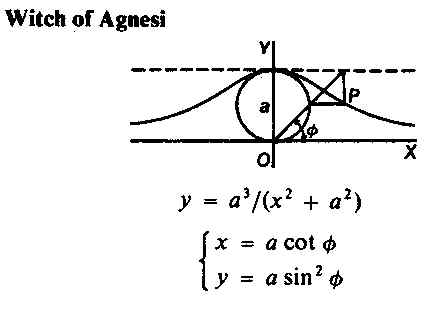
Witch of Agnesi
The Instituzioni analitiche..., among other things, discussed a curve earlier studied and constructed by Pierre de Fermat and Guido Grandi. Grandi called the curve versoria in Latin and suggested the term versiera for Italian, possibly as a pun: 'versoria' is a nautical term, "sheet", while versiera/aversiera is "she-devil", "witch", from Latin Adversarius, an alias for "devil" (Adversary of God). For whatever reasons, after translations and publications of the Instituzioni analitiche... the curve has become known as the "Witch of Agnesi"
Witch of Agnesi (full article)
Other
Agnesi also wrote a commentary on the Traité analytique des sections coniques du marquis de l'Hôpital, which, though highly praised by those who saw it in manuscript, was never published.
Later life
In 1750, on the illness of her father, she was appointed by Pope Benedict XIV to the chair of mathematics and natural philosophy and physics at Bologna, though she never served. She was the second woman ever to be granted professorship at a university, Laura Bassi being the first. In 1751, she became ill again and was told not to study by her doctors. After the death of her father in 1752 she carried out a long-cherished purpose by giving herself to the study of theology, and especially of the Fathers and devoted herself to the poor, homeless, and sick, giving away the gifts she had received and begging for money to continue her work with the poor. In 1783, she founded and became the director of the Opera Pia Trivulzio, a home for Milan's elderly, where she lived as the nuns of the institution did.
Remembrance
Witch of Agnesi, a curve
A crater on Venus
Asteroid 16765 Agnesi (1996)
.
Instituzioni analitiche
According to Dirk Jan Struik, Agnesi is "the first important woman mathematician since Hypatia (fifth century A.D.)". The most valuable result of her labours was the Instituzioni analitiche ad uso della gioventù italiana, (Analytical Institutions for the Use of Italian Youth) which was published in Milan in 1748 and "was regarded as the best introduction extant to the works of Euler." In the work, she worked on integrating mathematical analysis with algebra. The first volume treats of the analysis of finite quantities and the second of the analysis of infinitesimals.
A French translation of the second volume by P. T. d'Antelmy, with additions by Charles Bossut (1730–1814), was published in Paris in 1775; and Analytical Institutions, an English translation of the whole work by John Colson (1680–1760), the Lucasian Professor of Mathematics at Cambridge, "inspected" by John Hellins, was published in 1801 at the expense of Baron Maseres. The work was dedicated to Empress Maria Theresa, who thanked Agnesi with the gift of a diamond ring, a personal letter, and a diamond and crystal case. Many others praised her work, including Pope Benedict XIV, who wrote her a complimentary letter and sent her a gold wreath and a gold medal.
Witch of Agnesi
The Instituzioni analitiche..., among other things, discussed a curve earlier studied and constructed by Pierre de Fermat and Guido Grandi. Grandi called the curve versoria in Latin and suggested the term versiera for Italian, possibly as a pun: 'versoria' is a nautical term, "sheet", while versiera/aversiera is "she-devil", "witch", from Latin Adversarius, an alias for "devil" (Adversary of God). For whatever reasons, after translations and publications of the Instituzioni analitiche... the curve has become known as the "Witch of Agnesi"
Other
Agnesi also wrote a commentary on the Traité analytique des sections coniques du marquis de l'Hôpital, which, though highly praised by those who saw it in manuscript, was never published.
Later life
In 1750, on the illness of her father, she was appointed by Pope Benedict XIV to the chair of mathematics and natural philosophy and physics at Bologna, though she never served. She was the second woman ever to be granted professorship at a university, Laura Bassi being the first. In 1751, she became ill again and was told not to study by her doctors. After the death of her father in 1752 she carried out a long-cherished purpose by giving herself to the study of theology, and especially of the Fathers and devoted herself to the poor, homeless, and sick, giving away the gifts she had received and begging for money to continue her work with the poor. In 1783, she founded and became the director of the Opera Pia Trivulzio, a home for Milan's elderly, where she lived as the nuns of the institution did.
Remembrance
Witch of Agnesi, a curve
A crater on Venus
Asteroid 16765 Agnesi (1996)
.
Labels:
famous Lombards,
mathematics,
Milan,
Milanese heritage,
science
Friday, May 29, 2015
Maria Gaetana Agnesi - Groundbreaking Milanese Mathematician: Part 1
-- Dirk Jan Struik
Maria Gaetana Agnesi (16 May 1718 – 9 January 1799) was an Italian mathematician and philosopher. She was the first woman to write a mathematics handbook and the first woman appointed as a Mathematics Professor at a University.
She is credited with writing the first book discussing both differential and integral calculus and was an honorary member of the faculty at the University of Bologna.
She devoted the last four decades of her life to studying theology (especially patristics) and to charitable work and serving the poor. This extended to helping the sick by allowing them entrance into her home where she set up a hospital. She was a devout Christian and wrote extensively on the marriage between intellectual pursuit and mystical contemplation, most notably in her essay Il cielo mistico (The Mystic Heaven). She saw the rational contemplation of God as a complement to prayer and contemplation of the life, death and resurrection of Jesus Christ.
Maria Teresa Agnesi Pinottini, clavicembalist and composer, was her sister.
Early life
Maria Gaetana Agnesi was born in Milan, to a wealthy and literate family. Her father Pietro Agnesi, a University of Bologna mathematics professor, wanted to elevate his family into the Milanese nobility. In order to achieve his goal, he had married Anna Fortunata Brivio in 1717. Her mother's death provided her the excuse to retire from public life. She took over management of the household.
Maria was recognized early on as a child prodigy; she could speak both Italian and French at five years of age. By her eleventh birthday, she had also learned Greek, Hebrew, Spanish, German, and Latin, and was referred to as the "Seven-Tongued Orator". She even educated her younger brothers. When she was nine years old, she composed and delivered an hour-long speech in Latin to some of the most distinguished intellectuals of the day. The subject was women's right to be educated.
Agnesi suffered a mysterious illness at the age of 12 that was attributed to her excessive studying and was prescribed vigorous dancing and horseback riding. This treatment did not work - she began to experience extreme convulsions, after which she was encouraged to pursue moderation. By age fourteen, she was studying ballistics and geometry. When she was fifteen, her father began to regularly gather in his house a circle of the most learned men in Bologna, before whom she read and maintained a series of theses on the most abstruse philosophical questions. Records of these meetings are given in Charles de Brosses' Lettres sur l'Italie and in the Propositiones Philosophicae, which her father had published in 1738 as an account of her final performance, where she defended 190 theses. Maria was very shy in nature and did not like these meetings.
Her father remarried twice after Maria's mother died, and Maria Agnesi ended up the eldest of 21 children, including her half-siblings. In addition to her performances and lessons, her responsibility was to teach her siblings. This task kept her from her own goal of entering a convent, as she had become strongly religious. Although her father refused to grant this wish, he agreed to let her live from that time on in an almost conventual semi-retirement, avoiding all interactions with society and devoting herself entirely to the study of mathematics. During that time, Maria studied both differential and integral calculus. Fellow philosophers thought she was extremely beautiful, and her family was recognized as one of the wealthiest in Milan. Maria became a professor at the University of Bologna.
.
Labels:
famous Lombards,
Lombardy,
mathematics,
Milan,
Milanese,
science
Thursday, May 28, 2015
Italy runestones and Langbarðaland
Guðlaug had the stones raised in memory of Holmi, her son. He died in Lombardy.
Guðlaug let ræisa stæina at Holma, sun sinn. Hann do a Langbarðalandi.
-- Old Norse transcription of "U 141" runestone (see image)
Apparently his mother requested that two runestones be carved and erected in honor of her son who died while serving in the Byzantine "Varagian Guard."
**************************************************
The Italy runestones with English translation
BirkaViking
The Italy runestones with English translation from the Scandinavian runic-text database.
The young men who applied for a position in the Varangian guard were not uncouth roughnecks, as in the traditional stereotype, but instead, it appears that they were usually fit and well-raised young warriors who were skilled in weapons. They were the kind of warriors who were welcome as the elite troops of the Byzantine Emperor, and who the rulers of Kievan Rus requested from Scandinavia when they were under threat.
**************************************************
Italy runestones (Wikipedia)
The Italy Runestones are three or four Varangian Runestones from 11th-century Sweden that talk of warriors who died in Langbarðaland ("Land of the Lombards"), the Old Norse name for Italy. On these rune stones it is southern Italy that is referred to (Langobardia), but the Rundata project renders it rather anachronistically as Lombardy (see the translations of the individual stones, below).
The rune stones are engraved in Old Norse with the Younger Futhark, and two of them are found in Uppland and one or two in Södermanland.
| Langbard duchies Spoleto and Benevento in blue |
The young men who applied for a position in the Varangian guard were not uncouth roughnecks, as in the traditional stereotype, but instead, it appears that they were usually fit and well-raised young warriors who were skilled in weapons. They were the kind of warriors who were welcome as the elite troops of the Byzantine Emperor, and who the rulers of Kievan Rus' requested from Scandinavia when they were under threat.
Interpretations
Johan Peringskiöld (d. 1720) considered the Fittja stone and the Djulefors stone to refer to the Lombard migration from Sweden, whereas Celsius (1727) interpreted them in a strikingly different manner. He noted that the name Longobardia was not applied to Italy until after the destruction of the Kingdom of the Lombards in 774. He claimed that the kingdom had been taken over by Varangians from Byzantium in the 11th and 12th centuries, and noted that in Barbarossa's campaign in Italy there were many Scandinavian warriors. The stones would have commemorated Swedish warriors who died in Barbarossa's war. This view was also espoused by Brocman (1762) who considered Holmi to have died in the 12th century for either the Byzantine Emperor or ruler of the Holy Roman Empire.
von Friesen (1913) noted that it is not Lombardy in northern Italy that is intended, but Langobardia in southern Italy, which was ruled by the Byzantine Emperor during the 11th century. The Greeks had to fight several battles against the Normans in southern Italy during the mid-11th century. It is likely that Holmi, who is mentioned on two stones, took part in these battles as a member of the Byzantine Emperor's elite unit, the Varangian Guard, since they use a name based on the Greek name for the region.
**************************************************
It would be curious to know what contact may have occurred between the Vikings and the Langbard Kingdom, since the kingdom's demise and the start of what is considered the "Viking Age" were only a few years apart. It's also possible that, since these warriors probably died in Southern Italy, the location was in the southern Langobard duchies of Spoleto and Benevento. These two states continued on after Langbard was destroyed by Charlemagne. These Vikings likely had been Christianized by this time, as this was the on the verge of or past the point of the Viking Age. They had been brought into the Christian fold.
Inga raised this stone in memory of Óleifr, her son. He ploughed his stern to the east, and met his end in the land of the Lombards.
Inga ræisti stæin þannsi at Olæif sun sinn. Hann austarla arði barði ok a Langbarðalandi andaðis.
-- Old Norse transcription of "Sö 65" runestone (see image)
.
Labels:
Benevento,
Byzantines,
Greece,
Italy,
Langbard,
Langobards,
Lombards,
Lombardy,
runestones,
Scandinavia,
Spoleto,
Vikings
Wednesday, May 27, 2015
Nick Montana still a free agent
I saw Nick Montana play in person. He was freshman for the Washington Huskies, playing at Stanford in 2011. He had a chance to run a couple of drives late, and showed a strong arm. After transferring a couple of times, he ended up at Tulane in New Orleans. He did have one good year in 2013, where he led the Green Wave to a 7-5 regular season record, while throwing for 1,722 yards, 14 touchdowns and 10 interceptions, and a narrow 24-21 loss in the 2013 New Orleans Bowl.
Pro football doesn't have a farm-system, and even great players who were very unheralded at one time, like Kurt Warner, had to try to hang on by playing in the Arena Football League, the CFL, or one of the smaller semi-pro leagues which have sprung up in recent years. I don't know if he's willing to go that route if he isn't signed by an NFL team. He's still a bit of a raw talent. Even Joe Montana and Tom Brady were down on the depth chart even in college at one point, and weren't high draft picks.
'Tulane senior Nick Montana says goodbye to Wave football, but keeping future in sport open'
'Nick Montana: Latest on Undrafted Free Agent After 2015 NFL Draft'
**************************************************
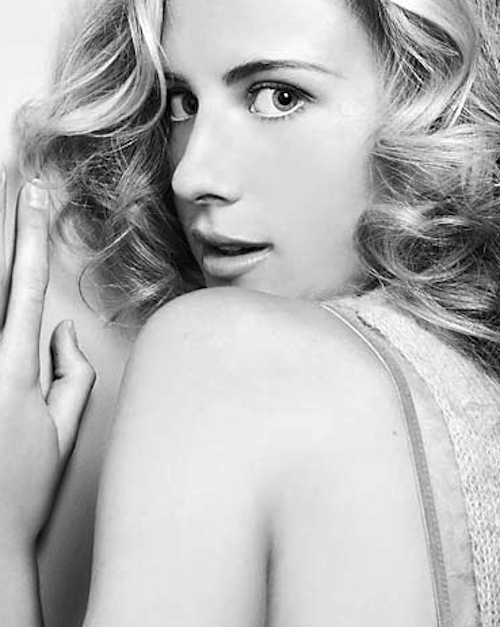
Nate Montana's sister Elizabeth, apparently still working as a model.
.
Labels:
American football,
Joe Montana,
Nick Montana,
sports
Subscribe to:
Posts (Atom)