The tradition that Leland invokes in Aradia is an idealistic tradition of the people. Unbound by the historical accuracy or literary criticism through the character of Margherita Taluti, who is herself unbound through the mask of Aradia, he attempts to give voice to a deeper current of thought running through the cultural narrative. Just as the African Diaspora Traditions easily slide between Christian saints and African gods, Aradia presents the picture of a living tradition that invokes the Spirits by their Signs without regard for any cultural designations. These are not the civilized gods of Empires, but the unrefined forces of Nature herself.
Despite the hesitation of some contemporary pagans over the use of the name Lucifer in the text, the marriage of Lucifer and Diana is not necessarily an amalgam of Judeo-Christian and Greco-Roman traditions. In Latin Lucifer can be interpreted as “Light Bearer” an epitaph for Apollo (also called Φοίβος, Phoibos, “radiant”) who is the brother of Artemis, Artemis being another name for Diana. With Italian being so close to Latin, it may be that the use of Lucifer actually predates the Christian tradition.
Another appellation given to Apollo is “born of the wolf”, and in pre-Hellenistic times (as Jake Stratton-Kent points out in his work Geosophia) Apollo had a definitive role in Cthonic (underworld) rites. The designation given in Aradia of Diana’s husband with “one who of old once reigned in Hell,” may be a subtle clue that it is this Cthonic Apollo, the Oracular Apollo, who is being called upon.
The Invocation to Aradia hints at this when it says, “may there be one of three signs distinctly clear to me: the hiss of a serpent, the light of a firefly, the sound of a frog” The Serpent was sacred to Apollo, and the connection of the firefly to the “light bearer” is self evident, the frog is sacred to Hekate, a Cthonic Greek goddess who, like Diana, is connected to magical rites and nocturnal pursuits.
If this seems a bit academic for folk wisdom, it may very well be. Leland’s recounting may be every bit as free as his critics contend. In his work English Gypsy Songs he laments that none of the Romany he spoke with could give an adequate representation of their tradition. “Not finding what I wanted, I had given up the intention of forming such a collection, when the perusal of a few excellent Romany ballads by a friend who may fairly claim to be among the ” deepest” of the deep in the language, as well as others by Professor Palmer and Miss Janet Tuckey, suggested to me the idea that poetry, impressed with true Gipsy spirit, and perfectly idiomatic, might be written and honestly classed as Romany, even though not composed by dwellers in tents or caravans. The experiment was made, great care being taken to avoid anything like theatrical Gypsyism, or fanciful idealization.”
There are many correspondences in Aradia to beliefs common to European and early American folk magic which Leland would have been familiar with through his extensive reading and passion for the “occult.” The Charm of the Stones Sacred to Diana is surprisingly similar to the seer stone used by Joseph Smith for treasure hunting and scrying while dictating the Book of Mormon. Leland’s niece recounts that he, “not only studied witchcraft with the impersonal curiosity of the scholar, but practiced it with the zest of the initiated,” so it would not be surprising if a bit of his own practice seeped in to the reworking of Margherita’s account of Italian witchcraft.
In fact Leland, in his memoirs, tells of his own ownership of such a stone, only he calls it a “voodoo stone,” and based on the timing of the tale he tells (at the end of the Civil War) his possession of it predates by many years his time in Italy:
“Now, to-day I hold and possess the black stone of the Voodoo, the possession of which of itself makes me a grand-master and initiate or adept…”
– Memoirs, Charles Leland
Similarly the Conjuration of Diana which calls for water, wine and salt, bears resemblance to invocation techniques used by folk magicians discussed in George Oliver's book from 1875, The Pythagorean Triangle: “It appears that in the time when conjurers could profitably exercise their art, they used to raise spirits within a circle nine feet in diameter, which they consecrated by sprinkling with a mixture of holy water, wine, and salt; that they might be protected from any onslaught of the fiend.” .
“If the lawful order (κόσμος) hate you, ye know that it hated me before it hated you.
If ye were of the lawful order (κόσμος), the lawful order (κόσμος) would love his own: but because ye are not of the lawful order(κόσμος), but I have chosen you out of the lawful order (κόσμος), therefore the world hateth you.
Remember the word that I said unto you, The servant is not greater than his lord. If they have persecuted me, they will also persecute you; if they have kept my saying, they will keep yours also.
But all these things will they do unto you for my name’s sake, because they know not him that sent me." – John 15:18-21
Most reading the charming reprinting of Charles Leland’s Aradia, Gospel of the Witches easily forget how far we are from rural Italy in the 19th century, from the world inhabited by those who remember the Ancient Ways, perhaps more telling, how far we are from the lives of the dispossessed in our own time. Leland’s disarming erudition of Margherita Taluti’s information lulls us into gentle repose, arrested only by the sudden bursts of light when the reality of Margherita’s world sneaks through our contemporary dream.
“In those days there were on earth many rich and many poor.
The rich made slaves of all the poor.
In those days were many slaves who were cruelly treated; in every palace tortures, in every castle prisons.
Many slaves escaped. They fled to the country; thus they became thieves and evil folks. Instead of sleeping by night, they plotted escape and robbed their masters, and then slew them. So they dwelt in the mountains and forest as robbers and assassins, all to avoid slavery.” An educated Western audience may find it uncouth that such things would be spoken aloud, but they aren’t spoken aloud, they are passed in secret, sub-rosa, in silence. Leland’s passion for various groups on the fringes of the society of his day, the Romany, the Native American, American Voodoo and European witches, gave him a strong sense of Romanticism for the struggles of the people, and provides him with the raw materials for an invocation of this struggle through his writing.
This is not the genteel voice of an educated Marxist lamenting capitalism, nor the hopeful philosophies of Utopian sustainability, this is Lex Talonis, justice driven by the Left Hand under the auspices of Divine Right. This is the uninhibited outcry of those who labor, live and die without ever seeing the fruits of their work, and watching daily while an uncaring elite sit in abstract control over their destinies.
During the Haitian Revolution in the late 18th century, escaped slaves met in the mountains and gathered strength while plotting to overthrow the Colonial French. During a ceremony in the northern mountains at Bois Caiman, which has since passed into a national myth, the freedom fighters called on the gods of their homeland to give them strength, protection and the vigor to overthrown their oppressors.
According to accounts of the ceremony “a woman started dancing languorously in the crowd, taken by the spirits of the loas. With a knife in her hand, she cut the throat of a pig and distributed the blood to all the participants of the meeting who swore to kill all the whites on the island.”
– History of Haiti and the Haitian Revolution
An interesting thing about Leland is that he’s writing from a place of experience. He was active during the American Civil War, both as a propagandist and journalist for the North and as a soldier, and was in Paris during the French uprising in 1848 where he participated in street fighting against the Royalist supporters.
In all of these revolutionary moments, however, we must be honest and recognize that the people do not stir on their own cognizance. Even the Haitian revolution was spurred on by educated Haitians who invoked the power of their traditions to stir the people. It takes someone to spark the collective consciousness, and that someone is more often than not a sympathetic member of the literati. .
Fiorella Terenzi is an Italian-born astrophysicist, author and recording artist who is best known for taking recordings of radio waves from far-away galaxies and turning them into music. She received her doctorate from the University of Milan but is currently based in the United States.
Described by Time magazine as "a cross between Carl Sagan and Madonna", Dr. Terenzi has studied opera and composition at Conservatory G. Verdi, Corsi Popolari Serali and taught physics and astronomy at various U.S. colleges and universities; she is currently on the full-time faculty at Florida International University in Miami. In research at the Computer Audio Research Laboratory, University of California, San Diego, she pioneered techniques to convert radio waves emanating from distant galaxies into sound, with some of the results released by Island Records on her acclaimed CD Music from the Galaxies. The goal of her audiofication/sonification of celestial data is to investigate how sound could reflect chemical, dynamical and physical properties of celestial objects, what she calls "Acoustic Astronomy."
Astro-physicist and composer Fiorella Terenzi has used the most modern radio-tele- scopes and computers to convert the natural radiation from a galaxy designated UGC6697 into the audible range then add instrumental harmonies.
Maybe this is going a little off topic, but this 1964 hit by Gale Garnett--entitled 'We'll Sing in the Sunshine'--really reminds me of part of a summer vacation that I spent with cousins in Wisconsin when I was ten. They lived right on a muddy lake, and I can still smell that particular mud scent. It was okay once you got out aways. It was hot every day. Also, the old photographs in this video remind me of certain places and how they were in the past. They really work with this song.
Another song that comes to mind is 'Holiday Road' by Lindsay Buckingham, which really reminds me of the feel of family vacations in the American west (song and movie). I never would have thought that the guy was actually from the UK. This song is from the 1983 comedy 'National Lampoon's Vacation' with Chevy Chase and Beverly D'Angelo. That's such a popular movie, as it's on TV all the time. .
Melissa Galka was a seventeen year old girl who died in a car accident some years ago. Her continued soul presence and clear relevant conversations--in her own voice--using EVP technology, appears to be proof of the afterlife. If it isn't proof, then we're experiencing the final stages of where soon "proof" will be undeniable. We're offered so many silly things in the mainstream media and popular culture, and here is arguably the most important issue of all staring us in the face. This could change the world forever. For one thing, it would usher in an era where there could possibly be eventual proof of "consequences" for actions committed in this plane of existence. That would be quite a game changer. It would also be the absolute end of Atheism, so I suspect that they will fight this thing to the bitter end. Additionally, it could eventually mark the end of "absolutist" or "supremacist" religion... particularly "faith-based" religion. The world would be a much better place. I'm not saying it would be the end of religion, far from it. But it may lead to more of a spiritual existence.
Needless to say, this is a very important case. Melissa Galka's angel-like spirit is still here. As far as what I have been able to understand, her soul must have passed over, then is free to wander over to this plane for as long as she wishes. Eventually the soul has the choice to experience life again. So she isn't really a "ghost" by exact definition. I don't believe that they can actually interfere with human fate. Just the fact that she can communicate with her family is quite a gift for them. Also particularly interesting in this episode of 'Ghost Adventures', is that at one point fellow spirit "friends" crossed over to where Zak Bagans was conducting communication with her in her parents house. It was a fascinating look at what could possibly be. As this spirit communication technology improves, it should become more and more interesting. The following link is the YouTube channel of Gary Galka, Melissa's father. It has numerous videos of EVP communications with Melissa and of other cases; as well as a good source of the continued evolution of this technology.
Union Cemetery (Easton, Connecticut) Union Cemetery is a cemetery located near Stepney Road in Easton, Connecticut. The site dates back to the 1700s and is reputed to be one of the most haunted cemeteries not only in Connecticut, but also in the entire United States. Connecticut demonologists Ed and Lorraine Warren have written a book about the cemetery entitled Graveyard.
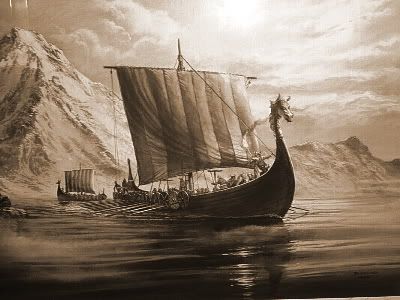
'The 13th Warrior' (Wikipedia) The 13th Warrior is a 1999 American historical fiction action film based on the novel Eaters of the Dead by Michael Crichton and is a loose retelling of the tale of Beowulf. It stars Antonio Banderas as Ahmad ibn Fadlan, Diane Venora and Omar Sharif. It was directed by John McTiernan. Crichton directed some reshoots uncredited. The film was produced by McTiernan, Crichton, and Ned Dowd, with Andrew G. Vajna and Ethan Dubrow as executive producers. While rewatching this film a few days ago, it just hit me. This film was a reversal of 'Lawrence of Arabia. Instead of a Western gentleman and adventurer aiding the "good Muslims" against the aggression of the "bad Muslims" in a foreign exotic land, it was a Muslim gentleman and adventurer aiding the "good Vikings" against the "bad Vikings" in a foreign exotic land. Antonio Banderas plays the role of Ahmad, who after a social-political dispute in Baghdad, is exiled to serve as an ambassador to "northern barbarians" (Vikings) who were apparently living somewhere in northwestern Asia. Omar Sharif plays the role of a senior official who teaches him the ropes. An old Viking woman with a raspy voice is a type of magical seer, and further adds to the idea of the Northmen as strange and exotic.
The Vikings are portrayed as unkempt, crude, and gruff, while Ahmad was well dressed, gentlemanly, and well spoken. Although it wasn't really clear to me, after an incident he is selected as a non-Northman "thirteenth warrior" by the seer when news arrives that their particular Viking tribal home is under attack. They embark back north by ship. Ahmad soon learns their language. To Ahmad, rich dark colors, the northern climate, heavy clouds, mountains, and forests would have seemed exotic and inhospitable. The architectural designs and Odinic totems was impressive. For the record, an Odinic death prayer was portrayed in the movie.
After repelling an attack by the enemy tribe, powerful men who were adorned with the heads, furs, and claws of bears, Ahmad soon gains respect after displaying his expertise with the sword and horse. He meets a Viking woman, whom is his semi-romantic interest throughout his stay. During the first battle, he bravely saves a little Viking girl, which further raises his stock with the group. The beastly cannibalistic enemy tribe reminded me of the accounts by the Romans of a particular people whom I think they referred to as the "Scritobini" in Scandinavia. I actually made a video about them a few years ago, in an expression of primal dark imagery, entitled Scritobini Dawn of Europe.
.
Spoiler alert beyond this point
.
.
.
.
After a long struggle, the enemy is defeated. The tribal chieftain Buliwyf kills the fearsome leader of the enemy tribe in battle, although he is terminally poisoned in the process. His character was based on the Beowulf legend. The dying Buliwyf, wants the story of this struggle told so he would be remembered. Ahmad, the allegorical "Lawrence of Arabia," then returns home by ship. According to this fictional account, Ahmad writes Buliwyf's story when he is back in Baghdad. Actually, there are some old texts about the Vikings by Islamic historians and writers.
This movie was not a financial success, likely partly due to the costs of the sets It's a good enough movie, but probably one that you would generally watch only once. .


 deepest” of the deep in the language, as well as others by Professor Palmer and Miss Janet Tuckey, suggested to me the idea that poetry, impressed with true Gipsy spirit, and perfectly idiomatic, might be written and honestly classed as Romany, even though not composed by dwellers in tents or caravans. The experiment was made, great care being taken to avoid anything like theatrical Gypsyism, or fanciful idealization.”