Fiorella Terenzi
Fiorella Terenzi is an Italian-born astrophysicist, author and recording artist who is best known for taking recordings of radio waves from far-away galaxies and turning them into music. She received her doctorate from the University of Milan but is currently based in the United States.
Described by Time magazine as "a cross between Carl Sagan and Madonna", Dr. Terenzi has studied opera and composition at Conservatory G. Verdi, Corsi Popolari Serali and taught physics and astronomy at various U.S. colleges and universities; she is currently on the full-time faculty at Florida International University in Miami. In research at the Computer Audio Research Laboratory, University of California, San Diego, she pioneered techniques to convert radio waves emanating from distant galaxies into sound, with some of the results released by Island Records on her acclaimed CD Music from the Galaxies. The goal of her audiofication/sonification of celestial data is to investigate how sound could reflect chemical, dynamical and physical properties of celestial objects, what she calls "Acoustic Astronomy."
Website of Dr. Fiorella Terenzi
Fiorella Terenzi YouTube channel
**************************************************
Dr. Fiorella Terenzi song "Eternal"
Astro-physicist and composer Fiorella Terenzi has used the most modern radio-tele- scopes and computers to convert the natural radiation from a galaxy designated UGC6697 into the audible range then add instrumental harmonies.
.
Showing posts with label famous Lombardians. Show all posts
Sunday, May 17, 2015
Monday, January 14, 2013
Movie Review: ‘White Mischief’ (1987)
‘White Mischief’ is a British movie portraying a well-known (in the UK) murder case which occurred during World War II. During the German “Blitz,” British elitist Jock Delves Broughton, and his much younger wife Lady Diana Broughton, escape to Colonial Kenya. They quickly fit in with a particular well-established crowd of their peers in the rural countryside. I guess that even the Westernized capitol of Nairobi was too close to the war front, although there were scenes shot along the coast.
This resort-like atmosphere seemed to be all fun-and-games, as there was little open concern of the prospect that the UK may lose the war and be colonized themselves. It sort've reminded me of the accounts of the Roman elites enjoying themselves as Rome fell to the barbarian hordes; or even the elites on the Titanic, who partied as the ship was sinking. The British had colonies the world over, and it would have been easy for the wealthy to hide out in many places. I suspect that they were investing and planning what they may do. It should be noted that the word “English” refers to the ethnic group, while the world “British” refers to the whole of the United Kingdom.
The Kenyan countryside portrayed was not the typical sub-Saharan landscape that most think of. It looked more like New Mexico; dry, somewhat mountainous. It seemed like an unlikely atmosphere for the unfolding debauchery among the social circles of these aristocratic personalities. I think that this movie reflected the final days of the globe as being just a big playground for this type of elitist. In other words, the days of wandering the exotic globe while the home front--which they may return to at any time--remains secure and unchanging, is gone. Sure they may still travel--even easier--but the entire world as a whole is less welcoming to their whims in a new world where they are a small minority of competing races, religions, and cultures.
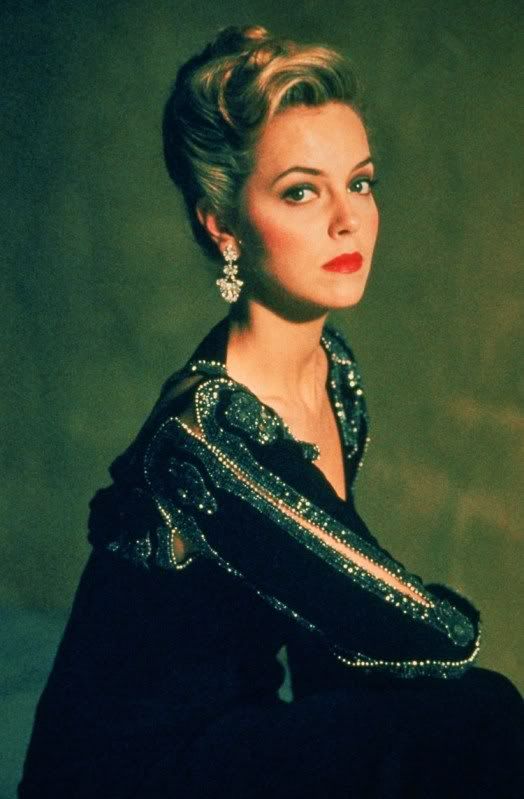
The Broughtons soon met the philandering Josslyn Hay, who almost immediately partakes in an non-discrete affair with Lady Broughton. That is the basic storyline, and I won’t do a spoiler for this. Suffice to say, there is conflict and drama. It’s a pretty easy watch, as there are no deeper storylines. Jock Broughton is more-or-less the protagonist, and he is played by British actor Joss Ackland whose face I have seen in numerous movies. Lady Broughton is played by a young beautiful Greta Scacchi. Joslyn Hay is played by British actor Charles Dance, who is also a familiar face.
Greta Scacchi was born in Milan, but grew up in the UK. She is half Milanese; and I think half English. Naturally her Lombardian ancestry is why I am writing this review, and she is someone very familiar to the English-speaking world. Her mother was an English citizen, as she then became as a girl. The word “great” is thrown around so often, but I objectively say that she is a very good actress. I perceive her performance in this movie as being somewhat like Kathleen Turner in ‘Body Heat’ (1980). The storylines are similar, and the sultry-sophisticated performances of both actresses are pointed to by some as quasi-real/fictional “perfect tens.” However, Scacchi has been a much better actress than Turner. In 1995, Greta Scacchi became an Australian citizen.
~Warning: Spoiler alert beyond this point!~
White Mischief (Wikipedia)
White Mischief is a 1987 film dramatizing the events of the Happy Valley murder case in Kenya in 1941, when Sir Henry "Jock" Delves Broughton was tried for the murder of Josslyn Hay, Earl of Erroll.
Based on a book by the Sunday Times journalist James Fox (originally researched with Cyril Connolly for an article in December 1969), it was directed by Michael Radford.
Plot
With much of the rest of the world at war, a number of bored British aristocrats live dissolute and hedonistic lives in a region of Kenya known as Happy Valley, drinking and indulging in decadent sexual affairs to pass the time.
On a January day in 1941, Josslyn Hay, the philandering Earl of Erroll, is found dead in his automobile in a remote location. The Earl has a royal pedigree but a somewhat sordid past and a well-deserved reputation for carrying on with other men's wives.
Lady Diana Broughton is one such woman. She is the beautiful wife of Sir John Henry Delves Broughton, known to most as "Jock," a man at least twice her age. Diana has a pre-nuptial understanding with her husband that should either of them fall in love with someone else, the other will do nothing to impede the romance.
Diana has indeed succumbed to the charms of the roguish Earl of Erroll, whose local conquests also include the drug-addicted American heiress Alice de Janze and the somewhat more reserved Nina Soames. It appears that Diana expects to divorce Broughton and marry the Earl, and, true to his word, Broughton publicly toasts their affair in front of them at a club in Nairobi.
The resentment he feels privately is known only to Broughton and possibly to old friend Jack Soames. In any case, the Earl's murdered corpse is found not far from Broughton's estate, and before long Broughton is charged with the crime.
Diana is distraught over losing her lover, as is Alice, who openly masturbates near his coffin. A local plantation owner, Colville, quietly offers Diana advice and solace, ultimately surprising her by proposing marriage.
Broughton stands trial. There are no witnesses to the crime and the physical evidence is incriminating but circumstantial. He obviously had the motive and means, but is found innocent and the scandal comes to an end.
Related article of interest:
'White Mischief' murder finally solved after 66 years (DailyMail.co.uk)
.
Labels:
England,
famous Lombardians,
Greta Scacchi,
movie reviews,
UK
Monday, October 22, 2012
Mother Cabrini Shrine Golden Colorado
Uploaded by DYNORECORDINGS
A walk up the 400+ steps at the Mother Cabrini Shrine in Golden Colorado on a beautiful Summer day. I have made the climb many time and its is not as easy as it looks....but well worth it
**************************************************
I wanted to add here that this is an impressive monument. Not a large gaudy structure, but an interesting outdoor assent up towards the sky. Also, just the location, in the middle of North America, and apparently at a higher elevation than Denver. Perfect. Good video. I would really like to visit this shrine; and much more so than Mother Cabrini's displayed remains. Actually, the main stature is of Jesus, but there's a relatively large Mother Cabrini statue there as well.
MotherCabriniShrine.org
Mother Cabrini Shrine Colorado view at entrance (views from a distance)
MOTHER CABRINI SHRINE (more complete video on a more crowded day)
.
Monday, December 19, 2011
Caesar Cardini
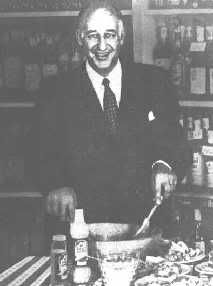
Last week, while grocery shopping, I noticed "Cardini's Salad Dressing." To me the name sounded like it could be of northern or Lombardian origin. Later I looked it up online and found that Caesar Cardini, whom the label was named after, is credited as the creator of the "caesar salad." His place of birth is mentioned simply as the "Lake Maggiore region," prior to emigrating to the United States (Sacramento).
Cesare Cardini (February 24, 1896 – November 3, 1956) was an Italian American restaurateur, chef, and hotel owner, who is credited with creating the Caesar salad.
He was born in the region of Lago Maggiore and had at least four siblings: Alessandro, Carlotta, Caudencio and Maria. While the sisters stayed in Italy, the three brothers emigrated to America; Alessandro and Caudencio eventually were in the restaurant business in Mexico City. Alessandro, who was called Alex in the USA, is reported to have been Caesar's partner in Tijuana, Mexico.
After having worked in European gastronomy, Caesar went to the United States in his early 20s. He ran a restaurant in Sacramento, then he moved to San Diego where he was in the restaurant business. At the same time he engaged in the same business in Tijuana, where he could avoid the restrictions of prohibition. He married Camille, and had a daughter, Rosa Maria Cardini (1928-2003).
Cardini is credited with having created "Caesar's salad" which became fashionable among Hollywood and other celebrities, especially after he had moved his restaurant a few blocks to the hotel built c. 1929 (nowadays called Hotel Caesar's).
The family moved to Los Angeles in 1935 and Cardini focused on the production and marketing of his salad dressing which he trademarked in 1948. He died in Good Samaritan Hospital on November 3, 1956 in Los Angeles following a stroke at his home at 8738 Bonner Drive and was buried in Inglewood Park Cemetery. His daughter took control of Caesar Cardini Foods Inc. Later, the label Cardini's was sold to a third party. It is still popular and offers more than a dozen varieties of the original recipe.
A Caesar salad is a salad of romaine lettuce and croutons dressed with parmesan cheese, lemon juice, olive oil, egg, Worcestershire sauce, garlic, and black pepper. It may be prepared tableside.
History
The salad's creation is generally attributed to restaurateur Caesar Cardini, an Italian immigrant who operated restaurants in Mexico and the United States. Cardini was living in San Diego but also working in Tijuana where he avoided the restrictions of Prohibition. His daughter Rosa (1928–2003) recounted that her father invented the dish when a Fourth of July 1924 rush depleted the kitchen's supplies. Cardini made do with what he had, adding the dramatic flair of the table-side tossing "by the chef."
Julia Child claimed to have eaten a Caesar salad at Cardini's restaurant when she was a child in the 1920s.
Nonetheless, the earliest contemporary documentation of Caesar Salad is from a 1946 Los Angeles restaurant menu, twenty years after the 1924 origin asserted by the Cardinis.
Recipe
The original Caesar salad recipe (unlike Alex's Aviator's salad) did not contain pieces of anchovy; the slight anchovy flavor comes from the Worcestershire sauce. Cardini was opposed to using anchovies in his salad.
In the 1970s, Cardini's daughter said that the original recipe included whole lettuce leaves, which were meant to be lifted by the stem and eaten with the fingers; coddled eggs; and Italian olive oil.
The trademarks "Cardini's", "Caesar Cardini's" and "The Original Caesar Dressing" are all claimed to date to February 1950, though they were only registered decades later, and more than a dozen varieties of bottled Cardini's dressing are available today. Some recipes include mustard, avocado, tomato, bacon bits, garlic cloves or anchovies. Cardini's Brand original Caesar dressing is somewhat different from Rosa's version.
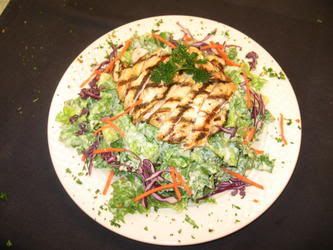
Many restaurants offer a more substantial salad by topping a Caesar salad with grilled chicken, steak, or seafood. Certain Mexican restaurants may improvise on items such as substituting tortilla strips for croutons and Cotija cheese for the Parmesan, or the addition of tomatoes.
Ingredients
Ingredients according to the Hotel Caesar's recipe from about 2006:
*Romaine or cos lettuce
*Olive oil
*Fresh crushed garlic – often in olive oil
*Salt to taste
*Fresh-ground black pepper
*Wine vinegar
*Lemon juice or lime juice - fresh squeezed
*Worcestershire sauce
*Raw or coddled egg yolks
*Freshly grated Parmesan cheese
*Freshly prepared croutons
Variations
There are limitless variations. However, some of the more common are:
*Other varieties of lettuce
*Grilled poultry (most often chicken), meat, shellfish, or fish
*Capers
*Romano cheese
*Anchovies
*Bacon
.
Subscribe to:
Posts (Atom)