Friday, October 26, 2012

Christianity's relationship with witchcraft: Part 3

Christianity's relationship with witchcraft: Part 3

I wanted to make a few closing points to this series, as well as tie in a few loose ends. First of all, I'm not an "ex-Christian," nor am I "anti-Christian." I just think that ExChristian.net did a good job, intrinsically, on this particular piece. This text was from one of their podcasts, but I thought it was important to make a text reference of it. I recall, unfortunately, of having lost important articles and text in the past. For the companion podcast, click here and select "Christianity's relationship with witchcraft" from the menu box.

I will also point out that every religion, spiritual tradition, and folk tradition of our ancestors is a part of this blog. Also, this blog has taken a look at religious and spiritual concerns of other peoples who have lived and have deep roots in North America... Christian/Catholic, or not. It is estimated, and I will post the references here in time, that the Camunian Valley was I recall about one-third "pagan" prior to the Val Camonica witch trials. If we are not sympathetic to the issue of this persecution, then who is!? Those Camunian Catholics and "Heathens" of the Middle Ages lived together in harmony.

The only thing I would disagree with in this article was the term "witchcraft." Although loosely a "magical tradition," I believe that most of the Camunian Heathenry were merely observing the "wheel of the year" and other ancient pre-Christian rites. Few literally practiced "magic," I believe, beyond simple folk traditions. "Heathenry" means "people of the hearth," or an earth-based spiritual tradition. In the Middle Ages, and going right back into the ancient world, the Camunian and Tellinian Heathens would gather on the very mountainous Tonale Pass to observe the seasonal sabbats. It was "Heathenism" (polytheistic earth-based religion), and prior to a millennium ago, it was "the religion of our people." 

It probably didn't have "one name," but it later became known locally as "Stregaria." An old Camunian word, "Engermadura," may have had the same or a similar meaning. It likely meant "spell" or "charm." Another old Camun word, "Bodena," seems to be a reference to the ancient "stag god".... probably Cernunnos. It is translated to something like "the denomination of the old stag," and it seems to have been a type of reference to an actual name of the faith. Despite the chief male god--along with various other goddesses, and sometimes gods--the tradition seems to have clearly been more maternal, symbolized by the moon.


What is covered on this blog?

1) Items having to do with the Camunian, Brescian, Bergamask, Lombard, or Italian-Swiss cultures--past or present--which would include prior cultures of Lombardy. Also, openly reaching out to these concerns worldwide.

2) Items having to do with religion and spiritual traditions, which mainly include Christian denominations and Heathen traditions of past or present Lombardians, Europeans, or peoples with roots in North America. Also reaching out, in some form, to these concerns worldwide.

3) Items having to do with the environment, the natural world, the earth, and the universe; all of which our ancestors cared a lot about. Also reaching out, in some form, to some of these concerns worldwide.

4) Reaching out, in some form, to other more smaller "sub-ethnic" European-American concerns or regional/provincial associations relating to the Italian peninsula worldwide. For example, Basque, Bavarian, Welsh, Piedmontese, or Bergamask.

The more controversial items are purposely avoided. However, this doesn't mean that they should be avoided by individuals.


What are our goals?

1) Helping to facilitate the establishment of a "Lombardian-American" society of some type. For association, cultural enrichment, and study. This would be best headquartered somewhere in the Great Lakes region. Iron Mountain would seem appropriate. There needs to be a property, building, and at least two full-time staff to start.

2) To develop the idea of people of Camunian roots on this continent as something equivalent to a Scottish clann. Our heritage is unique. We should see ourselves as more of a family than a culture or demographic. We're currently invisible.

3) To restore honor, in some form, to the spiritual tradition of which we are all heirs to. Even if you're 100% Catholic, what makes us so different to modern Greek communities who--while practicing Greek Christian Orthodoxy--share a great reverence to their polytheistic ancestry. Why should we be so different?

Goal number one is really THE goal. It's the minimum of what we expect to accomplish. A person in California of Italian-Swiss ancestry, should feel entirely connected though that heritage to a person in Wisconsin of Bergamask ancestry. Their forefathers spoke the same Lombard language for many centuries! There should not be this disconnect.

.

Thursday, October 25, 2012

Christianity's relationship with witchcraft: Part 2

Christianity's relationship with witchcraft: Part 2

Witchcraft was now classified a heretical cult. Not only that, but it was considered heretical to not believe in the power of the Devil. The punishments against witchcraft were carefully laid out, as well as the methods for detecting and trying witches. The hitherto sporadic cases of witchcraft were now to be viewed as a cohesive group that had been marshaled together by Satan to attack and destroy Christianity.

In view of this calamitous assault on Christ, the pope commissioned Henrich Kramer and Jacob Sprenger, educated Dominicans who occupied high positions at the University of Cologne, to systematically bring witches to trial and punishment. They carried out their assignment with a vengeance. ref

Pope Innocent’s immediate successors followed his lead and anyone who opposed the repressive measures could be considered in league with the witches. In the case of Venice, the entire state was threatened by Leo X if it did not obey the Inquisition in apprehending witches. Venice bowed to the Pope's threat, and within a year Venice had sentenced 70 witches to the flames.

The Witches Hammer, the Malleus maleficarum, is the most important and nefarious legacy the world has on witchcraft. Published in 1486, it was written by Heinrich Kramer and Jacob Sprenger. Their book is divided into three parts: the first proves the existence of witchcraft; the second sets forth the forms in which it manifested itself; the third describes the rules for its detection and prosecution. It states that the world in the last quarter of the 15th century was more given over to the devil than in any preceding age. It appeals to the Scriptures, the teachings of the Church and especially to Augustine and Thomas Aquinas for support. Witches and sorcerers are described as meeting at weekly sabbats and do the devil homage by kissing his ass. Satan appears among them as a tom-cat, goat, dog, bull or black man while demons of both sexes swarm at the meetings. During these sabbats, baptism and the Eucharist are ridiculed and the cross trampled upon. After an abundant feast the lights are extinguished and at the devil’s command of "Mix, mix," the participants celebrate with a lewd orgy. The devil, however, is a strict disciplinarian and applies the whip to errant members. Further, the book states that witches are supposedly transported through the air, they kill unbaptized children, and later they eat them. There is a very frequent mention of sexual intercourse. To quote: "…it is common to all of them to practice carnal copulation with devils.” Interestingly, there are two full chapters devoted to this topic alone.

For evidence of the reality of their charges, the authors cite their own extensive experience and declare that, in 48 cases of witches brought before them and burnt, all the victims confessed to having practiced abominable whoredoms for between 10 to 30 years.

Among the precautions which the book prescribed against being bewitched, are the Lord’s Prayer, the cross, holy water and salt, and the Church formulas of exorcism. It also adds that inner grace is a preservative.

The directions for the prosecution of witches, given in the third part of the treatise, are set forth in great detail. Public rumor was a sufficient cause for an indictment. The accused were to be subjected to the indignity of having the hair shaved off from their bodies, especially the more secret parts, lest perchance some imp or charm might be hidden there. Careful rules were given to the inquisitors for preserving themselves against being bewitched. If someone too zealously defended the witch, then that was taken as evidence that he was himself under the same influence. One of the devices for exposing guilt was a sheet of paper the length of Christ’s body inscribed with the seven words of the cross. This was to be bound on the witch’s body at the time of the mass, and then the ordeal of torture was applied. This measure almost invariably brought forth a confession of guilt. The ordeal of the red-hot iron was also recommended, but it was to be used with caution, as it was the trick of demons to cover the hands of witches with a salve made from a vegetable essence which kept them from being burnt. Such a case supposedly happened in Constance, the woman being able to carry the glowing iron six paces and thus going free.

The Witches Hammer was printed in many editions. It was issued 13 times before 1520 and 16 more times from 1574–1669.

That concludes part one of a three part series on Christianity’s fascination with witchcraft. You’ve been listening to the Ex-Christian Monologues, a podcast from ExChristian.Net.


Ref: Shaff-Herzog Encyclopedia of Religious Knowledge | History of the Christian Church | The Malleus Maleficarum


.

Wednesday, October 24, 2012

Christianity's relationship with witchcraft: Part 1

Christianity's relationship with witchcraft: Part 1

Hello, you’re listening to the Ex-Christian Monologues, a podcast from ExChristian.Net. I’m Dave, and today’s date is April 24, 2006.

Today I want to talk a little bit about Christianity’s historic relationship with witchcraft. This is part one of a three-part podcast. Part One draws heavily on the History of the Christian Church by Philip Schaff and the New Schaff-Herzog Encyclopedia of Religious Knowledge. Schaff’s classic work is in the public domain and freely available on the Internet.

Most primitive cultures attributed witches with the power to supernaturally injure crops, animals, health, and possessions. Many ancient cultures created laws to punish the offense. As in other cultures, the ancient Hebrews condemned witchcraft, as expressed in the Mosaic Law (
Deut 18:10 & Exodus 22:18). Following in Judaism's footsteps, the early Christian Church believed in and condemned witchcraft Acts 19:19, Acts 8:9. (Click here for Moree examples).

Belief in witchcraft never disappeared, but it wasn’t always severely persecuted. The Synod of Reisbach in 799, for example, formally mandated penance as a punishment for women convicted of witchcraft, but prohibited any capital punishment. For a time the official rhetoric of the Church even tried to tone down belief in magic or witchcraft, labeling it as either false superstition or delusion.

For centuries Christianity had taught that God was in HIS heaven, far removed from human society. The Church encouraged people to be content with their miserable, medieval lot in life. Poverty and sickness were considered gifts of God that helped people remain holy by focusing their minds away from this world and on to the next. Physical pleasures should be shunned — this life was to be endured, but not necessarily enjoyed. Common people weren't easily convinced to meekly adopt this philosophy — many hung on tenaciously to a belief in magic. They thought magic could empower them to deal with the some harsh realities of their lives. Belief in magic, instead of subsiding, actually grew.


Some so-called heretical groups, and some well meaning churchmen, doubted that witchcraft was anything more than illusions of the Devil. Most were convinced that witchcraft was a real power, fueled by the denizens of hell.

Witches were reportedly transporting people through the air and holding meetings, or sabbats, where they indulged in lust-filled orgies with demons. Mention is given to these activities in the The Bishop’s Canon, which appeared first in the 10th century and was later incorporated by Franciscus Gratianus, a lawyer from Bologna, in his collection of canon law in 1150. Women confessed to flying through the air, but Gratianus considered the women delusional. English author, diplomat and bishop of Chartres John of Salisbury, felt the stories illusions propagated by the Devil. But, his contemporaries, such as Englishman Walter Map, reported that the wild orgies were real, with the Devil appearing on the scene in the form of a tom-cat.

According to Philip Schaff, the daughter of a count was carried through the air every night, one night even escaping the arms a Franciscan monk who tried to hold her back. In 1275, a woman of Toulouse, under torture, confessed she had indulged in sexual intercourse with a demon for many years and had given birth to a part wolf, part serpent, monster. She added that she sustained the creature by feeding murdered children to it.

Pope after pope called upon the Inquisition to root out and punish witches alongside the heretics they were already persecuting. Pope Gregory IX issued a bull in 1231 invoking the use of civil punishment against witchcraft. Dominican theologians spread the belief that incubi and succubi were mating with people—a belief that was rooted in Augustine’s “City of God,” xv23., as well as in the Genesis account of angels mating with humans.

In 1233, Pope Gregory IX asserted that the Devil was making appearances in the forms of a toad, a pallid ghost and a black cat. His papal bull, the “Vox Rama,” shockingly and graphically detailed what was taking place during witch's satanic, sexual orgies, and with the stroke of his pen launched an official, large-scale persecution of witches.

In 1274, Thomas Aquinas supported the claims that humans were cohabitation with demons, and even declared that old women could inject an evil essence into young people with just a glance. I suppose that's where the evil eye myth was born.

Jean Gerson, the leading theologian of his age, said it was heresy and impious to doubt the practice of witchcraft, and Pope Eugenius IV spoke in detail about those who made pacts with demons and sacrificed to them.

Among all the papal and other documents on witchcraft, perhaps the place of pre-eminence is held by the papal bull, Summis desiderantes issued by Innocent VIII in 1484. The pontiff wrote, “…by their incantations, charms, and conjurings… they cause to perish the offspring of women, the foal of animals, the products of the earth, the grapes of vines, and the fruits of trees, as well as men and women, cattle and flocks and herds and animals of every kind, vineyards also and orchards, meadows, pastures, harvests, grains and other fruits of the earth… and hinder men from begetting and women from conceiving, and prevent all consummation of marriage; that, moreover, they deny with sacrilegious lips the faith… at the risk of their own souls, to the insult of the divine majesty and to the pernicious example and scandal of multitudes.”


.

Tuesday, October 23, 2012

Mother Cabrini Shrine (Wikipedia)

Mother Cabrini Shrine (Wikipedia)

Mother Cabrini Shrine is a shrine to Saint Frances Xavier Cabrini, known as Mother Cabrini, located in Golden, Colorado, United States.

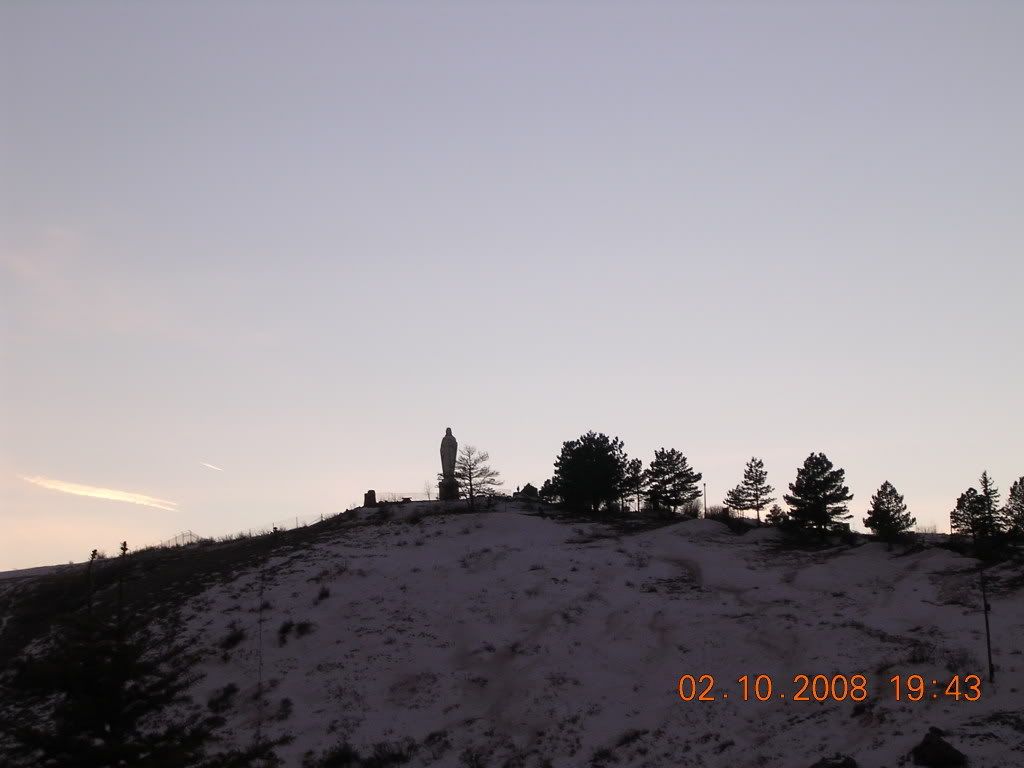
The shrine site includes the Stone House, listed on the National Register of Historic Places as the Queen of Heaven Orphanage Summer Camp, a 22 feet (6.7 m) statue of the Sacred Heart of Jesus designed by Maurice Loriaux, and a convent of the Missionary Sisters of the Sacred Heart of Jesus, the order founded by Mother Cabrini.


History

Mother Frances Xavier Cabrini found the property, which had two barns and a springhouse but no reliable source of water, on the side of Lookout Mountain in 1902. She negotiated the purchase of the property in 1910 to use as a summer camp for Queen of Heaven Orphanage. A small farming operation was established and operated by Sisters of the Sacred Heart and during the summer, the camp saw groups of girls from the orphanage to enjoy the outdoors and perform farm chores.

Water was hauled up to the camp from the stream in Mount Vernon Canyon until 1912, when Mother Cabrini discovered a spring on the property. A replica of the grotto of Lourdes was built over the spring in 1929, then demolished and replaced by the current sandstone grotto in 1959. The Stone House, designed as a dormitory for the summer camp, began construction in 1912 and was completed in 1914.

The property became a pilgrimage site in 1938 following Mother Cabrini's beatification. The property was established as a shrine in 1946, the year she was canonized. In 1954, a 22 feet (6.7 m) statue of the Sacred Heart of Jesus, designed by Maurice Loriaux and mounted on an 11 feet (3.4 m) base was erected at the highest point of the site. A 373-step stairway was placed, following the path Mother Cabrini took to the top of the mountain, and is taken by pilgrims today.

The summer camp closed in 1967 and the Stone House was used as a convent until a permanent convent building was completed in 1970. Today, the convent contains a chapel, meeting rooms, a gift shop, housing for the resident Sisters, and overnight accommodations for visitors.


Location
 

Mother Cabrini Shrine
20189 Cabrini Boulevard
Golden, Colorado 80401


.

Monday, October 22, 2012

Mother Cabrini Shrine Golden Colorado


Mother Cabrini Shrine Golden Colorado
 

Uploaded by DYNORECORDINGS

A walk up the 400+ steps at the Mother Cabrini Shrine in Golden Colorado on a beautiful Summer day. I have made the climb many time and its is not as easy as it looks....but well worth it


**************************************************


I wanted to add here that this is an impressive monument. Not a large gaudy structure, but an interesting outdoor assent up towards the sky. Also, just the location, in the middle of North America, and apparently at a higher elevation than Denver. Perfect. Good video. I would really like to visit this shrine; and much more so than Mother Cabrini's displayed remains. Actually, the main stature is of Jesus, but there's a relatively large Mother Cabrini statue there as well.

MotherCabriniShrine.org

Mother Cabrini Shrine Colorado view at entrance (views from a distance)

MOTHER CABRINI SHRINE (more complete video on a more crowded day)

.

Friday, September 28, 2012

Everything you need to know: Harvest Moon 2012


Everything you need to know: Harvest Moon 2012 (EarthSky.org)

The Harvest Moon is coming! Harvest Moon is the full moon closest to the autumn equinox. It’s the full moon of September 29-30.

The Harvest Moon is coming this weekend! The moon has been waxing larger each night, and full moon is the night of September 29-30, 2012. In traditional skylore, the Harvest Moon is the full moon closest to the autumnal equinox. For us in the Northern Hemisphere, the autumnal equinox came on September 22. That makes the September 29-30 full moon the Harvest Moon.

Order your 2013 moon calendar today.

There’s also a name for the next full moon after the Harvest Moon. It’s called the Hunter’s Moon, and it’ll come this year on October 29.

Officially, the crest of the full Harvest Moon will happen on September 29, 2012 at 10:19 p.m. CDT (3:19 on September 30 Universal Time). Depending upon your time zone, the full moon will be September 29 or 30. But the moon will appear round and full on all the nights around this full moon.

So don’t just look for the Harvest Moon on the night of September 29 or 30. Look for the moon to be bright and full-looking for several nights at the end of September, 2012. If you live far enough north – for example, in the northern states, Canada or Alaska – the Harvest Moon will continue to shine from dusk until dawn into early October. This procession of moonlit nights is what characterizes the Harvest Moon.


Why is the Harvest Moon special?

Harvest Moon is just a name. It’s the name for the full moon nearest the autumnal equinox. In the Northern Hemisphere, you’ll always see the Harvest Moon in either September or October. In the Southern Hemisphere, a moon with these same characteristics always comes in March or April.

But the Harvest Moon is more. Nature is particularly cooperative around the time of the autumn equinox to make the full moonrises unique around this time.

Here’s what happens. On average, the moon rises about 50 minutes later each day. But when a full moon happens close to the autumnal equinox, the moon (at mid-temperate latitudes) rises only about 30 minutes later daily for several days before and after the full Harvest moon. Why? The reason is that the ecliptic – or the moon’s orbital path – makes a narrow angle with the evening horizon around the time of the autumn equinox. The narrow angle of the ecliptic results in a shorter-than-usual rising time between successive moonrises around the full Harvest Moon.

These early evening moonrises are what make every Harvest Moon special. Every full moon rises around sunset. After the full Harvest Moon, you’ll see the moon ascending in the east relatively soon after sunset for several days in a row at northerly latitudes. The lag time between successive moonrises shrinks to a yearly minimum, as described in the paragraph above. Because of this, it seems as if there are several full moons – for several nights in a row – around the time of the Harvest Moon.

Want to know the time of moonrise in your location? My favorite source of that information is this Custom Sunrise Sunset Calendar. Once you get to that page, be sure to click the box for ‘moon phases’ and ‘moonrise and moonset times.’


Is the Harvest Moon bigger, or brighter or more colorful?

Not necessarily, but the actual size of the Harvest Moon depends on the year. The Harvest Moon has the reputation of being especially big and bright and orange. But it isn’t really the Harvest Moon’s size or brightness that distinguishes it from other full moons. In fact, the 2012 Harvest Moon is a touch smaller than an average-sized full moon.

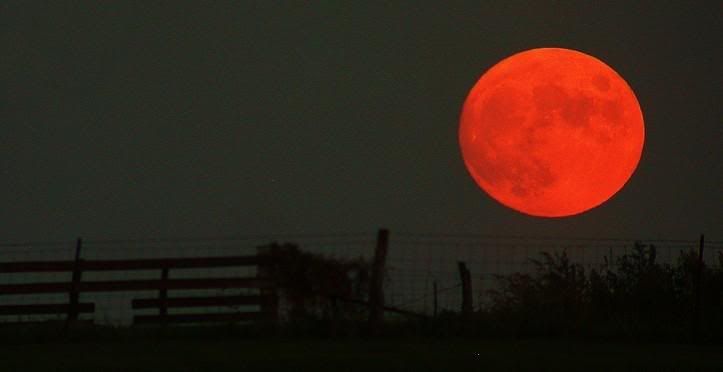
Still, you might think otherwise. That’s because the Harvest Moon has such a powerful mystique. Many people look for it shortly after sunset around the time of full moon. After sunset around any full moon, the moon will always be near the horizon. It’ll just have risen. It’s the location of the moon near the horizon that causes the Harvest Moon – or any full moon – to look big and orange in color.

The orange color of a moon near the horizon is a true physical effect. It stems from the fact that – when you look toward the horizon – you are looking through a greater thickness of Earth’s atmosphere than when you gaze up and overhead. The atmosphere scatters blue light – that’s why the sky looks blue. The greater thickness of atmosphere in the direction of a horizon scatters blue light most effectively, but it lets red light pass through to your eyes. So a moon near the horizon takes on a yellow or orange or reddish hue.

The bigger-than-usual size of a moon seen near the horizon is something else entirely. It’s a trick that your eyes are playing – an illusion – called the Moon Illusion. You can lengthy explanations of the Moon Illusion by googling those words yourself.


How the Harvest Moon got its name

So why is this moon – the moon closest to the autumnal equinox – called the Harvest Moon?

The shorter-than-usual time between moonrises around the full Harvest Moon means no long period of darkness between sunset and moonrise for days in succession. In the days before tractor lights, the lamp of the Harvest Moon helped farmers to gather their crops, despite the diminishing daylight hours. As the sun’s light faded in the west, the moon would soon rise in the east to illuminate the fields throughout the night.

Who named the Harvest Moon? That name probably sprang to the lips of farmers throughout the Northern Hemisphere, on autumn evenings, as the Harvest Moon aided in bringing in the crops. The name was popularized in the early 20th century by the song below.


Shine On Harvest Moon
By Nora Bayes and Jack Norworth (1903)
 

Shine on, shine on harvest moon
Up in the sky,
I ain’t had no lovin’
Since January, February, June or July
Snow time ain’t no time to stay
Outdoors and spoon,
So shine on, shine on harvest moon,
For me and my gal.

 
Bottom line: The Harvest Moon will come in late September in 2012. The Harvest Moon is the full moon closest to the autumnal equinox, which in 2012 comes on September 22. So the full moon of September 29-30 is 2012′s Harvest Moon. October 1 will have a beautiful bright full-looking moon, too. The Harvest Moon is not really bigger, brighter or more pumpkin-colored than other full moons, but it’s special because, at this time of year in the Northern Hemisphere, the time between successive moonrises is shorter than usual. Enjoy.


This week is the “harvest moon.” What does this mean exactly, and what is the “hunter moon” that comes next? (Dictionary.com)

The gigantic, orange globe sitting on the horizon may look like a celestial pumpkin, but it will actually be the harvest moon. (It is also known as the wine moon, the singing moon, or the elk call moon.)

The harvest moon happens once a year. It is the full moon nearest to the autumnal equinox. This lunar phenomenon is often mistaken for the hunter’s moon.  The hunter’s moon, which is also known as the blood or sanguine moon, is the first full moon after the harvest moon.

All full moons make their appearance around the time of sunset. But unlike the ascension of other full moons, there is no period of darkness between sunset and the moonrise of the harvest moon.

This special moon got its name because the immediate moonlight allowed farmers to continue harvesting even after the sun had set.

(If you ever get an email claiming that it will look like there are two moons in the sky, arm yourself with information; here’s the real story.)

The harvest moon can seem larger, brighter, more colorful, and just all around more dramatic than the moon we’re used to seeing. The lovely, autumn color of the harvest on the horizon is caused by light from the moon passing through a greater amount of atmospheric particles. This is true for all celestial bodies when they are low in the sky.

Don’t be alarmed if you experience what’s known as Moon Illusion. This is an optical illusion noted since ancient times where the moon appears larger closer to the horizon than it does higher up in the sky.

On lunar topics, consider the word honeymoon. What does the “moon” part of it actually refer to? It’s not a happy story, but it is fun. Learn the answer, here


Harvest Moon (Wikipedia)

.

Friday, September 7, 2012

Pagan Metal: A Documentary


Pagan Metal: A Documentary

Uploaded by MVDmusicvideo on Oct 18, 2011

First ever documentary about pagan/folk metal from the mind of Bill Zebub (Grimoire of Exalted Deeds magazine, Metal Retardation DVD). - Pagan/Folk Metal has been growing in popularity, and has overthrown Black Metal in Europe. These bands have tested the American shores and have played sold-out shows. The time has come to explore this invasion. This is the first documentary about Pagan/Folk Metal that has ever been made, and it features the best bands from the genre: Korpiklaani, Primordial, Finntroll, Ensiferum, Leaves Eyes, Turisas, and Tyr. Enjoy live performances, learn about the subcultures, and gain insight into the music. The artists give cordial and informative interviews - you will feel like you have made new friends. Two hours of metal await you! From the twisted mind of Bill Zebub (Grimoire of Exalted Deeds magazine, Metal Retardation, Breaking Her Will).

**************************************************

If you can endure the strange/cheesy first four and a half minutes, this is a fairly decent documentary about pagan/folk metal from Scandinavia and Ireland. Remember, this is "native cultural identity music" (pre-Christian). Even if you don't like metal, look for other types of identity music. Some even have a Christian/Catholic theme; and if you find something you like, then support it.

As far as pagan-folk metal, it's not unlike the heavy metal era in the 80s. Some of it good, a lot of it not so good. I think the best one I've heard so far is a band--covered here before--from Barcelona called the Crystalmoors, who play Gaulish-themed metal.

Lastly, you'd be surprised at the sub-culture of this type of music in North America. These bands do tour all around, and we don't generally even hear about it, but they attract good audiences. One good thing about YouTube is that in many cases, they have automatic links on band-specific videos, where you can see where they may be playing near you.

.