Kelcie McKenney - Minnesota Monthly - July 2015 Try a taste from a new vine, and sip on wine from the heart of South America. Piattelli Vineyards from Argentina has just launched a new line from their second winery located in Cafayate, Salta—a northern province of Argentina located on the Tropic of Capricorn.
When their first line of wines—made at their original winery in Lujan de Cuyo, Mendoza, Argentina—made their way into the United States, Minnesota was the first state to get their hands on the freshly imported bottles.
The reason why? Piattelli Vineyards’ owner Jon Malinski is a Minnesota native and lifelong resident who has spent the past 15 years passionate about Argentina’s wine after he and his wife found the potential for a winery on vacation in 2000. While Argentina is the fifth largest wine producer in the world, hardly any of those bottles were being exported—hence the light bulb that went off in Malinski’s head when he realized there was an opportunity he couldn’t pass by.
Today, between both wineries, Piattelli Vineyards has a total of 16 different wines including Malbec, Trinità, Cabernet Sauvignon, Rosé, Torrontés and Malbec-Tannat, with many in reserve, grand reserve and limited edition bottles.
While Piattelli Vineyards’ first winery had 121 acres of land to grow red and white Argentinian grapes, the new winery in Cafayate, Salta, Argentina—a northern sister region of Mendoza—has over 470 acres of land. So beyond those delicious grapes, this new location makes Piattelli the only Argentina wine brand to produce two full lines of wine in two distinct wineries and wine regions. Beyond their unique status, Piattelli Vineyards has won over 35 awards and is currently sold in 10 countries. But the best part is the affordability of the wine. With a price range falling between $10-$30, a bottle of this rich wine—whether on reserve or not—is hard to pass on.
For your first try from Piattelli Vineyards, we suggest their 2013 Cafayate Reserve Malbec. With its 90-point rating from the Wine Spectator and at only $17 a bottle, this wine from their newest vineyard is a delicious steal. Similarly, the 2012 Premium Reserve Malbec from Mendoza also received a 90-point rating and is an equally recommended option.
You can find Piattelli Vineyards at Surdyk’s Liquor Store, Haskell's, South Lyndale Liquors and your local liquor store.
************************* In Argentina, as in northern California, the pioneers of the wine industry have long been people of north Italian regional ancestry. Another connection is the deep roots of Lombard people in both Argentina and the Great Lakes region. For example, Cordoba, Argentina or Duluth, Minnesota are both fairly large cities with deep Lombard roots... although apparently they don't know each other. I guess to complete the circle, the late Robert Mondavi was originally from Minnesota, and achieved his fame and fortune in the Napa Valley wine industry; and his wife was Ticinese/Lombard. I suppose you could just as easily state that both, or even all three, regions also have deep German roots as well. I like this Minnesota-Argentina connection in any form it may take, and further so since I'm an Argentophile and I have family in the Great Lakes region. Piattelli Vineyards website
"The Clan" "Call it a clan, call it a network, call it a tribe, call it a family; whatever you call it, whoever you are, you need one."
"Mabon Song" - By Ruth Calder Murphy: Click "Show More" for information and a copy of the lyrics. Enjoy!
"Mabon Song" is a song by Ruth Calder Murphy, with artwork also by Ruth Calder Murphy. The copyright belongs to Ruth Calder Murphy.
If you wish to use any of the material in my videos - lyrics, music or visuals - in a different context from the video itself, please feel free to contact me and always use full credits, please, including links to my web page(s) where possible.
If you've enjoyed and/or used my video, I'd love to hear from you!
I can be contacted through any of the following web pages:
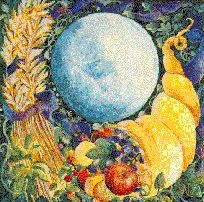
Cut the corn and store the grain, lay the Summer in the Earth, die that life will come again; Darkness leads to Light's rebirth.
Dance to Harvest gathered in, Sing the song of golden corn, Echoes of the far-off Spring, Summer that will be re-born.
Cut the corn and store the grain, lay the Summer in the Earth, die that life will come again; Darkness leads to Light's rebirth.
Dance to all that is Divine, Sing with one exalting breath; Join through every place and time - Death in Life and Life in Death. Cut the corn and store the grain, lay the Summer in the Earth, die that life will come again, Darkness leads to Light's rebirth.
Dance the dance of Evermore, Sing the song of Everything, Earth, air, fire and water, pour - Harvest safely gathered in.
Cut the corn and store the grain, lay the Summer in the Earth, die that life will come again, Darkness leads to Light's rebirth.
Dance to Spirit, infinite Sing to Air, Fire, Water, Earth, Dance the Day and dance the Night, Darkness leads to Light's rebirth.
Cut the corn and store the grain, lay the Summer in the Earth, die that life will come again, Darkness leads to Light's rebirth. **************************************************
What is the "fall equinox" — and how do we know when it happens?
To those who’ve unpacked their winter coats, closed their windows at night, and felt that telltale crispness in the air, it seems that autumn has already started. Astronomically speaking, however, the fall season only comes to the Northern Hemisphere on Tuesday, September 23rd at 2:29 Universal Time (10:29 p.m. EDT on Monday, the 22nd). At that moment, the Sun shines directly on Earth’s equator, heading south as seen in the sky. For us northerners, this event is called the autumnal equinox.
This seems awfully precise for seasons that gradually flow from one to the next, but the reason astronomers regard this event as the “End of Summer” and “Beginning of Fall” is because it is marked by a key moment in Earth’s annual orbit.
The apparent position of the Sun in our sky is farther north or farther south depending on the time of year due to the globe's axial tilt. Earth's rotational axis does not point straight up and down, like the handle of a perfectly spinning top, but is slanted about 23½° with respect to our orbit around the Sun.
Another way to think of this is that the plane defined by Earth's orbit around the Sun (called the ecliptic) is tilted with respect to the planet's equator. From our perspective, the Sun follows the ecliptic in its path through the sky throughout the year. Each day the Sun's daily arc moves northward or southward, depending on the time of the year. To observers at northern latitudes (in the U.S., Canada, and Europe, for example), the Sun appears to sneak higher in the sky from late December to late June, only to drop down again from late June through late December. The equinox occurs when the Sun is halfway through each journey.
This axial tilt also produces our seasons. When Earth is on one side of its orbit, the Northern Hemisphere is tipped toward the Sun and receives more direct solar rays (and more daylight hours) that produce the familiar climes of summer. Six months later, when Earth is on the opposite side of its orbit, the Northern Hemisphere is tipped away from the Sun. The slanting solar rays heat the ground less and daylight is shorter, producing the colder winter season.
The same pattern occurs, but in reverse, for the Southern Hemisphere. There September’s equinox marks the beginning of spring, while March’s equinox signals the start of fall. Christmas is a warm holiday in Sydney, Australia. For those living in equatorial regions, however, there are usually only two recognizable seasons: wet and dry; and the days themselves vary less in length.
Several other noteworthy situations happen on the equinoxes:
* Day and night are nearly the same length; the word “equinox” comes from the Latin aequinoctium, meaning “equal night,” according to the Oxford English Dictionary. However, a poke around your almanac will show that day and night are not precisely 12 hours each, for two reasons: first, sunrise and sunset are defined as when the Sun’s top edge — not its center— crosses the horizon. Second, Earth’s thick atmosphere refracts the Sun’s apparent position slightly when the solar disk sits very low on the horizon.
* The Sun rises due east and sets due west, as seen from everywhere on Earth; the equinoxes are the only times of the year when this occurs.
* Should you be standing on the equator, the Sun would pass exactly overhead at midday. Were you standing at the North Pole or South Pole, the Sun would skim completely around the horizon. .
The Harvest Moon is coming this weekend! The moon has been waxing larger each night, and full moon is the night of September 29-30, 2012. In traditional skylore, the Harvest Moon is the full moon closest to the autumnal equinox. For us in the Northern Hemisphere, the autumnal equinox came on September 22. That makes the September 29-30 full moon the Harvest Moon.
There’s also a name for the next full moon after the Harvest Moon. It’s called the Hunter’s Moon, and it’ll come this year on October 29.
Officially, the crest of the full Harvest Moon will happen on September 29, 2012 at 10:19 p.m. CDT (3:19 on September 30 Universal Time). Depending upon your time zone, the full moon will be September 29 or 30. But the moon will appear round and full on all the nights around this full moon.
So don’t just look for the Harvest Moon on the night of September 29 or 30. Look for the moon to be bright and full-looking for several nights at the end of September, 2012. If you live far enough north – for example, in the northern states, Canada or Alaska – the Harvest Moon will continue to shine from dusk until dawn into early October. This procession of moonlit nights is what characterizes the Harvest Moon.
Why is the Harvest Moon special?
Harvest Moon is just a name. It’s the name for the full moon nearest the autumnal equinox. In the Northern Hemisphere, you’ll always see the Harvest Moon in either September or October. In the Southern Hemisphere, a moon with these same characteristics always comes in March or April.
But the Harvest Moon is more. Nature is particularly cooperative around the time of the autumn equinox to make the full moonrises unique around this time.
Here’s what happens. On average, the moon rises about 50 minutes later each day. But when a full moon happens close to the autumnal equinox, the moon (at mid-temperate latitudes) rises only about 30 minutes later daily for several days before and after the full Harvest moon. Why? The reason is that the ecliptic – or the moon’s orbital path – makes a narrow angle with the evening horizon around the time of the autumn equinox. The narrow angle of the ecliptic results in a shorter-than-usual rising time between successive moonrises around the full Harvest Moon.
These early evening moonrises are what make every Harvest Moon special. Every full moon rises around sunset. After the full Harvest Moon, you’ll see the moon ascending in the east relatively soon after sunset for several days in a row at northerly latitudes. The lag time between successive moonrises shrinks to a yearly minimum, as described in the paragraph above. Because of this, it seems as if there are several full moons – for several nights in a row – around the time of the Harvest Moon.
Want to know the time of moonrise in your location? My favorite source of that information is this Custom Sunrise Sunset Calendar. Once you get to that page, be sure to click the box for ‘moon phases’ and ‘moonrise and moonset times.’
Is the Harvest Moon bigger, or brighter or more colorful?
Not necessarily, but the actual size of the Harvest Moon depends on the year. The Harvest Moon has the reputation of being especially big and bright and orange. But it isn’t really the Harvest Moon’s size or brightness that distinguishes it from other full moons. In fact, the 2012 Harvest Moon is a touch smaller than an average-sized full moon.
Still, you might think otherwise. That’s because the Harvest Moon has such a powerful mystique. Many people look for it shortly after sunset around the time of full moon. After sunset around any full moon, the moon will always be near the horizon. It’ll just have risen. It’s the location of the moon near the horizon that causes the Harvest Moon – or any full moon – to look big and orange in color.
The orange color of a moon near the horizon is a true physical effect. It stems from the fact that – when you look toward the horizon – you are looking through a greater thickness of Earth’s atmosphere than when you gaze up and overhead. The atmosphere scatters blue light – that’s why the sky looks blue. The greater thickness of atmosphere in the direction of a horizon scatters blue light most effectively, but it lets red light pass through to your eyes. So a moon near the horizon takes on a yellow or orange or reddish hue.
The bigger-than-usual size of a moon seen near the horizon is something else entirely. It’s a trick that your eyes are playing – an illusion – called the Moon Illusion. You can lengthy explanations of the Moon Illusion by googling those words yourself.
How the Harvest Moon got its name
So why is this moon – the moon closest to the autumnal equinox – called the Harvest Moon?
The shorter-than-usual time between moonrises around the full Harvest Moon means no long period of darkness between sunset and moonrise for days in succession. In the days before tractor lights, the lamp of the Harvest Moon helped farmers to gather their crops, despite the diminishing daylight hours. As the sun’s light faded in the west, the moon would soon rise in the east to illuminate the fields throughout the night.
Who named the Harvest Moon? That name probably sprang to the lips of farmers throughout the Northern Hemisphere, on autumn evenings, as the Harvest Moon aided in bringing in the crops. The name was popularized in the early 20th century by the song below. Shine On Harvest Moon By Nora Bayes and Jack Norworth (1903) Shine on, shine on harvest moon Up in the sky, I ain’t had no lovin’ Since January, February, June or July Snow time ain’t no time to stay Outdoors and spoon, So shine on, shine on harvest moon, For me and my gal. Bottom line: The Harvest Moon will come in late September in 2012. The Harvest Moon is the full moon closest to the autumnal equinox, which in 2012 comes on September 22. So the full moon of September 29-30 is 2012′s Harvest Moon. October 1 will have a beautiful bright full-looking moon, too. The Harvest Moon is not really bigger, brighter or more pumpkin-colored than other full moons, but it’s special because, at this time of year in the Northern Hemisphere, the time between successive moonrises is shorter than usual. Enjoy.
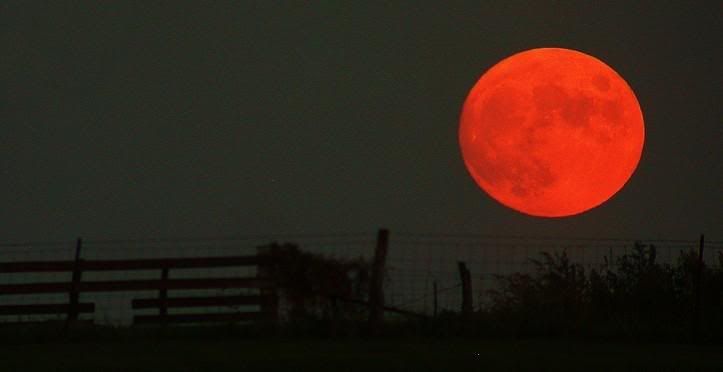
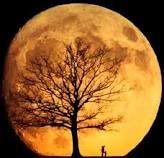
The gigantic, orange globe sitting on the horizon may look like a celestial pumpkin, but it will actually be the harvest moon. (It is also known as the wine moon, the singing moon, or the elk call moon.)
The harvest moon happens once a year. It is the full moon nearest to the autumnal equinox. This lunar phenomenon is often mistaken for the hunter’s moon. The hunter’s moon, which is also known as the blood or sanguine moon, is the first full moon after the harvest moon.
All full moons make their appearance around the time of sunset. But unlike the ascension of other full moons, there is no period of darkness between sunset and the moonrise of the harvest moon.
This special moon got its name because the immediate moonlight allowed farmers to continue harvesting even after the sun had set.
(If you ever get an email claiming that it will look like there are two moons in the sky, arm yourself with information; here’s the real story.)
The harvest moon can seem larger, brighter, more colorful, and just all around more dramatic than the moon we’re used to seeing. The lovely, autumn color of the harvest on the horizon is caused by light from the moon passing through a greater amount of atmospheric particles. This is true for all celestial bodies when they are low in the sky.
Don’t be alarmed if you experience what’s known as Moon Illusion. This is an optical illusion noted since ancient times where the moon appears larger closer to the horizon than it does higher up in the sky.
On lunar topics, consider the word honeymoon. What does the “moon” part of it actually refer to? It’s not a happy story, but it is fun. Learn the answer, here

 'From Argentina to Minnesota: Piattelli Vineyards Launches Second Line'
 Beyond their unique status, Piattelli Vineyards has won over 35 awards and is currently sold in 10 countries. But the best part is the affordability of the wine. With a price range falling between $10-$30, a bottle of this rich wine—whether on reserve or not—is hard to pass on.