Saturday, July 16, 2011

Guido von List: Part 1

Guido von List [from his Wikipedia page]

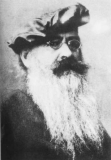
Guido Karl Anton List, better known as Guido von List (October 5, 1848 – May 17, 1919) was an Austrian/German (Viennese) poet, journalist, writer, businessman and dealer of leather goods, mountaineer, hiker, dramatist, playwright, and rower, but was most notable as an occultist and völkisch author who is seen as one of the most important figures in Germanic revivalism, Germanic mysticism, Runic Revivalism and Runosophy in the late 19th century and early 20th century, and continues to be so today.

He is the author of Das Geheimnis der Runen (The Secret of the Runes), which is a detailed study of the Armanen Futharkh, his intellectual world-view (as realised in the years between 1902 and 1908), an introduction to the rest of his work and is widely regarded as the pioneering work of Runology in modern occultism.

Biography

Guido von List was born in Vienna in the Austrian Empire to Karl Anton List, a prosperous middle class leather goods dealer, and Maria List (née Killian). He grew up in the Leopoldstadt district of Vienna. Like the majority of his fellow Austrians at that time, his family was Roman Catholic, and he was christened "Guido Anton List" as an infant in St Peter's Church in Vienna on October 8, 1848.

In 1862 a visit to the catacombs beneath the Stephansdom (St. Stephen's Cathedral in Vienna) made a deep impression, and List regarded the catacombs as a pagan shrine. As an adult he claimed he had then sworn to build a temple to Wotan when he grew up. This he recounted in volume 2 (page 592-593) of his book Deutsch-Mythologische Landschaftsbilder:

It was in the year 1862 - I was then in my fourteenth year of life - when I, after much asking, received permission from my father to accompany him and his party who were planning to visit the catacombs [under St. Stephen's Cathedral in Vienna] which were at that time still in their original condition. We climbed down, and everything I saw and felt excited me with a kind of power that today I am no longer able to experience. Then we came - it was, if I remember correctly, in the third or fourth level - to a ruined altar. The guide said that we were now situated beneath the old post office (today the Wohlzeile House No. 8). At that point my excitement was raised to fever pitch, and before this altar I proclaimed out loud this ceremonial vow: "Whenever I get big, I will build a Temple to Wotan!" I was, of course, laughed at, as a few members of the party said that a child did not belong in such a place… I knew nothing more about Wuotan than that which I had read about him in Vollmer's Wörterbuch der Mythologie.

Despite these artistic and mystical leanings, Guido was expected, as the eldest child, to follow in his father's footsteps as a businessman. He appears to have fulfilled his responsibilities in a dutiful manner, but he took any and all opportunities to develop his more intense mystical and naturesque interests. The trips that List had to make for business purposes gave him the opportunity to indulge his passion for hiking and mountaineering. This activity seems to have provided a matrix for his early mysticism.

His father died in 1877 when List was 29 years old. It appears that neither he nor his mother had his father's keen sense of business, and as economic times became difficult List quit the family business to devote himself full time to his writing, at this time still of a journalistic kind.

During this time List wrote articles for newspapers, such as the Neue Welt (New World), Neue deutsche Alpenzeitung (New German Alpine Newspaper), Heimat (Homeland), and the Deutsche Zeitung (German Newspaper), which dealt with his earlier travels and mystical reflections on the Loci (land spirits). Many of these written newspaper articles were anthologised in 1891 in his famous Deutsch-Mythologische Landschaftsbilder. He also had articles appear in the Leipziger Illustrierte Zeitung and on a regular basis in the newspaper Ostdeutsche Rundschau (East German Review), owned by the powerful publicist and parliamentary deputy Karl Heinrich Wolf. At this time he also came to know well Georg von Schonerer, a leading political figure and Pan-German member of the Imperial Parliament.

He also had many articles appear in periodicals such as Laufers Allgemeine Kunst-Chronik, Der Sammler, Das Zwanzigste Jahrhundert, Die Gnosis, Der Deutsche, Neue Metaphysische Rundschau, Die Nornen, Österreichische Illustrierte Rundschau and Johannes Balzli's occult magazine Prana.

In 1878 List married his first wife, Helene Föster-Peters. However, the marriage was not to last through this difficult period.

Through the years 1877–1887 List was also working on his first book-length (two-volume) effort, Carnuntum, an historical novel based on his vision of the Kulturkampf between the Germanic and Roman worlds centred at Carnuntum around the year 375 CE that was published in 1888 by the Wannieck family's organisation and publishing house Verein "Deutsche Haus" ("German House" Association) in Brno, where List made the acquaintance of the industrialist Friedrich Wannieck. This association was to prove essential to List's future development.

Throughout this period in List's life he devoted himself to writing more neo-romantic prose, such as Jung Diethers Heimkehr ("Young Diether's Homecoming") in 1894 and Pipara in 1895. An anthology of his earlier journalism Deutsch-Mythologische Landschaftsbilder was published in 1891, and List developed his writing skills in poetic and dramatic genres as well.

In 1892 he delivered a lecture on the ancient Germanic cult of Wuotan to the Verein Deutsche Geschichte (German History Association), and it is said that numerous other associations allied with this one proliferated in Austria at this time. Another group, the Bund der Germanen (Germanic League), sponsored a performance of List's mythological dramatic poem, Der Wala Erweckung ("The Wala's Awakening") in 1894. In another performance of this drama in 1895, which was attended by over three thousand people, the part of Wala was read by Anna Wittek von Stecky, a young actress who in August 1899 became List's second wife.

During the years 1888–1899 List was involved with two important literary associations. In May 1891 Iduna, which had the descriptive subtitle of "Free German Society for Literature", was founded by a circle of writers around Fritz Lemmermayer. Lemmermayer acted as a sort of "middle man" between an older generation of authors (which included Fercher von Steinwand, Joseph Tandler, Auguste Hyrtl, Ludwig von Mertens, and Josephone von Knorr) and a group of younger writers and thinkers (which included Rudolf Steiner, Marie Eugenie delle Grazie, and Karl Maria Heidt). The name Iduna was provided by List himself and is that of a North Germanic goddess of eternal youth and renewal. Richard von Kralik and Joseph Kalasanz Poestion, authors with specifically neo-Germanic leanings, were also involved in the circle. The other organisation List was involved with was the Literarische Donaugesellschaft (Danubian Literary Society), which was founded by List and Fanny Wschiansky the year the Iduna was dissolved in 1893. At this time List met Rudolf Steiner and Lanz von Liebenfels but his association with Liebenfels did not develop until Lanz had left the Heiligenkreuz monastery in 1899.

In August 1899, List married Anna Wittek von Stecky.

.

Monday, July 4, 2011

Cernic Rite: Summer Solstice


Cernic Rite: Summer Solstice

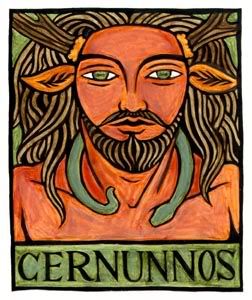
Cernunnos, the Celto-Gallic god of the forest. Ironically, a nearby house featured in this video has a depiction of the Green Man on it. The Cernic tradition goes clear back into the ancient world. So far back that it predates the Norse gods in Europe. However, many of the old ways have mingled with Norse, Slavic, and Mediterranean paganism. The Green Man being one such example.


CERNUNNOS
http://en.wikipedia.org/wiki/Cernunnos

Cernunnos is the conventional name given in Celtic studies to depictions of the horned god of Celtic polytheism. The name itself is only attested once, on the 1st-century Pillar of the Boatmen, but depictions of a horned or antlered figure, often seated in a "lotus position" and often associated with animals and holding or wearing torcs, are known from other instances.

Nothing is known about the god from literary sources, and details about his name, his cult or his significance in Celtic religion are unknown. Speculative interpretations identify him as a god of nature or fertility.


SUMMER SOLSTICE
http://en.wikipedia.org/wiki/Summer_solstice

The summer solstice occurs exactly when the Earth's semi-axis in a given hemisphere is most inclined towards the sun, at its maximum tilt of 23° 26'. Though the summer solstice is an instant in time, the term is also colloquially used like Midsummer to refer to the day on which it occurs. Except in the polar regions (where daylight is continuous for many months), the day on which the summer solstice occurs is the day of the year with the longest period of daylight. The summer solstice occurs in June in the Northern Hemisphere north of the Tropic of Cancer (23°26'N) and in December in the Southern Hemisphere south of the Tropic of Capricorn (23°26'S). The Sun reaches its highest position in the sky on the day of the summer solstice. However, between the Tropic of Cancer and the Tropic of Capricorn, the highest sun position does not occur at the summer solstice, since the sun reaches the zenith here and it does so at different times of the year depending on the latitude of the observer. Depending on the shift of the calendar, the summer solstice occurs some time between December 21 and December 22 each year in the Southern Hemisphere, and between June 20 and June 21 in the Northern Hemisphere.

Worldwide, interpretation of the event has varied among cultures, but most have held a recognition of sign of the fertility, involving holidays, festivals, gatherings, rituals or other celebrations around that time.

The word solstice derives from Latin sol (sun) and sistere (to stand still).


[Music: 'Cernunnos' by Kate West]


**************************************************

I just wanted to add a little to this entry. First, most of the Cernic efforts will be posted here rather than the other blog. I don't want to saturate the PAL blog with paganism. Only that which applies to historical Padan Christian or pagan traditions, while most of the rest can be placed here.

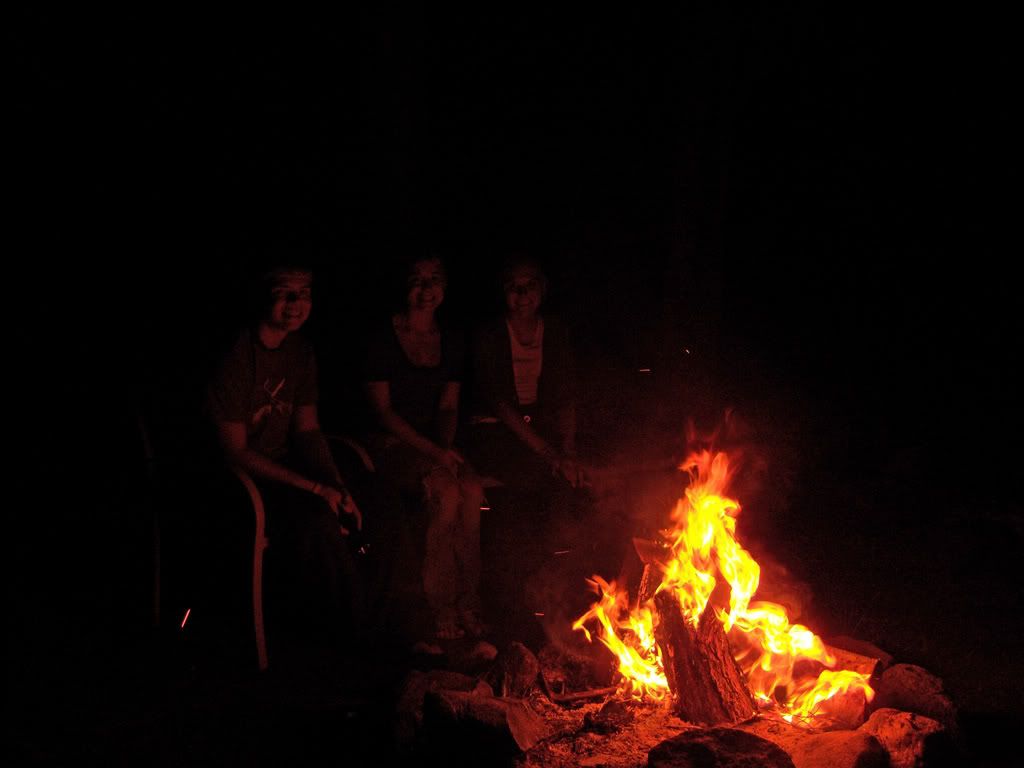
I learned something when I filmed this. I hiked in the dead of night, and it was so dark that I had to wait for some morning daylight in order to even enter the wooded area that I wanted to film. If there is no moonlight, the woods are usually completely black. I learned that it is not safe, for anyone, to hike in a remote area at night. It's easy to laugh, but it's no joke out there. It's an entirely different world at night. I almost bumped into a racoon. Now if I had stepped on it's foot or something, I could have been seriously hurt; or how about stepping on a rattlesnake?

I was carrying a lot of equipment and couldn't manage my failing disposable flashlight very well. It's really only safe to hike at night with others, and with adequate lighting. Actually, it's not even a good idea to hike at anytime alone, unless it's within a safe distance from a road. Another issue that crossed my mind is that it's always a possibility that you could encounter another person, which by itself is all the reason you would need to avoid hiking at night.

.

Monday, June 27, 2011

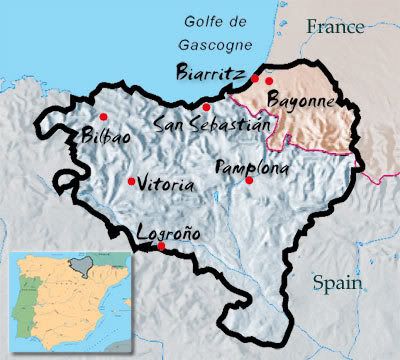
Basque culture, a similar heritage to ours

Learning about cultural groups, usually of a similar background (Europeans), is often a good way to understand your own heritage. The history of the Basques shows many similarities to the Camunians or Lombardian Alpines; however, not much to southern Lombardy.

For one thing, the Basque Country is located within the rugged Pyrenees Mountains between Spain and France, which is similar to our Alpine heritage. Also, the Basques derived partly from the Gallic Celtiberians, which is similar to our Gallic past. They have a distinct language, just like the Camunians or East Lombardians had their own language. Not surprisingly, considering these facts, there seemed to have been a somewhat of a hard road from Gallic paganism to Roman Catholicism. One other similarity is Basque and Camunian history leads us absolutely straight back to prehistoric times. In other words, being partly descended from proto-European peoples.

The Basque diaspora is also somewhat similar to Lombardian migration in general; although many more Basques live on this side of the ocean than do in the Basque Country itself. What I find incredible about Basque communities around the world, seems to be their very strong folkish connection to one another. That is one big difference, as the Risorgimento shattered Lombardian nationhood. Only small out-of-the-way regions, like the Camonica Valley, kept a genuinely distinct identity. We'll get back to this issue later.

Basques migrated very heavily, especially considering that the Basque Country is not particularly large, to Mexico, Argentina, Chile, and Brazil. Of course, we know that Lombardians migrated to South America, especially to "the Cone of South America," but not really to Mexico in any large numbers. All of this is really quite remarkable in comparison. In a larger sense, it could be said that the Basque Country is similar to the Val Camonica, the Ticino, Friuli, the Ladins, and other close-knit mountain communities in the Alps. Amazingly, Basques make up 10% of the population of Argentina.

The United States apparently has only about 57,000 Basque-Americans, less than even Columbia. According to the Basque-Americans Wikipedia page, "The states with the largest Basque-American populations are California (20,868), Idaho (6,637), Nevada (6,096), Washington (2,665) and Oregon (2,627)." However, despite their small numbers, they seem to have made an impact all over the country. Although I have been astounded by the accomplishments of Lombardians in the United States, also in very small numbers (with historically perhaps twice as many Lombardian immigrants) and spread far and wide, I was even more impressed with the strength and folkishness of the Basque communities, also spread very far and wide and thin.

I recall that there was a very small but close-knit Basque community in San Francisco. There are about fifty Basque clubs in the United States. One apparently is in San Francisco. I recall the Basque Hotel in San Francisco, which apparently is the hub of the community here. Boise, Idaho boasts 15,000 Basque-Americans, making it the largest concentration of Basque-Americans. I was going to only make a short entry here, but this is surely an area that I wish to read more about. The more I learn, the more I realize that there is to learn.

**************************************************

7-2-11 ADDITION: A few times in the last several days, I couldn't help after writing this entry, I thought that even further than the similarities here, there is an even closer tie-in between California Basques and California Ticinese. If we look at the culture and terrain of the Basque Country and Ticino, and also of the similarity of their migration and settlement in California (both north and south), the cultural tie-ins are just so similar. The only big difference is that Ticinese are lost between Swiss and Italian identity, while the Basques are not lost between Spanish and French identity.

.

Sunday, June 26, 2011

Three simple long-range goals of the Camonica Club

We have posted our goals here in the past, but perhaps they were not entirely clear. Our goals are very multi-faceted, so there is no definite answer to what our goals are when they are laid out in paragraphs.

For example, we may be interested in looking into the Ambrosian Rite of Catholicism, as it is Lombardian in origin, and certainly a part of our culture. However, that would really belong in the greater scheme of looking into all things Lombardian, and not because we all need to become Ambrosians.

Our chief goals could be herded into three parts. Within each part, there is more of a maze of smaller items that we may want to look into at some point. However, the following are our three main long-term goals.

1) Lombardian-American Society: To develop an association, voice, and organizational structure for those of Lombardian heritage in the United States. The number of people of Lombardian origin in this country is significant enough to justify a "Lombardian-American" cultural identity. There should be a headquarters of some type. A cultural center, probably located somewhere in the Great Lakes region, which would have at least several paid positions. A simple radio studio would be a must, as the opportunity for a community podcast over the internet is a possibility which cannot be passed up. A book and media library in order to conduct research into our heritage, especially our history on this continent, would be a must as well. There is a Tuscan-American Association, which has entirely beaten us to the punch in this area. Naturally we would look to develop local associations in different states as part of this plan. This is a goal even more important than our Camunian plan below.

2) Camonica Club of North America: With the number of people of Camunian ancestry being much smaller than the already small number of people of Lombardian ancestry, it would only make sense to combine all of us who live anywhere on this continent. Camunian heritage means something a little different than the Lombardian whole. In this way, it is almost like an extended family concept. One goal would be just simply to promote our heritage to our kindred. A longer range goal would be to form some type of milieu in every state and province. That could be just one person to start with. In other words, a "Camonica Club of Michigan," a "Camonica Club of Washington," or a "Camonica Club of Ontario." Perhaps one of those "Italians working abroad," who may live in Mexico City or someplace, could be a representative there. We don't have to think of ourselves as being limited by distance. Kindred who live in Alaska or Panama could see each other as distant family.

3) Temple of Cern: This is one area which definitely needs definition. The Camonica Valley has, for a long time, been considered very Catholic. Of that, there is no question. Our Camunian families who migrated to this continent would very likely have been strongly Roman Catholic. However, Greek-Americans are very solidly Orthodox Christians, but have no problem with their pagan past. That pagan past is not brushed under the rug. And remember, the pagan period of Greece was a very long time ago; while our pagan past flourished up to roughly four centuries ago. I mean, lets face it, the entire Italian peninsula was solidly Catholic.... except us! THINK ABOUT THAT!! Our ancestors were not merely a different denomination of Christianity, therefore subject to persecution, but many were pagans. Yes, it's true. There must be something a little different about us, perhaps something in our collective conscience. I think it is our cultural imperative to revive at least an interest in our old Cernic tradition.

.

Wednesday, June 22, 2011

Summer Camp as a Spiritual Experience

I thought that this fit into the pagan concepts that are discussed on this blog. Many times people underplay the significance of a youth summer camp, almost making fun of it in their wording. They will make statements like "oh, singing by the campfire at summer camp." I would disagree. It is a very memorable experience, and one that someone will not likely ever forget. I can even remember the words to songs that were sung when I went to summer camp. In fact, in a truly spiritual nation, it would/should be considered an essential youth experience.

It's the first experience away from home for many kids. For those from urban areas, which would more-or-less be the vast majority, the environment is completely different in every way, especially for me. I went to camp only once at age twelve. Although, in theory, adults could benefit from this experience too, it's not the same as when you a kid and everyone is not so serious or complicated as adults so often are. I can't imagine as to why most people would think that a professional sport game would be soo important, but a life-changing experience like summer camp is... not so special. 99.5% of all those "important games" are completely forgotten from one's memory, while camp is not something that you're likely to ever forget.

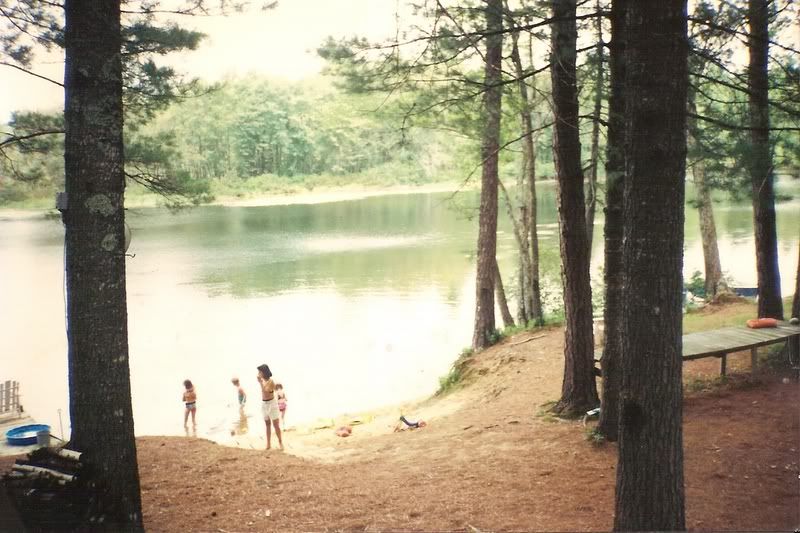
I attended through my grammar school. We left by bus on a Friday, probably early, and returned either the following Friday or Sunday. I forgot exactly, but it felt like three weeks! I won't go through every whistle and bell, but it was an hour drive at the most. The camp was run by the YMCA, and the name was/is "Camp Jones Gulch," which has been around since 1934. Upon arriving, the schedule was very fast-paced. The staff included regulars and volunteers. I can truly say that they were all very friendly and positive. We were broken up into boys and girls, and placed in small groups. One group for each cabin, and a volunteer councilor for each cabin.

The camp was located in the northern Santa Cruz Mountains, in an area not all that far from civilization, but it was plenty "away from it all." Anyone familiar with the Santa Cruz Mountains further south can attest to it's remoteness, but this area was significantly far enough from the lights of urban life to allow one to view a dark sky which was entirely full of stars at night. The camp itself was located in tiny La Honda, California, but in a remote area, apparently within the city limits, although it hardly felt like it as there were no houses anywhere, and there was only one main road cutting through the area. It was almost totally mountain forests, which in some places were so thick that even on the hottest days it was dark and cool in the shade. In some places it was actually dark, despite a clear sky and the sun beating down.

The days went by so fast because we were so busy. There was an outdoor eating area with a roof, and the rest of the time we were either hiking, learning how to make a shelter, taking night walks under the very stary sky, singing, sitting by the campfire, getting short lectures about nature. I can laugh now, but at the time I wasn't very crazy about the "open bathrooms." In other words, the cabin bathrooms had not stalls, with everything right out in the open, and the showers were like "group showers."

I don't really recall seeing many animals, outside of a few hawks or squirrels. I do know that there is a lot of wildlife up there though, including mountain lions. One time nature caught up with us, with one girl from my school getting stung by bees during a hike. Sometimes "nature" sounds almost like a passive word. Nothing could be further from the truth. People should sometimes ponder as to what they would do if they were lost and had to survive in a remote wilderness of any type.

When taking a hike at night, we did stop to gaze at the stary sky. Sometimes I think about how that sky is the same sky that our ancestors observed thousands of years ago. There were complex observatories in Val Camonica, near the villiage of Cevo. The god Cernunnos and other aspects of Camunian culture are based on astronomy. So on that night long ago, at age twelve, in the Santa Cruz Mountains, I observed the same sky that one of my distant forefathers or foremothers observed, at the same age, probably on the the exact same date, possibly eight or ten thousand years ago in the Alpine Mountains.

We don't usually think of it, but every living creature has within it, a "historical memory." I recently purchased an imitation owl to serve as a scare crow against birds who were leaving their droppings on a certain railing. I read where certain birds, like seagulls I think, are not afraid of the owl because they have no historical memory of them. Whereas most do have that memory and will avoid the statue. Foxes are being domesticated now, and it takes several generations to tame them for the same basic reason. That sky is part of my own historical memory.

Most of the children there were from Santa Cruz County. At that time, so many of them were blonde and Nordic-looking. Seeing them within this mountain-forest environment was almost like a historical memory. As the Langobards derived from the Winnili people of ancient Scandinavia, there were many generations who lived in the mountainous forests of central Europe. Perhaps I was having a flashback from the "ancestral memory" from that part of myself.

People could benefit from this type of experience at any point in their lives, but it wouldn't be the same if you could, hypothetically, go to a camp with random people from society, and you were with someone who couldn't wait to get online to check their stocks. I remember the 1993 movie 'Indian Summer', where some adults in their early thirties, had a "summer camp reunion" organized by the longtime facilitator of the camp who was either retiring or closing down the camp, which was located in the northwoods. I don't really think something like that would really happen in that way, but it was a great concept for a movie. What IF people could have types of obscure reunions like that? It's fun to ponder. If you haven't seen that movie, you should.

I was also a cub scout, and later a webelo, as a youth. It would have been interesting to have continued as a boy scout, but boys rarely continue in high school as it's a commitment of time, and with so many activities, it's hard to fit it in. It would be nice if scouting would make a comeback. I know that the woman who is the head ranger in the county I live in was a former girl scout in the area, and from probably about the same time as me, which is interesting.

.

Tuesday, June 21, 2011

Cernism: The Social Remaking of Wicca

There are a lot of ideas that need to be incorporated in this post, so I will just enter them in no particular order to speak of. To start with, "Cernism" is a pagan tradition that probably ties more of Indo-European cultures together than does Odinism. Celto-Gallic peoples lived in ancient France, Germany, the all of the British Isles, Iberia, the Italian peninsula, Scandinavia (Gotland Island), and even the Slavic countries (ex. Poland) and Greece (the "Keltoi). Any European-descended person could lay claim to being an heir to the Cernic tradition. It seems to be at least a stronger cultural-geographical bond than is Odinism. Although the name of the male stag god "Cernunnos" may have existed primarily in central Europe and down to Cisalpine Gaul, expressions of it were clearly found elsewhere.

When Gerald Gardner and company started "Wicca," they set out to create a universalist faith which mixed Celtic spiritual traditions with traditions outside of Europe (ex. Egyptian goddess "Isis" as an idol). It probably should be pointed out that the pentagram had been adopted into Euro-pagan circles for a few centuries. To add insult to injury, many modern Wiccans have used their religion as a political front to what they see as male-dominated, conservative Christianity. To quickly sum all that up, there has been a large amount of deliberate unfairness and slander from both sides and on many levels.

We could just ignore all of that and do our own thing, but the one strong blowback from all of this is the real or perceived rivalry between Christians and pagans. Greek communities are overwhelmingly of the Greek Orthodox denomination of Christianity. However, as folkish people they have no problem honoring their pagan ancestral path. That is a model which we should follow. Even if a person was of Celto-Gallic descent, and was a strong Catholic, why would they have any problem merely partaking in a ceremony which honors the tradition of their ancestors? They wouldn't need to take any oath, or "worship" anything. There can be a distinction between a "religion" and a "spiritual tradition." Of course there will be those who will take it much more seriously, and that could be the one difference between the modern incarnations of the Cernic tradition and the gods of ancient Greece. I don't know of anyone who considers themselves a believer of the ancient Greek gods, although "Gaia" is often floated around by the global elite/universalist crowd as part of a political agenda.

The following is a book review from Amazon.com user "templar357" regarding the book 'Wicca for Men' (Drew; 2000). Some of the latter part doesn't support our emerging position very well, from either our Christian or pagan ideal consensus, but it does bring up a lot of food for thought, and it accurately describes the current status quo:

I find myself trying to break away from the unforgiving, intolerant religion of my fathers, only to be shunned by the largest, fastest growing pagan religion in the U.S. It seems that after several millennia of abuse from the "patriarchal" religions, women have taken the only religion that does not oppress them or make them look like Jezebels and tried to make it their own. Thing is, they made it almost exclusively their own, projecting the same attitude toward men as has been shown to them for so long. Well, this book sets the record straight by pointing out that there is a room a plenty at Gods (esses) table. This book embraces all that is male (The Horned God) and introduces HOW TO EMBRACE THE GODESS AS WELL. This book is a true reconciliation between the two sexes. I started reading this book to affirm my place in the Wiccan religion. Only to find out it had already been done, and now know the real difference between a REAL witch, and these scissor-happy, man hating, neo-feminist "earth mothers" I always seem to run into. This book not only points out the incorrect way many Wiccan covens practice this religion, but also assures the curious and spiritually destitute man that Wicca, in fact, means MALE WITCH. (Sorry, ladies) However, this book takes it one-step further. I now realize the true beauty in seeing a gender duality in divinity because I found out that the Goddess (portion of Divinity seen as female) has never hated me nearly as much as I feared her.

Guys, I am happy to report that SHE IS NOT A THREAT and will welcome you with arms open, not closed. She loves and cares for our father and the reverse is true. THEY ARE THE SAME. I feel the Gods rage in this book as he explains through the author the hurt and outrage he feels to this day when it came to be that man had forsaken his wife, his partner. His best friend, his soul mate. OUR MOTHER.

Now that I have digested and assimilated this new philosophy and religion, I see God and myself in a very different light. In doing so, certain things have happened almost literally overnight.

I have come to know a peace I have never known before and it is through tears of joy that I can now release a lifetime of bigotry, sexism, rage, hate and pain. Simply put:

The Goddess has helped me heal.

Now I understand the conceptual philosophy of gender duality attributed to all things divine and profane, I feel that I know now who my mother is.

And she is so...very...beautiful.

I have been shown that to accept my mother DOES NOT MEAN I MUST FORSAKE MY FATHER. It is the piece missing from the myriad of one-side confusion myself and others have been raised to believe. I now see women in a completely different light as a result of seeing myself differently the product of seeing The Almighty differently. This book IS NOT MEANT as an affirmation for men to reassure them that their conception of divinity must be REPLACED, but EXPANDED. Things began to click with me instantly while Ishtar smiled. All she wanted was for me to know who she was. Moreover, to know that although I may have never known WHO or WHAT she was, she has never forgotten who I AM. More is the pity. Better late than never I suppose.

This book is a calling to all male pagans Wiccan and non-Wiccan alike, to now join our sisters in reuniting the planet as a family and not strangers. Though I would venture to say that a reference to the Goddess as the "consort" to the God would be met with equal disdain from the True Wiccan Woman and earth-mother alike, it also serves to show them how equally distasteful it is to us to have the God referred to by the same title. Unless of course, you mean consort as "partner," that is.

That IS what you meant, right?

THIS BOOK IS FOR MEN AND WOMEN BOTH. To enlighten the man about the Ways of the Wood, while setting the record straight with our fairer counterparts as to equality and "practice what you preach." Ladies, I love you all. Please know that we (men) are coming from the same battle torn, madhouse that is modern religion and we are just as bruised, bloody and hurting as you were when you left. We are glad you have capitalized on a little known secret and exposing it to the world, but please remember that those who started this ball rolling in the 20th century meant to re surface something beautiful and a LOT of those pioneers...

WERE MEN. Buckland and Gardener to name but a few. Remember the witch who helped repeal the anti-witchcraft laws of England in 1951? O.K. that, my dearest sisters was a MAN. Quite a few of these guys were in fact, freemasons, like myself. And it is by no means a coincidence that our initiation rituals are so similar. No coincidence at all, ladies. So when you see one of us staggering toward your camp, hungry, beaten and torn, understand that a kind word, a hot meal and a warm bed can do more for a person in that condition (male or female) than a closed door ever could. See what I have come to understand is that the God (or the conception thereof) did not do this to all of us. HIS INSANE FOLLWERS DID. They took off his horns and replaced them with guns. THIS IS NOT THE GOD. This wrongful conception of masculinity must stop and this book subtly points that out. Even if you are a soldier and have been to war, you want to show me how brave you are?

Try changing a diaper tough guy. Lets see how bad you REALLY are.

We are not just soldiers and conquerors. We are husbands, fathers, lovers and protectors. We are the hunter, the farmer and the Holy Man. When did we loose sight of our roles and responsibilities AS MEN?

When did the farmer become the executive, the warrior a soldier? When did the hunter become a poacher, and the father a deadbeat dad? When did the husband become a tyrant and the father become just a picture on somebody's wall. But most importantly:

What about Mom?

WHEN DID WE KICK HER OUT OF THE HOUSE?

When we did that, we kicked out our wives and mothers as well, tossing out the baby with the bathwater, turning our women into slaves and thus begun the Ruination of the World.

Read this book. Because it can change yours.

Blessed Be :-}

In the Cernic tradition, it appears that the female is largely in charge of facilitating spiritual matters on this planet. I don't think that is an innate rule, but the historical record seems pretty clear on that point. As to how this idea merges with Druidic traditions, which were present in ancient Gaul, I have no idea. It's a complete mystery to me. I do seem to get the idea, from reading a bit about Cernism and possible related traditions, that the Cernic tradition strongly influenced other regions in the ancient world, even if those regions were still primarily of a different pagan tradition. For example, within regions which were strongly Wotanist in faith, there seems to be almost like an alternate spirituality which sounds very similar to Cernism; and yes, it seemed to be very female-oriented. There also seemed to be a strong tolerance between different pagan traditions in pre-Christian Europe. This is perhaps because they may have overlapped each other, and many ideas were mixed together. In the book 'Creed of Iron' (McVan; 1997), Ron McVan argues that "Wotanism" was really the main stem of European paganism. I would argue that Cernism, or forms of it, were more widespread in pre-Christian Europe. Even Stregheria shares much in common with Cernism, and like many expressions of Ásatrú, it shares common origins. Cernism is more purely European than "Northern European Wotanism."

"Ásatrú" is another term for Wotanism or Odinism. Some denominations of Ásatrú appear to be following something much closer to Cernism than to Wotanism. Some followers of Ásatrú appear to be following almost like a form of "folkish Wicca," and that leads us to the key to the entire "Cernic Rite movement." The reformation of the very ancient European pagan tradition, which was present all over ancient Europe for tens of thousands of years. I mean more ancient than the Norse or Mediterranean Europeans, of whom many adopted these traditions after their migration eastward many thousands of years ago. What we are really talking about here is a spiritual tradition which goes back forty thousand years or longer.

Lastly, as part of this, and this is the most important point of all, the "Christian vs. pagan" thing needs to finally be put to rest; or at the very least, those unreasonable Christians and Wiccans should be kept away at a safe distance. To be very clear, I am referring specifically to the unreasonable, not to all Christians and Wiccans. In fact, this milieu could be fertile ground to begin this movement. Males and females should be considered as equals, but we need to accept the fact that at least a few exceptional folkish women will be the chief "facilitators" of spiritual matters and ceremonies, as well as the figureheads of small and large groups.

Not to get too far ahead of ourselves, but it would be nice to select a word to be the equivalent of what "hearth" is to Odinism, or to what a "coven" is to Wicca. In other words, a word for a small community of Cernic native believers. I was thinking of perhaps calling it a "bodina," which an ancient Gallic word which seems to mean the same thing as "midgard." Bodina is the origin for the modern French word "borne," which is translated as "milestone" or "landmark," or even "frontier." It almost sounds like a world which could describe the general area that you live in.

.

Wednesday, June 8, 2011

Interview With a Gothi

This was an interview with Hengest, the head of the "Court of Gothar," which is the ruling council of the Odinic Rite. I believe that I have posted this link a few times, but I wasn't able to find it. I just wanted to post it here as a separate entry. It's a great interview. It's hard to believe that a mere few thousand people have viewed these on YouTube.

The OR is based in the UK, but is a worldwide organization. I believe that this particular interview was conducted in Alberta, Canada. They have displayed the courage, leadership, and responsibility to speak out on the hard issues of our time which dramatically impact us.

One tiresome question which seems to creep up is "who can be an Odinist?" I don't think that within this folkish concept there is any definite dividing line. According to the OR, the answer more-or-less is a European-descended person who also descends from a region where Odinism once existed. Certainly "Langbard" fits into this category, as there are Cisalpine OR groups. Even the music compilation CD, produced by OR Media, feature musical artists from "Langbard" as they put it. This issue seems to get in the way of more important spiritual pursuits.

From the video description: "An interview with Heimgest, leader of the Odinic Rite. The Odinic Rite is an organization whose aims are to promote all aspects of the ancestral religion today called Odinism, the organic spiritual beliefs and way of life of the indigenous peoples of Northern Europe. The watch-words of the Odinic Rite are "Faith, Folk, Family" and this summarizes their ideals well."


Interview with a Gothi - Part 1


Interview with a Gothi - Part 2


Interview with a Gothi - Part 3


Interview with a Gothi - Part 4


.