
Apparently these are real proverbs from the Val Camonica. For each one, the fist part will be in native Camunian, the second in Italian, and the third in English (if it translated correctly):
Ôm stüdiùs màgher mùrüs.
Uomo studioso scarso amante.
Studious man insufficient lover.
--Anonymous
____________
L'è bèla come 'l cül dé là padèla.
È bella come il fondo della padella.
It is beautiful as the bottom of the frying pan.
--Anonymous
____________
Zò le mà dal bànc.
Giù le mani dal banco.
Down the hands from the bench.
--Anonymous
____________
Quànd chè la carne la diénta früsta pò a l'anima la sé giûsta.
Quando la carne diventa vecchia anche l'anima si aggiusta.
When the meat becomes old also l' spirit is fixed.
--Anonymous
____________
'N Avrìl 'l tàca pò 'l mànech de'n badìl.
Ad Aprile fiorisce anche il manico del badile.
To You open them blooms also the handle of attends them.
--Anonymous
.

Wednesday, February 23, 2011
Camunian proverbs: Part 1


Tuesday, February 22, 2011
'The Edge' (1997) movie review

Our ancestors lived in an environment at the same longitude as the state of Washington, and in a similar landscape. Coming out of the last ice age, Europe was probably pretty similar to modern Alaska, which was the location of the film.
Most of their existence was about survival. This was probably why they used animal symbolism for certain traits. For example, a wolf represented courage. They were much more in tune with the idea that "life is struggle." They probably had to contend with animals like the massive Kodiak bear shown in the movie, or with woolly lions, just within just the last several thousand years.
Another factor was that at one point up to about six thousand years ago, agriculture wasn't even possible due to the climate, so hunting would have been the chief source of food. Mammoths, which they hunted, only died out about ten thousand years ago.
'The Edge' is a great movie, which mixes personal struggles between people, with the struggle against the environment. That is a theme that has played itself over and over during eons of time. Anyone even just interested in paganism should see it on that basis alone. There have been movies about the very ancient past; but this movie, with a current theme, makes it easier to relate to the characters.

From 'The Edge' Wikipedia page:
The Edge is a 1997 survival and relationship drama film directed by Lee Tamahori starring Anthony Hopkins as billionaire magazine publisher Charles Morse and Alec Baldwin as Bob Green, one of his ambitious employees. Harold Perrineau also co-stars as the group's photographer Stephen. Elle Macpherson has a supporting role as Hopkins' trophy wife and model for his magazine. Her presence in the beginning of the movie acts as a catalyst for the film's bold rivalry between Baldwin and Hopkins. L. Q. Jones has a supporting role as an innkeeper. Bart the Bear, a trained Kodiak Bear known for appearing in several Hollywood movies, also appears, as a vicious grizzly, and it would be one of his last film roles.
The movie was written by David Mamet and, despite the unusual setting, it touches upon many themes common to Mamet's other works, including the bonding of strong male characters, tough posturings and playful surprises. The story explores, through action and intricate dialog, the survival instincts of these men in terms of their competition with each other and with their environment.
.
Monday, February 14, 2011
Two big revelations from a little pocket book

Let's get the negative one out've the way first. On page 9 under the heading "Language," it states: Un omm al gheva a düü fiö ("A man had two sons") could be the opening of any local fairytale, and anyone who's just done a course in Italian will be annoyed to discover that he doesn't understand a word. The strange language is Lombardian. Never fear, however, only a few small communities high in the mountains continue to communicate in it. The language of Dante - which marked the beginning of Italian literature - was Tuscan, and over the centuries Lombardian was gradually squeezed out by Tuscan Italian as the favored dialect.
Would I be overreacting to conclude that what I just read was someone gloating over the fact that a major part of one of the world's cultures was almost gone? The wording of it, at the least, showed a mindless slant towards the mere temporary visit of a tourist. Heaven forbid, should a person actually believe that Lombardia should still be a sovergn nation, still officially speak their own "strange language," and still be maintained as a intrinsic-homeland for the Lombardian people.
The second one was on page 54 of the chapter entitled 'Route 7' (Lake Iseo). It states: One very rewarding car excursion from the Lago d' Iseo is to Capo di Ponte, halfway up the Val Camonica to the northeast, famed for its prehistoric rock engravings. Around 158,000 of these have been discovered, and they date from different periods - some even from Neolithic times (8,000 years ago). The engravings, many of which show hunting scenes and religious symbols, can be admired in Capo di Ponte's National Rock Engravings Park (Parco Nazionale delle Incisioni Rupestri), which was declared a World Heritage Site by UNESCO in 1979.
The Neolithic dating for some of the Camunian symbols is very significant. It shows an incredible continuity of culture. This was long before the Celts migrated to this region. These were very ancient Alpine people who predated Mediterranean and Nordic peoples in Europe (both having later migrated westward from the Middle East and northern Eurasia). Also, the religious nature of some of the artifacts is significant. Imagine our ancestors, who had great knowledge of the stars, observing them on a perfect night.... 8,000 years ago. Lastly, this second revelation of Neolithic origins gives a perfect basis for why the first is such a negative.
.
Sunday, January 30, 2011
Insübria, Land of Waters
Insübria, as we all should know, is the name for Western Lombardy. It's named after the Celtic tribe, the Insubres, who occupied that region in pre-Roman times. In a perfect world, Insübria would be a state of Padania. Western Lombardy (including Milan, and Ticino, Switzerland) have a different native dialect than eastern Lombardy, although they both speak the Lombard language as their native tongue. This is a nice song about Insübria. New folk music, I guess it could be referred to as.
.
Saturday, January 29, 2011
Ultra rare Bugatti could be world’s most expensive car

Ultra rare Bugatti could be world’s most expensive car
A 1936 Bugatti Type 57SC Atlantic — one of just four made — sold recently to a private buyer, and its reported price is, in a word, stunning. Just how much, you ask? Well, auction house and broker Gooding & Company is keeping mum, but reports put the transaction at a stunning $30 million to $40 million.
The car used to be the flagship of the Williamson Bugatti Collection and took Best in Show at the 2003 Pebble Beach Concours d’Elegance. It doesn’t get much better than that.
According to Gooding & Co., the car was derived from Bugatti’s prototype Aerolithe Electron Coupe, and this particular car was the first of four made, whose restoration “has been revered by enthusiasts throughout the world.”
The car’s new owner has not been disclosed, but Gooding & Co. said the buyer is “a devoted connoisseur who will become the guardian of this treasured piece of automotive history.”
“I am extremely pleased to have found the new buyer for the 1936 Bugatti Type 57SC Atlantic, one of the world’s most significant and valuable automobiles that has been in a private collection and rarely seen during the past four decades,” David Gooding, president and founder of Gooding & Company, said in a statement. “It has been a great pleasure to work with the Williamson Family and Trust in this important endeavor.”
As for that astonishing price, reported on Autoblog.com, if it’s accurate the transaction would far eclipse a record set last year: $12 million for a 1957 Ferrari 250 Testa Rossa.
Friday, January 28, 2011
Ticinese Union of London
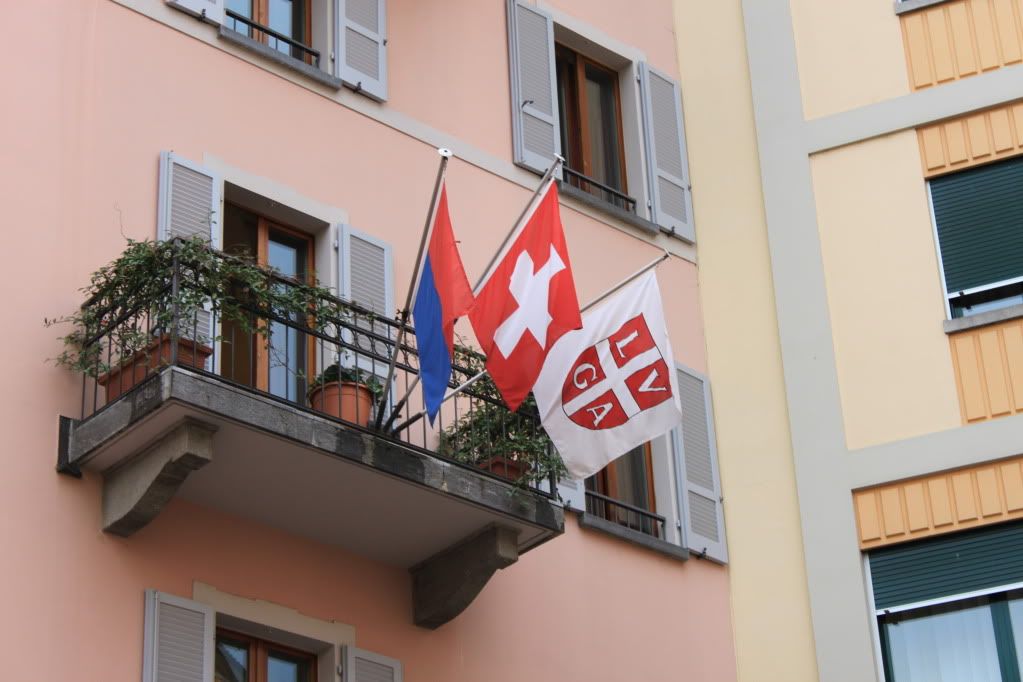
A Brief History of the Union Ticinese
The Unione Ticinese is one of the oldest Swiss clubs in the United Kingdom. It was founded in February 1874 by Stefano Gatti, a restaurant-owner and entrepreneur whose family had arrived in London from Marogno in the Val di Blenio a few decades earlier. It was a mutual aid society intended to provide care in sickness and company in health to the increasing number of Ticinesi working as waiters, but also as ice men and other professions, usually as emplOscar Gambazzi, Giuseppe Eusebio, Frank de Maria, revised by Peter Barber, Vita Ticinese a Londra : 125 Years of the Unione Ticinese (London: Unione Ticinese, 1999)oyees of more successful Ticinese immigrants in London. Most members came from the Blenio and Leventina valleys.
Subsidised hospital care and sickness pay were provided and almost from the first members had the right to burial in Society graves in Kensal Green and later in East Finchley. After a rocky start, due in large part to political tensions within the colony and inside Ticino itself, the Society flourished. For the first 70 years it was dominated and financially supported by wealthy Ticinese restaurateurs, and notably by the Gatti and later the Meschini families. It centered its activities on the district between Leicester Square and the Euston Road in London where the largest single concentration of Ticinesi was to be found, though there were smaller colonies in almost every resort along the south coast and in the London suburbs. For many decades members usually met at the Schweizerbund in Charlotte Street, though on special occasions banquets were held at the grander Ticinese-run restaurants, such as the Gattis’ Royal Adelaide Gallery , Monico’s on Piccadilly and Pagani’s, which was owned by the Meschini family.
Since 1945 the Society has altered radically. Its main support now comes from the members themselves. Often these are not native-born Ticinesi but friends of Ticino or descendants who want to learn more about the canton from which their ancestors emigrated. The establishment of the National Health Service and the increasing prosperity of members of the Ticinese colony has led to the gradual abandonment of the Society’s legal role as a benevolent society while the geographical dispersal of the Society’s membership throughout the country has inevitably led to a change in the pattern of its activities. Most notably, the Corale or choir, which was a central feature of the Society as late as the 1950s and early 1960s gradually withered away because of the increasing difficulty of organising rehearsals – and finding sufficient members familiar with the old songs. Dining in restaurants has given way to equally excellent meals prepared by the Society’s catering committee.
Over the same period there has been an increase in the number of lectures and outings. A well-attended barbecue in the Sussex countryside in late June has become an annual event. In its efforts to raise the profile of Ticino, the Society has fostered close links with the Museum of London as well as with the Swiss Embassy in London, other Swiss societies in the United Kingdom and governmental and cultural organisations inside Ticino. Its extensive records, particularly those dating from the 1920s, have been deposited with London Metropolitan Archives and are available over the internet as part of the Archives to Archives (a2a) network (http://www.a2a.org.uk/).
Yet in many ways, the Society would still be familiar to its founding members. Several members of today are descendants of founder or early members. The last days of October sees the annual Castagnata, a celebration in roast chestnuts and wine of what was until recently the staple diet of the Ticinesi. In early February the anniversary of the Society’s foundation is commemorated in appropriate style, often combined with a celebration of Carnevale. The Society’s members continue to have the right to burial in one of the Society’s graves in East Finchley. Elderly members receive a panettone around Christmas time when there is an annual gathering at which small children receive gifts from San Nicolao. The Unione Ticinese remains a family-oriented Society which extends a warm welcome to all who want to join, whether Ticinese-born or not.
If you want to learn more about the Society and the community from which it sprung, these books are available from the Unione Ticinese at £7.50 (including postage and packing within the United Kingdom):
Oscar Gambazzi, Giuseppe Eusebio, Frank de Maria, revised by Peter Barber, Vita Ticinese a Londra : 125 Years of the Unione Ticinese (London: Unione Ticinese, 1999).
Peter Barber and Peter Jacomelli, Continental Taste. Ticinese emigrants and their Café-Restaurants in Britain 1847-1987 [Camden History Society Occasional Paper 2] (London, Camden History Society, 1997).
.
Tuesday, January 11, 2011
A spiritual soul versus and unspiritual soul

Of course, you can't really judge a person by something that they might have written or typed at one particular time. Sometimes someone can go in a direction, and it might be misinterpreted. An individual may hold a certain principle that might, depending on the circumstances, be open to interpretation. However, this article made it quite clear, over and over, of what he believed.
He was pleased that our ancestral homeland was accepting massive third-world immigration from 152 different countries, with no end in sight. He was also upset that they weren't being treated well enough. Okay, that was enough of a mouthful, but it wasn't really what bothered me about this article. This person displayed some characteristics of a self-hating person. Every race or ethnic group has some self-hating people. In this case, I am referring to his assessment of what he referred to as the Italian experience in the United States, and he is not American. He believes that there is little difference between any culture within the Italian peninsula, and that Italians were an entirely downtrodden people in the United States, which basically led him to the brilliant conclusion that Italians in Italy have absolutely no right to oppose the new immigrants. He called it a crime against human history, or something of the like.
First of all, he's got everything wrong. I would like to react to him directly, however once I had done this via e-mail, to another person, and I later regretted it. First off, many European immigrant groups did a lot of pushing. They were aggressive people, just like the earlier pioneers, colonists, and settlers had been. Sometimes it was a class struggle, sometimes labor, sometimes xenophobia, sometimes religion, and sometimes it was just a reaction to large scale immigration to already heavily populated urban areas. The Irish immigrants often had it much worse than those who didn't speak English upon arrival. There's a lot to be said about his time period, and I could look further into the dynamics of it, but I don't want to now.
The 1999 HBO movie 'Vendetta' gave, I think, somewhat of a realistic look at probably the more negative aspects of this subject. Personally, I think the labor issue played the predominant role as far as bigotry, rather than religion or ethnicity. Louisiana was already largely Catholic then. Even black laborers opposed what was then large scale immigration. It should be noted that those New Orleans Italians were overwhelmingly Sicilian then, and today their descendants have merged with the French, Irish, Anglo-Saxons, etc. of that time, and are fully part of what might be called the "whites undifferentiated" majority of that state. Also, "national groups" of any background, were frowned upon in the historical South. In other words, the Protestant majority didn't want to see any "German club" or "Irish society." They wanted "American only," which meant "whites undifferentiated" for the most part.
The reason that this issue is being posted here, when it doesn't specifically have to do with our Lombardian heritage, is because this man IS of our heritage and has portrayed himself as a proponent of it. I simply cannot state his name now, in order to avoid damaging an already fragile cross-Atlantic communication with our kindred in Lombardy. 'Vendetta' also portrayed the Sicilian immigrants as being extremely industrious, as well as hard-working. Having grown up partly in what was still a largely "white ethnic San Francisco," with populations of second and third generation people whose grandparents and parents were from many different parts of Europe, I can say that white-on-white bigotry was very small for those assimilated into American society. However, with aggressive people from different backgrounds clashing and competing, even if they were white (back then), some very short-lived tensions could occur, which shouldn't be of any surprise.
There's much more I could look at, but I think I should stop there on that issue. There are legitimate grievances, and there are unreasonable sob stories. Everyone, every person, gets treated like crap at different times in their lives. However, nobody needs to rewrite history because of a bad experience or due to something that they perceive to be true like the person in question who sadly is... one of us. The same people who didn't want anyone in America unless they spoke English and were Protestant, which would not have included our people, are the same people who today adopt Haitian children and support the gay movement. All we should demand is that anyone who associates with us be a real proponent of OUR people. Some of our people might be Protestant, or gay, to use the examples that I just referred to. We're a folk family, period.
One "online friend" of mine is a woman from Wisconsin. I'm not sure if she was born in Sicily or Wisconsin. In any case, she grew up and lives in Wisconsin, the same area that my family came from. She is in her early fifties, a tall slender brunette, classy, a very attractive intelligent woman. She's very Wisconsin, but is proud of her roots, and interestingly is from a family who has maintained very close contact with relatives in Sicily. She has gone back there her entire life. I tend to believe in the "Israel homeland concept," by which a person can live in countries like the United States, Argentina, Australia, etc., while still holding onto their heritage. In other words, they have both their country and their "ancestral homeland" in a spiritual sense.
After I was so turned off by the earlier mentioned person's dark outlook and awful critical thinking ability for a short time, I thought of this woman and it gave me a brighter outlook. Her healthy spirituality, world view, and "can-do" attitude made this man look so small in my eyes. He's basically a bigot who wants to call others by that name. Although I may not be able to react to him like I might like, I feel more at ease that there are bright people like her to offset his bleak outlook.
.