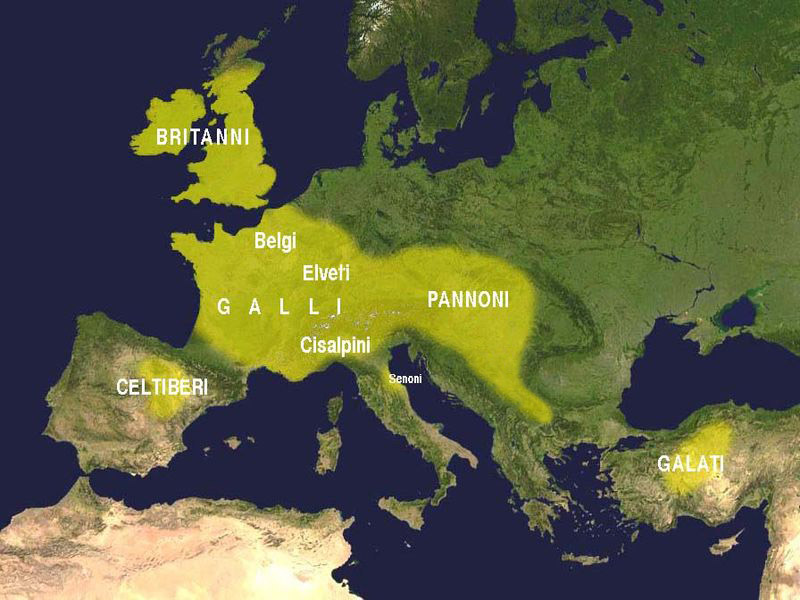
This information was taken from a part of Insubria87's
'Early Celtic Presence in Northern Italy'
Lepontii
The Lepontii were an ancient people occupying portions of Rhaetia (in modern Switzerland and Italy) in the Alps during the time of the Roman conquest of that territory. The Lepontii have been variously described as a Celtic, Ligurian, Raetian, and Germanic tribe. However, most evidence, including recent archeological excavations, and their association with the 'Golasecca culture' of Northern Italy, indicates a Celtic origin although they might actually be an amalgamation of Raetians (who were of Etruscan origin) and Celts.
The chief town of the Lepontii was Oscela, now Domodossola, Italy, and their territory included the southern slopes of the St. Gotthard Pass and Simplon Pass, corresponding roughly to present-day Ossola and Ticino. See also: Lepontic language. This map of Rhaetia [1] shows the location of the Lepontic territory, in the south-western corner of Rhaetia. The area to the South, including what was to become the Insubrian capital Mediolanum (modern Milan), was Etruscan around 600-500 BC, when the Lepontii began writing tombstone inscriptions in their alphabet (one of several Etruscan-derived alphabets in the Rhaetian territory).
http://en.wikipedia.org/wiki/Lepontii
Lepontic language
Lepontic is an extinct Celtic language that was spoken in parts of Rhaetia and Cisalpine Gaul (today's Northern Italy) between 700 BC and 400 BC. Sometimes called Cisalpine Celtic, it is considered a dialect of the Gaulish language and thus a Continental Celtic language (Eska 1998).
The language is only known from a few inscriptions discovered that were written in the alphabet of Lugano, one of five main varieties of Northern Italic alphabets, derived from the Etruscan alphabet. These inscriptions were found in an area centered on Lugano, including Lago di Como and Lago Maggiore. Similar scripts were used for writing the Rhaetic and Venetic languages, and the Germanic runic alphabets probably derive from a script belonging to this group.

Lepontic was assimilated first by Gaulish, with the settlement of Gaulish tribes north of the River Po, and then by Latin, after the Roman Republic gained control over Gallia Cisalpina during the late second and first century BC. The grouping of all of these inscriptions into a single Celtic language is disputed, and some (including specifically all of the older ones) are said to be in a non-Celtic language related to Ligurian (Whatmough 1933, Pisani 1964). Under this view, which was the prevailing view until about 1970, Lepontic is the correct name for the non-Celtic language, while the Celtic language is to be called Cisalpine Gaulish. Following Lejeune (1971), the consensus view became that Lepontic should be classified as a Celtic language, albeit possibly as divergent as Celtiberian, and in any case quite distinct from Cisalpine Gaulish. Only in recent years, there has been a tendency to identify Lepontic and Cisalpine Gaulish as one and the same language.
While the language is named after the tribe of the Lepontii, which occupied portions of ancient Rhaetia, specifically an Alpine area straddling modern Switzerland and Italy and bordering Cisalpine Gaul, the term is currently used by many Celticists to apply to all Celtic dialects of ancient Italy. This usage is disputed by those who continue to view the Lepontii as one of several indigenous pre-Roman tribes of the Alps, quite distinct from the Gauls who invaded the plains of Northern Italy in historical times.
The older Lepontic inscriptions date back to before the 5th century BC, the item from Castelletto Ticino being dated at the 6th century BC and that from Sesto Calende possibly being from the 7th century BC (Prosdocimi, 1991). The people who made these inscriptions are nowadays identified with the Golasecca culture, which has been ascribed a Celtic identity (De Marinis, 1991). The extinction date for Lepontic is only inferred by the absence of later inscriptions.
http://en.wikipedia.org/wiki/Lepontic_language