Friday, September 16, 2011

Guido von List: Part 5

I just started 'The Secret of the Runes', so I think that I will use this post to enter my related observations over time.

9-16-11: I just started the book, but it occurred to me that von List was originally from Vienna, only about three hundred miles from the Val Camonica. Apparently, one of von List's great interests was the ancient traditions of lower Austria, which would be much closer than that. I suppose if we were discussing someone else, this would be of little consequence, but since that is of ancient interest, there does seem to be some parallel since the Camonica Valley also has very ancient cultural roots. Also, there is the Celto-Alpine connection, which overlaps the Alpine region. For whatever it's worth, the Camonica Valley is only about thirty miles away from fully German-speaking areas (beyond Lombard and Romansh speaking areas in southern Graubünden).

9-17-11: This is a classic book on runic magic. A lot of New Age writers [copy] his occult ideas. The Right misunderstands him and the Left smears him. One of the most lied about men in occult history.

This book is well worth the price. Even though many of his ideas have been used by other occult writers, and some of his ideas on magic are standard New Age rite, it is always interesting to visit the soucre where these rivers sprung. Hopefully, all of Von List's book will be made ready to an English speaking market.

--Wyatt Kaldenberg, Amazon.com review

I was thinking under different circumstances, von List, especially as he appeared later in his life, could almost be labeled as some type of nature-loving hippie environmentalist in the modern era. Stephen E. Flowers' preface begins with "The time has come to let Guido von List at least speak for himself to the English reading public."

9-18-11: Excerpt from pages three and four of the book ('The Mystic Wanderer 1870-77'): List often went in the company of others on his journeys into the mountains, which were taken on foot, by wagon, horse, or rowboat; but he would usually strike out on his own at some point to seek the solitude of nature.

Besides gaining general mystical impressions in these outings, List also engaged in active celebratory ritual work. He would perform various rituals that sometimes seemed quite impromptu. The most famous depiction of such an event is his celebration of the summer solstice on 24 June 1875 at the ruins of the Roman City of Carnuntum. For this--as for so much else--we are dependent on List's own somewhat fictionalized account, first published in Vienna in 1881.

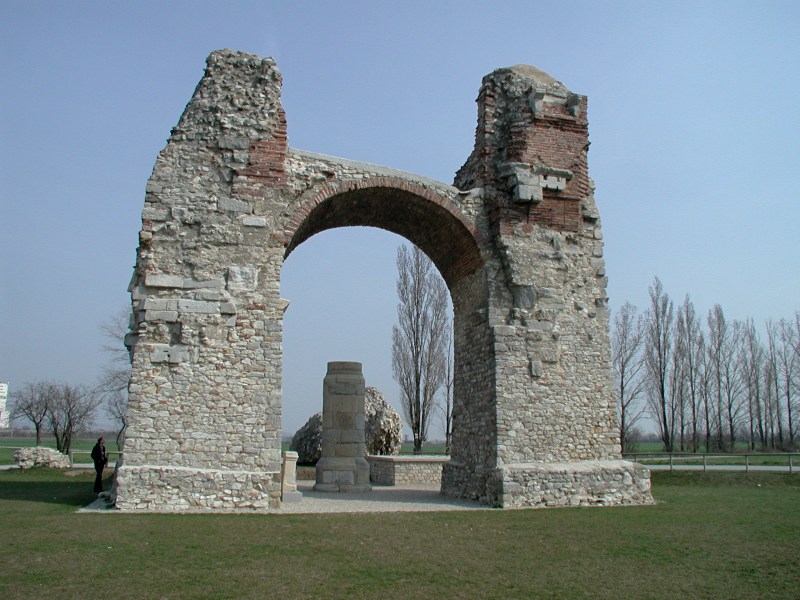
Basically, the ritual elements of this outing included the arduous task of gaining access to the so-called Heindentor ("Heathen Gate") of the city (which List mystically identified as the gate from which a German army set out to conquer Rome in 375 C.E.), the drinking of ritual toasts to the memory of the local spirit (genius loci) and the heroes of the past, the lighting of a solstice fire, and the laying of eight wine bottles in the shape of the "fyrfos" (swastika) in the glowing embers of the fire. List and his company then awaited the dawn.

These early experiences were sometimes later more completely fictionalized, as, for example, in his visionary tale "Eine Zaubernacht" (A Night of Magic). In this account, the persona (List) succeeds in onvoking from the great mound a divine seeress (Hechsa) who reveals to him that he is not to be the liberator of the Germans--but that despite this "the German folk has need of the skald."

[Above right: "Heathen's Gate" in Carnuntum]

Excerpt from page five (including text from 'The Folkish Journalist 1877-87' and 'The Nationalist Poet 1888-98'): Through these years, List was also working on his first book-length (two-volume) effort Carnuntum, a historical novel based on his vision of the Kulturkampf between the Germanic and Roman worlds centered at that location around the year 375 C.E.

Carnuntum was published in 1888 and became a huge success, especially among the Pan-German nationalists of Austria and Germany. Its publication brought its author more to the attention of important political and economic leaders of German nationalist movements. In connection with the appearance of Carnuntum, List made the acquaintance of the industrialist Friedrich Wannieck. This association was to prove essential to List's future development.

'Carnuntum' would be a period of history that certainly would have greatly affected our ancestors, who had already been basically herded into the Roman fold by that time. The book has not been translated into English though. The city of Carnuntum was located in what is now Austria. One irony, and further connection to us, is that the city was located in the Roman province of Pannonia, which was later the home of the Langobard tribe. They were considered Roman allies at that point.

Sunday, August 21, 2011

Nadia Fanchini: Top Alpine skier is from the Camunian Valley

It's interesting that Nadia is the same age as Lindsay Vonn and Julia Mancuso, whom we have covered on the other blog. She missed the 2010 Winter Olympics in Vancouver due to injuries however. She did compete in the 2006 Winter Olympics in Torino. She holds a victory in the Super-G event at the 2008 World Cup. So far, her best achievement was winning a bronze medal in the downhill event during the 2009 World Championships. These are pretty good signs, which show that she's fast approaching her prime. If she can avoid nagging injuries, she could be a major factor in the 2014 Winter Olympics in Russia.

From the Nadia Fanchini Wikipedia page:

"Nadia Fanchini (born 25 June 1986 in Lovere)[1] is an Italian alpine skier. She was born and lives in Val Camonica. She is the sister of Elena Fanchini, also an alpine skier.

"She came 3rd in downhill in the Alpine Skiing World Cup in Lake Louise 2006 and Sestriere 2008.[2] She represented Italy at the 2006 Winter Olympics and won a bronze medal in the Downhill at the 2009 Alpine Skiing World Championship in Val d'Isère."

Fanchini gets world cup win (video)

[Universal Sports on YouTube doesn't allow imbedding]

"2008, Lake Louise, Canada, FIS Alpine Skiing World Cup, Womens Super G, Nadia Fanchini of Italy, continues her stunning weekend. Yesterday she got 2nd in the downhill and today her first win, moving her up to 7th in the cup. (Universal Sports, UniversalSports.com)"

It's pretty cool to see her in that World Cup video, on this side of the Atlantic. In fact, in the Pacific Northwest. Lake Louise is located in the province of Alberta, on the British Columbia border. At the risk of sounding a little silly, she's pretty cute, as a google image search would show.
Link
Nadia Fanchini profile (The Ski Channel Television Network):

Nadia Fanchini
Country: Italy
Date of Birth: June 25, 1986
Hometown: Val Camonica (Lovere)
Height: 5'5"
Sport: Skiiing Alpine
Birthplace: Val Camonica
Weight: 143 lbs.
Website: http://sorellefanchini.it/

.

Thursday, July 28, 2011

Reconciling the Christian vs. Pagan issue


I wanted to at least touch upon this issue, which is one that I have largely avoided. I have given the Greek example numerous times, by which this issue is rendered into a complete non-issue. Recently, I was looking something up in a book of mine entitled 'Masonic and Occult Symbols Illustrated' (Burns; 1998). For a period, years ago, I had listened to Christian sources regarding "the occult." Now I haven't completely changed my mind on everything I used to believe, but I'll get to that later. "Occult" simply means "hidden," so theoretically something within Christianity could be "occult" as well. The word "pagan," from the Latin word "paganus," simply means "country dweller." "Heathen," from old Norse, means "a person from the hearth"; and "heathenry" means "people from the hearth." It's easy to see how Christianity demonized the pagans by taking an innocent word like "heathen" and using it as a term of scorn. Ruling classes always have used "shame on you" words to beat their opposition into submission.

'Masonic and Occult Symbols Illustrated' was written by a Christian named Kathy Burns. I'm not ragging on Christians, which I will explain later; but while this is a good reference book on symbols, she made some painfully untrue descriptions on some of them. For whatever it's worth, I had written snail mail to her a few times, and she was nice enough to send me a free small book after I had clarified one symbol for her. Be that as it may, I must at least take issue with her description of the Othala or Odal Rune. In the glossary of symbols, she wrote "possession" under the Othala. Comparatively, after reading the more-than-slight bias with the other symbols, it's pretty clear that she was suggesting something like "possession by a demon," which is wildly inaccurate. The symbol means "home," "homeland," "freedom," "personal possession," "the home front," etc.

This was a clear case of someone calling anything that doesn't coincide with their belief system as "the devil." To the author, every non-Christian symbol is "evil".... "occult!" I'm actually glad that I have something of a background in the Christian view of these matters, because I can spot problems a mile away. In other words, the truth is that there are problem areas in Christianity and the other major religions, as well as in the modern pagan world. There are some very dark influences in both Christian and pagan communities. Not the average person, but in many of the deep-pocketed political influences behind the scenes. I think I will just leave it at that for now, rather than confuse the issue further.

If we are to found a "Cernic Rite," we must decide first what course we need to take. I was looking at some photographs of some type of "pagan pride day" which is held each year in Berkeley, California. Clearly many of the participants were simply acting buffoonish and even dishonorable. Our ancestors didn't sacrifice their lives in order to allow some screwballs and political zealots to make fun of us. We will have to blaze our own path. I would venture to guess that about 10% of the current milieu of Wiccans and similar pagans are worthy of taking the Cernic path. There are some good ones. We know you're out there.

We need a movement which is at least somewhat similar to the Odinist movement. Naturally there would be some big differences too, but the basic tenant of our culture: "Faith, Folk, Family" should be our code. Any son or daughter of Europe should feel welcome. Celtic people lived, or at least influenced, every corner of Europe. In other words, a FOLKISH movement, period. That doesn't mean that we won't communicate with people, study other spiritual paradigms, facilitate guest speakers from other movements, etc.

Lastly, many Christians are probably correct in that magic is not something to be fooled around with. It's not for children. I believe that we would be best served by concentrating on natural sources in nature for our spiritual needs. Many people open doors that they can't close. For example, Ouija boards are a very bad source for this. Even when these people pack up and move, the dark energy follows them. Even within Christianity, these doors are opened. There are both positive and negative spirits in both Christianity and paganism. Therefore, I would strongly suggest... no oaths, and no conjuring up spirits. Lets just honor the ancient Gaulish gods and goddesses, and use the natural sources which they gave us.

.

Tuesday, July 26, 2011

The "House Wolf"


I was casually looking into words in the Camunian dialect on Mauro Fiora's Italian-Camunian translator. In standard Italian (Tuscan), the word for "wolf" is "lupo." Lupo can be a surname, and there are many surnames with "lupo" in it. For example, the surname "Cantalupo," generally of Neapolitan origin, means something like "singing wolf" (canta-lupo), probably regarding the wolf's howl. Of course, not many people in the Western world hear the howls of wolves any longer, but it was probably pretty common in past centuries.

The surnames "Calufetti" and "Caluffetti" are very definitely of Camunian origin. In the Camunian dialect, the word for house, home, or household is "ca." The word for wolf is "lùf" or "lüf." Therefore, before Romanization, the name was probably "Caluf" or "Caluff," which would mean something like "house wolf." This may have been either a reference to a domesticated wolf or to a family dog. If it was a wolf, then this surname may be so ancient, that a guess as to how old would be impossible. The Camunian culture goes back eight or ten thousand years.

According to the American Heritage Dictionary: Dogs were domesticated from gray wolves about 15,000 years ago. They must have been very valuable to early human settlements, for they quickly became ubiquitous across world cultures. Dogs perform many roles for people, such as hunting, herding, pulling loads, protection, assisting police and military, companionship, and, more recently, aiding handicapped individuals. This impact on human society has given them the nickname "Man's Best Friend" in the western world.

The origin of a surname, like Calufetti, can easily be lost without the aid of some type of reference to the original language that it came from. Caluf sounds like a word in the Camunian dialect. Not Tuscan, not Venetian, not German, not Slavic; but a word from a unique language, tied into the Lombard language. I would venture to guess that this word predates the linguistic influences of Etruscan, Roman, Langobard, and probably even Gaulish.

I had initially looked up "wolf," and discovered the world to be "lùf," then quickly made the connection to the surname. We are today connected to our ancient past much more than we think. Even though I'm not what is called a "dog person," I still instantly feel the connection from my ancient memory to the dogs who look more like wolves, like German Shepherds. Even in surnames, as we see them in the modern world, reflect a centuries-old tie to the past.

.

Tuesday, July 19, 2011

Guido von List: Part 4

I had initially intended on looking at a few applicable aspects connected to von List, however upon review I can see that there are almost endless tie-ins to a large host of other things! No wonder Guido von List is approached with caution by so many in modern times. In a nutshell, there was the Third Reich, preceded by the formation of the Nazi Party, which was itself preceded by a number of secret occult societies, which were themselves preceded by the works of Guido von List, Madame Blavatsky, and others who had long passed away when the National Socialists rose to power.

Although virtually all of von List's work was tied to Germanic pre-Christian paganism, the Runes themselves originated with Cisalpine peoples. I think the historical record is pretty clear on this point. Ironically, the Roman-Christian junta destroyed the Runes in Etruria when they took over there, and they later destroyed the Runes in Northern Europe, at least as far as their place in everyday life and culture. A great irony was that the Langobards marched into the Cisalpine territory under a flag which featured the odal rune, which stands for "homeland." It's probably is worth noting that Guido von List was very interested in the old traditions of lower Austria, which does tie-in to the general east Alpine milieu of Austria, Slovenia, and the tri-Veneto region.


'The Secret of the Runes' [von List; 1908]


Editorial Reviews

. . . serves as one of the major text on the meaning of the runes and their place in Teutonic cultures. (New Dawn, May/June 2003)

"If runes interest you at all, The Secret of the Runes is a historical and sociological document of great import. If you are a student of occult beliefs, you will recognize many of the newfangled new-age concepts we take for granted as vintage Armanen, perhaps very much to your dismay. Either way, this is an important book whose mysteries never fail to provoke thoughts and challenge beliefs." (Thor the Barbarian, Nemeton, Jan 2006 )


Product Description

The runes are said to have “revealed themselves” to von List, uncovering a complete cosmology and esoteric understanding of the primeval Teutonic/Aryan peoples, and becoming the cornerstone of his ideology. No other work so clearly and simply sets forth the full spectrum of von List’s fantastic vision of a mystical philosophy based on Germanic principles.


Amazon.com reviewer Tellie_1@hotmail.com

Fascinating

This is an incredibly interesting piece of work written by a truly enigmatic and fascinating individual. Guido Von List was an expert in Indo-European linguistics, Norse mythology, German folklore and had a broad understanding of etymology, anthropology and archaeology. He obtained this knowledge during his life-long study of the esoteric roots of pre-Christian Germanic society.

There have been many vocal detractors of List and his work, especially in the decades following the conclusion of World War Two. His writings have been described as "fascistic" and "fantastic". Perhaps List understood better than his critics did that documenting the racial/philosophical/religious/linguistic roots of the ancient Aryans was never meant to be a demonizing process.

'The Secret of the Runes' (first published in 1908) offers the reader a chance to explore many of List's basic themes in a very easy to read format. The translator and editor, Stephen Flowers, treats his subject matter objectively and fairly. Not once is there a hint of heavy handiness of politically correct whitewashing. The work is allowed to stand on it's own.

'The Secret of the Runes' is not a piece of work that will appeal to everyone. Modern practitioners of Wicca or "rune magik" will most likely find this work offensive for it's pro-Nordic, racial themes. However, anthropologists, mythologists and those who study language or the occult will undoubtedly find many interesting nuggets of information thanks to Lists' exhaustive research and insight.


'The Religion of the Aryo-Germanic Folk: Esoteric and Exoteric' [von List; 1910]


Editorial Reviews

As a follow-up to the classic and seminal work The Secret of the Runes, Rûna-Raven presents a translation of another of Guido von List's important volumes: Die Religion der Ario-Germenen in ihrer Esoterik und Exoterik, first published in 1910. This text, next to that of The Secret of the Runes provides an in-depth look at the ideological world of the turn of the century Viennese master. Perhaps no other text so precisely sums up List's religious world-view. In these pages he describes an esoteric, theosophical, cosmology in terms of Germanic mythology and addresses questions of astrology and the purpose and destiny of the human soul.

Those who have made a study of the esoteric world of early 20th century Germany and Austria will welcome this little book which sheds more light on the topic. The text is preceded by an introduction by Dr. Stephen E. Flowers (translator and editor of The Secret of the Runes) in which he addresses the issues of List's use of folk-etymology, theosophical influence on List's ideas, and most importantly issues statements on research into the topic of occultism in the Third Reich and the general misuse of the theory of "Nazi occultism"


Amazon.com reviewer B. Leavitt

This is a great book. Guido Von List who died much before the Nazi party began had nothing to do with National Socialism or the nazis. He died in 1912 or 1921. The secret of the runes is another great book of his. I recommend the one with only his name as author. There is another one with Stephen Flowers AKA Edred Thorsson, that is a good read also. I just don't know how they could of co-authored a book when Von List has been dead for 90 years.

.

Monday, July 18, 2011

Guido von List: Part 3


Guido von List [from his Wikipedia page]

Runic revivalism

The row of 18 so-called "Armanen Runes", also known as the "Armanen Futharkh" came to List while in an 11 month state of temporary blindness after a cataract operation on both eyes in 1902. This vision in 1902 allegedly opened what List referred to as his "inner eye", via which he claimed the "Secret of the Runes" was revealed to him. List stated that his Armanen Futharkh were encrypted in the Hávamál (Poetic Edda), specifically in stanzas 138 to 165, with stanzas 146 through 164 reported as being the 'song' of the 18 runes. It has been said this claim has no historical basis.

The Armanen runes are still used today by some Ásatrú adherents who consider the Armanen runes to have some religious and/or divinatory value.

Futharkh spelling

List noted in his book, The Secret of the Runes, that the "runic futharkh (= runic ABC) consisted of sixteen symbols in ancient times.".

As a side note to this, in the English translation of the work, Stephen Flowers notes that "(the designation futharkh is based on the first seven runes it is for this reason that the proper name is not futhark -- as it is generally and incorrectly written -- but futharkh, with the h at the end; for more about the basis of this, see the Guido von List Library number 6, The primal language of the Aryan Germanic people and their mystery language)."

Hexagonal Crystal and the Armanen Runes

List's system was allegedly based on the structure of a Hexagonal Crystal. You can shine light through a crystal at different angles and project all 18 of the Armanen runes.

List's rune row was rather rigid; while the runes of the past had had sharp angles for easy carving, his were to be carefully and perfectly made so that their shape would be a reflection of the 'frozen light', a pattern that he had found in his runes. All of his runes could be projected by shining the light through a hexagonal crystal under certain angles. Rune Hagal is so-called 'mother-rune' because its shape represents that hexagonal crystal.

Karl Hans Welz states that the "crystalline structure of quartz is the "hexagonal system" which is also one of the bases of the Runic symbolism (the hexagon with the three inscribed diameters)." and that "The hexagonal cross section of quartz and the fact that all of the 18 Sacred Futhork Runes are derived from the geometry of the hexagon is the basis of an enormous increase in crystal power when it is associated with Rune images."


Influence

Guido von List Society

A look at the signatories of the first announcement concerning support for a Guido-von-List-Gesellschaft (Guido von List Society), circa 1905, reveals that List had a following of some very prestigious people and shows that List, his ideology and his influence had widespread and significant support, including that amongst public figures in Austria and Germany. Among some 50 signatories which endorsed the foundation of the List Society (which had an official founding ceremony on March 2, 1908) were the industrialist Friedrich Wannieck and his son Friedrich Oskar Wannieck, Jörg Lanz von Liebenfels, and Karl Lueger (the mayor of Vienna). These supporters also included occultists such as Hugo Göring (editor of theosophical literature at Weimar), Harald Arjuna Grävell van Jostenoode (theosophical author at Heidelberg), Max Seiling (an esoteric pamphleteer and popular philosopher in Munich), and Paul Zillmann (editor of the Metaphysische Rundschau and master of an occult lodge in Berlin).

List's influence continued to grow and attract distinctive members after the official founding of the society in 1908. From 1908 through to 1912, new members included the deputy Beranek[disambiguation needed] (co-founder of the "Bund der Germanen" in 1894), Philipp Stauff (a Berlin journalist and later a founding member of the Germanenorden), Franz Hartmann (a leading German theosophist), Karl Heise (a leading figure in the vegetarian and mystical Mazdaznan cult at Zürich), and the collective membership of the Vienna Theosophical Society.

As the list demonstrates, the growth of nationalism within Germany during the late 19th to early 20th century, culminating in the Third Reich of Nazi Germany, provided an ideal audience of people who were already predisposed to accept List's ideas and unidentifiable personal gnosis of the Armanen way. The register shows that List's ideas were acceptable to many intelligent persons drawn from the upper and middle classes of Austria and Germany. So impressed were they that these men were prepared to contribute ten crowns as an annual society subscription. The main part of the Society's assets derived from the Wannieck family, which put up more than three thousand crowns at the Society's inauguration.

The Society's inner circle was called the High Armanen Order or Hoher Armanen Orden.

Quotes by List

"One must flee those places where life throbs and seek out lonely spots untouched by human hand in order to lift the magic veil of nature" (Deutsch-Mythologische Landschaftsbilder, 1st volume, p. 125.)

"Now, because men of our contemporary age are caught up in the ascetic view of a life-denying religious system, but in spite of this cannot deny the primal laws of nature, a distorted morality had to be developed, which spreads hypocritical appearances over hidden actions. This has brought to a head all those outward forms of modern life, whose vacuousness and corruption are now beginning to disgust us." (Das Geheimnis der Runen)

"A star is extinguished, another will begin to shine - thus it is written in the Book of Nature" (Der Unbesiegbare)

Popular culture

List is referred to throughout Katherine Neville's book, The Magic Circle, (NY: Random House; 1998) and is mentioned on page 154 of The Black Order, ([n.pl.]: Orion; 2006) by James Rollins. He also occurs as a character in the novel Vienna Blood (London: Century; 2006), the second in the Max Liebermann series, by British author Frank Tallis.

Influential List Society signatories, circa 1905

Friedrich Wannieck, president of the publishing house Verein "Deutsche Haus" ("German House" Association) in Brünn, and chairman of the Prague Iron Company and the First Brno Engineering Company (major producers of capital goods in the Habsburg empire)

Ludwig von Bernuth, health organisation chairman

Ferdinand Khull, committee member of the German Language Club

Adolf Harpf, editor of Marburger Zeitung

Hermann Pfister-Schwaighusen, lecturer in linguistics at Darmstadt University

Wilhelm von Pickl-Scharfenstein (Baron von Witkenberg)

Amand Freiherr von Schweiger-Lerchenfeld, editor of the popular magazine Stein der Weisen and a distinguished army officer

Aurelius Polzer, newspaper editor at Horn and Graz

Ernst Wachler, author and founder of an open-air Germanic theatre in the Harz Mountains

Wilhelm Rohmeder, educator at Munich

Arthur Schulz, editor of a Berlin periodical for educational reform

Friedrich Wiegerhaus, chairman of the Elberfeld branch of the powerful German Nationalist Commercial Employees' Association (Deutschnationaler Handlungsgehilfen-Verband, or DHV)

Franz Winterstein, committee member of the German Social Party (DSP) at Kassel

Influential List Society members from 1908

Rudolf Berger, a committee member of the German Nationalist Workers' League in Vienna

Hermann Brass, chairman of the defensive League of Germans in North Moravia (est. 1886)

Dankwart Gerlach, an ardent supporter of the romantic Youth Movement

Carl Friedrich Glasenapp, biographer of Richard Wagner

Colonel Karl August Hellwig, an organiser in Kassel

Bernhard Koerner, an heraldic expert and populariser of middle-class genealogy

Josef Ludwig Reimer, Viennese author

Karl Herzog, branch chairman of the DHV in Mannheim

Arthur Weber, a theosophical editor

Karl Hilm, occult novelist

General Blasius von Schemua

Written works

Das Geheimnis der Runen (The Secret of the Runes (book), 1908)

Der Unbesiegbare

Götterdämmerung (1893)

Von der Wuotanspriesterschaft (1893)

Die deutsche Mythologie im Rahmen eines Kalenderjahres (1894)

Der deutsche Zauberglaube im Bauwesen (1895)

Mephistopheles (1895)

Carnuntum

Jung Diethers Heimkehr (1894)

Der Wala Erweckung (1894)

Walkürenweihe (1895)

Pipara: Die Germanin im Cäsarenpurpur (Pipara: the Germanic Woman in the purple of the Caesars, 1895)

König Vannius (1899)

Sommer-Sonnwend-Feuerzauber (1901)

Das Goldstück (1903)

Kunstmärchen anthology: Alraunenmaren: Kultur-historische Novellen und Dichtungen aus germanischer Vorzeit (Mandrake-Tales: Cultural-historical Novellas and Poetry from Germanic Prehistory, 1903)

Eine Zaubernacht

Guido-List-Bücherei (a series of works)

Die Armanenschaft der Ario-Germanen (The Armanism of the Aryo-Germanic People, 1908 and 1911, 2 volumes)

Die Rita der Ario-Germanen (The Rita of the Aryo-Germanic People, 1908)

Die Namen der Völkerstämme Germaniens und deren Deutung (The Names of the Tribes of the People of Germania and their Interpretation; GvLB no. 4, 1909)

Die Religion der Ario-Germanen in ihrer Esoterik und Exoterik (The Religion of the Aryo-Germanic People in its Esoteric and Exoteric Aspects, 1909 or 1910)

Die Bilderschrift der Ario-Germanen: Ario-Germanische Hierogyphik (The Pictographic Script of the Aryo-Germanic People: Aryo-Germanic Hieroglyphics; GvLB no. 5, 1910)

Der Übergang vom Wuotanismus zum Christentum (The Transition from Wuotanism to Christianity, 1911)

Die Ursprache der Ario-Germanen und ihre Mysteriensprache (The Primal Language of the Aryo-Germanic People and their Mystery Language; GvLB no. 6, 1914)

Armanismus und Kabbala

.

Sunday, July 17, 2011

Guido von List: Part 2


Guido von List [from his Wikipedia page]

Mountaineering

In 1871, List's writing talents were given full rein as he became a correspondent of the Neue deutsche Alpenzeitung ("New German Alpine Newspaper"), later called the Salonblatt. He also began to edit the yearbook of the Österreichischer Alpenverein (Austrian Alpine Association), of which he became secretary in that year.

List was an ardent, enthusiastic mountaineer and hiker. On one of these adventures List came very close to losing his life. While climbing a mountain on May 8, 1871 in the Großes Höllental (Larger Valley of Hell) leading up to the Rax mountain in Lower Austria, a mass of ice gave way under his feet and he fell some distance. He was apparently saved only by the fact that he had landed on a soft surface covered by a recent snowfall. In memory of his good luck and to help others, at his own expense List had the track equipped with a chain put up and officially opened by him on June 21, 1871. It was also named (now called Gaislochsteig) after him the "Guido-List-Steig."

On June 24, 1875, List was camping with four friends near the ruins of Carnuntum. As the 1500th anniversary of the Germanic tribes' defeat of this Roman garrison in 375, the evening carried a lot of weight for List. Carnuntum became the title of List's first full-length novel, published in two volumes in 1888. After its success, it was followed by two more books set in tribal Germany; Jung Diethers Heimkehr ("Young Diether's Homecoming", 1894) and Pipara (1895). These books led to List being celebrated by the pan-German movement. Around the turn of the century, he continued with several plays.

Nobility and title

Between 1903 and 1907, he began using the noble title von on occasion, before finally settling on it permanently in 1907. As this was only permitted for members of the aristocracy, he faced an official enquiry. Here he produced evidence supporting his claim, which was accepted by the officials heading the inquiry.

Death

In late 1918, the 70 year old List was in poor health during the final stages of World War I in which the naval blockade of the Central Powers created food shortages in Vienna.

In the spring of 1919, at the age of 71, List and his wife set off to recuperate and meet followers at the manor house of Eberhard von Brockhusen, a List society patron who lived at Langen in Brandenburg, Germany.

On arrival at the Anhalter Station at Berlin, List was too exhausted to continue the journey. After a doctor had diagnosed a lung inflammation, his health deteriorated quickly, and he died in a Berlin guesthouse on the morning of May 17, 1919. He was cremated in Leipzig and his ashes laid in an urn and then buried in Vienna Central Cemetery, Zentralfriedhof, in the gravesite KNLH 413 - Vienna's largest and most famous cemetery (including the graves of Beethoven, Brahms, Schubert and Strauss.) in Vienna's 11th district of Simmering.

Philipp Stauff, a Berlin journalist, good friend of List and Armanist, wrote an obituary which appeared in the Münchener Beobachter called "Guido von List gestorben" on May 24, 1919, p. 4.

Ideology

Guido von List was strongly influenced by the Theosophical thought of Madame Blavatsky, which he blended with his own racial religious beliefs, founded upon Germanic paganism.

List called his doctrine “Armanism” (after the Armanen, supposedly the heirs of the sun-king, a body of priest-kings in the ancient Ario-Germanic nation). Armanism was concerned with the esoteric doctrines of the gnosis (distinct from the exoteric doctrine intended for the lower social classes, Wotanism).

List claimed that the tribal name Herminones mentioned in Tacitus was a Latinized version of the German Armanen, and named his religion the Armanenschaft, which he claimed to be the original religion of the Germanic tribes. His conception of that religion was a form of sun worship, with its priest-kings (similar to the Icelandic goði) as legendary rulers of ancient Germany.

List claimed that the dominance of the Roman Catholic Church in Austria-Hungary constituted a continuing occupation of the Germanic tribes by the Roman empire, albeit now in a religious form, and a continuing persecution of the ancient religion of the Germanic peoples and Celts.

This conception bears strong resemblance to many other 19th century romanticised ideas of ancient polytheistic religions in Europe; a comparatively similar text in the thematic elements and overall textual bias is the famous Oera Linda forgery from the Lowlands region of western Europe.

He also believed in magical powers of the old runes. In 1891 he claimed that heraldry was based on the magic of the runes. In April 1903, he had sent an article concerning the alleged Aryan proto-language to the Imperial Academy of Sciences in Vienna. Its highlight was a mystical and occult interpretation of the runic alphabet. Although the article was rejected by the academy, it would later be expanded by List and become the basis for his entire ideology.

Among his ideological followers was Lanz von Liebenfels. More controversially, some allege that, in his pagan-Theosophical synthesis, List developed the direct precursor of occult Nazism. His defenders counter that any influence was indirect and inconsequential; in Nazi Germany the strongest occult influence upon Heinrich Himmler, the head of the SS, was Brigadeführer Karl Maria Wiligut who believed List's Armanism to be a heresy from his own ancestral religion of Irminism and had various of List's followers interned in concentration camps.

List's concept of renouncing Christianity, a Semitic religion intertwined with Judaism, and returning to the pagan religions of the ancient Europeans did nevertheless find some supporters within the Nazi party and is favoured by some advocates of Neo-Nazism and White Nationalism in their turn. Germanic paganism has, as a result, been linked to Nazism since the early twentieth century — unfairly, in the eyes of many pagan revivalists.

List’s Ariosophy was closely related to the philosophy of the Thule Society which founded the German Workers’ Party (DAP), the predecessor of the Nazi party (NSDAP). List’s prophecy that a “German Messiah” would save Germany after World War I was popular among Thule members. Thule member and publicist Dietrich Eckart expressed his anticipation in a poem he published in 1919, months before he met Hitler for the first time. In the poem, Eckart refers to ‘the Great One’, ‘the Nameless One’, ‘Whom all can sense but no one saw’. When the Thules met Hitler in 1919, many believed him to be the prophesied redeemer. As most Thule members were socially and politically influential, their faith was crucial to Hitler’s meteoric rise.

.