Showing posts with label war. Show all posts

Tuesday, June 3, 2014

‘300’ (2006) – movie review


I don’t just review any movie. I try to stay somewhat on topic here, with either a cultural or spiritual tie-in. The Spartans had some strong similarities with the Langobards. Both were societies which were based on war and the warrior ethic… “Warrior Socities.” In both societies, boys were trained for war from an early age.

One difference is that the Langobards didn’t use “eugenics,” although it’s probably safe to say that the greatest Langobard warriors probably had more children than most. The Winnili/Langobards had no problem with “odds.” Their kill/loss ratio was staggering, and possibly unequaled in history. The better-known Spartans, however, produced the greatest single known battle effort in the history of warfare.

The movie was about the Battle of Thermopylae in 480 BC, where Spartan King Leonidas leading 300 Spartans against what was described as a Persian imperial army of millions.  Although exaggerated, the odds were in fact incredible. The battle has been described by some as “saving Western civilization,” which may cloud the harder reality that it certainly was part of saving Greek civilization at that time. The movie portrayed other items which were not accurate, of which I will avoid. Most of which are more-or-less obvious.

This battle was just a part of the “Greco-Persian Wars”(499-449 BC). YouTube has documentaries galore about these wars and the Battle of Thermopylae. It could also be noted that, along with the Langobard comparison, there is a clear comparison to the Samurai. The Samurai were another example of a “Warrior Society,” with similar traits to the Spartans. One trait that the Spartans and Samurai had in common was that they seemed to literally wish to die in the glory of battle. They actually would seek it, if the historical accounts are true. The Spartans at Thermopylae at least, must have had absolutely no fear of death.


King Leonidas
Battle of Thermopylae

A Greek force of approximately 7,000 men marched north to block the pass in the summer of 480 BC. The Persian army, alleged by the ancient sources to have numbered over one million but today considered to have been much smaller (various figures are given by scholars ranging between about 100,000 and 150,000), arrived at the pass in late August or early September. The vastly outnumbered Greeks held off the Persians for seven days (including three of battle) before the rear-guard was annihilated in one of history's most famous last stands.

During two full days of battle the small force led by Leonidas blocked the only road by which the massive Persian army could pass. After the second day of battle a local resident named Ephialtes betrayed the Greeks by revealing a small path that led behind the Greek lines. Leonidas, aware that his force was being outflanked, dismissed the bulk of the Greek army and remained to guard the rear with 300 Spartans, 700 Thespians, 400 Thebans and perhaps a few hundred others, most of whom were killed.


300 is a 2007 American fantasy action film based on the 1998 comic series of the same name by Frank Miller and Lynn Varley. Both are fictionalized retellings of the Battle of Thermopylae within the Persian Wars. The film was directed by Zack Snyder, while Miller served as executive producer and consultant. It was filmed mostly with a super-imposition chroma key technique, to help replicate the imagery of the original comic book.

The plot revolves around King Leonidas (Gerard Butler), who leads 300 Spartans into battle against the Persian "god-King" Xerxes (Rodrigo Santoro) and his invading army of more than 300,000 soldiers. As the battle rages, Queen Gorgo (Lena Headey) attempts to rally support in Sparta for her husband. The story is framed by a voice-over narrative by the Spartan soldier Dilios (David Wenham). Through this narrative technique, various fantastical creatures are introduced, placing 300 within the genre of historical fantasy.


Queen Gorgo
The film has a certain cinematic quality that is difficult to describe, but it’s as though one is watching it through a dark fuzzy lens, into historical abyss. The Persian armies must have had segments which were not ethnic Persians, who were from other territories of the Persian Empire.. but that point was however much exaggerated in the film. The film starts out making it very clear how Spartan boys were raised to be fighting machines. R. Lee Ermey couldn’t have done a better job of creating killing machines. They were trained to engage in pure evolutionary struggle, to ignore pain, and were constantly tested to their limits. “Respect and Honor” was their slogan, according to the movie; which reminded me of “Strength and Honor” from ‘Gladiator’.

King Leonidas was basically the main protagonist, along with his wife Queen Gorgo. The two are engaged in a political conflict, not only with the invading Persians, but with “bought-off traitors” within Spartan politics. Another quote from the movie, I think from the narrator Dilios, the only survivor of the 300, retelling the story: “Only the hard and strong may call themselves Spartans.”

Before going to war, a Spartan King must go through a religious rite in which he seeks guidance from the wise men of Greek polytheism. The movie portrays them as diseased and “monster-like”; which is the only real item from the movie that I would criticize. I know some people were not happy about what was a similar portrayal from the cable tv series ‘Vikings’, in which the Odinic Skalds were shown to be hideous.

The only other Greek polytheist concept that I remember from the film was was a scene which showed Persian ships sinking in a storm of rain, thunder, and lightning before they could land. One of the Spartans credited the Greek god Zeus for this happening. The opening battle was the most dramatic scene, with the Spartans killing Persians soldiers (or Persian Emperor Xerxes' imperial troops) at will using amazing fighting skills and bravery. The historical record shows that they killed a minimum of ten-to-one! It really could have been twenty-to-one.

Prior to I think the second battle, the narrator Dilios says: “We do what we were trained to do, what we were bred to do, what we were born to do.” Unlike some historical exaggerations, this quote was literally accurate.

Slight spoiler alert beyond this point...

.

.

.
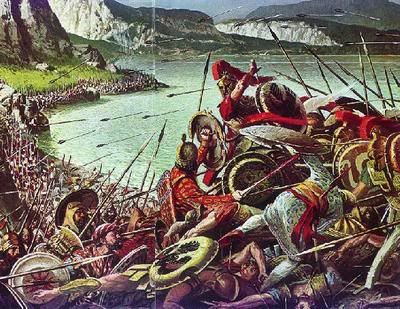

'Battle of Thermopylae'
After Leonidas and the 300 sacrificed their lives down to the last man, which allowed for Sparta the time to gather themselves, the stage was set for the big battle. An army of ten thousand Spartan warriors were lined up to do battle with an army of thirty thousand Persians. The narrator Dilios, for the purpose of the movie speaking in real time, gave a short speech to the army. He finishes with the following: “Give thanks, men, to Leonidas and the brave 300! TO VICTORY!”

When viewing it, I thought he said “Take Leonidas and the brave 300 to victory!" Actually, that line would have worked too! Good movie.

.


Wednesday, October 26, 2011

Centurion (movie review)

I viewed the movie 'Centurion' (2010) last evening, and thought there were enough cultural tie-ins to put a review here. The movie was from the UK, and I think they did a pretty good job with it. The movie, set about 2,000 years ago in what is now the Scottish Highlands, was similar to "a Roman versus Pictish Braveheart." The one big difference was that there was no effort to turn either side into either protagonists or antagonists. It was chiefly from a Roman perspective.


Centurion is a 2010 British film directed by Neil Marshall. It centres on the supposed disappearance of the Ninth Legion in Caledonia. The movie stars Michael Fassbender, Olga Kurylenko and Dominic West.


Plot

It is AD 117 and the Roman garrisons are struggling to contain the Picts, the original inhabitants of the Scottish Highlands. The Picts, under their king, Gorlacon, are perfecting guerrilla warfare and are eliminating Roman outposts one by one. Centurion Quintus Dias is the only survivor of a Pictish raid and is taken prisoner by Vortix. In the meantime, Agricola, the Roman governor of Britannia wants to obtain favour with the central administration, hoping to secure a transfer back to the comforts of Rome. He dispatches the Ninth Legion to the front under General Titus Flavius Virilus, with orders to eradicate the Pict threat, providing him with a Brigantian scout, a mute woman, Etain.


**************************************************


One interesting parallel with our culture is that the Picts were not Gaels. They were not Celts, but from a people who predated the Gaels in Scotland. A very ancient Atlanto-Mediterranean people. The vast majority of Scotland--or as the Romans called it: "Caledonia"--was their domain at this point. Gaels, originally from Ireland, occupied the far west end of Caledonia. Therefore, there is an interesting parallel to our culture with the very ancient Euganei people, and the Celto-Gaulish people who arrived later; and with the Euganeians and the Cisalpine Gauls both opposing the Romans. So I suppose that a Scottish person could take pride in both their Pictish and Gaelic heritage in the same manner that we would take pride in both our Euganeian (ancient Camunnian) and Gaulish heritage.

Pict homeland in blue
I thought that the acting and cinematography were very good. It was a particularly violent movie, and the characters reflected a world in which life was not worth much. In other words, they appeared like people who knew that they could die at any time. There wasn't much time for sentiment as the mortal struggle continued right to the very end. The mountainous Caledonian landscape was portrayed as rugged and beautiful. I would guess more beautiful, just in terms of the landscape, than it is today. For one thing it was more forested in ancient times; and inhabited by an equally rugged people. Most of the scenery appeared to be of the Scottish Highlands, or at least was intended to be. It was wonderfully dark, gloomy, cold, and wet. I would say that the Picts reminded me of the ancient Camunni.

Arianne
With all the good acting and characters, one which stood out with me was the character of Arianne (Emogen Poots), an exiled Pictish woman, thought to be a witch, who risked her life to help several Roman soldiers. She reminded me, very plausibly, of a beautiful, rugged, and self-sufficient young woman; both dainty and tough. She seemed to have managed a positive outlook despite a very rough life; which I found inspirational. Arianne, with her dark green dress, somehow reminded me more of a Welsh woman; however, Emogen Poots is actually English. The Romans in her home seemed to be taken in with her self-determinism and hospitable manner, and showed a great respect for her. While I'm on the subject, the movie portrayed a couple of Pictish warrior women, which I believe is historically accurate. I'm not sure about the Norse or Germanic peoples, but Celts and other ancient cultures did have a few of the stronger females serving as warriors.

The movie is based on the true story of the disappearance of the Roman Ninth Legion. A legion recruited in Roman Hispania (modern Spain/Portugal), and sent to Roman Britannia. It should be noted that the Roman Empire never conquered Pictish Caledonia or Gaelic Hibernia (Ireland). In reality, the Picts were the protagonists. They had every right to defend their homeland. I definitely recommend this movie. By the way, a "Centurion" was a Roman officer.

.